Millions of us are sick to death of watching Robert Downey Jr. playing Tony Stark / Iron Man for the umpteenth time. Sick of it, sick of it, sick of it. But the flying billionaire, debonair quipster, dashing adventurer and hotdog philanthropist is returning all the same, and you know what? You’re all going to have to sit there and take it. Four years after the events of Guardians of the Galaxy, Vol. 2, the Avengers join forces with the Guardians to battle Josh Brolin‘s Thanos, who wants…who gives a shit what he wants?
Costarring Mark Ruffalo, Tom Hiddleston, Chris Evans, Chris Hemsworth, Jeremy Renner, Chris Pratt, Elizabeth Olsen, Sebastian Stan, Benedict Cumberbatch, Paul Bettany, Cobie Smulders, Benedict Wong, Zoe Saldana, Karen Gillan, Vin Diesel, Dave Bautista, Bradley Cooper, Scarlett Johansson, Benicio del Toro, Tom Holland, Anthony Mackie, Chadwick Boseman, Paul Rudd, Don Cheadle, Letitia Wright, etc. Every last one of these guys collecting a big, fat Marvel paycheck. Directed by Anthony and Joe Russo from a screenplay by Christopher Markus and Stephen McFeely, Avengers: Infinity Wars opens on May 4th.
All The Money In The World director Ridley Scott flew to Rome and re-shot Kevin Spacey‘s scenes with Christopher Plummer between 11.20 and…are they still shooting? If they are the task will surely be completed by today or Thursday, 11.30 or Friday, 11.1. And then they’ll have two weeks to edit in the new footage before screening the film for press by Friday, 12.15. Astonishing yeoman work by Scott and his team, and an extra round of applause for Plummer.
Update: Variety is reporting that a “rough” version of All The Money in the Worldwill screen in New York next Monday, 12.4, for members of the Hollywood Foreign Press Assn. in order to qualify for Golden Globes consideration. Sony/TriStar Pictures still plans to screen the finished film for domestic press by 12.15, as previously expected, or perhaps even earlier than that.
HE to Scott: Said this before, saying it again. Please, please don’t toss the Spacey footage. He turned out to be a creepy predator, okay, but he’s also a brilliant actor. Don’t throw history into the trash bin. Include the Spacey performance as a Bluray extra.
In an 11.28 W profile by Lynn Hirscherg, Phantom Thread star Daniel Day Lewis took a stab at explaining why he’s decided to retire from acting. Well, he didn’t actually explain it but he said that a certain soul-draining ennui had seeped into his system as a result of making Phanthom Thread. It had dropped him into a mysterious and enveloping mood pocket that he didn’t want to settle into. Or something like that.
But many of us feel this way at one point or another. Our lives or professional callings are no longer fulfilling us and or have become draining. But very few of us retire or quit our jobs as a result. Why? Because quitting or retiring will require that we live on a smaller income, and most of us don’t want to sacrifice the quality-of-life factor. So we grim up and put up with our frustrations and disappointments and push on.
Why then is Daniel Day Lewis actually retiring? Because he can afford to. He’s got enough put away or enough invested or what-have-you. If he couldn’t afford it he wouldn’t be doing it. Simple as that.
Ostensible reason #1: “Before making the film, I didn’t know I was going to stop acting. I do know that Paul and I laughed a lot before we made the movie. And then we stopped laughing because we were both overwhelmed by a sense of sadness. That took us by surprise: We didn’t realize what we had given birth to. It was hard to live with. And still is.” HE comment: Poor baby.
Ostensible reason #2: Hirschberg reports that Jim Sheridan, the director of My Left Foot and two other Day-Lewis films, once remarked that “Daniel hates acting.” Day-Lewis to Hirschberg: “I’ll think, is there no way to avoid this? In the case of Phantom Thread, when we started I had no curiosity about the fashion world. I didn’t want to be drawn into it. Even now, fashion itself doesn’t really interest me. In the beginning, we didn’t know what profession the protagonist would have. We chose fashion and then realized, What the hell have we let ourselves into? And then the fashion world got its hooks into me.” HE comment: So the fashion world flew down like an eagle and pounced on poor Daniel and dug its sharp talons into his back and carried him away. Poor baby.
Ostensible reason #3: “There are spells in these films that you can’t account for,” DDL tells Hirschberg. “Paul and I spoke a lot about curses — the idea of a curse on a family, what that might be like. A kind of malady. And it’s not that I felt there was a curse attached to this film, other than the responsibility of a creative life, which is both a curse and a blessing. You can never separate them until the day you die. It’s the thing that feeds you and eats away at you…gives you life and is killing you at the same time.”
Adam Sandler: Do you read any of the reviews or any stuff about your performances?
Jennifer Lawrence: Only when they’re good. No, I don’t. Normally, I promote a movie, you put the work in to promoting it, ask people to go see it, and then it’s just kind of out of your hands. I normally just kind of let it go. Dating [Darren Aronofsky] was different, because we’d be on the tour together. I’d come back to the hotel, and the last thing I want to talk about or think about is a movie. He comes back from the tour, and that’s all he wants to talk about. I get it; it’s his baby. He wrote it; he conceived it; he directed it. I was doing double duty trying to be supportive partner while also being like, ‘Can I please, for the love of God, not think about mother! for one second?’ And then he would start reading me reviews, and I finally was like, ‘It’s not healthy…I’m not going to do it, because if I read it, I start getting defensive.’ Especially because it’s my man. I don’t want to sound in an interview that I’m defending what we’re doing in any way. It’s awesome, what we did. The people who hate it really hate it. But it’s nothing that needs to be defended. If I read a negative review, I just feel defensive.”
Posted on 9.15.17: “Is mother! in fact about ‘the madness, the mob, the awfulness, the vulgarity, the end, the abominations, Dr. Phil, the poison, the ego monsters and rampant obscenities and tables of half-drunk 20something girls wailing with laughter in bars…about every unfortunate social horror of the 21st Century?
“It’s a film about dark, malicious things happening to a home and more particularly to a shaky marriage between Jennifer Lawrence and Javier Bardem, but it’s not some primal, oozy, goo-gloppy horror flick but — surprise! — a nervy, wild-ass provocation that actually qualifies as ‘thoughtful’. Really. Five or six people can see mother! and come out with five or six different takes, and all of them valid.
“Obviously all horror flicks are signifiers of subterranean cultural undercurrents, but most stand and deliver as visceral experiences. The best ones slip into your bloodstream and before you know it you’re them. Or they’re you. mother! is visceral as hell, but you can’t watch it and not think ‘uhhm, this is about more than what I’m seeing on the screen…this might actually be about everything that’s happening on the planet right now.’ Or not. Up to you.”
No details about what particular behaviors sent Matt Lauer‘s career crashing into the rocks, but former MSNBC anchor Keith Olbermann tweeted this morning that NBC knew about Lauer’s sexual misconduct prior to getting whacked yesterday and that the network had chosen to “enable” and “bury” the issue rather than take action.
“Matt Lauer was [remorselessly] vindictive and tyrannical to everyone at NBC News and management repeatedly enabled him and buried the issue,” said Olbermann tweeted.
TMZ “sources” have said that “virtually everyone at NBC was in the dark that Lauer was on the chopping block.” And yet, TMZ says, “NBC had [allegedly] been investigating Lauer for weeks and wanted to get ahead of The New York Times and Variety, which were preparing stories on Lauer and alleged sexual misconduct.”
The woman whose complaint triggered Lauer’s firing and her attorney met with NBC Human Resources and legal depts. on Monday, 11.27 at 6 pm, during which time she officially vented. A Variety report says that Lauer was quite the hound within his realm.
At the same time Prairie Home Companion creator-headliner Garrison Keillor, 75, has been cut loose by Minnesota Public Radio, but the term in this instance was “improper conduct,” or allegations of his “inappropriate behavior with an individual who worked with him,” according to a statement from the radio network. The AP quoted Keillor saying that he’d been canned over “a story that I think is more interesting and more complicated than the version M.P.R. heard.”
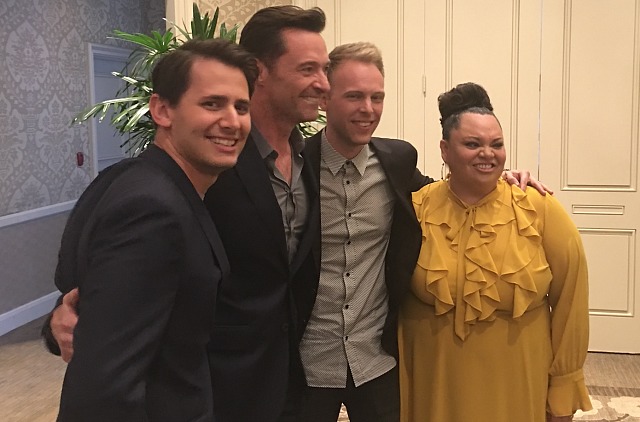
Late this morning we watched four musical segments from Michael Gracey‘s The Greatest Showman (20th Century Fox, 12.20). Lasting about 15 minutes, the footage contained four songs — “The Greatest Show,” “This Is Me,” “From Now On” and a song I can’t remember the title of. Then it was over to the Four Seasons for a nice lunch and then a performance of “This Is Me,” sung by Keala Settle with accompaniment from songwriters Benj Pasek and Justin Paul, who also wrote the lyrics to Justin Hurvitz‘s La La Land score. The performers were introduced by Hugh Jackman, who stars as showbiz impresario P.T. Barnum. The Greatest Showman opens in 22 days — no screening invites yet.
No details about what particular behaviors sent Matt Lauer‘s career crashing into the rocks, but former MSNBC anchor Keith Oldermann tweeted this morning that NBC knew about Lauer’s sexual misconduct prior to getting whacked yesterday and that the network had chosen to “enable” and “bury” the issue rather than take action.
“Matt Lauer was [remorselessly] vindictive and tyrannical to everyone at NBC News and management repeatedly enabled him and buried the issue,” said Olbermann tweeted.
At the same time Prairie Home Companion creator-headliner Garrison Keillor, 75, has been cut loose by Minnesota Public Radio, but the term in this instance was “improper conduct,” or allegations of his inappropriate behavior with an individual who worked with him,” according to a statement from the radio network. The AP reported that he’d been canned over “a story that I think is more interesting and more complicated than the version M.P.R. heard.”
Earlier today the National Board of Review handed three big fat awards to Steven Spielberg‘s The Post — Best Picture, Best Actress (Meryl Streep) and Best Actor (Tom Hanks). Everyone presumably understands by now that Call Me By Your Name operates on a much loftier aesthetic plane than the Spielberg film, and that it’s much more emotionally nourishing. But the anti-Trump political metaphor was hard to vote against, I suppose. The Post is a smartly written, highly stirring newspaper drama from the old school, and I for one loved the way it made me feel. But Call Me By Your Name is a masterpiece. I’m sorry but it is.
Lady Bird‘s Greta Gerwig won the Best Director trophy, and Laurie Metcalf (who plays Saoirse Ronan‘s stubbornly willful mom) who won the Supporting Actress prize. The Florida Project‘s Willem Dafoe won for Best Supporting Actor, and the Get Out cast took the Best Ensemble prize. Call Me By Your Name‘s Timothee Chalamet nabbed the NBR’s Breakthrough Performance award.
Paul Thomas Anderson took the original screenplay award for the richly perverse creation known as Phantom Thread, and Scott Neustadter and Michael H. Weber won the adapted screenplay award for The Disaster Artist.
The NBR choices for 2017’s Top 10 Films included Baby Driver, Call Me by Your Name, The Disaster Artist, Downsizing, Dunkirk, The Florida Project, Get Out, Lady Bird, Logan and Phantom Thread. They gave The Post their Best Picture, Best Actress and Best Actor award but didn’t include it among their top ten? And…wait, they blew off Darkest Hour, The Shape of Water and Three Billboards Outside Ebbing, Missouri? How will Pete Hammond and Tom O’Neil explain that one? Guys?
The magnificent Coco won the Best Animated Feature prize. Brent Scowcroft…I mean Brett Morgen’s Jane took the Documentary Feature award. Foxtrot, which I still haven’t seen, was named Best Foreign Language Film.
Freedom of Expression Awards went to John Ridley for Let It Fall: Los Angeles 1982-1992, and to Angelina Jolie for First They Killed My Father.
Wonder Woman helmer Patty Jenkins and star Gal Gadot took the NBR’s Spotlight Award.
The NBR awards will be handed out on Thursday, 1.4.18.
In a snide and dismissive 11.26 article called “Ten Years of Trying To Make Armie Hammer Happen,” Buzzfeed‘s Anne Helen Petersen describes Hammer’s difficulty in launching himself over the last seven years or so.
Most of her observations are partly true, but here’s how I’d put it. Hammer happened in 2010’s The Social Network (i.e., the “Winklevii”), and it was just a matter of landing another role as good. I was a bit worried for him after The Lone Ranger, but I suspected he’d recover. He actually did half-recover in The Man From UNCLE but the film…not good enough. And then Luca Guadagnino came along and just flat-out saved Armie’s ass. In the immediate aftermath of the first-anywhere screening of Call Me By Your Name at last January’s Sundance ’17, it was obvious Hammer had been restored, redeemed and propelled onto high ground.
But Petersen also strolls into an unfortunate p.c. mindset. “Hammer [has] comported himself the way people who have grown up with money often do,” she writes. “With confidence and charisma, or, if you’re being less generous, like a little bit of an asshole.” Because Hammer happens to be really good-looking, she means. And because he’s white, of course, which translates as arrogant and entitled. Petersen is expressing a basic attitude about confident, broad-shouldered whiteys that has embedded itself over the last…oh, dozen years or so. Which is that there’s something vaguely dickish and socially toxic about these guys.
In a 7.30 HE piece called “When Ax-Blade Handsome Was Okay,” I asked “which upper-echelon actors in today’s realm are ax-blade handsome in that tall, broad-shouldered, WASP-ian way? Two guys I can think of — Armie Hammer and (when he’s not summoning memories of Ernest Borgnine) Henry Cavill. But that’s about it.
On top of scoring the year’s biggest per-screen average last weekend ($101K per screen on four screens for a total of $404,874), Luca Guadagnino‘s Call Me By Your Name added fuel to the fire tonight by taking two Gotham Awards, Best Feature and a Breakthrough Actor trophy for Timothee Chalamet. Jordan Peele‘s Get Out wasn’t ignored — he took the Bingham Ray Breakthrough Director Award plus a Best Screenplay award. And HE’s own James Franco took the Best Actor Gotham Award for his indelible Disaster Artist performance, and Lady Bird‘s Saoirse Ronan landed a Best Actress trophy.
A Washington Post story posted at 2:55 pm Pacific: “A woman who falsely claimed to The Washington Post that Roy Moore, the Republican U.S. Senate candidate in Alabama, impregnated her as a teenager appears to work with an organization that uses deceptive tactics to secretly record conversations in an effort to embarrass its targets.
“In a series of interviews over two weeks, the woman shared a dramatic story about an alleged sexual relationship with Moore in 1992 that led to an abortion when she was 15. During the interviews, she repeatedly pressed Post reporters to give their opinions on the effects that her claims could have on Moore’s candidacy if she went public.
“The Post did not publish an article based on her unsubstantiated account. When Post reporters confronted her with inconsistencies in her story and an internet posting that raised doubts about her motivations, she insisted that she was not working with any organization that targets journalists.”
“On Monday morning, Post reporters saw [this woman] walking into the New York offices of Project Veritas, an organization that targets the mainstream news media and left-leaning groups. The organization sets up undercover ‘stings’ that involve using false cover stories and covert video recordings meant to expose what the group says is media bias.”