Carson’s Hopper Doc

There’s a “Cinefamily” screening tomorrow night at L.A.’s Silent Movie theatre of L.M. Kit Carson and Lawrence Schiller‘s The American Dreamer, a 1971 doc about the late Dennis Hopper. The 90-minute feature, which hasn’t been seen in eons, will begin at 9:30 pm. (Following a 7:30 pm showing of Easy Rider.) It’s the kickoff attraction for Cinefamily’s Hopper tribute series.

Carson will regale with Hopper stories after the show ends, or roughly around 11 pm. I wrote Carson and asked for a sample. He wrote back with the following: “Hopper’s 50th birthday hit while we were shooting Texas Chainsaw Masaacre 2 in Texas in May ’86, and on the birthday party night Hopper insisted on cutting the cake with a chainsaw — laughing and shouting ‘gotcha 5-0!’ I don’t think Dennis ever thought he’d actually die.”

“The wild, unexpected success of Easy Rider ushered in what is now seen as one of the most significant turning points in film history, making pathologically rebellious Dennis Hopper an unlikely King Of Hollywood for a day,” the notes read. “Incredibly, that day was filmed — and not just filmed, but captured by two innovative and inventive filmmakers. Co-directed by L.M. Kit Carson and Lawrence Schiller, The American Dreamer is many things: an insightful document of a complex artist in the midst of his creative process, a self-reflective exploration and explosion of verite filmmaking tropes, and a playful and entertaining snapshot of the private life of one of Hollywood’s most eccentric stars at the peak of his newly found fame.

“Hopper boldly allowed access to his crazy life in all its aspects: firing his rifles off in the desert, editing The Last Movie, stripping naked and walking through downtown Taos, New Mexico, pontificating about art and life, and holding forth guru-like to a room full of naked women. Fortuitously timed, fantastically made, and virtually unseen, The American Dreamer is the great ’70s film doc you always wished existed.”

Handles


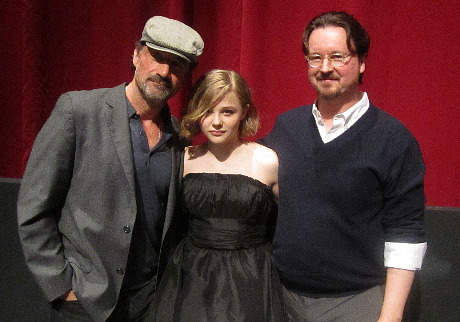
Kisses director Lance Daly after Tuesday night’s screening at the Tribeca Grand. Here again is my review.

I’ve been having problems with my left eye due to screen brightness. Hours and hours of writing each day is causing my left eye to get red and puffy. (The right eye is feeling left out.) So I’ve been (a) turning the screen brightness down and (b) wearing these green glasses while I write. It helps. It definitely feels less stressful.

One of the things that Brooklynites love about the L line is its tendency to run even slower than usual (and that’s saying something) when it’s really hot or really cold outside. This was taken at the height of rush hour yesterday morning. The cars were jammed tight and everyone was fuming because of the L line’s tardiness. It’s the worst subway line in the world. People offer vulgar gestures, corrrectly, to the driver as the train pulls in.

Dutch soccer fans on Soho’s Grand Street last Tuesday evening.

Poor Little Suddenly

From a home-video perspective, Suddenly (’54) is one of the most shat-upon little movies of all time. A moderately decent political-assassination thriller with Frank Sinatra as a psycho bad guy, it’s been in the public domain for decades, and has always looked gray, hazy and diminished. Until a year ago, I mean, when Legend Films put out a slightly better looking b & w version. Now it has a bluish tint, and is more sharply defined.

The Legend guys also included a colorized version that corrected the legendary error made by the bozos at Hal Roach Studios when they put out a colorized VHS in which Sinatra’s eyes were brown.

“In 1959, five years after the release of Suddenly, a novel was published which had a remarkably similar ending,” the Wikipedia page says. “This was The Manchurian Candidate written by Richard Condon, a former Hollywood press agent recently turned novelist. His book also features a mentally troubled former war hero called Raymond Shaw who, at the climax, uses a rifle with scope to shoot at a presidential candidate. Because of such strong similarities, it is now thought that Suddenly was one inspiration for Condon’s Manchurian Candidate.”

In the late ’70s Suddenly costar Sterling Hayden (who lived in my home town of Wilton) told me that they made Suddenly before Sinatra’s big comeback in From Here to Eternity. (Hayden presumably meant before FHTE opened in August 1953, although he might have meant before Sinatra won his Best Supporting Actor Oscar in early ’54, since Suddenly opened in October 1954.) Even though Sinatra’s career was in a “down cycle,” as Hayden put it, he “still had the old kezazz.”

Each and everyone of us has to bring that old kezazz to our lives each and every day, and if we fail to do that on a consistent basis then we’re basically dead. I don’t have as much kezazz as I could right now, but at least I feel guilty about it and intend to rev up and get going later today.

Try, Try Again

One of the best analysis pieces I’ve ever posted to this column (and we’re talking literally thousands of items and stories since HE’s August 2004 launch) was my High Noon vs. Rio Bravo thing, which I wrote about three years ago. I’m very proud of having made it clear to God and Peter Bogdanovich and Quentin Tarantino and all the other Bravo cultists out there why I feel Howard Hawks‘ 1959 film has, okay, some merit (it’s a half-decent film) but doesn’t hold a candle to Fred Zinneman‘s 1952 classic.


Howard Hawks had to know that making a romantic couple out of the hulking 51 year-old John Wayne and the doe-like, rail-thin 26 year-old Angie Dickinson was ludicrous, but I think he hired her anyway because of her great gams. And I think she knew this.

I just re-read the article and man, it really feels good when you discover that a semi-oldie reads clean and straight and true.

But in reading another well-written Rio Bravo analysis piece — actually a Rio Bravo vs. El Dorado thing, written a year ago by G.A. de Forest — it hit me that my ’07 article overlooked a huge aspect of Rio Bravo history, which is that Hawks more or less remade it twice — as El Dorado and Rio Lobo.

And so the obvious question: how good or classic or what-have-you can Rio Bravo be if the director not only decided five or six years later that he could improve upon it, but acted upon this notion not once but twice (with remakes #2 and #3 only four years apart), and using the same lead actor (John Wayne) in all three versions? And then admitting later on that the third version was shite?

Did Fred Zinneman feel the need to remake High Noon? Not as far as I know. We know for sure that he never did. Could it be that Zinneman felt it was good enough and didn’t need an upgrade? Uhm, probably. Does anyone think there might have been a reason why Hawks felt a need to remake Rio Bravo twice? I’m just spitballing, but the obvious conclusion is that he simply didn’t think Rio Bravo was “good enough,” to borrow from the Hawks lexicon.

Rio Bravo, for ill-defined reasons, is the more generally admired by critics,” de Forest wrote. “Hawks specifically remade it because he believed he could improve on the first version, and then believed he had. I too, maybe because [I’m] a child of the Sixties, have always preferred El Dorado, though having just seen Rio Bravo again and giving it proper attention, I appreciate its niceties more than before.

“Hawks knew what he was doing in remaking it…[and] by most measures El Dorado is a less compromised piece of filmmaking. Maybe simply to give the ensemble cast more on-screen time, there is a conscious insert in Rio Bravo where singing stars Dean Martin and Ricky Nelson get to do their thing — Dean crooning a cowboy song — ‘My Rifle, My Pony, and Me’ — with less C & W feel than anyone since Roy Rogers. Ricky bats his thick eyelashes and heavy lids for the girls rather irritatingly throughout, and almost pouts his more-generous-than-Elvis lips. Walter Brennan comes close to self-parody with his incessant cackling.

“On top of this, the original is far too wordy, especially for a western — courtesy of the screenplay by highly cultured Hawks favorites Jules Furthman and Leigh Brackett.”

I really think this settles it once and for all. All those Bravo groupies need to stand up, man up and explain clearly and concisely how a film that its own director felt a need to remake twice is somehow superior to a single, stand-alone western that its co-creator (the other being Carl Foreman) never re-thought or re-made. Because it can’t be done. I knew about the remakes all along, of course, but now that I’ve re-thought everything and re-read the ’07 article and jumbled it all around, I now feel — in my own mind, at least — that the High Noon vs. Rio Bravo debate is over and done with, and the bitches have scattered.

Only If You Notice

I’m reminded of Jean Luc Godard‘s intriguing assessment of Rio Bravo, which is basically that it’s a better film than High Noon because the exceptionally good things in Rio Bravo can be ignored, and therefore may be unnoticable to a good-sized portion of the audience.

“The great filmmakers always tie themselves down by complying with the rules of the game,” Godard wrote. “Rio Bravo is a work of extraordinary psychological insight and aesthetic perception, but Howard Hawks has made his film so that the insight can pass unnoticed without disturbing the audience that has come to see a Western like all others. Hawks is the greater because he has succeeded in fitting all he holds most dear into a well-worn subject.”

I hold Godard’s theory in much higher regard than I do Rio Bravo. But I’m now asking myself which films of the last few years have lived up to Godard’s standards in this regard? Which recent movies, in other words, have delivered escapism by way of same-old-shit genre cliches (over and over and over again) while at the same time exciting and arousing the highbrows in such a sleight-of-hand way that Joe Popcorn, dumbass that he is, doesn’t even realize that a double-tracking thing is happening?

Principles

The initial title of Tuesday’s Lindsay Lohan post was “Throw The Key Away.” I wrote this on my iPhone early Tuesday evening while waited for a screening of Kisses to begin at the Tribeca Grand. The thought was “this woman has shown herself to be all but hopeless and needs to be slapped awake or she’ll be dead in ten or fifteen years, so don’t slap her on the wrist — hit her hard and pretend to throw away the key. Maybe that’ll get through.”

So the headline didn’t quite say it. But it was close, and sometimes you just need to go with what seems right before the screening begins.

After thinking things through the next morning I decided that I had to plop in a new title. Lilo needs to live and breathe and create and have a future. The point of pretending to throw away the key was to wake her up to the point that she might start to consider that she’s Errol Flynn-ing and Tallulah Bankead-ing and needs to turn it around. So I went with “The Crowd Roars” — generic but workable.

In response to which a couple of HE readers complained, saying that I lacked the stones to stick to the original headline. I responded as follows:

“I can and will change anything I want, whenever I want, if and when the mood changes or suits or whatever. I am the Lizard King. I can do pretty much anything. And it’s all about keeping things in flux, being adaptable, being open to whatever tremors or instincts or subliminal urges occur. I’m not the managing editor of the Kansas City Star in 1957 with a deadline approaching and final edits being applied downstairs before the presses roll. This is a fluid and sometimes cantankerous Thelonious Monky jazz column. I always reserve the right to tweak, modify, edit, change, add and, yes, sometimes, if the urge is strong or persistent enough, wimp out.

“Wimping out is part of human nature from time to time, so the freedom to wimp out is one of the tunes I might play — and so is the freedom to decide later on that I shouldn’t have wimped and thereafter a decision to restore whatever it is or was that I may have wimped out on in the first place.

“That said I stick to 97% of the stuff I put down initially. Make that 98%. Oh, and if I decide to edit this very post I’m writing right now then I will do that. Live with it or leave or whatever.”

Two Years After

I’m way late to the table regarding Lance Daly‘s scruffy and charming and very well-acted Kisses, which Oscilloscope Laboratories is opening on July 16th. And yet it’s one of the best films I’ve seen in 2010. It’s not without issues, but it has this honest, no b.s. young-love groove that I believed and fell into in a sort of Ken Loach-y way. The problem is that it’s been around forever and I can’t expunge that fact from my mind.

It may seem too inside-baseball to go off on this, but it does feel a bit funny to call Kisses a 2010 film considering it was shot between late ’06 and ’07, premiered at Telluride and Toronto almost two years ago, is regarded by the IMDB and Rotten Tomatoes as a 2008 film, and played theatrically in England last summer.

For whatever reason I missed Kisses at Toronto’s ’08 festival. I don’t even remember hearing about this occasionally twee but engaging and natural-vibey Irish kids-on-the-run film, but whatever — Oscilloscope Laboratories saw it, got it and acquired it for theatrical. And then sat on it for the better part of two years.

Kisses scored an 83% positive when it opened in England in the summer of ’09, but still no Oscilloscope action. It’s finally beginning a city-by-city break on 7.16 and good for that, but — I know I shouldn’t be harping on this so much — the time-passage element makes it’s hard to feel the full-on jazz. The two barely pubescent leads — Shane Curry and Kelly O’Neill — were 10 or 11 at the time, and are now 14 or 15 and several inches taller, I was told after last night’s screening. Jett commented as we were leaving that the roller-wheel sneakers the kids buy at a Dublin mall during the film’s second act were happening about four or five years ago, but no longer.

It’s stuff like this that slightly ages a film, sometimes in ways you can spot and sometimes in ways that you can’t; it also underlines a point I made a year or two ago that you need to get a film into commercial circulation no later than 18 months after filming, and preferably within a year. There has to be a feeling that the audiences seeing a film at a given point in time are sniffing the same cultural pollen that the filmmakers did when they did principal photography. I mean, this film was shot well before anyone was even starting to talk about Barack Obama being a semi-credible candidate for the Democratic nomination.

You could speak dismissively and say Kisses is a short film that runs feature length, and that its story of two kids, Dylan (Curry) and Kylie (O’Neill), who, traumatized by abusive families, decide to run away together to Dublin on Christmas eve, isn’t developed enough. And that it over-works the Bob Dylan references, and goes for the “endearing moment” once or twice too often.

But when it’s good, it’s really good. Curry and O’Neill deliver the most unaffected and emotionally sincere performances of unhappy kids I’ve seen in a long, long while. The shooting and cutting are mostly lean and down to the bone (except during the occasional seizure of the “cutes”). And Daly’s going from black-and-white to sepia-toned color to full color and back to monochrome again is…okay, obviously the old Wizard of Oz playbook, but for my money Daly makes it work all over again.

It’s very worth seeing, it’s definitely above average, it’s among the best I’ve seen this year and thank God for the occasional subtitles. (There’s really no understanding the Dublin accents without them.) But why was this…okay, somewhat flawed little jewel of a film kept on the sidelines for so long?

Fresh Hints

It’s true, apparently, about Criterion Co. offering a visual hint in their latest newsletter about their intention to release James L. BrooksBroadcast News (1987), presumably in DVD format only but Bluray would be extra nice. I tend to regard the passage of time in terms of acts or chapters or movements rather than years, but even with that buffer in mind it feels…well, not exactly queer or curious to think of this film being 23 years old. But damned if it ain’t.

There’s also been a recent indication somewhere within Criterion’s Facebook page that Alexander McKendrick‘s Sweet Smell of Success (calling Carrie Rickey!) will also soon be released.

Tampico Hot

New York City’s sweatbox agony will soon be over. It was 103 yesterday and right now — 3:15 pm — it “feels” like it’s 101, although the thermometer is actually down to 96. Thursday will be in the high 80s and on Friday the average may actually settle down to the 70s.

I know that the climate in Manhattan yesterday felt like Abu Dhabi mixed with Panama mixed with a hot frying pan, and with everyone afflicted with an energy-depleting virus . The air felt trapped and uncirculated and unholy, as if a sadistic God had plugged in a giant reverse air-conditioner. Everything was happening in slow motion. Every couple of blocks I would visit a store I had no interest in visiting, just for the a.c. comfort.

Minor Scuffle

In a response to last week’s Greatest Insults video (which I posted on 7.1), Philadelphia Inquirer critic Carrie Rickey yesterday voiced a preference for ridicule with “more polish and less profanity.” Like, for example, Burt Lancaster‘s kiss-off to Tony Curtis in Sweet Smell of Success (1957): “You’re dead, son. Go get buried.”

That is slightly incorrect. The line is actually “You’re dead, son. Go get yourself buried.” No biggie in itself, but Rickey used the quote in her headline. So I wrote her yesterday afternoon at 5:48 pm (sitting in Fanelli’s, using my iPhone) and explained her excusable error. She wrote back at 9:37 pm with a dispute. “According to imdb.com and an Ernest Lehman essay I cross-checked with, I have it right,” she said. “Of course, they could both be wrong. Next time I watch SSoS I’ll listen extra-hard.”

Yeah, do that. Because the IMDB has the quote as “You’re dead, son — go get yourself buried. Wikiquote has the quote as “You’re dead, son — go get yourself buried.” And I have it as that in my head, having watched Sweet Smell of Success something like 12 or 13 times (including three times in a theatre). Sorry, Carrie, but I got this.

The Crowd Roared

Lindsay Lohan has been sentenced to 90 days in jail — yes! suffer! — followed by 90 days of rehab in a lockdown facility of some kind. (I think.). In a pre-sentence statement she was tearful, submissive, pleading, plain-spoken. “I have to provide for myself…I have to work,” she said. “I’m not taking this as a joke. It’s my life, it’s my career.”

I love it when people who’ve lived upper stratosphere lah-lah lives get taken down and have to submit to Average Joe rules and regulations. It’s extra wonderful when they cry upon hearing the bad news, as Lohan did yesterday afternoon. I heard the news yesterday afternoon and saw the TMZ tapes last night. I always wanted to see something like this happen to Mia Farrow‘s Daisy Buchanan in the 1974 film version of The Great Gatsby, and now it finally has.

There’s also the matter of Lilo’s acting talent (which she has a fair amount of) and the fact that her addictions have been taking her down and that she really needed a combination wake-up and face-slap. She’ll do about three weeks (the average sentence on raps like this is about 25%), and plus 90 days of rehab. Speaking as the son of a lifelong alcoholic and a guy who had a vodka-and-lemonade problem in the mid ’90s, I know that’s a good thing. I’ve seen it all and I know that the lives of people who make constant whoopee always turn tragic — hurt careers, disease, early death, financial issues. That judge did LiLo a huge favor, and all she could say was “what?….what?”

Is Lohan more marketable now? Will raising the dough for Inferno be a tad easier? I would think so.