
Travesty of the Year

Since I have little else to write about in these late December doldrums, I’m going to re-run some of HE’s 2009 highlights over the next couple of days. And one piece I’m especially proud of is the slapdown I gave to director William Friedkin and his “high-contrasty, snow-grained, color-bleeding, verging-on-monochrome” Blu-ray of The French Connection that came out last February.
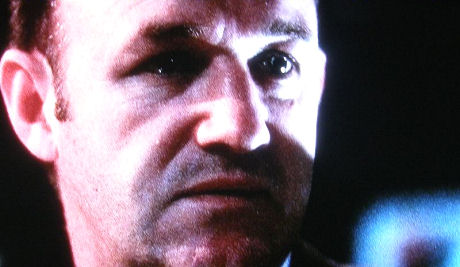
This Blu-ray disc was, no exaggeration, the most offensive act of corporately-sanctioned vandalism to happen to a classic film in motion-picture history, and I’m thinking it can’t hurt to give Friedkin another couple of lashes for completion’s sake, just to put the cap on and to make double sure no one ever tries something like this again.

Jeffrey Wells to William Friedkin: The French Connection was obviously your film when you were developing, shooting and cutting it, and certainly your film when you were promoting it in ’71. And you were most responsible for winning the Best Picture Oscar, clearly. But those days are over, pal, and while you may feel some form of residual parental ownership rights today, you’re out of line. At least as far as revisionist futzing rights are concerned.

Whatever your attorney has told you or the contracts may say, you do not own The French Connection, Mr. Freidkin — the moviegoing public does. The fans who’ve been watching and worshipping this film for the last 38 years do. Your ownership rights went out the window, sir, once that legendary New York crime film became a huge hit, and they sure as shit were null and void after it won the Best Picture Oscar of 1971. And you can’t just stroll into a post-production house on Highland or Seward and re-visualize it and put out a snow-bleachy version on Blu-ray and say, “This is it — the best version of this film ever made!”

Well, you can because you have. But you have no legitimacy in doing so.

I’m referring to what cinematographer Owen Roizman strongly stated last week, which is that you’ve desecrated The French Connection with this new Blu-ray version.
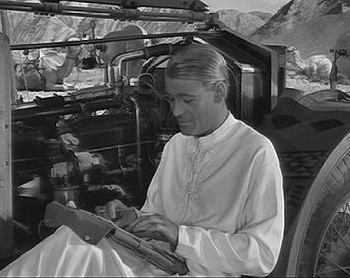

Frame capture from David Lean’s revised version of Lawrence of Arabia.

The word on the street is that you intend to do the same thing to The Exorcist down the road. I got the idea from listening to you speak the night before last that if you had a chance you’d probably do the same to upcoming remasters of Sorcerer and To Live and Die in L.A..

I’m writing to tell you, sir, that this has to stop because in the eyes of the Movie Gods you haven’t the right to do this, despite what your pallies at Fox Home Video and others in the film-cultivating community may have told you.

You can’t mangle what belongs to the public and to history, Mr. Friedkin. Art belongs to the artist until he or she creates it, and then it belongs to the world. Period. That means forever. That means no retroactive whimsical messing-around rights can kick in. And that means no Greedo-shoots-first revisionism of any kind unless the intention is to try and bring genuine (i.e., nonrevisionist) improvement to the original vision. Richer, fuller, crisper, cleaner…fine. But no “atrocious” and “horrifying” revisions.

That means if Pablo Picasso comes back from the grave he can’t go to Spain and decide that “Guernica” works better in color because he had a recent vision in heaven that painting it in black and white in 1937 was the wrong way to go. That means that the ghost of David Lean can’t come back to earth and decide to reimagine and remaster Lawrence of Arabia as a black-and-white period movie in the vein of John Ford‘s The Lost Patrol (1934).

The same thing goes for The Exorcist, Sorcerer and To Live and Die in LA.. You don’t have the right because they’re not your films, buster. You made them, obviously, but they have a life and a culture and a spirit of their own now. And I am telling you, speaking for myself and I suspect for many others, to back off and leave those movies alone. I mean it. Stand aside, sheath your sword, holster your pistol and find some other way to be creative.

You can do what you can to improve the appearance of these films on DVD, Blu-ray and hi-def digital downloads feeds. You can help to make sure they look precisely as they did when they were shown as brand-new prints in first-run theatres, or help make them look even sharper and cleaner and more vivid than they did back then if you so choose, but that’s all.

Otherwise you’re a brilliant and accomplished filmmaker, and an excellent fellow to discuss the ins and outs of the movie business with. And Bug deserved more attention and acclaim than it got. And all hail Michael Shannon!

The Masses

MCN’s Michael Wilmington has assembled a somewhat lengthy but well-chosen list of 2009 DVDs that he considers the year’s 21 best — most of which I agree with. Wings of Desire, Z, Do The Right Thing, North by Northwest, The Man Who Shot Liberty Valance, The Wizard of Oz…the usual-usuals.

But surely a key value in determining “best” in this context alludes to high-end appearance. Wilmington should be talking about best looking, best mastered, best restored, etc. But he barely mentions this, focusing instead on the lasting long-view film-bum value of the movies themselves. Which you can get from any greatest-flicks-of-all-time book written by anyone.

And why is Wilmington focusing on DVDs in the first place? Isn’t this a little like writing a piece in 1999 about the best VHS tapes of the year? A sophisticated uptown film hound like Wilmington should be on the Blu-ray beat, period. Has the DVD audience not primarily become dishevelled middle-market and downmarket types who wander about Walmart and Target and Giant stores on Sunday afternoons?

“Systemic Failure”

“If we can’t catch a Nigerian with a powerful explosive powder in his oddly feminine-looking underpants and a syringe full of acid, a man whose own father had alerted the U.S. Embassy in Nigeria, a traveler whose ticket was paid for in cash and who didn’t check bags, whose visa renewal had been denied by the British, who had studied Arabic in Al Qaeda sanctuary Yemen, and whose name was on a counterterrorism watch list — who can we catch?” — from a 12.29 Maureen Dowd column in the N.Y. Times.

Indeed — you’d think that someone in airline security.that day would have put two and two together and stopped Umar Farouk Abdulmutallab from boarding. But as the security system has an apparent “systemic” weakness or two, doing so would have required a security employee to apply intelligent analysis and individual assessment on his or her own, and also to step up to the plate and say to his/her superior, “Uhm, there’s this guy we might want to take a second look at.” But what do all companies and organizations instruct their employees to do above all else? Get along, follow the form, support the team.

Avatar Aiding Holmes?

An HE correspondent says he’s been “getting reports from theatre managers that many people are choosing to see Sherlock Holmes only after finding Avatar to be sold out.” How would Holmes be doing on its own, without the Avatar feed-through? I wonder. Avatar pays off — Holmes is a burn.

Hurt Catching a Break?

We all know about the supposed relationship between box-office earnings and being nominated for Best Picture (i.e., not enough dough = forget it), but Pete Hammond has amended this thinking in a passage from his 12.28 Envelope/Notes on a Season column.

Director-screenwriter Bill Condon (Dreamgirls, Gods and Monsters), who co-produced last year’s Academy Awards show, tells Hammond that “voters are more understanding” when it comes to low-earners like The Hurt Locker.

Kathryn Bigelow‘s film cost $11 million to make and has taken in a bit more than $12 million, but “I think the Academy is a lot more likely to forgive a movie like The Hurt Locker for its lack of big box office since they admire it and know it didn’t cost a lot to make in the first place,” Condon says.

Hammond seems to agree when he writes that “history shows the Academy of Motion Picture Arts & Sciences ‘& Money,’ as Mel Brooks once put it, is far more likely to deny Oscar glory to movies that cost a lot and turn out to be big box-office losers.”

In other words (and I hate to say this for Harvey Weinstein‘s sake), Nine?

Still Don’t Get It

In a 12.28 piece that attempts to explain the low-tech tabulating process that determines Oscar nominations, The Wrap‘s Steve Pond says the following about the Best Picture nomination process: “You’re listing 10 films on your ballot, but you’re only actually voting for one. Your ballot gives you a single vote, which goes to a single film. And if a movie’s not ranked number one on somebody’s ballot, it’s out.”

Pond also points out that “the magic number for a Best Picture nomination is 501,” based on (a) the goal of 10 nominations, (b) having started with 5,500 Best Picture ballots and (c) dividing 5,500 by 11, giving you a magic number of 500.

I think I understand this, but maybe I don’t. To a guy who’s always had trouble with numbers, this seems to mean that if Precious doesn’t end up with 501 Academy members (i.e., one tenth of the membership plus one) listing it as their top Best Picture choice, it won’t emerge as one of the ten finalists. And if this doesn’t happen, Mo’Nique‘s chances of winning the Best Supporting Actress Oscar…naah, she’ll win regardless. I know when I’m beaten.

One result of this system, says Pond, “is that the number of films contending for the 10 Best Picture nominations will actually be no larger than the number that would have been contending for five.” Wait…what?

Movie City News, he explains, “is now compiling all the critics’ top 10 lists for the year. As of this weekend, they had 54 lists, which mentioned a total of 104 different films. But only 21 of those films were ranked number one on the ballots — so if those lists were tabulated using the preferential system, those 21 films would be in the running and the other 83 would be immediately eliminated.”

I’m still having trouble with the 501 thing. It’s theoretically possible that Avatar, The Hurt Locker and Up In The Air might be listed as the #1 Best Picture choice on, let’s say, 4500 Academy ballots. That would mean that remaining choices on these 4500 ballots won’t mean squat, right? That would leave 1000 more ballots from which seven other Best Picture nominees would need to be chosen. This means that these seven would have to appear as #1 Best Picture choices on only 142 ballots…right?

No, it’s not right. A little voice is telling me this, and to hell with it. I don’t want to understand the math. I’ve never wanted to. I used to fail math quizzes when I was a teenager.

Those Days

On page 84 of Star: How Warren Beatty Seduced America (Simon & Schuster, 1.12.10), author Peter Biskind summarizes Beatty’s thinking about the character who eventually became George Roundy, the scampy hairdresser in Shampoo.

Freudian analyses had a certain currency in the ’60s and ’70s, and, as Beatty puts it, “I wanted to challenge the fashionable assumption that the proverbial Don Juan figure is expressing self-hatred, self-love, hatred of women, homosexuality, sadism, masochism, a wish for eternal life and so on.”

“Beatty never thought about himself as someone who was inordinately interested in sex, obsessed or addicted to it in any way,” Biskind explains. “His attitude was, it’s perfectly normal, and society was too puritanical to accept it. And indeed, if you looked like him and were gifted with the talent for seduction that was his, why not? He did it because he could, thank you very much, Dr. Freud!”

Dead Calm

The holiday doldrums — 12.25 through 1.2.10 — are upon us now. This may seem like a good thing from an impulsive-adventure perspective (read two books, drive to Vermont, fly to London, walk into the city), but I was outside this morning and it’s 22 degrees (and feels like 4, according to weather.com). So I suppose I’ll go with the reading. If only Criterion’s Che Bluray was obtainable…

Another One

Marshall Fine‘s Best of the Decade list reminded me of two I should included in my ownPedro Almodovar‘s Volver and Errol MorrisThe Fog of War. Wait a minute…Kill Bill? And The Hours?

The 42 Greatest

I made a mistake running my Best of the Decade piece back in early October. It got 109 comments, but I still don’t think many people were thinking sum-ups at the time. Since then every critic and blogger on the planet has posted a best-of-decader, of course. So I may as well post mine again only with four extra titles [UPDATED] — James Cameron‘s Avatar, Michael Mann‘s Collateral, Pedro Almodovar‘s Volver and Joel and Ethan Coen‘s A Serious Man — for a total of 42. The top ten are obviously indicated so if that’s what you’re looking for…

In order of preference: (1) Zodiac, (2) Memento, (3) Traffic, (4) Amores perros, (5) United 93, (6) Children of Men, (7) Adaptation, (8) City of God, (9) The Pianist, (10) The Lives of Others, (11) Sexy Beast, (12) Avatar, (13) There Will Be Blood, (14) Michael Clayton, (15) Almost Famous ( the “Untitled” DVD director’s cut), (16) 4 Months, 3 Weeks and 2 Days, (17) Collateral, (18) Dancer in the Dark, (19) A Serious Man, (20) Girlfight, (21) The Departed, (22) Babel, (23) Ghost World, (24) In the Bedroom, (25) Talk to Her, (26) Bloody Sunday, (27) No Country For Old Men, (28) The Quiet American, (29) Whale Rider, (30) Road to Perdition, (31) Open Range, (32) Touching the Void, (33) Maria Full of Grace, (34) Up In The Air, (35) The Hurt Locker, (36) Million Dollar Baby, (37) The Motorcycle Diaries, (38) An Education, (39) Man on Wire, (40) Revolutionary Road, (41) Che.and (42) Volver.

Blazing Gonads

Besides being a great headline in the tradition of ‘Headless Body in Topless bar,’ it also turns down the terror factor by making the underwear bomber a figure of foolery.