
I never wrote anything about Patrick Swayze‘s passing. I should have and I’m sorry — he was way too young and caught a bad break — but the guy just never appealed to me all that much. Not in a deep down sense, I mean. I never loved or bonded with him. I wasn’t even that taken with him in Point Break. So in the midst of all the Toronto hubbub I kind of allowed myself to put off sitting down and paying the poor guy some form of appropriate respect. I’m playing catch-up here. Anyway, I’m sorry. Rest well and sail on.
Daily
Collapse Wallops
I went right over to my favorite Starbucks work station (at Bay and Cumberland) right after seeing Chris Smith‘s Collapse, which jolted and melted me down like no documentary has in a long, long while. And as I started to work on a reaction piece, I discovered that Hollywood Elsewhere had gone down. Yes, again. A similar-type wipeout happened last April, and there’s just no alternative at this stage but to sign up with another server, which I’m in the process of doing. HE is back up again, but that’s all she wrote for the Houston-based Orbit/The Planet.
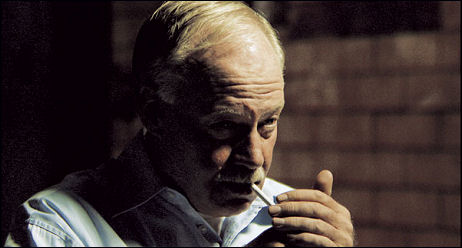
Michael Ruppert
Back to Collapse…
Shot over a two-day period last March, Collapse is basically a Spalding Gray-like soliloquy piece in which Michael Ruppert, a former LA police officer turned independent reporter, author and truth teller, explains in a blunt spoken, highly detailed and extremely persuasive way that our economic and energy-using infrastructure is on the verge of worldwide collapse.
There’s too much debt, too much greed, not enough oil and it’s all going to start falling apart — in fits and starts, bit by bit and then more and more, and then eventually…well, look out. A vast and terrible turnover that will devastate and destruct is just around the corner. Ten years, twenty years…forget it. I listened and listened to what Ruppert said, and “a hard rain’s gonna fall” ain’t the half of it. A survivable scenario, but a very different and much tougher world awaits.
Before I saw Collapse I would have readily agreed with the view that things are very, very bad in terms of the world’s economic and energy scenarios. After seeing Collapse I’m 95% convinced that we’re on the brink of Armageddon — that we’re truly and royally fucked. Get hold of as many organic vegetable seeds as you can and start growing your own food. Hey, Viggo…nice shopping cart!
The 5% of me that isn’t fully convinced has concerns about Ruppert’s personality and temperament, which seem a little bit wiggy at times. He’s been called a 9/11 Truther and, according to a CBC News summary, “claims to have met one of JFK’s shooters.” He seems stable and knowledgable enough and is obviously quite bright, but he chain smokes, is having trouble paying his rent, and is clearly emotionally distraught over the data he’s gathered and the information he’s sharing. Collapse gets into his head and soul the way Erroll Morris‘s The Fog of War burrowed into Robert McNamara.
The reason I’m only 5% concerned with Ruppert is because he fits the paradigm of other crazy prophets who’ve been right. He’s the aged soothsayer who went up to Julius Caesar and said “beware the Ides of March.” He’s Elijah, the man in rags who warned Ishmael in John Huston‘s Moby Dick that “there will come a day when ye shall smell land but there will be no land, and on that day Ahab will go to his grave…but within the hour he will rise and beckon.” He’s I.F. Stone, whose newsletter called it right on so many issues in the ’60s and ’70s.
Isn’t it in the nature of most whole-equation alarmists to be alone and uninvested in establishment currencies and memberships with a tendency to shout from streetcorners, publish nickel-and-dime newsletters or expound in low-budget documentaries such as Collapse?
There’s another reason why I believe Ruppert and why his manner doesn’t bother me all that greatly. The reason is that everything he says in Collapse seems or sounds, to the best of my admittedly limited knowledge, to be absolutely dead-on.
There were three basic kinds of group mentalities aboard the Titanic, Ruppert remarks, once the crew understood the extent of the iceberg damage. The first was the reaction of sheep — “We don’t know what to do, we’re scared, we’re cold, and all we want to do is huddle together.” The second was “yes, this is serious, we get it — and what can we do to build lifeboats?” And the third was “you’re crazy, this ship can’t sink, the people who are saying this are pathetic alarmists, and we’re just going to sit at the bar and enjoy the pleasures of decades-old bourbon.”
The thought that kept hitting me as I watched Collapse was everyone needs to see and really listen to it without drifting into the usual denial patterns. President Barack Obama really needs to see this thing. Even though his ability to do anything about the collapse is limited, to say the least. Ruppert says he’s basicaly a prisoner of the organizations that surround and fortify the power structure that supports his Presidency. Obama doesn’t have the power (and perhaps not even the will, much less solve) to really address the coming calamity. It’s really in our hands.
So what will it be? Huddle, bourbon or lifeboat-building?
The Last Day
I’ve got Tim Blake Nelson‘s Leaves of Grass at 8:30 am (i.e., twelve minutes from now), Bruce Beresford‘s Mao’s Last Dancer at 9 am if Nelson’s film doesn’t work out, Chris Smith‘s Collapse ( a said-to-be-gripping doc about forces and premonitions stirred by the economic meltdown of the last twelve months) at 10:15, Damjan Kazole‘s Slovenian Girl at 12 noon, and then we’ll see where improvisation takes us the rest of the day and into the evening.
One of the cats who live in the home-of-a-friend where I’ve been staying for the last seven or eight days took a dump on my bed and pissed in an area close to my pillow. That’s the cat’s way of saying (a) “I’m not sure that I like the fact that you’re staying here” and (b) “Perhaps you might consider moving out sooner rather than later?” I’m back to NYC tomorrow morning so he/she will be happy.
The Burden of Fibbing
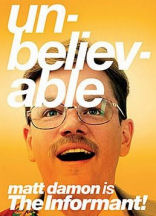
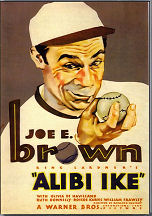
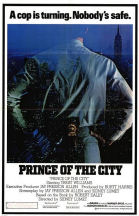
Steven Soderbergh‘s The Informant! — an entertaining enough LQTM dramedy with a jaunty Marvin Hamlisch score and a knockout lead performance by Matt Damon — is, in my mind, a Midwestern gene-splicing of Joe E. Brown‘s Alibi Ike (1935) and Sidney Lumet‘s Prince of the City (1982). Soderbergh’s film is basically about pathological lying, and Ike was a Chicago Cubs baseball movie about a guy who couldn’t help telling one whopper after another. Mix that in with the Prince of the City ethos (i.e., nothing can be hidden) and there it is.
“Write The Check, Roger!”
Henry Gibson‘s finest acting moment in his entire career is viewable at the 1:43 mark in this Long Goodbye trailer. He died Monday at age 73.
My favorite Long Goodbye dialogue:
Marty Augustine (Mark Rydell): “When I was in junior high school I was terrified of gym class. Because I never had any pubic hair until I was 15 years old.”
Philip Marlowe (Elliott Gould): “Oh, yeah? You musta looked like one of the three little pigs.”
Lonely Number
I caught and very much liked Tom Ford‘s A Single Man this morning. It’s basically about passing through grief and despair and coming out alive on the other side. We’re speaking of a very lulling and haunting thing to settle into. I can’t rouse myself into full-on review mode, but the thoroughly readable feelings in the features of star Colin Firth — longing, grief, numbness, curiosity, contentment — keep the film aloft.
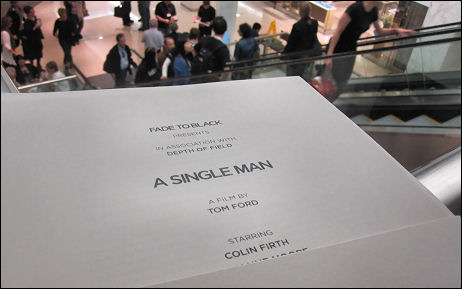
Along with the immaculate visual values, of course. A Single Man reminded me at times of Michelangelo Antonioni‘s Red Desert and La Notte. The conservative gayish vibe will mean box-office issues with hinterland heteros, I suppose (i.e., support hose), but it’s so exquisitely composed and refined and well-written, etc. A huge hit with urban gay audiences, but film lovers of all persuasions owe it to themselves.
Beer, Hell, etc.
The redband trailer for I Hope They Serve Beer In Hell (opens 9.25), directed by Bob Gosse and written by Tucker Max and Nils Parker, based on Max’s book.
“Go For It, Losers”
“It does not bespeak great wisdom to call the film The Bad Lieutenant, and I only agreed to make the film after William (Billy) Finkelstein, the screenwriter, who had seen a film of the same name from the early nineties, had given me a solemn oath that this was not a remake at all. But the film industry has its own rationale, which in this case was the speculation of some sort of franchise.
“I have no problem with this. Nevertheless, the pedantic branch of academia, the so called ‘film studies,’ in its attempt to do damage to cinema, will be ecstatic to find a small reference to that earlier film here and there, though it will fail to do the same damage that academia — in the name of literary theory — has done to poetry, which it has pushed to the brink of extinction.
“Cinema, so far, is more robust. I call upon the theoreticians of cinema to go after this one. Go for it, losers.” — an excerpt of Werner Herzog‘s statement in the Bad Lieutenant press notes, as passed along by The Wrap‘s Eric Kohn.
Inarritu on Cove Turnaround
Tokyo Film Festival jury chief Alejandro Gonzalez Inarritu played a crucial negotiating role in the decision of the festival chiefs to screen The Cove, as reported this morning by Variety‘s Mark Schilling. This despite Cove director Louie Psihoyos having stated that the festival wouldn’t be showing The Cove for political reasons.
“I truly believe that festivals exist as spaces of resistance against the easy distractions our culture offers us on a day-to-day basis,” Imnaritu wrote yesterday as the situation was being resolved. “I hope this film is exposed and as many others, and that it will generate some emotions and reflections that trigger discussions and conscience in order to put an end to the horrifying dolphin slaughter, which is now going on.”
NYFF Dweeb Values
A little over a month ago the selections for the forthcoming New York Film Festival (9.25 through 10.11) were revealed. Many noted that the slate seemed to reflect the tastes of a rather hermetic, esoteric, film-dweeby selection panel with an aversion to anything that smacked of accessibility and across-the-board engagement. But I didn’t know how dweeby until just a little while ago when I was told by an excellent source that the NYFF committee turned down the Coen Bros.’ A Serious Man, Lone Scherfig‘s An Education and Jacques Audiard‘s A Prophet. To which I said, “What?”
On 8.11 Film Society of Lincoln Center programmer Richard Pena tried to explain the dweeb slate to the Hollywood Reporter‘s Stephen Zeitchik as follows: “Two years ago, we had the Coen brothers and Wes Anderson and Julian Schnabel and Noah Baumbach and Sidney Lumet. Last year, there was less, and this year there is much less.”
Except the NYFF selection committee did have the Coens this year in the form of A Serious Man, which, in the view of many who’ve seen this film in Toronto, is arguably one of the best they’ve ever made. And yet the NYFF selection committee — Pena and critics Dennis Lim, Scott Foundas, J. Hoberman and Melissa Anderson — for the most part disliked it and declined to show it.
I don’t know who specifically voted against it except for a vague understanding that Foundas is not a fan. (Apparently Foundas and Hoberman gave A Serious Man a “bomb” rating in the Critic’s Choice chart in the new issue of Film Comment.) But having seen A Serious Man myself and given the large Upper West Side Jewish audience that attends this festival, I can say with absolute authority that the NYFF committee is imbedded way too deeply inside its own posterior cavity. I mean, they’re really nuts not to show this film. As they are in having also turned down An Education and A Prophet.
These are three movies with serious critical cred that also play to an audience. Each would be a huge hit, trust me, with the NYFF crowd that attends each and every year. The NYFF selection committee has become a gathering of Trappist monks who’ve been slurping too much goat’s milk with their granola. I’m not the only one who thinks this, trust me.
Garcia
Last night’s chat with Mother and Child director-writer Rodrigo Garcia went smoothly enough, but it was partly a technical disaster on my end. I forgot to take a photo of him for some reason, and the video footage I shot was accidentally erased during a file transfer I attempted an hour after we parted. But at least I have the mp3. I’d summarize what we discussed but my first film of the day — Love and Other Impossible Pursuits — starts in 17 minutes.

Mother and Child director-writer Rodrigo Garcia in a N.Y. Times photo taken four years ago.