
Having leafed through a print edition of Variety, New Yorker‘s Richard Brody reported today that Noah Baumbach ‘s Greenberg, a relationship drama with Ben Stiller and Greta Gerwig, and Sofia Coppola‘s Somewhere, which I know zip about but which costars Stephen Dorff, Elle Fanning and Michelle Monaghan, will screen at the American Film Market (11.4 to 11.11). I’m thinking I could wangle my way in if I was out there.
Daily
Vidal Polacko
Even I, a Roman Polanski apologist and let-it-go-already arguer, don’t agree with some of what Gore Vidal has told The Atlantic‘s John Meroney about the Samantha Geimer case in an 8.28 posting. There are, however, slivers of truth here and there.
Meroney: “In September, director Roman Polanski was arrested in Switzerland for leaving the U.S. in 1978 before being sentenced to prison for raping a 13-year-old girl at Jack Nicholson‘s house in Hollywood. During the time of the original incident, you were working in the industry, and you and Polanski had a common friend in theater critic and producer Kenneth Tynan. So what’s your take on Polanski, this many years later?
Vidal: “I really don’t give a fuck. Look, am I going to sit and weep every time a young hooker feels as though she’s been taken advantage of?”
Meroney: “I’ve certainly never heard that take on the story before.”
Vidal: “First, I was in the middle of all that. Back then, we all were. Everybody knew everybody else. There was a totally different story at the time that doesn’t resemble anything that we’re now being told.”
Meroney: “What do you mean?”
Vidal: “The media can’t get anything straight. Plus, there’s usually an anti-Semitic and anti-fag thing going on with the press — lots of crazy things. The idea that this girl was in her communion dress, a little angel all in white, being raped by this awful Jew, Polacko — that’s what people were calling him — well, the story is totally different now from what it was then.
“Hollywood once provided protection for some of its people. For example, Rock Hudson was heterosexual to the public until 1985, when he announced he had AIDS.
“Studios protect big moneymakers. The movies with Rock Hudson and Doris Day were profitable. Each star was given the Sheriff’s telephone number to say, ‘Lay off.’ The Sheriff wasn’t going to go fucking around with the talent. They were the income of Hollywood.”
Meroney: “During the 1970s, Warren Beatty, Jack Nicholson, and producer Robert Evans were celebrated for lifestyles of sexual extravagance.”
Vidal: “Well, they’re all virgins, every last one of them. I can testify to that. And the last one you mentioned, he’s a super virgin.”
Meroney: “They’ve certainly never been criticized and condemned for their sexual excesses. But Polanski was condemned even before he pled guilty to raping a girl.
Vidal: “Well, believe it or not, anti-Semitism is very strong out here, even though this is a Jewish business. L.B. Mayer was the worst anti-Semite of all.”
Meroney: “But he was Jewish.”
Vidal: “Well, Mayer’s view was, ‘The public will turn on all of us if they know that one of us has done anything.'”
Meroney: “You think anti-Semitism is motivating the prosecution of Polanski?”
Vidal: “Anti-Semitism got poor Polanski. He was also a foreigner. He did not subscribe to American values in the least. To [his persecutors], that seemed vicious and unnatural.”
Meroney: “What are ‘American values’?”
Meroney: “Lying and cheating. There’s nothing better.”
Meroney: “So you’re saying that a non-Jewish director wouldn’t have to worry about getting caught up in a sex crime scandal? Such a thing wouldn’t be an issue for Martin Scorsese?”
Vidal: “Well, he’s an absolutely sexless director. Can you think of a sex scene that he ever shot?”
Meroney: “Errol Flynn stood trial for raping underage girls in 1943, and was acquitted. Was he treated differently than Roman Polanski?”
Vidal: “Everybody liked Errol Flynn.”
Altman Forever
Responding to a fierce putdown of the late Robert Altman by Time‘s Richard Schickel in a review of Mitchell Zuckoff‘s Robert Altman: The Oral Biography, director Alan Rudolph has written an equally stern rebuke.Earlier today L.A. Times columnist Patrick Goldstein posted the Rudolph letter and laid into Schickel also.
“The power of a major artist is that he or she is a force, standard, guide,” Rudolph wrote. “What [Schickel] doesn’t grasp is that great artists always lead the way. The torch gets passed, the message out, the influence permanent. You don’t have to be aware of originators to be modified by them.
“Bob’s insistence on doing things his own way was essential. It’s the major struggle. And Altman won. Which is the ultimate defeat for the studio ruling class and establishment apologists. [Schickel] uses Jules Feiffer‘s troubles with Bob as an example of overindulgence, but glibly dismisses Feiffer’s description of Altman as a genius. In the critic’s mind, Bob wasn’t the right kind of genius.
“Altman never changed. To have ‘comebacks’ shows he never went away. Some of his films might have been less than others, but each had the stuff of brilliance, and was part of a larger collection. Bob knew that continuously working in the rough was the best way to find the jewel. His biting humor never spared reality nor himself. The painful absurdity of it all. There was nobody like him during his professional peak, and there isn’t now.”
For what it’s worth, Hollywood Elsewhere stands with Rudolph and Goldstein.
Schickel wrote that “none [of Altman’s films] whatsoever will survive as anything more than historical curiosities. [They] do not transcend their times; even the best of them remain trapped within those times.” And that, for me, is glorious enough. Because those times — the ’70s, mainly, when Altman had his great creative run — delivered a rich and flavorful kind of filmmaking (and film-watching) that has inspired and nourished tens of thousands of film lovers, and will continue to do so. I didn’t say “millions” because the Altman movies never reached…okay, were never intended to reach the popcorn multitudes, even when they were firing on all eight cyclinders. But what a delicious feast they are, and always will be.
Schickel states that Zuckoff’s book “provides massive evidence that people had lots of fun making” Altman’s films, the implication being that relatively few these days have fun watching them. The above clip from Altman’s California Split (which I initially posted last February) disproves Schickel’s suggestion and then some. It isn’t just funny but exhilarating. It makes you smile at everything and everyone. I laugh every single time I see it, and if Altman had done nothing more in his career than create moments like this, he would still be in my pantheon with a gold star next to his name.
I only wish I could be in LA for the upcoming UCLA Film and Television Archive Robert Altman tribute, which begins on Sunday, 11.1. Included will be an 11.13 screening of Altman’s The Long Goodbye, which Goldstein calls “a personal favorite.” Me too, and for two reasons in particular.
The first is a scene in which Mark Rydell, playing a vicious and oily gangster, mentions to Elliott Gould‘s Phillip Marlowe that he was always afraid of getting undressed in the locker room at the end of gym class because he “never had any pubic hair until I was 15 years old,” and Gould deadpans “Oh, yeah? You musta looked like one of the Three Little Pigs.” The second is a third-act scene in which a small-town Mexican official refers to Marlowe’s friend, a sociopath named Terry Lennox (Jim Bouton) who may have committed suicide, in heavily accented English as “the deceased,” and Gould — probably improvising — says, “The diseased…yeah, right.”
Flying Off The Shelves
This T-shirt is being sold at Cinefile, the DVD store next to West L.A.’s Nuart theatre. Presumably it can be ordered online. Obviously a must-own. The guy modelling the shirt could use a little time at the gym.

“Go For It”
I met Bad Lieutenant director Werner Herzog around 9:30 pm last night at the Tribeca Grand Hotel. Immediate following this he sat for a q & a before an audience in the hotel’s screening room. Herzog asked Bad Lieutenant screenwriter William Finklestein and dp Peter Zeitlinger to join him in front of the crowd during the interview.
Lennon as Girlyman
Sam Taylor-Wood‘s Nowhere Boy, which premieres tonight at the London Film Festival, is a marginally effective, vaguely muffled chick-flick account of John Lennon‘s teenage years in Liverpool, circa 1956 to ’60. I’m not calling it dull, exactly. Somewhat underwhelming? I respond best to films about transcendent, climb-out-of-it responses to problems rather than ones that mainly portray the muck and the grief of things. And Nowhere Boy‘s somewhat feminized, all-he-needs-is-love story just didn’t turn me on.
But before I get into it I need to stop and report something phenomenal (and I don’t mean to sound like a fiendish hard-ass in saying this). See Nowhere Boy for the Lennon curiosity factor or for the moderately good reviews it may receive down the road, but it primarily needs to be seen for one of the most grotesque miscastings in motion picture history. I’m speaking of Taylor-Wood’s decision to hire Thomas Brodie Sangster — a pint-sized, pencil-necked, chipmunk-faced actor — to play Paul McCartney.
Everyone knows the teenage pompadoured McCartney was sort of Elvis-y looking, and that he was more or less the same size and weight as Lennon. Sangster looks like a growth-stunted audio-visual squad dweeb (he resembles Hustle and Flow costar DJ Qualls, only dorkier), and is nearly a head shorter and seemingly 20 or 25 pounds lighter than Johnson. His wrongness for the part is so complete that he throws you right out of the film…wham. This is easily the equal of John Wayne being cast as Genghis Khan in The Conqueror (1956). It’s not quite as absurd as, let’s say, the dwarf-sized composer Paul Williams (he played a rock-music mogul in Phantom of the Paradise) being cast in the ’70s as N.Y. Jets quarterback Joe Namath, but it’s almost in that realm.
The stumbling block for this fan of Lennon’s music (as well as the general Beatles catalogue, of course) is that Nowhere Boy is too concerned with his domestic parenting issues — i.e., Lennon’s half-supportive but vaguely estranged relationship with mother Julia (Anne Marie Duff) and a somewhat contentious relationship with Aunt Mimi (Kristin Scott Thomas). And the fact that Taylor-Wood seems only dutifully interested in his musical beginnings with the Quarrymen and the young McCartney and George Harrison.
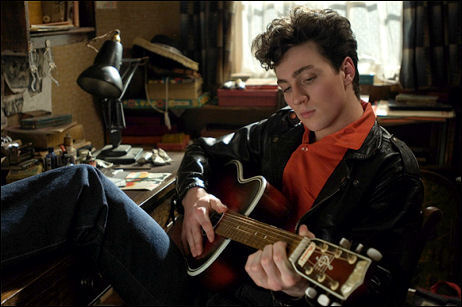
Aaron Johnson as John Lennon in Nowhere Boy
There’s something rote and almost side-issue-ish about the musical scenes. Taylor-Wood shoots them but doesn’t seem to feel them. That’s partly because Nowhere Boy is primarily a hearth-and-home perspective on Lennon’s early life.
I wanted to see a film about the birth of the Beatles, or at least one that would give me an authentic taste of what it was like for Lennon in mid to late ’50s Liverpool, struggling with his personal issues, okay, but mainly about his finding a way out through music and performing. But all Nowhere Boy provides, for the most part, is a somewhat mopey soap opera. Young John may have been emotionally needy deep down, but this doesn’t feel right or true or complete. I didn’t feel Lennon’s rock ‘n’ roll vitality and virility, and certainly not his rage.
Matt Greenhalgh‘s script is based on a memoir called “Imagine This” by Lennon’s half-sister Julia Baird. I understand that this was the key issue of Lennon’s youth, but the film didn’t sell me on this, and in fact seemed to be frittering away its time by focusing on it. Lennon’s anguish was primal enough (“Mother, you had me but I never had you,” etc.) but my reaction all through it was, “Okay, but can we get to the musical stuff, please?”
Nowhere Boy boasts a relatively decent lead performance by Aaron Johnson. He doesn’t overdo the mimicry and keeps his Liverpudlian accent in check. And yet it’s a somewhat overly sensitive, touchy-feely rendering of a rock ‘n’ roll legend who was known, after all, for his nervy, impudent and sometimes caustic manner, at least in his early incarnations.
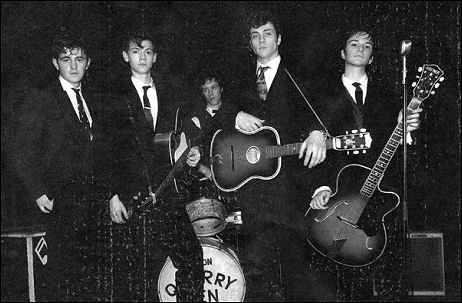
Notice the disparity in size and weight between Aaron Johnson (second from right) and Thomas Sangster (second from left).
I didn’t believe the hurting look in Johnson’s eyes. All those looking-for-love feelings he shows are too much about “acting,” and hurt-puppy-dog expressions don’t blend with the legend of the young Lennon (as passed along by biographies, articles, A Hard Day’s Night etc.) Emotionally troubled young guys tend to get crusty and defensive when there’s hurt inside, and this was certainly Lennon’s deal early on.
And Johnson is needlessly compromised, I feel, by a curious decision on Taylor-Wood’s part to create her own, reality-defying physical version of Lennon. She ignores the fact that he had light brown, honey-colored hair by allowing Johnson to keep his own dark-brown, nearly-jet-black hair. Nor did she have Johnson wear a prosthetic nose — one of the oldest and easiest tricks in the book — in order to replicate Lennon’s distinctive English honker. Where would the harm have been if they’d tried to make Johnson look more like the real McCoy?
Thomas is fine and acceptable as Mimi; ditto Duff as Julia and David Morrissey as Julia’s live-in boyfriend/husband/whatever. I liked the young actress who has a small part as Lennon’s impulsive lust object. (I think I’m talking about Ophelia Lovibond.) And the atmospheric detail is nicely handled, although Lennon/ Johnson seems awfully well dressed (pressed shirts, jacket and tie, fur-collared overcoat) in certain scenes. In every photo I’ve seen of him he’s never spiffy, always in scruffy hand-me-downs. It seems as if Taylor-Wood gave her wardrobe designer too much liberty.
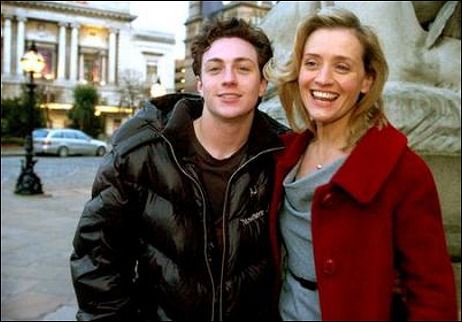
The hair color of Anne Marie Duff, who plays Lennon’s mother Julia, is slightly lighter but fairly close to the honey-brown tint of the real John Lennon’s hair. And yet director Sam Taylor-Wood ignored this and let Johnson keep his nearly black hair for the film.
Sidenote: It sounds as if the trailer-makers have used an audio clip of the real Lennon narrating the opening of the trailer. I could be wrong, but one of the interesting distinctions about Johnson’s performance is that he doesn’t try to imitate Lennon’s voice — he approximates it — but the man speaking in the beginning of the trailer sounds like Lennon himself.
Recession Tale
Jamie Stuart‘s Isn’t She?… is being described as “an ode to John Hughes that follows a day in the life of Claire (Lauren Currie Lewis) as she tries to claim unemployment insurance.”
Saw It
I’ve just returned from a 6:15 pm show of This Is It, and I need to split in 20 minutes for a Werner Herzog interview at the Soho Grand. But I can at least say how startled I was by how enjoyable the Jackson doc was. I just love listening to those familiar catchy tunes all amped up with great bass tones, and watching Jackson and the team perform some pretty sharp dance moves — it’s almost pure pleasure. Almost, I say.
Because if you do any thinking at all about the back-story — why the “This Is It” tour was launched, why Jackson didn’t tour for years, why he looks like Skeletor — it all starts to feel a little strained. A diversion. A piece of a story without the full story. A sell job that doesn’t fully work. But if you can turn your brain off, it really isn’t that bad. You could do a lot worse for your $12.50. (Yes, that’s what I paid at the Chelsea Clearview.) And I came away with renewed respect for Jackson’s perfectionism and obvious determination to deliver like never before. He looks like hell here and there, but then he looked awful for years. The last time he looked semi-human was in the early ’90s.
I love this paragraph from David Edelstein‘s New York review: “Perhaps if he had pulled this concert series off, he might have been able to leave that young Michael behind and move in a new direction…reinvent himself…maybe alongside John Lennon if Mark David Chapman had misfired…and Buddy Holly on back-up guitar if his plane hadn’t crashed, and…oh, what’s the use? He was a mess and destined to self-destruct.
“When he held forth onscreen in a prologue to that song about the danger to the Earth (‘I love the planet … I love trees … What have we done to the world?’), all I could think was, ‘What have you done to your own natural state?’ In the name of evolution, this beautiful African-American boy turned himself into a whey-faced ghoul with a nose whittled down to cartilage. Maybe in the end he displaced his horror at his own self-mutilation onto Mother Nature.”
Dartboard
L.A Times/Gold Derby guy Tom O’Neil asked Us Weekly‘s Thelma Adams, World Entertainment News‘ Kevin Lewin, Gawker‘s Richard Rushfield, USA Today‘s Suzie Woz and myself to suggest the ten most likely Best Picture candidates.
Everyone agreed on The Hurt Locker, Invictus, Precious and Up. I was the only one to stand up the Coen Bros.’ A Serious Man, and yet Lewin picked Star Trek….Jesus! I waffled my tenth-place choice, unable to decide if it’ll be Inglourious Basterds or District 9. This is strictly a pulse-taking prediction, of course. Only partially to do with my choices for the year’s best.
Liman’s Return to Form?
A longtime friend of Coming Attractions‘ Patrick Sauriol caught Doug Liman‘s Fair Game and is calling it “a really a tremendous, thought-provoking film. It’s based on the same titled memoir by former CIA Agent Valerie Plame, who of course worked for the agency as an undercover spy until her husband wrote an op-ed piece declaring that the Bush White House lied about Sadaam Hussein‘s efforts to buy yellow-cake uranium from Niger.
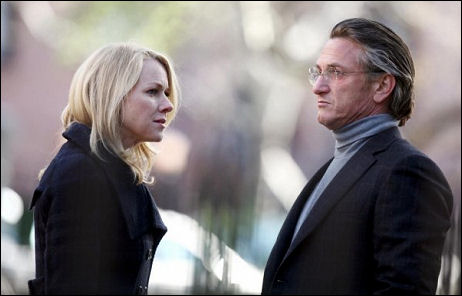
Naomi Watts, Sean Penn in Doug Liman’s Fair Game.
“Naomi Watts plays Plame (and as shown at the ending, really looks a lot like her), and plays her wonderfully. The story is set up through a sequence at the beginning showing her in action in the field, and in the CIA headquarters being completely dedicated to her job. She loves what she does for her country even at the price the travel and the secrecy puts on her family life.
“She’s married to former Ambassador Joe Wilson, played by Sean Penn in what very easily could (and should) be his next Oscar nomination. Wilson is a man in turmoil almost from his opening scene, dining with friends who think they know everything about the world. They don’t, Wilson doesn’t, but he certainly knows more about the Iraq situation than they do and is glad to tell anybody about it who will listen.
“His expertise gets him looked at (through no suggestion of his wife) and requested of by the CIA to take a trip to Niger to investigate reports that Hussein was looking to buy uranium from that country, which Wilson was a leading expert on. He agreed, made the trip, found that there was no possible way that a purchase of yellowcake was made, and reported that back to the government. The administration, as we now know, chose to ignore this report, and used the incorrect intelligence as a key basis in its case for war.
“This destroys Wilson, who starts to speak up in the press, and the leak of his wife’s identity was made. We’re led to believe that the order of the leak was made by Karl Rove to Scooter Libby (played by a hilariously serious David Andrews), and the rest is history. Plame’s career is destroyed, her marriage (and life) nearly go along with it, and a major investigation into corruption in the Bush White House is launched, ultimately leading to the fall of Libby.
“The film clocked in at roughly 1:50, and paced tremendously well. There was a side-plot they spent a bit too much time on involving an Iraqi family and Plame’s valiant efforts to save them from the invasion, but that was really the only [problem with] the film. Watts is excellent, at least as good as she was in Eastern Promises, and Penn is as good here as I’ve seen him.
“It’s directed by Doug Liman, who did an excellent job of it, and I believe he also served as DP, so kudos to him as I often forgot the camera was even rolling. Truly a wonderful human drama with political suspense that should interest anybody no matter how they vote. 9/10.”
Underhanded
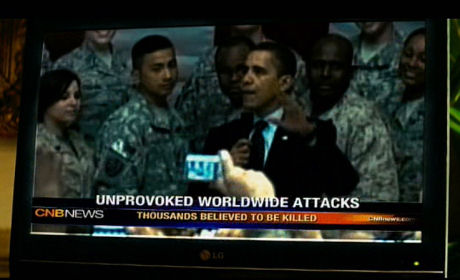
A friend was watching Transformers 2 a while ago and spotted a pair of 4-frame blips of Barack Obama on TV monitors as the Decepticons are announcing their plans. So he is in the film after all. My friend thinks “it pretty much means that in its own subtle way the movie is anti-Obama propaganda. He’s mentioned by name as president, his administration is the bad guy trying to get rid of the Autobots to negotiate with the Decpticons, the military usurps his assistant, etc.”
Mully Over Meryl
When a respected veteran actress faces a talented newcomer in the Best Actress race, nine times out of ten the newcomer wins. So concluded And The Winner Is columnist Scott Feinberg in a piece that went up yesterday. This means that — historically and prematurely speaking, of course — An Education‘s Carey Mulligan is well positioned to snag more votes than Julie & Julia‘s Meryl Streep in this year’s Oscar race.
Scott asked a few columnists to chime in on the subject. Here’s what I sent him last night:
“Meryl Streep gives an expert performance as Julia Child in Julie & Julia. She always gives expert performances. She always gets everything right. But this time around she isn’t half as spirited or soulful as Carey Mulligan in An Education. Seriously, not by half. Streep is doing a bit. She’s the master of this kind of acting. But Mulligan is turning on the current, acting her butt off and pouring her heart out. She’s fresh and alive and expert as well. She’s got the moves and the chops.
“The industry worships Streep but I know more than a few people who are sorta kinda sick of her being so good all the time. Always the grand dame, always being nominated, etc. As she deserves to be — don’t get me wrong. But the bottom line reality is that her performance in Nora Ephron‘s decently made film is nowhere near as good as Mulligan’s in Lone Scherfig‘s superb one. That’s a fact.”