
As a dad, I think I understand a bit of what John Travolta is feeling about the sudden death of his 16 year-old son Jett. It goes a bit beyond that, actually, with my oldest son having the same name. Travolta’s Jett was born in ’92, four years after mine. Jett wrote me yesterday saying “there’s now one less Jett in the world…feels weird to see my name in an obit.” My sympathies all around. This is awful.
Daily
Kid’s Got It
Visit msnbc.com for Breaking News, World News, and News about the Economy
Soft Touch
“For all the crap talk of ‘choice feminism’ — whatever the hell that means — we are never going to feminize the world. Women who want to succeed pretty much have to work as long and as hard as men typically do, and that’s that.
“What does Caroline Kennedy know of this hellishness? She hasn’t held a paid position since her children were born, nor did she have a proper job even before that.
“Kennedy is entering the political fray under exceptional circumstances: she’s a former First Daughter, and her family functions as American royalty. No other women with less-blue blood could even attempt to get away with what she seems to in fact be getting away with. This is not sexism; this is reality.” — author Elizabeth Wurtzel (“Prozac Nation”, “Bitch: In Praise of Difficult Women”, “More, Now, Again”) writing in the Daily Beast.
Tough-Ass Jews
Inspired by Defiance, Ed Zwick‘s drama about the Nazi-fighting Jews of the forest (which isn’t half bad, by the way), Lewis Beale has written a 1.4 L.A. Times article about the receding of the Holocaust mentality and how that has allowed for the emergence of the scrappy, two-fisted, gun-totin’ Jewish fighter.
Author Rich Cohen (“Tough Jews”, “The Avengers”) tells Beale that “most European Jews died in the Holocaust, and [for a long while] that was the story. People felt the other side could be read as a criticism of those who died. The story of the Holocaust for Jews became holy over time, and for that reason, anything that muddied that story, there was no interest in it for a long time. But now there is. The image of Jews has changed.”
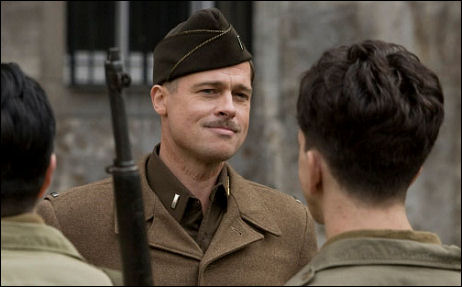
For some reason Beale doesn’t mention that half of Quentin Tarantino‘s upcoming Inglourious Basterds is about a band of raging Jewish G.I.s out to murder and scalp as many Germans as they can get their hands on during World War II. There’s a character named Donny Donowitz, a.k.a. “the Bear Jew” (played by Eli Roth) who carries around a baseball bat, looking to shatter German skulls and cause their brain matter to go glop on the cobblestones.
Pussies!
“I was a shy kid but a lot of my childhood was spent punching the bullies out,” Clint Eastwood tells an Esquire interviewer in an issue that was current during the Xmas break. “We live in more of a pussy generation now, where everybody’s become used to saying, ‘Well, how do we handle it psychologically?’ In those days, you just punched the bully back and duked it out. Even if the guy was older and could push you around, at least you were respected for fighting back, and you’d be left alone from then on.”
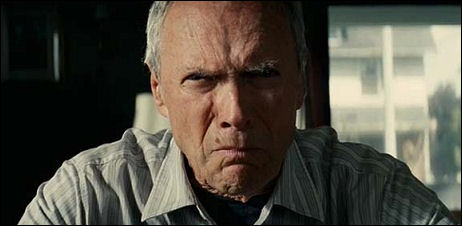
That’s a great paragraph and pure Eastwood. And he’s speaking the truth besides. Even if you get beat up as a result of fighting back the bullies will respect you and leave you alone after that. America machismo was built upon such childhood experiences.
But then Clint ruins the vibe when he says, “I don’t know if I can tell you exactly when the pussy generation started. Maybe when people started asking about the meaning of life.”
I’m pretty sure that people have been wondering about the meaning of life since the days of Socrates, Achilles, Pythagoras and Hepatitis, if not earlier. But the introspective American pussy generation Eastwood is wondering about was basically sired by affluence and living-room creature comforts starting in the early 1950s. The kickback lifestyle softened people up and made them susceptible to the mystical influences of the Beat generation that began in the late ’40s and ’50s, the serious rock ‘n’ rolling that began in the mid ’50s, the growth of a left-wing intellectual community to fight back the right-wing commie purges of the late ’40s and ’50s and the Curtis LeMay nutters in the military, the influence of liberal psychology and the Dr. Spock philosophy upon baby-boomer kids, the expansion of the U.S. economy in the ’60s and the increasing comforts that followed, the Beatles, the Kinks and the long-hair revolution that followed, pot and psychedelic drugs and rampant hippiedom…all of these things helped to pussify America.
And God help us if we hadn’t gone through all this. We’d be so brutish and Neanderthal that our culture would have ceased to function for its inability to relate to other cultures and values. I for one am glad for the pussy influence that helped shape who I am, but I also worship Eastwood’s steely machismo. I may even go see Gran Torino again when it opens next Friday, if only to savor the audience reaction. People get this film — it’s an audience pleaser — and they certainly get Clint.
Filmdrunk has posted a nice Harris and Klebold parody of the Eastwood mentality.
Get Over It
I drove through and around the New Jersey neighborhoods of my youth yesterday — Westfield, Clark, Rahway, Mountainside — and was mildly taken aback by the Christmas decorations still up everywhere. It was two days after the dawn of ’09 — time to take down the tree, put away the tree lights, grim up and get back to work — but New Jerseyans were hanging tough with the mistletoe and the candles in the windows and the sugarplum fairies, etc.
Goldstein’s Oscar Criteria
On 12.29 Patrick bloggy-blog Goldstein wrote that “it’s painfully obvious that somewhere in the evolution of the Oscars academy members started rewarding movies not for their skill and craftsmanship but for their aesthetic and social importance. This has transformed the Oscars from a mainstream movie institution to an elite art society, leading to its increased marginalization both as a barometer of public taste and as a big-time media event.”
Marginalization be damned. And Oscar show ratings be damned also, if need be. It is the duty of any award-giving organization to honor the highest motion picture standards across the board — paying tribute to movies with some kind of vision of life on earth and the focus and craftmanship to make it whole, along with whatever aesthetic and social gravitas can be thrown in to provide a little art-house spritz.
A list of the ten most popular films of any given year makes it clear that average ticket-buyers only occasionally care about “high standards.” They mostly like movies that provide laughs, jolt rides, cheap cries and wish-fulfillment fantasies. Look at the recipients of the People’s Choice Awards. It”s like a vision of narcotized hell. This year the PCA’s have Queen Latifah as their spokesperson, for heavens sake.
Understand, then, that it is the duty of any award-giving organization worth its salt to — no offense, respectfully — spit in the eye of the moviegoing public. Is that clear to everyone, and Goldstein especially?
A group that really cares about movies needs to say to the public each and every year by way of its nominees and winners, “Look, you guys do what you want, enjoy what you want, eat your popcorn…fine. But we’re supposedly trying to reward the best films being made each year, and you guys just don’t care that much. You never have and you never will. AMPAS gets it wrong in many ways each year, granted. It’s way too political and sometimes embarasses itself (a la Crash vs. Brokeback Mountain), but at least it’s half-trying to keep the idea of passion and professionalism in mind when it divvies out nominations and Oscars.”
Goldstein thinks it’s possible for both camps to be made happy. His implication seems to be that the Academy needs to broaden — a polite term for “lower” — its standards.
“If we want studios to make movies that embrace both popular taste and deft artistry, we need to find a way to give out awards that reflect both kinds of aspirations,” he writes.
Indeed, the best films are the ones that manage to combine the two, but this happens once in a blue moon. You have to deal with the world as it is, and generally speaking it’s a good idea to pooh-pooh popular taste because of the cloying emotionalism and razzle-dazzle vulgarity that the public too often responds to and celebrates.
“If we put the Oscar movies in an Oscar ghetto of limited release in small pockets of urban America, we’ll end up insuring that they never reach a broader audience,” Goldstein laments.
Good! Mass culture is swirling downwards anyway, and those resisting this trend need to cling to the rim of the toilet bowl at all costs. Anyone who cares about real film art needs to ensure that the game is defined and controlled by denizens of those small pockets of urban America. Once an awards show starts taking into account the opinions of Average Joes in Fresno and Abilene and Trenton, it’s finished. Tennessee Williams wrote it 61 years ago: “Don’t hang back with the brutes!”
Westlake Is Gone
Donald Westlake, the prolific author and father of “John Dortmunder,” the character played by Robert Redford in The Hot Rock, and “Walker,” the money-reclaiming payback machine played by Lee Marvin in Point Blank, died Wednesday night on his way to a New Year’s Eve dinner in Mexico.
The finest film based on a Westlake crime novel was John Flynn‘s The Outfit (’73), which I’ve written about over and over for not being available on DVD. Warner Home Video has the rights. Will they please remaster and issue a no-frills DVD…please? It’s a genuine B-movie gem, as lean and hard-boiled as they come. (Except for the ending.) It stars Robert Duvall as Macklin, an ex-con of fee words, and Robert Ryan as a sinister-silky gangster. The costars are Karen Black, Joe Don Baker, Timothy Carey, Richard Jaeckel, Joanna Cassidy and Sheree North.
A die-hard user of manual typewriters (he reportedly couldn’t stand the sound of the humming IBM Selectrics, and probably never even looked at a Mac Powerbook), Westlake was 75 years old. His final novel, “Get Real,” comes out in April.
Yeah, yeah, I know — “Walker” wasn’t the name Westlake chose. His literary character was called Parker. I like Walker better.
Will Huppert Meet Basterds?
I’d like to be on a fly on the wall as Isabelle Huppert, jury president of the forthcoming 62nd Cannes Film Festival (5.13 to 5.24), steers the debate over Quentin Tarantino‘s Inglourious Basterds (Weinstein Co., 8.21). Except now that I think about it, Basterds — a surreal jape if I ever read one — is almost certain to play out-of-competition. Or am I being too straight-laced about this?

Isabelle Huppert; mock-art for Quentin Tarantino’s Inglourious Basterds
After reading the Basterds script last July I called it a “categorically insane World War II attitude comedy on top of a quasi-exploitation film about angry Jews paying back the Nazis for their many atrocities. It begins and ends in QT’s movie-nut head, and is very entertaining for that.
“It is absolutely the most inauthentic, bullshit-spewing World War II movie that anyone’s ever written. Every other line is a howl or a chortle. It almost could have been written by some 15 year-old suburban kid who used to play pretend WWII games with his friends when they were 10 or 11. Four or five times I literally laughed out loud, and that’s rare for me. And every scene is pure popcorn, pure shit-kickin’ Quentin, pure movie poontang.
The script “flaunts its fakery and movie ‘tude to such a degree that it’s pure adolescent (i.e., teenage boy) pleasure. The Europe it depicts doesn’t exist and never will exist, and that’s fine. The German and French characters are so idiotically cliched they almost sound like the kind of material that a John Candy SCTV skit would use. But not quite. It’s actually kind of perfect that way. The balance, I mean.
“The film is going to seem loony-tunes to some, and that’s good. The Cinema Paradiso section (pretty young Jewish refugee running a Paris cinema, changing reels, not smoking for fear of burning the stored silver nitrate film reels) goes on a bit, page 50 to 100, give or take. A lot of bodies hit the floor from page 100 to 165. A lotta blood and bullets. The violent finale is wackjob. It’s either insane beyond measure or wildly imaginative in a good way, or both.”
No Mercy
Last month N.Y. Times columnist David Carr, a.k.a., “the Bagger,” was at an industry screening of Stephen Daldry‘s The Reader and “totally flipped his lid,” he writes in the third person, “when the couple next to him chattered happily through a scene in which a young man walks silently through a concentration camp. ‘Are you twits really going to talk your way through a scene at a concentration camp?’ he hissed.”
Twits! The growing fashion these days, of course, is to pull out a gun and start shooting when someone talks during a film, or at least pull out a squirt gun and let ’em have it two or three times in the back of the neck, or in the ear. Such luxuries, of course, are out of bounds for a Times guy. But more and more I’m detecting a John Wayne frontier-justice attitude about theatre gabbers. Critic-columnist Marshall Fine recently expressed sympathy for the motives of the Philadelphia shooter. “Awww, I didn’t hurt him!”
Master Class
Go to the nine-minute mark and watch the last 57 seconds. Nobody does elegant slapstick like Cary Grant…nobody. His timing is just so, and he uses just enough economy with the broad stuff. A touch more or less and his bits wouldn’t be half as funny. Grant was as expert at this sort of thing as Charles Chaplin, Harold Lloyd and Buster Keaton were at their specialties.
Oh, What A Year…
A sweeping summation of 2008 movies by Neoavant’s Matt Shapiro. I don’t know, man. An awful lot of flying (or falling) bodies, explosions, and people who got punched. Don’t we need to consider (i.e., pay more attention to) the calmer, quieter stuff? I feel there’s too much emphasis on Baz Luhrman‘s Australia in this piece, and nowhere near enough clips of Che. But it made me feel half-good, this thing. 2008 had its share of moments.
Last year Shapiro assembled a first-rate assemblage called “2007: A Year for Drama.”