
A nice video-clip appreciation of Billy Wilder‘s amusing, ascerbic and finally compassionate The Apartment by N.Y. Times critic A.O. Scott.
Daily
Dirty World
You think some journalists and columnists are mean and critical and dismissive of this or that actor or filmmaker? You should hear what the big-studio suits say about their interest in hiring some of them. A filmmaker friend I had dinner with the other night ran down a list of actors who would be a good choices to fill certain roles in a certain film that’s preparing to foll film in ’09, and one after another, he said, have been turned down by the studio guys. Mainly, he said, because their names don’t sell tickets overseas.
“Nope…don’t want him…fuck her…no way…somebody else….her last movie died…nobody likes him…he’s red ink,” etc.
I know the project in question and almost every one of of the rejected actors sounded like pretty good choices in terms of how they’d fit the part and how good they might be. Of course, it isn’t my job to worry about overseas grosses. But after hearing about this actor being rejected and that one being rejected and on and on and on, I said, “God, those studio guys are really friggin’ brutal about this stuff!” Journalists and critics might criticize this or that performance (or an aspect of one), but they’re not saying “no” about this or that actor being hired . Denying good paychecks to talented people — that’s cold.
Certain directors, also, aren’t able to put their movies together because actors don’t want to work with them because they’ve come to believe that these directors aren’t as interested as they could be in providing emotional, well-written roles and thereby serving the potential of the actors (i.e., making them look and sound their very best), and are much more interested in fulfilling their own visions and making their own stuff happen.
And yet the directors who are supposedly having trouble along these lines (two or three were discussed) are talented as hell and by my judgment have always tried to make rich, shaded, high-quality films. I don’t get it. I just know that making decisions about who to hire on movies is a much tougher racket than anything journalists could be a party to.
Hissing of Summer Lawns
Lee Siegel, writing for the Wall Street Journal‘s real estate section, takes a poke at Hollywood’s long tradition of of claiming spiritual death by station wagon in a piece called “Why Does Hollywood Hate the Suburbs?”
Siegel basically thinks that the industry’s view of suburbs as sedate soul-killing gulags, advanced in such films as Revolutionary Road, The Ice Storm, Far From Heaven, The Stepford Wives (both versions), No Down Payment, Strangers When We Meet and American Beauty, is somehow undeserved and over-baked.
The piece leads you to conclude that Siegel either (a) never grew up in a suburb as a teenager or (b) is kowtowing to the Journal‘s advertising interests. I grew up in the suburbs and I’m telling you they’re hell for young guys who hunger for the real thing. They’re fine for kids and moms and older people who want peace and quiet and lots of trees and green lawns in the summertime. They offer good schools, of course, and the girls you meet in the richer suburbs (like the towns in Fairfield County, which is actually exurbia) tend to be a lot prettier than most because beauty follows money.
But I knew a few guys who felt that life was so nice in Wilton, Connecticut, and all the towns in that realm (Westport, New Canaan, Darien, Ridgefield, Weston, Easton, Redding) that they decided they probably couldn’t live as well and might live a lot worse if they went out into the world, so they decided to stick around and get local jobs, etc. And yes, some turned out okay (especially the ones who got into construction) but others didn’t do so well, succumbing to the usual maladies out of boredom or whatnot, in some cases curling into fetal balls and dying of spiritual malnutrition. Hell, I was almost one of them.
Here’s MCN’s Kim Voynar taking issue with Siegel’s piece also.
Right On It
Tom Arnold is starring in this basketball-related CBS Interactive web series called Heckle-U, which will begin in February and run for ten episodes…fine. I met Arnold back in ’99 or ’00 at one of Jonathan Kaufer ‘s chinese-food-and-DVD parties, and I liked him right away for something that happened before we shook hands or said hello.
I had parked my car down the road and was approaching Kaufer’s home, which was located up in the hills inside this gated McMansion community, in the darkness. I saw a group of three or four people standing outside the black-iron gate. Usually you just push the intercom button and the owner buzzes you through and that’s that, but this group, which Arnold was a part of, was just standing around and murmuring to each other. (I had noticed them as I drove up so they’d been there a couple of minutes.) So I said out loud, not knowing who anyone was, “How come all you guys are just standing there?”
And Arnold replied in that unmistakable voice, “Because we’re assholes?”
Death’s Honesty
In Leslie Bennett‘s Vanity Fair profile of Cate Blanchett, the actress talks about the Benjamin Button grim-reaper factor. Director David Fincher told her it would be “about death,” she says, “and I think that’s great.” And so do most of us, I believe. We alI think it’s pretty darn cool when a movie comes along and tries to get us to confront our mortality.

“We’ve enshrined the purity, sanctity, value, and importance of bringing children into the world,” says Blanchett, “[and] yet we don’t discuss death. There used to be an enshrined period where mourning was a necessary part of going through the process of grieving; death wasn’t considered morbid or antisocial. But that’s totally gone. Now we’re all terrified of aging, terrified of death. This film deals with death as a release. I hope it’s a moment of catharsis.”
“It’s sort of like a repository for your grief, about whatever you grieve about — the loss of loved ones, the missing of opportunities, whatever,” Fincher tells Bennetts,. “You hope it will leave people feeling hopeful about certain things, and sad about certain things.”
“It’s Gonna Be Clint”?
The Envelope‘s Tom O’Neil is taken aback that Village Voice columnist Michael Musto doesn’t see Leonardo DiCaprio being Best Actor nominated for Revolutionary Road, especially since Leo was nominated the year before last for Blood Diamond “of all things…c’mon!” And Musto says Leo was better in Blood Diamond. No, he wasn’t. And he was nominated for that Ed Zwick film because he used a South African accent. That was it. That was the whole thing.
End of the Hat
This is my last and final post about the emotionally vivid cowboy hat, which connects to an item I ran yesterday. Which you need to read along with the comments in order to understand the context. Okay? Do that first and then come back to this.

The Star hotel is a b & b — not a hotel. I stayed there in ’07 and ’08 and was very content to do so. Carol Rixey, who’s been managing until this year (when her son took over), runs it quietly and efficiently but with a kind of personal touch. She makes you feel as if you’re staying in someone’s home back in 1962 or something. My mother would love it if she was still getting around. So would have Gary Cooper , I suspect, if he had dropped by during the Eisenhower administration.
For the Star is a quiet little old-time America trip — a kind of time-capsule remnant of the way it all used to be and feel. (Except for the wi-fi.) It’s a homey little place with family pictures and little knick-knacks on the walls, and it all makes you feel good and settled-down. Carol serves breakfast in the morning, there are always potato chips and pretzels and cheese squares on the kitchen table, and if you’re feeling sick with a fever (as I was last year, beginning on the day that Heath Ledger was found dead) Carol might offer you a homemade remedy or a first-aid pack that she keeps in a box near the front entrance.
But you have to be a mellow, quiet, laid-back type to fit in. Some haven’t. A couple of lesbians going through relationship problems stayed there last year — it was a little bit weird. A pair of Australian party animals stayed there the year before — they were coarse and gross and stank of booze in the morning, and one of them slurped his Cheerios like a pig. But the Toronto Globe and Mail‘s Liam Lacey has stayed there year after year in a very col and quiet way. He gets it, fits in, etc. As I have.
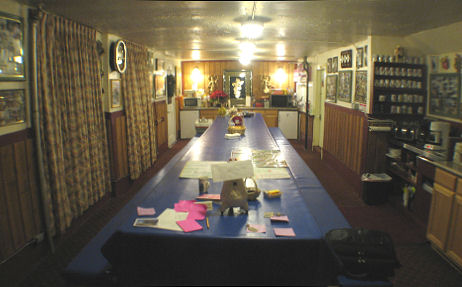
Star hotel”s dining room
Carol is a Texan but she kind of reminds me of my grandmother (my mom’s mom) in a tough way. She’s no softy and won’t take any guff, but she’s maternal and caring in her way. And I came to feel very cared for there. I could talk to Carol like she was family and vice versa. And the wifi is pretty damn good. Not the fastest but always functioning.
So when I said to her last year that I’d like to leave my cowboy hat there so I could just pick up in ’09 where I left off in ’08, I was obviously saying to her (in my head at least, and I can’t imagine how she could have interpreted this any differently) that I’d like it very much if she could be a nice and considerate grandma and hold my hat for me, and that I’d be back to stay the following year. Simple and quite clear all around. I trusted her to get what I meant because, I figured, she surely recognizes the trust and affection that we’ve had between us over the past two years.
But now things have ended badly. Very badly. I just heard from Carol that she considers my having discussed the matter in the column to be a form of blackmail (a somewhat hysterical interpretation, in my view) and that she’s given my hat to the Park City police and that I can pick it up there when I get to town. The fuzz, for God’s sake! She’s brought the cops into this! Talk about a violation of the trust that comes with friendship and the values of good grandma-hood!
The idea that nice people can turn around and suddenly act erratically and illogically (to put it in gentle terms) is not a very pleasant one, but obviously it happens. Good God.
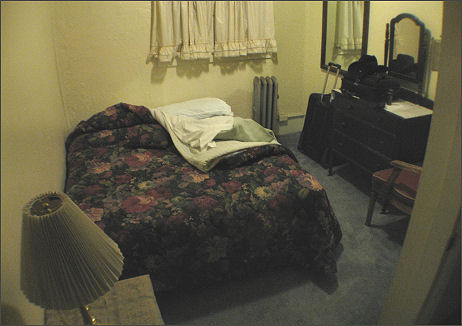
Typical Star Hotel bedroom.
The Rourke “Idea”
“Out of all the guys who could be nominated, don’t we all want to see Mickey Rourke win? How great would that be to see this guy shamble up to the stage, tears flowing — it’d be amazing. And I’m not even a huge fan. I like the ‘idea’ of Rourke maybe more than the man himself. But the way he really puts it all out there in this film is pretty great. I don’t even think he was acting. So maybe, somehow, he doesn’t deserve it over some other guy who really is ‘acting,’ but it’s still a performance, and it might be the best thing anyone’s done this year (except for Ledger, of course).” — HE reader “Mindless Obamaton,” posted at 5:53 am.
For Whom The Text Smears
Updated with comment added: Daily Beast contributor Gerald Posner reported today that yesterday (12.28) “a Los Angeles entertainment honcho shared a text message with [him] that Mickey Rourke had sent him about Sean Penn: ‘Look seans an old friend of mine [but] i didnt buy his performance at all — thought he did an average pretend acting like he was gay besides hes one of the most homophobic people i kno'” [sic]
Needless to say, it’s extremely scummy of Posner’s anonymous “Los Angeles entertainment honcho” to pass along a privately-sent text message with the idea that it might possibly turn up in a Daily Beast story. It’s craven and low. I posted the item because Posner is a highly respected investigative reporter and author, and because the Daily Beast is a top-of-the-pile, high-profile site. But two key factors were at work here. One, the story wouldn’t have been considered persuasive or titillating enough to run without the text message quote. And two, Posner and the DB obviously know that running the text message quote essentially amounts to a double-edged smear, plain and simple. I think it’s going to backfire against Rourke and in Penn’s favor.
Posner writes that “several entertainment industry sources” have said that Rourke is “trash talking” Penn, but he only mentions two — the text message plus an alleged comment Rourke made backstage after a “Late Night with David Letterman” taping on 12.23. Rourke allegedly said “he was surprised that so many people seemed to think that Penn was his Oscar competition since ‘I’m not even sure he’ll get a nomination.'” Doesn’t the word “several” mean at least…what, four or five? (If I had three sources on a story, I wouldn’t say I had “several” sources — I would say I had three.)
A friend has written HE with the following comment: “Gerald Posner’s use of an unattributed source for his Daily Beast story about the Mickey Rourke/Sean Penn texting reminds me of the sermon in Doubt in which Philip Seymour Hoffman speaks about gossip and compares its irreparable damage to the feathers from a pillow dispersing in the air.”
Dese Dem Dose
Two Lovers (2929 Prods., 2.13.09) is a very decent…no, better-than-decent blue-collar drama from director-writer James Gray. It plays in the vein of Paddy Chayefsky‘s Marty, and has very fine performances from the entire cast, but especially from Joaquin Phoenix, Gwynneth Paltrow and Vinessa Shaw.
Americans Loved ‘Em
The ten biggest-grossing films of the year, two of which — WALL*E and The Dark Knight — were serious knockouts. A third — Jon Favreau‘s Ironman — was a very satisfying commercial fanboy flick. The other seven represented varying grades of muck and disappointment.