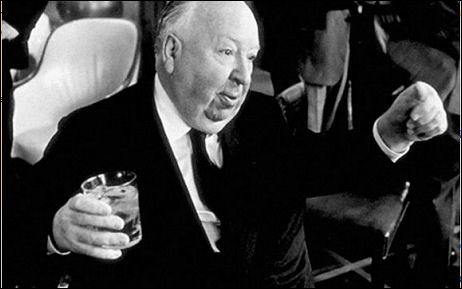
Here‘s a tape of Alfred Hitchcock speaking to Francois Truffaut in the mid ’60s for the book that eventually became “Hitchcock/Truffaut.” The subject, as Hitchcock described, was “a little matter of the physical aspect of the kissing scene in Notorious. The actors, of course, hated doing it. They felt dreadfully uncomfortable in the manner of how they had to cling to each other. And I said, I don’t care how you feel, I only know how it’s going to look like on the screen.
Alfred Hitchcock
“I conceived the scene in terms of a desire on the participants not to break the romantic mood. To normally break apart, it’s possible that the moment would be lost. But there were things to be done, movements to be made with the telephone and the door, where it was still essential for them not to break the embrace. And I felt that the camera, representing the public, should be permitted as a third part, to join in the embrace. I was giving the public the great privilege of embracing Cary Grant and Ingrid Bergman together. It was a kind of temporary menage a trois.
Here‘s the best part: “The aspect of not wanting to break the mood…the idea was given to me when I was in a train coming from Bologne to Paris and the train was going through a tup rather slowly,” Hitchcock says. “It was a Sunday afternoon and there was a big factory and there was a large red brick wall, and against the wall was standing a young man with his girl. The girl had her arm linked through his, but he was urinating against the wall. But she never let go of his arm. She was looking down at what he was doing, then she looked around the countryside and then back again, and I thought this was true love really functioning, and that was the actual inspiration for the scene in Notorious.”
Here’s a site with links to several tape portions of the Hitchcock/Truffaut sessons.
WALL*E is running 88, 45, 26 — extraordinary numbers for a family/kids movie because the kids aren’t polled. Figure $50 to $60 million. Wanted, also opening this weekend, has similar numbers — 86, 44, 26 — but without the kid factor and the ceiling on violence (plus the fact that the movie is brutish and rancid) it’ll do a fairly safe $30 million, maybe a bit more. Never has a worse movie Will Smith‘s Hancock, opening on Tuesday, July 1st, is running at 91, 56 and 19 — obviously quite strong. Guillermo del Toro‘s Hellboy 2: The Golden Army (Universal), opening on 7.11, is running at 74, 33 and 3. That’s a little weak, no? On one hand you could say people don’t seem to want to go there again. On the other hand this isn’t looking too bad since there’s a heavy first choice on Hancock and The Dark Knight. You could say that Hancock has to open and disappoint and get out of the way for Hellboy 2 to get rolling. Journey to the Center of the Earth (Warner/New Line, 7.11) is running 73, 23 and 1. Not good. Doing even worse is Eddie Murphy‘s Meet Dave (20th Century Fox) at 49, 17 and 0 — toilet time. it opens in two weeks and it’s dead. It’s obviously a referendum on Murphy’s fan base. The Dark Knight (Warner Bros., 7.18) is looking huge — 76, 60 and 19, and it’s three weeks away. Mamma Mia (Universal), running against the bat, is 62, 23 and 5. Obviously an older female thing. “Definite interest’ running in the mid 30s. Tracking like Hairspray.
“Every movie probably suffers from logic flaws,” notes Artful Writer Craig Maizin in a piece he posted on 6.8. “The goal, of course, is to avoid crossing the threshold of tolerance. There are some flaws in The Godfather, for instance. If Tessio can figure out where Michael is meeting The Turk and have enough time to plant a gun, why can’t he plant a few guys in the back kitchen? Or in a back alley? Have them do the murders, and not put Al Pacino‘s Michael on the hook?
“But the logic flaws in The Godfather simply don’t cross the threshold of tolerance. Because they don’t, no one really gives a damn. In fact, many people will instinctively argue that the logic flaws aren’t flaws at all. So we gloss by logic errors in films that don’t cross the threshold of tolerance, because they haven’t done enough damage to shake the illusion of intention.
“But you can only suffer so many shots below the waterline before the ship starts to sink. If the audience’s illusion of intention is repeatedly or grossly challenged by logic problems, they will revolt.
“Make up any rules you’d like for your fictional system, but adhere to them. For instance, in the latest Indiana Jones film, the crystal skull is presented as an object so magnetic, it can literally attract metal shavings out of the air from hundreds of feet away. But sometimes, it doesn’t seem to be magnetic at all. Like when it’s in a jeep. Or near guns. Or bullets.
“That was a glaring logic flaw that pulled a lot of people out of the moment, including myself. On the other hand, the filmmakers were smart to include a fast shot of the words ‘lead-lined’ on the refrigerator that Indy climbs into just before the nuclear blast goes off. That’s enough to satisfy the Logic Nazi.”
But not me. Indy locking himself inside that lead-lined refrigerator was my first big logical break with Indiana Jones and the Kingdom of the Crystal Skull. The reason — very simple — is a universally recognized law that says anyone who crawls into a refrigerator and closes the door shut is locking him or herself into a tomb and will soon suffocate to death. I’ve been taught that since I was five friggin’ years old. I don’t care if the refrigerator is blown a mile or so into the desert by an exploding atom bomb, banging and rolling around like a ball bearing. The door will never open unless you pull the latch handle. Once you’re inside, you can’t get out.
A big logic problem for some in M. Night Shyamnalan‘s The Happening is that everyone responds to the plant toxin effect, which has destroyed the natural human instinct to self-preserve, by deliberately killing themselves in all sorts of different ways. It’s been argued that a loss of the self-preservation instinct would more likely result in people offing themselves in much more casual (i.e., not immediately homicidal) ways — absurd binge-drinking, family arguments escalating in to homicides at the drop of a hat, Mad Max-style speeding on the freeway resulting in all kinds of fatal pile-ups, a resurgence of unprotected ’70s and early ’80s-style gay bathhouse sex, people binging on Ben and Jerry’s, etc.
This didn’t bother me as much as it did others because I (like Shyamalan himself) was so taken with all those chilling images of bodies falling from buildings and hanging from trees.
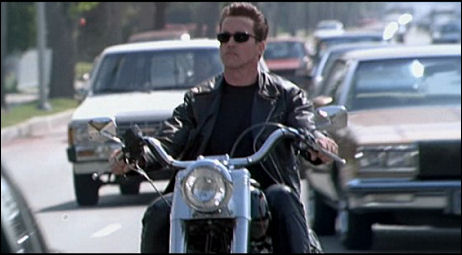
I’ve always said that James Cameron‘s T2: Judgment Day should have ended with a completely illogical occurence that nonetheless would’ve worked emotionally. As Arnold Schwarzenegger’s cyborg is saying goodbye to Eddie Furlong as he deliberately lowers himself into that steel-mill inferno, a single tear should have leaked out from the corner of one of his lifeless eyes.
The movie clearly has established in an earlier scene that Arnie’s cyborg can’t cry and in fact has no idea what crying is. (Schwarzenegger asks Furlong at one point to explain it.) But Schwarzenegger has also been learning certain phrases and social habits from Furlong (hand slaps, “eat me,” “hasta la vista, baby”) so it’s conceivable that a resourceful super-robot might have somehow generated the ability to weep by the end of the film. Illogical, yes, but it would have worked.
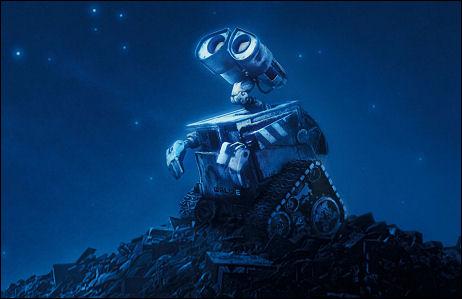
A friend saw Andrew Stanton‘s WALL*E (Disney, 6.27) and says it’s (a) sort of an animated Jacques Tati film in the vein of Mon Oncle, in part because there’s almost no dialogue for the first 45 minutes or so, (b) it’s a kind of companion piece to An Inconvenient Truth in that it’s a strong message movie, set in a ruined post-apocalyptic world, about how we’re killing our world with poisons.
You might think from the trailers that it’s basically a robot love story, but that ain’t the half of it. It’s “not your typical wheee, happy, up-up-up animated family entertainment,” the friend says. “Once again, Pixar is pushing the buttons. It has a lot more on its mind.”
WALL*E is this little robot going around in this huge junkyard that used to be the earth, now inhabitable due to some toxic poisoning, saving remnants of what life once was. He’s obsessed with Barbra Streisand‘s Hello Dolly and plays these clips over and over,” he says. “The story later shifts its base to this massive shopping-mall space station, a floating planet of some sort with all these overweight fat people who can’t walk on their own, moving through a giant mall…an exaggeration of our culture today.”
I’ve come up with a new reason to leave movies before they’ve ended. Over the last two days I’ve left two as they got into their third acts because — I’m being serious — I liked them so much I didn’t want their endings to spoil them.
I did this with a showing of Clint Eastwood‘s Breezy at the Aero on Sunday night. This wasn’t the main reason I bailed last night on the last 15 minutes of You Don’t Mess With the Zohan, but it was an underlying one.
You’re liking the film, it’s going well, everything’s working…so why mess with the possibility of the ending screwing everything up? Leave 15 minutes before it ends, ask your friends what happens, and then catch the whole thing on DVD three or four months hence. Especially if the film in question is a drama that’s subtly telegraphing that some kind of heavy or unpleasant turnaround is just around the corner. Or if some guy is sitting next to you and ruining everything by saying “wow!” when hot girls in hot underwear make a brief appearance. Get out while the going is good.
Obviously this is an incredibly lowbrow attitude for someone such as myself. I’m not confessing to it with any pride or suggesting in any way that I’m going to watch films with this attitude henceforth. I’m just saying that over the last 48 hours I’ve left two films that I liked, and that my reason or doing so made sense to me, and that it left me in peace.
So which rides have been destroyed by the Universal fire? Has City Walk been affected? Any decent photos posted? No time to process this, having gotten off the ferry and now behind the wheel of a rental on 95 north.
Getting on on Air France 777 now (1:03 pm), having missed the 10:15 am flight. (Don’t ask.) Before every flight, I cross myself and ask God Almighty not to seat me next to a morbidly obese person. There are at least two whales in line right now, and I’m feeling a very slight apprehension about this. There are thousands of people in Paris who look well-fed or stocky or fat, but I’ve seen no Jabbas. You might expect otherwise in a foodie city like Paris, but nope. Update: No fatties but Doug Liman is on my plane. He’s returning from a trip to three African countries, at least one or two of which (Rwanda or Uganda or both) proved to be fairly dangerous. He told me was arrested once, and possibly twice. I admire the cojones of anyone willing to risk the worst to order to encounter things unique, surprising, challenging. We talked about the red-clay color of Uganda’s dirt. Liman’s boot laces were untiedcand flopping around as we walked and talked. He was wearing a round-brimmed straw hat.
Steven Soderbergh‘s Che, my choice for the most exciting and far-reaching film of the Cannes Film Festival, didn’t win the Palme d’Or this evening. Lamentable, dispiriting news. Instead the jury gave the coveted top prize to Laurent Cantet‘s justly admired Entre Les Murs. I was wandering around Montmartre when the news broke, and when I heard it I just swore to myself and put it out of my mind and kept waking. I didn’t have my computer with me and I didn’t care.
At least the gifted Benicio del Toro won the Best Actor prize for his portrayal of Che Guevara in the twin Soderbergh films.
Cantet has everyone’s respect, but to me his films have always seemed more quietly admirable than arousing. I’ve never gotten a lightning-bolt charge from anything he’s done. I just feel let down about this, knowing what a Palme d’Or win might have done to at least partly help Che‘s chances in finding the right U.S. distribution deal. I’m obviously thinking politically, and this just doesn’t feel right. Sean Penn and the jury members went with their idea of the best film of the festival, and that’s cool. Entre Les Murs will play at elite art theatres when it opens in the U.S. for two or three or four weeks. Connoisseurs of first-rate French cinema will pay to see it. Terrific.
Congrats to Matteo Garrone‘s Gamorra, which everyone liked for the most part, for winning the Grand Prix. And double congrats to Three Monkeys‘ Nuri Bilge Ceylan for winning the Best Director prize. A Jury Prize went to Paolo Sorrentino‘s Il Divo. Sandra Corveloni won Best Actress for her work in Walter Salles‘ Linha de Passe, and the Best Screenplay award went to Jean-Pierre and Luc Dardenne‘s Lorna’s Silence. (Sorry, but I don’t agree with that one at all — the Lorna story did not end on a satisfying note.) The Cameras d’Or prize went to Steve McQueen‘s Hunger.
The jury obviously wanted to be magnanimous by giving a little something to everyone. They succeeded.
[Final Nice Airport post before 7:15 pm Easy Jet flight to Paris.] I heard some scuttlebutt this afternoon about which films and filmmakers might win some Cannes Film Festival awards on Sunday evening, the principal buzz being that Steven Soderbergh‘s Che may — I say “may” — be in a favoring position to win the Palme d’Or.
The talk is that jury honcho Sean Penn is presumed to be advocating the Soderbergh, in large part because of his lefty political views. The Che downside, I’ve been told, is that Spanish-speaking cineastes up and down the Croisette are said to be down on it because of the “accent salad” rap — i.e., complaints that very few in the cast of Soderbergh’s film speak with a convincing Cuban accent. (Referring, I presume, to The Argentine.) No telling how jury member Alfonso Cuaron feels about this.
The other pro-Che factor, according to Envelope columnist Pete Hammond, is that Harvey Weinstein is vocally pushing for it with jury members.