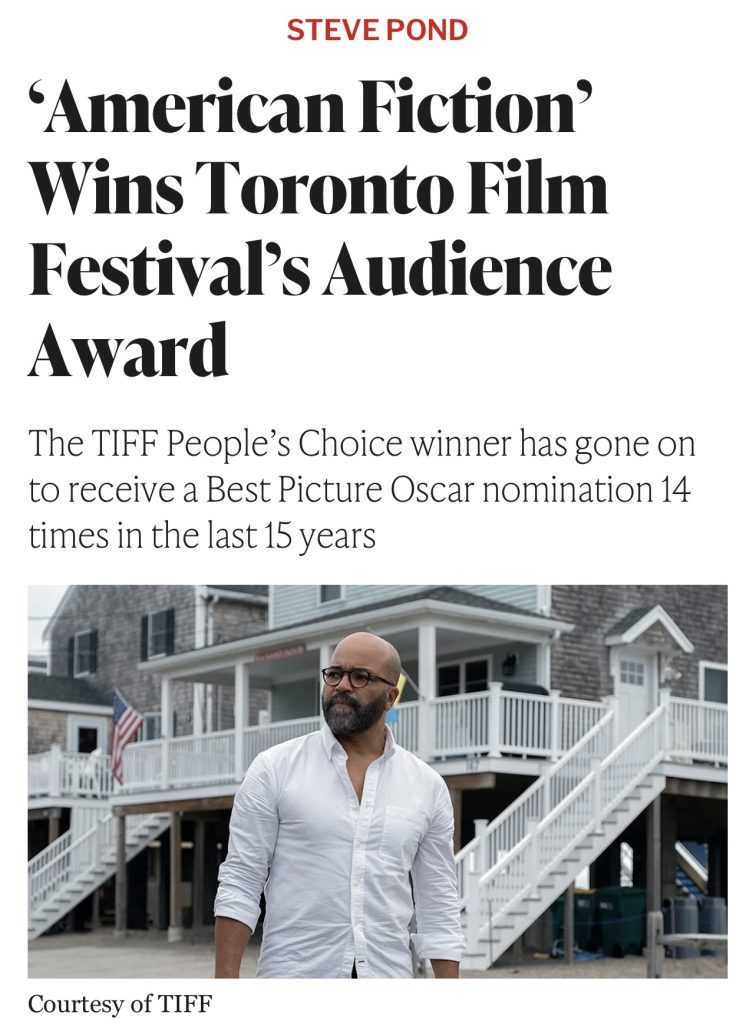
American Fiction, TIFF: 2:44 Drew Barrymore: 12:42 Lauren Boebert: 18:26
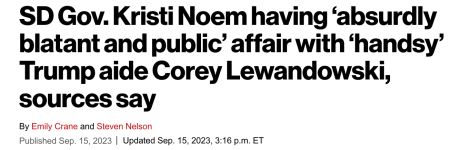
TIFF People’s Choice Award: 34:12 Russell Brand + Me Too: 35:37 Kristi Noem/Corey Lewandowski affair + Biden and Harris 50:36
Best Picture + Pot Au Feu: 63 mins Killers of the Flower Moon: 70 mins Mississippi Burning: 72 mins The Parallax View: 75 mins JFK and anti-government/paranoid movies: 83 mins
…is “what an arrogant, exhibitionist, beyond-egotistical low-rent moron…not to mention that ridiculous Venice canalwatertaxiincident…talk about the very personification of déclassé.
Director-writer friendo: “Drew Barrymore’s reaction to the backlash isn’t unexpected, as she’s more a pleaser than a disruptor. Who knows what the next shoe will be but Drew will need to be careful not to dig herself into a deeper hole.
“Barrymore wants to be liked so she caved, but the reality is this: is it really worth pressing ahead with a daytime talk show when you’re being called a scab with craven, third-tier guests getting catcalled by protesters outside?
“Bill Maher, who isn’t scabbing but greenlighting a hollowed-out version of his show sans writer’s input, probably won’t blink, especially since he’ll most likely have political pundits on his show and can justify Real Time (until the WGA strike is finally settled) as being a late-night version of Face the Nation or Meet the Press minus comedic wraparounds.
“He’s also a defiant guy and will revel in the headline-making persecution from the WGA.
“Five months is too long for a showbiz strike and there was no end in sight until top showrunners started questioning WGA leadership, as well as Maher opting to autonomously take care of his own business. Now, it seems, the WGA strike could wrap up by Halloween.”
HE to director-writer friendo: “The WGA strike could wrap up ‘by Halloween’? Why not within the next couple of weeks? Why Halloween? Why not Thanksgiving?”
Director-writer friendo: “I said Halloween because it takes time to draft language, present the proposal, get a vote, etc. Plus the AMPTP would want to then negotiate with SAG before Thanksgiving hits. This is just a conjecture, of course, since Apple TV just suspended two high profile deals. This could go either way, but a deal with the WGA means the AMPTP will want to get SAG resolved so films like Deadpool 3 can resume.
“Someone needs to ask why David Young mysteriously stepped aside for negotiating a WGA deal. Probably because he and Carol Lombardini know how to make deals, are strong union people, and the WGA wanted a strike. Young probably offered a reality check on mandatory staffing.”
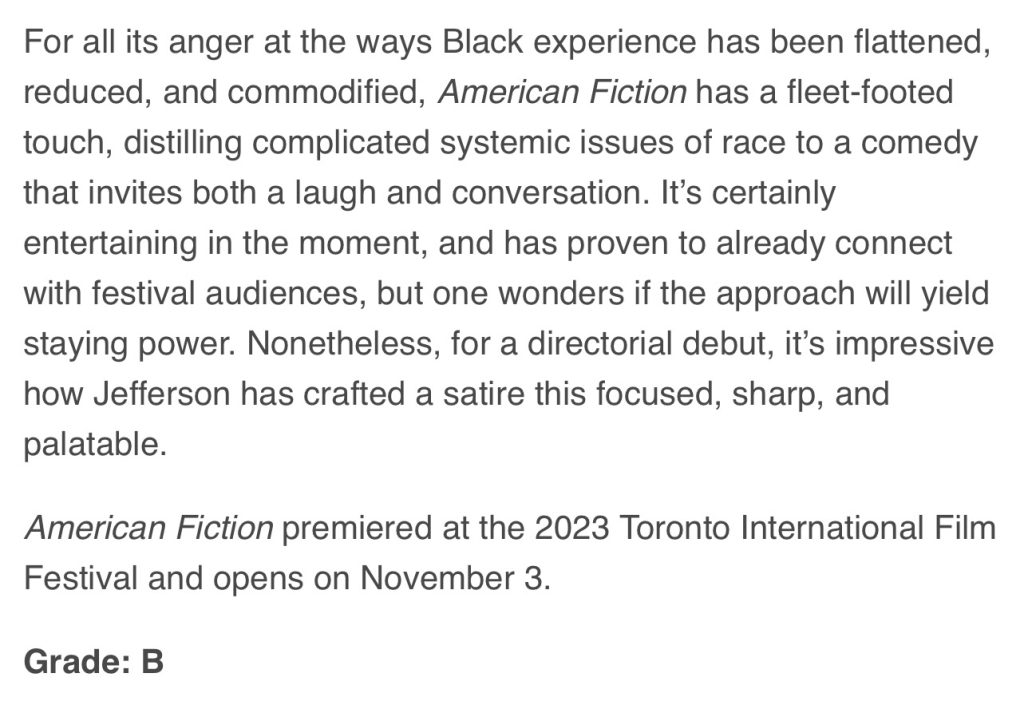
Has any TIFF-attending journo written a concise, HE-styled, straight-from-the-shoulder capsule assessment of Cord Jefferson’s film? It’s a racial satire but howeffective? Just asking.
Jordan Ruimy: “It’s verygood…reminded me of Alexander Payne’s movies.”
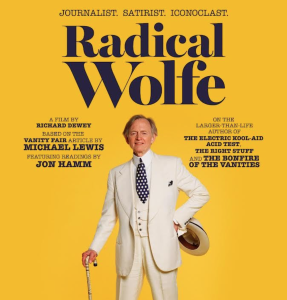
Two good things happened last night after I watched Richard Dewey and Michael Lewis‘s Radical Wolfe (Kino Lorber), a decent, mildly approvable documentary portrait of the magnificent Tom Wolfe, who passed in mid-May of 2018, during that year’s Cannes Film Festival.
One, it prompted me to read the Vanity Fair article that inspired the doc — Lewis’s 2015 article about the celebrated writer (“How Tom Wolfe Became Tom Wolfe“). And two, it convinced me to order a copy of Wolfe’s “Hooking Up,” a compilation that contains Wolfe’s wicked 1965 satire of The New Yorker, called “Tiny Mummies.” (I’d bought a copy years ago but left it in West Hollywood when I moved east.)
HE to friendo about Radical Wolfe, which I saw last night: “I thought the Wolfe doc was pretty good or, you know, not bad. It covered what needed to be covered, and was properly descriptive and reverent and enthused in an acceptable sort of way.
“But after decades of reading Wolfe’s stuff the doc didn’t (and perhaps couldn’t) deliver all that many bong highs. Wolfe’s writing has been giving me bong highs since the ’60s, but there were only a few (and mild ones at that) in Dewey’s film.
”Honestly? I got more enjoyment and enthusiasm…more in the way of the sheer euphoric love of delicious, sugar-rush writing…I got more of that from Owen Gleiberman’s Variety review of Radical Wolfe than from Radical Wolfe itself.
“Of all the stories and sides of Leonard Bernstein that Bradley Cooper decided to leave out of Maestro, the most infamous is surely “Radical Chic: That Party at Lenny’s” (6.8.70)”, Gleiberman notes. “Wolfe’s New York magazine cover story, described in delectable you-are-there detail, focused on a party thrown by Lenny and his wife, Felicia, at their Park Avenue apartment to raise funds for the Black Panthers.
“Several of the Panthers were there, mingling with the swells of aristocratic liberal New York, and Wolfe captured the contradictions of that evening in a tone of such scathing perception that it was as if he’d defined the concept of bourgeois political correctness, disemboweled it, and danced on its grave, all in the same moment.”
I watched Radical Wolfe with a faint hope that it might deliver several cinematic equivalents of Wolfe-ian prose highs. For a filmmaker to have managed such a feat…a kind of Adam Curtis-like re-experiencing of the Wolfe panorama…well, who knows if such a thing would be possible? But he/she would have to get really ambitious & UNCORK THE BOTTLE & REALLY GO TO TOWN in terms of creating a cinematic corollary.
Such a doc would have to be a four- or five-parter…180 or 240 minutes…and it couldn’t really be about just Wolfe’s unique literary experience, but about what he saw and felt and imagined and disapproved of and found fascinating…the whole raging sea of American life and culture from the late ‘50s, 60s, ‘70s, ‘80s and early ‘90s….a mad, churning, sweeping history of pre-boomer, boomer and GenX America….the whole tornado as witnessed and processed by a single gifted fellow but also all of us.
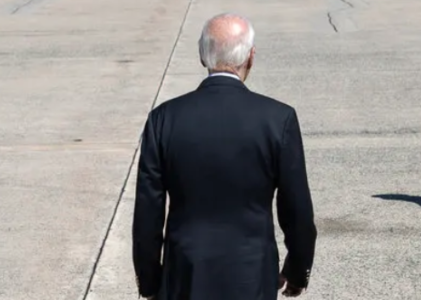
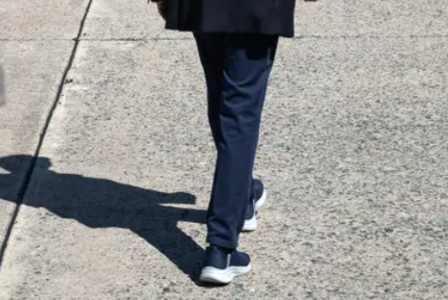
If President Biden insists on wearing old-man comfort shoes, he could at least wear the all-black kind that would at least simulate the black leather Presidential footwear tradition that has been in place since the days of Abraham Lincoln if not before.
Biden’s wearing of whitesides is appalling — a symbolic degradation of the dignity of the office.
Nicolle Wallace: “Where are all of the Republicans who still have little slivers of a following in the cesspool that is the MAGA base?”
Special Trump prosecutor Jack Smith has asked a judge to place Orange Sociopath under a limited gag order for attempting to publicly intimidate potential witnesses. Smith’s filing says the “narrowly tailored” order would prevent harassment of witnesses. It seems likely that sooner or later a MAGA wacko will try something violent.
While admitting that he was absolutely randy and ravenous during his Hollywood heyday, Russell Brand is “absolutely refuting” accusations of “rape, sexual assaults and emotional abuse” in a 90-minute Channel 4 documentary that will air this evening in England. The Sunday Times is reporting that Brand has been accused of sexual assault by four women between 2006 and 2013.
Band is claiming the sexual encounters were consensual; his accusers are asserting otherwise.
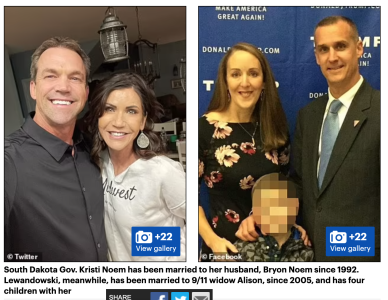
They’re both big-time Trump supporters as well as family values proponents. Governor Noem has been married to husband Bryon since 1992. Lewandowski has been married to the former Alison Hardy (her husband was killed on 9/11 as one of the passengers on United flight 175) since 2005, and has four kids with her…four!
Then again when have big-time political players (office holders, candidates, heavyweight operatives, donors) not been hypocrites? It goes with the territory.
Most of us are familiar with the term “the heart wants what it wants.” Most of us understand that certain affairs of the heart (and the loins) can, depending on the chemistry of the participants, result in a form of insanity. I was involved in a crazy extra-marital thing a quarter-century ago. (She was the infidel — I was the unmarried “other man.”) So I know how it feels to have wings on your heels. I know what is to be seized by this kind of madness. Then again Lewandowski and Noem have reportedly been indiscreet, and that’s on them.
Noem has been on the short list of potential vice-presidential running mates alongside Donald Trump in the ’24 campaign. The reports about her thing with Lewandowski will probably kill this talk.
It’s mystifying why the Best Int’l Feature know-it-alls are so in the tank for Anatomy of a Fall, which is a good, talky and well-layered did-she-do-it? film…a smartly written marital mystery-slash-courtroom procedural. It is also, truth be told, a wee bit irksome by way of visual confinement (only two Grenoble locations — an A-frame home and a courtroom interior) and, at 150 minutes, is certainly a prolonged rear-end punisher. Plus I don’t like the kid.
Being what it is Justine Triet’s cerebral bad-marriage film naturally doesn’t try to deliver anything like the emotional-devotional contact high you get from Tran Ahn Hung’s The Pot-au-Feu, a sensual foodie bliss-out if I’ve ever sat through one. There’s no question which film is more seductive and pleasurable but the fix seems to be in all the same for Triet and Sandra Huller’s marathon talkfest.
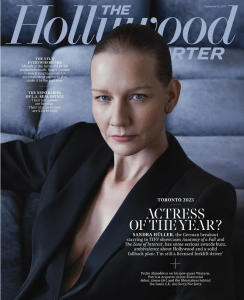
Is it a political-gender-feminist preference thing? Is it because the feminist smarty-pants set is in the tank for Huller’s likely Best Actress nomination, which was recently proclaimed in a Hollywood Reporter cover story? (She’s also very good in Jonathan Glazer‘s The Zone of Interest but her character, the wife of an Auschwitz camp commander, is subdued.) Is it because The Pot-au-Feu, directed by a Vietnamese arthouse veteran, has been tagged as too much of a sensual white gentleman’s film and therefore not cool…a film that’s not just about the devotional and spiritual worship of fine French cuisine but Benoit Magimel’s idealized, classically old-fashioned, all-consuming pedestal love for Juliette Binoche?
Should HE file the necessary papers in order to be designated the official website for the Anatomy of a Fall Int’l Takedown Campaign? I don’t really want to do this as it’s clearly an intelligent and (as far as it goes) engaging film. All I know is that THE POLITICAL FIX SEEMS TO BE IN.
A new trailer for THE POT-AU-FEU / THE TASTE OF THINGS, for which Tran Anh Hung won Best Director at this year's @Festival_Cannes. Starring Juliette Binoche and Benoît Magimel and in French cinemas November 8. pic.twitter.com/fRZhRvwxiN