
Nia DaCosta‘s The Marvels (Disney, 11.10) will obviously be torture for a great many people.
Daily
The Worst Three Hours of My Moviegoing Life
…will engulf me on Thursday evening (4.13), and all I can say is that “the clarity of mind experienced by a man standing on the gallows is wonderful.”
Although I hate certain aspects of my life and indeed myself, I do respect my willingness to sit through an IMAX presentation of Beau Is Afraid. Willingness as in hardcore manliness.

Funky, Family-Owned L.A. Beach Motels
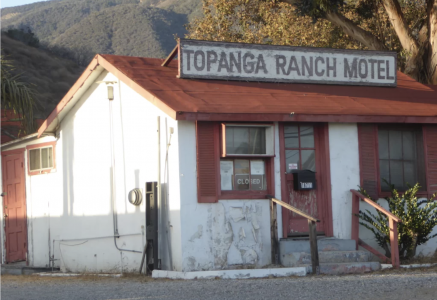
“A new concept arrived in the 1930s, the motel — a portmanteau word made out of motor + hotel. They sprang up all over, and in the early years they were usually family owned.
“A classic example of an early bungalow-style operation was the Topanga Ranch Motel. Built in the mid ’30s and once owned by William Randolph Hearst, it was one of the first Topanga-Malibu hostelries to cater exclusively to the motorcar crowd.
“We know a screenwriter who would stay at the Topanga Ranch Motel for weeks in winter. [It was] a gently decaying relic, but cheap and quiet and there were no distractions — just a TV that only received three stations on a good day. But by then, the era of the motel was over.”
— from an excellent piece in Topanga New Times, dated 11.4.22 and titled “Hotel California.” Written by Suzanne Guldimann.
Jeff & Sasha Substack: Hold Out Until Cannes
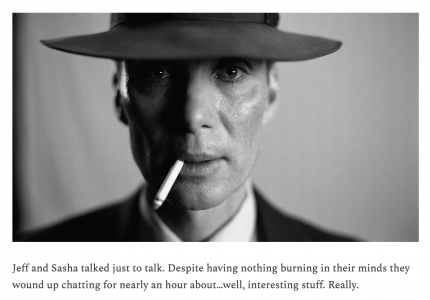
Sasha and I were chatting yesterday in a general sense, this and that and whatever. The subject eventually drifted into “what’s out there that sounds good…something that might heat up the blood?” We discussed some of the big attractions at the ‘23 Cannes Film Festival (the slate will be announced on Thursday, 4.13), and for whatever reason I forgot to mention that I’ll be submitting to both Renfield and Ari Aster‘s Beau Is Afraid that same day. I also didn’t mention HE’s most eagerly awaited pre-Cannes film, which is Matt Johnson and Matthew Miller‘s BlackBerry (IFC Films, 5.12). Anyway…

Sensitivity Editing (i.e., Censorship) for Plays
The gist of Martin McDonagh‘s recently-aired beef is that certain theatrical producers want words in his 2003 play The Pillowman, set for a revival presentation in London two months hence, so be diluted to as not to offend woke audience members.
McDonagh to BBC’s Today: “They wanted to make some words more palatable to them or what they think their audience is. It seems like governments are becoming increasingly more scared of dissenting voices,” which makes this “a very frightening time.”
McDonagh #2: Writers should “get off social media”, “stop checking the internet” and “go out and outrage.”
In other words theatrical producers are urging the same kind of sensitivity editing that has afflicted the publishing industry.
Good Shootin’
When I first saw Triple Frontier in early ’19, I didn’t process it as a comfort film. A good one, especially the second half, but not a repeater. I’ve watched it at least five or six times since. So it’s a comfort film, I guess. Except for the ending. My issues are explained within the last four paragraphs.
I was looking for a video clip of one the most vivid scenes, when a portion of a narrow cliffside trail crumbles and a poor overloaded mule goes over the side. Mesmerizing. They either created a donkey dummy and threw it over a cliff, or created the moment with exceptional CG.
Posted on 3.6.19: I was into Triple Frontier during the first half, but not exactly gripped by it.
We aren’t told very much about the five ex-commandos (Affleck’s character is sketched out to some extent — he’s fat, financially strapped, has an alienated daughter) and the general feeling is that the film is a stone skipping across the surface of a lake. Or, you know, more into treading water than actually swimming.
The key moment is when they discover that the drug lord has much, much more cash socked away in his jungle abode than expected. $250 million or something like that. If these guys could get away with $10 million each they’d obviously be doing just fine. Hell, they could make off with $20 million each.
But no — cash-strapped Affleck suddenly wants a Kardashian-sized bank account. He not only loses his mind — let’s take it all, look at this, we’re loaded beyond our wildest dreams! — but everyone else falls in line.
The problem is that Oscar Issac has arranged for a large Russian-made chopper to take them over the Andes, but all that extra dough (bags and bags of it) weighs a hell of a lot, and they find out too late that the helicopter can’t manage to clear the 11,000-foot Andes peaks with all that weight. The chopper goes down, and then, finally, Triple Frontier gets interesting.
Gripe: More than anyone else, Affleck’s character goaded the team to carry off a lot more money than they had originally planned to find, etc. Everyone went along with this, but Affleck leads the charge, urging them on.
Taking more money makes no sense as there are clear weight limits on the amount of cash the chopper can carry over the Andes. The pilot (Pedro Pascal) voices concerns about this, but they’re all so money-crazy they decide to risk it anyway.
So after Affleck dies and the others make it back safely, they decide to DONATE THEIR SHARES to Affleck’s family fund. The principal recipient is Affleck’s chubby daughter, a typically sullen teen who refuses to face life without ear buds.
I would make sure the daughter gets a full one-fifth share of the loot, naturally, but why does she get all of it? I really don’t get this at all. Affleck inspired the team to think and act in greed mode. He was the father of it. How does that translate into the fat daughter pocketing every last dime?
Statement of Values
Spoiler whiners are little babies whose sole…okay, primary concern is subject matter (i.e., “then what happens?”).
You’ve gone through college and decades of living and struggling and you still don’t understand that subject matter is oatmeal?…a thing to start with but also a form of confinement if you allow it to run things? It’s the lowest and most rudimentary form of absorption and processing that a film or streaming-drama viewer can possibly know. For peons only.
But to the whiners subject matter is their Lord and Ruler…a flag, a way of life, a Gregorian chant. To 95% of viewers, subject matter is damn near everything.
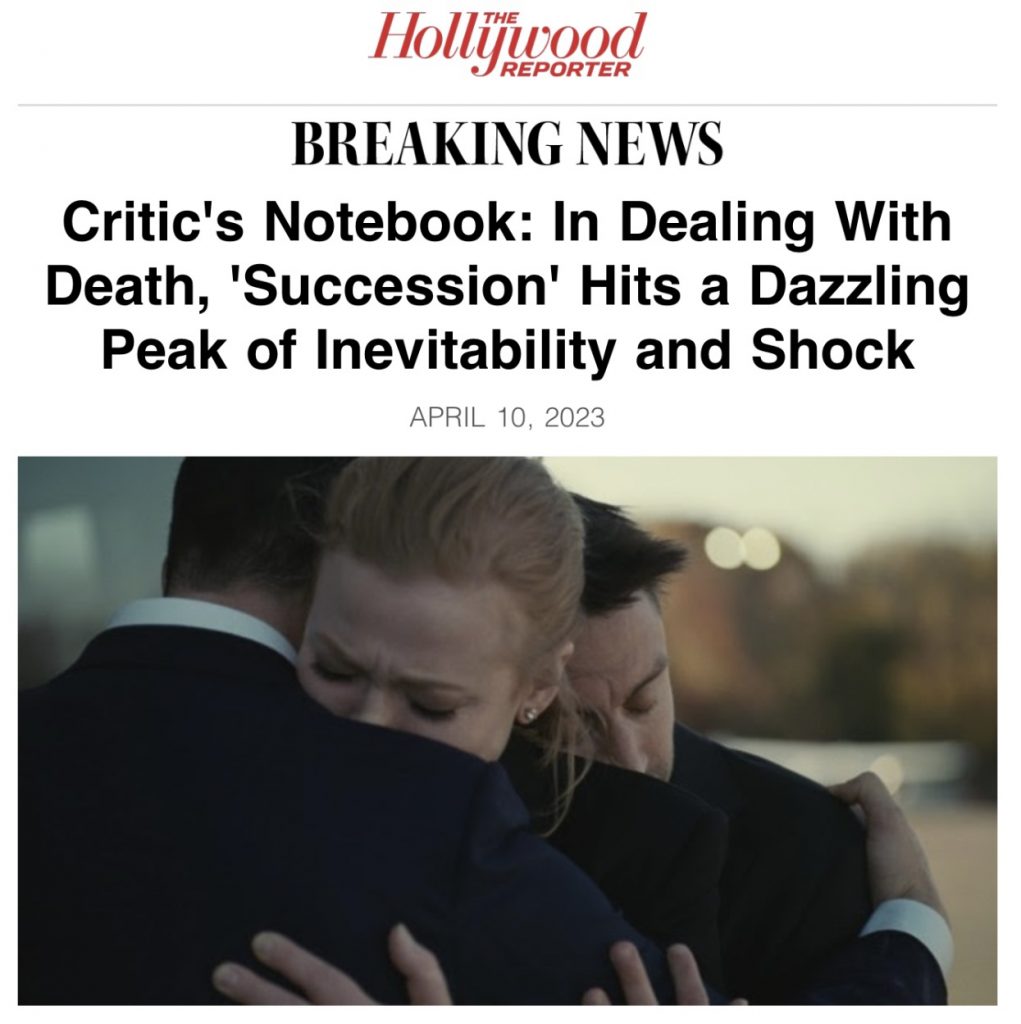
Around 11 pm last night somebody told me what had happened on Succession, and urged me to watch episode 3 straight away. Firstly I thanked them, and secondly it only whetted my appetite.
Having been tipped off didn’t affect my enjoyment of any of the elements (story, acting, dialogue, visual strategy) IN THE SLIGHTEST WAY. Do you know why? Because I’m not an infant. Because I’ve achieved a semblance of an adult perspective in my life.
A teenaged friend once spoiled the ending of Nicholas Ray’s King of Kings (‘61). Not just the crucifixion part but the resurrection stuff…all of it. I’ve never forgiven him.
“The singer, not the song”…shut up! Bastard! I don’t want to know you!
However, HE’s basic limited spoiler avoidance policy (i.e., always wait two weeks after a film opens unless everyone else has already spoiled it) remains in place. Same policy regarding shocking plot turns on extended streaming series (i.e., mum’s the word for two weeks unless it’s been spoiled by everyone else right away, in which case it’s fine to jump into the pool).
HE’s Cannes Film Festival policy is to exercise restraint whenever appropriate, but if everyone else spoils I’m not going to hold out.
Define The Term “Destined For Cult Status”
Or do I mean “mainstream kiss of death”?
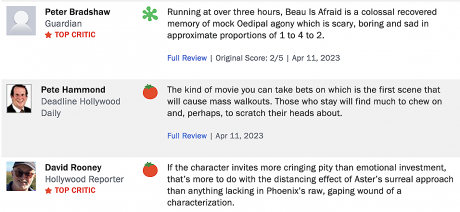
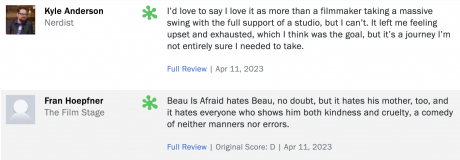
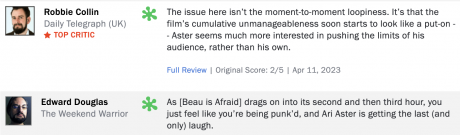
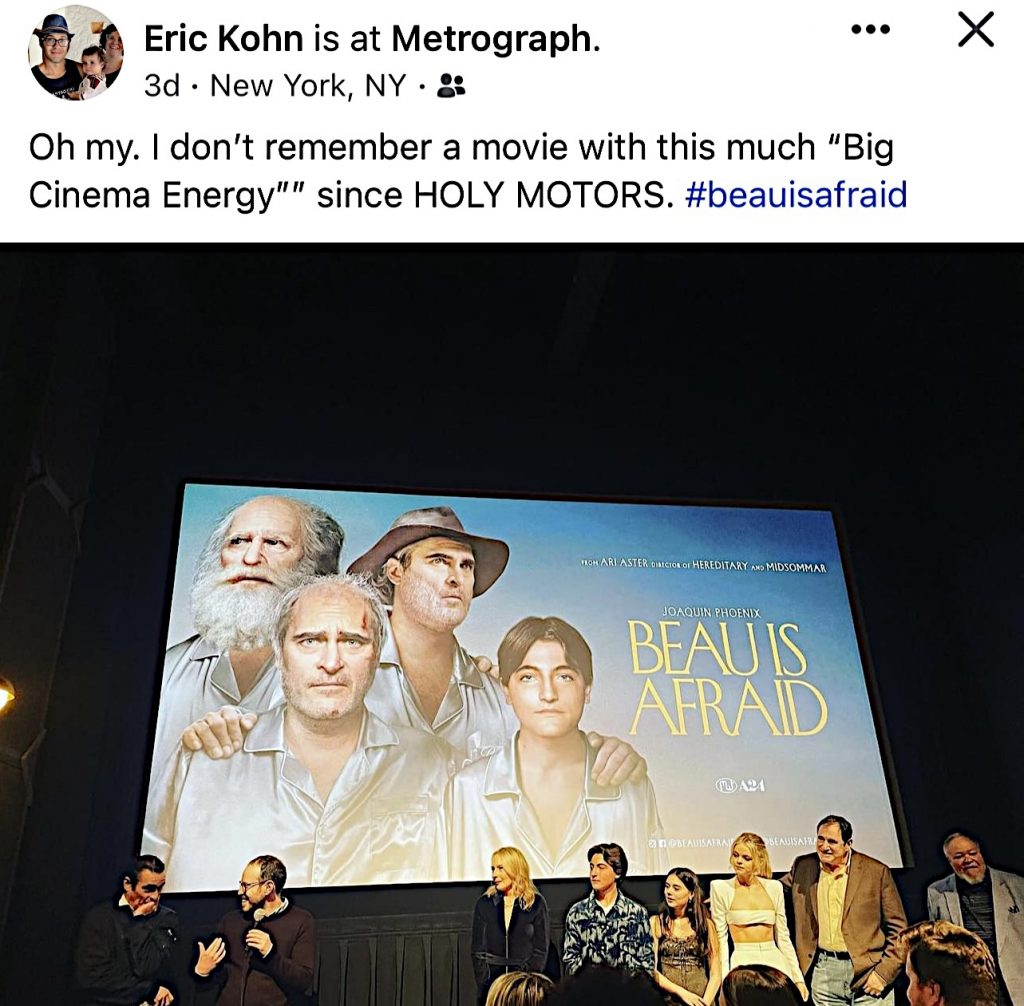
Answer: That recent Facebook post about Ari Aster ‘s Beau Is Afraid by IndieWire ‘s Eric Kohn.
If you know how Kohn assesses and writes and what his often generous reviews sometimes really signify, reading that sentence was like hearing the sound of a condemned man’s neck snapping.
Honestly? I first smelled trouble when I saw the face of Armen Nahapetian, who plays Joaquin Phoenix’s titular character at age 14 or so, in an early one-sheet. Nothing I could put my finger on, but, to paraphrase Bill Maher, I just knew.
Kohn’s self-description in his Super Mario Bros. review: “An optimist who searches for the potential of movies to thrive wherever they can”

Moment of Passage
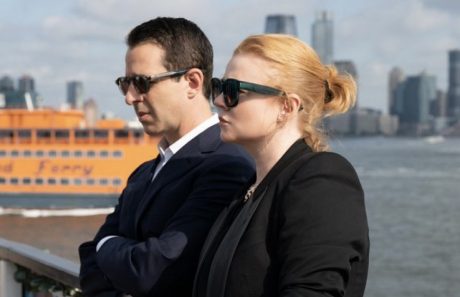
It happened last night, and I, for one, was deeply impressed by the fact that the first knock of the door wasn’t dramatized and was in fact barely shown, certainly as far as the departed was concerned.
And it really held you. It was all about awkward, anxious, dumbfounded, grieving, semi-stumbling reactions. Truly excellent writing and direction. Palpable anxiety, fascinating behavior, etc. And it was only episode 3.
Small side issue: I distinctly recall, in my early to mid 30s, feelings of trepidation and even, truth be told, horror as I began to grapple with facial puffiness (sugar and wine). It’s your body telling you to cut down on the partying and to join a health club.
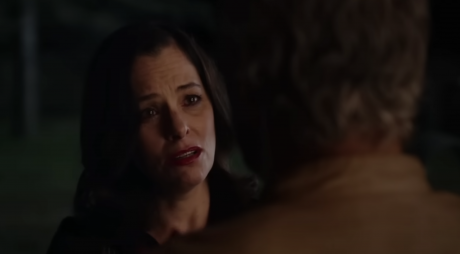
Last night was my first taste of season #4, and I’m afraid that this syndrome (and I’m not faulting) is beginning to afflict poor Sara Snook, certainly compared to her appearance over the first couple of seasons. Not a tragedy, not a felony, just saying.
“A Fruity Movie About Suffering”
All hail the late Michael Lerner, whose best performances were in The Candidate (’72 — “gimme five!”), The Postman Always Rings Twice (’81), Eight Men Out (’88, Arnold Rothstein), Barton Fink, Newsies (’92), The Road to Wellville (’94), Art School Confidential (’06), A Serious Man (’09)…what else?
Marrakech Meander
Good Marrakech paragraph, posted on 12.6.10: “If I never return to the Marrakech Film Festival it’ll be too soon, but not everything has been bad. Yes, the wifi problems have been unrelenting but everyone you run into is polite and calm and gentle to a fault. There’s apparently no such thing as an impolite Marrakech resident. (Okay, I did run into a couple of ruffians on a bike on Saturday night who tried to assault me and steal my wallet — I later named them Dick and Perry — but I pushed one of them in the chest and told them both to fuck off and then ran in the opposite direction and they were good enough not to follow, so even the thieves and the roughnecks are polite.) And there’s no indoor smoking ban. And there are no helmet laws so you can scooter down the street with the wind blowing through your hair. And the food is wonderful. And the energy in the main old-town square is so exciting and heavenly. And there are horse carts all over the city, and sometimes as you’re driving down the street you can smell horseshit, and that is a very good thing. The older you get and the more plastic and corporate the world becomes, the better horseshit smells.”
All Of Them ’66 Hotties
One year before the official beginning of the late ’60s to mid ’70s glory period…an era that some believe was ignited or sign-posted by Bonnie and Clyde in the summer of ’67…1966 happened, and that was no chump change.
To hear it from The Limey‘s Terry Valentine (i.e., Peter Fonda), 1966 was the only year in which “the ’60s” were fully in flower. There were countless manifestations — spiritual, creative — and hints of coming disturbances. April ’66 saw the famous Time magazine cover that asked “Is God dead?”, which was used by Roman Polanski during the filming of Rosemary’s Baby a year later. The following month saw the release of Bob Dylan‘s Blonde On Blonde (and the coughing heat pipes in “Visions of Johanna”) and Brian Wilson‘s Pet Sounds, and three months later Revolver, the Beatles’ “acid album” which turned out to be their nerviest and most leap-forwardy, was released.
All kinds of mildly trippy, tingly, unnerving things were popping all over.
But you’d never guess what was happening to go by the mood, tone and between-the-lines repartee during the 39th Oscar Awards, which honored the best films of 1966 but aired in April ’67, or roughly seven weeks before the release of Sgt. Pepper. Bob Hope‘s opening monologue is punishing, almost physically painful to endure. And look…there’s Ginger Rogers!
Fred Zinneman‘s A Man For All Seasons won six Oscars that night — Picture, Director (Fred Zinneman), Actor (Paul Scofield), Adapted Screenplay, Cinematography, Art Direction — and there’s no question that it still “plays”. Well acted, beautifully written by Robert Bolt. But it also feels a bit smug by today’s standards, a little too starchy and theatrical.
What 1966 films play best by today’s aesthetic standards? Certainly Michelangelo Antonioni‘s Blowup, a London-based film that completely absorbed and reflected what was happening there in late ’65 and ’66, and that wasn’t hay — the entire avant garde world was rotating around London’s musical intrigues and atmospheres back then.
The second best, I feel, was The Sand Pebbles, which contained Steve McQueen‘s most open-hearted, career-best performance.
The third finest was Richard Brooks‘ The Professionals, a crafty, ace-level western actioner that plays beautifully by today’s measure and which contains Lee Marvin‘s second-best performance (after “Walker” in ’67’s Point Blank).
And let’s not belittle The Battle of Algiers, The Good, The Bad and The Ugly, Persona, Au hasard Balthazar, Masculin Féminin and Polanski’s Cul-De-Sac…what is that, six?
Other ’66 hotties: Mike Nichols‘ Who’s Afraid of Virginia Woolf?, Lewis Gilbert‘s Alfie, John Frankenheimer‘s Seconds and Grand Prix, Milos Forman‘s Loves of a Blonde, Billy Wilder‘s The Fortune Cookie, Norman Jewison‘s The Russians Are Coming, the Russians Are Coming, Claude Lelouch‘s A Man and a Woman, Richard Lester‘s A Funny Thing Happened on the Way to the Forum, Woody Allen’s What’s Up, Tiger Lily?, Pier Paolo Pasolini‘s The Gospel According to St. Matthew, Karel Reisz‘s Morgan!, or a Suitable Case for Derangement. (12)