In all my decades of movie-obsessing, only one film has given me pause in the matter of male anatomy. Pause and a slight feeling of discomfort.
I must have been 14 or 15 when I first watched this scene from Mr. Roberts in our family TV room, and I distinctly remember saying to myself, “Jesus, you can see Jack Lemmon‘s twin gonads right through his Navy khaki pants.”
It wasn’t so much distasteful as distracting — I stopped listening to the letter that Lemmon was reading. I didn’t hear a word of it.
If I’d been directing (not sure if it was John Ford, Mervyn LeRoy or Joshua Logan shouting “action” and “cut” when this scene was shot), I would have pulled Lemmon aside and told him to duck into wardrobe and put on one of those metal jockstraps that baseball catchers wear. That or stuff his underwear with a big wad of toilet paper, Mick Jagger-style.
I couldn’t be the first person to notice this, I told myself. Mister Roberts played everywhere in 1955, and was considered family-friendly for the most part. But not this part.
HE’s all-time favorite Lemmon performances: Operation Mad Ball, Some Like It Hot, The Apartment, Days of Wine and Roses, The Fortune Cookie, Save the Tiger, The China Syndrome, Missing, Long Day’s Journey Into Night, JFK, Glengarry Glen Ross, Short Cuts, Off the Menu: The Last Days of Chasen’s (13).
…is whether or not WBHE’s Casablanca 4K Bluray (11.8) will resemble my all-time-favorite version, which is the slightly DNR-ed 2008 Bluray. If it has that clean and velvety look, fine. If it doesn’t and instead resembles the unfortunate 70th anniversary 2012 Bluray, which is crawling with billions and billions of digital mosquitoes, I will (a) be unhappy and (b) do what I can to spread the word.
I know that grain is integral to celluloid images, but I hate it all the same. Especially when it comes to black-and-white. I don’t want to know from grain, ever. Grain is a pestilence. I want clean, pristine, silvery images that look exquisite by present-day standards.
The new 4K Casablanca “was restored and remastered from a 2022 4K 16bit film scan of the best-surviving nitrate film elements. The 4K-scanned digital images went through an extensive digital restoration process to clean and repair the picture for an unprecedented and pristine ultra-high-resolution presentation. The restored images were then graded in High Dynamic Range for today’s premium 4K display experience, providing the highest fidelity in image contrast and detail retention. This work was meticulously handled by Warner Bros. Motion Picture Imaging. The original theatrical mono audio has also been newly restored as well, providing a richer and broader frequency response than previously possible.”
I think it’s fair to ask Variety‘s Clayton Davis if he’s finally seen Casablanca. If he has, fine, but he should submit to extensive questioning. If he hasn’t, he needs to be a man and admit that.
Oscar Expert (singular) stands for identical twins who are 24 or 25, and for my money they’re fairly sharp and articulate as far as their age and experience has taken them. (I still haven’t determined their actual names.) What’s interesting is that they’re simultaneously obsequious and ambivalent about The Fabelmans. Just listen.
“This all points to a collapse of Russia. All sorts of other other peripheral actions in the Russian zone of influence will be curtailed as a consequence of Ukraine.” — General Richard David Shirreff, a retired senior British Army officer and author. From March 2011 to March 2014 he served as Deputy Supreme Allied Commander Europe.
Chief Putin assassination ringleader to key trigger man [transcribed]: “Just remember that when you fire the projectile, you need to aim straight for the front left tire of his limousine…get that tire or we’ll all be in trouble. Blow that tire to shreds!”
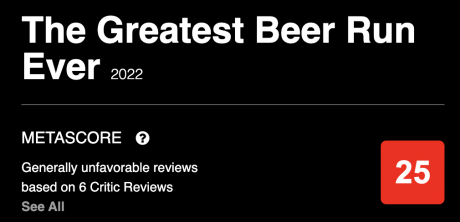
Blend the Rotten Tomatoes and MetacriticBeer Run scores and you’ve got a bracing 35%! You know what this does? It prepares people for a piece of shit, but when they go to see it and realize it’s nowhere near as bad as these scores suggest (just ask Kate Erbland!), they’ll be pleasantly surprised.
Now that we’re all up to speed on presentism, or the current industry-wide requirement that all historical films need to reflect present-tense diversity standards and enlightened present-tense attitudes, we can more readily understand why Green Book was so viciously attacked almost exactly four years ago.
Peter Farrelly‘s film was bludgeoned by wokesters because it adhered to the realm of 1962 rather than 2018. It told the story (i.e., a tour of the Deep South by African-American pianist Don Shirley and Italian-American bouncer Frank “Tony Lip” Vallelonga) according to the standards and mindsets of the Kennedy era.
In the eyes of Bob Straus and the Green Book condemnation squad, thus was the one unforgivable sin.
Casting presentism: “For the last four or five years Hollywood progressives have also insisted that all historical films have to adopt the practice of presentism in terms of casting. That means that all casts have to reflect social values as they should be in terms of inclusion and representation rather than how they actually may have been during the time of the story.”
Now that Peter Farrelly‘s The Greatest Beer Run Ever (Apple+, 9.30) has premiered in Toronto (last night at 6 pm), the scenario that I’ve been predicting all along has come to pass, or so it seems.
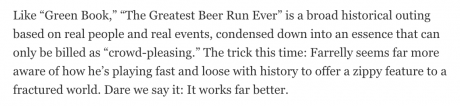
The woke Stalinist critics who did everything in their power to take down Farrelly’s Green Book four years ago have come out guns blazing against Beer Run, partly to punish Peter for winning the Best Picture Oscar despite their best efforts to prevent that from happening,
They also don’t care for the meathead mentality of Zac Efron‘s “Chickie” (Variety‘s Owen Gleiberman is calling him “the beer whisperer“) and his stupid plan to give his ‘Nam-serving buddies a beer hug.
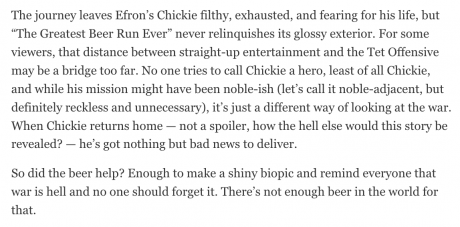
Well, from what I’m gathering from the reviews, the film doesn’t seem to admire Chickie all that much either. Certainly not by the end of the film. Because he’s a changed, beaten-down man by then.
The arc seems to be “naive patriotic idiot goes to Vietnam to show love to buddies stuck in the war machine, and gradually learns what an absolute horror the Vietnam War is and what a ludicrous and lethal lie the Pentagon is selling.” So he finally comes to see, through hard experience, what his war-protesting sister was on about in Act One.
And some viewers seem to approve. Deadline‘s Pete Hammond, for one. He was a Green Book champion also Here’s his review:
And guys like Raven Brunner #TIFF22, who said last night that The Greatest Beer Run Ever “is SPECTACULAR…a topical story set to the Vietnam War that addresses the conflict between news media & the public, & the casualties of war. Zac Efron charms as Chickie who navigates the war zone with optimism & a gag mission. #TIFF22 pic.twitter.com/61itIX5xWM
The Beer Run team was never going to get the elite critics to like this film, not with the Green Book history. Posted on 8.17.22: “A film about a New York working-class paleface with a meathead accent travelling thousands of miles to bring beer to his Vietnam War-serving bruhs in ’67 and ’68 is going to be attacked six ways from Sunday…too white, too apolitical and not guilty enough for starters.”
But something is telling me that Joe and Jane Popcorn may take a shine to it. Maybe.
Hammond: “This is the rare Vietnam film seen from the POV of a civilian, a key reason it works as well as it does.”
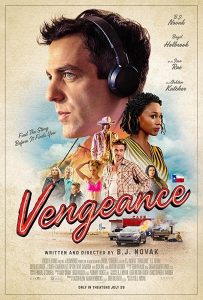
Late last night I streamed B.J.Novak‘s Vengeance (for $20 bills!) and was seriously, genuinely impressed. How the hell did the Blumhouse animals get involved with this? It’s way, way above their usual crude-horror level. And at the same time it’s a Focus Features release, and I was asking myself “what the hell happened with the marketing on this thing?” I’d barely heard of it until Sasha Stone urged me to see it yesterday afternoon.
The Texas-based Vengeance is VERY sharp and savvy, and at the same time one of those rare films with the capacity to settle down and “listen to the grass grow” (a line from Hud, another rural Texas drama) and even feel a semblance of generosity and human compassion for the lives and values of red-state primitives, which is to say folks who aren’t so appalling once you get to know them. Come to think of it I don’t just mean the Texas rurals but also Novak’s “Ben Manalowitz”, whom we also get to know in ways we don’t see coming.
This semi-dweeby 30something who’s played by the star (as well as the director and screenwriter) is a bright, low-key, entirely rational Brooklyn horndog type, way ahead of himself in some ways and at the same time on the emotionally stunted side, and what he experiences in Vengeance is part Brigadoon, part Local Hero and part…well, not quite The Long Goodbye but something that certainly flirts with that realm.
My initial assessment was to call Vengeance a culture-clash dramedy — an extremely social-media-attuned Brooklyn hipster & writer/podcaster & hook-up artist vs. more-than-initially meets-the-eye, family-anchored rurals in Bumblefuck, Texas.
Except it’s not really a “dramedy.” The satirical humor is so dry and under-stated and nuanced and even drill-bitty at times, punctuated as it occasionally is by curiously wise reflections about liberal social media perceptions and ways of living and relating that one could describe as empty or at least lacking in a smartphone-oriented sense vs. under-educated, trailer-park Whataburger Texas primitives, and delivered with a near-total absence of conventional schtick that I didn’t know where to put it.
But I knew for sure that I was watching something real and refreshing. Plus it conveys a learning curve and emotional growth on Novak’s part. And it gives Ashton Kutcher his best-written, most quietly charismatic role ever.
The problem comes at the very end when Novak delivers a surprise ending that was seemingly stolen from, as mentioned, Robert Altman‘s The Long Goodbye, and I’m telling you that it really, REALLY doesn’t work, even though Novak declares early on that he’s not a Texas-styled vengeance type of guy, which is a set-up for an ironic finale. Ben Manalowitz isn’t Shane or Charles Bronson in Death Wish, and there’s no way a guy like this will suddenly morph into an angel of moral justice…no way in hell. I would go so far as to call what I’m half-describing as a train-wreck ending, although Novak manages it throw in a few grace notes after the big surprise. There were four or five ways to go at the very end, and Novak chose the absolute worst option.
That aside (and it’s only a short bit at the very end), Vengeance is WELL worth seeing and thinking about the next day, I’m actually considering giving it a re-watch later this week. There’s no question that Vengeance, which sounds like a primitive actioner in the Mel Gibson mode, is a completely shitty title considering what it’s actually about. Whoever said “wait, let’s call it Vengeance!” should be put into a paddock for seven days and be made to suffer the ridicule of being hit with tomatoes and rotten bananas. Okay, that might be too harsh. But they should at least go on an apology tour and try to explain what their thinking was.
One small thing: Within the Texas family that Ben Manalowitz spends a fair amount of time with is a foxy airhead-y teenage blonde, played by Dove Cameron. Her character, “Kansas City Shaw”, just wants to be “famous”, she says, and for a while you’re thinking “okay, where’s this going to go?” Is she going to hit on Ben in hopes of his inviting her to visit Brooklyn? (She delivers a line early on that alludes to oral predilection.) Is she going to post Instagram videos of herself interacting with Ben or something? But nothing happens. We all like hot blondies but Novak drops her like a bad habit. There’s a second-act family feast scene at Whataburger, and we can see the back of Cameron’s blonde head, but Novak doesn’t give her a line or even a quick insert close-up. She’s part of the family but has been, in a manner of speaking, erased. A curious call.
I’ve yet to see B.J. Novak‘s Vengeance (Focus/Blumhouse) but I intend to stream it within the next day or two. This contemporary dark comedy been viewable since late July. Sasha Stone has only just watched it, and she insists that Vengeance is “one of the best films I’ve seen this year.”
Last two Stone paraaraphs: “Vengeance is the kind of movie that I could see Roger Ebert discovering on his show, back when he was alive and when he had a weekly show. People would watch it and find out about a great movie called Vengeance.
“[But today] a movie has to have some sort of platform, lots of money behind it, and some kind of hook. And this film doesn’t really have a hook. It’s just about great writing and especially some interesting observations about this moment in our history.
“Vengeance only made about $4 million at the box office. It was clearly something that was hard to sell. But in the end, my friends, take it from an old timer: great movies have a way of being discovered and rediscovered as we move through time. This one will be one to look back on years from now and see just how insightful it was about things everyone feels deep down but few will talk about in an up-front way.”
Has anyone in the HE community seen Novak’s film, and if so, what’s the verdict?
I can’t think of a single clever or irreverent thing to say about Rian Johnson‘s Glass Onion. I can only repeat that Johnson is a good egg (bright, perceptive, fast on his feet) who’s been friendly and considerate to me for years. Except now he’s a multi-millionaire, which means that the once stimulating Rian-and-Jeff chemistry has been altered on some level.
We all understand that life sometimes brings about ch-ch-ch-ch-ch-ch-changes, and that “money doesn’t talk, it swears.” Okay, not always.
We’re all (a) invested in Daniel Craig‘s Detective Benoit Blanc, (b) ready to chuckle at Edward Norton‘s perversely witty bad guy, a tech billionaire named Miles Bron, who will presumably as Chris Plummered sometime during the first two acts, and (c) prepared to identify with Janelle Monáe‘s Cassandra “Andi” Brand, a tech entrepreneur and Miles’s ex-business partner.
Glass Onion pops theatrically sometime in November, and begins streaming on Netflix on 12.23.22.
There’s absolutely no question that Damien Chazelle‘s Babylon (Paramount 12.25) is going to arrive with a huge bang at year’s end. Hell, it already has with today’s trailer (although one insider is calling it a teaser).
I’ve spoken with two people who saw a version of Babylon last March, and they both say it’s such a flamboyant, orgiastic, lavishly imagined, decade-spanning Hollywood epic of the 1920s and ’30s (i.e,, Vincente Minnelli meets Fellini Satyricon meets Singin’ in the Rain without the music) that not nominating it for a Best Picture Oscar would seem all but impossible.
You’ll notice that the main Babylon characters are quite the lively and diverse bunch, but let’s boil out some of the snow, shall we?
First and foremost, Diego Calva‘s “Manny Torres” is the lead character…the audience stand-in and neutral observer who’s prominently introduced at the film’s wild-party beginning and is also front and center in the somewhat subdued finale in 1952.
Margot Robbie‘s “Nellie LaRoy” (based on Clara Bow and in fact called CLARA BOW in a 2019 draft of the script) is the strongest or certainly the most feisty and relentless female character, and is likely to land a Best Actress Oscar nom.
The trailer is selling Brad Pitt‘s “Jack Conrad” (Clark Gable-resembling but based on John Gilbert) as a major character, but in fact it’s a strong supporting role. Jack isn’t a constant presence, and he doesn’t carry the story.
Fourthly, current attitudes are such that I’m required to point out that 1920s Hollywood (or 1920s America for that matter) wasn’t exactly known for being invested in equal-opportunity trailblazing. With a few minor if distinctive exceptions (Anna May Wong, Josephine Baker, Sessue Hayakawa, Louis Armstrong) the film industry was largely a white-person fraternity with guys enjoying the upper hand.
The trailer conveys a certain impression of a diverse demimonde (Calva plus Jovan Adepo‘s “Sidney Palmer”, a jazz musician, and Li Jun Li‘s “Lady Fay Zhu”, based on Anna May Wong) but that’s Paramount marketing doing the presentism two-step.
The facts are that Manny, who sounds like a cross between Desi Arnaz and Marlon Brando‘s Emiliano Zapata, is the lead guy (he actually becomes a senior studio exec as the story goes on) while Sidney and Lady Fay are no more than modest supporting characters. Sidney is part of the band in the opening orgy-party sequence, and then he re-appears as a minor player in a film. Lady Fay is an important figure in the opener (at one point she sings a song about eating pussy), and is prominent in a few other scenes.
Olivia Wilde is in Babylon (there’s actually a quick shot of her in the trailer), but Mr. Snitch doesn’t recall seeing her in the version he caught several months ago.