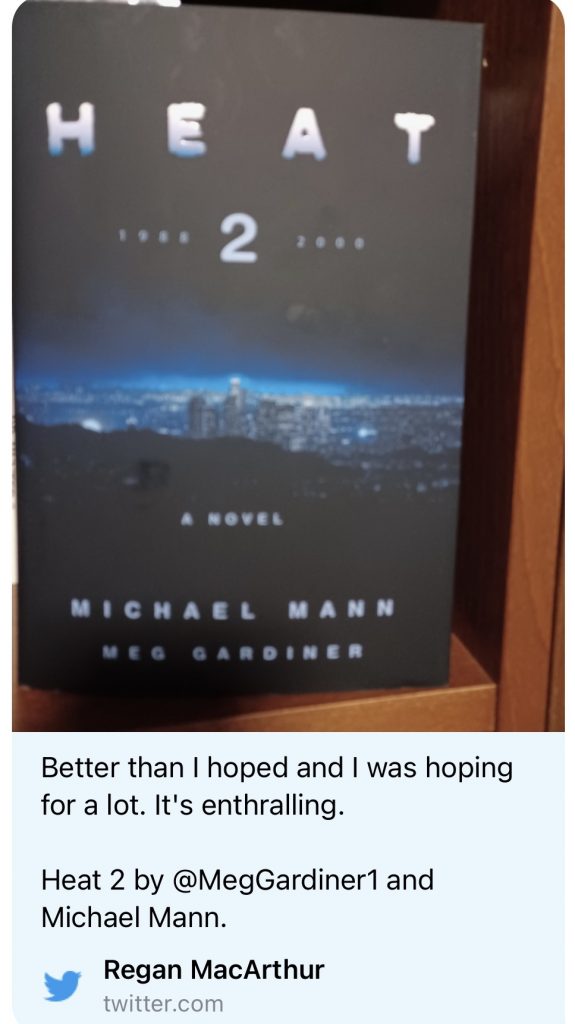
I wasn’t sure at first, but now I’m thinking I might cough up for a Kindle version of Heat 2, a prequel. Jett bought it the other day; says I can read it after he’s finished. I’d rather not wait. Update: I just bought it.

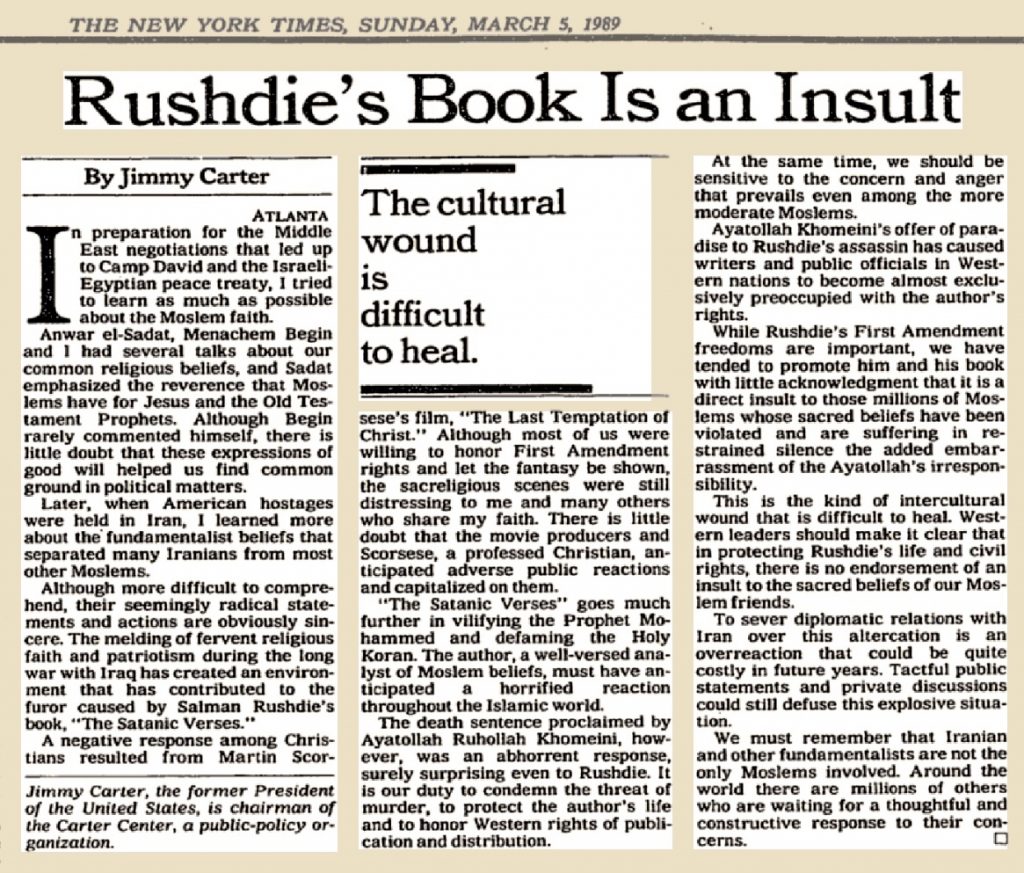
On 3.5.89 an essay titled “Rushdie’s Book Is An Insult,” authored by former President Jimmy Carter, was published in the N.Y. Times. He condemned Ayatollah Khomeini’s “fatwa” — a decree calling for Rushdie’s murder — as “an abhorrent response,” but he also cut apoplectic Muslims a little slack.
Carter compared the Islamic outrage that greeted Rushdie’s “The Satanic Verses” to the lunatic conservative Christian fury provoked by Martin Scorsese’s The Last Temptation of Christ (‘88) — an accurate analogy in that both firestorms arose out of rank fundamentalist ignorance. Except Carter said that he half-sympathized with (or at least understood in an emotional Christian-bedrock sense) the anti-Temptation mob.
Carter’s basic point was “try to see things from the Muslim perspective…if you do that their rage will become half-understandable ” His implication was that Rushdie had only himself to blame for poking the hornet’s nest.
Industry friendo sez…
It’s fairly unusual — make that highly unusual — when an apparently gifted actress comes along who qualifies as (am I allowed to even say this?) strikingly beautiful.
Like Emma Mackey, I mean — 26 years old, most recently seen in Eiffel (’21) and Death on the Nile (’22), and soon to be appreciated in Emily, an Emily Bronte biopic that will debut at TIFF ’22.
Captivating brunette actresses were standard issue throughout the 20th Century (they were often favored for their looks back then…a tactic of sexist oppression) but that aesthetic began to fade 10 or 15 years ago. Or so it seemed to me. I won’t argue about this.
To my eyes Mackey is one-third Jamie Pressly, one-third Jaqueline Bisset in her ’70s heyday and one third Lesley-Anne Down as she appeared in the ’70s.
Jodie Comer may or may not be a better actress than Mackey, but she’s cut from a similar cloth.
…but I’ve watched this San Sebastián wave smartphone video a good 20 times (probably more) and it makes me chuckle every time. It’s not the engulfing of the couple with the baby or the squat older guy with a black cap — it’s the excited Asian guy taking the footage — the wave hits him like a combination damburst and avalanche, and he goes down like a bowling pin…hilarious.
Five days ago (8.16) World of Reel‘s Jordan Ruimy posted a limited consensus view (i.e., three viewers) that James Mangold‘s A Complete Unknown, recently research-screened, is allegedly “just okay”, partly due to an opinion that it runs a bit long (two and a half hours).
The law west of the Pecos says that we should never, ever put much stock in research-screening reactions. Still, the Ruimy piece instills a slight feeling of concern. My guess is that Mangold being Mangold, A Complete Unknown may (I say “may”) be leaning toward the usual game plan of a generic biopic, and very much not in the vein of Todd Haynes‘ I’m Not There.
Way back in ’22 I wrote the following:
Remember the aggravated conflict between Steve McQueen and director John Sturges on Le Mans, the ’71 racing flick? It came down to Sturges wanting to tell a story about a race car driver…a story that would deliver some kind of emotional resonance for the audience…and McQueen wanting to make a boundary-pushing anti-movie about the racing experience. He didn’t want to invest in the usual strategies and beats — he wanted to immerse audiences in the reality of what big-time racing is really about…how it sounds and smells and makes the bones vibrate.
I’m wondering if a similar conflict has been animating the development of A Complete Unknown (previously Going Electric) since 2020.
HE to Mangold: Be Steve McQueen, be Steve McQueen, be Steve McQueen.
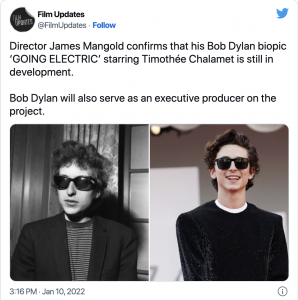
Somebody (Mangold?) wants to fashion a semi-traditional musical drama set in the early to mid ’60s…a script with a solid three-act structure and the right kind of dialogue from the right characters and so on. Timothee Chalamet as Bob Dylan (this could be the best role he’s ever had) and God-knows-who as Albert Grossman, Pete Seeger and the boys in The Band, etc.
And somebody else is saying “fuck all that…I don’t want a regular-ass popcorn movie that quote-unquote ‘tells the story’ of Bob Dylan’s musical journey between ’63 and ’65…I want a movie that feels and unfolds like ‘Murder Most Foul‘ except delivering a theme about birth rather than death and finality.
But the way to do this is to not try and fashion a traditional-feeling James Mangold film. If you make another Ford vs. Ferrari but with a story focused on Dylan vs. Folkies Who Don’t Like Electric, it’ll be a disaster.
I’m not saying don’t write a good script or don’t use it as a structural diagram or launchpoint, but you can’t make “a Mangold film”…you have to find your way into a different psychology and more of a Hoyte von Hoytema shooting style. Mangolr did quite well with Walk The Line, of course, but this is 2022 and the old Mangold ways have to give way to the new. (Or in this case to the “old”.)
Listen to me, you HE antagonist: The way to make this fucking movie is to just sink into the music, man, and shoot as the story evolves…make it feel like an acted-out Don’t Look Back…use the kind of raw, Dogma-like documentary approach that Lars Von Trier might have gone with if he’d shot Going Electric 15 or 20 years ago…make the kind of film that Luca Guadagnino or David O. Russell or Paul Greengrass might make if they were on a roll…something loose and jam-sessiony and semi-fragmented…find your way through it because you know where it’ll end up at the end so the pressure’s off.
Make a film about Dylan’s folk-to-electric transition that’s as good as Greengrass’s 9/11 movie.
To paraphrase Hal Holbrook‘s “Deep Throat,” just “follow the music.”
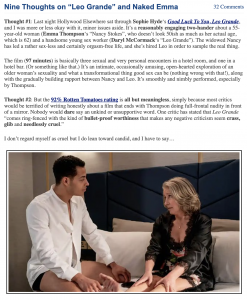
Who knows if the Academy will bend its Oscar-qualifying rule about streaming films having to open theatrically seven days prior to streaming launch, and thereby permit Searchlight’s Good Luck to You, Leo Grande to become a Best Picture contender? And, just as importantly, to allow Emma Thompson to launch a Best Actress campaign for her performance as a sex-starved spinster?
The British sex “comedy” (it’s mildly amusing here and there but definitely not “comedic”, trust me) was released on Hulu on 6.17 but became ineligible when the Academy reverted to its pre-pandemic requirements.
Thompson is fine in Leo Grande — she gives a good, pro-level performance that’s fleet and fitting — but it’s too slight of a film to launch an Oscar campaign upon. Honestly? The Thompson hoopla (generated yesterday by Variety‘s Clayton Davis) is basically about her brief full-frontal nude scene, which was acclaimed last June as a plus for the body-positivity movement, particularly as it affects older women.
In short, nominating Thompson for Best Actress would mainly be a political statement — a gesture of support for the idea of all older women leading fuller lives as well as a nod to society’s willingness to regard them as sexual beings despite their advanced years.
Here’s my 1.26.22 review of Good Luck to You, Leo Grande.
HE is horrified to read that distinguished author Salman Rushdie, whom I chatted with a few years ago in Telluride, has been stabbed at the Chatauqua Institution.
The 75 year-old was about to give a speech when he was knifed by an Islamic nutter..some Iranian loser who wanted to execute Rushdie for writing “The Satanic Verses” (’88). In ’89 Ayatollah Ruhollah Khomeini, the Supreme Leader of Iran, proclaimed a fatwā against Rushdie (i.e., a call for his murder) for his book having defamed Allah.
Cat Stevens (aka Yusuf Islam) was quoted in ’89 as being supportive of the Rushdie fatwa, but he claimed he was misquoted.
It’s highly doubtful that anyone will ever re-watch Shainee Gabel’s A Love Song for Bobby Long (‘04), a New Orleans-set relationship film costarring John Travolta and Scarlet Johansson. But I remember it vividly because of the snarky alternate title that some industry smartass coined at the time of release — Bobby Way–Too–Long.
HE is asking for other classic re-titlings of movies that ran into a brick wall — parody titles that in some cases became as well known as the originals.
The fact that Steve Martin “went through” an impressive line of hot, classy numbers in the ‘80s and ‘90s (which I also would have done with absolute sincerity and relish if I’d been in Martin’s shoes) is common knowledge — Linda Ronstadt, Bernadette Peters, Victoria Tennant, etc. But I’d completely forgotten that Martin was deeply involved with poor Anne Heche between October ‘94 and early ‘97, and that it ended when she dumped him cold for Ellen DeGeneres. That’s the legend, at least. Things were probably winding down of their own accord before Heche’s historic get-together with DeGeneres at the March ‘97 Vanity Fair Oscar after-party.