Critical Mass

Critical Mass

Is there anyone out there looking forward to a slew of 9.11 movies next year?
Okay, maybe “slew” isn’t quite accurate, but there are at least two solid 9/11 features in the pipeline and there’s a third one trying to finalize a script and get rolling, and they’re all funded by major studios. Plus there’s an ABC-TV miniseries and maybe one or two others looking to commemorate (i.e., cash in on) the 5th anniversary of that nightmare, and all but one is slated to open in mid to late ’06.
And if one of these is truly exceptional, people will naturally want to see it. But how much of an appetite is really there for the idea of tripping back to 9.11 time and time again with a bag of popcorn in your lap?
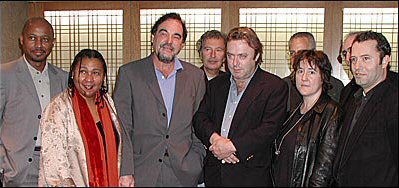

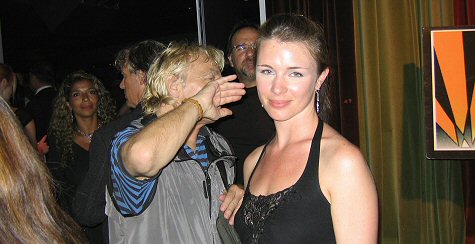
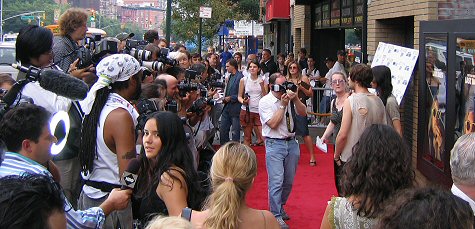
Oliver Stone, Christopher Hitchens, Robert Shaye and others before Alice Tully Hall discussion panel held roughly three weeks after 9/11/01.

Yesterday I asked some friends about the market for these movies and the general mood out there, and their responses are summarized in a story that follows (i.e., the one after the next one). But before you wade into this…
Hasn’t the extensive news and documentary coverage of this nearly four-year-old tragedy already captured the horror and human drama elements pretty thoroughly? What can a movie be expected to bring to the table except to dredge it up all over again with actors and scripted dialogue and CG recreations?
And why are all these 9/11 movies being conceived from the same patriotic and (can I finally say this?) in some ways simple-assed point of view?
< ?php include ('/home/hollyw9/public_html/wired'); ?>
The three tenets of this view are (a) it was an absolutely horrible day, (b) some people responded to the horror with selflessness and amazing heroism, and (c) the Al Qaeda terrorists were motivated solely by the will of Satan, and the U.S. had nothing to do with provoking them in any way, shape or form.
This view is so politically dominant that Oliver Stone, a guy who knows better, not only bailed on trying to make a 9/11 movie that sounds far less rote and much more inquisitive, but agreed to direct what sounds like the biggest mainstream 9.11 sentiment film of them all.
A little over two years ago Stone hired screenwriter John Leone to write a movie about domestic terrorism called Jihad — a thriller that would have depicted the 9/11 horror in the first act but then developed a plot about an attempted nuclear-bombing of Manhattan by a renegade Al Qaeda terrorist.

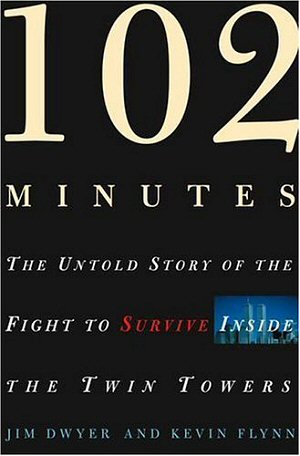
If there is, as I suspect, limited interest in these films, does this put at least a temporary kibosh on other simmering 9/11 projects? Like, for example, that developing adaptation of 102 Minutes , the best-seller by Jim Dwyer and Kevin Flynn that focuses on the stories of people who were inside the twin towers that day?
Sony-based producer Mike DeLuca hired Shattered Glass director-writer Billy Ray to turn 102 Minutes into a screenplay last March or thereabouts. DeLuca didn’t comment about Ray’s script, but he wrote this morning and said…
“We don’t consider ourselves in a race, and we strongly feel that we are dealing with an as-yet-untold story about the events of that day in New York, a story that only needs to be told the right way…that to put time pressure on something so delicate and sacred would be a blasphemy, and Sony feels the same way.
“To reduce this subject matter to a race between Hollywood movies is wrong-minded and plain wrong to do. This isn’t some summer nonsense about asteroids coming to earth or the like. This all HAPPENED, and it needs to be treated with RESPECT.
“We’re going to make it when it’s right, and the other films have nothing to do with how and when we arrive at [knowing] when it’s right.”
Okay, sure…but DeLuca and Sony are in a game of providing movies that people will want to pay to see, and when you’re the third theatrical 9/11 movie and with people already writing in the press about matters of taste and how soon is too soon and how much is overkill…
I think there’s only one way DeLuca can win this one, if he winds up making this film, and that’s for the first two films to be generally regarded as pretty good but not great, and for DeLuca’s film to be spellbinding. No matter how you look at it, he’s up against it.
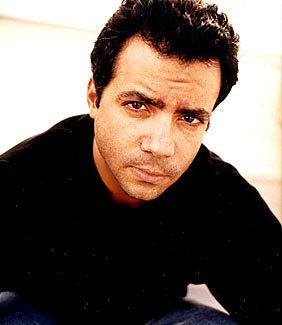

102 Minutes producer Michael Deluca

The two ready-to-go 9/11 features are (a) Oliver Stone and Paramount Pictures’ still-untitled project about the two Port Authority cops who were buried under the rubble of the collapsed World Trade Center towers, and (b) a just-announced feature called Flight 93 for Universal that Paul Greengrass (The Bourne Supremacy, Bloody Sunday) will direct and Working Title’s Tim Bevan and Eric Fellner will produce.
So far Michael Shamberg and Stacy Sher and screenwriter Andrea Berloff are the primary auteurs on the Paramount project. Stone came on as a director-for-hire and is widely presumed to have done so as a career-repair maneuver in the wake of the disastrous reception to Alexander.
Then again, you can bet this film will walk, talk and rumble like any other Oliver Stone film after all is said and done. How can he shoot this thing without delving into the surreal? “Real” was captured by a thousand video cameras that day — a filmmaker worth his salt has no choice but to go someplace else.
The buried-under-rubble project will begin filming in October in New York, and will probably hit screens sometime in late `06.
The Greengrass film is about the hijacked flight that crashed in rural Pennsylvania on 9/11, most likely as a result of passengers overpowering the Al Qaeda hijackers, who intended to slam the jet into a target in Washington, D.C. — either the White House or the Capitol building.
The $15 million film, which will run 90 minutes in “real time” (i.e., the actual time it took the flight to hit Pennsylvania terra firma after takeoff), will begin production on or about October 1st and will wrap before the end of the year. It could be released as early as next summer.
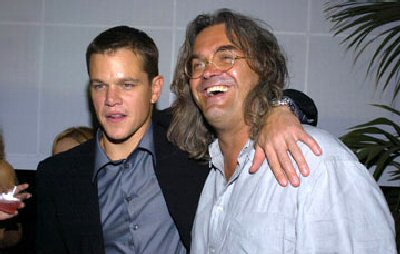

Matt Damon and director Paul Greengrass, apparently (but not necessarily) at the premiere of The Bourne Supremacy, which they both contributed to significantly.

There are three TV projects are in the works, according to Variety, including an ABC miniseries which is starring Harvey Keitel as FBI terrorism expert who was killed in the 9/11 attacks.
And you can bet your bottom dollar than all these projects will wind up saying, in effect, “sad, brave America…a morally decent country attacked by demons..such a godawful day but people were heroes,” etc.
To which anyone would say, yes, yes, it was all that and more, but these impressions have been conveyed over and over in this and that documentary and in tons of books and magazines already.
As one anonymous screenwriter told me on Tuesday, “The 9/11 tragedy has been so overexposed, so written about, so commented upon…but it was five years ago and the national mood has moved so far beyond that.”
In other words, isn’t it time for a bold filmmaker or two to take what happened and move beyond the factual and say something else?

No-Risk Approach

Oliver Stone, one of the few guys out there willing to call a spade a spade, wanted to be that brave filmmaker. Four years ago he had an idea for a drama that would have had 9/11 influences but would have taken things in a more hard-edged, Battle of Algiers-like direction than the rescue movie he’s about to start shooting. But it wasn’t in the cards.
A couple of years ago Stone arranged for a project called Jihad — a thriller about terrorism that used 9/11 merely as a first-act incident — to be written by John Leone (Tough Enough ). Leone is a screenwriter and playwright who’d worked for Stone on a script called Mexico as well one for producer Michael Fitzgerald and Sean Penn.
Leone’s work on Jihad was paid for by Intermedia, the Alexander producers. But then Alexander tanked and Stone’s confidence appeared to weaken. A former associate says, “After Alexander bombed last November, Oliver’s feelings about Jihad were basically, ‘I can’t do this, I’m not going to do this.'”
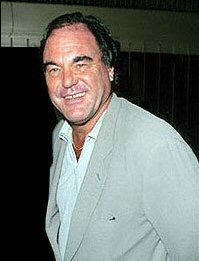
Stone didn’t return a call I made about this on Tuesday, but on top of his acknowledged suffering about the failure of Alexander he most likely concluded he didn’t have the power to push through a provocative 9/11 film in the wake of the biggest tank of his career, particularly in view of…here I am writing this again…Hollywood’s increasing reluctance to finance films with any kind of pointed political content.
Between other fascinating off-the-cuff thoughts he shared during a panel discussion in Manhattan in early October ’01 about Hollywood practices called “Making Movies That Matter: The Role of Film in the National Debate,” Stone outlined the rough idea for Jihad.
“I’d like to do a movie on terrorism,” Stone said to the packed house. “It would be like The Battle of Algiers in which you’d just go in and show how it works. And it would be a hunt — people looking for them [the terrorists] while they’re about to do this. And perhaps it’s an old formula, but if it were done realistically without the search for the hero, which is often required, if could be a fascinating procedural.
“If it’s well done and real and accurate, you would see the Arab side, you’d see the American side….people will respond and they will go. I don’t buy this thing that everybody just wants to see Zoolander.”
Leone’s script is about “an Al Qaeda guy who is supposed to participate in 9/11 but doesn’t…he misses his assignment and goes on the run. It’s more like a Kubrick comedy about terrorism. It shows exactly how easy it would be to perform a really serious terrorist act…the purpose is to wake people to something out there that’s really dangerous.”


Scene from Gille Pontecorvo’s The Battle of Algiers

Another source familiar with Jihad says it’s about “an Al Qaeda terrorist living in San Diego [and] he’s smuggling a nuclear weapon into the U.S. and planning to blow up New York…it’s a very hard-hitting, very edgy, very political thriller.”
The odd thing is that Stone pretended to be ignorant about this project when I raised my hand and asked about it during a public interview he did with director Rod Lurie at the Los Angeles County Museum of Art last January (or so I recall — it may have been February).
I didn’t know about Leone’s script at the time, but I had heard Stone riff about the Algiers-like thing at the New York discussion and thought it sounded like a cool premise. And Stone said he didn’t remember anything about it and Lurie moved on to the next questioner.

Aristopundits

I asked a bunch of journalist, studio exec, producer and screenwriter pals what kind of interest they sense is out there for a run of 9/11 movies, and whether reliving a real-life nightmare in movie-ish terms is any kind of desirable. And they said…
“Frankly the best 9/11 film to date is The Barbarian Invasions. Why? Because it contained an actual shot from 9/11 — a low-angle, surprisingly close piece of video footage of one of the planes ramming right into one of the towers, quite different from the ones we’re most familiar with.
“The simple fact of the matter is no motion picture recreation can beat 9/11 itself. It’s like preferring ‘Beatlemania’ to the Beatles. Why pay for a recreation after you’ve seen the real thing?
“Of course there’s the option of making Costa-Gavras style drama about the connections between the Bush and Bin Ladin families, but I doubt anyone is interested in that.” — David Ehrenstein, Los Angeles film critic and essayist (L.A. Weekly, et. al.).
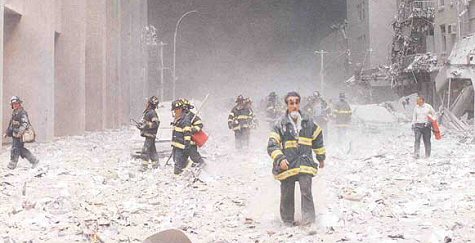
“I would say that five years seems to be the threshold for portraying a national tragedy on film. Look to The Deer Hunter, I suppose, or the Manson TV film. The tragedy has to become history in order for it to be exploited. I would say that audiences will allow filmmakers to exploit history, but not tragedy.” — A name-level director-screenwriter who asked for anonymity.
“People don’t want to be toyed with. They don’t want [this tragedy] to be exploited. They don’t want to see Leonardo DiCaprio hanging off the edge of the North Tower.” — Jim Dwyer, New York Times reporter and co-author of 102 Minutes.
“People will pay to see a movie they want to see, regardless of 9/11. Convince them in ads that it is a good movie and you will open. Fail to rise above the `gimmick’ in a way that can be made clear in marketing and people will buy tickets for Fantastic Four II instead. No one NEEDS a 9/11 movie. And any drama in theaters is fortunate to hit the $60 million mark, which has been unfairly held up as a [measure of] failure for Cinderella Man.” — David Poland, Movie City News.
“I think it’ll be like any of the showdowns where people try to produce nearly-identical pictures. Hype will win. The film that has the best hype — looks the best, that has the best pedigree, is sold most confidently by its respective studio — will win. It might coincide with quality and it might not. That’s not really the point.
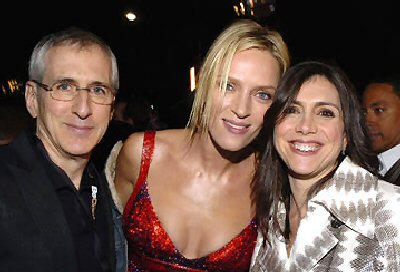

Producers Michael Shamberg (l.) and Stacy Sher (r.), the duo behind the Oliver Stone buried-under-rubble 9/11 film, flanking Uma Thurman.

“I’m willing to bet that Greengrass and Stone will make very good pictures based on what we know already. Greengrass has proven that he has an eye for this type of material with Bloody Sunday. Shooting that sort of emotionally volatile drama on that airplane… how can that not play well to an audience? He wants to improv, he wants to use a handheld camera… this one sounds like a heck of a movie, no matter what the subject.
“And I think Americans are going to have a powerful emotional response to this in theaters if Greengrass pulls it off. When the Americans rise up and stop the terrorists, you’re going to see people applaud in theaters and yell and get involved.
“Stone’s not making a political picture if he sticks to the script he’s got right now. He’s making a film about ‘the unappreciated heroes,’ which is the exact right move for him to make to help re-establish himself. If he made a kooky conspiracy picture about 9/11, I think the audience would never forgive him. Not yet, anyway.
“It’s way too soon to try and get people angry. Right now, it’s about showing us the faces of the heroes of these tragedies. It’s about trying to make us feel better about the people who were involved.
“I think there’s the chance that audiences will reject the films outright… but I doubt it. If the hype is right, they’ll be there. And that’s what will win this race, and I’m betting on Universal [in this context]. I think they’re better at opening their `big’ pictures that Paramount is, although with things so up in the air at Paramount, it’s hard to tell exactly who will be in charge of selling this one right now.
“It all depends on what they’ve got. If they’ve got a genuinely great angle on the tragedy, something unique and human that they can sell as a visceral event, then I’d say keep going. If it’s just another 9/11 movie, then they need to consider the competition
carefully.” — Drew McWeeny, Aint It Cool News.
“Frankly, I don’t think this is an answerable question. The marketplace decides how much is too much – all else is personal opinion. William Petersen thinks three CSIs is too many but CBS feels otherwise…and so does the viewing public.
“Go back to 1988: Vice Versa bombed, Like Father, Like Son bombed, and then Big opened and became a monster hit. Obviously, #3 wasn’t harmed by the stench of the first two.
“And Deep Impact didn’t hurt Armageddon six weeks later. And the constant stream of lame-brain Ben Stiller comedies hasn’t reached burn-out yet. And so on and so on.
“Thus, each 9/11 film will be judged on its own merits and attended accordingly. If we could predict the future, we wouldn’t be here — we’d be at Hollywood Park. — Major Studio Exec who asked to be nameless.
“I think it is fucking brave to be making these 9/11 movies. And it’s all quality producers making them, which is maybe why they are the top producing guns. Who knows if these movies will do business, but that’s not really the (artistic) point. Remember when no one would make Vietnam movies? Then we got Go Tell the Spartans, Platoon, Deer Hunter and I’m sure others I’m forgetting about that were excellent and provocative.

“Good luck to all of them. I’m proud to know Tim, Eric, Michael and Stacey, and I wish them well. I may not go to the movies as I am still resistant to those images, but I’m sure time will change that.” — Jonathan Dana, producer.
“I’d be very concerned if I had the third of any movie type, be it 9/11 or `a girl and her horse’ or flight thrillers or whatever. I probably wouldn’t make the third movie about this subject, though they all sound cool in their own way.
“Personally, as someone who lost a friend in the WTC, I don’t especially want to spend two hours reliving something that is still more vivid than any movie I’ve ever seen. My guess is the general public is in no rush to see this stuff on screen either. I understand the race between studios in town, but in the big picture (aka ,middle America) I’m not sure the public is clamoring for this stuff at all.
“Also, any 9/11 movie that even has a whiff of liberal bias is going to be torn apart by watchdogs on the right well before it hits theaters. I see a lot of risk in this new subgenre, just on concept alone. Keep in mind [that] most folks go to the movies nowadays to get away from the heavy shit in life. Getting them to shell out $10 bucks to relive the heaviest shit in any of our lifetimes will be tough, in my opinion.” — Another Studio Exec who asked to be nameless.
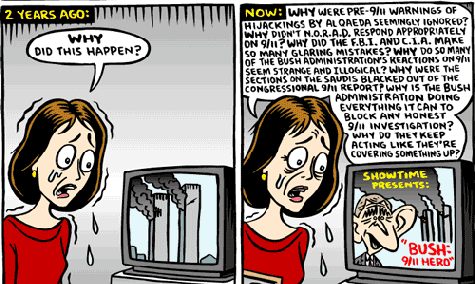
“As far as I’m concerned, a little goes a long way. To the degree that the unfortunate events of 9/11 have already been exploited to death by the Bush administration, and demeaned beyond belief by print and TV coverage, I don’t look forward to another onslaught.” — Peter Biskind, author, “Easy Riders, Raging Bulls,” “Down and Dirty.”
“Hollywood and indie filmmakers were doing Vietnam movies even when they weren’t overtly or specifically about Vietnam — even when they thought they were avoiding Vietnam, they were somehow acknowledging its effects.
“So far, the most imaginative post-9/11 movies made at the Hollywood level are War Of The Worlds, The Terminal, David Mamet’s Spartan and Zack Snyder’s remake of Dawn of the Dead. None of which is officially ‘about’ 9/11 in any explicit, one-to-one way.
“Which isn’t to say there can’t be any good movies dealing directly and realistically with 9/11, just that sometimes an oblique approach frees a filmmaker’s imagination, freeing him/her to deal with the world in a rawer, more instinctive way, without fear of giving offense.” — Matt Zoller Seitz, critic, New York Press.

Grabs
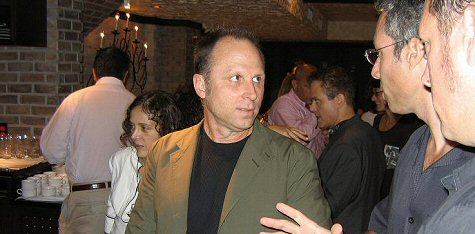

Picturehouse chief Bob Berney schmoozing it up at a journalist breakfast held at Abbacatto on Tuesday, 8.16. Journalist Sheri Roman is to the left; New York Post critic Lou Lumenick is the guy in the rear with his back turned. (He quickly turned and went over to the serving table for more French toast when he saw me get my camera out.) Berney said that Picturehouse’s The Notorious Bettie Page, directed by Mary Harron and starring Gretchen Mol, will play Toronto
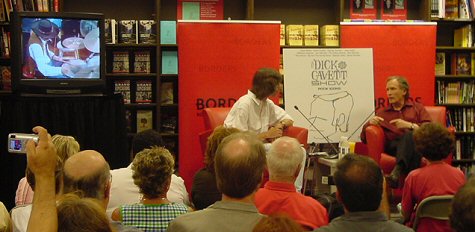
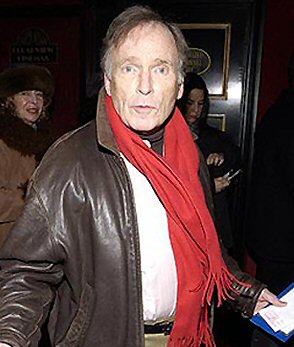
Dick Cavett (r.) being interviewed during appearance at Borders Books at Warner Center on Tuesday evening, 8.16, 6:35 pm, to sign copies of new Shout! Factory DVD “The Dick Cavett Show: Rock Icons.
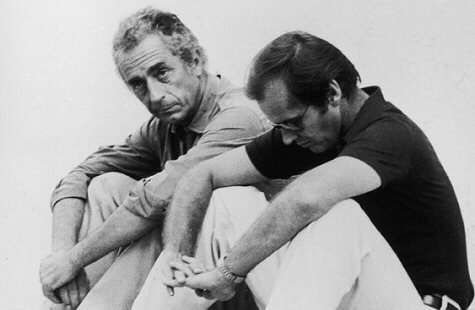
Michelangelo Antonioni, Jack Nicholson during filming of The Passenger, the 1975 semi-classic that Sony Classics is bringing into theatres prior to a DVD release.

Union Square subway underground, R line downtown — Monday, 8.15, 11:20 pm.

Twin towers of the Time Warner center at Columbus Circle.

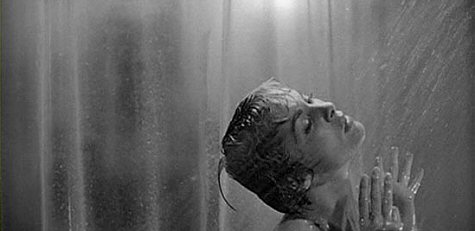
There’s always been something really penetrating about this shot, and I’m not just double-entendre-ing. I’m talking about the damp silvery beauty of the tones in this shot…about the indistinct ghostliness of the guy behind the shower curtain and how Janet Leigh seems so vulnerable and yet so exquisite and glistening and shagadelic.
Eat Me

Eat Me

Here we go with another sad-irony weekend at the box-office…
The big openers are Four Brothers (spirited action crap), Asylum (British wife self-destructs from hunger for crazy sex with an emotionally unstable asylum inmate), Deuce Bigalow: European Gigolo (simian-level geek-sex comedy), The Great Raid (passable, historically-invested World War II heroism drama), Pretty Persuasion (cynical time-waster about a pair of soulless manipulative high-school heathers) and The Skeleton Key (disposable southern horror crapola).
And oh, yeah…Werner Herzog’s Grizzly Man (Lions Gate, limited), for which internet ads aren’t even being composed because no one wants to stick their neck out.


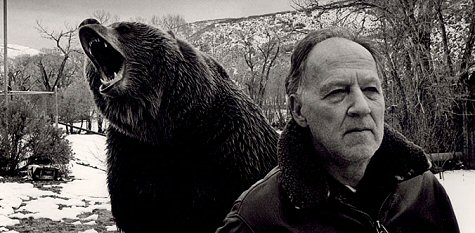
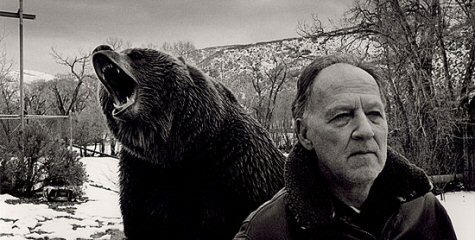
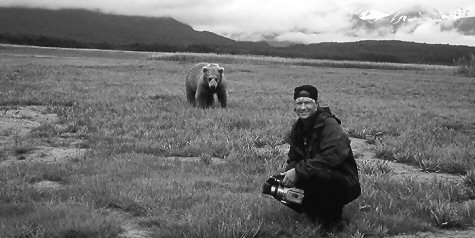
Timothy Treadwell during one of his many Alaskan taping sessions, in a monochrome still from Werner Herzog’s living-color Grizzly Man.

This riveting doc is, of course, the best new film of all…and it’ll probably end up selling the smallest number of tickets (which will be only partly due to the number of screen it’s showing on). Of all the newbies, this is the one least likely to leave you feeling burned or under-nourished. But don’t let me stop you….Deuce!
It may not sound nourishing to involve yourself in the fate of a guy who got mauled and eaten by a grizzly bear but…
It happened less than two years ago in the Alaskan wilderness to an oddly brave, vaguely-loony former boozer named Timothy Treadwell, 46. He had become known in naturalist circles as a guy who’d gotten into communing with grizzly bears on their native turf and had published a book about his exploits (“Among Grizzlies,” co-written with Jewel Palovak) and landed himself a guest slot on Late Night with David Letterman, etc.
< ?php include ('/home/hollyw9/public_html/wired'); ?>
And it all ended like that because a certain bear was hungry and didn’t care and just charged right over and slashed and tore into Treadwell and then got down to business and started biting in and chowing down.
And then he moved onto Treadwell’s girlfriend, Amy Huguenard, who was cowering in a nearby tent when it happened and for some reason didn’t run.
Guys like Hideo Nakata and Wes Craven dream up and manufacture horror presentations, but all their films put together are spit in the wind compared to the blind shrieking agony of what Treadwell and Huguenard endured in their final minutes.
Nature is not always sweet and calming, Herzog is telling us. It is often beautiful but it is what it is, and woe to the man or woman who expects it to behave according to their own neurotic imaginings.
Most of the Grizzly Man is composed of Treadwell’s videos, and they’re a fascinating window into all sorts of realms…not the least of which is Treadwell’s wacked but serene psychological state during his bear face-offs.


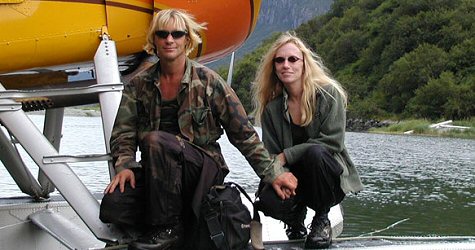
Timothy Treadwell and companion Amy Huguenard

“They’re challenging everything, including me,” he says at one point as a couple of grizzlies prowl around nearby. “If I show weakness, if I retreat, I may be hurt, I may be killed. I must hold my own if I am going to stay within this land. For once there is weakness, they will exploit it…they will take me out, they will decapitate me… they will chop me into bits and pieces.”
But Treadwell’s camera time with the bears was about proving to viewers (as well as himself and maybe God) that he was nature’s Exception Man…the guy who so loved and understood grizzlies that the usual laws and likelihoods didn’t apply.
Herzog has been drawn his entire life to stories of men who dig into their souls by traveling to exotic dangerous places and searching for something ecstatic or obliterating…or both.
Treadwell is cut from pretty much the same cloth as that manic 16th-century explorer in Aguire, the Wrath of God or the opera-loving fanatic in Fitzcarraldo (both played by Klaus Kinski) or that helium-balloon guy, Dr. Graham Dorrington, who was recently profiled by Herzog in The White Diamond.
Herzog’s documentaries, which he’s been making since the early `70s, are always extra-personal, intense and down to the marrow. Check out his authorized site or do a little reading about the guy, especially if you’re just discovering him. He’s a madman in the best sense of that term.
A friend who’s had dealings with Herzog says he’s not especially nice and is in fact an obstinate manipulative prick….whatever. Very few artists who are heavy drill-bitters are sweethearts. I will never forgive deliberate cruelty, but otherwise I believe in cutting artist eccentrics all the slack in the world.
I obviously can’t prove that Herzog will be one of the few filmmakers that people will speak of in hushed respectful tones 100 or 200 years from now, but I’m fairly certain of it.


Werner Herzog during last January’s Sundance Film Festival,where Grizzly Man had its U.S. premiere.

The thing about Treadwell is that his life only started to come together when he began to seriously invest in something greater than himself, and yet, paradoxically, at the same time began to celebrate an imagined sense of himself…when he began to invest in performance art that portrayed the power of his personality and sensitivity to this corner of nature.
There is arrogance and foolishness in what Treadwell was doing in the Alaskan wilds, but also a kind of serenity. Herzog knows nature can be savage and unforgiving and that only fools risk their lives to prove otherwise, but he also regards Treadwell as a kind of kindred spirit, or at least treats him with understanding.
I still say this is finally a movie about a meal, and that viewers of the Grizzly Man DVD should be allowed to sample the horror straight-up.
I’m referring to that audiotape of Treadwell and Hugenard suffering their last…the one that Herzog is shown listening to in Grizzly Man but doesn’t share and in fact recommends, on-camera, that it be burned. That is nothing but showmanship on Herzog’s part. I don’t believe the sensitivity angle for a second.

Repent

Leonard Cohen is coming to the Toronto Film Festival. And I don’t just mean that Lian Lunson documentary about Cohen called I’m Your Man. I mean Mr. Zen-Cool himself.
Or…how else can I put it?…Mr. Former Buddhist Monk who couldn’t quite handle the austerity thing with the robes and seclusion and just had to go back to wearing suits and shades and inhabiting the persona of that guy who wrote “Susanne” and “Everybody Knows” and “I’ve Seen The Future, It Is Murder.”
Falco Ink is handing interview requests, if you’re so inclined.


Leonard Cohen

Cohen, architect Frank Gehry and stoner-comedian Tommy Chong are among the subjects receiving documentary attention at the festival, which unspools September 8th through 17th.
The Gehry doc, Sketches of Frank Gehry, was made by director Sydney Pollack (The Interpreter, The Firm). I love Gehry’s work, as far as I know it. Director Phillip Noyce, a friend, lives in a very cool Gehry creation on Melrose Avenue.
Josh Gilbert’s A/K/A Tommy Chong will focus on Chong’s bust and imprisonment for selling bongs online.

Bass Hail

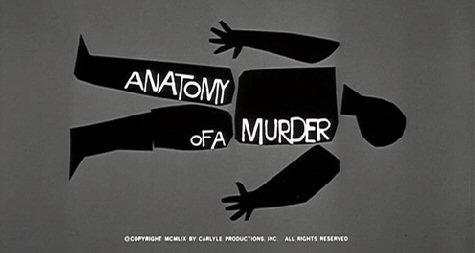
Here’s my idea of a must-visit site — a showcase for the work of the great Saul Bass.
If you don’t know this guy, you oughta. He’s the main-title-sequence designer who gave birth to all those iconic visual concepts for all those cool ’50s and ’60s Otto Preminger films (Bonjour Tristesse, The Man with the Golden Arm, etc.) as well Psycho, Spartacus and so on.

It doesn’t have downloads of the actual credit sequences, but it lets you click along on each one and savor the still images as they were presented on film. There are also a couple of essays about Bass’s work.
Congrats to website creator-editor Rumsey Taylor, editors Matt Bailey and Leo Goldsmith, and contributing editors Thomas Scalzo, Beth Gilligan and Rich Watts.

They Live!

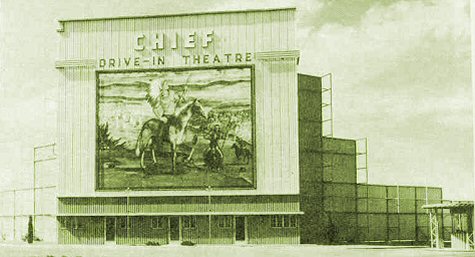
“There are still drive-ins, Jeff! I’m sure you were speaking in general terms and not meaning to proclaim their utter distinction. But as I pointed out in my sidebar on drive-ins in this week’s Entertainment Weekly, there are still over 400 in the U.S., representing about 600 screens.
“That’s a pretty serious comedown from 4,000-plus at their peak, obviously. And it’s mostly a small-town phenomenon at this point, since the land was too valuable in bigger cities for these lots not to become Walmarts. But there are plenty of small bergs across America where the drive-in is the only place in town to see a film.
“And plenty of big cities still have one or two — including L.A., which has the Vineland in the City of Industry and, a little further out, the Mission out in Pomona/Montclair (both four-screeners).

“There are still those of us who look at a trailer and think, ‘Probably sucks… but it’d be fun at the drive-in,’ then make good on that.
“Right now I’m in Massachusetts and I’m considering going to the Northfield Drive-in near the Mass./New Hampshire border to see The Dukes of Hazzard a second time, just because I love the experience and Dukes is a quintessential ’70s-style drive-in movie, at least for someone like me who grew up on Dirty Mary, Crazy Mary and other car-crash/chase films in the great outdoors.
“But Four Brothers? I don’t know if even a night under the stars would be worth braving something that smells from that far away.” — Chris Willman
Wells to Willman: I haven’t driven by a drive-in and seen a movie playing in the darkness in I don’t know how long, which is why they seem dead to me. But I’m glad to hear there are 600 or so still kicking. Four Brothers is first-rate crap. The Dukes of Hazzard isn’t crap — it’s gas.

Lincoln Ford

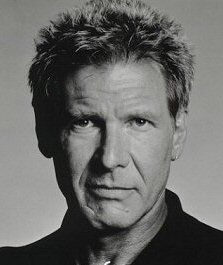
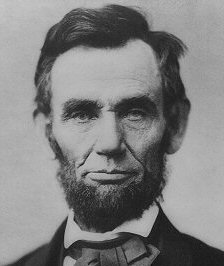
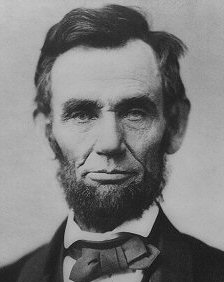
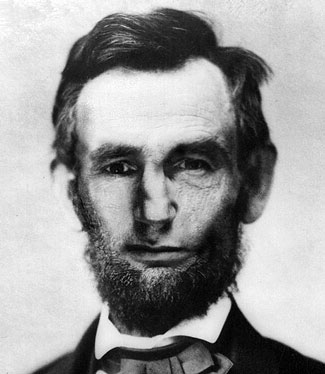
“I was staring at the photo of Abraham Lincoln on your site this morning, trying to place the not-Liam-Neeson actor it reminded me of. There was something about the way his lower lip plopped out on the left side that set off the dead-ringer alarm in my head. Finally it hit me: Harrison Ford.
“You don’t have to look any further than the picture on Ford’s IMDB page to see that, facially, Ford has a lock on this role.

“The lips are a match, from the plopping lower to the philtrum above the upper. Neeson’s nose, though prominent, is too chiseled and lacks the squat, bulbous nostrils of Lincoln and Ford. With the amount of weight he’ll likely lose for the role, Neeson will develop Lincoln’s hollow cheeks naturally, but the prominent cheek lines on Ford’s face compare exactly to those on Lincoln’s.
“Finally, Neeson’s eyes are crystal clear and alive, and will leap past whatever facial prosthetics and bushy eyebrow makeup he is outfitted with. Ford’s eyes are more closed up and less expressive, much closer to the beleaguered, blunt eyes of Abraham Lincoln in the photo on your page.
“But when you stop comparing the photos and evaluate the two actors on a performance level, Neeson books the role hands-down. While I’d much rather see Ford and Spielberg re-team on this project than the inevitably regrettable Indiana Jones 4 we’ve been promised, it’s been obvious for years that Ford is not at all interested in the stretch that a role like this would demand of him as an actor.
“Can you imagine how he would react, for instance, to the note you passed along to Neeson about the pitch of Lincoln’s speaking voice?” — John C., Brooklyn, NY.
“Ford did play Lincoln on the cover of George magazine back in 1997. You’re right…he’s perfect.” — Rob Thomas, Entertainment Writer, Capital Times, Madison, Wisconsin.
[Note: I don’t know why the link won’t work but one URL for the Ford/George cover is http://www.apartment42.com/images/hf-pics/mag-geo97.jpg.]
“Glenn Close would make a fine Mary Todd Lincoln, but Cherry Jones would be even better.” — Richard Hashagen

Dreamland

“It wasn’t on your Toronto list but Terry Gilliam’s Tideland is premiering there on September 9.
“I’ve been looking forward to it since reading Mitch Cullin’s novel last year. It’s a terrific ballsy little book about a little girl whose father dies of an overdose and leaves her stranded in a country house in the middle of nowhere.
“If the film is even half-true to what I read, it’ll be the darkest, most twisted thing Gilliam’s ever done, and that’s saying something.


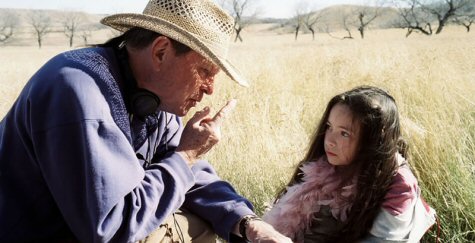
Tideland director Terry Gilliam and star Jodelle Ferland.

“It’ll definitely be a divisive film, it’s not gonna break any opening weekend records, and it might even cause controversy among the League of Decency types, but it should be interesting.
“The little girl is played by Jodelle Ferland. Her adult costars are Janet McTeer, Jeff Bridges, Brendan Fletcher and Jennifer Tilly.
“If you’re going to Toronto I’d love to hear your take on it, even if you trash it… actually especially if you trash it.” — Max Evry.

Brothers Blows

“Jeff, sometimes you are truly confounding. You railed on Mr. & Mrs. Smith, a piece of harmless fluff, for what seemed like years, and then you turn around and give a pass to a piece of worthless shit like Four Brothers…a movie that is fucking
garbage from start to finish.
“It’s impossible to care about their mother because she is gunned down in the first scene and we never get to know her. The attempt to humanize her by having her lecture the kid she catches stealing candy is laughable.
“The action scenes are horribly shot and poorly edited. It’s one of those movies in which the bad guys can’t hit anything despite having automatic weapons and outnumbering the good guys.
“The story is totally predictable the whole way through. Walhberg is okay, but his fag jokes get old after about ten minutes. The villains are a joke. There isn’t an original moment in the entire flick. The emotional scenes are unintentionally funny. I could go on and on.
Four Brothers is an awful, awful movie with no redeeming qualities at all. There’s clearly a reason it’s an August release.” — Paul Doro

Grabs


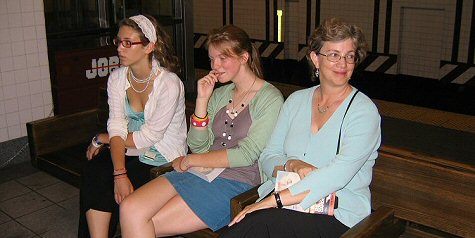
Hollywood Reporter columnist Anne Thompson with daughter Nora (center) and a friend, waiting for the L train at the 14th Street and 8th Avenue station last Monday evening, after we’d all visited the Reel Paradise party and hung with John Pierson, Kevin Smith, Ming Chen and the gang.

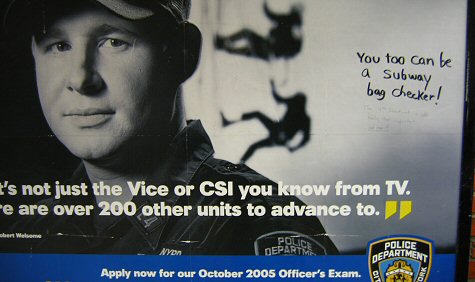
Underneath the graffiti another person wrote that “the 4th Amendment really isn’t that important” and that the other person should “get over it!”

A dull photo…really and truly nothing.

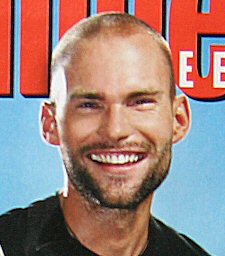
I’ve been thinking all along that Seann William Scott is going to give his career a fresh infusion when he appears in Richard Kelly’s currently shooting Southland Tales, but damn…that haircut! It makes his ears look juggy and his teeth a bit more feral than usual.

Wrongo

“What I’ve read so far about The Constant Gardener has left me wondering if Fernando Meirelles could make the first genuinely kickass Bond film in ages.
“And by the way, maybe it’s the color correction or just a light
trick, but does he have violet-colored eyes? On my monitor, that’s what they look like, or are they just intensely blue?” — Lindsey Corcoran
Wells to Corcoran: I know you mean well, but you don’t ever want to use the term “Bond film” in any sentence containing the words “Fernando Meirelles.”

Beach Girls…baah!

“I’m amazed that the helicopter banner for Lifetime’s Beach Girls resulted in your declaration that ‘apparently it’s not too bad.’ I watched the two-hour debut with my girlfriend, and we both agreed that it was almost unwatchable.
“And I know from where I speak. I regularly watch the teen/parents soap opera One Tree Hill on WB to see what my production friends in Wilmington, NC are up to, and while I admit it’s a mere guilty pleasure, this show at least knows how to create dramatic tension beyond just providing backstory conflict for characters.
Beach Girls seems so flat and all the actors come off badly, either through poor direction or the leaden dialogue (you would think George Lucas was the ghostwriter). Searching around after your comment, I found that it is getting surprisingly okay reviews, but this one from the Boston Globe agrees with my assessment. Here are the key quotes:
“And much of the dialogue feels like heavy-handed psychological exposition — in case we can’t deduce their emotional states, the characters will make it all very, very clear. ”Aunt Stevie and Aunty Maddy were Mom’s best friends,” Nell tells her father during one confrontation. ”They have all these memories, all this information about her. If I can’t see them, it’s like you’re taking her away from me all over again.”
“Like most scenes, this one smacks of actors reading lines: too many awkward pauses, too little chemistry. Nobody behaves like a real person, which might be acceptable if Beach Girls was either highly literary or highly schlocky. But it’s neither. It’s far too dull and heavy for a hot summer night.” — Jay Smith

Round Trip

“I was pretty surprised to see Michelangelo Antonioni’s The Passenger on your list of upcoming releases. I’ve thought about that film often. I don’t think it’s available on DVD, but knowing your fondness for Antonioni (I just looked at L’eclisse after your mention of it…a treat), and wondered about your thoughts on it.
“I saw The Passenger when it first came out, and was left cold. It seemed an attempt to capture all the clich√É∆í√Ǭ©s of foreign films.
“But then I went back to the same theatre a while later to catch a sneak preview of The Wind and the Lion (which I, of course, liked a lot) and said to the folks with me, when the regular feature started after the sneak, ‘I’ve seen this, it isn’t any good, let’s just stay till you get bored and we’ll split.’
“But the movie came alive and opened up. For whatever reason I had the patience or stillness of mind to follow along the second time. We stayed for the whole film.” — Joe Hanrahan, Phoenix Creative.
Wells to Hanrahan: I don’t think The Passenger is in quite the same realm as the Antonioni films of the ’50s and ’60s, but second-tier Antonioni is still worth it. And that last shot that tracks slowly toward the hotel-room window and then goes through the window bars is a classic.

More Grabs


Lunch at Pastis, the lower west-side French joint where Woody Allen filmed that bookend scene for Melinda and Melinda

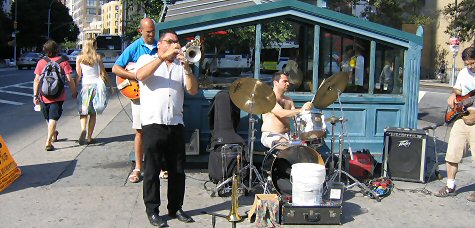
The Cagle family performing near the R train entrance at the underground Union Square subway station on Wednesday, 8.10.

Love Come Lately

Love Come Lately

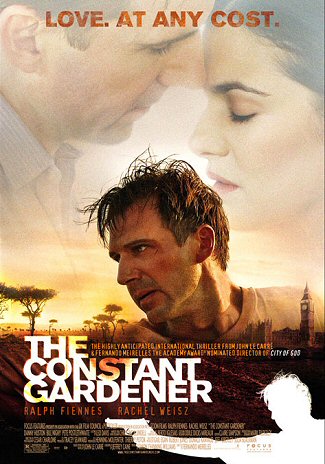
I’ve already mentioned I was pretty much blown away by Fernando Meirelles’ The Constant Gardener (Focus Features, 8.26). What’s hitting me now about this film has more to do with irony.
Gardener is essentially a political murder-mystery that achieves a very unique payoff because it also invests in an unusual kind of love story (i.e., a widower falling more profoundly in love with his wife after she’s dead than when she was alive).


The Constant Gardener director Fernando Meirelles, during interview in Regency hotel lounge — Tuesday, 8.9, 4:25 pm.

In so doing Gardener delivers what seems like precisely the sort of freshness that audiences, fed up with the usual usual, are said to be especially hungry for these days. I’ve seen it twice now and if anything it gained from a second viewing.
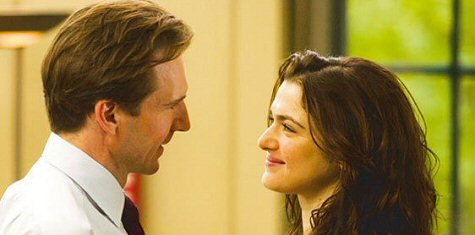
Mostly set in Kenya, it’s about the brutal murder of a mouthy British activist named Tessa Quayle (Rachel Weisz), who was also the wife of a milquetoasty British diplomat named Justin Quayle (Ralph Fiennes).
Prior to her death, Quayle has lived within a cloistered and genteel world that doesn’t permit any rude socio political intrusions. But once he starts looking into her killing, he discovers who she really was and gradually finds himself trying to follow her ethical lead as his investigations lead into some complex and dangerous mucky-muck involving the pharmaceutical industry (i.e., Big Pharma).
< ?php include ('/home/hollyw9/public_html/wired'); ?>
The irony is that this visual tour de force (beautifully shot by City of God‘s Cesar Charlone and edited by Claire Simpson) may be too thoughtful and complex and emotionally subtle to play with a popcorn audience.
There’s also the concern we’ve all been hearing about releasing a high-toned fall movie in late August plus the old saw about the two leads, Ralph Fiennes and Rachel Weisz, not being marquee names, etc.
You might think you’ve seen this kind of thriller (i.e., man/woman is determined to find out who killed a loved one) fifty or sixty times before, but there’s such a feeling of adult complexity and discovery in this thing that memories of all those other what-really-happened? dramas are fast forgotten.

I sat down with Meirelles at Manhattan’s Regency hotel on Tuesday afternoon to mainly talk about the cinematography and the editing, which are worth the price of admission in themselves.
There’s a fine line between hyper photography and super-fast cutting being very cool and very annoying. Some of the cutting in The Bourne Supremacy was in the latter category. It seemed that it was cut faster than any big-studio action film that had come before so people would notice it was cut faster than any big-studio action film that had come before.
Simpson’s cutting of The Constant Gardener doesn’t ever feel this way and there’s not much difference between the two so I’m talking about some very slight quantifications. Good editing is like good music and it’s always hard to explain musical quality…but most of us know it when we hear it.
Meirelles and Simpson arrived at the shape and pacing of The Constant Gardener very slowly, he said. At first they told the story in a standard sequential way start to finish, which ran about three hours…but it was “boring.”
They eventually decided to hop around during the first half and start with Tessa’s death being discovered, which, of course, is exactly how the John Le Carre novel begins. They edited it for a total of six or seven months, including two months in Kenya last summer and three months in Meirelles’ native Brazil.


Ralph Fiennes, Rachel Weicz

Meirelles is sensing an evolving receptivity to faster and faster cutting. “People wouldn’t understand” Gardener‘s editing style, he says, if it had been released in the 1950s. He supports wholeheartedly the influence of MTV videos over the past 20 years or so, which have brought about a new visual discipline among directors.
Nonetheless, something tells me there’s a limit to this. Velocity in and of itself can be extremely bothersome without a really masterful conductor keeping time.
Meirelles’ next film will be a multi-character piece that will try to explore the effects of globalism, or the gradual eradication of local culture at the hands of corporate multinationals. Meirelles may be kidding or not, but he says the title will be Intolerance: the Sequel.
I’ve said it twice and I’ll say it a third time: The Constant Gardener is the best theatrical adaptation of a John le Carre novel since The Spy Who Came In From The Cold (1966), partly because it’s the most emotionally involving. Forget the last John le Carre adaptation, which was John Boorman’s sluggish The Tailor of Panama. Gardener is of a much higher order.

Elder-ly

John Singleton’s Four Brothers is quality crap, and I mean that respectfully.
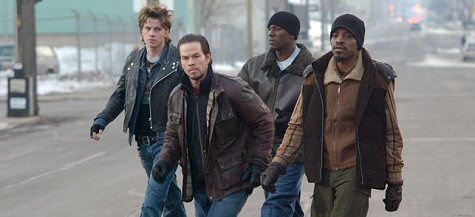
It’s basically a John Wayne western…a likable, stupid-ass gunfight movie that nonetheless works because it turns the cliches around just enough in each scene, and because the acting and dialogue between the actors playing the bi-racial brothers (Mark Wahlberg, Tyrese Gibson, Garrett Hedlund, Andre Benjamin) is warm and spirited and funny now and then, and because the action scenes are organically slam-bang — fast and hard with a kind of ’70s verismilitude.
This would be a great movie to see at a drive-in if there were still drive-ins. It’s also the kind of film that probably plays a little bit better if you’re drinking beer.


If you’re a slightly older genre buff, the action-driven plot of John Singleton’s Four Brothers will remind you of…

It’s a formula revenge thing about four Detroit guys going after the gangsta scum who were behind the shooting death of their mother. It’s all pulp but I didn’t mind it, and I was expecting to hate it because I haven’t trusted Singleton in a long time. I could feel the audience at last night’s all-media screening having a good time. It’s going to do pretty well this weekend.
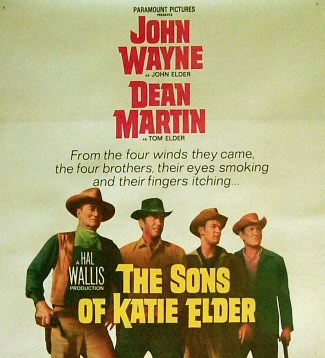
David Elliot and Paul Lovett’s script seems pretty closely modeled on Henry Hathaway’s The Sons of Katie Elder (1965), which was about four rambunctious brothers avenging their father’s death and untangling a financial swindle that had victimized their mother.
Kindly but tough-talking Evelyn Mercer (Fionnula Flanagan) is fatally shot for absolutely no reason during a random grocery holdup, which means, of course, that she’s the victim of a hit. The movie starts with her four sons coming home for her funeral, and we know they’ll eventually get wise and take action.


…Henry Hathaway’s moderately entertaining The Sons of Katie Elder, which co-starred John Wayne, Dean Martin, Earl Holliman and Michael Anderson, Jr. (One kink in the rope was the fact that Wayne and Anderson seemed way too far apart in age to be sons of the same mom.)

What wins you over is that Singleton takes his time getting to this point, paying attention first to character-building with good humor and easygoing acting and even some surreal stuff.
When the action stuff kicks in (the highlights are a nighttime car chase during a blizzard and a ferocious attack on the family home by the baddies with automatic weapons), he goes for balls-out vigor but in a non-martial-artsy, forget-John-Woo way that feels refreshing as shit.
As an ex-con with a hair-trigger temper, Wahlberg pretty much carries every scene he’s in. Steady backup is provided by Gibson (Baby Boy, 2 Fast 2 Furious), Benjamin (mainly known as a rapper with OutKast) and Hedlund (the kid with the asshole father in Friday Night Lights).
Also good (if under-utilized) are Hustle & Flow alumni and Singleton pals Terrence Howard and Taraji P. Henson. British actor Chiwetel Ejiofor (last in Woody Allen’s Melinda and Melinda, and before that in Stephen Frears’ Dirty Pretty Things) pretty much kills and is even amusing a couple of times as a Detroit gangster who keeps his troops in line by occasionally humiliating them a la Warren Beatty’s “crawl and bark like a dog” routine in Bugsy.

Envisioning Abe

I’ve spoken to Liam Neeson about his upcoming portrayal of Abraham Lincoln twice this week — once at Focus Features’ Constant Gardener party on Monday night and again at last night’s small-scale soiree at Michael’s for Paramount Classics’ Asylum.
And the second time I passed along a tiny piece of information about Lincoln’s speaking voice that Neeson thanked me for, and which might affect his performance on some level. Hey, it’s conceivable.
Neeson is playing our 16th President in a Lincoln biopic that Steven Spielberg will most likely begin shooting, Neeson said, sometime in March ’06. There was an earlier plan to begin filming in February, he added, but with this, that and whatever (including, probably, some Oscar campaigning for Spielberg’s Munich movie) this date will probably get bumped.


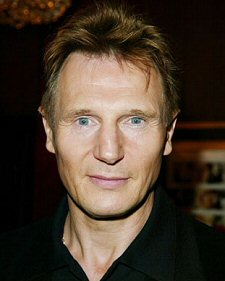
Liam Neeson (not as he appeared at Monday night’s Constant Gardener soiree or at Tuesday’s Asylum party…I didn’t have the brass to take his picture), and a former White House resident known for tallness, eloquence, greatness, etc.

Spielberg has been talking about making a Lincoln movie since `01, when DreamWorks bought rights to a bio being written by Doris Kearns Goodwin. That book will come out in the fall, reportedly under the title “Master Among Men: The Political Genius of Abraham Lincoln.”
Apparently the most recent screenwriter on the Lincoln script has been the British playwright Paul Webb, who has written at least two previous screenplays, Four Knights and Spanish Assassins.
Neeson says the film will be an inspirational thing. “I think his story really speaks to our time,” he said. “About the separation in this country” — I took it he was referring to the red vs. blue culture wars – “and the sacrifices made and the losses of [the Civil War]…160,000 men killed…the losses, my God.”
He believes that Lincoln’s story “shows we can come through this” — an apparent reference to the war against terrorism — “because it shows men at their best and what we could be again.”
I mentioned that Edward R. Murrow, another honorable historical figure, will soon be portrayed in George Clooney’s Good Night, and Good Luck. Neeson said he was interested in seeing this.


Rendering by Hollywood Elsewhere columnist Michael Felsher (“Cinema Obscura”) of how Liam Neeson will most likely appear in Steven Spielberg’s Abraham Lincoln biopic, which will probably begin shooting in March 2006 and hit screens in ’07.

What part of Lincoln’s life will the Spielberg film cover? “From his inauguration to his assassination,” he said.
How long will it be? “I’m not going to get into that,” he replied.
Has anyone else been cast in any roles? Not that he knew of, Neeson said. (I’ve read a suggestion somewhere that Ben Stiller would make a good John Wilkes Booth. I think Glenn Close would make a good Mary Todd Lincoln.)
Lincoln “spoke very well with his hands,” Neeson said. I recalled a certain hand gesture that Jack Kennedy used to use during speeches — not the famous index-finger jab but an easygoing palms-up gesture, and Neeson said, “Because his palm was up it was non-aggressive and sent an appealing message.”
We eventually talked about Lincoln’s voice, which is where my little sprig of information came into play.
Neeson said that the writings of a contemporary of Lincoln’s named William Herndon said that he had “a clear, higher-pitched voice.” I found similar views during internet research the next day. Lincoln didn’t have a bass or baritone voice, apparently, but a tenor voice. It was described by another witness, Abram Berggen, as “high-keyed.”


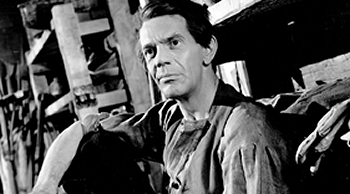
Raymond Massey in Abe Lincoln in Illinois.

Neeson briefly mentioned Raymond Massey’s Lincoln performance in Abe Lincoln in Illinois (1940) and Henry Fonda’s in John Ford’s Young Mr. Lincoln (’39). That led to me to look up Massey’s no-frills biography on Wikipedia. On it I found the following passage:
“Early in Massey’s career, Abraham Lincoln’s son, Robert Todd Lincoln (1843-1926), heard Massey perform and was struck by the close similarity of Massey’s speaking voice to that of his father.”
Neeson was enthusiastic and grateful when I told him about this last night. Massey had a twangy tenor voice mixed with a certain forlorn tone, like he was hoping for something he knew was unattainable.
If I were about to play Lincoln I’d probably want to come up with a voice something like Massey’s, or at least one that doesn’t sound overly “shrill, squeaking, piping [and] unpleasant,” which is how Herndon described Lincoln’s voice as he gave a speech just before assuming the Presidency.

Jarhead

“Just weighing in with my opinion on Sam Mendes’ Jarhead, which screened late last week in Sherman Oaks. I gave it mostly ‘very good’ or ‘excellent’ marks on my feedback card. It’s clearly a smart, haunting, well-acted, handsomely produced modern war film.
“The acting is solid all the way around, especially from Peter Sarsgaard. On my card, I encouraged a strong Oscar push on his behalf.


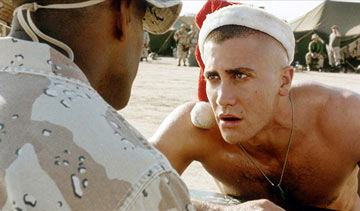
Jake Gyllenhaaal (r.) eyeballing a noncom who just might be played by Jamie Foxx (l.) in Sam Mendes’ Jarhead.

“As others have noted, many of the musical selections compliment the film nicely (much in the same way Coppola found the right songs for Apocalypse Now). In fact, young Nirvana-lovers like your son may be able to enjoy this film a bit more due to the music.
“You were right on the money when you suggested that this was a Full Metal Jacket for the Gulf War. This is both good and bad. The audience loved the opening scene, despite the fact that it directly rips off R. Lee Ermy’s famous boot camp tirade. (For this, I jotted down a scathing remark to Sam Mendes on my card…not that he’ll ever read it personally.)
“Overall it works very well and needs only to be tightened ever-so-slightly. Let’s all hope it finds a broader audience than David O. Russell’s unjustly ignored Three Kings.” — John McGilicutty

Going Wrong

“All praise to you! That’s right, all of it! You hit the goddamn nail on the head. Bad year for Hollywood? No, no, no…great year for Hollywood.
“So tickets are down. You know why? Movies are down. I haven’t been this happy since The Real Cancun tanked in theatres and my fear of reality movies taking over film as they did television subsided. In professional sports these are called rebuilding years. Hopefully this is a year where the business realizes it doesn’t have a championship-caliber team after all.
“Hopefully after this we will bear witness to studio executives keeping their noses out of the cookie jars and letting the creators do what they do best…fucking create. They might create a piece of shit, but you know what? At least that piece of shit might be more original, instead of a watered-down piece of shit that doesn’t have an identity. That’s what we’ve been getting. I want ambitious failures! Give me Heaven’s Gate!
“Hopefully — I might be hoping a bit too much with this — we might see a new age of creativity come out of this. One that reverts film from the blockbuster template back to the nitty gritty, I’ve-got-an-idea-let’s-shoot-it-no-matter-how-crazy-it-sounds stuff from the 70’s.
“Here’s to a great bad year of cinema!” — Sean Whiteman

Grabs


New York Daily News gossip columnist George Rush (i.e., “Rush and Molloy”) speaking with The Constant Gardener director Fernando Meirelles (r.) at post-premiere party thrown by Focus Features at Compass on West 70th Street — Monday, 8.8,10:25 pm.

Asylum star Natasha Richardson at tres elegant post-premiere party at Michael’s, 24 East 55th Street on Tuesday, 8.9, 10:40 pm — delivering her thank-you-all-so-very-much, this-is-a-wonderful-moment remarks about her many satisfactions in making the film (a descent-into-madness sexual affair movie set in a British facility for the mentally un-hinged) and especially from the rigors of sinking her teeth into an especially ripe character. Paramount Classics co-prez Ruth Vitale stands to the right in semi-darkness.

Jazz band letting go across the street from Cooper Union — Saturday, 8.6, 2:15 pm.

If I hadn’t gone to Rockaway Beach last Sunday and seen this large banner being dutifully pulled across the skies by a helicopter, I would probably never have known about, much less watched, Beach Girls. But I’ve read up on this Lifetime six-hour miniseries and apparently it’s not too bad. Here’s a review by the Baltimore Sun‘s David Zurawik.

Director-writer Kevin Smith, producer and producer John Pierson at Wellspring party for Reel Paradise, Steve James’ doc about Pierson’s running a theatre in Fiji a couple of years ago. Party followed a premiere screening at Tribeca Cinemas, just south of Houston.

Waiting to see the 10 pm show of Bernardo Bertolucci’s The Conformist at the Film Forum — Saturday, 8.6, 9:40 pm.

Rockaway Beach — 8.7, 2:20 pm.

The Virginian

“I have a few questions/observations about your WIRED piece about the failure of Hollywood’s big-budget, high-concept theme-park movies:
“1. Are these really failures? Of course they’re artistic failures, but it’s my understanding that crap like Stealth still makes money, especially once you factor in the overseas haul. The much-debated domestic box-office slump may be a reflection on how bad these blockbusters have gotten, but unless the international receipts also dry-up, Hollywood will never learn.
“2. Given the importance of the international audience, what are the odds that these films will go away any time soon? You know as well as I do that if it’s loud and dumb, it translates well to the overseas market — you don’t need to subtitle an explosion. Cheap seats are still filled with mouthbreathers whether they’re in Times Square or Thailand.
“3. I sense in your words a lament that these piles of disappointment have constantly pushed out worthier, more artistic films of merit. I disagree, in part. The independent artsy films are still getting made in droves, and while they may not make it to the multiplex in the hinterland, they are making it into homes in both blue and red states via cable and DVD.
“The real casualty here is the intelligent action movie or thriller. These are increasingly difficult to find. Critics such as yourself frequently point to Jaws and Star Wars as the culprit, but such highlighting always fails to recognize that those were actually good films, deserving of their success.
“James Cameron’s Aliens or the two Terminator films or the original Die Hard are reminders that Hollywood has put out compelling, intelligent, and entertaining action films, and a whole lot more recently than the 1970s. Hell, these movies look like absolute classics in comparison to dreck like Stealth, which would have been straight-to-video back in the day (with Michael Dudikoff, most likely).

“Yet there are far fewer films of this quality today, and even the ones that come close — like Spielberg’s War of the Worlds — often fall apart upon closer reflection.
“4. Finally, given the problems with getting audiences into theaters, what do you think the solution is? Do you offer them a quiet introspective talky film that plays exactly on DVD at home as it does on the big screen, or do you offer them a big, loud, brash explosion-fueled adventure movie that exploits the THX sound and big screen? There’s a reason why Hollywood relies on this swill: they’re the only things that can get moviegoers to the theater. Geez, this dynamic has been out there for years, I’m surprised I hear so few critics talk about the distinction between movies that are rentals and those that demand to be seen on the big screen.
“Of course, as home theaters improve, more films are going to fall into the rental category regardless of their quality. And as ticket sales fall, Hollywood will inevitably raise ticket prices, killing the golden goose. Meanwhile, the only thing that can possibly save the theater from complete irrelevancy– improving the movie-going experience for people who actually enjoy seeing more than one movie a year on a big movie screen, regardless of subject– that core audience will be ignored.
“Alas, that core audience may paradoxically be the first to abandon theater-going — speaking for me alone, I used to see about sixty movies a year in the theater, but I made less than fifty last year, and in 2005 I’m on pace for less than forty. At these prices and in these conditions (bad lighting, bad sound, bad timing, scratchy prints, inept concessions, annoying patrons), not even a die-hard fan of the big screen like myself is likely to spend money on crap like The Dukes of Hazzard, a film I would have probably seen on a lark as recently as a few years ago.” — Dave, Arlington, Virginia.

More Grabs


Johnny Cash during the Folsom prison performance he gave back in ’68. I’ve been in and out of a Cash head-space since seeing James Mangold’s Walk the Line last Thursday. I’ve pledged not to say anything about it until Toronto, but I wouldn’t want the lack of even a hint of any enthusiasm about it to say the wrong thing, so let me just say without really saying anything that it tells Cash’s story the right way.

Broadway and… I forget, but roughly two or three blocks north of Houston.

I’m starting to have some serious aesthetic doubts about these slow-exposure blur shots.

At the IFC Center last Saturday afternoon, around 4:30 pm. The former Waverly Theater is a brand-new indie house with a cool
restaurant featuring the servings of chefs Claudia Fleming and Gerry Hayden.

Is this the only shot of whatsername, the tattle-tale Jude Law nanny? I read somewhere she’s going to spill to the tabloid news shows…terrific.

I never even went inside when I took this last Friday or thereabouts, but it’s located on West 15th just east of Eighth Avenue.

Reactions?

Whenever a one-sheet art serves up a concise iconic image, it’s easy to accept a notion that the film has its shit together.
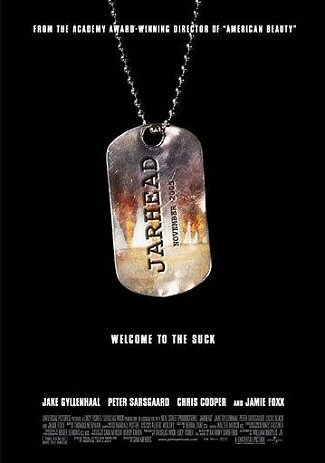
The poster for Sam Mendes’ Jarhead (Universal, 12.15) shows dog tags with what looks like blood stains at first, but upon closer study is a reflection of the burning oil wells in Kuwait that Iraqi troops ignited at the end of the Iraq war of ’91…very neat.
It’s also clear that the tone and texture is going to be very male and gritty, especially with that slogan. It’s an encouraging take-it-or-leave-it way to start things off.
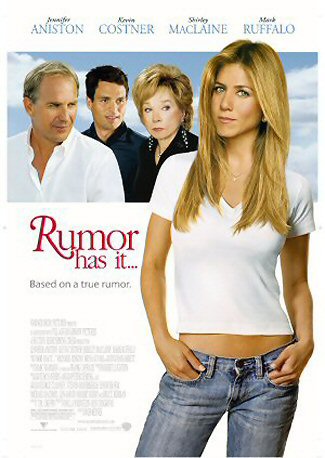
The contrast with the one-sheet for Rob Reiner’s Rumor Has it (Warner Bros., 12.25) couldn’t be sharper. Reiner’s film is for couples and women and maybe guys, if it’s funny. Jarhead is…well, I’d like to think that women will get into it also.

Too Brainy

Too Brainy

There’s a reason Jay Chanderasekhar’s Super Troopers (2001) caught on — the absolute go-for-broke, beyond-hope stupidity of the characters. A similar thing worked for the Farrelly’s Dumb and Dumber and, going way back, Bill Pullman’s “Earl Mott” character in Ruthless People
If you really get it, deep-down genetic stupidity can be hilarious. And I don’t mean stupid-but-cool and not cleverly stupid and not uneducated but street smart…I mean, forget-about-it brontosaurus dumb. But you have to go all the way, and that’s what Chanderasekhar didn’t do when he shot The Dukes of Hazzard.


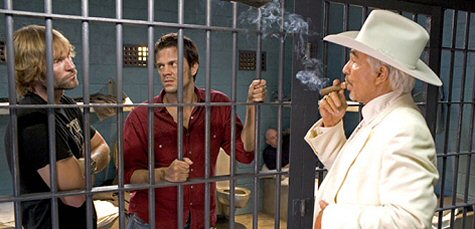
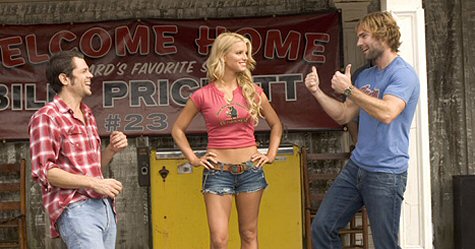
The Dukes of Hazzard costars (l. to r.) Seann William Scott, Johnny Knoxville, Burt Reynolds.

The characters of Bo Duke (Seann William Scott) and his brother Luke (Johnny Knoxville) are garden-variety yeehaws. But they’ve also been given a certain country dignity, and that’s what’s unfunny about this deeply painful film — the effort to try and put these guys over as likable rascals.
They need to be dribbling-saliva stupid but of course, that would be insulting to rural Southern audiences and the fans of the TV series, etc.
I’ll bet anyone a dozen corndogs that the producers (Bruce Berman, Bill Gerber, et. al.) said to Chanderasekhar, “We loved Super Troopers, but a lot of people love the TV series, so don’t make these boys too retarded….right? They’re ballsy guys…not too smart but cool and brash and all that. You know…round `em out a bit.”
< ?php include ('/home/hollyw9/public_html/wired'); ?>
So they made a shit movie that got a 25% positive rating on Rotten Tomatoes. And lots of people are going to shell out to see it this weekend. Hooray for Gerber and Chanderasekhar and the rest of the crew.
But Seann William Scott has pushed things right to the limit. He’s played the same spirited moron in 10 or 11 films over the last six years or so, and sooner or later audiences get sick of it and when they finally do you’re over. Scott is lucky…make that very lucky…that Richard Kelly has cast him in a mostly sober part in the currently shooting Southland Tales.


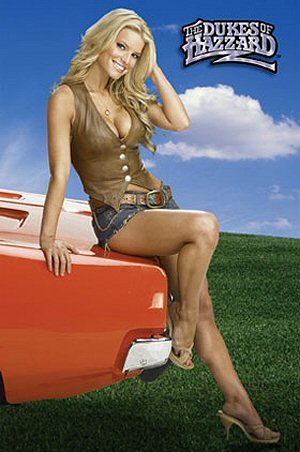
The thing that Jessica Simpson had (describe it any way you like) is now, with the debut of The Dukes of Hazzard, worth a good deal less.

Every critic in the country has gone to town with this thing, but two guys from Arizona — Phil Villarreal of the Arizona Daily Star and Bill Muller of the Arizona Daily Republic — are my favorites.
I especially like Villarreal’s comment, to wit: “Hell, suck the exhaust fumes from a 1969 orange Dodge Charger. But whatever you do, no matter how big a fan you were of the show, do yourself a favor by skipping this movie.”

In The Pudding

Seeing the smartly engaging Proof (Miramax, 9.16) right after The Dukes of Hazzard felt like a spring rainfall washing away toxic chemicals.
Directed by John Madden (Shakespeare in Love), Proof is an earnestly delivered, well-written intellectual drama — you can feel the structural discipline of David Auburn’s play all through it — with a title and theme that doesn’t just apply to mathematics.
I never saw Proof on Broadway but I know of its reputation, and I can understand where all the praise came from.
The film has some weak aspects, okay, but it’s certainly not flawed enough to have justified Miramax’s decision to shelve it last fall, or roughly eight or nine months ago. The research scores weren’t spectacular, I’m told, due to Gwynneth Paltrow’s remote and chilly performance, but it’s obviously an impassioned quality-level thing that will send no one out into the street feeling burned.
Why didn’t Harvey just release it and give it a shot? It’s far from an embarrassment. Smart, well crafted, food for thought. Why taint it by shelving it?


Gwynneth Paltrow, Jake Gyllenhaal in second-act scene from John Madden’s Proof

Madden called this morning and says Proof was pushed aside last year so Miramax could devote more time to pushing Miramax’s two big Oscar contenders, The Aviator and Finding Neverland, and that once the end-of-the-year slot was gone he insisted on a fall ’05 debut rather than a winter or spring opening.
Proof is about the cloistered world of mathematics scholars and a recently passed-away professor named Robert (Anthony Hopkins), once a genius-level pathfinder who lost his grip on sanity when he entered middle age.
The story is about his daughter Catherine (Paltrow) coping with the possibility that she may inherit his insanity, and particularly how to deal with a discovery in a notebook that Robert may have had a late-inning surge of brilliance and come up with a mathematical proof that will re-order everything. Simultaneously urging her forward and pitching woo is a young math student named Hal (Jake Gyllenhaal).
How do you prove love to someone you say you love? By trusting them absolutely, Auburn says. To question them, to ask for rationality or practicality is not love…it’s the lack of faith that ruins a love affair. This may well be true, but there’s a scene between Paltrow and Gyllenhaal in which this view is, I feel, insufficiently felt and invested in.
Paltrow’s Catherine is such a sourpuss, such a “no” person, such a killjoy that you almost want to ally yourself with her tedious sister Claire (Hope Davis), but she’s such a mediocre and unimaginative prig that you can’t help but recoil.
The one you support and identify with the most, of course, is Hal, a hopeful, positive, fully-engaged fellow. This is Gyllenhaal’s most winning character ever. For once — finally! — he’s not playing a withdrawn neurotic wearing a pained, woe-is-me expression.

But we should identify with and want to support Paltrow more — she’s carrying this thing on her back, bearing the burden — and while I found her performance believably lived in and particular and behaviorally convincing for the most part (Paltrow played the role in a play performed in London), I found it hard to really get behind her character. She’s so caught up in her private space, so unwilling to divulge or open up.
Catherine is a bit puzzling. She’s been touched by genius herself, and yet she’s so enmeshed in her neg-head attitude that she can’t summon the pride and force of spirit to at least claim recognition for that which is hers. She decides in act three to withdraw and submit to lethargy and depression rather than stand up for herself because if she accepts her genius, she also accepts the inevitable mental instability that will come later in life.
That’s a tough situation. I suppose I can relate to a woman who might feel reluctant to claim her rightful glory and her place in history out of fear of the burdens of being a genius…but for God’s sake, life is very hard…you might as well accept the glories and take your bows for what you’re good at because you’re certainly not going to escape the difficult stuff.
And yet Catherine is unlike any female character I’ve seen recently in a film. I enjoyed being in her company despite her constant gloomheadedness and general downer shit. (She would get along perfectly with Paul Giamatti’s “Miles” from Sideways.)
Hopkins seems to be phoning in his part of the once-brilliant father. He’s played these complicated living-in-their-head guys so often that it feels like an exercise.
One question that has to be asked is what exactly does coming up with a radical new proof in the realm of mathematics actually mean for the world? What does it have to do with the price of rice? What are the possible practical (or impractical) applications down the road? I realize it’s vital for mathematicians to be probing the bounds of the quantifiable universe, but we all know what the fast-food crowd will be saying.


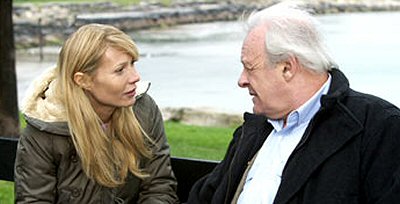
Paltrow, Anthony Hopkins in Proof

I started thinking about Albert Einstein after seeing Proof, and asking myself how exactly did Einstein’s theory of relativity affect the state of things? He expanded our knowledge of the exact properties of time and light and the ramifications of space travel, and he alerted FDR to the work being done by the Germans on building a nuclear bomb…but what does all this fascinating mumbo jumbo in Proof about breaking ground and pushing the mathematical envelope and re-configuring high-level math concepts really have to do with…well, anything?
In dramatic terms it isn’t all that relatable. People always admire pioneers and anyone exploring new turf, but what Hopkins and Paltrow and Gyllenhaal and their friends are all hopped about feels a little bit mysterious and maybe even a little so-whatty.
I’m not for a moment dismissing higher mathematics, but anyone who sees this film will be hard-pressed to come to a conclusion about what it all boils down to from even a semi-grounded perspective.
Of course, all this stuff I’ve been discussing was probably in the play. So why did Harvey even make this thing if he wanted to reach the people who eat dinner at McDonalds?

Re-Selling Cavett

For me and anyone else who loved watching “The Dick Cavett Show” on ABC from ’69 to ’74, the pleasures of the show were primarily about inquisitiveness, urbanity and cultivation. The idea was to entertain and get ratings, etc., but always with an aura of class.
You could always count on Cavett’s witty humor and his having these intoxicating, extra-brainy conversations with his fascinating guests, who tended to reside above the level of Don Rickles. And then there were the wild incidents (like Lester Maddox walking off the show when Cavett refused to apologize over some blithe remark) that would happen from time to time.
But these aspects of the show are perhaps a bit too challenging for today’s audiences. This, at least, is the decision of a distributor called Shout! Factory, which will be issuing a series of Cavett DVDs over the next five years.
I got wind of this after running into Cavett on Lexington Ave. last Wednesday and we got to talking about Shout’s first DVD package coming out later this month called The Dick Cavett Show: Rock Icons.


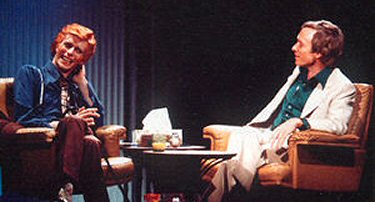
David Bowie speaking to Dick Cavett sometime during the his Ziggy Stardust phase, probably in ’73 or thereabouts.

It’s basically footage of ’70s rockers like Janis Joplin, David Bowie, George Harrison, Sly And The Family Stone, Stevie Wonder and others performing on his show, plus some conversation.
The following day (i.e., yesterday) I spoke to Robert Bader of the L.A.-based Shout! Factory. Bader said he’s been watching tapes of the Cavett show for the last 18 months and that he’s looking very much forward to turning on new generations of fans to Cavett’s sublime talent as a celebrity interviewer and late-night wit.
But he said something disturbing as well, which is that after looking at the tapes his conclusion is that Cavett’s literary-cultural shows don’t entertain as well as the others.
On top of which he has to “sell” these shows to the Shout! marketers, so basically they’re putting together packages that are more broadly marketable. Packages, in other words, that will attract people who shop at Target.
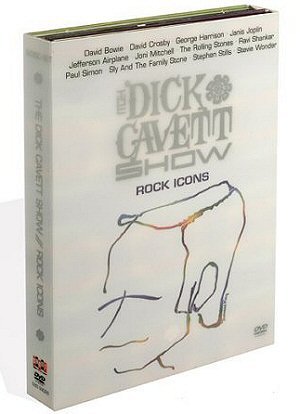
The “Rock Icons” collection comes out on August 16th, followed by a collection of Ray Charles shows (three shows, 14 performances of songs) on 9.13, a DVD devoted to guest appearances by John Lennon and Yoko Ono (due in November), and then a “Comedy Icons” package that’ll be out sometime in the first quarter of ’06.


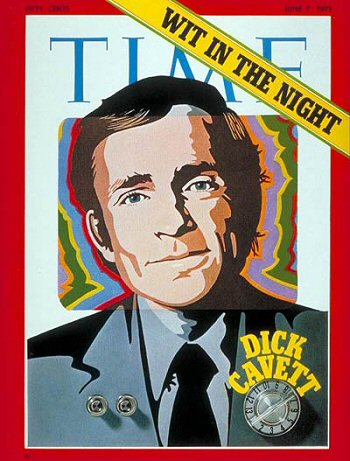
Dick Cavett as he appeared on cover of Time‘s 6.5.72 cover story, published at the apex of his popularity and influence.

Then, if Bader pitches them well and other packages sell decently, we’ll see “Hollywood Legends” (Marlon Brando, et. al.) and “Great Filmmakers” disc sets. Neither of these has been confirmed with the marketing people but Bader is going to push for them.
Which is all well and good, but if you ask any fan about the “Dick Cavett Show,” they’ll all say it was the show’s intellectual and cultural and sometimes political discussions that were the prime signature.
It’s what separated Cavett from Johnny Carson, who, sharp and funny as he was, was always a man of conservative Nebraskan sensibilities and mainstream showbiz tastes. In today’s terms, Carson had the reds and Cavett had the blues. Cavett’s show was a slightly more uptown Charlie Rose with laughs and an audience…a slightly less downscale David Letterman.
Bader says some of the writers and cultural types I’m interested in will be woven into tapes featuring rock stars and guests like Mickey Mantle and John Wayne so all is not lost, but obviously the chances of seeing Cavett DVDs of those famous shows with Gore Vidal, Norman Mailer, Truman Capote and other literary types are not high right now.


The Dick Cavett Show “Rock Icons” DVD set, being issued by Shout! on 8.16.

Bader is a smart guy and knows what he’s talking about. He’s also a realist in terms of the marketplace and what he can get the company to release.
“The reality of the present marketplace is not to be dismissed lightly in matters like releasing ‘The Dick Cavett Show’ on DVD,” he says. “We feel that we have an extremely valuable commodity and are carefully working out our releases in order to put out as many sets as possible. I think it would be safe to say that we don’t want to put out a set that sells 5,000 copies right now. We would not get too far into our planned series of releases if that were to happen.”
Bottom line: a beloved late-night showcase of comic wit, urbanity and sophistication in the early ’70s, a show that reflected to some extent the turbulence and cultural upheavals of that era, is being repackaged to modern DVD viewers as…I’m tempted to say as an upscale “Ed Sullivan Show.”
No would argue that mainstream America is a much more conservative and reactionary culture today than it was in the ’70s, and all of that lefty-intellectual New York conversational stuff from the ’70s probably won’t play that well in 2005 Peoria…if in fact it ever did.
We all know that a DVD needs to sell to “red” America if it wants to end up in the black, and the cultural dissolution that has occurred in this country over the last 30 years is not a myth. It may be a clich√É∆í√Ǭ© to say that we were a brighter, more inquisitive, more intellectually alert nation back then…but we were.

I’m glad these DVDs are coming out, but I have to say I’m more than a tiny bit disappointed.
The film industry has produced two Truman Capote movies over the last year or so. The first, Bennett Miller’s Capote (Sony Pictures Classics), will debut at the Toronto Film Festival and hit theatres in late September. Then comes Douglas McGrath’s Have You Heard? (Warner Independent), but not until the fall of ’06.
Obviously there are producers and distributors who are convinced that there’s some kind of decent-sized audience out there that knows and cares about Capote and who he once was.
It therefore seems odd that a celebrated TV talk show that was (a) known for its intellectual edge, (b) had Capote on a few times and (c) is issuing commemorative DVDs of its glory days isn’t, right now, thinking about including the appearances of Capote and other literary types who were grandly associated with this show in its heyday.
In fact, the more I think about it, the more depressing it seems.
“If I put out ten shows with authors as the main guests at the start of our release cycle, I can assure you we’d be in deep trouble,” Bader admits. “You and I might be dying to see Tennessee Williams chat it up with Dick but by and large the public that purchases these things finds Dick’s incoherent chat with Sly Stone infinitely more entertaining.”


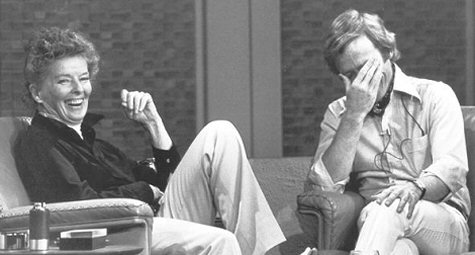
Katherine Hepburn during show that Cavett devoted entirely to interviewing her and her alone.

Rainfall


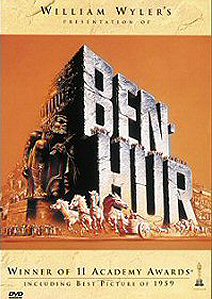
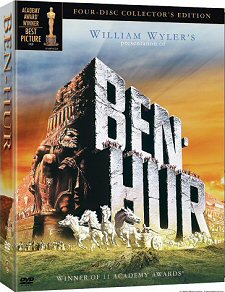
Jacket art for DVD of William Wyler’s Ben-Hur six or seven years ago (l.) and jacket art for upcoming four-disc version (r.). The obvious difference is that arid ancient Judea, where most of the film takes place, has become a much greener place.

Wilson-Flynn

“While I agree that Owen’s a little — make that very — thin-skinned for telling his lawyers to suppress the Butterscotch Stallion T-shirt, I’m not so sure about your question regarding Errol Flynn. He hated not only the phrase ‘in like Flynn’ but every joke that mentioned him. In fact, he hated comedians in general (other than Jimmy Durante, who didn’t do Flynn jokes). I learned all this from his posthumous autobiography, which the publisher entitled…’In Like Flynn.’ Hey, he was dead.” — Kevin Kusinitz, New York, NY.
Wells to Kusinitz: Nope…incorrect. Flynn’s autobiography was called “My Wicked Wicked Ways.” And none of the Flynn biographies I’ve discovered online were called that.

John Lennon vs. Italians

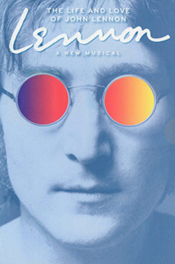
“You wrote in your WIRED item about Don Scardino’s Lennon Broadway show that’s opening on 8.14 that ‘anyone whose name ends with a vowel would probably get John Lennon wrong anyway.’
“Dude, what the fuck is that all about? You’ve been administering a pretty fair amount of vitriol to one contingency or another for quite some time, but really, what are you actually trying to say with that? I’m sure there is some sort of half-cocked generalization to be made about folks whose last name is some sort of pointless pluralization as well, but why make the effort? Focus, dude.” — Brian McIntire.
Wells to Mcintire: I was basically saying that the odds are against a New York-area Italian-American like Don Scardino really and truly understanding who and what John Lennon — a working-class Brit from Liverpool — was deep down. It takes blood to know blood.

Spike Lee made the same point about ten years ago when he argued that Norman Jewison was the wrong guy to direct a biopic about Malcolm X…that a black director like himself felt and understood things about Malcolm X’s life that were beyond Jewison’s ability to see or properly dramatize.
I don’t think Scardino can get Lennon any more than Lennon, when he was alive, could have been expected to write an authentic song about the Italian doo-wop music culture that arose from New York City area in the 1950s.
And by the way, here’s a portion of a news story about the delay of the Lennon show: “When asked about speculation that David Leveaux (Fiddler on the Roof, Nine) was brought in to replace director Don Scardino, a production spokesperson said that Leveaux ‘is a friend of the production and has offered support to Don Scardino and the creative team.'”
The word is that the show is dreadful and will probably close before too long.

Grabs


The new Vanity Fair “50 Greatest Films of All Time” supplement in the Jennifer Aniston issue is rather whore-ish. It’s like an advertising supplement for Turner Classic Movies, which has bought all the advertising. The great film choices are fine (I’ll go with Old School as one of the 50…as some kind of perverse joke) but the writing is totally rote, like something pulled out of a Golden Retriever video catalogue.

I figure it’s okay to say I had lunch at Cafe Boulud on East 76th Street on Wednesday with screenwriter and industry spitballer William Goldman (All The President’s Men, Misery, Marathon Man). We just talked about stuff…nothing for attribution. Nobody…knows…anything.

The formidable Trevor Jett Wells, deep in thought and trying to bang out an assignment for a journalism pre-college course at NYU — Sunday, 7.31, 7:55 pm.

Very cool bar on First Avenue near 3rd or 4th Street.

Lobby of the Carlyle Hotel — Wednesday, 8.3, 2:45 pm.

If you dont know these faces….

Wildposts on 15th Street near 8th Avenue — Tuesday, 8.2, 5:50 pm.

Old snaggle-tooth…fearsome but kinda cute in a brute-beast sort of way.

Hot “Date”

Hot Date

The youngish producers of a little movie called My Date With Drew (DEG, 8.5) — Jon Gunn, Brian Herzlinger, Brett Winn and Kerry David — have gone through an exhilarating ride as well as a cold and lonely one for the last 20 months or so, and it’s all been paradoxical.
All the buyers liked or loved Drew but all but one said no to a theatrical release because they felt it looks and feels too much like reality TV. And yet there’s no question this indie thing plays with 30-and-under audiences, and I mean in a big way.


My Date With Drew producer Jon Gunn, producer-star Brian Herzlinger.

I’ve seen Drew three times with a crowd, and I especially felt the excitement when I saw it a year and a half ago at the Vail Film Festival. Each time it’s made people smile, laugh, tear up, cheer. It’s one of the few films out this year that delivers a genuine emotional high, and when a film works as well as this one does it doesn’t matter what it resembles.
What matters is the heart and soul of it. For most people, the emotional-spiritual stuff is what sells tickets…if they hear the right things from their friends, that is.
There’s no reaching the gorillas who automatically see the latest piece-of-shit studio movie every weekend…Dukes of Hazzard, Stealth, The Island, etc.
< ?php include ('/home/hollyw9/public_html/wired'); ?>
But there’s a whole ‘nother demographic out there…people with the ability to step outside the lab-rat syndrome in selecting films, people with a semblance of focus and inquisitiveness and a touch of emotionality…these are the ones who will presumably get Drew and turn it into something.
This surprisingly disarming 30-and-under date movie finally opens in theatres (in New York, Los Angeles, Chicago and Dallas) on Friday, and then will fan out from there.
Here are the basic facts, and when I say “facts” I don’t mean impressions and/or opinions that I feel should be regarded as factual because I have this subjective fervor, blah, blah.
Drew is about this amiable, thick-bearded, beagle-eyed guy named Brian Herzlinger who, back in ’03, tried like hell to somehow land a date with Drew Barrymore…with the steady help of Gunn, Winn and David.

Brian’s been a Drew worshipper since he was 6 years old or something, but this is vaguely depressing to some of us so let’s not dwell.
They’ve got only $1100 to invest (which Herzlinger has won on a game show) and 30 days to get the date, since the camera they’re shooting with has been “bought,” in a manner of speaking, at a Circuit City store in Los Angeles that was offering a 30-day, no-questions asked return policy.
So Drew is a ticking-clock thing as well as a docu-comedy, but it gradually grows into something more….although it’s initially hard to see how this will happen, given an implicitly trite (although extremely well edited) blast-off section that sets everything up.
The film shows the crew using their limited Hollywood connections to get to anyone with the slightest relationship to Barrymore, including a cousin, a skin treatment specialist, Corey Feldman (who “went out” with her when she was 10), Charlie’s Angels screenwriter John August and actor Eric Roberts.
At the same time Herzlinger and David repeatedly call Barrymore’s Flower Films to try to persuade her “people” (especially company team-leader and closest Drew confidante Nancy Juvonen) to watch a 30-second trailer about the project, which of course they refuse to do.

This is standard Hollywood blow-off behavior for people who work for big-name celebs — saying no is always easier and less threatening than saying maybe, and keeping would-be invaders out of the inner sanctum and thereby maintaining a sense of cocooned reality is, of course, always the main priority.
All kinds of stuff happens, but the effort finally pays off when the team creates a website and the numbers get bigger and bigger and the smug-heads at Flower Films eventually wake up and pay attention.
To me, at first, Herzlinger seemed like a putz. What semi-intelligent male would come to a conclusion that spending two or three hours (or whatever amount of time it would eat up) with a rich, over-pampered, Hollywood ego princess like Drew Barrymore is worth sinking his heart and soul into? Not to mention all his financial resources?
But guess what? It doesn’t matter. This is not a film about Drew Barrymore. This is a film about gumption, positivism, tenacity, and working with your friends to somehow make your dream come true. It manages to pay off in ways that are largely unexpected and curiously shrewd. It’s a little-engine-that-could movie that sends you out shaking your head with amazement and wearing a big dumb grin.
Without getting too specific, it can be revealed that Barrymore does make an appearance in the film, and it struck me the last time I saw it that My Date with Drew is easily the most emotionally engaging thing she’s appeared in for quite a while.

What was Barrymore’s last half-decent movie? Confessions of a Dangerous Mind? Riding in Cars With Boys? Neither of these films makes her seem as lovable and well-rounded as she is in My Date with Drew. In fact, this $1200 video pic is almost enough to erase memories of the two Charlie’s Angels films. For Barrymore, Drew is a major karma-balancer alongside these lasting abominations.
Naturally, of course…Barrymore hasn’t done a single thing to help promote the Gunn-Herzlinger-Winn-David film.
Before the launching of the Iraq War a certain Fox Searchlight exec declared that Drew is too TV-ish and lacking in real-movie substance to warrant a theatrical run. Maybe she’s right — maybe Drew will fizzle like all the naysayers have predicted all along — but even if it does she and others like her will have still missed the point.
This movie has it where it counts. It delivers an emotional payoff that truly sinks in. See it this weekend and tell me I’m wrong.
Herzlinger, Gunn, Winn and David not only made a nifty little film, but they’ve parlayed its notoriety into the beginnings of industry careers, so good for them and a pat on the back for having the pluck and moxie that anyone needs to make it in this town.

Witness

“While on a camping trip last week in Kanaskis Country in Alberta, Canada, my family and I were about to go on a hike around Upper Lake (about an hour away from Calgary) when a guy with a walkie-talkie came running up and politely asked us to move as we were in the shot of a movie they were filming. It turned out that in the middle of the Canadian Rockies we had stumbled onto the outdoor set of a new Robin Williams comedy called RV.
“Williams plays an overworked man who abruptly loads his family into an RV en route to Colorado, hoping they won’t discover he is actually going there to attend a business meeting. It’s being directed by Barry Sonnenfeld. The costars include Jeff Daniels and Curb Your Enthusiasm star Cheryl Hines (i.e., Larry David’s beleaguered wife).
“We asked if we could watch some of the filming and the walkie-talkie said sure. So we took some pictures and now you’re running one that gives away one of the big sight gags!
“We got to see Robin chase his RV down a hill and then watch as it sinks into the lake. W e also got to see him film a dialogue scene right after he gets out of the water. His wife asks him why he needs a $4,000 bike, and he says its because his hips are out of alignment. She then asks if she is happy now because his kids know their dad is a freak.

“They were using 2 RVs. The one parked at the top of the hill and a separate one already sunk in the lake with the back half of it still sticking out of the water rigged with a cable holding it in place. When they filmed the scene the cable was released and the RV started to sink completely under water as Robin chases it. We later saw this one after it was pulled out of the water and it was just a shell with nothing inside.
“Robin looked to be in good shape and was clean shaven. He wore a green shirt and kakhi pants. He and Cheryl both had doubles on the set dressed like them but the doubles just sat around and never got involved. Robin gamely ran into the water numerous times and it was very cold. We got to see Sonnenfeld direct. He was wearing a white cowboy hat and smoking a cigar.
“We took our hike after the crew shut down for the day. Near the top of a mountian there was an open area which my daughter scanned with binoculers, and she saw a grizzly bear was rambling along the top of this ridge, probably looking for berries to eat. It was awesome…. the real reason we went camping.
“It was kind of amusing to think about the cast and crew being driven back to the comfort of their hotels while we headed back to our campsite in the woods.” — Charles Buckner

Larson’s Song

“I don’t see why everyone is blaming director Christopher Columbus in advance for the possible failure of Rent (Columbia, 11.11). I mean, it’s Rent! Sugar bleeds from this thing.
“If you should blame anyone, blame Jonathan Larson, the author and composer. It’s really horrible the way he died and all, but there’s kind of a reason it took him so long to bust through.
“He workshopped it too much and he really didn’t know too many people in the biz so funds and staging were a constant problem.


The cast of Christopher Columbus’s Rent

“Another factor is that the lyrics to most of the songs sound like he wrote them in his diary, like a teenage girl would write during a slumber party…fluff tunes that would make everyone happy and given them something to perform and be forgotten later, but remembered fondly in their later years.
“If Larson had lived, he could have seen the off-Broadway premiere of Rent and had that for comfort. I remember when that play came out — you could not turn on the TV without hearing how he died and the success of Rent.
“There are only two types of people who like Rent: (a) hipster types who listen to bland pop music, and (b) depressed individuals who need a severe pick me up.” — Alfred Ramirez, Fort Worth, Texas.

Herzog

“I’m looking forward to Grizzly Man (Lions Gate, 8/12). Shit, Herzog’s been blowing my mind for almost 30 years, and there are powerful forces at work in any universe in which someone can make a film like “Aguirre” at the age of 29.
“At the same time I’m not buying his Herzogian disingenuousness about not including the audio tape of the bear attack because he’s “not making a snuff film.” First, that negates the definition of “snuff film.” Second, while I haven’t seen the film, I can clearly picture the scene you’ve described: of Herzog listening to the tape on camera, and then telling the owner to burn it.


Grizzly Man director Werner Herzog

“And the way I’m picturing it, at least, this is likely to be every bit as disturbing, albeit in a different and more director-calculated way, than the tape itself. And perhaps more so? I mean, start with ‘less is more’ and go on from there. Of all the possible uses Herzog might have made of this tape in his film, isn’t this the one that seems the most Herzogian? (I promise I will never write, or say, “Herzogian” after this email.)
“To me, the most haunting and disturbing image in Herzog’s Aguirre, the Wrath of God was that of the young Spanish noblewoman, dressed in her absurd 16th century finery, walking trance-like into the jungle after she discovers her husband has been assassinated, while a battle rages around her.
“She’s committing suicide — either by wild animal, starvation, or who-knows-what at the hands of the natives — but clearly, SHE DOESN’T CARE, and Herzog simply shows the jungle closing around her. I have pondered the realities of her fate so many, many times since I first saw that film.” — Josh Mooney

Gripe

“What’s with all of the critique of women in the WIRED posts the last couple of times?” — James Kiehl
Wells to Kiehl: Whatsername in the Toronto paper wrote the thing about Jessica Simpson — I just commented on it. And MSNBC’s Eric Lundergaard wrote his piece about sexy women and I just riffed on it…what?
Kiehl to Wells: It doesn’t really seem to be your forte. That Lundergaard article was kinda crappy, but the least you could have done was counter it with five sexy women of your own to prove the point. Just criticizing a critic seems silly, especially when you are a critic yourself.
Wells to Kiehl: I did post a favorite…Anouk Aimee in the ’60s and ’70s!
Kiehl to Wells: Anyhow, don’t you remember when Britney acted like Jessica does now? We loved her.
Wells to Kiehl: I didn’t! She’s a lame-o!
Kiehl to Wells: This is not some seismic shift to the dumb blonde worship. We’ve been there for years. Marilyn Monroe, anyone?
Wells to Kiehl: Monroe played “dumb blonde,” but by the mid ’50s it was evident in her performances and off-screen behavior that she was hurting big-time on a personal level, and that gave her soul. Plus she attended Lee Strasberg’s New York class plus she married Arthur Miller, etc. Monroe was a full meal and a complicated wreck, aching and striving and having breakdowns and all that. Jessica and Britney are little pieces of drug-store candy compared to her.

Grabs

Oscar Countdown Begins

And So It Begins

Once August is here the summer is basically over. Any marketer will tell you August isn’t the summer — it’s “August.” And that means contending with the likes of Must Love Dogs, Red Eye, The Dukes of Hazzard, Deuce Bigalow: European Gigolo, Four Brothers, Pretty Persuasion and The 40 Year-Old Virgin already.
And this means that out of lethargy or some kind of psychological avoidance pattern people like myself are shifting into a September frame of mind (Toronto Film Festival!), which will quickly feed into October and the dawning of Oscar season. And none too soon.


Matthew Macfadyen, Keira Knightley in Joe Wright’s Pride & Prejudice

I’ve seen 23 films so far this year that I’d call somewhere between very good and exceptional, and out of these I’d say six or seven (The Constant Gardener, Crash, Hustle & Flow, Mad Hot Ballroom, Grizzly Man, Match Point, A History of Violence) may penetrate in terms of screenwriting, acting or best feature doc nominations.
There are about another 30 or so films opening between now and December 31st that may qualify also, so figure 35 or so films and their creators competing for everyone’s consideration, and out of these maybe 10 or 12 will wind up in the final lap.
< ?php include ('/home/hollyw9/public_html/wired'); ?>
There’s very little I know right now but I’ve “heard” stuff, read some scripts, poked around and come up with some powerful hunches (Peter Jackson’s King Kong will only be up for only tech awards…heard that one?).
Let’s just jump into this and challenge some of those long-throw early-bird assumptions we’ve all been hearing from Dave Karger and David Poland and the like…prognosticators who, one gathers, are voicing some kind of assimilated community view. Let’s see about that.

Slap-Downs

Shakiest Presumed Best Picture Contender of All: Steven Spielberg’s Munich (Universal, 12.23) — I’m saying this because Spielberg isn’t a hardballer. He’s mushy at heart, and sentiment can swing either way at the drop of a hat, and is often a close relation of equivocation and accommodation. I’m seriously wondering if Spielberg has the cojones to handle this story about Mossad’s revenge upon the Palestinians behind the 1972 Munich killing of Israeli athletes without giving in to emotion or kowtowing to pro-Israeli sentiments by depicting the Palestinians as evil and subhuman.


Famous shot of Palestinian kidnapper during 1972 Munich Olympic Games standoff, almost certain to be used or recreated in some fashion in Steven Spielberg’s currently-rolling Munich (Universal, 12.23)

Munich costar Daniel Craig expressed the theme of this film as having something to do with the futility of revenge, but the hairs on the back of my neck are telling me Spielberg will finally go with a theme that says “revenge leaves a bitter aftertaste but when you’re eliminating some really wretched people who killed innocent Israeli athletes, it’s also kind of righteous.” If he doesn’t go this way and makes a film that, say, Costa-Gavras might have made in his late ’60s heyday, a lot of us will be delighted and amazed.
Jarhead isn’t Platoon — It’s More Like Full Metal Jacket . This was my guarded opinion after reading William Broyles, Jr.’s script last year. It may be something else entirely, its own thing, whatever…but I felt more of a dispassionate life-of-a-soldier thing than an emotional ride of any kind. I guess I’m just not feeling it quite yet, except for the reassuring notions of Sam Mendes (Road to Perdition, American Beauty) directing and Peter Sarsgaard costarring. (Universal, 11.11)
Second Shakiest Best Picture Contender: The Producers: The Movie Musical (Universal, 12.23). I say this because Susan Stroman, an obsequious Mel Brooks associate, is the director. If she follows Mel’s handbook to the letter the film will most likely wind up playing a little too something or other…broad, shameless, etc. (Mel Brooks was never Luis Bunuel.) Okay, there’s the Broadway and Tony Award momentum and yes, everyone loved the stage show and big brassy uppers sometimes do well with the Academy but c’mon….Susan Stroman?


Ziyi Zhang in Rob Marshall’s Memoirs of a Geisha

Heading For a Fall?: Memoirs of a Geisha (Columbia, 12.9) — This is one big-budget prestige movie that’s just waiting to get picked off because of the advance fatigue factor that I can sense all the way back here in Brooklyn. Ziyi Zhang as a woman from a Japanese fishing village who moves from one patron to the next and gradually becomes one of Japan’s most celebrated geishas…? See what I mean? Your eyelids are drooping as you read this.
There’s a premonition going around (I’m not the only one saying this) that it’s not going to play all that strongly with the public. And Rob Marshall having directed it is another grenade waiting to go off. The memory of Marshall’s Chicago having won the Best Picture Oscar over The Pianist two years ago still makes some of us twitch, and — honestly? — there would probably be a twinge of satisfaction in this corner if Memoirs of a Geisha were to fail, as a kind of payback-for-Chicago thing. An irrational, back-biting attitude? Sure, but unless Memoirs of a Geisha is some kind of masterwork such symmetrical notions may come into play.
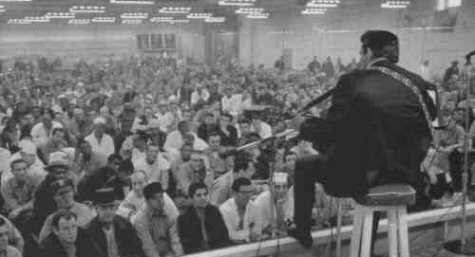
Upticks

Has Cameron Crowe’s Time Arrived? — Neither Walter Parkes nor any Walter Parkes-minded uber-executive will have anything to say about the final shape of Elizabethtown (Paramount, 10.14) so maybe things will turn out this time for director-writer Cameron Crowe…better than they did with Almost Famous, I mean, which wasn’t fully appreciated until it came out on DVD as Untitled.
I read Elizabethtown way back when and I’m telling you it’s a peach, but I guess I shouldn’t be trusted, being a Crowe loyalist and all. This sad-funny story of a suicidal shoe designer (Orlando Bloom) getting in touch with his down-home Kentucky side during his father’s funeral and falling in love with Jean Arthur-like airline stewardess (Kirsten Dunst) definitely has the stuff. Crowe’s films dance to their own clock and work for their own reasons and they always pay off (except for Vanilla Sky), so I’m wondering why it even matters if the Academy gets on the bandwagon or not.


Orlando Bloom, Kirsten Dunst during filming of Cameron Crowe’s Elizabethtown (Paramount, 10.14)

Word is Just Starting on Pride & Prejudice, and While It May Not Be The Second Coming…: “I think when it comes to your Oscar forecasting you can’t ignore this one,” a New York journo told me this morning. “Focus has pushed it back to November so it will get more attention, and it deserves a look. It’s quite good with has a top-notch cast. I think Matthew Macfadyen is gonna get lots of attention as Mr. Darcy, and Brenda Blethyn looks like Supporting Actress material as Mrs. Bennet. Falco is handling.” Hey, Falco…can I see it? (Focus Features, 11.18)

Conceivables

* Terrence Malick’s The New World (New Line, 11.9) The script has heart and says all the right things. The trailer promises wonderful photography with that great pastoral particularity Malick is known for. Colin Farrell as Cpt. John Smith and what looks like a strong supporting turn by Christopher Plummer — these and other indicators are quite heartening.
* James Mangold’s Walk The Line (20th Century Fox, 11.18) Great performances, okay, but will Academy types feel a little funny about the notion of handing nominations to another period music bio one year after Ray? Is it fair to even bring this up? If a film works, it works.


Joaquin Pheonix as Johnny Cash in Walk the Line (20th Century Fox, 11.18)

* All The King’s Men (Columbia, 12.16) Don’t know a damn thing about this except it’s apparently a modern take on the Robert Penn Warren novel about the rise and all of a Huey Long-like southern politician. Sean Penn has to be fantastic in the lead role, but why after every acting job does he always say he’s taking two years off because he’s burned out? (I’m burned out myself, but I can’t afford to take even a week off. Guess that’s the difference between being a big-time actor and a journalist, huh?)

Buckshot

I could spend another several hours on this thing, but it’s almost 2 pm in New York and I can’t…
* Ask The Dust (Paramount Classics, December) — Labor of love and devotion for many years for director-writer Robert Towne. Can’t wait to see Colin Farrell play a quiet, internal character; ditto those South African visions of 1930s Los Angeles.
* The Constant Gardener (Focus Features, late August) — I’ll say it again: this is the best feature-length adaptation of a John Le Carre novel since The Spy Who Came In From The Cold. Well written, superbly photographed, and basically sublime all the way around the track. Perhaps a bit too subtle in some respects for some, but definitely not me. If only director Fernando Meirelles (City of God) hadn’t cast Danny Huston as the heavy…


Viggo Mortensen in David Cronenberg’s A History of Violence (New Line, 9.30)

* A History Of Violence (New Line, 9.30) — Cronenberg’s best film in a long time, but even the best Cronenbergs don’t tend to register as award-level films. Except for the acting, I mean. Viggo Mortensen, Bill Hurt, Maria Bello….each performance burns deep.
* Brokeback Mountain (Focus Features, 12.9) — Ang Lee’s gay cowboy drama… bend over, grab that hitching post and get ready to feel the heartbreak. Jake Gyllenhaal (who popped up on Defamer this morning re Ted Casablanca) and Heath Ledger…I don’t know. I’m an old cowhand from the Rio Grande.
* Syriana (Warner Bros., 12.9) — Feels kinda particular, political, subdued, male-ish. What do I actually know? What have I heard? Nothing.
* The Three Burials Of Melquiades Estrada (still no distributor, presumably opening later this year) — A likely Best Actor nomination for director Tommy Lee Jones, if nothing else. And lots of critical support if and when it opens later this year.


Heath Ledger, Stephen Gyllenhaal in Ang Lee’s Brokeback Mountain (Focus Features, 12.9)

* Crash (Lions Gate) — This punchy thoughtful little indie that made it big with the paying public deserves all the accolades it can get, especially for the script (Paul Haggis, Bobby Moresco) and for Don Cheadle’s performance.
* North Country (Warner Bros., 10.7) — The new film from Whale Rider‘s Niki Caro, about an actual sexual harassment case from the mid ’80s that involved a female miner. Charlize Theron, Frances McDormand, Woody Harrelson, Sissy Spacek.
* Get Rich or Die Tryin’ (Paramount, 11.11) — Something hit when I realized this biopic about 50 Cent’s life in the criminal lane would be out in November after wrapping in early July. And you can feel the energy from the trailer. Doesn’t 50 Cent have a video game coming out in November, and didn’t I hear him say something about wanting to have the #1 song, the #1 movie and the #1 video game out at the same time?
I can’t do any more. I’ll have to jump into Part Two next Wednesday, which will include potential acting, directing and screenwriting nominees.

Rent Defense

“So let me get this straight: because there’s an effective treatment for HIV, the movie musical of Rent is out of date?
“Why can’t it be appreciated for its music and for highlighting a period in American history when people were dying from a virus that had no effective treatment? (And by the way, most of the world still doesn’t have access to these drug cocktails that treat it.)
“I’m sorry but David Karger and David Poland’s reasoning for dissing the coming of Rent are totally absurd.
“I’m not sure how Chris Columbus, the director of the film version, has handled the ending but it was an odd ending to begin with by having Mimi come back from what appears to be septic coma. If you have a medical background you would know eventually within a year that a person like Mimi would have been dead due to her continued weakened immune system and no effective treatment to fight off the virus that killed off her CD4 count.
“On top of which Rent is not just about AIDS but about the plight of anyone looking at their mortality faced with a terminal illness. Get a clue.” — Nick Good
Wells to Good: I would add, Nick, that the story of anyone facing any life-threatening situation works as a metaphor for terms we all face, which is that life is short and very dear, and continued health is not something any of us can entirely count on. In other words, treasure life as much as you can while you’re here…right?

Grabs


Broken Flowers director Jim Jarmusch, costar Jessica Lange at Maritime Hotel party following premiere at Chelsea Cinemas — Wednesday, 7.7, 10:48 pm.

Stella’s Pizza, 110 Ninth Avenue between 17th and 18th Streets…excellent!

All those turn-the-other-cheek Christians who wrote in to complain about my disdain of this and that aspect of their trip should check out Bill McKibben’s thoughtful and very sincere look at their skewed spiritual attitudes in a piece called “The Christian Paradox: How a Faithful Nation Gets Jesus Wrong,” found on page 31 in the August issue of Harper’s. There’s another terrific piece in the same issue by Mark Crispin Miller called “None Dare Call It Stolen: Ohio, The Election and America’s Servile Press.”

Harry Winston-level jeweler David Yurman, Broken Flowers star Bill Murray in lobby of Clearview Cinema’s Chelsea West just prior to premiere showing of Jim Jarmusch film — Wednesday, 7.27, 7:05 pm.

There are more slow-walking tourist pudgeballs shuffling around in groups of four and five near this intersection than in any other part of town. Shot taken Wednesday, 7.27, 6:35 pm.

Saturday, 7.25, 12:25 am.

For what it’s worth, the most succinct, persuasive and elegantly written subway ad I’ve seen all summer.

Way over on 33rd Street, a block or two from the home of the New York Daily News. I don’t know why I’m even running shots like this. Movie art on a big building….so what?

Gilbert Stood Tall

Gilbert Stood Tall

There are two things you need to know about Penn Gillette and Paul Provenza’s The Aristocrats (ThinkFilm, 7.29 limited). One, it’s quite funny but not in the usual way — it makes you laugh and also say at the same time, “Am I really laughing at this?” And two, you need to see it not just for the humor, but for the journey it takes you on.
There’s a quote made famous by the late Michael O’Donoghue that says “making people laugh is the lowest form of humor.” This is one of the few films I’ve seen that actually seems to get what O’Donoghue was on about.


Gilbert Gottfried, not just one of the stars of The Aristocrats but the star…at Caroline’s following New York premiere — Tuesday, 7.26, 11:15 pm.

This is a movie that basically gets laughs out of the different ways that gifted comics get laughs out of the same joke. And it’s really something to find yourself laughing at the tenth or the eighteenth or the twenty-fifth version of this rancid concoction…something because “the joke” isn’t all that funny, despite its reputation as a landmark gag that every major comic has passed along and had fun with.
The joke is basically about a man making a pitch to a talent agent with a claim that he and his family has a great act, and the agent agreeing to sit down and watch them perform it. The act is foul… in defiance of every tenet of civilized, moralistic behavior. And then the agent asks what the act is called and the man says, “The Aristocrats.”
< ?php include ('/home/hollyw9/public_html/wired'); ?>
I happen to agree with Drew Carey that the joke works better if you do the arm thing (as Jillette and Provenza are doing in the photo below) when you say “the Aristocrats.” But this doesn’t really change what Pat Cooper says early on in the film, which is that “the joke sucks!”
And that’s not the point.
You start laughing at this stupid-ass gag after the third or fourth telling, and the more you laugh the less you care about laughing, and the more you’re enjoying the talent and inventions and personalities of the joke-tellers and sampling the dozens of ways this relatively mediocre gag can be made to work.
It’s odd, but sharing in the enjoyment of telling a lame joke really well gradually makes the experience of laughing at a genuinely funny joke pale in comparison.
This is one of those movies you have to see because you have most likely never heard of, much less considered, the acts described in the various renditions of the joke. And to mull it all over in the company of strangers feels like some kind of therapy.


(l. to r.) The Aristocrats maestros Paul Provenza and Penn Jillette

It’s an oddly liberating thing to be sitting with a group of people and acknowledging (by the evidence of constant laughter) our gross animal commonality.
The experience is made extra-palatable by watching all these cool-cat big-name comics — George Carlin, Paul Reiser, Martin Mull, the great Gilbert Gottfried, Robin Williams, Bob Saget, Whoopi Goldberg, Jason Alexander, Eddie Izzard, Drew Carey, Eric Idle, et. al. — serving as goaders and ringleaders.
I said last January that the funniest bit of all is a tape of Gilbert Gottfried telling the joke at a Friars Roast of Hugh Hefner that took place in Manhattan only a couple of weeks after 9/11. He’s like Zeus up there on the mike…like Alexander the Great.
Nobody wanted to push any envelopes at this Friars Club thing, for obvious reasons. Everyone wanted to go easy — some comics wondered if it was even appropriate to try and be funny at such a time. What does Gottfried do? He gets up there and tells a joke about catching a connecting flight out of the Empire State building.** Somebody in the audience shouts out, “Too soon!”
It was at this point, more or less, when Gottfried began telling the Aristocrats joke and brought down the house.
It’s not just that he tells it with typical Gottfried-ian gusto, or that other comics in the room (like Rob Schneider) are literally on the floor. It’s the metaphor of what he’s doing.


(l. to r.) Gottfried at the Hugh Hefner roast almost four years ago in New York City, a couple of weeks after 9/11.

People of moderation and mediocrity are always telling creative people not to stick their necks out and tow the conventional moral line. Gottfried ignored this and rolled the dice and tapped into the emotional undercurrent and made it into something else. Laughter has always been about expunging hurt, and this time there was a lot to go around.
Gottfried’s routine also showed that truly creative people never second-guess themselves. They never sand down their material to fit what they’ve been told people supposedly want or don’t want. They go for it and let the chips fall.
I also love that when you bring this up to Gottfried he shrugs and goes, “Okay…that sounds good.” What he means is that he didn’t do anything deliberately, he didn’t think about it — it just happened.
The second funniest bit in The Aristocrats is Kevin Pollak telling the joke in the voice of Christopher Walken, or in the voice of Walken’s Sicilian goombah in True Romance.
The third funniest bit is Martin Mull telling the “kiki” joke (the one with the two anthropologists captured by loin-clothed natives and being told they can either die or suffer “kiki” and…you know how it goes), but with an Aristocrats substitution.
The fourth funniest joke is that clip of one of the little South Park guys telling it.
** The exact joke went, “I have a flight to California. I can’t get a direct flight. They said they have to stop at the Empire State Building first.”

Malleable Sheep

Adam Curtis’ The Century Of The Self is a nearly four-hour, BBC-produced documentary that’ll begin showing at Manhattan’s Cinema Village on August 12. Trust me, it’s worth the four hours and then some. It’s quite simply the most intriguing, audacious and insightful study of publicity, mass psychology and Orwellian mind control ever assembled.
The Century Of The Self is the pretty much untold and appalling story of the creation of psychological selling points in commercial and political marketing, and how this led to the culture of “me” and the expansion of mass-consumer societies in Britain and the United States. How was the all-consuming self created, by whom, and in whose interests?
Sigmund Freud, the founder of psychoanalysis, and his nephew Edward Bernays, the father of modern public relations and the concept of “spin,” are the genteel ogres at the heart of Curtis’s social history.

The Century Of The Self is the story of Bernays’ amazing influence, beginning in the 1920s, upon the techniques of selling and mass persuasion…techniques based upon the insights into the human psyche that his illustrious uncle made famous.
Curtis’s film says in essence that Freud’s uncovering of the drives within the human mind — and particularly the influence of our subconscious urges — has changed the world by way of Bernay’s seminal revolution in public relations techniques, the results of which are everywhere today, especially in big-time politics.
Before Bernays came along advertising and political promotion was essentially about laying facts before the public and leaving them to decide to buy or not buy based on rational evaluation. Bernays’ big idea was getting industry to start pitching products and services to people’s unconscious — to pull them in based on what they emotionally wanted, but didn’t necessarily need.
An explanation on a BBC website puts it well: “By introducing a technique to probe the unconscious mind, Freud provided useful tools for understanding the secret desires of the masses.
“Unwittingly, however, his work served as the precursor to a world full of political spin doctors, marketing moguls, and society’s belief that the pursuit of satisfaction and happiness is man’s ultimate goal.”

Telluride Film Festival director Tom Luddy was the one who turned me on to The Century of the Self during the 2003 San Francisco Film Festival.
Luddy told me soon after that journalist/author Christopher Hitchens is a big fan of this film; ditto Orville Schell, Dean of Berkeley’s Graduate School of Journalism.
Schell, said Luddy, had thought one way for The Century Of The Self to be seen in this country would be for PBS’s Frontline series to air it. A call or two suggested otherwise. Brilliant and on-target as many believe Curtis’s documentary to be, it may, by the standards of American TV journalism, not be “balanced” enough.
Self says in essence that we live in a country run by leaders who have never trusted the voters and have always sought (successfully, in most ways) to “control” our thinking and appetites and political allegiances. Such a declaration would almost certainly ignite controversy.
A show like Frontline, says Luddy, would “have to have two sides…they’d have to have this quote-unquote ‘objectivity’…and this film is a polemic…it suggests that our democracy is manipulated by people who believe the voting public is fundamentally irrational.”
Schell, who describes Luddy as a kind of Johnny Appleseed of new, see-worthy films, agrees that The Century Of The Self “is a natural to be aired someplace because it’s a very good film.

“But I don’t know that it’s a natural for ‘Frontline.’ I don’t think that show lends itself well enough to this kind of mission statement. But I think it’s an amazing project, and precisely the kind of thing American TV should be providing.√ɬ¢√¢‚Äö¬¨√Ǭù
However, says Schell, “If a film such as this were to appear on a network, I think I’d have a heart attack. The tragedy is that it’s so unimaginable that a film such as this could be shown, much less made, by any of the apparatus that has come to be known as American TV.”
I called Curtis in London in June ’03 and asked about what has been perceived by some as a lack of balance in this film. He said the mode of presenting differing points of view about a controversial subject is obviously a venerated approach, but it’s now old hat.
“Those days of journalism are over,” he said. “That was the sort of journalism that was formed during the Cold War. Our job is to actually tell a story, but it’s not a polemic — it’s a particular story told from a particular viewpoint.
“In the old days everyone knew what was happening on the world political stage…there was a big struggle, that was it. Now there isn’t an agreed-upon story, an agreed-upon position to be adopted. Christopher Hitchens has said that the job of modern journalism is to make sense of all these fragments that you can argue for or against.”

The Century of the Self is composed of four one-hour chapters titled “Happiness Machines,” “The Engineering of Consent,” “There is a Policeman Inside All Our Heads: He Must Be Destroyed” and “Eight People Sipping Wine in Kettering.”
There’s a whole rundown — photos, chapter breakdowns, links– about the series on a BBC site that will fill in some of the gaps.
This doc really deserves to get out there and be seen as widely as possible by New York media types, so it’ll get some decent exposure when the DVD comes out.

Ancient Pelican

Don’t ever expect movies that you liked as a kid to stand up when you see them again as an adult. It’s almost better to leave them in your head than confront the reality of what they really are and were.
I haven’t seen William Wellman’s The High and the Mighty since I was 11 or 12, when I caught it on the tube in a pan-and-scan version. I’ve never seen this 1954 film in widescreen (it was shot in the somewhat wider CinemaScope used in the early to mid ’50s, which had an aspect ratio of about 2.55 to 1). And I have these hazy notions of it being an emotionally affecting thing (I’ve always been a sucker for Dimitri Tiomkin’s emphatic scores) and John Wayne exuding a certain authority in the role of the middle-aged co-pilot.
I guess this means I’m going to at least rent the two-disc special edition DVD when it comes out August 2nd, especially with all the extras….but I’ve got my fingers crossed.


Jacket cover for Paramount Home Video’s DVD of The High and the Mighty (due August 2nd) and one-sheet issued during film’s 1954 theatrical release.

The High and the Mighty is about a commercial flight from Honolulu running into trouble during a flight across the Pacific to San Francisco, and a lot of people — the crew among them — becoming more and more persuaded that the plane and its passengers are headed for the drink.
It was Hollywood’s first multi-character soap-opera disaster movie, and was thought to be a little sappy and sentimental even for its day, and we all know how cornball characteristics tend to worsen over time.
A pen-pal journalist who’s seen the DVD says The High and the Mighty “is worse than anyone remembers…hopelessly stodgy and dumb, and very boring unless you’re into laughing at it.”
He trashed the cockpit POV shot when the injured plane finally lands at San Francisco airport and the landing lights form a crucifix and Wayne says, “Now I lay me down to sleep.” Okay, overbaked…but I flew across the country one time in a Beechcraft Bonanza four-seater and when you land at night the runway lights do look like a cross. (I wonder what the lights look like if the pilot of a damaged plane is a Muslim or a Buddhist.)
It’s all speculation until I see it, but here’s one thing I know for sure: the jacket art on the DVD makes it look like something from one of those cheapo companies who put out public-domain films.
Quality level DVDs either use some representation of the original ad art or come up with a modern variation or substitution that’s even better looking. Paramount’s High and the Mighty jacket art does neither. That close-up shot of Wayne in his airplane pilot’s uniform along with that drawing of an airplane looks like it’s aimed at the K-Mart crowd.

Grabs


ThinkFilm honcho Mark Urman (l.) at Tuesday night’s after-party at Caroline’s following the premiere of The Aristocrats. I don’t know the guy on the right.

Actress Leigh Spofford (Kinsey, The Human Stain) with L.M. Kit Carson (l.) at the 7.26 Aristocrats party. Spofford is the star of Cat’s Paw, a thriller that’ll soon be shooting in and around Oxford, England, and will costar John Shea. Carson is exec producing. Alun Harris is directing the film, which Carson describes as “Pulp Fiction meets Chariots of Fire.” Spofford played Liam Neeson’s daughter in Kinsey. (Apologies for having gotten the title wrong earlier — Carson and Spofford made a short together last year, and this was the source of the confusion.)

Captives in underground blast furnace-sweat box — Sunday, 7.25, 6:40 pm.

Would a caption make a difference? First Avenue just north of 3rd Street — Sunday, 7.24, 11;20 pm.

First Avenue around 3rd or 4th Street — Sunday, 7.24, 10:50 pm.

Park Avenue looking south from 61st Street — Monday, 7.25, 10:50 am.

Daily News columnist Lloyd Grove, Dick Cavett at Tuesday’s Aristocrats party.

Why do the women reading paperback books in subways and airport lounges always seem to be reading mass-market fiction? Why don’t I ever see one, just one, reading a book by, say, William Faulkner or Gore Vidal?

Cover of last Sunday’s New York Daily News, lying on top of garbage in waste basket on corner of 9th Avenue and 39th Street.

One-sheet for Jim Sheridan’s Get Rich or Die Tryin’ which only just wrapped two or three weeks ago but is coming out in November. That may not be a super-fast turnaround by Otto Preminger standards (he finished shooting Anatomy of a Murder in May of ’59 and had it on the screen two months later), but it’s pretty quick by today’s.

Still The Shit — High-Fivin’ “Hustle & Flow”

Still The Shit

I’ve written so much about Hustle & Flow I’m starting to bore myself, but this is the weekend and now’s the time. I saw it with my son and a couple of his friends at the sneak last Saturday night, and I felt the same satisfied vibe from the people walking out…the same one I’ve been feeling since last January.
This movie sells ideas about life and creativity that may not be true, but people sure as hell want to believe them…I know that. We’ve all got pain in our hearts and poetry in our souls and it’s never too late to make your move, etc,


Terrence Howard and Taraji P. Henson in Craig Brewer’s Hustle & Flow.

In a perfect world the response this weekend would trash the idea that Craig Brewer’s pic is primarily an African American rap movie that’ll play best with non-whites. Bullshit. It should do as well in Bangor, Maine, and Tempe, Arizona, as it does in Memphis, Tennessee. It is so much more than what you think it might be.
Hustle & Flow is as grittily rendered as a formula film can get, and that’s a good combination. By my standards it’s a fairly honest portrait of who and what people are deep-down and how it all works out there, but it’s also a film out to please. It’s got some laughs and some good music and good people in it, and a happy ending.
< ?php include ('/home/hollyw9/public_html/wired'); ?>
In other words, formula can be intriguing. To say you’ve “seen this kind of film before” means nothing. The question must always be, “How well was it made, and how much did you care?”
It’s worth it alone for Terrence Howard’s D-Jay, a flawed, at times brutally insensitive guy in a classic do-or-die struggle to make it as a rap artist. This is really Howard’s time…he’s off and on his way. I hope the Cinderella Man crap-out doesn’t stop that Joe Louis film he’s supposed to make from getting funded.
Anthony Anderson is almost as good as Howard…so good he’s made me wonder more than once why he’s made so many throwaway piece-of-shit movies during his career. Costars Taryn Manning, DJ Qualls, Taraji P. Henson and Ludacris make it play true and steady and right as rain.


Hustle director Craig Brewer, producers Stephanie Allain and John Singleton just after first public showing at last January’s Sundance Film Festival.

Every frame of this movie says, “You know what we’re doing…this guy wants to climb out of his crappy situation and maybe we’re gonna show him do that…but we’re gonna do it in a way that feels right to us.”
And once D-Jay hooks up with Anderson and Qualls and starts to put together a sound and record a few tracks, Hustle & Flow is off the ground and pretty much stays there, suspended.
Forget the funky backdrops and gritty-ass particulars — is there anyone out there who can’t relate to a character who feels stuck in a tired groove and wants to do more with his/her life? Is there anything more commonly understood these days?
Whatever you might expect to feel about D-Jay, he is, by the force of Howard’s acting and Brewer’s behind-the-camera input, utterly real and believable, and even with his anger and brutality you can’t help but root for him. And, for that matter, the film.

Lazy Ass

I didn’t dislike The Bad News Bears. Didn’t love it, didn’t mind it, didn’t hate it…half went with it.
Billy Bob Thornton has been in shittier films and will be again. He’s another nihilist drunk this time, but he’s also an ex-baseball player who used to be good and has retained a certain poise and centeredness. He’s loaded but smooth about it.
I would be ashamed if I were Richard Linklater, who made a much-better studio jerkoff movie called School of Rock a couple of years ago, not to mention the sublime Before Sunset, a film that anyone would be proud of. But of course, I’m not Richard Linklater.
As Thomas Becket says in the movie, “Honor is a private matter, and each man has his own version of it.”

I said to The Bad News Bears about ten or fifteen minutes in, “Okay, you don’t care that much about showing me a really good time, but you’re mildly entertaining here and there. So I’m just gonna sit here and be mildly satisfied and nod off if I feel like it and let it go at that.”
What this is is a decent lazy movie, like a friend who comes over and does nothing but eat potato chips and watch movies without saying too much. He/she is never going to accomplish anything big or invite you to climb mountains in Austria, but he/she is a good soul and you like him/her and that’s good enough.
There are movies that are so slovenly and dumb-assed that they stink. The Bad News Bears is only half-assed bad. According to my system, that means it’s also half-assed good.
I can actually see renting the DVD in December, or watching this thing on a plane someday with the headphones on (as opposed to my standard habit of watching films without sound and seeing how expressive and particular they can be on purely visually terms).

Lifeboat Again

During our brief chat last week about the October release of Alfred Hitchcock’s Lifeboat on DVD, Fox Home Video publicist Steve Feldstein didn’t tell me the precise date. Come to think of it, he didn’t even tell me the month. I’ve since learned from other sources that this special-edition DVD will be in stores on Tuesday, October 18th.
The boilerplate rundown on this disc, passed along at DVD Answers, doesn’t say anything about a digital remastering, but it’s inconceivable that some kind of visual improvement wasn’t pushed through by Fox’s resident preservationist Shawn Belston.

The extras will include a commentary by USC film studies professor Drew Casper, a generic “Making of Lifeboat” featurette (no word if Hitchcock specialist Laurent Bouzereau, who’s directed many making-of featurettes for other Hitchcock DVDs, was hired to do this particular one), the theatrical trailer and a still gallery.
It’s interesting that Fox has taken a shot of the lifeboat survivors in the film, colorized them and lightened them somewhat, and put them onto a wide-angle shot of a placid moonlit sea. A very pretty image. Intriguing, attractive…but my recollection is that nothing remotely like this is seen in the Hitchcock film.
My earlier Lifeboat commentary ran last week, and here it is…just scroll down to the lower part of the page.

Severin

If you haven’t yet decided to see Gus Van Sant’s Last Days this weekend (along with Craig Brewer’s Hustle & Flow, of course), maybe this will put you in the mood. I just listened to it myself, and I’m half-inclined to see Days for the fourth time. Either you hear it or you don’t.

Spanning Decades

“I rented L’Eclisse maybe three months ago, right after the Criterion DVD came out, mainly because it was an Antonioni picture but also because of recommendations I read on several websites, including yours. It’s also present in Scorsese’s documentary on Italian cinema.
“I watched it and granted it was kind of hard at times, but as you said it was unforgettable, especially the final minutes of it and all the stockholder bidding scenes.
“Since then I’ve been trying to spark some interest among my friends to see this film, or any Antonioni movie they can find, and it’s definitely not happening. It’s the same with Kurosawa, Fellini, Tarkovsky, Dassin and everything that is old.


Monica Vitti, Alain Delon in Michelangelo Antonioni’s L’ecclise

“I can’t say there’s a definite ‘no way’ attitude about it, but there’s not a real interest in it. It’s a generational thing, but these people are supposed to be interested in film (like your film students) and Kill Bill is not the end of the rainbow, you know.
“I just watched the War Trilogy of Wadja and I’m stunned at how accesible and just beautiful to look at those films are, and it’s been impossible to convince anyone of my age to see them. I go to rent movies, and all these great old ones are just sitting there and all these young “hipsters” are fighting each other to rent ,Party Monster or Lost in Translation.
“But now there’s a lot of interest in seeing Last Days, so maybe we’re onto something.
“Anyway, even though not many people my age care or would appreciate the greatness of L’Eclisse, I just wanted to drop a line saying that everything’s not lost cause I’m 25 and completely loved that one, and when I saw those final minutes of empty streets and wandering strangers in silence, it felt liberating, like cinema has no boundaries or something like that.
“It’s kind of like the feeling you get from Kubrick movies, and 8 1/2, and if film students are not watching these films and others as good, well, they should.” — Alexandro Aldrete, Monterrey, Mexico.

Christians

“I wish you wouldn’t waste your energy and column space sparring with the Christian Right. They are indeed wacko, in addition to being hypocritical and naive. You can bet your ass you will not see Mark from Boston in an Iraqi foxhole anytime soon.
“The Christian right is not interested in compassion, the basic message of Christ. James Dobson, et. al. are more interested in declaiming themselves as members of a Chosen Few Network, and then lording it over the rest of us.
“You can go ahead and inhale NASCAR fumes, lay your concrete or other low value-added job, and be xenophobic. But there are engineers in China and India who soon will be able to dictate our standard of living. And they don’t give a scrap about Jesus.

“So Christian Right lads & lassies, it’s not so much the content of your belief, but your constant, anachronistic mantra has distracted the United States from it’s traditional role as a progressive, rational, technologically superior, and respected nation.
“I disagree with D. Tucker also. I believe the Christian right would vote for a Democratic candidate if and when the bottom falls out of this deficit economy and they have no money for Wal Mart.” — Arizona Joe

“I’ve enjoyed reading your column for several months now, despite my wincing occasionally at some of your condescending prose regarding middle-American Christians. However, you’ve taken it a little too far this week with your denigration of Doug Liman’s “cool hip Christians” comment. What you said has seemed ignorant and offensive, at least to this Christian.
“So I’m removing Hollywood Elsewhere from my list of bookmarks. Just thought you might want to know your arrogance has lost you at least one reader. But since you automatically presume I’m a badly dressed, strangely smiling automaton, you probably won’t mind too much.” — Todd Wicks, Detroit, Michgan.
Wells to Wicks: No, I’m sorry you’re leaving. Sort of.
“Regarding your comment about middle-American Christians dressing horribly, I would blame that more on retail sales than on religion. Trends seem to hit the United States in New York and Los Angeles and work their way inland. By the time a trend is popular in the Midwest, there’s something new on the coasts.
“Availability is another problem. I’m an avid GQ reader, and if I see
something nice in, say, the July issue, odds are I have to get it from a place in New York or LA or maybe Chicago. I think the reason many small-town Midwesterners, Christian or not, dress poorly is that their only choices are the clothes available at their local Wal-Mart.
“I enjoy your column. It’s turned me on to quite a few decent films, most recently Crash — my favorite of 2005 so far.” — John Wilson, Des Moines, Iowa

Wedding Payoffs

“You’re right about the third act in Wedding Crashers killing the steam, but don’t most comedies go that way? Even classic comedies have trouble maintaining the momentum of the first two acts because eventually you have to turn over jokes at the hands of the plot.” — Evan Boucher.
Wells to Boucher: Yes, generally speaking, most comedies turn it down and start playing their sincere cards (i.e., the ones that tell us what the main characters are really feeling) at the end of act two before cutting loose at the finale…Some Like It Hot, The Graduate, Jerry Maguire…all the great ones do this. But these three films, also, don’t seem to be wandering around and trying things out without much assuredness, as Wedding Crashers seems to do in its final act.

Boucher to Wells: Vince Vaughn and Rachel McAdams are the big winners here. Vaughn for being uniquely good at the rapid-fire dialogue and bringing out that affectionate duality (you love him because he’s a good guy and an asshole), which he should stick to for the rest of his career. And McAdams for being more unspecialized. She’s obviously talented, and one dividend of that is that she gives you more than what you think you’re going to get and seems pretty genuine.
“It’s funny that McAdams got her break in Mean Girls as the villain, then went to The Notebook for some chick-flick immersion and now this. Pretty good career path for diversification.”
Wells to Boucher: I think Owen Wilson got a pretty good bump also. The first time people stepped back and realize he’d formulated this witty, absent-minded Texas space-cadet character and had figured out the patent was when he did Shanghai Nights with Jackie Chan and it made money. The Wedding Crashers payoff is about people realizing his presence in comedies always results in a certain intellectual pedigree, and that Wilson can also do emotional sincerity and romantic stuff fairly well.
Boucher to Wells: “Yeah, but I get a different thing from him after this movie. I think that he is just about as good as whatever he’s reading. If it’s good (anything he writes with Wes Andersen, or this one, or Meet the Parents) he comes off as really being a plus for the film. But he certainly doesn’t look like he can carry anything, and he can’t really make something out of nothing.

Wells to Boucher: Aaah, but he can! Everything he’s in, he rewrites or tweaks in order to make that guy he always plays come off in a pithy-funny way. You never just hire Owen Wilson to just show up and act — he’s always the co-writer.
Boucher to Wells: Wilson has never had a success without Stiller or someone else to be the real draw. It might be an odd comparison, but maybe he’s slightly like Jason Alexander in the way that he can never be the man. The worst thing that could happen to this guy’s career is that with that bump you’re saying he’s getting off Wedding Crashers, that he will go back to believing he’s the man and make ten more Big Bounce‘s or Behind Enemy Lines-type things.”

Grabs


49th or 50th Street (forget which) between B’way and Seventh Ave. — Thursday, 7.21, 9:25 pm.

Unintentional shot taken on way out the 8th Ave. and 14th Street subway station — Sunday, 7.20, 6:25 pm.

Stinky, totally soaked aftermath of fire in small store on Canal Street near Lafayette — Saturday, 7.16, 11:40 pm.

The unkindest gossip of the last couple of days is that Katie Holmes either has hammer-toes or only four toes on one foot. It’s cruel to publicly criticize someone’s anatomy. (Private critiquing is another matter.) This close-up shot, which has been cropped from a larger photo, seems to dispel both notions. There was a woman I knew in the late ’90s who had hammer-toes, and I vividly remember standing in her kitchen once and fighting off the thought that her feet looked like an adult gorilla’s, except they were hairless. It would have been painful for her to have overhead this, but I used to refer to this woman in private conversation as “gorilla foot.” In any case, Holmes is not that and she has all five digits on both feet, so leave it alone.

Saturday, 7.16, 9:55 pm.

T-shirt worn by woman at Last Days party — Tuesday, 7.19, 11:20 pm. Cultural-animus sentiments allegedly taken from photo of graffiti snapped in 1979.

There’s only one slight pre-viewing problem with Must Love Dogs (which is sneaking Saturday night) and it’s not that big a deal, but it’s there. It’s my impression, based on the trailer, that John Cusack, one of my favorite guys, has put on a few pounds. He needs to get back to his Gross Point Blank weight.

Nice shot I happened to run across — obviously pre-9/11.

Actual page from press kit for Pretty Persuasion, a Samuel Goldwyn release due in August. I’m a huge fan of James Woods’ performance in Citizen Cohen. I thought he lent considerable dignity to the character of Nate Cohen, a Jewish businessman living in a small Texas down during the 1950s and ’60s who’s forced to deal with anti-Semitism.

49th or 50th and Seventh Ave. — Thursday, 7.21, 7:50 pm.

Kurt’s Eclipse

Kurt’s Eclipse

It took me a while, but I’ve finally come to see that Gus Van Sant’s Last Days (Picturehouse, 7.22) is some kind of great film, and maybe even a masterpiece.
About five weeks before I first saw Last Days at the Cannes Film Festival, I showed Michelangelo Antonioni’s L’eclisse (The Eclipse), a stylishly profound piece about alienation and spiritual drainage among the aspiring classes in 1962 Rome, to some UCLA students in a class I was teaching.


Michael Pitt (l.) as the Kurt Cobain-like Blake, with Kim Gordon (wife-partner of Sonic Youth’s Thurston Moore) in Gus Van Sant’s Last Days.

I told the students this was a movie in which almost nothing happens, and that they may feel bored or frustrated by it initially. But I promised them they would never forget it, and that if they didn’t stop being film buffs (i.e., really paying attention to movies) they would eventually understand its greatness, although probably, in most of their cases, not until they hit their 30s or 40s.
I acknowledged that it’s essentially a movie about, in a manner of speaking, “nothing”…about a couple of attractive people toying and flirting with each other and having a bit of sex here and there, but otherwise doing and saying relatively little, without anything resembling a story between them and certainly without any pronounced conflicts or resolutions of same in the third act.
But it has an emotional seep-through effect. There’s a torrent of small things in L’ecclise that stay with you — dispirited looks, hints of eros and emotional voids, meditative moments, intimations of ennui and pointlessness. It doesn’t “say” anything but there are echoes all through it.
< ?php include ('/home/hollyw9/public_html/wired'); ?>
Anyway, I showed L’eclisse because I know it’s one of the most sophisticated art films of the 20th Century, and because the students would probably never see it on their own (it had recently come out on a spiffy new Criterion DVD) and because, as I said to them before showing it, no one in the commercial or semi-commercial realm is making films like this any more.
And then, super-observant guy that I am, I went to Cannes and saw a direct descendant of L’eclisse in Last Days, which has a lot of similar chops and attributes. And I didn’t even see it.
Even without the Antonioni analogy, Last Days deserves your obeisance and then some.


L’eclisse costars Monica Vitti, Alain Delon

The idea of it being masterful has been kind of sneaking up on me since my second viewing about three weeks ago here in Manhattan. I don’t expect most of the readership to agree. Some will hate it or find it frustrating, and others will be half-and-halfers. But that’s the usual drill with bold-ass art of any kind.
After the Cannes screening I knew it deserved respect for the way it was shot and cut, for going once again with that story-free verite thing that Van Sant used on Gerry and Elephant .
I wrote that “ten or fifty years from now people will watch [Last Days] and say, “Weird movie… what was that? But you know something? It’s got something.”
I also said that “compared to Shane Black’s Kiss Kiss Bang Bang and Atom Egoyan’s Where the Truth Lies [which I had seen the same day], Last Days is the least formulaic and the most out-there. Unlike the other two, it feels like it was made in the 21st Century.”
So I respected it but at the same felt a bit underwhelmed. I wrote, “Nice chops but the emotional content is zilch.”


A hot and sticky crowd in front of the Sunshine theatre on East Houston Street for the New York premiere of Last Days — Tuesday, 7.19, 7:20 pm. That’s Maria Full of Grace star Catalina Sandino Moreno being interviewed at lower left, Michael Pitt
(wearing T-shirt with hole in the back) standing to right, Gus Van Sant (in blue) closer to theatre entrance.

That was my inner middle-class suburban guy who used to get B’s and C’s in high school talking. I like movies that make me feel something that I want to feel — shoot me. What this means is that when a film makes me feel something I don’t want to feel, I recoil and complain.
I also thought Van Sant had pushed his deconstuctionist aesthetic a bit too far this time.
Watching Michael Pitt, in his performance as a Kurt Cobain-ish junkie musician called Blake, mumble and shuffle around and occasionally nod out didn’t seem as involving to me as the happenings in Van Sant’s Elephant, about some banal activities among kids at a high school on the day of a Columbine-like massacre. That film, at least, had a kind of ticking-clock suspense element.
My basic beef, in short, was that not enough happens in Last Days that’s worth caring about…unless, that is, you’re a big Cobain/Nirvana fan and any movie that sheds even a shard or two of light about Cobain’s 1994 suicide is therefore worth the price of admission.
Last Days should really be called Last Hours. The use of “days” in a title implies at least three 24-hour cycles, and it didn’t seem to me as if what happens in the film takes place over more than two days. It could be occurring in a 36-hour period…not that this matters a whole lot.


Screenwriter-producer L.M. Kit Carson and Picturehouse chief Bob Berney at Last Days after-party at Piano’s — Tuesday, 7.19, 10:40 pm.

Pitt (last in The Dreamers and Murder by Numbers ) gives a much better performance as Blake than you might appreciate at first. He’s very into the stupor, the lack of anything emotive…the heroin-fog personality. He convinced me he’s really into the same nihilistic space that Cobain was apparently caught up in just before the end.
Remember those long unbroken shots of kids walking through school hallways in Elephant? Same deal here, except this time the subjects are spaced-out, half-articulate heroin users hanging out inside an unheated home and doing stoned musician-type stuff…talking about music, cooking up macaroni-and-cheese in the grungy kitchen, having sex, listening to the Velvet Underground in their living room, etc.

The film is mostly about Blake, of course, who plays a tune at one point and is shown taking an overnight camping trip through the woods early on. Mostly, however, he avoids the phone and runs away whenever someone knocks on a door and spends a lot of time sitting around like a zombie and nodding out, even when a Yellow Pages salesman comes to visit.
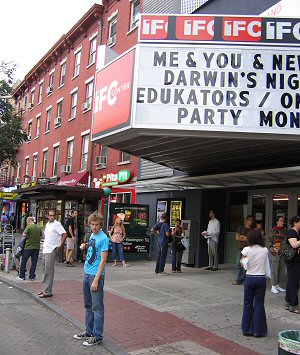
Cobain had a heroin problem near the end of his life and it’s obvious Blake is using big-time in the film, but Van Sant chooses not to show him hitting up. I thought at first this was a tad dishonest, like a film about a man dying of cancer in a hospital that doesn’t show any scenes with doctors or nurses or chemotherapy.

But now I don’t know. Without syringes and tying off and blackened spoons, there’s a metaphor to consider. Don’t ask me what it might be because I’m still toying around with ideas. But it has something to do with showing us what’s being missed and slept through and thrown away. It’s about the sin of not being able to see beyond your own shit.
The more I think about it, the more of a really effective anti-drug movie this seems to be. It isn’t just life-like, but life-affirming.
After the Cannes screening I wrote that the juiciest scene in Last Days is when one of Blake’s bandmates (amusingly played by Scott Green) goes into the living room and puts on the Velvet Underground’s “Venus in Furs”– that plodding, screechy, oddly hypnotic cut from their 1967 banana album in which Lou Reed sings, “I am tired, I am weary, I could sleep for a thousand years.”
I was rocking in my seat last night when this scene played — it’s a great musical moment — but I wasn’t focused on it as much as before. Instead I was getting off on almost everything in the film in different ways.
This isn’t just a movie about states of mind. It’s about “wow, man…whew….the world out there…keep it out, don’t let it in.”
I really like the dispassionate artified way that Van Sant and his cinematographer, Harris Savides, capture the squalor. Everything they show is painterly, perfectly framed…almost serene. And I love the drugginess of it. There hasn’t been a film that has felt this exotic and ultra-believable about a fairly familiar subject (the star of a rock band having difficulties) in a long time.


Michael Pitt, Last Days music consultant Thurston Moore during latter stages of after-party at Piano’s — Tuesday, 7.19, 11:55 pm.

For what it’s worth, Last Days really knows the heroin-user mentality. I used to hang with guys who were into smack when I was living in Boston in my early 20s, and the way they sat around and talked and basically did very little…that’s this movie, all right.
It’s no small thing for a film to be observationally fascinating (the third viewing was just as watchable for me as the first two) but at the same time relatively banal-seeming and tension-less in terms of story. Last Days isn’t playing the precise same tune that L’ecclise did, but it’s certainly playing with a lot of the same instruments and a vaguely similar attitude.
Do it right — rent L’eclisse this weekend and see it before going to Last Days, or vice versa. I’d really like to hear some reactions by Sunday night.

What Happened Was…

I didn’t know (i.e., nobody told me) I needed to renew ownership of the domain name of “Hollywood Elsewhere” on or before 7.19 so the site came to a sudden grinding halt Wednesday morning. I fixed the error at 8 a.m. but it took about twelve hours for the renewal of the domain to promulgate around the world. I don’t know about anyone else, but I love spending time on this shit. Talk about fulfilling.

“You Can’t?”

This isn’t hard to identify. Shall we let it go at that?

Hustle & Flow

“It’s too bad that Hustle & Flow‘s trailer seems to be turning more people off than on. This, at least, is what a couple pals said after the Saturday sneak preview. They said it’s not very good at portraying the real rhythm of the movie. I’ve seen it myself and agree wholeheartedly.
Hustle & Flow is going to make a whole lot of money, whether in theatres or on DVD. Sneaking it was the smartest thing Paramount Classics could have done, to dispel some bad vibes people have, thanks either to the trailer or the attachment of MTV’s name to the piece.
“Whether or not Terrence Howard gets a big awards push for this role, it’s going to take him to the A-list for sure. DJ Qualls finally gets a decent part to work with, along with Anthony Anderson and the rest of the cast.
“A genuine, smooth-flowing script and a note-perfect cast makes this one more worthy of your six to twelve dollars than most films of the last few years.” – Moises Chiullan

Redneck Supreme

“I enjoyed your piece on The Last American Hero. Odd that it isn’t available on DVD because I’d always heard great things about the movie. Odder still that your Fox contact didn’t realize the movie was one of ‘ours’? The film has been shown a number of times on FXM (Fox Movie Channel) over the past six months. I’ve caught it twice, I think. Are all the p.r. guys at the big home video distributors this knowledgeable and on top of it?” — Darth Presley
Wells to Presley: I think they’re just over-burdened…too many balls in the air, too much on the plate.

Grabs


Tarnation director-producer Jonathan Caouette and two pals whose names I didn’t get (sorry) at Last Days after-party at Piano’s — Tuesday, 7.19, 11:10 pm.

Sculpture
based upon famous “Lunch on a Skyscraper, New York City 1932” photo, sitting on some kind of towable platform in Soho — Saturday, 7.16, 10:10 pm.

Original “Lunch on a Skyscraper, New York City 1932” photo, shot roughly 55 stories above Rockefeller Center.

New York City photographer-painter-clothing designer Sequoia Emmanuelle (www.sequoiaemmanuelle.com ) posing for Hollywood Elsewhere photographer while waiting for Brooklyn-bound L train last Saturday afternoon, 7.16. Rainbow-rasta hair styling by Dana Ferrullo (www.goddessmaker.com) who says she’s created this hair style to roughly 30 or 40 people so far on both coasts.

Young man
with a Canon A95 digital camera — Saturday, 7.16, 1:25 pm.

Greene Street near Broome Street — Saturday, 7.16, 11:20 pm.

Christians

“For fuck’s sake, Wells — stop it already with the attack against Christians.
“Don’t you realize that this vehement anti-Christian rhetoric you’ve been spewing all these years is now coming dangerously close to hate speech? How is it possible that you don’t understand that you’re exhibiting the same kind of (closed-minded) behavior towards Christians that you claim ‘95%’ of them exhibit towards others?” — Mark from Boston
Wells to Mark: I just took issue with the notion of “cool hip Christians,” which I believe to be an oxymoron. The things I wrote about the Christian socio-political agenda drew on impressions that are pretty widely shared, I think.
Mark-from-Boston replies: “This anti-Christian stuff has become an obsession with big-city, left-leaning hipster types (I see it in Boston daily), and it’s got to stop. I’ve never met a single Christian who was anything but honest and kind and genuinely well-meaning. They’re responsible for a great deal of the good that’s being done in the world on day-to-day, ground-level basis (feeding the poor, housing the homeless, etc.). You see a few of them on TV spouting anti-gay rhetoric and you think that’s representative of the entire culture? That’s called prejudice.”

Wells to Mark: My impression — the civilized world’s impression — is that a fair number of Christians out there — the vaguely wacko kind — seem to be xenophobic homophobes who, in their heart of hearts, want to smite the wicked and roll back the clock.
Mark-from-Boston replies: “And so what if a good deal of them seem to support Bush? You’re welcome to disagree with them. Just please stop hating everyone that disagrees with you for moral reasons. This kind of crap makes you look juvenile. Christians aren’t the evil empire you’d like them to be. They’re individuals, just like you and me.”
Wells to Mark-from-Boston
Ruins of Roman collisseum, called the Flavian amphitheatre in its day.
“And since many of these guys see abortion as a civil-rights issue (i.e., the civil right of the unborn child not to be terminated), there’s no way they’ll vote for people like Gore and Kerry regardless of their positions on deficit reduction, etc.
“And your comment that Christians can’t dress and all smile strangely? Come on, Jeff. You would never say that about any other religious group.” — D. Tucker
Wells to Tucker: But c’mon….middle-American Christians do dress horribly for the most part and some do smile like pod people. Shouldn’t the truth count for something?
“So Mark-from-Boston sez, ‘I’ve never met a single Christian who was anything but honest and kind and genuinely well-meaning.’ Is this guy kidding?? Give me a fucking break!!
“Apparently he’s not willing to acknowledge how the Christian right-wingers are in our current U.S. political landscape are really overstepping their well-meaning boundaries…it’s driving me absolutely CRAZY! Keep stickin’ it to ’em, Jeff, and if guys (and gals) like Mark don’t like to read it, they can go elsewhere…just not Hollywood Elsewhere.” — Bryan from L.A.

Charlie Plummet

“Those 6.9 million copies of the new Harry Potter book being sold last weekend is probably the main reason why Charlie and the Chocolate Factory experienced that Friday-to-Saturday 8% falloff.
“Say a million of those kids were interested in seeing Charlie last weekend. At an average kid ticket price of $7 (and I think you’ll agree the price is low), that adds an additional $7 million to Warner’s coffers for the weekend, sending Charlie over the $60 million mark for the weekend.
“At the music festival where I work, it seemed like four out of five kids entering the park were carrying around a copy of the book last weekend while exactly half the mostly college-aged employees in the accounting room were reading it as well.
“The Potter effect is very real. That’s not to say you’re wrong about kids about kids not reading much these days. There’s a ton of kids my age (I’m 19) who couldn’t tell you who Truman Capote, John Steinbeck or Nathaniel Hawthorne were, but they’ve read each of the Potter books five times. This isn’t so much a literary phenomenon as a cultural one that sits alongside the iPod and the Xbox joystick.” — Kyle Dickinson

More Grabs


Big celebration at Fanelli’s (neighborhood bar at Prince and Mercer) following bridal-shower party — Saturday, 7.16, 10:40 pm. (It’s been my experience that women who are very close to getting married are more approachable and even seducible than when they were single and unattached. I’ve gotten lucky in this respect twice, and the reason, I’ve concluded, is because the women said to themselves, “This is my last shot before tying the knot — I don’t want to break my marriage vows so if I’m going to bed some guy I’m attracted to, now’s the time.” The reason I’ve mentioned this is because the expression of the woman with the veil seems to be expressing…vaguely suggesting?…this attitude on some level.)

L train to Brooklyn — Saturday, 7.16, 12:25 pm.

Two girls and a guy looking for tickets to a show at the B.B. King Blues Club on 42nd Street — Tuesday, 7.20, 6:50 pm.

Breakfast at El Brilliante on Montrose Avenue in East Williamsburg — Sunday, 7.17, 9:25 am. Check out those prices…$6.50 for a skirt steak?

Bathing suit designs by Keiko (“…by far the most innovative bathing suits in the American market,” according to fashion-icon.com) at 62 Greene Street.

Never Got ‘Em: Don’t Want No “Dukes”

Never Got `Em

The Dukes of Hazzard (Warner Bros., 8.5), a ’70s retro redneck fast-car thrillbillie movie that looks like a lotta fun…the kind of fun that comes from sticking needles in your eyes…will be upon us three weeks from today.
I think it’s entirely fair to assume the worst with films of this type. I mean, look at the trailer already. Get out the chewing tobacco and clothes pins.


Johnny Knoxville, Jessica Simpson, Sean William Scott in The Dukes of Hazzard.

Does anyone see any indications that this might be Starsky and Hutch, a ’70s TV series film that was smartly written and better-than-tolerable for the Ben Stiller- Owen Wilson repartee? Dukes looks common, crude…or am I leaning too much on impressions?
The director is Jay Chandrasekhar (Super Troopers, Club Dread); the costars are Johnny Knoxville, Sean William Scott, Jessica Simpson, Burt Reynolds, Joe Don Baker and Willie Nelson.
I’ll be there because of Simpson’s skimpy outfits but gimme a break with the General Lee flying through the air and all the other crap. And I’m not a reflexive hater of hot-car movies. I loved Gone in 60 Seconds (guiltily) and I bought into The Fast and the Furious.
< ?php include ('/home/hollyw9/public_html/wired'); ?>
I’m encouraged by the tracking reports that a high percentage of urban respondents are marking this one down as a must-to-avoid. Revolt! Go blues!
Reynolds needs the money, I suppose, but it’s a tiny bit ironic he’s in this thing, which is a kind of salute to the redneck films of the mid ’70s to early `80s. Ironic because Reynolds killed his career by making too many of these films with Hal Needham directing.
I don’t remember Joseph Sargent’s White Lightning (’73) as being too bad, but the rest — Stroker Ace, Gator, the three Smokey and the Bandit‘s — were on the painful side.

Redneck movies were born in the early `70s (’72 and ’73, to be exact). They got rolling in the mid `70s, peaked in the late `70s and early `80s, and were pretty much over by ’84.
That was the year when Reynolds burned his once-loyal fans for the last time (i.e., those who were still with him after two previous Needham pics) with a farewell performance as J.J. McLure in The Cannonball Run II. Nobody was better than Reynolds at being smug.
There were two kinds of ’70s redneck films — the high-speed, action-packed, stupid-ass variety about sexy-macho moonshine smugglers always being chased by the fuzz and always with a Daisy Mae girlfriend or two, along with the creepy-pervy ones about city folk running into toothless inbreds in overalls with all kinds of foul things happening, including outdoor pig-squealing anal sex.
The fun redneck movie was pretty much shoved into gear by White Lightning (’73), in which Reynolds first played the stud-smoothy Gator McLusky. He played the character again three years later in Gator.
The creepy kind came into being in ’72 with John Boorman’s Deliverance (which still plays…a brilliant film) and Wes Craven’s Last House on the Left. And the genre still lives today, most recently in the form of Greg McLean’s Wolf Creek.

Hero‘s Salute

There was only one high-velocity ’70s redneck film that was any good, and it wasn’t even a redneck film.
It was a scrappy piece of backwoods Americana about a young guy on the wrong side of the law who went on to become a famous stock-car racer, a movie that was actually loved by critics and was also an unfortunate financial disaster: Lamont Johnson’s The Last American Hero (1973).
For me, this is the super-daddy of redneck movies, the one that got it right with unaffected realism and a kind of dignity by not dealing in the usual cliches and showing respect for its characters, and by being intelligent and tough and vivid with fine acting.

Hero was loosely based on Tom Wolfe’s legendary 1965 Esquire article about one-time moonshine smuggler and stock-car racer Junior Johnson. Wolfe’s piece was called “The Last American Hero is Junior Johnson. Yes!”
The movie is about a guy named Junior Jackson (Jeff Bridges) who’s more or less content to smuggle illegal hooch until he gets pinched and his soul-weary dad (Art Lund) persuades him to think twice, and he eventually uses his car-racing skills to break into stock-car racing.
Geraldine Fitzgerald, Ed Lauter, Gary Busey and Valerie Perrine are among the costars.
There’s no question that Johnson’s film was widely admired (nearly all the serious film critics got behind it, especially Pauline Kael). And its influence in Hollywood circles seems hard to deny, its commercial failure aside, for the simple fact that it was the only backwoods-moonshine movie at the time that was seriously respected for what it was, as opposed to being (nominally) respected for what it earned.
As movies steeped in rural southern culture go, The Last American Hero had roughly the same levels of honesty and sincerity as Coal Miner’s Daughter, which came out in 1980.
Hero stood out for the gritty low-key realism that Johnson and his collaborator Bill Kerby brought to the script. The original Hero screenplay was officially credited to William Roberts, but, as Johnson told me during a brief phone conversation yesterday. “it didn’t have any real people in it,”


The Last American Hero director Lamont Johnson

The Last American Hero wasn’t an art film — it was a punchy thing with a kind of B-movie feeling — but it stood out for its avoidance of easy ironies and from any kind of condescension toward the hardscrabble characters, and for the totally on-target performances.
Articles like Wolfe’s and films like The Last American Hero make me forget about my loathing of red-state attitudes and even lead to affection for the vitality of working-class types and the blue-collar thing. They make me feel like their characters belong to my country. They make me want to eliminate the “Blue State” blue-ribbon logo that I’ve displayed in this column space for nearly a year.
It’s not genuine Americana that I can’t stand — it’s the degraded, stupid-ass, hee-haw stuff peddled by downmarket opportunists and turned into corporate-brand jackoff diversions like The Dukes of Hazzard TV series and motion picture.
What galls me is that most consumers out there don’t even know what genuine backwoods Americana is — they just know the Happy Meal-kind that corporations have sold to them.

The irony is that one of the biggest corporations, Rupert Murdoch’s Newscorp, the owner of 20th Century Fox, isn’t selling The Last American Hero. It isn’t available on DVD, and Fox Home Video, the rights holder, has no plans to put it out.
When I called that division’s public-relations guy on Thursday to ask about possible DVD plans, he asked, “This is ours? It’s a Fox movie?” Yeah, it’s a Fox movie, I said. Fox has the rights. “We produced it?” Yeah, Fox produced it in ’73, and Fox Home Video put it out as a VHS in ’97.
I think I convinced him, but I wrote him back again today to ask if he’d had a chance to ask the higher-ups, and he didn’t respond. But at least I’ve started the awareness thing a little bit. Maybe someone else will pick up the ball.
It would be nice to see this film again along with DVDs of my two other most-wanted ’70s films — Play It As It Lays and The Friends of Eddie Coyle.

Jarmusch

One of the six or seven reasons today’s column went up so late today is because I got hung up with technical issues in trying to prepare a digitally recorded interview for what I hope will be the first of a series of Podcasty-type deals I’m trying to turn into a regular thing.
It’s a recording of an interview I did Thursday, 7.14, with Jim Jarmusch, the writer-director of Focus Features’ Broken Flowers, which will open in theatres on August 5.
Apologies for the long boring rambling intro — I’m re-recording it this morning (Saturday). And all that rumbling background noise you can hear while Jarmusch is speaking…I dont know what that could be. We were sitting in a very quiet back room of an Italian restaurant.


Jim Jarmusch in the back room at Ballato’s, an Italian eatery at 55 East Houston (between Mott and Mulberry) — Thursday, 7.14, 4:45 pm.

Like anything else, it’s going to take a while to get these things down and sounding right.
Anyway, here it is. Thanks to Moises Chiullan, a good guy from Florida State University in Tallahassee, for urging me to do this and doing the sound editing and whatnot.
And I’m highly recommending the restaurant, by the way. It’s called Ballato’s, a kind of old-feeling, late 1940s Godfather-y type place. Visually, I mean. Jarmusch has been going there for years and says the food is wonderful. It’s at 55 East Houston, between Mott and Mulberry.


The late-afternoon light in Ballato’s back room is really beautiful — delicate, diffused.

This is Jarmusch in a nutshell — he told the publicity people to run his press kit biography as lean and pruned down as possible. None of the usual press-kit blather…just list what he does, list the film titles and that’s it.

At Long Last

Lifeboat, the only Alfred Hitchcock movie that hasn’t been restored and/or remastered and put out on DVD, is finally undergoing that process and will be released by Fox Home Video before the end of the year, according to spokesperson Steve Feldstein,
Lifeboat isn’t often recognized as one of Hitchcock’s best films, but for me it’s right up there with Strangers on a Train, Rear Window, North by Northwest, Shadow of a Doubt, Notorious and Vertigo.
I’m astonished that it took Fox Home Video this long to come around. They had it out on laser disc in the early ’90s but the transfer was awful, which always seemed extra-offensive to me given that Glen MacWilliams’ black-and-white photography is exceptionally beautiful with all kinds of moody textures and fog lightings and whatnot.


The Lifeboat team (l. to r., minus Walter Slezak and Canada Lee): Henry Hull, John Hodiak, Hume Cronyn, William Bendix, Heather Angel, Tallulah Bankhead.

Lifeboat is one of the best-written Hitchcock films (script by Ben Hecht, Jo Swerling and John Steinbeck) with whip-smart dialogue that is on-target and feels authentic for its time. It has a certain “written” quality that was par for the course in the early ’40s, but it’s so well shaped and phrased that the theatrical refinement feels right in the pocket.
Tallulah Bankhead, John Hodiak, William Bendix, Hume Cronyn, Walter Slezak, Henry Hull…talk about assurance. Six performances with a certain actorliness (and flamboyance, in Bankhead’s case), but at the same time relatively straight, unaffected and concise. (There are three performances that feel overly sentimental — Heather Angel’s, Canada Lee’s and Mary Anderson’s.)
Lifeboat is easily Hitchcock’s most visually inventive film. He imposed a huge challenge upon himself in having to tell a riveting story and make it all feel vital and visually absorbing despite the entire thing being set in a lifeboat on the North Atlantic, and damned if he didn’t succeed. (Hitchcock even figured a way for his usual cameo appearance to happen.)
It’s an excellent example of how persuasive studio-based photography and 1940s visual effects could be in the hands of the right director. It was all shot on a Hollywood sound stage, but you can really feel the unruly energy of the sea and taste the salt water on your lips. It’s a much more convincing evocation of what it must be like to be afloat and helpless in the middle of a vast ocean than anything you saw in Waterworld.

I’ve been asking the Fox Home Video people off and on for years about when they were finally going to move on a Lifeboat DVD, and they’ve never had any kind of answer. Like all home-video divisions Fox Home Video has seemed, to me, almost Soviet-like in its penchant for secrecy and not being candid about internal workings or plans.
And yet, oddly, South Korea put out a Lifeboat DVD in 2003.
Check out the image of Hodiak and Bankhead on the Korean DVD jacket cover [above]. It’s from a scene in the film, of course (their characters become lovers aboard the lifeboat, although it doesn’t seem to involve anything more than making out), but there’s no missing the allusion. It seems as if Bankhead, who was quite the liberated woman in her time…well, you get the drift.

Grabs

Is “Charlie” The Beginning of End for Burton?

Groaning with Charlie

I have a very strong if fragmented opinion of Charlie and the Chocolate Factory. That’s because I saw only the opening 35 minutes last Thursday evening, so take these words with a grain of salt and read someone else for an in-depth review.
But I know what I know, darn it, and I’ve always been able to spot problematic movies in ten minutes or less (just like I can tell if a script is any good or not after reading the first ten pages), and for whatever this method or impression may be worth to readers, I despised this Tim Burton/Johnny Depp film.


Johnny Depp as Willy Wonka in Tim Burton’s Charlie and the Chocolate Factory.

Not in the way I hated Mr. and Mrs. Smith (that’s a kettle of fish I can’t bear to savor any further at this point) but because it feels like such a rank and oppressive Tim Burton ego trip. Burton is an immaculate visual composer, but Charlie has been made with such a lack of humility and directorial restraint that it sucks up all the oxygen in the room.
Forget Johnny Depp’s Michael Jackson-esque performance…this is what I know and feel and sense up and down. Charlie and the Chocolate Factory (Warner Bros., 7.15) is not truly a children’s film. It’s a movie by, for and about a 46 year-old director who has tended more and more over the last few years to over-emphasize and over-indulge for visual composition’s sake alone.
< ?php include ('/home/hollyw9/public_html/wired'); ?>
Thick Burton syrup has been poured over each and every frame. It’s an ooze-fest, this film.
It’s all about Burton more or less proclaiming, “Me! This movie is about me! Aloof, detached, visually exacting. I know you all know this, but I need to say again that I’m an absolute master at creating these lavish, ultra-particular compositions, especially when I have a lot of money to work with…and Brad Grey certainly saw to that.”
Of course, all great filmmakers invite you into their world and make essentially the same film over and over again. I guess I’m basically saying that Burton has nothing to say any longer and has become an anal-obsessive bore in a pictorial/compositional sense.

Not that any of this will matter commercially. Charlie is tracking through the roof and will make a huge bundle this weekend.
I didn’t leave Charlie after 35 minutes because I hated what I was seeing, but because I had to scoot over to a 7 pm screening of The Wedding Crashers — a film I was very much looking forward to — in the same plex. I was extremely relieved to escape into the world of Vince Vaughn and Owen Wilson after suffering so badly in the House of Burton. It’s possible I was extra-delighted with Crashers because of this.
Two days later (i.e., last Sunday) I happened to catch an hour’s worth of Mel Stuart’s Willy Wonka & the Chocolate Factory, the 1971 Gene Wilder film that Burton’s film is based on even if he says it isn’t (he’s been telling everyone he didn’t like the ’71 film and that his version is primarily based upon the Road Dahl book).
I tend to have a bad time with kids’ films and I had therefore avoided Wonka my entire life, but here I was finally watching it and, to my surprise, half-enjoying it right away. It has a certain fanciful quality and an easy-going attitude, and Wilder — in the top-hatted lead role — manages to pitch his performance to both kids and adults.
And Stuart’s film seems to be much more about the Dahl book (which I’ve skimmed) than Burton’s film is.


Gene Wilder in Mel Stuart’s Willy Wonka and the Chocolate Factory

The Corpse Bride may be a successful turnaround, but for now I’m thinking Burton might be over. Seriously. I think he’s caught up in his own mystique and mythology, and Charlie is the latest proof. Burton’s absorption in just-so photography and production design has become an end in itself…a bore.
There doesn’t appear to be anyone at Warner Bros. who’s aesthetically planted or strong of character or well situated enough to tell him “no, this is too much” or “no, this doesn’t quite work” and so Burton goes hog-wild during shooting. He’s not off the reservation; he’s floating above it. He’s become an auteur the way Michael Cimino was an auteur when he was making Heaven’s Gate.
The Tim Burton of Ed Wood, Edward Scissorhands, The Nightmare Before Christmas and Beetlejuice is dead.
The bad Burton…the Burton of Planet to the Apes, Mars Attacks, Batman Returns, Big Fish and Sleepy Hollow (a beautifully-made spooky-fable movie, but mainly about production values) now rules.
To paraphrase Pauline Kael, when Burton’s on the set he seems to act like mad royalty, adding rooms to the palace. He’s rolling in the clover of his own imaginings, in production bucks, overly indulged, given to excess, etc.


Charlie and the Chocolate Factory director Tim Burton

A little voice told me last weekend I should see Charlie and the Chocolate Factory start to finish, despite the lethargy that awaited, so I made my way to Manhattan last night (i.e., Tuesday) to see an IMAX version. Alas, I arrived about ten minutes late and was told there were no seats. I snarled and expressed disappointment with the publicists in the lobby, but I was secretly glad.
Last Thursday’s brief exposure was, for me, the next thing to absolute proof that I’d be in for a very rough time with a complete viewing. There has never been and there never will be a movie that turns out to be good after rubbing you the wrong way for the first 35 minutes. If a movie has the right stuff, you can always tell…you can smell it like good food.

Incidentally…

The Warner Bros. publicist at last night’s IMAX screening told me it’s studio policy to forbid or prevent journalists from reviewing a film off an IMAX print — a completely ridiculous and absurd position, of course. If anything, IMAX presentations tend to enhance a film’s value, not detract.
I saw Batman Begins in both 35mm and IMAX versions, and while both provided every last visual and thematic point that director Chris Nolan intended, the IMAX, naturally, had more of a “wow” impact. But I wouldn’t have missed a thing if I’d only seen the IMAX version. The film is the film is the film.

Youth


Michelle Pfeiffer (l.) flirting with an obviously delighted journalist during June 1982 press schmoozer at Manhattan’s Paramount building (located back then at Columbus Circle) to promote Grease 2.

Down With Capote

A bird…you know, one of those little tweety birds…told me a few days ago that Bennett Miller’s Capote (Sony Classics, 9.30) is probably going to play the Toronto Film Festival. I guess that’s not much of a surprise, is it?
I’ve also learned that Douglas McGrath’s Have You Heard?, the competing Capote biopic that Warner Independent will distribute, will open in September 2006.
It finished shooting in April 2005 and therefore could have been ready for release before the end of the year, but two Capote movies going up against each other during the final four months would have probably been destructive on both ends.
I would have loved to see both come out simultaneously. I would think that people inclined to see a Capote biopic in the first place would make a point of seeing both no matter what. But that’s not the majority viewpoint.


Phillip Seymour Hoffman as Truman Capote and Catherine Keener as “To Kill a Mockingbird” author Harper Lee in Bennett Miller’s Capote (Sony Classics, 9.30).

Phillip Seymour Hoffman plays the celebrated author in Miller’s film (I can’t wait to see this…is there any way Hoffman won’t totally kill in this role?) and Capote lookalike Toby Jones plays the lead role in the McGrath version.
There’s an understanding that both films will cover more or less the same arc in Capote’s life, beginning with Capote’s research, writing and triumphant release of “In Cold Blood” in the early to mid ’60s, and then go into the downfall period of the ’70s and ’80s.
The latter period was partly caused by and certainly highlighted by Esquire magazine’s publishing of an excerpt from Capote’s never-finished roman a clef called “Answered Prayers,” and ended with Capote’s 1984 suicide, which Gore Vidal famously called “a very wise career move.”
Catherine Keener will play Capote’s lifelong pal Harper Lee (author of “To Kill a Mockingbird’) in Miller’s biopic. Sandra Bullock will play Lee in the McGrath.
Both will focus on Capote’s very intense, possibly sexual relationship with convinced Clutter family killer Perry Smith. Mark Ruffalo will play Smith in the McGrath film; Clifton Collins, Jr., will play him in the Miller version.
The only thing giving me pause about Toby Jones is that he’s played the voice of “Dobby the House Elf” in the Harry Potter movies and “Smee” in Finding Neverland.
Postscript: For whatever reason my source in Laura Kim’s office at Warner Independent didn’t tell me when I spoke to her on Wednesday that McGrath’s Capote film has been retitled Have You Heard? and is therefore no longer being called Every Word is True.
In preparing my story I somehow overlooked a New York Times piece by David Carr that discusses the two Capote biopics, and was posted on 7.13.

Not Bad

I realize Tom Cruise gags have gotten tedious over the last couple of weeks, but this one…well, you tell me.

Island-ing

I missed seeing Michael Bay’s The Island (DreamWorks, 7.22) at one of those sneak preview showings last weekend, but I caught the premiere on Monday night at the Zeigfeld. Not my kind of flick, but the after-party at Roseland was terrific — extremely tasty food, not too crowded, ambitiously decorated.
I don’t know why exactly, but there were more big-breasted girly-girl types at this event than at any other social gathering I’ve attended in Manhattan since I arrived here six and half weeks ago.
I’m holding my reactions to the film until next week sometime, even though the sneak made it fair game. Here are two responses — one from Fox 411’s Roger Friedman, the other from Movie City News’ David Poland.
A critic friend is calling it “viscerally abusive and totally prosaic,” and says “watching it is like reading a letter by someone who’s a terrible writer, but thinks he’s compelling your attention by SUDDENLY SHIFTING INTO CAPITAL LETTERS and ENDING SENTENCES WITH FIVE EXCLAMATION POINTS!!!!!”


Follically-challenged thirtysomething guy at Monday night’s after-party following the premiere of The Island

Michael Bay, director of The Island

Adult-sized, Matrix-inspired clone fetuses, straight from the Island shoot and used at entrance-way decorations for lavish Island party at Roseland.

Island Tracker

“Maybe the reason that The Island isn’t tracking very well is simply that the damn trailer gives away every possible plot twist and surprise in the movie.
“I realize that’s a common complaint today, but it’s one thing to do it for Pride and Prejudice (which every college-educated woman in America has already watched the miniseries of) and another to do it for a Matrix-y sci-fi thriller which depends, in large part, on the clever ideas and secrets it will dole out as the movie goes along.
“If you watch that trailer, you quickly learn that (1) there is no Island (several lines of dialogue state this explicitly to remove any doubt), 2) the characters are clones being harvested for body parts, something seen not only in Parts: The Clonus Horror but basically in Coma and Logan’s Run, meaning it’s basically another ’70s remake, (3) they run away and there’s a big car chase (hey there’s a novelty in a sci-fi movie these days), (4) one of the high points is them having sex for the first time and being wowed by it, and (5) Steve Buscemi apparently playing the same disaffected scientist role he played in Spy Kids 2.
“Would anyone have cared about seeing the original Matrix if its trailers had given away its major revelations and high points so determinedly?
The Island needed to have some mystery about it and let the sinister secrets be revealed slowly; this trailer makes sure you know there’s absolutely nothing here you haven’t just seen in Minority Report or on an average night on the Sci-Fi Channel.
“Watch the trailer in a big crowd and you can feel the air going out of a promising (if a bit old hat) premise. If The Island tanks, it’ll be a suicide.” — Mike Gebert

Grabs


Columbus Ave. and 74th Street — Tuesday, 7.12, 7:40 pm.

Looking south from Seventh Ave. and 50th Street, just after leaving the Island party — Monday, 7.11, 11:35 pm.

Has anyone out there actually bitten into one of these Charlie and the Chocolate Factory Hostess Twinkies…like I have?

Aboard Metro North train heading for Westport, Connecticut — Friday, 7.8, 8:05 pm.

Bedford Avenue and 5th Street — Monday, 7.11, 5:35 pm.

Security line at Loews 42nd Street plex to get into press screening of The Wedding Crashers — Thursday, 7.7, 6:59 pm.

“Has anyone ever said that you overplay your various roles rather severely, Mr. Kaplan?”

Eastbound L train — Thursday, 7.7, 11:10 pm.

Bedford and 2nd Street — Monday, 7.11, 5:40 pm.

Tim Burton decline chart and theory, submitted by Grant Peterson.

Here They Come….Wedding Crashers!

Here They Come…

That Vince Vaughn profile in the current Newsweek doesn’t lie. His performance as a motor-mouthed, totally scheming hound in Wedding Crashers — a very sharp, at times inspired comic romp — is so hilarious at times that it feels off the earth.
I was saying to myself during last night’s press screening, “This is astounding…the great dialogue just keeps blasting away and Vaughn isn’t missing a beat.”


Immaculate deception: Owen Wilson and Vince Vaugh in David Dobkin’s Wedding Crashers

It’s not just Vaughn, of course, but Vaughn and Owen Wilson — also playing a schemer but at the same time the half-soulful counterpoint to Vaughn’s totally sociopathic manipulator — and the banter between them. These guys are a better comic team than Wilson and Ben Stiller. The back-and-forth is fantastic…it’s Martin and Lewis-level.
Vaughn’s comic timing and manic energy make this far and away his best performance since Swingers, and yet he’s so much better here than he was in that 1996 film. It’s Vaughn finding his groove the way Cary Grant kicked into gear when he made The Awful Truth and Bringing Up Baby.
< ?php include ('/home/hollyw9/public_html/wired'); ?>
Vaughn never falters except at the end when the movie makes him go all sappy and sincere. But mostly (and let’s just admit here and now that Crashers doesn’t quite make it all the way around the track) he’s perfect. We’re talking major current here.
Wedding Crashers (New Line, 7.8) stumbles at the close of the second act and doesn’t get its groove back until the very end (it flops around like a goldfish for about 20 minutes), but most of it works. Just because a section of the final act doesn’t play like it should doesn’t mean the first 80% isn’t glorious.

Nobody sings anything in The Wedding Crashers, but the gags and especially the His Girl Friday-on-steroids banter between Vaughn and Wilson is so hilarious and whip-smart that it feels like great music. We’re talking kick-ass dialogue of an exceptionally high order…flip, smarty-pants stuff that doesn’t quit and keeps building and getting funnier.

Plus a reasonably decent stab at romantic sincerity here and there and a very winning, career-making performance by Rachel McAdams.
It’s Vaughn and Wilson (giving the warmest, most fully developed and winning performance of his career…as much of a career-bump thing as his breakout performance in Shanghai Noon was) hitting comic highs that haven’t been felt in a mainstream studio comedy in ages.
It’s the whole concoction — the chemistry between Vaughn and costar Owen Wilson, the wit and attitude in Steve Faber and Bob Fisher’s script (jazzed by Vaughn and Wilson’s on-set improvs), and echoes of not just Meet the Parents but Mike Nichols’ The Graduate.
The Wedding Crashers isn’t as successful as it could be with the sincere emotional stuff, but it does a half-decent job of working with the Graduate scheme of the Three D’s (desire, deception, discovery).

The Graduate is about Benjamin Braddock’s desire for the sultry Mrs. Robinson, the deception he has to throw around to pursue his weeks-long affair with her, and the discovery of true love when he meets and falls for Elaine, her classy and soulful daughter. The last act is about Benjamin’s trying to stop Elaine from marrying a sexist arrogant asshole named Carl.
The Wedding Crashers brings a slightly different order to the formula — discovery preceded by desire preceded by deception.
It’s about a likable deceiver (Wilson’s John Beckwith) — a guy who spends all his time crashing weddings with his pal Jeremy (Vaughn) so he can score with emotionally receptive bridesmaids by lying his ass off about everything…whatever works so he can get in their pants.
Emotions thicken when he falls for a very classy and soulful girl (McAdam’s Claire Cleary), a daughter of a powerful man (like Elaine’s attorney dad was). The discovery comes when he realizes he’s in love and absolutely has to prevent her from marrying an arrogant asshole named Sack (Bradley Cooper, who bears a resemblance to Brian Avery, the actor who played “Carl” 38 or 39 years ago).
I don’t want to make too much of the Graduate analogies, but they do exist and The Wedding Crashers is at least trying to fuse sincere emotionality with rollicking humor. Call me an easy lay, but the fact that it’s not too bad during the heartfelt portion (the last 20 minutes or so) strikes me as acceptable.
The bottom line is that most of this film sails above the clouds. I realize the R rating is going to restrict business among kids in the hinterlands, and it may be too hip for the room in the red-state areas and especially among those who thought Meet the Fockers was the schizzle.


Rachel McAdams, giving the most winning and emotionally grounded performance in a romantic comedy in a long time.

The Wedding Crashers is so much sharper and scalpel-ish than Fockers, they’re not even in the same ballpark. I think it’s funnier and a lot hipper than Meet the Parents even.
There’s only one seriously “off” element, and this is elaborated upon in a transcript of a back and forth I had last night with a guy (see below).
This is a great, great guy comedy…it accepts and celebrates the fact that 95% of the time the only way to get rolling with a woman is to give a sincerely tender, bullshit-stuffed performance. And the first two-thirds (or three-quarters or whatever) take you on a ride with a couple of serious pros who know all the ropes and the angles and still get thrown for a loop and are made to suffer for their sins.
And it’s 80% pure pleasure.

Debate

A guy named “Erasmus” wrote last night to say he’d recently seen Wedding Crashers at a screening held by Creative magazine, and that he thinks it may be getting mixed word-of-mouth because of the ending.
“Not true,” I answered him. “This movie really sails for the first two thirds. I was howling. I was in fucking heaven. It loses its way when the guys get busted, yes, but it gets it back at the very end. And those first three-quarters are incandescent.”
And here’s how it went from there….
Erasmus: To be fair the first two acts which would roughly be the first one hour and ten minutes work reasonably well.
Wells: Not “reasonably well”….inspired. When this movie is in the groove it is in the damn groove and three or four times funnier than Meet the Parents when it is. I’m not exaggerating my feelings. It is awesomely funny at times.

Erasmus: In a Hollywood genre-go-lucky way.
Wells: I really think you’re missing it. I think it’s brilliant, wonderful, ecstasy-time during those first two acts.
Erasmus: But the third act falls apart and everyone knows it’s how the audience feels as they walk out of the movie that matters.
Wells: The third act is bit of a fumble, yes. The movie loses the heat when the guys are busted and sent packing. But the end of it works pretty well. It’s not inspired but it’s pretty good. It touches the bottom of the pool.
Erasmus: And then there’s that big-name supporting cameo that totally kills the movie.
Wells: [Name]’s appearance is not a good thing for this film…you’re right. He’s not funny. He’s actually a drag. He’s actually tedious. He’s a monkey wrench…a chemistry killer.
Erasmus: In fact, some people will say, why is this guy is every comedy all the time? They did not need him.
Wells: Correct.
Erasmus: Any other actor but this guy would have been fine.
Wells: Agreed.
Erasmus: And so in a summer filled with many movies with serious third-act problems — War of the Worlds, Bewitched, Mr. and Mrs. Smith — another has been added to the list.


Jane Seymour, Owen Wilson

Wells: You’re not wholly wrong, but the third-act problems are not fatal. They just wound it somewhat.
Erasmus: This movie will still be a hit, despite the stock characters.
Wells: Isla Fisher’s character — the little redhead Vaughn hooks up with — brings a certain freshness to the piece. Rachel McAdam’s character is on the stocky side, fine, but she’s such a good actress she makes her character feel more believable than she’s actually written. Walken is a bit more supple and less obsessive in his father-of-the-bride role than De Niro was.
Erasmus: And a Jane Seymour development that is
started and then dropped right this.
Wells: Why did they do that? Drop her, I mean.
Erasmus: The first two-thirds work. But they had a chance for Meet the Parents-like numbers of $160 million but will get, at the maximum, $80 million.
Wells: I don’t think so. This thing sails so well during the first two thirds, it will be as big as Parents….I think.

Clone Wars

To cover their bases, critics planning to review Michael Bay’s The Island (DreamWorks, 7.22) should probably take a gander at a 1979 low-budget sci-fi flick called Clonus, which came out on DVD last March.
I won’t be seeing The Island until this weekend (it’s sneaking Saturday night) and I haven’t seen Clonus (a.k.a., Parts: The Clonus Horror), but I know they’re both paranoid thrillers about people being cloned by some super-secret government agency.
It’s being widely alleged by a lot of geeks out there (as well as the “movie connections” references for both films on the IMDB) that The Island is a remake of Clonus.


Scarlett Johansson, Ewan McGregor in The Island

Here’s a link to one of the many websites making this claim.
The general view seems to be that the makers of the 26 year-old Clonus — director Robert S. Fiveson, screenwriters Bob Sullivan and Ron Smith — should have received credit or compensation or something.
If the remake allegations have merit (I say “if”), the Island producers and the DreamWorks attorneys probably compared the 1979 film to their about-to-be-filmed screenplay and calculated there was no way the Clonus team could come after them legally.
Clonus, which has apparently been shown on the Sci-Fi Channel and Mystery Science Theater 3000, is about a character named Richard, a resident of some kind of remote micro-managed outpost. Like all the inhabitants of this carefully controlled environment, Richard hopes to be chosen to be sent to a country where everything is ultra-cool and civilized, or something like that.

He eventually discovers that everything about his existence is bogus. He and all of his friends are actually clones whose basic purpose is to provide spare parts for their organic human counterparts. Knowing it’s only a matter of time before this happens, Richard and a fellow clone named Lena attempt an escape to an outside world, blah blah.
The IMDB’s synopsis for The Island reads as follows: “A man (McGregor) goes on the run after he discovers that he is actually a ‘harvested being’ and is being kept along with others in a utopian facility.”
For what it’s worth, if you do a Google search for ‘Clonus’ and ‘The Island’ you’ll get thousands of hits commenting on the similarities.
There’s a difference of opinion about whether Clonus is a moderately worthy little sci-fier or a grade-Z enterprise that sucks eggs. Reader opinions will be considered and possibly posted.

Considering

At the beginning of my so-called journalistic career some 26 years ago, I came up with an idea for a magazine called Nothing.
It was supposed to be a half-serious, half-satiric look at celebrities and media matters and movie culture, etc. It seemed to me back then that the tendency of magazines and newspapers to cover the especially puerile and shallow aspects of entertainment culture was getting more and more pronounced.
I figured it might work if a magazine came out that pretended to play this game along with everyone else but was actually satirizing it on some level. Maybe the idea was a little ahead of its time, but it doesn’t seem to be that now with David Spade planning to host a Comedy Central show that lampoons celebrity and movie coverage on shows like Extra and Access Hollywood.

The idea wouldn’t be to suggest that the people profiled or subjects covered in Nothing are empty in and of themselves, but that everything is seeming more accelerated and vacant, and less and less deserving of even our passing attention.
Nothing is all we have, all we’re left with in the end.
It could be kind of a two-tiered thing, actually — satirical as well as existential commentary. I don’t mean to draw a specific reference, but I guess I was half-thinking about Jean Paul Sartre’s Being and Nothingness when I thought up the name.
The magazine wouldn’t so much as cast a glance in Sartre’s direction, of course. It would be aimed, I suppose, at the readers of…I don’t know, Radar or Giant…the usual under-40 males with a sense of humor who’ve had a brush with higher education.
I just know that the culture is about as far away from matters of real substance as it’s ever been, and seems to more and more into pointless diversion. And we need more magazines…well, not exactly deploring this but at least pointing it out in some appropriately dry fashion.
This test cover (thrown together by the intrepid Michael R. Felsher, author of the new HE column “Cinema Obscura”) is what it could look like…maybe. I’ve always imagined something a little dryer, a bit more like Harper’s or The Atlantic.

Another idea I came up with 25 years ago is a regular column called “Hollywood Weltschmerz: The Celebrity in Pain.”
Every damn article about every celebrity is always about how great their life is…how productive, creative, exciting, challenging, etc. I’m not imagining a column that would seek to portray celebrities as gloom-heads but something that would attempt to portray hard-driving filmmaking types in mock-bleak terms…kind of like what Art Linson goes for in his books about producing.
Webster’s Online defines “weltschmerz” as “sadness over the evils of the world…an expression of romantic pessimism.”

New Guys

Here are logo headers for some of the new columns that have been going up. Some of the columnists are just getting going and probably won’t hit their stride for a few weeks yet, but when you get a chance….