Kubrick Taschen

Instead of spending 10 bucks to see Adam Sandler clobber prison guards this weekend, think about dipping into your slush fund and coughing up a portion for The Stanley Kubrick Archives (Taschen). Take it home and bolt your doors and let it seep in, page by lustrous page.
I’m so in love with this thing that I packed it in my suitcase earlier this month and hauled it all the way from Los Angeles to New York, and then up to my parent’s home in Connecticut. I almost took it with me to the Cannes Film Festival. It’s my best friend, my rock `n’ roll, my lump-in-the-throat. I haven’t felt this way about a mere possession in a long, long time.
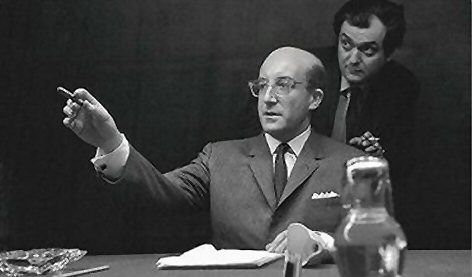

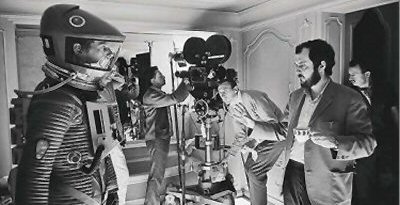
Stanley Kubrick (r.) directing Peter Sellers in his President Merkin Muffley guise on the set of Dr. Strangelove, or How I learned to Stop Worrying and Love the Bomb.

I’m not buying the claim on Amazon.com that this 544-page beast weighs 14.6 pounds. It felt like at least triple that when I was lugging it around Kennedy Airport.
The cost weighs pretty heavily too. 200 dollars, according to the Taschen website. But if you’ve ever thought about laying down serious coin for a first-rate coffee-table book, this might be the deal-maker. Besides, you can get it on Amazon for only about $125. I’ve blown $125 on things that I wasn’t all that thrilled about the morning after. I know I’m going to feel good about having this book twenty years from now.
< ?php include ('/home/hollyw9/public_html/wired'); ?>
Of course, you have to be a fool for Kubrick’s films in the first place. You have to get the Kubrick thing altogether, which means not just worshipping Paths of Glory or Dr. Strangelove or admiring most of Barry Lyndon, but also coming to terms with Eyes Wide Shut, which wasn’t easy at first but I got there.
I did this by facing up to the fact that resistance was futile. I’ve watched that red-felt pool table scene when Sydney Pollack explains the facts to Tom Cruise over and over, and I don’t even know why exactly…it’s like voodoo.
I presume this same susceptibility has enveloped most of the readers of this column.
The Archives text — articles, essays, interview excerpts, all kinds of data — has been edited and assembled by Alison Castle. It’s all smart, elegant and informative stuff, but this is par for a book of this size and scope from Taschen, the Rolls Royce of prestige publishers.
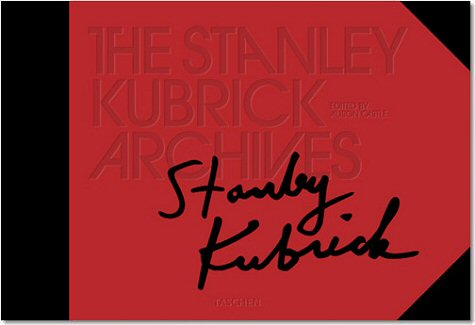
It’s the purely visual stuff that does it to you, in a strategy that mirrors that of Kubrick’s films. There are something like 1600 images in this thing — 800 immaculate frame blowups from all the films, and another 800 behind-the-scenes stills and various “items” (drawings, script notes, letters), most of which have never seen before. Plus essays by Kubrick scholars Michel Ciment, Gene D. Phillips and Rodney Hill
There are two keepsakes in The Stanley Kubrick Archives that are nearly worth the price alone: a twelve-frame film strip from a 70mm print of 2001: A Space Odyssey, taken from a print in Kubrick’s private vault, and a CD containing a 70-minute audio interview with Kubrick by Jeremy Bernstein in 1966…when Kubrick was at the summit of his powers.
All through my first reading I was feeling envious of Castle, who was given complete access by Kubrick’s widow, Christiane, and his longtime producer and brother-in-law, Jan Harlan. What an amazing job she had for two or three years.
All those details, all that minutae…and she and the Taschen editors only got one little thing wrong. I’m referring to a photo taken on the Spartacus set that identifies costar Rudy Bond (who played a loud-mouthed gladiator, although for some reason this role isn’t listed on his IMDB page) as the film’s producer, Edward Lewis. There’s a very slight chance I’m wrong about this (Lewis may have been a dead ringer for Bond), but I doubt it.
This is a spa book…something to sink into and be replenished by. And yet it’s not quite the ultimate down-to-the-bone Kubrick book of all time. It’s more the ultimate Kubrick massage…a thinking person’s pleasure cruise…a first-class voyage into a very sumptuous and particular world.
It’s been called the most comprehensive book on Kubrick thus far. It is that, but in a selectively affectionate way.
Is it the most penetrating exploration of who Stanley Kubrick really was, and what his life and work finally amounted to, warts, missed opportunities and all? That’s not the intention here.
Does it explore the conflicts Kubrick had with Marlon Brando in the development of One-Eyed Jacks, which resulted in Brando firing him? I would have loved to have read something specific about this, but no.
Does it get into the specific clashes Kubrick had with Kirk Douglas over the making of Spartacus? Here and there, but not to any great detail.
The best books about artists should not only celebrate but dish some rude stuff here and there.
It’s been reported before that Douglas was offended by Kubrick’s pre-production suggestion that he, Kubrick, be given screen credit for Dalton Trumbo’s script, since Trumbo, it was assumed at the time, couldn’t be given this due to his blacklisted screenwriter status. (Douglas eventually gave Trumbo this credit, which helped to end the blacklist era.)
Was this the only reason that Douglas referred to Kubrick during a 1982 interview I had with him as “Stanley the prick”? Douglas was famously egotistical and a scrapper, but I always wanted to know more about his and Kubrick’s relationship.
I guess what I’m saying is that Archives would have been a tad more interesting if Castle and Kubrick’s family hadn’t been so fully committed to the late director’s perspective and had brought in a few naysayers or nitpickers for added flavor.
Does it take a hard look at Kubrick’s fastidious, increasingly isolated way of living and working, removing himself more and more from life’s rough and tumble as he got older…more exacting, more of an aesthetic unto himself? Again, not the shot.
Does it ponder the regrets and might-have-been’s and shortfalls? Somewhat, but family-sanctioned tributes are never about tough love.
It would have steered in this direction if I had been the editor. Not to take Kubrick down (I’m as much a fan as Castle or anyone else on the team) but to explore the ironies more fully. I’m saying I would have zeroed in on the paradoxical lesson of Stanley Kubrick’s life and career, which is that absolute creative control can have its downside.
The truth is that the more he became “Stanley Kubrick,” the more he ate his own creative tail. Kubrick became powerful off the success of Dr. Strangelove and 2001: A Space Odyssey in the 1960s. This led to the carte blanche support he enjoyed from Warner Bros. starting with the making of A Clockwork Orange, which in turn allowed him to follow his intrigues to his heart’s content. But this became both his salvation and his trap.
This is an old tune with me, but as watchable as his movies are and always will be, the more remote and mercurial Kubrick became the more rigidly mannered his films were. This is why I’ve always been more of a fan of his work period from The Killing to A Clockwork Orange than the last 24 years of his career, during which he produced only four films — Barry Lyndon , The Shining, Full Metal Jacket and Eyes Wide Shut.
I realize that the emotional bloodlessness of Barry Lyndon is partly what makes it a masterwork, but you can’t tell me Kubrick’s personality wasn’t at least a partial ingredient in this.
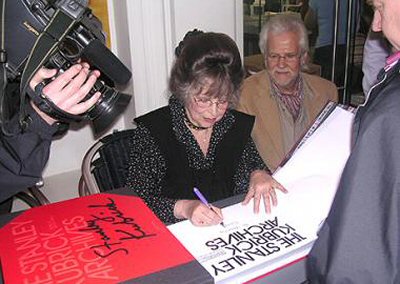

Christiane Kubrick signing copies of The Stanley Kubrick Archives a few days ago in London. Her brother Jan Harlan, who produced Kubrick’s later films, sits to her left.

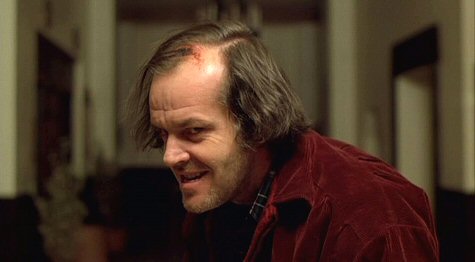
The opening 20 or 25 minutes of The Shining are among the spookiest ever captured in any film (that interview scene between Jack Nicholson and Barry Nelson is sheer perfection) but the very last shot, the one that goes closer and closer into that black-and-white photo of Nicholson’s Jack Torrance celebrating at an Overlook Hotel black-tie ball in the 1920s, is metaphysical claptrap. It’s a terrible ending.
(I was one of the few who saw a version of The Shining with an excised scene between Nelson and Shelley Duvall that comes right before this shot — Kubrick cut it before the film went into general release. I don’t have the book with me as I’m writing this, but I don’t think it makes any mention of this last-minute edit.)
(And while we’re on the subject, it would have been really special if the book had included frame blowups from the reported five minutes or so from 2001‘s “Dawn of Man” segment that Kubrick trimmed out just after a critics preview. But it doesn’t.)
The labored dialogue in the Vietnam portions of Full Metal Jacket (like “I say we leave the gook for the mother-lovin’ rats” or “Am I a heartbreaker? Am I a…whoo-hoo!..life-taker?”) makes Jacket feel like some kind of stage production rather than something actually going down in that war-torn region in the late ’60s. I read somewhere that some of the actors (Adam Baldwin, for one) bitched behind Kubrick’s back about this, or maybe to his face…I don’t precisely recall.
And yet that final battle sequence (going after that female Vietcong sniper in Hue) is breathtaking.
Don’t get me started on Eyes Wide Shut, but Kubrick’s belief that he would get an R rating (which he was contractually obliged to deliver) for that mansion-orgy sequence footage indicated a man who had stopped taking the pulse of things outside his country estate.
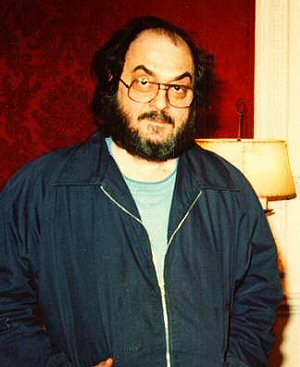

Kubrick at his home in January 1984, in a snap taken by a friend.

And yet for a guy hooked on visual fastidiousness and an increasingly misanthropic view of human affairs, Kubrick nonetheless made films that were tantalizing and seductive….each one a feast.
There’s a Kubrick quote in this book that I’m paraphrasing here, which is that the final measure of lasting motion picture art — all art — lies in the emotional.
It comes down to simple visual pleasures…the thought-out, strongly fortified kind that has led me to watch the Barry Lyndon DVD 15 or 20 times, even thought I don’t care very much for the funereal tone of the film’s second half. I sit through it because I love the Lord Bullington duel sequence and the final epilogue card that states, “Rich or poor, happy or sad, they are all equal now.”
I wouldn’t want to suggest that The Stanley Kubrick Archives is too softball. It is what it is, and that’s a hell of a thing.
The second half takes you in to Kubrick’s deliberative mind more thoroughly (i.e., more personally) than anything I’ve read. From the perspective of first-hand creative immersion, of recreating a world as the artist himself tried to know it and lick it as best he could, it’s one of the finest books on a film director ever published.
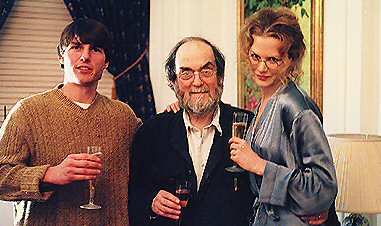

Tom Cruise, Stanley Kubrick, Nicole Kidman on the set of Eyes Wide Shut. It never occured to me before reading this book that Kubrick was on the short side, or shorter than Cruise anyway.

Slightly Gentler Neil

I was so traumatized by the weakness of the dollar during my stay in London last Saturday through Tuesday that I was having anxiety attacks the whole time. I did a lot of speed-walking and visiting different internet cafes and questioning my dumb impulsiveness in flying there in the first place. I didn’t eat anything except fruit and coffee and fast food….awful.
And yet in the face of this I decided last Monday night to see Neil Labute’s Some Girls, which opened a day or two later. I’d missed Labute’s last two, Fat Pig and This Is How It Goes (which both played in New York), as well as The Mercy Seat and The Distance From Here, which I didn’t even know about until I read the program. I felt I needed to catch up.
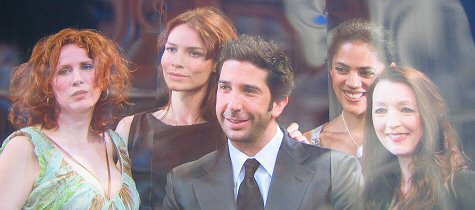

Some Girls costars Catherine Tate, Saffron Burrows, David Schwimmer, Sarah Tate, Lesley Manville.

And I wanted to see how former Friends star David Schwimmer, who began on the Chicago stage, would handle himself in the lead role. Verdict: he’s relaxed and assured and does quite well.
He’s playing a nominally sensitive short-story writer who’s run away from relationships all his semi-adult life, and is now feeling a bit guilty about this as he prepares to get married. So he pays a visit to four ex-girlfriends in four different cities to talk things over and see if any of them are still pissed about anything…anything at all.
He’s really looking to be forgiven or at least hear that he’s not so bad. This doesn’t happen. He gets a good stiff shot of reality from each ex.
Labute’s plays and films are usually about what pigs or weaklings men are in their relationships with women, and in this light the dealings in Some Girls aren’t as searing or corrosive as usual. It’s not lacking in emotional bruisings, but it’s not quite mild-mannered either.
And Schwimmer’s character makes an effort to at least talk a sensitive game when he catches up with the women. But who and what he really is — a serial escape artist — comes through soon enough, and at the end you feel for his young fiance (whom we never meet) because you know what she’s in for.
The one-act play is funny here and there, briskly paced (at roughly 100 minutes) and sometimes very biting. A moderately enegaging piece. But it doesn’t build or develop all that excitingly and it basically leaves you with a “yeah, not bad” reaction. Is it a movie? No, but maybe an HBO or a Showtime thing.
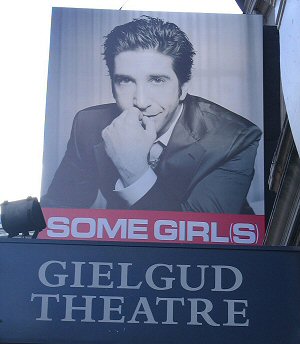
Schwimmer’s first visitation is in Seatlle with Sam (Catherine Tate), whom he dropped just before the senior prom in high school. Married to a local guy who works in a food store and raising kids, she’s still riled about what Schwimmer did (especially his having taken another girl to the prom) and having her emotions stirred.
Then there’s Tyler (Sara Powell) from Chicago, a randy easygoing type who needs a little time to remember what a bastard Schwimmer was to her…and then the anger catches fire.
In Boston he pays a call on Lindsay (Lesley Manville), a married woman he had an affair with behind her busband’s back, and who is also quite angry and looking for revenge.
Finally there’s Bobbi (Saffron Burrows) from Los Angeles, who is hurt but still cares for him…although she’s too smart and proud to open up a second time, even when he tells her she’s the love of his life.
The actresses are all sharp and on top of their roles, and each scene deftly reveals a surprise or two about their past relationship with Schwimmer. LaBute is a gifted writer and psychologically shrewd, but Girls is basically laying out Schwimmer’s history without adding anything urgent or present-tense to it.

Randomly

I was so upset by London I decided to get back to States as quickly as possible. That meant flying Easy Jet from London to Amsterdam for the connection back home, and since I had a few hours to kill I decided to train into town and look around.
I don’t get high so the whole cannabis side of things didn’t hold any appeal, but it’s mildly startling to be in the Abraxas Cafe and see the wide variety of hallucinogenic brownies being sold. Amsterdam is cool but English is spoken so widely and there are so many Brits and Americans running around that the exotic appeal feels diminished for me.
It’s obviously more than just a party town for stoners, but that’s what it felt like during my three-hour visit. Stoners and flower markets (what exactly do you do with a tulip?) and prostitutes and Burger Kings.


Southern sector of Hyde Park near Lancaster Gate — Sunday, 5.22, 5:50 pm.

McDonald’s delicacy available primarily to Londoners.
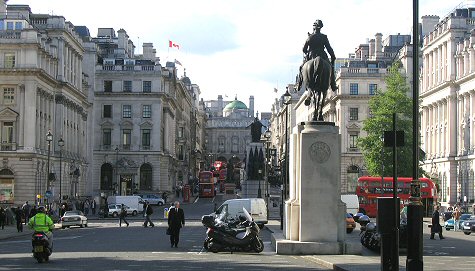
Four or five blocks due south of London’s Piccadilly Square — Monday, 5.23, 4:45 pm.

Near London’s Sussex Gardens — Sunday, 5.24, 2:35 pm
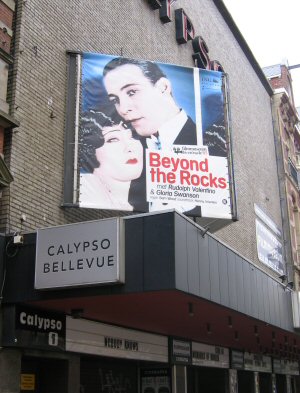
Valentino and Swanson at Amsterdam’s Calypso Bellevue — Tuesday, 5.24, 3:10 pm

Amsterdam — Tuesday, 5.24, 5:05 pm.

Amsterdam — Tuesday, 5.24, 3:50 pm.

Amsterdam — Tuesday, 5.24, 4:10 pm.

Tuesday, 5.24, 10:10 am.
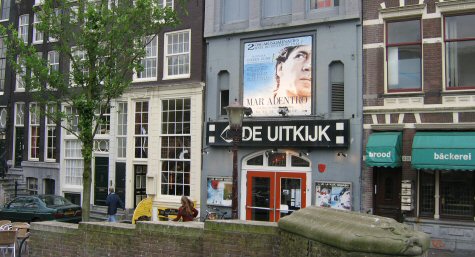
Canal-adjacent theatre in Amsterdam — Tuesday, 5.24, 3:05 pm.
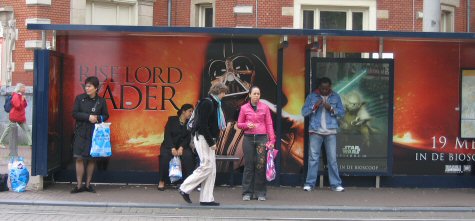
Amsterdam commuters — Tuesday, 5.24, 3:20 pm.

Near London’s Sussex Gardens — Sunday, 5.22, 2:15 pm

Residential street near London’s Sloane Square — Sunday, 5.22, 4:20 pm.

Returned…

…to these shores late Tuesday night, and currently putting finishing touches to Wednesday’s column this morning, i.e., Thursday. Apologies to those who’ve come to expect a stricter adherence to the schedule.

Dead Beach

It’s straight-up noon on Saturday (5.21), and the aura of finality is everywhere. This is one totally flatlined film festival.
For 94% of the visiting journalists, I mean. Make that 96%. The locals are gearing up for the awards ceremony tonight, which I’ve never attended and probably never will attend.
I’m gone early this evening, which is unfortunate because there’s an opportunity to see the movies I missed (most notably the presumed Palme d’Or winner, Michael Haneke’s Cache) at the catch-up screenings on Sunday.


American Pavilion beach, looking westward — 5.21.05, 10:40 am.

But I’ve had it and I don’t care. I mean, I do care but the spirit rebels and suddenly you need to get the hell out of here.
In the unlikely event that Cache (a.k.a., Hidden) doesn’t win tonight, the surprise winner could be Jean-Pierre and Luc Dardenne’s L’enfant, about some low-life druggies taking care of a baby. I didn’t see this one either. I know, I know.
My favorites were David Cronenberg’s A History of Violence, Tommy Lee Jones’ The Three Burials of Melquiades Estrada, Gus Van Sant’s Last Days (because it’s stayed with me…what you feel and think during the watching of a film is only the half of it), Jim Jarmusch’s Broken Flowers (despite slight reservations) and Woody Allen’s Match Point (because of the great ending).
And I liked Brent Hamer’s Factotum, the Charles Bukowski film with Matt Dillon in the lead role.
< ?php include ('/home/hollyw9/public_html/wired'); ?>
And I loved watching East of Eden last night at the Salle Bunuel. It feels a bit too tidy and 1955-ish at times, but James Dean was a prince and a genius, Jo Van Fleet gives one of the scrappiest female performances ever put on the screen, and Julie Harris’s acting in this Elia Kazan film still breaks my heart.
I never got around to writing anything about Amos Gitai’s Free Zone, which I found half-absorbing (it certainly isn’t the bad film that the Hollywood Reporter guy said it was). I loved the driving-through-Israel-and-Jordan footage, and Natalie Portman gives a performance that’s as grounded and filled out as she was in Closer.
No more filing until Monday or maybe even Tuesday. There’s plenty of stuff to get into that’s been piling up over the last eleven or twelve days.

The Why Of It

I saw Wim Wenders’ Don’t Come Knocking on Thursday morning, and I’m sorry to say I was profoundly unmoved.
I’m sorry because I’ll always admire Wenders for his exceptional films (The American Friend is still my all-time favorite, followed by Wings of Desire) and for the auteurist streak that used to be his handle, but this, lamentably, has ebbed and flowed according to the quality of the project in recent years.


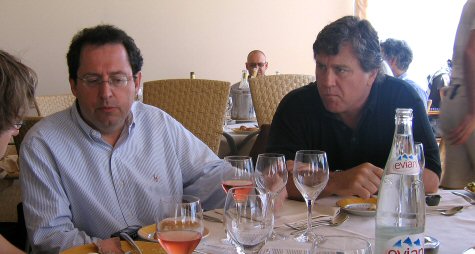
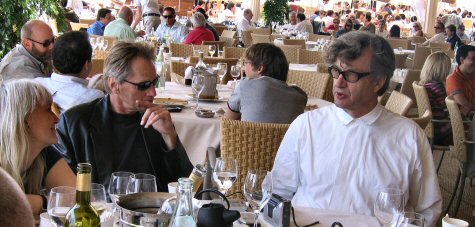
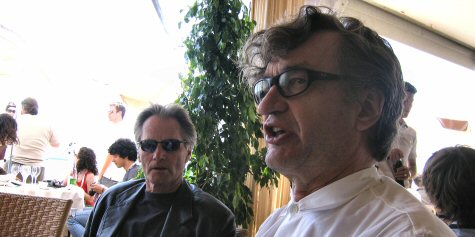
Don’t Come Knocking screenwriter-star Sam Shepard (left), director Wim Wenders at Sony Classics press luncheon at Carlton beach cafe — 5.20.05, 2:10 pm.

Wenders and screenwriter-star Sam Shepard last collaborated together on Paris, Texas (’84). That was a fairly strong, deservedly admired film, and I suppose they thought they could make lightning strike twice, or at least create a few meaningful sparks.
“We decided to fuck with it again,” Wenders said earlier today (5.20) during a press luncheon.
Like Jim Jarmusch’s Broken Flowers, Don’t Come Knocking is about a middle-aged guy on a downturn cycle facing up to all the crap in his life by reconnecting with a woman he used to love (or at least have sex with) in his youth, and also looking to find and perhaps get acquainted with a fully-grown son he never knew he had.
Trust me, Jarmusch’s film is a far, far better thing.
Shepard’s Howard Spence is an alcoholic, self-destructive actor who’s on his way down fast. The film begins with Howard hightailing if off the set of his latest film, a western being directed by a journeyman type in his late ’70s, played by George Kennedy.

This put me off right away. Guys who look like George Kennedy direct television shows…maybe. If they used to be feature directors and their rep carries some weight. But mostly they don’t direct anything because the industry discriminates against white-haired guys of this age, so right away I was saying to myself, “Bullshit.”
I also don’t find alcoholics the least bit interesting, especially ones who walk away from paying gigs for no discernible reason other than the fact that the screenwriter has decided the character is a fool who’s going through a midlife crisis.
Howard stays with his mother (Eva Marie Saint) for a while, who sees right through his bullshit boozy behavior but feels no need to call him on it. She provides the inciting incident, 45 minutes into the story, when she tells Howard that he has a son by Doreen (Jessica Lange), his ex-wife (or ex-girlfriend…not that it matters either way).
Howard makes his way up to Butte, Montana, and meets up with Lange, and she points out his son Earl (Gabriel Mann), a local country music performer.
Earl is black-haired and hugely pissed off and averse to emotional exposure of any kind, which means, of course, he doesn’t want to know Howard. He’s one of those guys given to throwing clothes and furniture out of his second-story apartment when emotions come to a boil.


Don’t Come Knocking costar Sarah Polley.

Howard’s mother has a scrapbook full of newspaper clippings about him, and his fame allows him to score with women he’s just met, but Earl, a 30 year-old, doesn’t know who he is. “What is he, an actor?” he says at one point.
The Cannes-based Hollywood Reporter critic wrote that Wenders and Shepard have yielded “a dry, spare, odd and oddly satisfying drama about a modern-day lonesome cowboy, lost in a desert of his own making, who seeks out salvation by seeking out those he left behind.”
Oddly satisfying? The movie is deeply aggravating. I was sitting there trying to decide when to leave. I wanted to see enough so I couldn’t be accused of missing most of it. I knew I was stuck there for a good 90 minutes or so, but I damn sure wasn’t going to sit through all 122 minutes’ worth.
To me, Knocking is not a Wim Wenders film. It doesn’t have his mood or visual signature or stylistic consistency.
It has an unfocused, shuffling-along attitude that feels way, way off. The script is sloppy and raggedy-assed, although there’s a good scene in which Lange tells off Shepard for being an irresponsible screwup.


Sony Classics honchos Michael Barker (l.) and Tom Bernard — 5.20.05, 1:20 pm.
I asked Wenders to respond to a comment about his film written by New York Times critic Manhola Dargis and published today, to wit: “This deeply sincere film takes place in an American West that bears little relation to the real world, perhaps because that isn’t the America with which [Wim] Wenders first fell in love.
“Like other artists and intellectuals from abroad, Mr. Wenders seems to have fallen for an America that mostly exists on Hollywood back lots and in rock ‘n’ roll lyrics, which probably explains why the romance has lasted so long.”
To this Wenders responded, “I have travelled around this country and gotten to know it better than any film critic I’ve ever met. I don’t think [Dargis] has ever been to Butte, Montana.”
I can’t write any more about this, but I had a swell time at the press luncheon and enjoyed speaking to Wenders and Shepard and costars Sarah Polley, Gabriel Mann and Fairuza Balk (who said I had “an interesting face,” which made me feel funny for some reason.)
I’m just sorry I had such a rough time with the film, and I’m hoping Wenders and Shepard do better next time.


Shepard, Wenders — 5.20.05, 2:05 pm.

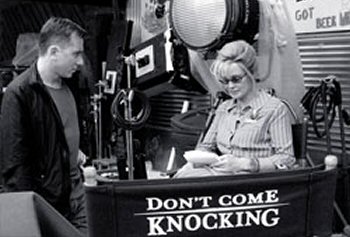
Don’t Come Knocking costars Tim Roth, Jessica Lange on set.

Exquisitely designed cappuccino cup, sipped from and remarked upon by Wim Wenders and yours truly during Knocking luncheon — 5.20.05, 2:20 pm.
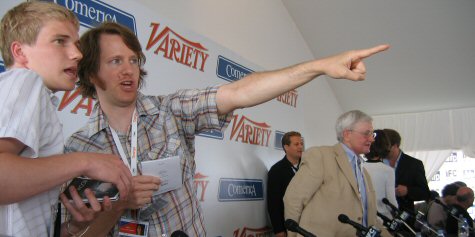
Roger Ebert (third from right, standing) snapping photos before start of Knocking luncheon. Variety critic Todd McCarthy (gesturing, wearing cap) stands to Ebert’s immediate right.

Respecting a Dead Guy

I’ve agreed not to wade into Tommy Lee Jones’ The Three Burials of Melquiades Estrada until 10:30 pm Thursday (Cannes time) and it’s only around 7 pm now, so I’ll have to write this a certain way.
I think it’s fair to say what other journos are saying, which is that they’re very admiring, and that some (like the Toronto Sun‘s Bruce Kirkland) are surprised at how smartly composed and compassionate and thematically rich it is.


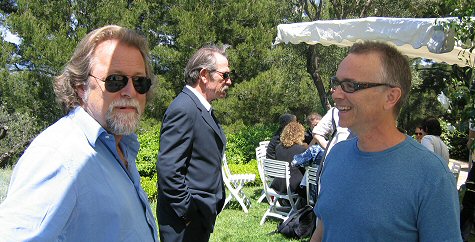
The Three Burials of Melquiades Estrada producer Michael Fitzgerald (left, avec beard), director-producer-star Tommy Lee Jones (center) and Toronto Sun critic-reporter Bruce Kirkland at Thursday’s press gathering at a wonderfully picturesque and soul-soothing villa in the hills above Cannes — 5.19.05, 12:35 pm.

Surprised because you never know what to expect from a first-time-out director **, especially when he’s a famous actor. It could have been indulgent or precious or half-baked.
But then Jones is a very intense, exceptionally bright, very passionate hombre, so his having scored with top-level journos shouldn’t be that surprising. Especially with Jones basing the film on an obviously thoughtful, time-shuffling script by Guillermo Arriaga, who wrote Amores Perros and 21 Grams.
I think it’s also fair to report that I attended an American Pavilion interview late Wednesday afternoon between Jones and Roger Ebert. Ebert made it clear he’d had a positive reaction to the film. He also asked if anyone in the audience had seen it, and when I raised my hand he asked me what I thought and I offered a thumbs-up gesture.
I don’t know if Melquiades Estrada is going to stand up against the supposed Palme D’Or favorites thus far, which are Michael Haneke’s Cache (which I missed last Saturday, and hasn’t, as far as I know, been shown since), David Cronenberg’s A History of Violence and Jim Jarmusch’s Broken Flowers.
It may (I say “may”) be received as more in the realm of being very good or worthy rather than masterful (there’s a prominent critic for a monthly who, according to a Texas-based critic, feels it falls apart during the second half), but I wouldn’t be surprised if the buzz is better than that.


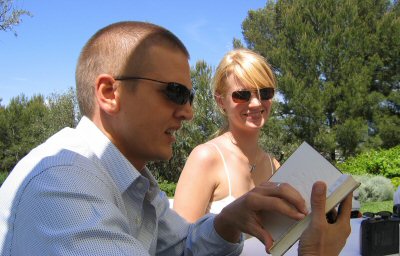
The Three Burials of Melquiades Estrada costars Barry Pepper and January Jones at press table, as Pepper reads from a diary-journal he wrote during production. In it he described Tommy Lee Jones as “a Southern badass with a ruthless work ethic and a heart the size of the Copper Canyon.”

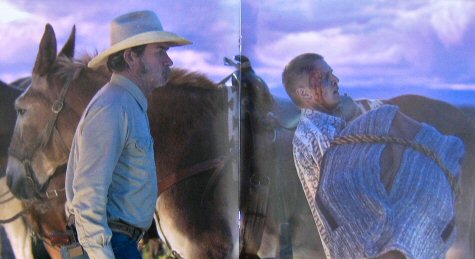
The Three Burials of Melquiades Estrada is a modern-day tale set in western Texas and northern Chihuahua, Mexico. It deals with a ranch foreman (Jones), a border patrolman (Barry Pepper) and an illegal immigrant named Melquiades Estrada who works for Jones. The second half is a horseback-journey film about redemption and seeing through prejudices and imbedded attitudes.
It’s a film with a great deal of compassion and soul and a generally humanistic view of things. If you want your literary influences, check out Flannery O’Connor’s work and William Faulkner’s “As I Lay Dying.”
In the press kit, Arriaga says he wanted “to make a study in social contrast between the land that’s south of the Rio Grande river and the land that’s north of it. About what iron ies, injustices, glory, beauty and redemption you can find in this area that has its own character…something that cannot be imposed, something that has grown and evolved… something that cannot be controlled.”
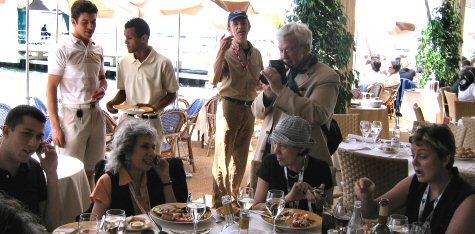
Just before 11 am today myself and a few other journos (Kirkland, Stephen Schaefer, Desson Thomson, Harlan Jacobson, Shari Roman, etc.) were driven in a minivan from the Gray d’Albion hotel near the Croisette into the hills above Cannes, and eventually (the driver got lost) to a beautiful hilltop villa.


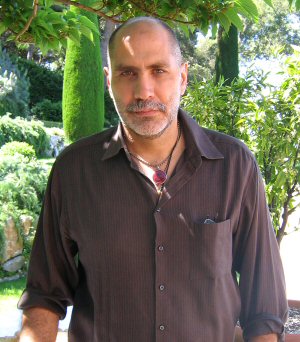
Guillermo Arriaga, hunting buddy of Tommy Lee Jones and screenwriter of The Three Burials of Melquiades Estrada (as well as 21 Grams and Amores Perros.

The purpose was to allow for a brief schmooze with Jones, Arriaga, Pepper, young co-star January Jones and producer Michael Fitzgerald (whose other ventures include Colour Me Kubrick and Sean Penn’s The Pledge).
Pepper said that Jones “has a very deep passion for strong visual composition and the poetry of words.” He read some passages from his on-set journal, and on one page he described Jones as “a Southern badass with a ruthless work ethic and a heart the size of the Copper Canyon.”
He mentioned two things that Jones told him before shooting a couple of scenes — “Keep it stupid simple” and “don’t do somethin’, just stand there.”
I mentioned to Jones, Arriaga and Fitzgerald that since seeing their film on Wednesday I’ve had trouble remembering the exact title. I like the earnest writerly sound of it — it doesn’t sound like your standard test-marketed title — but there is something about the name “Melquiades Estrada” that won’t stick in my brain, and I’m not trying to sound like a xenophobe when I say that.
Somebody asked Jones and Fitzgerald about the U.S. distribution prospects, and Jones said that “the wheels of commerce are turning as we speak.”


Tommy Lee Jones, Barry Pepper in scene from The Three Burials of Melquiades Estrada, taken straight from an image in press book (i.e. laid flat on the rug at the American Pavilion, and then cropped and refined).

Jones was asked to articulate the film’s themes, but he’s not what you’d call a press-junket gabber. Aside from calling it “a journey toward redemption,” he said, “You’re invited to read into it anything you deem appropriate…all you want, all you want.”
Pepper said that Jones read aloud from the book of Ecclesiastes during shooting. Jones was later asked why. “Because I like the book,” he replied.
His philosophy of directing actors, he said, is the same attitude he brings to handling a horse, which is “never ask a horse to do what it can’t do.”
Jones was asked what doesn’t work on the setas far as directing is concerned. “Tantrums are not constructive,” he said. “Egotism is not, I think, a good thing.”
He said he’s long wanted to direct a film of Cormac McCarthy’s “Blood Meridian,” and was asked a few years ago by then-Sony chief John Calley to write an adaptation of it in script form. He delivered it a year later but “they said it was too violent,” he said.


View of Cannes and the Med from EuropaCorp-rented villa, the site of Thursday’s press junket for The Three Burials of Melquiades Estrada.

The session ended after an hour or so, and everyone was driven back to town.
A journalist I spoke to near the front of the Gray d’Albion said I should have snapped a photo of January Jones when she was eating a banana at our press table. He was struck by this act of consumption for obvious reasons.
A wafer-thin and very beautiful brunette woman who does interviews for French TV sat next to me in the van on the way back. She was dressed in a sheer white dress and smelled like jasmine mixed with musk.
I glanced at a printed itinerary she was holding in her hand, and I saw that she had three hair and makeup appointments set for today — one at breakfast, a second just after lunch and a third before going out this evening.

Numbers

There is no more time at all…none…but the caption says it all. I’ll try and amplify tomorrow morning:


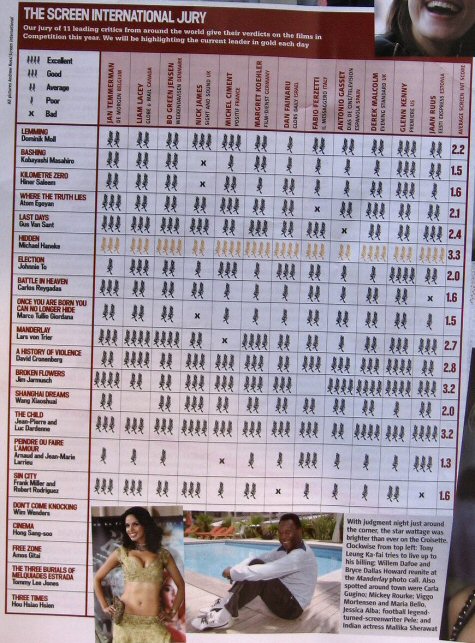
Screen International‘s poll of mostly European critics (and no Americans) still had Michael Haneke’s Cache (a.k.a. Hidden) at the top of the list of Palme d’Or contenders as of Wednesday, 5.18, in a graphic published in Thursday’s (5.19) issue. Notice that the Jim Jarmusch’s Broken Flowers is running a very close second. Tommy Lee Jones’ film was shown for the first time late Wednesday morning, and therefore didn’t figure. To what degree do these conclusions reflect the sympathies of the Palme d’Or jurors? I couldn’t say, but they do indicate what a lot of people I’ve spoken to myself are saying. Notice also that Pendre ou Faire L’Amour, which I walked out on, has the lowest ratings of all.

Beached!

I was taking a break yesterday (Thursday, 5.19) on the beach in front of the American Pavilion when I spotted two guys cruising along about 100 years out in the bay in some kind of watercar — an engine-driven car with tires and windshield wipers and everything else that floats and can be driven across the water.

Didn’t I see one of these in a James Bond film back in the early ’90s? Or in some Herbie or Love Bug remake from Disney?
Anyway, the two guys and their watercar started heading for the beach. Paddle, paddle…blub, blub, blub….so far, so good.

Then the tires hit the sand and they started spinning out. The slope of the beach is very gradual and slight, but the car couldn’t get any traction. They kept trying, accelerating, spitting water into the air ….failure.
The various onlookers on the beach began to laugh and joke with each other and point at the beached jalopy. Dumb invention! Back to the drawing board! How very quickly and suddenly the love and support of the public evaporates.

Fact

When I made my first trip to the Cannes Film Festival in ’92, topless women on the beach were a common sight. I used to love to stop for a minute or two and pretend to look at the water and sky and everything else except these women, and there were always several to gaze upon.

But nowadays it’s rare to see a bevy of women lying around topless. I noticed exactly two earlier today, and it’s very sunny and warm out. I think this signifies something. French culture is turning more covered and conservative, apparently…but why? This demands further thought. If anyone has any theories, please send them along.

Eight Days In

It’s late Wednesday morning, 5.18, and this signifies, among other things, that the Cannes Film Festival started a week ago and there’s another couple of days to go before everyone collapses into a heap.
This morning’s competition film, Peindre out Faire L’Amour (To Paint or Make Love), did nothing for me or to me. It’s another one of those leisurely paced, mezzo-mezzo domestic French dramas about middle-class, middle-aged people, and I’m sorry but I couldn’t abide it.
I know it sounds lazy and arrogant to dismiss a film like this without giving it its proper due, but I’m just being honest. I have enjoyed films of this type before and I hope to again, but not this morning, Monique.


I took this out-of-focus shot around 8 pm yesterday evening (5.17) aboard a large yacht that Stella Artois beer and the Hollywood Reporter were throwing a party on. (The invite came via courtesy of Gregg Kilday.) Notice the heaving seas — it looks like a rescue scene from Richard Lester’s Juggernaut. And the seas really were heaving and rocking the boat and pitching everything and everyone around, and it was magnificent to be on this little red craft and feel all this natural turbulent energy.

< ?php include ('/home/hollyw9/public_html/wired'); ?>
I’m seeing the rugged outdoor drama that Tommy Lee Jones has directed and starred in, The Three Burials of Melquiades Estrada, at a private screening at noon, but I’ve agreed not to write about it until Thursday, so I don’t know what to do for today’s column.
I hate writing a daily column, but I love nailing it and doing it well when my energy’s up and the synapses are firing away like the spark plugs inside the humming engine of Jimmy Stewart’s The Spirit of St.Louis over the icy north Atlantic at 5 ayem.
People seemed to be getting irritable yesterday, which I attribute to the fact that people always get irritable after going 18 hour days for seven says straight.
If you’re looking for something fresh, please scroll down and check out my new “head” shot. I’ll try and post something intriguing later today.

Mostly

I respected and mostly liked Jim Jarmusch’s Broken Flowers, but I didn’t find it entirely sublime. It felt a bit sketchy and under-fueled and sketchy at times, but that’s Jarmusch for you — a real less-is-more kind of guy. He likes his characters and scenes fairly cut and dried without any of that emotional backstory stuff.
This isn’t to say Broken Flowers doesn’t penetrate. It’s a dryly intriguing comedy, at first, that slowly darkens into a sobering adult drama. The ending isn’t “happy” or tied up in a red bow, but on Jarmusch’s own terms it has integrity, and in fact “works.”


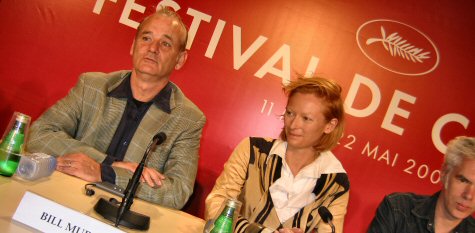
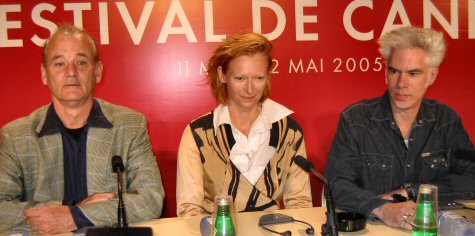
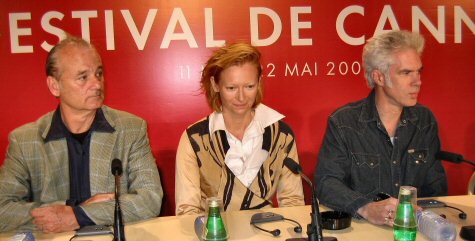
Broken Flowers star Bill Murray, costar Tilda Swinton and (half cropped) director-writer Jim Jarmusch.

The story’s about a middle-aged lonely guy (Bill Murray) flying around the country and trying to figure out which old girlfriend has written him a note telling him he has a 19 year-old son.
All we’re told about Murray’s character, who’s called Don Johnston, is that he’s financially comfortable and emotionally remote. In the film’s early scenes one could call him emotionally shut down — too much so, I felt.
We’re all used to Murray’s half-comic underplaying (which was never better than in Wes Anderson’s Rushmore) but this works best, I feel, alongside higher-energy characters or situations. For the first 25 to 30 minutes, Jarmusch and Murray are almost too synched up for their own good.
The story begins with Johnston getting dumped by his latest girlfriend (Julie Delpy) over emotional remoteness issues, including Johnston’s aversion to having family. Then comes the letter, partly written with a typewriter, and on pink paper inside a pink envelope. The import is that the alleged 19 year-old son may be looking for Johnston.
There’s a hangup, though: the girlfriend doesn’t identify herself. Johnston shows the letter to his next-door neighbor Winston (Jeffrey Wright), a guy with five kids and three jobs who fancies himself as a kind of internet sleuth. Winston asks Johnston to write down a list of ex-flames who might be the mystery letter-writer.
Murray comes up with the names of four women, and Winston finds their addresses and whatnot online. He urges Johnston to visit each and try to learn what he can.


Broken Flowers stars Murray and Swinton, director-writer Jim Jarmusch.

Winston twice tells Johnston that his romantic history qualifies him as some kind of former Casanova. Of course, having had four ex-lovers during the mid ’80s is not especially hound-like. The Great Nookie Shutdown of the mid to late ’80s (caused by fear of AIDS) hadn’t quite kicked in in the early years of the Reagan administration, and single heteros were almost as frisky as they were in the ’70s.
The ex-girlfriends are played by Sharon Stone, Jessica Lange, Frances Conroy (from HBO’s Six Feet Under) and a just-about-unrecognizable Tilda Swinton, covered in a black wig and heavy eye mascara.
The film picks up steam once Murray/Johnston goes on the road and pays a visit to each ex, always offering a bouquet of flowers but saying and asking very little. For some reason, Johnston never puts his cards on the table and just says, “Did you write me a letter on pink paper that said I have a 19 year-old son?” Instead, he hints and tippy-toes around and asks if they own a typewriter.
What’s so bad about posing a straight question? A middle-aged man asking an ex-girlfriend whether he might have a son he never knew about…what’s so gauche or off-putting about that?


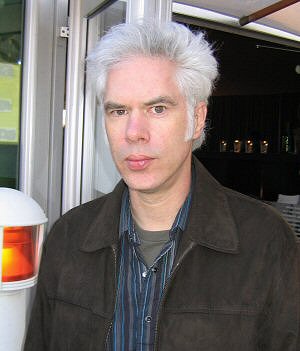
Jim Jarmusch — Monday, 5.16.05, 7:55 pm.

Of course, all the tip-toeing around makes the encounter scenes (and the film itself) about undercurrent — the things people think and do not say.
What’s interesting and finally quite satisfying about Broken Flowers is how Jarmusch doesn’t feel obliged to answer each and every last question, either on the part of Johnston or the audience.
Flowers has, of course, Jarmusch’s signature elements (minimalism, understatement, observings of cultural minutae), and a somewhat taciturn, occasionally hilarious lead performance by Murray.
One of the funnier things Murray does is a carrot-eating scene at the home of Conroy and her real-estate-mogul husband. I’m not going to describe it. I couldn’t.
Wright is fine and believable, although he doesn’t have that much of a part. The standout among the four exes is Swinton, and she has maybe eight or nine lines, if that. Stone, Lange and Conroy are intriguing in their respective turns.
Murray was asked at the press conference about his minimalist acting style, and he said “it comes from deterioration of ability. As time moves on I find I have less and less to give.”

Boiled down, his role in Broken Flowers is about how “I get beaten up by all these women,” he said. “It was a far more precarious thing than I expected it to be. Always being off-balance and feeling unsettled.”
A journalist told Murray he was very scared as a kid when he saw all the spooks and monsters in Ghostbusters. “You’re safe now,” Murray replied. “We took care of all that.”
Another guy asked Murray an extremely arcane, hard-to-follow question, and Murray replied, “Are you the same guy who asked me outside a few minutes ago to take on the Argentinean Senate? I mean, why not? I’m looking for work.”
Murray said at another point that “doing that back-story stuff sometimes takes you out of the moment [when you’re doing a scene].”
Jarmusch said he’s “not interested in back-story…my style is looking at details and nuances. My religion is that of the imagination.”

Plantation Blues

Manderlay didn’t do it for me, and I’m speaking as a totally ardent fan of von Trier’s Dogville , Dancer in the Dark and Breaking the Waves, as well as a general fool for his bad-boy provocateur routine.
It’s a relentlessly talky, intelligent and provocative film that addresses…well, American racism, certainly, but more generally a do-gooder tendency by American governments to try and shape other societies so they more resemble our own (Iraq, Vietnam, etc.). And it indulges in the usual proddings and agitations that are par for this Danish filmmaker.


Willem Dafoe and Bryce Dallas Howard in opening scene from Lars von Trier’s Manderlay.

I don’t know when it’ll open in the States, but I’m presuming Manderlay wi ll piss off African-Americans when it opens there for saying, in part, that they are playing (or have played) a willing part in their economic subjugation by whites.
The second installment in von Trier’s America, Manderlay is a continuation of the adventures of Grace, the gangster’s daughter played by Nicole Kidman in Do gville, the trilogy’s 2003 kickoff, and by Bryce Dallas Howard in the new film.
Both films are stagey and pedantically inclined, and shot on what is probably the same massive sound stage with imaginary props and sets. (The third installment will presumably follow suit.)
Manderlay‘s problem is that it’s too similar to Dogville…and not similar enough.
Despite its slow pace and very gradual plot development, Dogville had a surprise character revelation (i.e., that Kidman is the daughter of gangster James Caan, and not his girlfriend, as the film allows us to assume at first) and a shockingly violent finale that expressed von Trier’s negative feelings about what he sees as American tendencies to exploit the less fortunate.


The perfect-bound, pocket book-sized press notes for Lars von Trier’s Manderlay.

Manderlay is supposed to walk, talk and feel like a Dogville companion. It is broken up by titled chapters, John Hurt again provides the dry and pungent narration, and the closing credit sequence is nearly identical with the same David Bowie song (“Young Americans”) played over a series of stills that il laminate the uglier aspects of America’s history – in this instance, the treatment of African-Americans over the last century or so.
But there’s no big jolt or surprise at the finale — you can pretty much tell what’s coming from the get-go – and it so closely recalls Dogville‘s aching-butt aspects that watching it feels like a chore.
Set in the early 1930s, some days or weeks after Dogville ended, Grace and her father (Willem Dafoe, taking over for James Caan) and his gang of thugs pull up out side the gates of an Alabama plantation called Manderlay.
To her shock, the na√É∆í√ǬØve and willful Grace quickly learns that slavery is still in place here — the black workers lorded over by a white family (which is headed by Lauren Bacall). She quickly decides to use her dad’s power to take over the plantation and institute democracy and free choice and self-sufficiency.
But the process of teaching is kind of fraught with contradictions. Grace needs to order and organize and put structure into place, and the black men and women of Manderlay resist or elude her plans in different ways, and old habits revive themselves and Grace gradually ends up becoming a tyrant — just like the slave-running family she replaced.


Manderlay‘s sound-stage set.

She develops the hots for a laborer named Timothy (Issach de Bankole) whom she first saw tied to a post and about to be whipped. She and Timothy eventually submit to their mutual libidinal urges, but he is tied up again by the end of the film and this time Grace is doing the whipping.
She also executes an older woman named Wilma (Mona Hammond) who, it is charged, was responsible for the starvation death of a child.
The bottom line is that Manderlay isn’t punchy or startling enough to justify the two hour and 19 minute running time.

Violence

I meant to write longer about David Cronenberg’s A History of Violence, which I caught Sunday night and liked quite a lot, but I have to postpone writing about it again and it’s two days later.
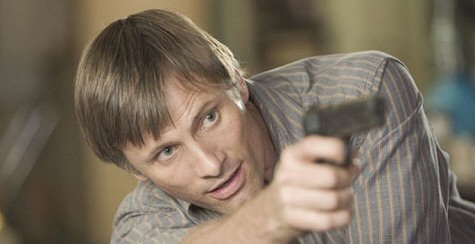
Viggo Mortensen stars as Tom Stall, a man who leads a relatively quiet, small-town life with his wife (Maria Bello) and two kids.
The truth starts to come out when Mortensen defends a waitress about to be attacked from a pair of thugs, dispatching them with speed and savage efficiency. This act makes him into a news media hero, which brings him nationwide attention.


Viggo Mortenson in David Cronenberg’s smartly assembled, suprisingly amusing A History of Violence.

Then it turns out he’s a guy with a criminal past who’s adopted a fake name, and then some of the gangster types he ran with — dark-suited baddies from Philadelphia, including a pair of creepy nogoodniks played by Ed Harris and William Hurt — start showing up and saying, “Heyyyy…”
I was especially turned around by the dark humor aspects. A lot of people get bloodied and shot and killed in this film, but it’s a very funny thing at times, and I wasn’t the only one feeling this way.
There was a French guy in the audience at the Salle de Bussy’s 7:30 pm showing who yelled at the audience while the film was running, saying,in effect, “Stop laughing…this isn’t funny!”

Randoms


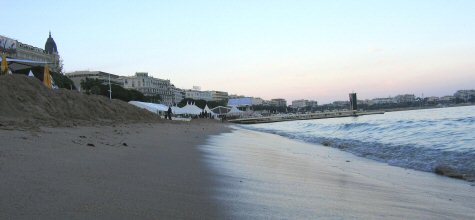
Cannes beach in front of Noga Hilton beach annex — Monday, 5.16.05, 7:40 pm.
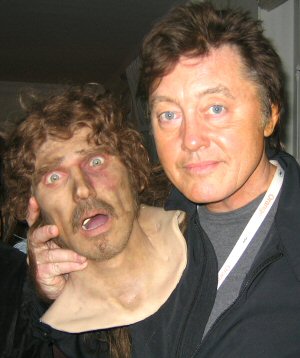
Enterprising journalist holding an obviously first-rate prosthetic severed head. Head was found sitting on a mantle at a party thrown by and for socially ambitious under-25 Brits on the evening of Tuesday, 5.17, at a faux-castle residence in the eastern section of Old Town.

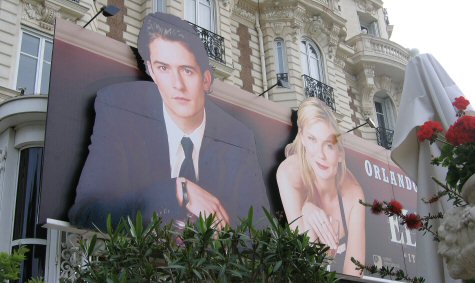
Carlton Hotel billboard for Cameron Crowe’s Elizabethtown.

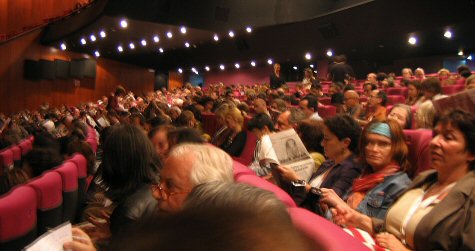
Audience at Salle de Bussy on Sunday evening, just before the lights went down and David Cronenberg’s A History of Violence began — Sunday, 5.15.05, 7:25 pm.

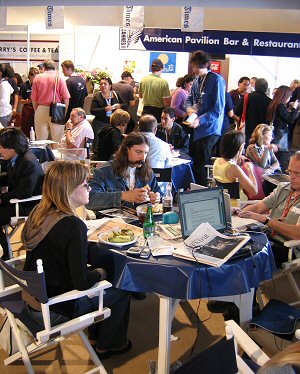
My work station (i.e., lower right, newspaper on keyborad) at the American Pavillion — Monday, 5.16.05, 1:55 pm.

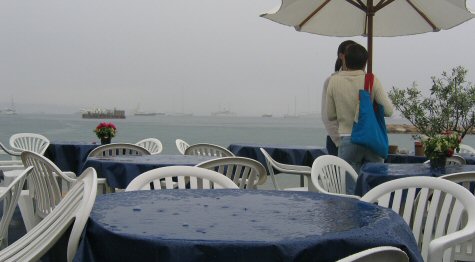
View of rainstorm from American Pavillion — Monday, 5.16.05, 2:40 pm.
London filmmaker Natalie Turner (Sfumato), Channel 4 journalist-critic Annette Dasey at Sunday night’s Star Wars party — 5.16.05, 12:20 am.
Fireworks over baie de Cannes — Sunday, 5.15.05, 11:40 pm.

Death Stars

George Lucas and his digital galactic posse arrived in Cannes Sunday
(5.15), and attracted, to no one’s surprise, more attention than any other film or team of filmmakers who’ve dropped by thus far.
Which is symmetrically appropriate, I suppose, since we all realize that Stars Wars: Episode 3 — Revenge of the Sith will most likely attract more ticket buyers than probably all the other films showing here (including the market offerings) combined.


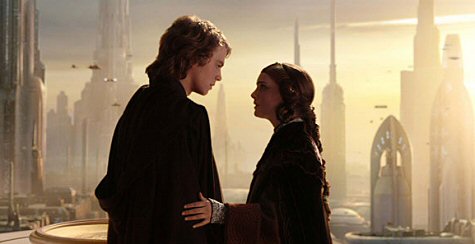
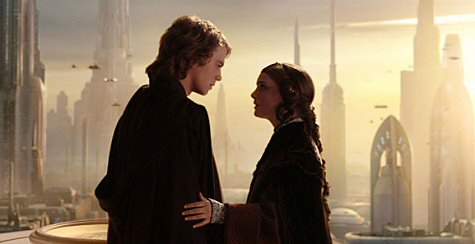
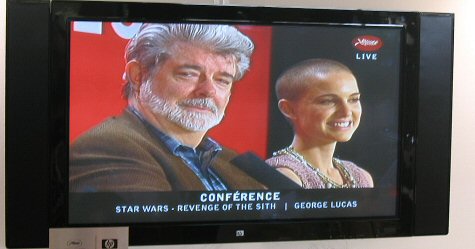
Star Wars: Episode 3 – Revenge of the Sith director-writer George Lucas and costar Natalie Portman during Sunday afternoon’s Cannes Film Festival press conference, which I would have attended if I didn’t have better things to do — 5.15.05, 1:10 pm.

There’s no percentage in being a sorehead and teeing off on George and his unstoppably mediocre film all over again, so let’s just zip it.
The Sith press conference, which just ended about 20 minutes ago (i.e., at 2 pm), was a two-toned affair — the occasional (make that very occasional) journalist asking a somewhat pointed question and Lucas not really answering them, and the other journos asking puffball questions.
Big surprise, right? The world wants to love this film, publishers and editors who employ Cannes-covering journalists know this and just want the standard oooh-ahhh coverage, and who gives a hoot anyway?
Movie City News and Film Stew contributor Sperling Reich asked Lucas why he had made it more difficult for websites and bloggers in recent years to cover Star Wars-related news by not affording them the same access given to print publications. Lucas ignored the question and spoke about his love for the free exchange of information that the internet provides, etc. And Reich didn’t follow up.

I was standing by a big window overlooking the path that Team Lucas (Hayden Christensen, Rick McCallum, Portman, Samuel L. Jackson, etc.) were about to walk by, and I was going to snap a photo when one of the Wi-Fi Cafe volunteers (i.e., French girls in their early 20s dressed in white T-shirts and white ass-hugging pants) said no pictures, per order of some festival bigwig.
I put my camera away but donnez-moi un fucking break.
The 20th Century Fox publicity people gave me tickets to the Sunday night after-party, which is classy of them given my general animus, etc.

Saturday Afternoon


Bob Berney, head of the newly formed Picturehouse, the newly-formed HB0 and New Line-backed indie distribution company, and wife Jeanne Berney (who’s on a temporary hiatus from publicity chores) at beachside party celebrating the company’s launch — Saturday, 5.14, 5:35 pm

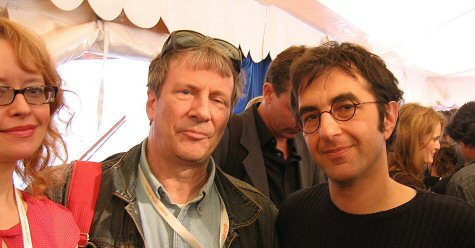
Chicago Tribune reporter Jackie Fitzgerald (far left), film critic Michael Wilmington and Where the Truth Lies director Atom Egoyan (right) at Picturehouse launch party — Saturday, 5.14.05, 6:20 pm.
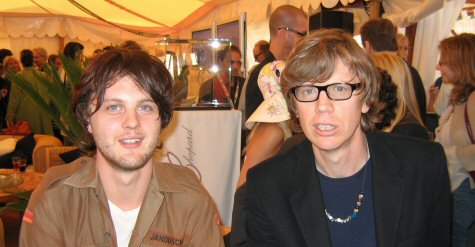
Last Days star Michael Pitt (l.), Sonic Youth’s Thurston Moore at Picturehouse party — Saturday, 5.14.05, 6:47pm.

.

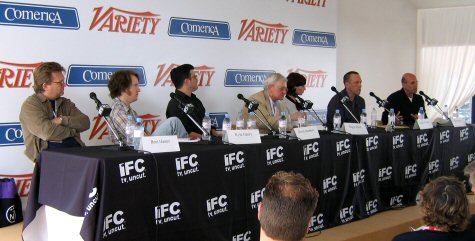
During Variety-sponsored panel discussion among American directors: (l. to r.) Brent Hamer (Factotum), Kyle Henry (Room), David Jacobson (Down in the Valley), host Roger Ebert, Miranda July (Me and You and Everyone We Know), Lodge Kerrigan (Keane) and Stuart Sammuels (Midnight Movies: From the Margin to the Mainstream).

Room director Kyle Henry (sideburns, facial blemish, second from left); panel host Roger Ebert slightly behind and to the right — Saturday, 5.14.05, 4:05 pm.

No Worries

I saw about an hour’s worth of Joyeux Noel at the Salle Bazin earlier today. That’s right — it wasn’t good enough to see through to the end.
It’s a French-produced period drama about the World War I Christmas truce of 1914, written and directed by Christian Clarion. It suffers from a too-modest budget, simplistic writing, the worst dubbing of an actor and actress pretending to be opera singers I’ve ever seen in my life, and a generally sentimental and ham-fisted tone that will almost certainly not play with audiences in the States, if any US distributor is reckless enough to pick it up.
As regular readers know, I ran a piece a few months ago about two other films being planned about this exact same subject.
Vadim Perlman (House of Sand and Fog) is (or was) planning a film called Truce, working from a script by Stuart Beattie. Paul Weitz and his brother Chris have been talking about making a film called Silent Night…exact same deal.
What I’m saying, obviously, is that Perlman and Weitz have only each other to fear…if their respective projects are still on the rails and moving ahead, I mean (which I’m not sure about at this stage)

While Tapping…

…out a lead piece about Jim Jarmusch’s Broken Flowers, which everyone saw at this morning’s 8:30 am press screening (and which will have its black-tie premiere tonight), I may as well put up these photos from the post-screening press conference, which ended a bit after 12 noon.
I respected and mostly liked Broken Flowers, bit I didn’t find it entirely sublime. It felt a bit under-fueled and sketchy at times, but that’s Jarmusch for you…he likes his characters…his movies, I mean…cut and dried without any of that emotional backstory stuff.


Broken Flowers star Bill Murray, costar Tilda Swinton and (half cropped) director-writer Jim Jarmusch.

Broken Flowers is actually fairly penetrating. It’s a dryly intriguing comedy about a middle-aged lonely guy (Bill Murray) flying around the country and trying to figure out which old girlfriend has written him a note telling him he has a 19 year-old son.
Mostly it’s about loneliness and regret and missed opportunities, and is one of those films that gets better the more you mull it over. I saw it about four hours ago and it’s growing on me already. I liked that it doesn’t fill in all the blanks or neatly tie things up at the finish.
< ?php include ('/home/hollyw9/public_html/wired'); ?>
It has, of course, Jarmusch’s signature elements (minimalism, understatement, observings of cultural minutae), and a somewhat taciturn, occasionally hilarious lead performance by Bill Murray.
Anyway, I’ll expand on this in a little, and in the meantime here are some more press conference photos, plus a shot of Jarmsuch taken yesterday (Monday, 5.16) at a Fortissimo Films party at the Noga Hilton beach annex:


Broken Flowers stars Murray and Swinton, director-writer Jim Jarmusch.

Jim Jarmusch — Monday, 5.16.05, 7:55 pm.

Plantation Blues

Manderlay didn’t do it for me, and I’m speaking as a totally ardent fan of von Trier’s Dogville , Dancer in the Dark and Breaking the Waves, as well as a general fool for his bad-boy provocateur routine.
It’s a relentlessly talky, intelligent and provocative film that addresses..,well, American racism, certainly, but more generally a do-gooder tendency by American governments to try and shape other societies so they more resemble our own (Iraq, Vietnam, etc.). And it indulges in the usual proddings and agitations that are par for this Danish filmmaker.


Willem Dafoe and Bryce Dallas Howard in opening scene from Lars von Trier’s Manderlay.

I don’t know when it’ll open in the States, but I’m presuming Manderlay wi ll piss off African-Americans when it opens there for saying, in part, that they are playing (or have played) a willing part in their economic subjugation by whites.
The second installment in von Trier’s America, Manderlay is a continuation of the adventures of Grace, the gangster’s daughter played by Nicole Kidman in Do gville, the trilogy’s 2003 kickoff, and by Bryce Dallas Howard in the new film.
Both films are stagey and pedantically inclined, and shot on what is probably the same massive sound stage with imaginary props and sets. (The third installment will presumably follow suit.)
Manderlay‘s problem is that it’s too similar to Dogville…and not similar enough.
Despite its slow pace and very gradual plot development, Dogville had a surprise character revelation (i.e., that Kidman is the daughter of gangster James Caan, and not his girlfriend, as the film allows us to assume at first) and a shockingly violent finale that expressed von Trier’s negative feelings about what he sees as American tendencies to exploit the less fortunate.


The perfect-bound, pocket book-sized press notes for Lars von Trier’s Manderlay.

Manderlay is supposed to walk, talk and feel like a Dogville companion. It is broken up by titled chapters, John Hurt again provides the dry and pungent narration, and the closing credit sequence is nearly identical with the same David Bowie song (“Young Americans”) played over a series of stills that il laminate the uglier aspects of America’s history – in this instance, the treatment of African-Americans over the last century or so.
But there’s no big jolt or surprise at the finale — you can pretty much tell what’s coming from the get-go – and it so closely recalls Dogville‘s aching-butt aspects that watching it feels like a chore.
Set in the early 1930s, some days or weeks after Dogville ended, Grace and her father (Willem Dafoe, taking over for James Caan) and his gang of thugs pull up out side the gates of an Alabama plantation called Manderlay.
To her shock, the na√É∆í√ǬØve and willful Grace quickly learns that slavery is still in place here — the black workers lorded over by a white family (which is headed by Lauren Bacall). She quickly decides to use her dad’s power to take over the plantation and institute democracy and free choice and self-sufficiency.
But the process of teaching is kind of fraught with contradictions. Grace needs to order and organize and put structure into place, and the black men and women of Manderlay resist or elude her plans in different ways, and old habits revive themselves and Grace gradually ends up becoming a tyrant — just like the slave-running family she replaced.


Manderlay‘s sound-stage set.

She develops the hots for a laborer named Timothy (Issach de Bankole) whom she first saw tied to a post and about to be whipped. She and Timothy eventually submit to their mutual libidinal urges, but he is tied up again by the end of the film and this time Grace is doing the whipping.
She also executes an older woman named Wilma (Mona Hammond) who, it is charged, was responsible for the starvation death of a child.
The bottom line is that Manderlay isn’t punchy or startling enough to justify the two hour and 19 minute running time.

Until Tomorrow…

I have to quit now, but here are some photos I took last night and today. I’m seeing Jim Jarmusch’s Broken Flowers, starring Bill Murray, tomorrow morning.
I meant to write about David Cronenberg’s A History of Violence, which I caught Sunday night and liked quite a lot, but I’ll have to get into it tomorrow also.


Viggo Mortenson in David Cronenberg’s smartly assembled, suprisingly amusing A History of Violence.

Viggo Mortensen stars as Tom Stall, a man who leads a quiet, small-town life with his wife (Maria Bello) and two kids. Then it turns out he’s a guy with a criminal past who’s adopted a fake name, and then some of the gangster types he ran with — dark-suited baddies from Philadelphia, including characters played by Ed Harris and William Hurt — start showing up and saying, “Heyyyy…”
I was especially turned around by the dark humor aspects. A lot of people get bloodied and shot and killed in this film, but it’s a very funny thing at times, and I wasn’t the only one feeling this way.
There was a French guy in the audience at the Salle de Bussy’s 7:30 pm showing who yelled at the audience while the film was running, saying,in effect, “Stop laughing…this isn’t funny!”

Randoms


Carlton Hotel billboard for Cameron Crowe’s Elizabethtown.

Audience at Salle de Bussy on Sunday evening, just before the lights went down and David Cronenberg’s A History of Violence began — Sunday, 5.15.05, 7:25 pm.

My work station (i.e., lower right, newspaper on keyborad) at the American Pavillion — Monday, 5.16.05, 1:55 pm.

View of rainstorm from American Pavillion — Monday, 5.16.05, 2:40 pm.

London filmmaker Natalie Turner (Sfumato), Channel 4 journalist-critic Annette Dasey at Sunday night’s Star Wars party — 5.16.05, 12:20 am.

Fireworks over baie de Cannes — Sunday, 5.15.05, 11:40 pm.

Death Stars

George Lucas and his digital galactic posse arrived in Cannes Sunday
(5.15), and attracted, to no one’s surprise, more attention than any other film or team of filmmakers who’ve dropped by thus far.
Which is symmetrically appropriate, I suppose, since we all realize that Stars Wars: Episode 3 — Revenge of the Sith will most likely attract more ticket buyers than probably all the other films showing here (including the market offerings) combined.


Star Wars: Episode 3 – Revenge of the Sith director-writer George Lucas and costar Natalie Portman during Sunday afternoon’s Cannes Film Festival press conference, which I would have attended if I didn’t have better things to do — 5.15.05, 1:10 pm.

There’s no percentage in being a sorehead and teeing off on George and his unstoppably mediocre film all over again, so let’s just zip it.
The Sith press conference, which just ended about 20 minutes ago (i.e., at 2 pm), was a two-toned affair — the occasional (make that very occasional) journalist asking a somewhat pointed question and Lucas not really answering them, and the other journos asking puffball questions.
Big surprise, right? The world wants to love this film, publishers and editors who employ Cannes-covering journalists know this and just want the standard oooh-ahhh coverage, and who gives a hoot anyway?
Movie City News and Film Stew contributor Sperling Reich asked Lucas why he had made it more difficult for websites and bloggers in recent years to cover Star Wars-related news by not affording them the same access given to print publications. Lucas ignored the question and spoke about his love for the free exchange of information that the internet provides, etc. And Reich didn’t follow up.

I was standing by a big window overlooking the path that Team Lucas (Hayden Christensen, Rick McCallum, Portman, Samuel L. Jackson, etc.) were about to walk by, and I was going to snap a photo when one of the Wi-Fi Cafe volunteers (i.e., French girls in their early 20s dressed in white T-shirts and white ass-hugging pants) said no pictures, per order of some festival bigwig.
I put my camera away but donnez-moi un fucking break.
The 20th Century Fox publicity people gave me tickets to the Sunday night after-party, which is classy of them given my general animus, etc.

Saturday Afternoon


Bob Berney, head of the newly formed Picturehouse, the newly-formed HB0 and New Line-backed indie distribution company, and wife Jeanne Berney (who’s on a temporary hiatus from publicity chores) at beachside party celebrating the company’s launch — Saturday, 5.14, 5:35 pm

Chicago Tribune reporter Jackie Fitzgerald (far left), film critic Michael Wilmington and Where the Truth Lies director Atom Egoyan (right) at Picturehouse launch party — Saturday, 5.14.05, 6:20 pm.
Last Days star Michael Pitt (l.), Sonic Youth’s Thurston Moore at Picturehouse party — Saturday, 5.14.05, 6:47pm.

.

During Variety-sponsored panel discussion among American directors: (l. to r.) Brent Hamer (Factotum), Kyle Henry (Room), David Jacobson (Down in the Valley), host Roger Ebert, Miranda July (Me and You and Everyone We Know), Lodge Kerrigan (Keane) and Stuart Sammuels (Midnight Movies: From the Margin to the Mainstream).

Room director Kyle Henry (sideburns, facial blemish, second from left); panel host Roger Ebert slightly behind and to the right — Saturday, 5.14.05, 4:05 pm.

No Worries

I saw about an hour’s worth of Joyeux Noel at the Salle Bazin earlier today. That’s right — it wasn’t good enough to see through to the end.
It’s a French-produced period drama about the World War I Christmas truce of 1914, written and directed by Christian Clarion. It suffers from a too-modest budget, simplistic writing, the worst dubbing of an actor and actress pretending to be opera singers I’ve ever seen in my life, and a generally sentimental and ham-fisted tone that will almost certainly not play with audiences in the States, if any US distributor is reckless enough to pick it up.
As regular readers know, I ran a piece a few months ago about two other films being planned about this exact same subject.
Vadim Perlman (House of Sand and Fog) is (or was) planning a film called Truce, working from a script by Stuart Beattie. Paul Weitz and his brother Chris have been talking about making a film called Silent Night…exact same deal.
What I’m saying, obviously, is that Perlman and Weitz have only each other to fear…if their respective projects are still on the rails and moving ahead, I mean (which I’m not sure about at this stage).

Plantation Blues

Manderlay didn’t do it for me, and I’m speaking as a totally ardent fan of von Trier’s Dogville, Dancer in the Dark and Breaking the Waves, as well as being a general fool for his bad-boy provocateur routine.
This is a relentlessly talky, intelligent and provocative film that addresses…well, American racism, certainly, but more generally a do-gooder tendency by American governments to try and shape other societies so they more resemble our own (Iraq, Vietnam, etc.).
And it indulges in the usual proddings and agitations that are par for this Danish filmmaker. But not enough to satisfy.


Willem Dafoe and Bryce Dallas Howard in opening scene from Lars von Trier’s Manderlay.

I don’t know when it’ll open in the States, but I’m presuming Manderlay will piss off African-Americans when it opens there for saying, in part, that they are playing (or have played) a willing part in their economic subjugation by whites.
The second installment in von Trier’s America, Manderlay is a continuation of the adventures of Grace, the gangster’s daughter played by Nicole Kidman in Dogville, the trilogy’s 2003 kickoff, and by Bryce Dallas Howard in the new film.
< ?php include ('/home/hollyw9/public_html/wired'); ?>
Both films are stagey and pedantically inclined, and shot on what is probably the same massive sound stage with imaginary props and sets. (The third installment will presumably follow suit.)
Manderlay‘s problem is that it’s too similar to Dogville…and not similar enough.
Despite its slow pace and very gradual plot development, Dogville had a surprise character revelation (i.e., that Kidman is the daughter of gangster James Caan, and not his girlfriend, as the film allows us to assume at first) and a shockingly violent finale that expressed von Trier’s negative feelings about what he sees as American tendencies to exploit the less fortunate.


The perfect-bound, pocket book-sized press notes for Lars von Trier’s Manderlay.

Manderlay is supposed to walk, talk and feel like a Dogville companion. It is broken up by titled chapters, John Hurt again provides the dry and pungent narration, and the closing credit sequence is nearly identical with the same David Bowie song (“Young Americans”) played over a series of stills that illuminate the uglier aspects of America’s history — in this instance, the treatment of African-Americans over the last century or so.
But there’s no big jolt or surprise at the finale — you can pretty much tell what’s coming from the get-go — and it so closely recalls Dogville‘s aching-butt aspects that watching it feels like a chore.
Set in the early 1930s, some days or weeks after Dogville ended, Grace and her father (Willem Dafoe, taking over for James Caan) and his gang of gun-toting thugs pull up outside the gates of an Alabama plantation called Manderlay.
To her shock, the na√É∆í√ǬØve and willful Grace quickly learns that slavery is still in place here — the black workers lorded over by a white family (headed by a frail old woman played by Lauren Bacall). She decides to use her dad’s power to take over the plantation and institute democracy and free choice and self-sufficiency.
But the process of teaching is fraught with contradictions. Grace needs to order and organize and put structure into place, and the black men and women of Manderlay resist or elude her plans in different ways, and old habits revive themselves and Grace gradually ends up becoming a tyrant — just like the slave-running family she replaced.


Manderlay‘s sound-stage set.

She develops the hots for a laborer named Timothy (Issach de Bankole) whom she first saw tied to a post and about to be whipped. She and Timothy eventually submit to their mutual libidinal urges, but he is tied up again by the end of the film and this time Grace is doing the whipping.
She also executes an older woman named Wilma (Mona Hammond) who, it is charged, was responsible for the starvation death of a child.
The bottom line is that Manderlay isn’t punchy or startling enough to justify the two hour and 19 minute running time.

Until Tomorrow…

I have to quit now, but here are some photos I took last night and today. I’m seeing Jim Jarmusch’s Broken Flowers, starring Bill Murray, tomorrow morning.
I meant to write about David Cronenberg’s A History of Violence, which I caught Sunday night and liked quite a lot, but I’ll have to get into it tomorrow also.


Viggo Mortenson in David Cronenberg’s smartly assembled, surprisingly amusing A History of Violence.

Viggo Mortensen stars as Tom Stall, a man who leads a quiet, small-town life with his wife (Maria Bello) and two kids.
Then it turns out he’s a guy with a criminal past who’s adopted a fake name, and then some of the gangster types he ran with — dark-suited baddies from Philadelphia, including characters played by Ed Harris and William Hurt — start showing up and saying, “Heyyyy…”
I was especially turned around by the dark humor aspects. A lot of people get bloodied and shot and killed in this film, but it’s a very funny thing at times, and I wasn’t the only one feeling this way.
There was a French guy in the audience at the Salle de Bussy’s 7:30 pm showing who yelled at the audience while the film was running, saying,in effect, “Stop laughing…this isn’t funny!”

Randoms


Carlton Hotel billboard for Cameron Crowe’s Elizabethtown.

Audience at Salle de Bussy on Sunday evening, just before the lights went down and David Cronenberg’s A History of Violence began — Sunday, 5.15.05, 7:25 pm.

My work station (i.e., lower right, newspaper on keyboard) at the American Pavilion — Monday, 5.16.05, 1:55 pm.

View of rainstorm from American Pavilion — Monday, 5.16.05, 2:40 pm.
London filmmaker Natalie Turner (Sfumato), Channel 4 journalist-critic Annette Dasey at Sunday night’s Star Wars party — 5.16.05, 12:20 am.

Fireworks over baie de Cannes — Sunday, 5.15.05, 11:40 pm.
Death Stars

George Lucas and his digital galactic posse arrived in Cannes Sunday
(5.15), and attracted, to no one’s surprise, more attention than any other film or team of filmmakers who’ve dropped by thus far.
Which is symmetrically appropriate, I suppose, since we all realize that Stars Wars: Episode 3 — Revenge of the Sith will most likely attract more ticket buyers than probably all the other films showing here (including the market offerings) combined.


Star Wars: Episode 3 – Revenge of the Sith director-writer George Lucas and costar Natalie Portman during Sunday afternoon’s Cannes Film Festival press conference, which I would have attended if I didn’t have better things to do — 5.15.05, 1:10 pm.

There’s no percentage in being a sorehead and teeing off on George and his unstoppably mediocre film all over again, so let’s just zip it.
The Sith press conference, which just ended about 20 minutes ago (i.e., at 2 pm), was a two-toned affair — the occasional (make that very occasional) journalist asking a somewhat pointed question and Lucas not really answering them, and the other journos asking puffball questions.
Big surprise, right? The world wants to love this film, publishers and editors who employ Cannes-covering journalists know this and just want the standard oooh-ahhh coverage, and who gives a hoot anyway?
Movie City News and Film Stew contributor Sperling Reich asked Lucas why he had made it more difficult for websites and bloggers in recent years to cover Star Wars-related news by not affording them the same access given to print publications. Lucas ignored the question and spoke about his love for the free exchange of information that the internet provides, etc. And Reich didn’t follow up.

I was standing by a big window overlooking the path that Team Lucas (Hayden Christensen, Rick McCallum, Portman, Samuel L. Jackson, etc.) were about to walk by, and I was going to snap a photo when one of the Wi-Fi Cafe volunteers (i.e., French girls in their early 20s dressed in white T-shirts and white ass-hugging pants) said no pictures, per order of some festival bigwig.
I put my camera away but donnez-moi un fucking break.
The 20th Century Fox publicity people gave me tickets to the Sunday night after-party, which is classy of them given my general animus, etc.

Saturday Afternoon


Bob Berney, head of the newly formed Picturehouse, the newly-formed HB0 and New Line-backed indie distribution company, and wife Jeanne Berney (who’s on a temporary hiatus from publicity chores) at beachside party celebrating the company’s launch — Saturday, 5.14, 5:35 pm

Chicago Tribune reporter Jackie Fitzgerald (far left), film critic Michael Wilmington and Where the Truth Lies director Atom Egoyan (right) at Picturehouse launch party — Saturday, 5.14.05, 6:20 pm.
Last Days star Michael Pitt (l.), Sonic Youth’s Thurston Moore at Picturehouse party — Saturday, 5.14.05, 6:47pm.

.

During Variety-sponsored panel discussion among American directors: (l. to r.) Brent Hamer (Factotum), Kyle Henry (Room), David Jacobson (Down in the Valley), host Roger Ebert, Miranda July (Me and You and Everyone We Know), Lodge Kerrigan (Keane) and Stuart Sammuels (Midnight Movies: From the Margin to the Mainstream).

Room director Kyle Henry (sideburns, facial blemish, second from left); panel host Roger Ebert slightly behind and to the right — Saturday, 5.14.05, 4:05 pm.

No Worries

I saw about an hour’s worth of Joyeux Noel at the Salle Bazin earlier today. That’s right — it wasn’t good enough to see through to the end.
It’s a French-produced period drama about the World War I Christmas truce of 1914, written and directed by Christian Clarion. It suffers from a too-modest budget, simplistic writing, the worst dubbing of an actor and actress pretending to be opera singers I’ve ever seen in my life, and a generally sentimental and ham-fisted tone that will almost certainly not play with audiences in the States, if any US distributor is reckless enough to pick it up.
As regular readers know, I ran a piece a few months ago about two other films being planned about this exact same subject.
Vadim Perlman (House of Sand and Fog) is (or was) planning a film called Truce, working from a script by Stuart Beattie. Paul Weitz and his brother Chris have been talking about making a film called Silent Night…exact same deal.
What I’m saying, obviously, is that Perlman and Weitz have only each other to fear…if their respective projects are still on the rails and moving ahead, I mean (which I’m not sure about at this stage).

Death Stars

George Lucas and his digital galactic posse arrived in Cannes today (Sunday, 5.15), and attracted, to no one’s surprise, more attention than any other film or team of filmmakers who’ve dropped by thus far.
Which is symmetrically appropriate, I suppose, since we all realize that Stars Wars: Episode 3 — Revenge of the Sith will most likely attract more ticket buyers than probably all the other films showing here (including the market offerings) combined.


Star Wars: Episode 3 – Revenge of the Sith director-writer George Lucas and costar Natalie Portman during Sunday afternoon’s Cannes Film Festival press conference, which I would have attended if I didn’t have better things to do — 5.15.05, 1:10 pm.

There’s no percentage in being a sorehead and teeing off on George and his unstoppably mediocre film all over again, so let’s just zip it.
The Sith press conference, which just ended about 20 minutes ago (i.e., at 2 pm), was a two-toned affair — the occasional (make that very occasional) journalist asking a somewhat pointed question and Lucas not really answering them, and the other journos asking puffball questions.
< ?php include ('/home/hollyw9/public_html/wired'); ?>
Big surprise, right? The world wants to love this film, publishers and editors who employ Cannes-covering journalists know this and just want the standard oooh-ahhh coverage, and who gives a hoot anyway?
Movie City News and Film Stew contributor Sperling Reich asked Lucas why he had made it more difficult for websites and bloggers in recent years to cover Star Wars-related news by not affording them the same access given to print publications. Lucas ignored the question and spoke about his love for the free exchange of information that the internet provides, etc. And Reich didn’t follow up.

I was standing by a big window overlooking the path that Team Lucas (Hayden Christensen, Rick McCallum, Portman, Samuel L. Jackson, etc.) were about to walk by, and I was going to snap a photo when one of the Wi-Fi Cafe volunteers (i.e., French girls in their early 20s dressed in white T-shirts and white ass-hugging pants) said no pictures, per order of some festival bigwig.
I put my camera away but donnez-moi un fucking break.
I was under the mistaken impression earlier this afternoon that the Sith after-party would be held late tonight aboard the Queen Mary II. I was wrong — it’s being held at a place called La Baoli. Lucas is being given an award aboard the Queen Mary sometime later this afternoon or early this evening.
I can see the Queen Mary right now from my vantage point at the American Pavilion, moored out in the baie de Cannes about a quarter-mile from the beach. I’m told it’s the world’s largest ocean liner.
The 20th Century Fox publicity people have graciously given me tickets to the party, which is classy of them given my general animus, etc.

Saturday Afternoon


Bob Berney, head of the newly formed Picturehouse, the newly-formed HB0 and New Line-backed indie distribution company, and wife Jeanne Berney (who’s on a temporary hiatus from publicity chores) at beachside party celebrating the company’s launch — Saturday, 5.14, 5:35 pm

Chicago Tribune reporter Jackie Fitzgerald (far left), film critic Michael Wilmington and Where the Truth Lies director Atom Egoyan (right) at Picturehouse launch party — Saturday, 5.14.05, 6:20 pm.

Last Days star Michael Pitt (l.), Sonic Youth’s Thurston Moore at Picturehouse party — Saturday, 5.14.05, 6:47pm.

.

During Variety-sponsored panel discussion among American directors: (l. to r.) Brent Hamer (Factotum), Kyle Henry (Room), David Jacobson (Down in the Valley), host Roger Ebert, Miranda July (Me and You and Everyone We Know), Lodge Kerrigan (Keane) and Stuart Sammuels (Midnight Movies: From the Margin to the Mainstream).

Room director Kyle Henry (sideburns, facial blemish, second from left); panel host Roger Ebert slightly behind and to the right — Saturday, 5.14.05, 4:05 pm.

No Worries

I saw about an hour’s worth of Joyeux Noel at the Salle Bazin earlier today. That’s right — it wasn’t good enough to see through to the end.
It’s a French-produced period drama about the World War I Christmas truce of 1914, written and directed by Christian Clarion. It suffers from a too-modest budget, simplistic writing, the worst dubbing of an actor and actress pretending to be opera singers I’ve ever seen in my life, and a generally sentimental and ham-fisted tone that will almost certainly not play with audiences in the States, if any US distributor is reckless enough to pick it up.
As regular readers know, I ran a piece a few months ago about two other films being planned about this exact same subject.
Vadim Perlman (House of Sand and Fog) is (or was) planning a film called Truce, working from a script by Stuart Beattie. Paul Weitz and his brother Chris have been talking about making a film called Silent Night…exact same deal.
What I’m saying, obviously, is that Perlman and Weitz have only each other to fear…if their respective projects are still on the rails and moving ahead, I mean (which I’m not sure about at this stage).

Downturn

It’s Friday afternoon — day #3 of the Cannes Film Festival — and I’ve decided to file from the American Pavilion because the wi-fi hardly ever crashes here (unlike the flaky Wi-Fi Cafe inside the Grand Palais).
And I’ve seen three high-profile features since running my semi-rave of Woody Allen’s Match Point on Thursday, which took me hours to get right. I haven’t been to a single party or gone out to dinner or kicked back at all.


Looking west from beach adjacent to American Pavilion — Friday, 5.13.05, 1:45 pm.

And I’m having a much better time sitting in this crowded and clattery beachside cafe and trying to write something intelligent about Gus Van Sant’s Last Days, Atom Egoyan’s Where The Truth Lies and Shane Black’s Kiss Kiss Bang Bang than I did watching these films.
That’s because they suffer from the same problem. All three are very well made with a solid grasp about what kind of movie experience they are and how to deliver their particular stuff, but they’re all about stories and characters you don’t care very much about. Nice chops, but the emotional content is zilch.
Last Days is the most respectable because it’s the least formulaic and the most out-there. Unlike the other two, it feels like it was made in the 21st Century. Ten or fifty years from now people will watch it and say, “Weird movie…what was that? But you know something? It’s got something.”
Where the Truth Lies is another one of those investigation procedurals about a pain-in-the-ass journalist (Allison Lohman, last in Matchstick Men) digging up the ugly facts about a long-buried crime — in this instance, the death of a seemingly innocent young woman.


Kevin Bacon, Rachel Blanchard, Colin Firth in one of the booty scenes in Where the Truth Lies.

The apparent guilty parties, one is led to presume throughout the film, are a couple of Dean Martin and Jerry Lewis-styled comics named Lanny Morris (Kevin Bacon) and Vince Collins (Colin Firth), who were hot in the 1950s. That is, before the woman died and their act broke up. Both had airtight alibis and were never charged with anything but Lohman is sure something happened, etc.
We all know how these things go. Tangy dialogue, snappy performances, lots of period flavor, gathering clues, some red herrings…and it all comes out in the wash. In the final moments, I mean. And when it does, it’s a big “eh.”
Actually, it’s kind of a hoot because it uses one of the biggest four-word cliches associated with the whodunit genre. (If anyone wants to know what these words are, ask and I’ll answer back.)
Bacon and Firth are quite good in the `50s portions, partly because they’ve taken the time to work out a convincing — i.e., fairly funny — stage act. They’ve really got that Martin-and-Lewis patter and energy down cold. It would have been more engaging if Egoyan, whose script is based on a novel of the same name by Rupert Holmes, had just made something about the wild and woolly adventures (booze, broads, relationships with gangsters, etc.) of these two during their peak years.


Robert Downey and Val Kilmer in Shane Black’s Kiss Kiss, Bang Bang

I didn’t buy Lohman as a journalist/novelist. She talks the talk but she never seems like anything other than a pint-sized actress (she’s about five feet tall…I know because I stood next to her at a screening last year) playing a role. She convinced me like Patricia Arquette convinced me she was a doctor in Beyond Rangoon.
On top of which Lohman’s character has a night of hot sex with Morris and is manipulated into having lesbian sex by Collins after she pops a couple of Quaalude-like pills. Pulitzer-level stuff.
Kiss Kiss, Bang Bang is Shane Black doing the same-old same-old, only this time he’s directing on top of writing. It’s fast and funny and cynically entertaining in a what-else-is-new? vein. I didn’t hate it, I half-liked it, but I wasn’t floored. Everyone’s been saying the same thing since this morning’s screening — “It’s all right,” “pretty good,” etc.
It has lots of clever dialogue and smart-assed attitude and several hairpin turns, and a pair of high-energy performances from Robert Downey and Val Kilmer (playing, respectively, a not-very-bright thief pretending to be an actor and a wily gay private detective), and what felt to me like a breakout performance from Michelle Monaghan (next in Mr. and Mrs. Smith and Syriana ).


Michael Pitt during the Last Days press conference, as rendered on a monitor outside the press conference room inside the Grand Palais — Friday, 5.13.05, 12:45 pm

Last Days is a fictional account of the last hours in the life of Kurt Cobain, the Nirvana pop star who took himself out with a shotgun blast in ’94.
That’s right…hours, not days. The use of “days” in a title implies at least three 24-hour cycles, if you ask me, and it didn’t seem to me as if what happens in the film takes place over more than two days. It could be occurring in a single day…not that this matters very much.
It stars Michael Pitt (The Dreamers) as a Cobain-like figure called Blake, and for what it’s worth Pitt is very heavily into his character’s pain. He convinced me he’s really going through the same crap that Cobain was reportedly caught up in just before the end.
Like Van Sant’s Gerry and Elephant, Days is the last part of a trilogy (or so I’ve read) that uses a heavily deconstructed narrative. That’s a high-falutin’ way of saying there’s nothing routinely composed about it. There’s no scripted dialogue or story tension or close-ups or multi-angled editing. You know…none of that phony, tricked-up stuff.
Remember those long unbroken shots of kids walking through school hallways in Elephant? Same deal here, except this time the subjects are spaced-out, inarticulate heroin users hanging out inside an unheated home and doing stoned musician-type stuff…talking about music, cooking up macaroni-and-cheese in the grungy kitchen, having sex, listening to the Velvet Underground in their living room, etc.

It’s mostly about Blake, of course, who plays a tune at one point and is shown taking an overnight hike through the woods early on. Mostly, however, he avoids the phone and runs away whenever someone knocks on a door and spends a lot of time sitting around like a zombie and nodding out.
Cobain had a heroin problem near the end of his life and Blake is obviously using big-time in the film, but Van Sant chooses not to show him hitting up. A journalist friend is telling me there’s a brief view of track marks on Blake’s arm, but I missed this if it’s there. I think it’s dishonest not to show Blake doing the deed. It’s a little like making a film about a man dying of cancer in a hospital but not showing any scenes with doctors or nurses or chemotherapy.
Remember that rumor about Keanu Reeves and River Phoenix getting into heroin when they acted in Van Sant’s My Own Private Idaho, and Reeves coping with a lingering usage problem when he was acting in Francis Coppola’s Dracula? I don’t know anything at all, but an agent friend who claimed to be in a position to know told me it wasn’t a rumor. Or at least, not entirely.
The most alive scene in Last Days happens when one of Blake’s bandmates plays the Velvet Underground’s “Venus in Furs,” from their 1967 banana album. You know…that plodding, screechy, strangely hypnotic cut in which Lou Reed sings “I am tired, I am weary, I could sleep for a thousand years”? And uses the word “severin” over and over? (I never knew what that word meant.)


Looking east from beach adjacent to American Pavilion — Friday, 5.13.05, 1:48 pm.

What I mean is that I was hugely grateful when this cut was played because something, at last, was happening of a focused nature.
If you ask me that banana album, which also has the famous Reed song “Heroin,” is filled with junkie music. Likewise, Last Days really gets the heroin-user mentality. (It’ll probably be a big hit with addicts when it comes out on DVD.) I knew some guys who were into smack when I was in my early 20s, and the way they sat around and talked and basically did very little…that’s this movie, all right.

Random Shots


Saturday, 5.14.05, 10:20 am.

Sunday, 5.14.05, 10:05 am.

It rained for an hour or so on Saturday, sometime between noon and 1 pm. The air felt much cooler right after and a strong breeze was coming off the bay as I described this from my American Pavilion table. I missed the pleasure of watching the downpour due to being at a screening of Brent Hamer’s Factotum, a bittersweet lower-depths comedy-drama based on a Charles Bukowski novel. Following in the footsteps on Ben Gazzara and Mickey Rourke, Matt Dillon gives one of the most confident and centered performances of his career as the famously besotted writer-poet. I snapped this shot of the rear Palais area on 5.14 at 1:20 pm, right after the screening and before plugging in and setting up.

Sunday, 5.15.05, 10:05 am.

Sunday, 5.14.05, 3:20 pm.

TV Antennas

“I’m a Brit and a big fan of your site, and I just thought I’d let you know that despite your doubts about Londoners using some rooftop TV antennas in Woody Allen’s Match Point, modern-day Londoners do indeed still use them. Although satellite and cable TV are big business now, a lot of people still have only five terrestrial channels (because, really, how many crap reality shows do you need?).
“So Woody’s got that right, even if he’s got all the actors speaking like they’ve got sticks up their arses. (I’m guessing from the cast list that he hasn’t quite played up London’s multiculturalism either, has he?)” — Richard Eaton

Match and Set

I’m going to crawl out on a bit of a creaky limb and just say it: Woody Allen’s Match Point is his darkest and strongest film — certainly his most moralistically bitter and ironic — since 1989’s Crimes and Misdemeanors.
I’m not saying it’s as good as Crimes and Misdemeanors, but this mixed-bag drama — somewhat stiff and artificial here and there, and at the same time scalpel-like in its social observations — deals the same kind of cards and has its footing in more or less the same philosophical realm, and it has a finale that absolutely kills.


Match Point costar Emily Mortimer, writer-director Woody Allen, and costar Scarlett Johansson at this morning’s press conference inside the Grand Palais — Thursday, 5.12.05, 11:05 am.

I’m speaking of one the neatest twist endings I’ve ever seen in a film involving a murder and police inquiries and all that. It’s so clever and surprising that several people in the audience were clapping. I spoke to Roger Ebert about this in the press conference room right after the screening and he said Cannes audiences often clap for this and that, so maybe this isn’t a big deal. But it got me, I can tell you.
What’s special about it is that the nature of the twist ties in with what Match Point is basically saying, which is that life has no moral discipline or scheme, and that much of what happens to us is about sheer dumb luck.
< ?php include ('/home/hollyw9/public_html/wired'); ?>
Set in present-day England (mostly London) and funded by BBC Films, Match Point is a jaded moral tale by way of A Place in the Sun and Fyodor Dostoevsky’s “Crime and Punishment.”
It’s about a young teacher of tennis skills (Jonathan Rhys-Meyers) who relationships his way into an upper-crust English family by way of one of his male students, a cheerful smoothie named Tom Hewett (Matthew Goode). He is soon romancing and then marrying Tom’s sister Chloe (Emily Mortimer), but almost-as-quickly becomes involved with Tom’s fianc√É∆í√Ǭ©, a struggling American actress named Nola Rice (Scarlett Johansson).
The story essentially turns on the matter of Nola becoming pregnant and insisting that Rhys-Meyer’s character, who’s called Chris Wilton, leave his wife for her, and how Chris deals with the pressure of this.


Mortimer, Allen, Johansson and Jonathan Rhys-Meyers facing the cameras before the start of this morning’s press conference — Thursday, 5.12.05, 11:02 am.

Rhys-Meyers handles his part skillfully and with exactly the right balance between terrible, gut-wrenching guilt and the suggestion of a sociopathic undercurrent. But it’s Johansson, far and away, who gives the finest performance. She seems in possession of a fierce, almost Brando-esque naturalism here. She grabs Allen’s dialogue by the shirt collar and slaps it around.
Why a creaky limb? Because Match Point plays a bit awkwardly from time to time. The dialogue feels a bit pat and coy and even a touch antiquated (are there any present-day Londoners who rely on rooftop TV antennas for their tellies?), and certain aspects of the plot feel contrived.
It’s not a totally artificial piece, but it’s certainly mannered and tidied up. It doesn’t feel taken from life as much as concocted and then imposed.
I don’t know how much of an “uh-oh” this will turn out to be. Maybe it won’t be one. Ebert said he feels it’s Allen’s best film in years. A Los Angeles-based journalist friend, however, just told me a little while ago she didn’t care for it at all.
There’s no question that Allen’s writing isn’t as sharp as he used to be, and that his films since the mid ’90s have been feeling more and more mannered and sealed-off and…oh, let’s just say it and be done with it. The term is old-fogeyish.


Journalist pour into the Grand Palais this morning prior to this morning’s screening of Match Point — Thursday,5.12.05, 8:05 am.

It’s become tiresome to me, to name one example, that Allen’s stories and characters are almost always planted in a world of affluence and cultivation and luxurious distractions.
It wasn’t always this way. The worlds of Annie Hall and Manhattan are Allen-esque, but they also reflect to some extent the pulse and character of urban life as it was in the late ’70s. By the same token, it’s pretty hard to argue that Match Point, Melinda and Melinda and Anything Else are any kind of representations of life as it is lived and grappled with by GenX and GenY types in the 21st Century.
To be perfectly frank, Allen’s fatigued manner at the press conference (due to jet lag, I presume), his occasionally meandering reactions to questions and his being so hard of hearing that he asked moderator Heni Behar to repeat each question to him….all this suggested he’s not the on-top-of-it guy he used to be.
On the other hand, he got a huge laugh when he pretended not to know who Michael Bay was. His exact line was “Michael who?”
I asked him to riff about similarities between Match Point and Crimes and Misdemeanors, and he said he didn’t see them as similar at all. “But I may not be right,” he added, “and what you are seeing, and what others may be seeing, may be valid.”


Photographers in front of the dais before the start of this morning’s Match Point press conference.

I loved Allen’s reason for making a new movie each year. He said making a new film (a process that takes a full year, all in) is a magnificent distraction that keeps him from lethargy and feeling depressed and other dark tendencies, which would swallow him up, he believes, if he didn’t have this to distract him.
I’ve said this over and over, but generally speaking a Woody Allen film with some problems here and there is usually much better than a typical Hollywood thing. And Match Point makes a very sharp and coordinated philosophical point, and it ties it all together with great cleverness at the finish, so…
The odd thing is that it doesn’t have a U.S. distributor….yet. The IMDB says the foreign openings will happen in the fall.
Kate Winslet was originally cast in Johansson’s role, but she bailed for some undisclosed reason. Allen disclosed that he’ll be shooting another film in England this summer — a comedy — and that Johansson will again be starring. Allen will also play a role in it, he said.

Cote d’Azurred

Here we are again, Cannes-ing around and dropping pounds from all the walking up and down the Croisette with my black computer bag around my shoulder and saying “hey” to all the (mostly) smiling journalists and publicists who say “hey!” or “hello, Jeffrey!”…the usual traipsing-around bon ami stuff.
The festival’s lineup looks pretty good this year. I don’t even know where to begin, but there’s James Marsh’s The King, David Cronenberg’s The History of Violence, Johnnie To’s Election, Woody Allen’s Match Point , Lars von Trier’sManderlay, Martha Fiennes’ Chromophobia and Carlos Reygadas’ Battle in Heaven.


Facing le plage and all that, sometime in the late afternoon on Tuesday, 5.10.05.

Plus Jim Jarmusch’s Broken Flowers, a special screening of Adam Curtis’ The Power of Nightmares, Wim Wenders’ Don’t Come Knocking , Gus Van Sant’s Last Days, Atom Egoyan’s Where the Truth Lies…and I’m only scratching the surface here. Plus whatever discoveries happen to pop up.
I’m hearing intriguing things about Shane Black’s Kiss Kiss Bang Bang, which press-screens on Friday at 1 pm. I’ll probably post a review a few hours later…that is, unless the wait for a computer in the press room is impossible, and/or if the Wi-Fi in the wireless cafe isn’t screwing up again.
KKBB stars Robert Downey and Val Kilmer, and is said to be about the intrigues of a thief on the run auditioning for a part in a detective film.
Black’s hard-hitting action screenplays (Lethal Weapon, The Long Kiss Goodnight) had him on top in the late ’80s to mid ’90s, but then he seemed to go into an eclipse. No matter — everyone loves a comeback.
The first significant thing I did after arriving at the Cannes Film Festival was to blow off Lemming, the opening-night film by Dominik Moll. (The press screening, I mean, which showed this morning at 10:30.)

Not very thorough or engaging of me, obviously, but I had the usual logistical crap to contend with (behind on today’s column, wi-fi connection problems in the press room) and I don’t trust opening-night films anyway. They always seem to be a bit off and under-nourished in some way.
This was my half-assed rationale, in any event. For what it’s worth, I was assured by a Canadian journalist who sat down near me in the press room after the film broke that missing it wasn’t a tragedy.
I felt badly anyway because it meant missing Charlotte Rampling as one of the leads, and because I was moderately intrigued with Moll’s last film ( With a Friend Like Harry , a.k.a., Harry Is Here to Help), a dry, perverse thriller about a manipulative creep who throws a married couple’s life into chaos.
I might have gone anyway if it hadn’t been for the official program describing it as being about “the bursting of irrationality into a hitherto orderly life.”


Toronto critic Bruce Kirkland (far left), Sperling Reich and two guys whose names I’ve forgotten (plus some bearded guy I’ve never met…and I don’t want to) at La Pizza, a very nifty restaurant near the harbor — Tuesday, 5.10.05, 10:35 pm.

And if that damn wi-fi hadn’t given me so much trouble. One of the tech guys said there were too many computers using it and the system couldn’t handle it. They made a hurried call early this afternoon for an upgrade.
Apparently the 20th Century Fox people are throwing some kind of floating bash late Saturday night for Star Wars: Episode 3 — Revenge of the Sith, which will screen at the Grand Palais that night.
If so, that’s (probably) one event I won’t be going to, given my recent postings about this last and final episode. I guess I can always try and wangle an invite regardless.

Tomorrow morning’s big screening is Allen’s Match Point. It’s a tragedy, and Allen’s first film shot on foreign shores (i.e., England). It stars Scarlet Johansson, Jonathan Rhys-Meyers, Emily Mortimer, Brian Cox and Penelope Wilton.
Set among the upper-class (Woody never does down and dirty), it’s “about a young man’s rise in society and the terrible consequences of his ambition,” the program says. “The protagonist is torn between two women and finding no way out, resorts to extreme action.”
It’s 8 pm — time to speed-walk down to the press room again and have another go at throwing this thing together. If those wi-fi gremlins act up again…

Bitchery

I saw Monster-in-Law for the second time last week (in Manhattan, at a large theatre near Lincoln Center) because I wanted to see it with a crowd.
I knew it wasn’t all that laugh-out-loud funny; all it is, at most, is amusing. But it scored with the New Yorkers. The room wasn’t rocking exactly, but I didn’t get an after-vibe that anyone felt burned, and there were a fair number of journos there.
I’m saying this because there seems to be a disconnect between front-line critics and average Joe’s, based on some of the pans I’ve read so far. Maybe I’m getting soft but I gave it a pass. It’s aimed at women and relatively square ones at that, but it’s spritzy and determined and reasonably well arranged, like a nice vase of flowers.
To say I wasn’t doubled over in pain sounds like a knock, but guys like me aren’t supposed to get high off films like this.

It has Jane Fonda, at least, and it’s nice to say that after a 14-year absence (her last role was in 1991’s Stanley and Iris) she hasn’t lost any of that verve and pizazz. She’s a gusto machine in this thing, and her comic timing and willingness to not only act but, at times, look totally unhinged gives Monster-in-Law the kind of crazy energy that farces need to stay afloat.
I know, I know…afloat isn’t the same thing as tearing across the bay with an outboard motor.
Why isn’t it better? It’s not real. It never quite touches the bottom of the pool. It’s all about bitchery and cat-fighting and smoldering rage, and a lot of half-baked characters banging into each other and doing and saying things that I wouldn’t dream of saying or doing if I were them. I called it spritzy but a better description is high-strung, and that can feel tiresome after a while. In all candor, I didn’t believe any part of it…not really.
What’s good about Monster-in-Law then (besides Fonda’s performance)?
The what-the-hell attitude. It doesn’t care that it’s second-tier. It plows ahead regardless and scores in a spirited way from time to time, and never quite deflates. And then it ends with a great Stevie Wonder song, “For Once In My Life,” which doesn’t precisely fit or feed off what’s happened in the film, but it put me in a good mood and what’s the difference anyway?
Fonda is Viola Fields, a rich, high-powered TV talk-show host who’s just been canned for being too old (her producers are after a younger demographic), and is feeling semi-hysterical and off-balance.

Viola is the kind of driven personality who needs a big project or challenge in her life to feel whole, and so she decides, with nothing else on the horizon, to derail the engagement of her beloved twentysomething doctor son Kevin (Michael Vartan) to a sweet and considerate young woman (Jennifer Lopez) whom Fonda doesn’t feel is good enough for him because she works as a temp and a dog-walker and nightclub waitress.
That’s the whole film, basically — Fonda trying to screw things up for these two, and her assistant (Wanda Sykes) clucking and shaking her head but pretty much standing aside and taking the path of least resistance. And then Lopez fights back and gives Fonda a taste of her own maliciousness, and finally Fonda comes to her senses and backs off and things suddenly turn alpha and embracing.
I didn’t believe that a woman of Viola’s smarts and accomplishments would freak this heavily just because her son decides to marry beneath his station. Her neurosis feels like a slapstick construction. In any case, she wouldn’t be this blatant about it. She’s a professional politican, after all.
I didn’t buy anything about the doctor at all. It’s conceivable that a guy with a domineering mom might be attracted to a woman on the opposite end of the spectrum, but J.Lo `s character isn’t that much of a pushover. She’s a level-headed, stand-her-ground type.
Of course, young doctors rarely marry women who don’t have some kind of pedigree, but we’ll let that one slide. What I really couldn’t swallow was how Vartan keeps telling Lopez that his mom is stable and considerate and thinks Lopez is terrific, all indications to the contrary. He’s supposed to be exceptionally bright and mature, but the film keeps making him into one of the dumbest Dr. Kildare’s in history.

And that he would have been in a previous relationship with Fiona (Monet Mazur), a scheming, icy-hearted blonde and a totally empty glass…a non-character thrown in just to spoil things, and to make J. Lo look good.
Everyone has too much money in this thing. I hate movies in which everyone has everything they need and they never sweat a mortgage payment.
I didn’t believe J. Lo could afford the apartment she lives in — way too big and well decorated and nicely furnished for a struggling 20-something. Dr. Vartan is presumed to have a healthy income and all, but the king-sized, two-floor bungalow he lives in is far too pricey-looking. It’s the kind of thing a well-to-do guy in his 40s or a hip-hop mogul could afford, but not some guy only a few years out of medical school.
So go to Monster-in-Law if you’re looking for a nice layback deal that will irritate you if and when you give it any serious thought…so don’t.

Sith Stuff

“I’m a long-time reader of your column (since Mr. Showbiz days!) and a film critic (for a Montreal alt-weekly) myself, and an indie filmmaker. I read your piece on “Revenge of the Sith” yesterday and I wanted to share my reactions to it, as I felt very much the same way you did.
“What I basically told my friends was `don’t expect any miracles.’ Most of my pals — all in their late 20s or thereabouts and thus very much of the Star Wars generation — felt the way I did about the first two prequels, which is that they were complete pieces of shit, through and through…almost bafflingly bad.
“And yet…and yet we were all kinda sucked in by the Sith trailer, which, having seen the actual movie, I can say is probably the best piece of filmmaking to come out of the whole prequel fiasco.

“That’s one good trailer: light-saber battles, Wookies, lava, Darth Vader, that music. But the movie itself, while probably the best of the three (and what’s that saying?) suffers from basically the same problems as the other two. I found it impossible to invest myself at all in what was happening onscreen. I just don’t care about these characters.
“As the movie progressed and we got closer to the stuff I was invested in, at least once (Luke and Leia, Vader, all that stuff), I found myself slightly, very slightly more drawn in. But too little, too late. Which is what I’d say about Revenge of the Sith in its entirety, actually.
“I found myself a little sad and contemplative after the screening. I couldn’t help but thinking how much better the prequels would’ve been if Lucas had started the series with Anakin around the same age as Luke was in the first Star Wars, If Anakin’s character arc had mirrored Luke’s over the series — with the exception that Anakin makes the wrong choice at the crucial moment — think of how much more resonance the series would have had! The tragic parallels!
“Oh well, it’s all over now, and for the best, I suppose. Lucas has chosen to make the films feel trivial, not resonant, and that’s his choice. Incidentally–when I first saw the SW series I was just a kid, but I felt that Vader and the emperor were scary bad guys –real avatars of EVIL. In the prequels, they seem less like terrifying monsters and more like, well, dicks.
“Anyway, thanks for the fine article.” — Name withheld upon request.

“Thanks for the review on Sith. Yours is the last I’m reading until actually seeing the movie and I kinda figured you wouldn’t like it.
“Like you (and like everybody, really), I think The Empire Strikes Back was the be-all, end-all to this series and I think it is Lucas’ cold dissociation with human beings and real life that has caused the prequels to be closer to fetish objects than actual, you know, movies.
“And believe me, I buy his `galaxy far, far away’ hokum hook, line and sinker, but I totally appreciate and value your point of view. I have come to accept my own mental blocks (or maybe, mental deficiencies) for loving this series of movies. It’s hard not to be
enamoured with this stuff if you saw it when you were five years old. Ah, the power of nostalgia.
“Lucas may have left the building, but I still think he has it in him to make one great movie before he dies … he just needs to suck it up and hire an actual writer and maybe needs someone like Scott Rudin to push him around as a producer.” — Joey Santos
“Your review of Revenge of the Sith was one of the worst, most unprofessional reviews of a movie I’ve read in a long while.
“It’s obvious you have some sort of agenda because half the review you rake Lucas over the proverbial coals. You don’t really offer any critique of the movie other than the stock critiques that everyone likes to spout like mentioning the bad acting and over-reliance on CGI.
“It’s also obvious that I’m a fan of these and I can take a negative review but only one that actually critiques the film.
“Why even mention the Kevin Smith review? Do you have some lingering issues with your former employee or something? The showing was 40 minutes late and people got up when the credits started rolling? Who cares? What does that have to do with the movie?
“There was no buzz or `current’ in the room? Again, who cares?
“So congratulations — you’ve written a totally asinine negative review of Revenge of the Sith, and you’ve subverted pop culture with your superior film intellect. Unreal.” — Tom

Wells to Tom: Sorry, man, but I didn’t want to be too specific. I didn’t want to give anything away in any detail. I felt it was a little early to do that.
“Thanks so much for cutting through all the bullshit hype with your Star Wars: Episode III review. (I started to worry about you when you said how jazzed you were to be seeing it. All of the mainstream critics who’ve reviewed it have essentially been telling the fanboys what they’ve wanted to hear, that it’s the Star Wars movie they’ve been waiting for, blah blah blah.
“I never believed it for a second, and I’m not even as big a hater as you. I actually — gulp — liked Return of the Jedi (the most-watched movie of my childhood, without a doubt), and I even found things about Episode I to enjoy. But Episode II was the jumping-off point for me – a boring, turgid piece of crap that had me realizing that the prequel trilogy was an irrevocable failure.
Sith could be the greatest thing ever to happen to Star Wars, and it still wouldn’t redeem the trilogy as a whole.
“So naturally, I’ve been rolling my eyes ever since I saw the trailers and heard people saying that this was going to be the one (when are people going to realize that trailers don’t indicate a film’s quality, only the editing skills of the marketing team?). I knew that once you’d finally seen the film, you’d be a voice of reason amidst the marketing crap. Thanks for keeping it real.” — Mark Van Hook, Boston, Mass.

Cote d’Azurred

Here we are again, Cannes-ing around and dropping pounds from all the walking up and down the Croisette with my black computer bag around my shoulder and saying “hey” to all the (mostly) smiling journalists and publicists who say “hey!” or “hello, Jeffrey!”…the usual traipsing-around bon ami stuff.
The festival’s lineup looks pretty good this year. I don’t even know where to begin, but there’s James Marsh’s The King, David Cronenberg’s The History of Violence, Johnnie To’s Election, Woody Allen’s Match Point , Lars von Trier’sManderlay, Martha Fiennes’ Chromophobia and Carlos Reygadas’ Battle in Heaven.


Facing le plage and all that, sometime in the late afternoon on Tuesday, 5.10.05.

Plus Jim Jarmusch’s Broken Flowers, a special screening of Adam Curtis’ The Power of Nightmares, Wim Wenders’ Don’t Come Knocking , Gus Van Sant’s Last Days, Atom Egoyan’s Where the Truth Lies…and I’m only scratching the surface here. Plus whatever discoveries happen to pop up.
I’m hearing intriguing things about Shane Black’s Kiss Kiss Bang Bang, which press-screens on Friday at 1 pm. I’ll probably post a review a few hours later…that is, unless the wait for a computer in the press room is impossible, and/or if the Wi-Fi in the wireless cafe isn’t screwing up again.
< ?php include ('/home/hollyw9/public_html/wired'); ?>
KKBB stars Robert Downey and Val Kilmer, and is said to be about the intrigues of a thief on the run auditioning for a part in a detective film.
Black’s hard-hitting action screenplays (Lethal Weapon, The Long Kiss Goodnight) had him on top in the late ’80s to mid ’90s, but then he seemed to go into an eclipse. No matter — everyone loves a comeback.
The first significant thing I did after arriving at the Cannes Film Festival was to blow off Lemming, the opening-night film by Dominik Moll. (The press screening, I mean, which showed this morning at 10:30.)

Not very thorough or engaging of me, obviously, but I had the usual logistical crap to con tend with (behind on today’s column, wi-fi connection problems in the press room) and I don’t trust opening-night films anyway. They always seem to be a bit off and under-nourished in some way.
This was my half-assed rationale, in any event. For what it’s worth, I was assured by a Canadian journalist who sat down near me in the press room after the film broke that missing it wasn’t a tragedy.
I felt badly anyway because it meant missing Charlotte Rampling as one of the leads, and because I was moderately intrigued with Moll’s last film ( With a Friend Like Harry , a.k.a., Harry Is Here to Help), a dry, perverse thriller about a manipulative creep who throws a married couple’s life into chaos.
I might have gone anyway if it hadn’t been for the official program describing it as being about “the bursting of irrationality into a hitherto orderly life.”


Toronto critic Bruce Kirkland (far left), Sperling Reich and two guys whose names I’ve forgotten at La Pizza, a very nifty restaurant near the harbor — Tuesday, 5.10.05, 10:35 pm.

And if that damn wi-fi hadn’t given me so much trouble. One of the tech guys said there were too many computers using it and the system couldn’t handle it. They made a hurried call early this afternoon for an upgrade.
Apparently the 20th Century Fox people are throwing some kind of floating bash late Saturday night for Star Wars: Episode 3 — Revenge of the Sith, which will screen at the Grand Palais that night.
If so, that’s (probably) one event I won’t be going to, given my recent postings about this last and final episode. I guess I can always try and wangle an invite regardless.

Tomorrow morning’s big screening is Allen’s Match Point. It’s a tragedy, and Allen’s first film shot on foreign shores (i.e., England). It stars Scarlet Johansson, Jonathan Rhys-Meyers, Emily Mortimer, Brian Cox and Penelope Wilton.
Set among the upper-class (Woody never does down and dirty), it’s “about a young man’s rise in society and the terrible consequences of his ambition,” the program says. “The protagonist is torn between two women and finding no way out, resorts to extreme action.”
It’s 8 pm — time to speed-walk down to the press room again and have another go at throwing this thing together. If those wi-fi gremlins act up again…

Bitchery

I saw Monster-in-Law for the second time last week (in Manhattan, at a large theatre near Lincoln Center) because I wanted to see it with a crowd.
I knew it wasn’t all that laugh-out-loud funny; all it is, at most, is amusing. But it scored with the New Yorkers. The room wasn’t rocking exactly, but I didn’t get an after-vibe that anyone felt burned, and there were a fair number of journos there.
I’m saying this because there seems to be a disconnect between front-line critics and average Joe’s, based on some of the pans I’ve read so far. Maybe I’m getting soft but I gave it a pass. It’s aimed at women and relatively square ones at that, but it’s spritzy and determined and reasonably well-arranged, like a nice vase of flowers.
To say I wasn’t doubled over in pain sounds like a knock, but guys like me aren’t supposed to get high off films like this.

It has Jane Fonda, at least, and it’s nice to say that after a 14-year absence (her last role was in 1991’s Stanley and Iris) she hasn’t lost any of that verve and pizazz. She’s a gusto machine in this thing, and her comic timing and willingness to not only act but, at times, look totally unhinged gives Monster-in-Law the kind of crazy energy that farces need to stay afloat.
I know, I know…afloat isn’t the same thing as tearing across the bay with an outboard motor.
Why isn’t it better? It’s not real. It never quite touches the bottom of the pool. It’s all about bitchery and cat-fighting and smoldering rage, and a lot of half-baked characters banging into each other and doing and saying things that I wouldn’t dream of saying or doing if I were them. I called it spritzy but a better description is high-strung, and that can feel tiresome after a while. In all candor, I didn’t believe any part of it…not really.
What’s good about Monster-in-Law then (besides Fonda’s performance)?
The what-the-hell attitude. It doesn’t care that it’s second-tier. It plows ahead regardless and scores in a spirited way from time to time, and never quite deflates. And then it ends with a great Stevie Wonder song, “For Once In My Life,” which doesn’t precisely fit or feed off what’s happened in the film, but it put me in a good mood and what’s the difference anyway?
Fonda is Viola Fields, a rich, high-powered TV talk-show host who’s just been canned for being too old (her producers are after a younger demographic), and is feeling semi-hysterical and off-balance.

Viola is the kind of driven personality who needs a big project or challenge in her life to feel whole, and so she decides, with nothing else on the horizon, to derail the engagement of her beloved twentysomething doctor son Kevin (Michael Vartan) to a sweet and considerate young woman (Jennifer Lopez) whom Fonda doesn’t feel is good enough for him because she works as a temp and a dog-walker and nightclub waitress.
That’s the whole film, basically — Fonda trying to screw things up for these two, and her assistant (Wanda Sykes) clucking and shaking her head but pretty much standing aside and taking the path of least resistance. And then Lopez fights back and gives Fonda a taste of her own maliciousness, and finally Fonda comes to her senses and backs off and th ings suddenly turn alpha and embracing.
I didn’t believe that a woman of Viola’s smarts and accomplishments would freak this he avily just because her son decides to marry beneath his station. Her neurosis feels like a slapstick construction. In any case, she wouldn’t be this blatant about it. She’s a professional politican, after all.
I didn’t buy anything about the doctor at all. It’s conceivable that a guy with a dominee- ring mom might be attracted to a woman on the opposite end of the spectrum, but J.Lo `s character isn’t that much of a pushover. She’s a level-headed, stand-her-ground type.
Of course, young doctors rarely marry women who don’t have some kind of pedigree, but we’ll let that one slide. What I really couldn’t swallow was how Vartan keeps telling Lopez that his mom is stable and considerate and thinks Lopez is terrific, all indications to the contrary. He’s supposed to be exceptionally bright and mature, but the film keeps making him into one of the dumbest Dr. Kildare’s in history.

And that he would have been in a previous relationship with Fiona (Monet Mazur), a scheming, icy-hearted blonde and a totally empty glass…a non-character thrown in just to spoil things, and to make J. Lo look good.
Everyone has too much money in this thing. I hate movies in which everyone has everything they need and they never sweat a mortgage payment.
I didn’t believe J. Lo could afford the apartment she lives in — way too big and well decorated and nicely furnished for a struggling 20-something. Dr. Vartan is presumed to have a healthy income and all, but the king-sized, two-floor bungalow he lives in is far too pricey-looking. It’s the kind of thing a well-to-do guy in his 40s or a hip-hop mogul could afford, but not some guy only a few years out of medical school.
So go to Monster-in-Law if you’re looking for a nice layback deal that will irritate you if and when you give it any serious thought…so don’t.

Sith Stuff

“I’m a long-time reader of your column (since Mr. Showbiz days!) and a film critic (for a Montreal alt-weekly) myself, and an indie filmmaker. I read your piece on “Revenge of the Sith” yesterday and I wanted to share my reactions to it, as I felt very much the same way you did.
“What I basically told my friends was `don’t expect any miracles.’ Most of my pals — all in their late 20s or thereabouts and thus very much of the Star Wars generation — felt the way I did about the first two prequels, which is that they were complete pieces of shit, through and through…almost bafflingly bad.
“And yet…and yet we were all kinda sucked in by the Sith trailer, which, having seen the actual movie, I can say is probably the best piece of filmmaking to come out of the whole prequel fiasco.

“That’s one good trailer: light-saber battles, Wookies, lava, Darth Vader, that music. But the movie itself, while probably the best of the three (and what’s that saying?) suffers from basically the same problems as the other two. I found it impossible to invest myself at all in what was happening onscreen. I just don’t care about these characters.
“As the movie progressed and we got closer to the stuff I was invested in, at least once (Luke and Leia, Vader, all that stuff), I found myself slightly, very slightly more drawn in. But too little, too late. Which is what I’d say about Revenge of the Sith in its entirety, actually.
“I found myself a little sad and contemplative after the screening. I couldn’t help but thinking how much better the prequels would’ve been if Lucas had started the series with Anakin around the same age as Luke was in the first Star Wars, If Anakin’s character arc had mirrored Luke’s over the series — with the exception that Anakin makes the wrong choice at the crucial moment — think of how much more resonance the series would have had! The tragic parallels!
“Oh well, it’s all over now, and for the best, I suppose. Lucas has chosen to make the films feel trivial, not resonant, and that’s his choice. Incidentally–when I first saw the SW series I was just a kid, but I felt that Vader and the emperor were scary bad guys –real avatars of EVIL. In the prequels, they seem less like terrifying monsters and more like, well, dicks.
“Anyway, thanks for the fine article.” — Name withheld upon request.

“Thanks for the review on Sith. Yours is the last I’m reading until actually seeing the movie and I kinda figured you wouldn’t like it.
“Like you (and like everybody, really), I think The Empire Strikes Back was the be-all, end-all to this series and I think it is Lucas’ cold dissociation with human beings and real life that has caused the prequels to be closer to fetish objects than actual, you know, movies.
“And believe me, I buy his `galaxy far, far away’ hokum hook, line and sinker, but I totally appreciate and value your point of view. I have come to accept my own mental blocks (or maybe, mental deficiencies) for loving this series of movies. It’s hard not to be
enamoured with this stuff if you saw it when you were five years old. Ah, the power of nostaligia.
“Lucas may have left the building, but I still think he has it in him to make one great movie before he dies … he just needs to suck it up and hire an actual writer and maybe needs someone like Scott Rudin to push him around as a producer.” — Joey Santos
“Your review of Revenge of the Sith was one of the worst, most unprofessional reviews of a movie I’ve read in a long while.
“It’s obvious you have some sort of agenda because half the review you rake Lucas over the proverbial coals. You don’t really offer any critique of the movie other than the stock critiques that everyone likes to spout like mentioning the bad acting and over-reliance on CGI.
“It’s also obvious that I’m a fan of these and I can take a negative review but only one that actually critiques the film.
“Why even mention the Kevin Smith review? Do you have some lingering issues with your former employee or something? The showing was 40 minutes late and people got up when the credits started rolling? Who cares? What does that have to do with the movie?
“There was no buzz or `current’ in the room? Again, who cares?
“So congratulations — you’ve written a totally asinine negative review of Revenge of the Sith, and you’ve subverted pop culture with your superior film intellect. Unreal.” — Tom

Wells to Tom: Sorry, man, but I didn’t want to be too specific. I didn’t want to give anything away in any detail. I felt it was a little early to do that.
“Thanks so much for cutting through all the bullshit hype with your Star Wars: Episode III review. (I started to worry about you when you said how jazzed you were to be seeing it. All of the mainstream critics who’ve reviewed it have essentially been telling the fanboys what they’ve wanted to hear, that it’s the Star Wars movie they’ve been waiting for, blah blah blah.
“I never believed it for a second, and I’m not even as big a hater as you. I actually — gulp — liked Return of the Jedi (the most-watched movie of my childhood, without a doubt), and I even found things about Episode I to enjoy. But Episode II was the jumping-off point for me – a boring, turgid piece of crap that had me realizing that the prequel trilogy was an irrevocable failure.
Sith could be the greatest thing ever to happen to Star Wars, and it still wouldn’t redeem the trilogy as a whole.
“So naturally, I’ve been rolling my eyes ever since I saw the trailers and heard people saying that this was going to be the one (when are people going to realize that trailers don’t indicate a film’s quality, only the editing skills of the marketing team?). I knew that once you’d finally seen the film, you’d be a voice of reason amidst the marketing crap. Thanks for keeping it real.” — Mark Van Hook, Boston, Mass.

All Over Now

If you felt at least somewhat satisfied or soothed by the last two dud Star Wars films…
That is, if rock-like dialogue, mummified performances, crazy-beehive CG action scenes and a general skewing to a twelve year-old mentality hasn’t presented too much of a problem, Star Wars: Episode 3 — Revenge of the Sith probably won’t feel like too much of a burn.
For this sixth and final Star Wars feature, franchise creator and originator George Lucas hasn’t come up with any fresh surges or inspirations.


Hayden Christensen, Natalie Portman in Star Wars: Episode 3, Revenge of the Sith.

Here he is taking his Last Big Shot, and he just can’t break through the restraints of his conservative instincts and modest writing-and-directing abilities.
For a lot of people out there, this will be good enough (among them my former boss Kevin Smith, who raved after seeing it last week) and it’s okay with me. You know…whatever.
The fact of what Revenge of the Sith is….the big finale of a six-part sci-fi adventure saga that began 28 years ago…delivering the Big Payoff in fulfilling a tale foretold in The Empire Strikes and Return of the Jedi…depicting at long last the beat-by-beat of Annakin Skywalker’s final descent into the fires of anger and ego, leading to his transformation into the malevolent Darth Vader…can’t help but bring a certain satisfaction.
< ?php include ('/home/hollyw9/public_html/wired'); ?>
And it kind of does. Sort of. But oooh, man…the stuff you have to sit through. Roughly two hours and 15 minutes worth, not counting the end credits.
Which not that many people stayed for, by the way, at Thursday afternoon’s all-media screening at Manhattan’s Zeigfeld Theatre. (Which started 40 minutes late, by the way…incredible.) An awful lot of people got up and bolted as soon as the words “directed by George Lucas” hit the screen.
I wasn’t feeling much of a current in the room, frankly. There were a couple of woo-hoo! moments involving Yoda, and maybe one other. Every now and then an especially awful line was laughed at. The biggest hoot was in response to a line spoken at the very end by poor Jimmy Smits, about how he and his wife have always….whoops, forgot. No spoilers.

The immaculate CG delivers the usual eye-candy splendor, as usual, but c’mon…this is another woefully stiff, broomstick-up-the-butt sci-fi soap opera with the actors clearly suffering from having to mouth George Lucas’s hokey dialogue, and the only relief coming from the frantically busy visuals and the numerous action scenes.
These are more or less the same things that people were complaining about with The Phantom Menace and Attack of the Clones, right?
Sith is not a flat-out disappointment, but for anyone looking for that Big Uptick, for that sense of profound fulfillment and emotional finality with everything falling into place with and the meaning of it all….jeez, enough with the verbose pussyfooting. As the output of George Lucas goes, this is a somewhat grander, slightly more emotional, probably more necessary-to-see piece of shit.
The trades are already out with their reviews, and I’m presuming the dailies will run early-bird reviews (as they did with Phantom Menace and Clones), and David Poland went up last night with a reaction, so it seems fair to run something now as long as I don’t spoil.
Sith is critic-proof and certain to whup box-office ass, so what difference does it make what anyone says now or next week or the day before it opens (May 19th)?
The problem…the menace…is George Lucas, the big Star Wars Kahuna over the last 30 years who unfortunately insisted writing (with the help of polishers) and directing the three prequels.

It wasn’t his determination to make the Star Wars play like Saturday-matinee serials that messed things up, but his inability to make the dialogue (even with alleged ghost-writer Tom Stoppard doing polishes) feel the least bit alive or angular in any way, or direct his actors in a way that doesn’t feel like showroom furniture arrangement.
Not to mention Lucas’s catastrophic decision to cast Jake Lloyd and Hayden Christensen as the two Annakin Skywalkers.
I’m not even sure the visuals are all that great, really. For all the ambitious design and detail and organic-looking textures, it basically belongs to the video-game world. All the fervor and inspiration that comes from having lots and lots of money to spend on complicated digital effects is relentlessly on view.
Remember those creaky old action sequences in Star Wars and The Empire Strikes Back when, say, three or four Empire star-fighters were chasing the Millenium Falcon here and there? Now we have scenes with hundreds of different vessels roaming around and blasting each other willy-nilly.
The idea seems to be that more is more. Over and over we’re shown this and that variation of a galactic traffic jam, and I don’t understand why Lucas and his ILM flunkies think that visual busy-ness and chaos in the skies is so cool.
Star Wars: Episode 3 — Revenge of the Sith is a prisoner- of-war movie. It’s about war (or, according to the narration crawl at the very beginning, “War!”) and the actors are prisoners in it. Jailed by George Lucas’s down-on-your-knees dreadful dialogue, and being well paid for their trouble.

Samuel L. Jackson has spoken in interviews about his character, Mace Windu, meeting his end in this film, so I don’t think this counts as a spoiler. I felt relief for the poor guy when he finally checked out. I thought to myself, “He’s free”…because he looked so miserable when alive.
There are two performances from Ian McDiarmid as Supreme Chancellor Palpatine — one very good, one excessive. He’s much better at being insinuating and diplomatic in the first half…before his character goes through a certain evolution and Lucas tells him to pull out the stops.
Natalie Portman, who seems to be suffering as much as Jackson, has a childbirth scene at the end. (C’mon…everyone knows she’s the mother of Luke and Leia.) I think it’s fair to call this scene the most unrealistic and unconvincing childbirth scene in cinema history.
There’s a scene in which a certain warrior gets his head cut off, but Lucas chickens out and doesn’t show the head rolling across the floor. I understand wanting a PG or PG-13 rating and all, but why write a beheading scene in the first place if you don’t intend to show it?
(On the other hand, Lucas was right not to show a scene in which a bunch of kids get light-sabered to death. This scene has been spoiled all over the place, by the way, so don’t yell at me.)
Just before the climactic battle between the Sith and the Jedi begins at the beginning of Act Three, there’s an order given to the Empire troops by a certain evildoer to commence “attack plan 66” (or something very close to that). I guess Lucas decided to leave off the third “6” because he didn’t want the allusion to seem too obvious.

Don’t get taken in by those clips and stills of a wookie army. Lucas has given Chewbacca the shaft in this film. He and his brethren are barely in it.
Some will be calling this the best of the prequels. Okay, maybe…but that’s not saying much.
There will be others calling this the most emotional of all six films. It is that, I suppose, but I didn’t feel all that much. And it’s not like I can’t feel anything from these films.
I don’t think the light-saber duels mean very much any more. They’re inventively staged here, but they’re just light-saber duels. They’ve burned themselves out.
Just because a franchise continues to sell tickets and merchandise doesn’t mean it’s not over. Just think…no more new Star Wars features from here on, and that’s probably for the best. It’s all going to TV next. Good move.

Stiff

“I think you can’t trust trailers any more. I think we’re all falling prey to the cutting, which can be very manipulative and often extremely false. You may remember that the Phantom Menace trailer made it look like it was on the level of the previous films, possibly even The Empire Strikes Back.
“I think Revenge of the Sith does look better than the last two pieces of shit Lucas put out but there is one warning sign that I picked up on: the dialogue scenes.
“Once again it looks boring and talky. And every line of dialogue is delivered with two people standing side by side. None of the dialogue is taking place during a real scene of any kind. Just two people standing around.
“This is exactly the horrible template Lucas used in the past two films. Some action scenes interspersed with a bunch of boring, lame after-school-special quality dialogue.
“Like you, I’m buying into the marketing and the hype but mostly the hope. I hope to God it doesn’t suck.” — Rich Elvers

Funny

Chicago Tribune writer Mark Caro ran the following interview piece about the link between Ben Affleck, Darth Vader and Revenge of the Sith in May 5. I’m rushing for a train so I can’t take the time to provide a link — I’ll put it in later today.
The article is called “Dark Lords: Anakin, Affleck”:
“For those who griped that the Star Wars movies have been too kiddie, here comes Star Wars: Episode III–Revenge of the Sith.
“The flick will be the first PG-13 movie of the series, and not only features Anakin Skywalker’s bloody mutilation, but also (SPOILER ALERT!) his taking a light saber to the junior Jedis in training. It happens off-camera, though.
“Chatting Wednesday at George Lucas’ scenic Skywalker Ranch north of San Francisco, where the movie was unveiled to journalists the previous night, producer Rick McCallum came up with an interesting analogy for Anakin’s actions.

“Q. Do you think some audiences are going to have a problem with Anakin mowing down a bunch of kids?
“A: He has to kill those kids because that’s the only way he can get that power to be able to eventually work with Palpatine [the dark lord] to figure out a way to save his wife.
“He does it for kind of the right reasons, but if you put it in perspective, I always think of it as like watching Ben Affleck and Matt [Damon]. They wrote this thing [Good Will Hunting], they have this background together, they grew up together, they’re best friends, and they’re two totally different human beings right now. One is laid back, cool, does his work, works as best as he can, tries to be a good actor. The other one has taken the Dark Side, the dark route. It’s just amazing.
“Q: Because Ben Affleck has embraced the whole celebrity aspect?
“A: Yeah, the power thing.
“Q: He hasn’t killed little kids, though.
“A: No, but, can we take this out of [real] Ben? Take the hypothetical Ben in three or four years…career down the slide…and he’s given a choice to be able to resurrect his career, which is probably the most important thing to him, the fame aspect of it. Would he do anything? Who knows?”

Rednecks

Crash (Lion’s Gate, 5.6) is worth your attention and respect. It’s one of those films that has the Big Picture on its mind. It isn’t preachy or assaultive (not to my mind anyway), but it damn sure swings for the fences.
Directed and co-written by Paul Haggis (who also adapted Million Dollar Baby), it’s a realistic, nicely sculpted, multi-character thing about racism. L.A. racism, to put a fine point on it, but folks in other regions will relate.


Larenz Tate, Chris “Ludacris” Bridges in Paul Haggis’s Crash.

It’s not a flip or cynical film, but mulling it over made me think of Randy Newman’s “Rednecks”. The chorus of this song and what Crash is saying fit together on a certain level.
Crash is one of those multi-character, criss-crossing fate movies that most of us associate with Robert Altman (Nashville, Short Cuts , Gosford Park) or Alan Rudolph (Choose Me, Welcome to L.A.). But it’s tighter and more disciplined that Altman’s usual stuff.
The closest comparison I can think of is Paul Thomas Anderson’s Magnolia, and I hope I haven’t scared anyone off by saying that.
< ?php include ('/home/hollyw9/public_html/wired'); ?>
Crash is also about rage and mistrust and bad tempers and fatigue, but it plays in a different key. The script, by Haggis and Bobby Moresco, is very intricate and well developed, and eventually (during the last third) it starts to feel like something really sharp and extra.
There are no weak or so-so performances in Crash, and it has some ace-level ones given by Don Cheadle, Thandie Newton, Terrence Howard, Ryan Phillipe (best thing he’s ever done), Larenz Tate, Chris “Ludacris” Bridges, Sandra Bullock and Matt Dillon.


Ryan Phillipe as a conflicted police offer…his career best so far

One of the things I really liked about Haggis and Moresco’s script is that no character is seen as just one color or tendency. People are misread and mistaken for people they’re not all through it, and they all go through these little epihanies.
Matt Dillon’s character, an L.A. patrol cop whose racist attitudes are so belligerent and sulfuric he feels like a throwback to the L.A. Confidential era, is the most offensive, but even he turns out to have traces of heroism and compassion.
Crash is broad-minded enough to even acknowledge that some racial attitudes are semi-justified, or at least understandable.
New Yorker critic David Denby said that Crash “is the first movie I know of to acknowledge not only that the intolerant are also human but, further, that something like white fear of black street crime, or black fear of white cops, isn’t always irrational.”
Here’s an interesting Geoff Pevere interview with Haggis that will bring you up to snuff on the genesis of it.


Thandie Newton, playing the wife of a successful Hollywood director (Terrence Howard) and grappling with rage and humiliation at the hands of a racist cop.

After you’ve seen a movie like Crash you know you’ve seen something. I’ve seen it twice now, and it got me thinking about who I really am, deep down, in terms of racial attitudes.
I’ve never thought of myself as a racist, but I’d be lying if I didn’t admit to being race-conscious. I’m merely saying that I notice stuff — traits, behavior, physical characteristics — that are specific to this or that racial-cultural crew. Is that so terrible? Talk to Paul Theroux about this.
Middle-aged white people from the Midwest, for example, not only look like a very culturally specific bunch but they behave and dress in a very specific oddball way. Their bodies are a bit softer and rounder, they have appalling taste in travel attire, and they always look slightly cowed.
It’s always a fascinating game for me in European airports to try and spot which travelers are French, English, American, German or Italian.
When you’re walking around the Dallas Ft. Worth airport there’s no missing the genetic differences between the natives (who come from Irish and Scottish ancestry) and the folks you’ll see in Los Angeles or San Francisco or Chicago.

And anyone can spot in a second the multi-ethnic stew (old-school Italian, Irish, African-American, Caribbean, Middle Eastern, Russian, Indian, etc.) that is New York City when you’re walking through JFK or La Guardia.
I’m not being completely honest. Between the lines of my airport observations, occasional racist thoughts — call them flashes or spasms — pop through from time to time. I’m ashamed to admit it, but it’s true.
Jeez, I’ve written myself into a box here. I’m just trying to be frank and I’m sounding like Rod Steiger in In The Heat of the Night.
Maybe if I go even deeper I can dig myself out. This is a totally true story that happened to a friend in late ’94. In fact, now that I think about it, it could have been worked into Crash.
It involves alcoholism and reckless behavior, but the guy is over this problem now and I know he’s proud of that.
The guy is coming back from a party and half in the bag. Not blind drunk but definitely impaired. He’s on Sunset near Crescent Heights, and the car in front of him stops dead and he bangs into the car’s rear bumper. Nothing heavy, but there’s been some minor damage and insurance cards need to be exchanged.


Matt Dillon.

Two African American women get out. He says “hey” in a relaxed way, and both parties agree to pull over to the side and sort things out, so the guy gets back in his car and then starts thinking, “Wait a minute.” He’s just been in another alcohol-related car accident (which the cops never heard about, luckily for him) and he doesn’t want to submit another report to the insurance company so soon after the last banger.
Being the mature, level-headed, shake-hands-with-reality type of dude he was at the time, the guy peels out and takes a sharp left and takes off down Sunset. I can lose these guys, he figures. But they peel right out and hit the gas and are right on his ass. He drives faster and faster…no change. He panics and starts to really break the traffic laws but he can’t shake them.
After about five minutes of this, he gives up and pulls over into an empty parking lot, and the women pull up next to him…freaked.
They’re hysterical with rage, outrage, fear and everything else. One of them pulls out her cell and calls the cops. The guy tells them he’s really sorry and doesn’t know why he gave into the idiotic impulse to run away and is trying to calm them down and talk things out, but the women are volcanoes and they want him nailed but good.
A cop car pulls up a few minutes later. The guy is cool with the fuzz, telling them he’s been a jerk and that he apologizes and wants to settle things, and the women are losing it — so angry and hysterical they’re close to crying, saying “he ran off!” and “you’ve got to arrest him!” and so on.

And guess what? The cops side with the guy. Because he’s calm and the woman are so over-the-top emotional and…
They make sure the women and the guy exchange phone numbers and whatnot, and then they tell the women to calm down and chill and they’ll take care of this guy. After the women are gone they tell my friend to lock his car and walk home because they can tell he’s had a few. And then one of them says, “Don’t ever say the L.A. police never cut anyone a break.”
This happened sometime around the O.J. Simpson trial — make of this what you will.
The guy is overwhelmed with affection for these two emissaries of the law. He can’t believe they let him walk. But they did because they didn’t like those two women. My friend rejoices at the racism behind this. He feels scared and shaken up, but strangely filled with hope. He loves L.A.!
We’re rednecks, we’re rednecks. We don’t know our ass from a hole in the ground. We’re rednecks, we’re rednecks. We’re keeping the niggahs down.

Surprise

I went to the House of Wax all-media on Monday night, more or less expecting to hate it. I thought I might get some material for a nice rip piece. But it’s not that bad for a throwaway slasher film. It’s reasonably decent — jolting, suspenseful, inventive.
The producer, Joel Silver, sometimes hires faceless MTV hotshots to direct his second-tier movies, and Jaume Collet-Serra, an MTV guy originally from Barcelona, clearly fits the bill, but he obviously knows what he’s doing and shows some real visual flair in the third act.
Collet-Serra could follow up on this and — who knows? — make himself into the next Antoine Fuqua.

It’s a lot wilder and bloodier than the 1953 House of Wax, a 3-D horror film with Vincent Price and Carolyn Jones. There are two significant links between them — i.e., the existence of a wax museum and a hard-core technique used to create life-like human sculptures.
House of Wax is a hodgepodge of every city slickers-visit-the-hinterlands shocker flick you’ve ever seen, from Psycho to The Texas Chainsaw Massacre to Deliverance to Last House on the Left, with a little taste of Brian DePalma’s Sisters.
Visually, Collet-Saura and Silver have really gone to town with the wax thing. The film is covered with the stuff…sprayed with it.
The guy who pops through is Chad Michael Murray (WB’s One Tree Hill). He plays the bad-ass brother of Elisha Cuthbert’s female lead — a guy who takes no lip and has aggression problems, etc. But it’s very satisfying when these anti-social impulses come into play against the villains of the piece, and you’re left thinking that it’s not so bad to have a bad-ass malcontent around when the going gets rough.
Wolf Creek, an Australian-made horror film I saw at last January’s Sundance Film Festival (and will apparently open later this year via Dimension) is still a better thing. Grittier, tastier, more original.


Chad Michael Murray, Elisha Cuthbert in House of Wax.

I also went to Wax because I wanted to enjoy Paris Hilton being killed. Isn’t that a pretty strong motivation all around? A Warner Bros. publicist was wearing one of those “See Paris Die” T-shirts at the door. And people in the audience did titter a bit when she got it. But not me.
I felt…could it be pity? Compassion? All I know is, she’s not that bad an actress — the word is inoffensive — and I don’t hate her any more. This sounds absurd, I realize, but her acting feels natural and unaffected. She doesn’t force it.
Theoretical question: if you throw a piece of sharp pipe at a person’s head (like a javelin or something), how likely is it that it will go right into their head and come out the other side? I’m not sure this would happen if you threw an arrow-shaped lead pipe at a really rotten, gutted pumpkin.
Complaint: Jared Padalecki, the guy who plays Cuthbert’s boyfriend, is way too big for her. He’s a foot and a half taller. Next to her he looks like a Wookie. [Note: Sorry for getting mis-identifying Padalecki earlier.]

Rising Intrigue

I am a Determined Detractor of George Lucas and the Star Wars prequels. I have said this over and over, but I am a hater because, a long time ago in a galaxy far, far way, I was a lover of The Empire Strikes Back, the best film in the series.
I feel Lucas has shamed the franchise over the last 22 years (since the release of Return of the Jedi) by not even trying to measure up to Empire.
And also because I hated Jake Lloyd in The Phantom Menace. And because those memories of Jar-Jar Binks will never go away. And because I despise Hayden Christensen’s Toronto accent and those awful vowel sounds. I remember an especially irritating delivery of a line (spoken to Natalie Portman) in Attack of the Clones: “I need haahllp!”


Hayden Christensen, Natalie Portman in Star Wars: Episode 3, Revenge of the Sith.

But I have to say (and I feel like a schmuck saying this because you can’t trust trailers) that the trailer or music video or whatever it is makes Star Wars: Episode 3, Revenge of the Sith (20th Century Fox, 5.19) look half decent.
I’m seeing Sith at Manhattan’s Ziegfeld on Thursday night. I have to admit that I’m feeling jazzed about this. Pretty much everyone is.
Sith is George’s last shot at restoring his reputation. If he fails with this final installment, his name as will be marginalized forever as a filmmaker who got it right with THX 1138, American Graffiti and Star Wars…and then went bad and corporate in his imaginings.
But if he succeeds…

Talk

There’s a commentary piece by Wendell Wittler in the current Newsweek listing the most memorable Star Wars moments.
His favorite Star Wars line is Harrison Ford’s “I know” to Carrie Fisher’s “I love you!” in Empire. Mine too.
My second favorite line is Ford saying to Fisher, “You like me because I’m a scoundrel.”

My third favorite line (and I realize this makes no sense at all, and I can’t even think up a good nonsensical reason right now to justify it right now) is also from The Empire Strikes Back and also spoken by Ford. It comes in the opening minutes. Han Solo is pissed at Chewbacca for letting go with one of his wookie laugh-growls at an inappropriate moment and he says…
“Laugh it up, fuzzball.” This is the dumbest thing I’ve ever copped to in this column, but I love this stupid-ass line.
I also love the sound of James Earl Jones’ electronically synthesized voice as he looks down at Solo’s carbon-frozen body and says, “Well, Kalrissian, did he survive?”
And like everyone else in the fanboy universe, I love the beautiful delivery that Jones gives to the immortal line, “No…I am your father.”
See what I mean? Empire lines, all.

Sez Who?

“When Attack of the Clones came out you posted what you thought were obvious spoilers, yet they were still spoilers. Can we have a spoiler warning this time, no matter how trivial, for the Last Lucas-directed Star Wars movie ever…please?
“Hayden’s Toronto accent doesn’t sound any better in the new trailer.
“Take this with a grain of salt, but my talent manager and an old buddy of mine from USC heard from some vp at FOX (my gut says it’s the same guy — my friend and manager don’t know each other) that the movie is terrible.
“The Fox guy also said that the people working on it couldn’t wait for it to be over.
“That said, neither friend buys this after seeing the new trailers.” — Name Withheld for Strategic Reasons

Kingdom‘s Lure

A few days ago a story about alleged right-wing disdain for Ridley Scott’s Kingdom of Heaven (20th Century Fox, 5.6) appeared in the London Times. **

The paper’s L.A. correspondent John Harlow reported that “Christian hostility” to the film (the righties don’t like it that some of the Crusaders are portrayed as selfish and “mean-spirited,” and they really don’t like it that Saladin, the Muslim military leader, is portrayed in “chivalrous” terms) may prove “damaging” at the box office.


Orlando Bloom during relatively early scene in Ridley Scott’s Kingdom of Heaven.

Harlow wrote that “a spate of hostile reviews are due to appear in the increasingly influential religious press this week [that] will urge America’s 80 million born-again believers to avoid the $130 million film.”

Trust me — the righties are loony. One of the things I admire about Kingdom of Heaven is that it doesn’t draw crude stereotypes and is fairly even-handed in its portrayals of Christians and Muslims. Christian foam-at-the-mouth views about this are agenda-driven and skewed.

I wonder, in any case, if fans of The Passion of the Christ care all that much about the reputations of Christian Crusaders? As Revolution Pictures exec (and former 20th Century Fox distribution chief) Tom Sherak says, “That [Times] story is interesting but you know something? If people want to go to a movie, they’re going to go to it.”

And yet it’s significant, I feel, that the right-wing Christians vs. Kingdom of Heaven story is being seen as some kind of good thing. Controversy creates curiosity and leads to ticket sales, etc.

Others suspect it may be a case of too little, too late. The fact is that Ridley Scott’s big-budget epic — a beautifully made, epic-styled drama about the Muslim siege of the Christian-defended Jerusalem in the 12th Century — is looking to number-watchers and data crunchers like a passable performer, at best.

Before I get into this, let me say one thing: forget all this crap and just go. If you’re a fan of fine pageant-level filmmaking, Kingdom of Heaven is an essential. What do you care what others think?

That said, I think it’s fair to ask, as other journalists have done, whether Kingdom of Heaven will do better domestically than Hollywood’s last three historical battle epics — Alexander, King Arthur and The Alamo — which all turned out to be duds.
Especially considering that Heaven opens only a week from today (5.6) and research data suggests that average-viewer interest isn’t where it should be.
How many people really know what Kingdom of Heaven is about, given that the basic story comes off as a bit vague in the trailers?
How many people out there give that much of a toss about the Crusades, or have a clue what they were about?
How big of a mainstream draw is the film’s star, Orlando Bloom? He rules with 15 year-old girls but does he mean anything to the 25-and-over crowd?
Is Kingdom going to be a Troy-styled success, with modest returns in the U.S. but double-sized or better grosses overseas?


Bloom and Kingdom costar Eva Green.

Ask around and opinions vary. Some marketing executives are pessimistic or doubtful; others are uncertain or mildly positive.

A senior marketing executive based at a major studio said a couple of days ago that audience interest in Kingdom of Heaven is, according to tracking data, not that great.

“It’s hard to say what [Fox marketing] could be doing differently at this point,” he said. “But if I were handling this film, I would definitely be very nervous at this point. It’s a difficult story line to communicate…the biggest problem they have is communicating that. But it’s not over until it’s over.”

“I don’t have any delusion that this movie is going to be a colossal blockbuster, but you’ve got to watch the numbers every day,” a seasoned box-office analyst said Friday morning. “If the numbers don’t move after this weekend, they’re in trouble. If they do move, they’ll be fine.”

Two days ago an executive from a marketing boutique agency said, “What’s making me happy about Kingdom of Heaven is that it seems to have a solid older audience, which means it’s the kind of film that won’t drop a lot. People are going to go to it over a period of weeks, and interest among the four quadrants — young males and females and older males and older females — is averaging about 39, which is fairly good. So I don’t think you can count ’em out.”

“Right now, this movie is positioned somewhere in between where Gladiator, King Arthur, Troy and The Last Samurai were,” said Sherak. “This movie is really about Ridley Scott. The question is, will it have any heat going into the marketplace next week? It isn’t Gladiator, but right now the numbers are solid.”

A veteran marketing executive disagrees. He says the film “is an ill-conceived project and it stars Orlando who? Think of Master and Commander without Russell Crowe. The title is lousy, the ending doesn’t work, the creative materials don’t tell you anything, they don’t have an advance-review campaign underway, it sounds like a three-snore picture and I’m telling you that the Fox people are worried sick.”

It was suggested during research on this story that I examine “comparables” to get an idea how Kingdom of Heaven is doing compared to the awareness and interest levels in Gladiator, King Arthur, Troy and The Last Samurai one week before their respective openings.

The figures come from a private industry tracking service called Cinesys, which provides its data to clients through National Research Group (NRG).

Based on telephone polling, it measures levels of unaided awareness (i.e., people knowing about a film without being told what its title is), general awareness, definite interest, and whether or not seeing this or that film is a first-choice selection.

As of today (Friday, 4.29), one week before opening, Kingdom of Heaven‘s unaided awareness is at 4%, general awareness is at 65 %, definite interest is at 40 % and 7% of the respondents called it a first-choice selection.

A marketing guy says, “One week from the opening and a 7% first choice for a movie of this cost and stature is toilet time, no matter how you look at it.”

One week before its 7.7.04 opening, King Arthur‘s unaided awareness was 4%, general awareness was at 76%, definite interest was at 48%, and 6% called it a first-choice selection. I don’t have the whole spreadsheet before me, but the IMDB says that King Arthur took in just over $51 million domestic.

The next three films had big stars in the lead role, so take these comparisons with a grain of salt.
One week before its 5.14.04 opening, Troy‘s unaided awareness was 17%, general awareness was 84%, definite interest was at 59%, and 18% called it a first-choice selection. Troy took in $133 million in the U.S., but the foreign totals were at least double that.

One week before its 5.5.00 opening, Gladiator‘s unaided awareness was 6%, general awareness was 75%, definite interest was 44%, and first choice was at 13%. It ended up with about $187 million domestic and a very healthy overseas gross.

One week before its 12.5.03 opening, The Last Samurai‘s unaided awareness levels were at 9%, general awareness was 81%, definite interest levels were at 42%, and first choice was at 6%. It was a groaner, but it wound up making $111 million domestic.

One way to build up interest in a high-profile film is to run advance rave reviews from major critics or get Time or Newsweek to run a feature story a week or two out. This hasn’t happened.

A friend tells me he heard a Kingdom of Heaven radio ad this morning that used a plug from CNN talk-show host Larry King. If that isn’t a sign of trouble, I don’t know what would be.

I disagree with the marketing veteran’s notion that Kingdom of Heaven ‘s ending doesn’t work.

I’ll repeat what I said in my 4.18 column: “Has there ever been a big expensive film about warring armies in which one side didn’t triumph absolutely? In which the loser wasn’t totally beaten down and slaughtered?

“I felt amazed and lifted up when this didn’t manifest…when life and sanity, in effect, is chosen over death and fanaticism.

And I think Orlando Bloom acquits himself in the lead role. Grimy and unshaven, he stands up and shoulders his responsibility like a man.
In the previous piece I called Heaven “a textural masterpiece” and “a big-canvas historical drama that dares to be different. It’s a complex and unusual thing… and what got me is the beauty of the brushstrokes. That and the avoidance of the usual usual.”

I’m seeing it again tonight and I`m looking very much forward to this. I only wish more people felt the same way.

Hold On…

There’s some kind of confusion about whether Focus on the Family film critic Bob Waliszewski is leading some kind of San Juan Hill charge against Kingdom of Heaven. It’s been suggested by Fox publicity sources that John Harlow of the London Times may not have it right, but I’m not sure either way because I can’t reach him.
In any case Fox sent me a statement from Bob Smithouser, editor of a site called Plugged In, which casts doubt upon the Waliszewski angle:
“Due to one journalist’s recent misrepresentation of Bob Waliszewski’s comments regarding the new Ridley Scott film Kingdom of Heaven, some people have been misled to believe that Focus on the Family is rallying forces against the movie. That’s simply not true.”
“Mr. Scott’s film about the Crusades actually deserves credit for carefully avoiding the wholesale vilification of either Christians or Muslims. While people of faith may object to individual moments, statements or characters in Kingdom of Heaven, the movie is not extreme or malicious, and we are content to let it succeed or fail on its own merits.”
This has no bearing on the marketing data aspects of my lead article about Kingdom of Heaven. I could rewrite the damn thing and just cut out the right-wing stuff at the beginning, but it’s easier to do it this way…for now.

Crop Calls

I absolutely swear to God there’s a great-looking Warner Home Video DVD of Elia Kazan’s A Face in the Crowd (1957) hitting stores a week from Tuesday (5.10).
It has terrific monochrome values, I mean…sharp and super-clarified and almost color-like in their fullness.
There’s only one problem: WHV technicians have cropped the image too tightly and presented it in what looks to me like a 1.85 (or 1.78) to 1 aspect ratio, with too many hairdos and foreheads sliced into for no reason.
A Face in the Crowd was photographed by Harry Stradling, who started out in the 1920s, shot A Streetcar Named Desire and ended his career working on a string of ’60s Barbra Streisand movies, including Funny Girl and Hello Dolly.

A scene from John Frankenheimer’s The Train, presented in more-or-less correct 1.66 to 1 aspect ratio on the MGM/UA Home Video DVD. Notice the sense of visual balance and breathing space around everyone’s head.
An early scene from Elia Kazan’s A Face in the Crowd, presented with an overly severe aspect ratio (seemingly 1.85 to 1) on an upcoming (5.10) Warner Home Video DVD. Notice the top of the frame scissoring into Andy Griffith’s pompadour.

Trust me when I say that old-fashioned guys like Stradling never used the top of the frame to crop into people’s heads, unless there was an emotional or compositional point to be made by doing so.

DVDs of almost all non-Scope movies shot in the 1950s and ’60s should be presented with 1.66 to 1 aspect ratios. I don’t care if the dp on a certain ’50s or ’60s film composed the shots with an expectation that 1.85 aperture plates would be used in theatres (because 1.85 was being used back then) — just use 1.66 and don’t think about it and don’t get creative and just shut up.

That is, except for special-dispensation films like Shane and Dr. Strangelove, which look much better when presented with a full-frame aspect ratio of 1.33 or 1.37 to 1.

MGM/UA Home Video’s DVD of John Frankenheimer’s The Train does it right. There’s a perfect sense of balance and proportion in every shot, and here are no scenes with anyone’s hair or forehead sliced into except when this kind of shot is appropriate and intended.

Face-Off

On Tuesday afternon I saw a DVD of Paul Schrader’s Exorcist prequel flick, which has been titled as Dominion: A Prequel to The Exorcist. Warner Bros. will release it on May 20, and it’s about friggin’ time.
Do I have to recount the whole Exorcist mishegoss over the last two or three years? Are there people who haven’t read about Morgan Creek’s James Robinson shelving the Schrader because he felt it wasn’t scary or pea-soupy enough, and then hiring Renny Harlin to shoot a slicker, aimed-at-the-youth-market version, blah blah?


Stellan Skarsgard (r.), star of Dominion: A Prequel to The Exorcist, and costar Billy Crawford (l.) in burning demonic possession mode.

The story of the Schrader version, which was shot between late ’02 and early ’03, coming back from the dead and finding release is in this week’s Entertainment Weekly , in a “News and Notes” article by Missy Schwartz.
What I have to say may not muss your hair and knock you out of your chair, but it’s the truth. Schrader’s version is the better film.
< ?php include ('/home/hollyw9/public_html/wired'); ?>
By that I mean smarter and more grounded and being actually about something. It’s one of Schrader’s most thematically satisfying films, and there’s a caring and compassionate tone in the third act that feels unusual coming from the writer of Taxi Driver, Raging Bull, Hardcore and American Gigolo.
Okay, it has a couple of lumpy elements (one or two CG shots that don’t quite cut it, a lead female performance by Clara Bellar that feels stiff and awkward), but nothing to throw you off the rails.
The Schrader isn’t as juiced as the Harlin and it doesn’t have Izabella Scorupco (who has, for me, a close-to-breathtaking shower scene in the latter), but the Schrader is so much fuller and richer and more rooted than the Harlin it’s not even funny. It’s an actual movie, as opposed to a thrill-ride reel.

And the star of both films, Stellan Skarsgard, delivers a tenderer, more expressive performance in the Schrader version. His acting actually left me feeling emotional allegiance and admiration for a Catholic priest character, which I frankly haven’t gotten from any theatre-viewed film since…well, William Friedkin’s The Exorcist .
When I see a priest in a movie, I usually think “pederast alert!” or “okay, here comes the obligatory guy-who-doesn’t-get-it” or something along these lines. Schrader’s film manages to punch through all this and come up with a real hero in Skarsgard’s Lankaster Merrin, a Dutch priest who will eventually grow old and turn into Max von Sydow and meet up with Linda Blair and die of a heart attack in her refrigerated bedroom.
I saw the Schrader after watching Harlin’s Exorcist The Beginning, which came out last August and hit the DVD shelves on 3.1.05. I never bothered to see the Harlin, and I probably wouldn’t have even rented it on DVD if it hadn’t been for the arrival of the Schrader.
I have to say that I half-liked the Harlin…at first. Because it’s so beautifully photographed (by the great Vittorio Storaro, who also shot the Schrader version) and because it has that expensive texture and accelerated rhythm and feeling of sublime polish that big-budget films always have because people are somehow comforted by them (as I was myself, to a limited extent).
But it gradually gets worse and worse (i.e., stupider, tackier, more desperate) and by the time it’s over it’s hard not to hate it.
The Harlin is a better cheap-high movie than the Schrader, granted, but in what kind of perverse universe do we applaud cheap highs?

If you go to the Schrader saying, “Okay, I want to see some really cool stuff I can talk about with my friends later on,” you may be disappointed. In fact, I was a tiny bit disappointed…at first. But it gets better and better, and by the time it’s in the home stretch it’s paying off on a fairly profound level.
There are loads of similarities between the two films, and a few key differences.
The Schrader takes place in 1947. The Harlin happens in 1949. Don’t ask why. Even Schrader, whom I spoke to this morning, says he doesn’t have a clue.
Both films are about how Merrin re-connects with his belief in God and the righteous scheme of things after losing faith in just about everything after enduring a horrible Sophie’s Choice-like incident during World War II.
A German officer (played by the same actor in both films) is threatening to kill a large group of Dutch villagers if someone doesn’t confess to killing of a German soldier. He orders Merrin, the local Catholic priest, to select the guilty party…only one person at first, and then, after Merrin initially refuses, ten.
Schrader’s film begins with this episode, and is much more psychologically intriguing (by the virtue of being better written) than it is in the Harlin film, which flashes back to this episode in piecemeal fashion.
The Harlin film is totally shameless in having the German officer shoot an innocent little girl in the head. The Schrader isn’t any less traumatic than Harlin’s version, but it doesn’t feel like it’s exploiting a terrible situation.


Establishing title card in the Harlin version…

..and in the Schrader film.

The main story line of both films is about Merrin facing fundamental evil during an archeological dig in Kenya, where an ancient cathedral is being excavated…along with some long-buried demonic forces.
This unholy emergence not only forces Merrin to eventually confront a living devil, but to rediscover his lost faith…mainly, obviously, because it’s the only weapon that will work.
The Schrader is much more layered and ambivalent in some ways about the way native Africans regard the emissaries of Christianity. Some characters feel that Christianity is a bringer of a kind of plague. There is one male character, embittered about losing his son, who picks up a framed painting of Jesus Christ at one point and smashes it on a desk and then throws it to the ground.
And yet the conclusion of Schrader’s film is one of the most spiritually centered I’ve ever seen. Skarsgard’s Merrin is standing tall and firm and fully resolved about who he is and what he needs to do as a priest in order to fight evil. Merrin is also a priest again at the end of Harlin’s film, but the undercurrent isn’t as strong.
There’s a female doctor in the Schrader film played by Pellar. The doctor in the Harlin version is played by Scorupco, perhaps not in a fully believable way (female doctors are rarely this attractive, in my experience) but she’s still a better actress that Pellar. And her slightly-older-fashion-model, eastern-European quality (she’s Polish-born) is highly stimulating.


The great Izabella Scorupco in Harlin’s Exorcist: The Beginning

Scorupco’s breasts are (or should be) objects of sincere religious worship. They require abasement and groveling on the church floor. They made me feel born again, or do I mean newly born? Harlin deserves full credit for getting her shower scene just right.
Gabriel Mann plays a young and ardent Catholic priest in the Schrader version, but he is replaced by a somewhat less passionate, altogether less reliable priest, played by James D’Arcy in the Harlin.
There’s a local native guy named Chuma (played by Andrew French in both) who is Merrin’s closest and frankest ally. He seems more of a typical secondary character in the Harlin film, and a more intriguing and layered fellow in the Schrader version.
The Harlin film has a young African boy of about nine or ten falling victim to demonic possession. The possession host in the Schrader is a 20-something character named Cheche, played by pop star Billy Crawford. Sickly and spindly at first, his demonic inhabiting doesn’t turn him into a Linda Blair-type monster but an androgynous-like Hindu God figure with his physical maladies gone and his personality warped by ego, ferocity and manipulation.


Painting of Satan as it appears on buried cathedral walls in Harlin’s version.

Billy Crawford in Satan mode in Schrader’s film.

This is far, far more interesting than the usual possessed by Beelzebub or the demon Pazuzu or Izusu crap in the Harlin version.
On the DVD I saw, the Schrader version looks like it was shot in 1.85 (i.e., standard Academy ratio) and the Harlin version is clearly framed in 2.35 to 1.
Schrader said that his version was actually shot in Univision, a system devised by Stroraro which has a wider aspect ratio than 1.85, and will be projected in theatres as Scope.
Schrader’s is more political than Harlin’s in the character of some British troops. They are portrayed as seriously belligerent pissers in his version but they barely figure in the Harlin film, except for the suicide of a certain officer character. (He shoots himself in the mouth in both films.)
Skarsgard seems to weigh a bit more in the Schrader version. He might be ten or fifteen pounds lighter in the Harlin film. His hair might be a touch blonder and he even seems a bit tanner.


Slightly fuller-faced Sarsgard as he appears in Schrader’s film…

..and as he appears in Harlin’s.

The pacing of the Schrader film has been slowed down. “I wanted to make it feel like an older film,” Schrader told me, “rather than follow the typical pace of another jacked-up, pumped-up horror film.”
Schrader was contractually obliged to keep his yap shut last year before the Harlin film opened, but the gloves are off now.
“I saw in the Harlin film every bad idea that I had fought off,” Schrader told me. “Every bad Jim Robinson idea that I rejected, re-surfaced in the Harlin film, so I think the issue of true authorship is pretty clear.”
Schrader’s film cost about $30 million; the Harlin cost another $50 million. The total domestic gross for the Harlin as of last November was about $42 million. I don’t know what it’s made worldwide and on DVD, but probably another $50 or $60 million, at least, and maybe a lot more.
Would the Schrader film have earned as much? I doubt it. It’s not a mass-audience film. But when it’s over, you know you’ve had some nutrition. The Harlin makes you feel like you’ve just wolfed down a Big Mac and some fries.


Dutch villager-killing German officer as he appears in Schrader’s film…

…and as he appears in Harlin’s version.

And of course, people like junk food. They know Big Macs are mostly chemicals and ground-up noses and ears and hooves and fatty sauces and most people don’t care. They just want the rush, and guys like James Robinson knows this.
By all means see the Schrader when it opens, but the more interesting thing to do is to watch these Exorcists prequels in tandem on DVD, like I did yesterday. Robinson and Warner Bros. should have put them both out simultaneously in theatres, a plan I suggested in this column on 8.11.04.
I quoted film critic and essayist David Thomson in that particular column. At one point he attempted a reading of why Schrader, who has never been and never will be a horror film kind of guy, took the deal to make the Exorcist prequel in the first place.
“There had to be an understanding on Paul’s point of view what a troubled route he was taking,” Thomson said. “He must have known what problems he was in, and I guess he took a gamble that they would argue it and change it a bit, and then let it go. I assumed he had made a bargain with himself that he could do [this film] to please himself and Morgan Creek at the same time.


Billy Crawford in third-act scene from Schrader’s Dominion.

“I don’t know why they hired him,” Thomson continued. “It must have been clear in the script there were not great torrents of vomit.” Thomson saw a version of Schrader’s cut early on, and said in the piece that it “didn’t really seem like a continuation of the Exorcist franchise, and to that extent one could foresee trouble. Schrader had made a film about spiritual isolation…a study in a crisis of faith.”
Except it’s not a troubling experience to watch. Okay, the first part is, a tiny bit, but you get past that soon enough, and then it gathers force and it ends like gangbusters.
Schrader’s film may not work for your 15 year-old son or nephew, but unlike 97% of the horror films cranked out these days, it has an actual undercurrent. It’s a film about a spiritual tug-of-war by a guy who has written and directed more films about spiritual (and often volatile) conflict than anyone else I can think of.
If you don’t believe me or you’re not sure, click on Schrader’s IMDB page and read his credits.

Design for Flying

We’ve all seen that Man of Steel get-up that Brandon Routh will be wearing in Bryan Singer’s currently-rolling Superman Returns (Warner Bros., 6.30.06). And Movie City News recently ran a photo created by some fanboy site with a more routinely designed outfit, which is obviously meant as a suggestion.
The message, which I sense is probably endorsed by a good number of those who are jazzed about the Superman mystique and are looking forward to the film, is that Singer not do to Superman what Joel Schumacher did to Batman with the ass closeups and those pointy nipples on the chest plate.
The Singer suit uses burgundy instead of traditional fire-engine red for the shorts, cape and boots, and has Routh wearing hot go-go dancer bikini briefs instead of the standard gym shorts that Chris Reeve used to tool around in.

The fanboy designer, whomever he or she is, will eventually learn to live with the burgundy, but he/she obviously doesn’t like that bikini shit. The alternate design is pure D.C. Comics and straight out of the 1930s (or 1950s, a la George Reeve). The fanboys can see what’s going down and…well, draw your own inferences.
Of course, the boat has sailed and whatever kind of Superman Routh is going to be (and whatever his suit may end up conveying), it’s a done deal and the fanboys will have to make their calls as they see ’em.
Singer gave the X-men movies a certain dimension, I think, by subtly portraying the sense of social apartness that mutants feel in terms that any socially aware gay guy could relate to. I’m not saying this was overt, but it was there.
Remember that hilarious Roger Avary riff that Quentin Tarantino acted in Sleep With Me about the subtext of Tom Cruise’s Maverick character in Top Gun? “Go the gay way, go the gay way…you can ride my tail,” etc.?
I used this to mess with Jerry Bruckheimer and the late Don Simpson during a Crimson Tide junket interview about ten years ago. I told them, “Guys, you’re missing out on a whole marketing angle here. You should do an Advocate cover story and talk about the gay subtext in all your films, starting with the submarine in Crimson Tide.”

Monster Talk

“Your source wasn’t lying about Monster-in-Law being a hit waiting to happen.
“Unless the anti-Lopez sentiment keeps the crowds away, it should be a hit. I saw it this morning, and the audience went nuts for Jane Fonda’s wonderfully whacked-out performance as Viola Fields, a Barbara Walters type who loses her grip when she’s replaced on her talk show, ‘Personal Intimacy,’ by a ditzy hottie.
“The movie seemed to strike an especially strong chord with women who might have endured similar situations in their own lives.

“Still reeling from her abrupt fall from grace, Viola freaks when her son, a doctor (Michael Vartan, whose role is so perfunctory we never really even learn what his specialty is), proposes to Charlie (Lopez), a dogwalker/yoga instructor/aspiring designer, who also works as a temp in a doctor’s office.
“Viola throws the couple an engagement party and invites numerous celebrities and diplomats, just so she can introduce her future daughter-in-law with ‘this is Charlie — she’s a temp!’
“For those in the audience who have fantasized about seeing J.Lo humiliated, insulted and hassled, most of the rest of the film is going to be a delight. Wanda Sykes also got more than a few laughs as Viola’s put-upon assistant, who is caught in the crossfire between Viola and Charlie.
Monster-in-Law is not a comedy classic, but it’s good fun and an excellent reminder of how sharp and funny Fonda can be.” — James Sanford.