Hatfields vs. McCoys

Hatfields vs. McCoys

I spoke last night with someone we’ll call Talent Guy, who just got back to town from a vacation and who spent most of yesterday soaking up the whole brouhaha about the way Viacom chief Sumner Redstone cut Paramount’s ties with Tom Cruise. And he had some pretty bold things to say.
I’m not saying his thoughts are the sum total of mystical godly wisdom out there, but I know his views reflect what a lot of big-time talent types are saying amongst themselves.
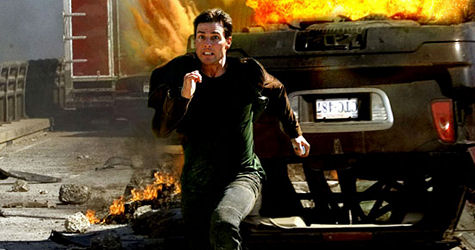
Before I get into Talent Guy’s words, bear with me for the last next six graphs. For others who are only just now getting up to speed, the 82 year-old Redstone blew a lot of minds Tuesday by telling the Wall Street Journal that Paramount was ending its 14-year relationship with Cruise’s C/W Prods. because of the actor’s “off-screen behavior”, which “was unacceptable to the company.”
As I wrote that day, it’s astonishing that Redstone would say this because it wasn’t really necessary to spell things out. The usual Hollywood routine in explaining a parting of the ways (creative or otherwise) is to use polite respectful terms, which Redstone obviously decided against.
< ?php include ('/home/hollyw9/public_html/wired'); ?>
In a New York Times story out today, various industry insiders were described as being “flabbergasted” at the manner in which Redstone lowered the boom.
Some have said why axe Cruise and his partner, Paula Wagner, for Cruise’s eccentric behavior now when the really loopy stuff (apart from the ongoing tabloid perception that Cruise is a manic control freak keeping Katie Holmes and daughter Suri under lock and key) happened in the summer of ’05?
Wagner put it to the Times that Redstone’s diss had put Paramount chairman Brad Grey and Viacom CEO Tom Freston in a “lose-lose” situation.


Sumner Redstone

“If you didn’t know anything about this [statement in advance], how effective are you at running a studio?” Wagner said of the two executives. “Would anyone want to work with management that’s ineffectual? And if you’re complicit in it, would anyone work with a studio that devours its own?”
Talent Guy thinks that Redstone is getting old and stepped into this controversy partly because of the malady that 83 year-old guys all over tend to suffer from, which is that they can be blunt and cranky and intemperate. (My father isn’t far from this age, and he’s much snippier and ruder than he used to be.)
And yet, Talent Guys says, that doesn’t mean Redstone isn’t expressing what a lot of suits are thinking these days, which is “let’s make the big-dollar talent guys sweat — they’re still one of the biggest reason movies cost so much, they don’t necessarily justify the investment, they make too much back-end, they’ve overplayed their hand and it’s time for those of a strong corporate disposition to step up and swat ’em down and herd them back into the corral where they can be restrained and made to see reason.”
As one insider “suit” puts it, “Studios are making very little money on the big movies because talent deals are taking up too much of the back end. Gross players have to be trimmed down. Tom Cruise is the only one who made money on M:I:3, Peter Jackson is the only one who made out like a bandit on King Kong and Bryan Singer is the only one who came away rich, clean and cash-flush on Superman Returns. Back-end deals of this sort are fiscally imprudent and stupid in this environment.”
And yet Talent Guy, who knows a lot of others in his realm (A’s, B-plusses, B’s), says that the A-list people in Hollywood feel that “the suits have overplayed their hand, they’ve overbuilt their companies, staffed them with too many executives whose salaries are too high, and they need to be swatted down. They’ve turned this industry into a monopoly. They’re all in collusion and getting together and flattening it all down.
“This is the start of a whole Hatfield vs. McCoy war,” Talent Guys says. “Suits vs. top- and mid-level talent. There’s a lot of whispering and mumbling and grumbling at parties all over town, and I’m telling you it’s about much, much more than ‘is Tom Cruise a nutbag?’ or ‘is Sumner Redstone a nutbag?’ It’s really a fight for the soul and the future of this business.
“First off, let me tell you without a doubt that Will Smith, Tom Hanks, Adam Sandler, Jim Carrey, Ben Stiller, Cameron Crowe, Robert Zemeckis and a lot of other guys are close, close friends of Tom Cruise’s and they love him… they’ve all seen his baby, they all know he’s really in love, they all know it’s a crock of bullshit…they all know he shouldn’t have laid into Brooke Shields but guess what? So does Tom…he’s apologized for what he said.
“And I’m telling you that these people I’ve just named — the ten or twelve really big talents in this town that the studios need to worry about and keep happy — are not happy about how this went down, and they’re not happy about the Bigger Picture.
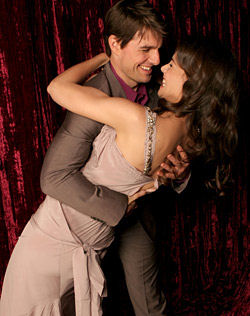
“From the talent side of view, we didn’t turn all these studios into these massive corporate conglomerates,” Talent Guy argues. “We didn’t make it a business in which it takes 200 executives to make 20 movies a year…they’re the ones who’ve created a business in which the cost of making movies is so expensive that there’s only a 5 to 7% return during a good time…if there was a purity to this business with the DVD money and foreign sales, this would be a huge cash business.
“The A-level talent guys in this town aren’t interested in playing this war out in the press, but the suits have decided that the way to beat these people down is through the press…but I’m telling you, we feel strongly about this. The suits have fucked this business up, not us. Quit laying the blame on movie stars. Don’t say it like that, don’t sell it like that.
“This Tom Cruise-Sumner Redstone thing is like a 9/11 flashpoint almost…maybe it’s more like the bombing of the Marine barracks but it’s one of those flare-ups that has a lot of people talking and getting mad. And it’s going to kick off a long war that’s going to play out over the next 10 to 15 years. And I promise you that in the end the studios as we know them now are going to crumble.”
Talent Guy and his brethren basically foresee a world in which it’ll eventually cost less to make and market movies, with a lot of the studio deadweight being jettisoned. They see a world with high-speed internet delivery of movies and direct-to-viewer marketing in which movies can be made and sold more efficiently than they are now, and in which they’ll own significant percentages of these films and therefore won’t need to demand huge upfront fees.
A world, in short, with the big machinery of developing and selling movies by studio executives sharply reduced in its size, impact and importance. Because they always push for the wrong kind of movies and they’re deadweight functionaries in many respects. And because studio accountants are liars.


C/W Prods. partner Paula Wagner

“If the studios had been honest about their share of the profits, you never would have talent costing what they cost,” he says. “But they lie so much and apply humungous fees and pay for their massive buildings and parking structures and charge ridiculous sums back to their own budgets for things they already own and are already getting incomes from…it’s ridiculous.
“And the bottom line is that eventually the studios won’t be able to afford their huge infrastructure, and they’ll start downsizing themselves and laying more and more people off, and they’ll become smaller and smaller distribution companies and releasing only their big tentpole movies. We don’t need all these executives…we really don’t.
“But the suits need the big stars and the big writer-directors much more than they think they do. Right now they don’t think they need them….they don’t have any respect for talent because of who they are, because they see movies as more of an animated CG music-video form with stars and directors and writers brought into the mix, at best, as seasoning.
“We didn’t bring on this culture of marketing running everything, and the movies talking down to audiences…of bringing the whole movie culture down to the interest levels of a typical 17 year-old high school boy or girl…or placing so much empha- sis on visual pizazz and special effects in movies and the letting the concept of marketing budgets hitting $40 or $50 or $60 million dollars become the norm…we didn’t do any of this, they did.

“I can see what people are talking about when they say some big movie stars make too much money, but they’re just getting what they feel is a fair and justified cut of a pie that’s been growing by leaps and bounds over the last 10 or 15 years.
“The far more pernicious element to me is the way the synthetic, quarter-of-an- inch-deep hugeness of movies today — their manic, pogo-stick, look-at-our- latest-cheap-trick mentality, the hyper-glossy aspect of everything they put out today — has become a kind of monster…a world in which guys like Peter Jackson and McG and Michael Bay and Brett Ratner are kings.
“Not altogether, thank fortune — not with guys like Chris Nolan and Alexander Payne and Steven Soderbergh and even Sofia Coppola and movies like Little Miss Sunshine…there are heart movies, personal movies out there, but the good things have happened and prospered in this town in spite of what the suits have been doing for years, which is playing it safe and low and shallow and trying to turn the whole magic-of-movies alchemy into something synthetic and shit-level and poisoned with CG.”
As for the problem of Sumner Redstone himself, Talent Guy thinks the only way for Paramount to restore itself in the eyes of the community is to gradually put him out to pasture.
First, put the word out now among agents and producers that, privately, Grey and Freston think Redstone has started to lose his bearings, and that they’re going to start making moves to take him out of the loop. And then wait four to six months and quietly announce that Redstone is going to devote himself to some new charitable foundation while lessening his day-to-day duties as Viacom chief.
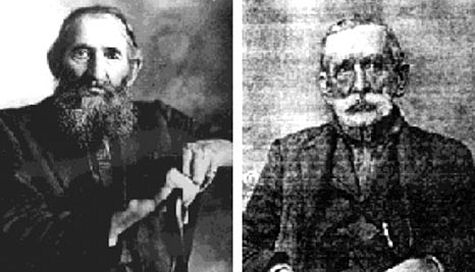

“Devil Anse” Hatfield, Randel McCoy

Of course, Talent Guy is leaping aboard the sentiment bandwagon voiced by guys like CAA agent Richard Lovett telling the N.Y. Times that “Paramount has no credibility right now…it is not clear who is running the studio and who is making the decisions.” And Cruise’s lawyer Bert Fields calling Redstone’s comments “disgusting” and suggested that “he’s lost it completely, or he’s been given breathtakingly bad advice.”
For what it’s worth, my insider “suit” feels that Redstone said it plain and straight. He feels that Cruise has melted down and is damaged goods, and that Steven Spielberg, for one, doesn’t see Cruise in warm friendly terms. “He thinks Cruise is eccentric and borderline irrational,” he says. “Spielberg always reacts to the bottom line, to the greed factor…and he thought he was robbed of millions and millions of dollars when War of the Worlds underperformed…he knows Cruise cost him a lot of money going public on Scientology the way he did.”
(Talent Guy says he knows that Spielberg takes money very seriously, but says his years-long friendship with Cruise is alive and well and undiminished.)
This source also says that Wagner has been talking to other studios for a while now about taking C/W Prods. to one of their lots for a housekeeping deal and “nobody bit. If anyone was interested somebody would have stepped up to the plate by now. Everybody knows C/W Prods. is looking and available, and if there had been a clamor, somebody would have stepped up. And in this climate, they haven’t. And that’s the bottom line.”

Toronto Finals

Toronto Finals

The final tally of Toronto Film Festival titles has been released, and along with that comes HE’s initial checklist (must-sees, should-sees). This usually includes about 50 or 55 films, which always has to be whittled down to a more realistic 25 or 30.
My first run-through has resulted in 49 titles, give or take. I’m posting this list in hopes of hearing from the usual know-it-alls in hopes of pruning it down or getting wise to films that aren’t on my list but should be.


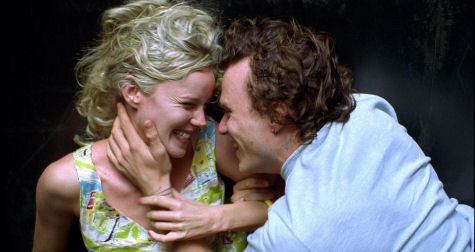
Abbie Cornish, Heath Ledger in Neil Armfield’s’s Candy (ThinkFilm, 11.17.)

The only high profile head-turner in this morning’s official list is the inclusion of Ridley Scott‘s A Good Year (20th Century Fox, 11.10). For whatever reason I hadn’t heard this was definitely going there.
Here are most of the categories reprinted with HE’s priority titles in boldface (and the ones I’m already seen in bold italic). If anyone knows anything good, hard and solid about any films I haven’t boldfaced — positive or negative — please advise and I’ll work them into the schedule. Obviously I don’t need to see the italicized bold titles again and there are all kinds of additions to come, and I can keep updating and modifying as I go along:
< ?php include ('/home/hollyw9/public_html/wired'); ?>
The only high profile head-turner in this morning’s official list is the inclusion of Ridley Scott‘s A Good Year (20th Century Fox, 11.10). For whatever reason I hadn’t heard this was definitely going to be up there.
Here are most of the categories reprinted with my priority titles in boldface (and the ones I’m already seen in bold italic). If anyone knows anything good, hard and solid about any films I haven’t boldfaced — positive or negative — please advise and I’ll work them into the schedule. Obviously I don’t need to see the italicized bold titles again and there are all kinds of additions to come, and I can keep updating and modifying as I go along:


Russell Crowe in Ridley Scott’s A Good Year (20th Century Fox, 11.10)

Opening night gala: The Journals of Knud Rasmussen. Closing night gala: Amazing Grace.
Gala Presentations (10): After the Wedding, All The King’s Men, Away From Her, Babel, Banquet, Black Book, Bobby, Bonneville, Breaking and Entering, Dixie Chicks — Shut Up and Sing, For Your Consideration, A Good Year, Infamous, Mon Meilleur Ami, Never Say Goodbye, Penelope, Volver.
Special Presentations (13): 10 Items or Less, A Chairy Tale, Alatriste, Begone Dull Care, Blinkity Blank, Brand upon the Brain!, Bubble, Cantante, Catch a Fire, Congorama, Crime, Dog Problem, Exiled, Fall, Fay Grim, The Fountain, Golden Door, HANA, Hen Hop, Homme de sa Vie, Horizontal Lines, Jindabyne, Kabul Express, Last King of Scotland, The Last Kiss, Little Children, Lives of Others, Love and Other Disasters, The Magic Flute (ought to see it, don’t want to).
Plus: Manufactured Landscapes, Merle, Mon Colonel, Namesake, Neighbours, Nue Propriete, Opening Speech,
Pan’s Labyrinth, Paris, Je T’aime, Pas de Deux, Pleasure of Your Company, Post-Modern Life of My Aunt, Quelques Jours en Septembre, Seraphim Falls, Snow Cake, Stars and Stripes, Stranger than Fiction, Synchromy, This Is England, Venus, Vince Vaughn’s Wild West Comedy Show: 30 Days & 30 Nights, Woman on the Beach.


Jude Law, Juliette Binoche in Anthony Minghella’s Breaking and Entering (Weinstein Co., December…maybe)

Contemporary World Cinema (6): 12:08 East of Bucharest, Abeni, Antonia, Beauty in Trouble, Bella, Bet Collector, Born and Bred, Bothersome Man, Candy, Chronicle of an Escaped Citizen Duane, Confetti, Copying Beethoven, Diggers, Dimanche √É∆í√Ǭ† Kigali, Dog Pound, Falling, A Few Days Later…, Fiction, Four Minutes, Grbavica, Hula Girls, Indigenes, Italian, Last Winter, Mainline, Monkey Warfare, Nouvelle Chance, Offside, Outsourced, Palimpsest, Prague, Rain Dogs, Red Road, Requiem, Retrieval, Silence, Sleeping Dogs, Slumming, Starter For Ten, Suely in the Sky, Summer ’04, Summer Palace, Sweet MudTimes and Winds, To Get to Heaven First You Have to Die, Tourneuse de Pages, Twilight Dancers, Unnatural and Accidental, Violin, Waiter, Wake, The Way I Spent the End of the World, White Palms, Winter Journey.
Discovery (0): 7 ans, Art of Crying, As the Shadow, Bliss, Cashback, DarkBlueAlmostBlack, Falkenberg Farewell, Family Ties, Glue, Grave-Keeper’s Tale, Griffin & Phoenix, King and the Clown, Out of the Blue, Reprise, Silly Age, Thicker than Water, True North, Vanaja.


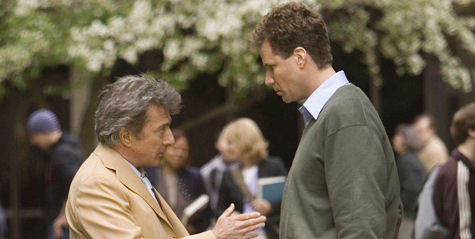
Dustin Hoffman, Will Ferrell in Marc Forster’s Stranger Than Fiction (Columbia, 11.10)

Masters (3): Caiman, Coeurs, EMPz 4 Life, I Am the Other Woman, Untouchable, Lights in the Dusk, Missing Star, Optimists, Rescue Dawn, STRIKE, Voyage en Armenie, When The Levees Broke: A Requiem In Four Acts (seeing this on HBO), The Wind that Shakes the Barley.
Mavericks (2): “An Evening with Michael Moore“, “Making of a Bollywood Blockbuster: Karan Johar, Shah Rukh Khan, Rani Mukherji”, “Vanguard Cinema: John Waters in conversation with John Cameron Mitchell“.
Midnight Madness (3): Abandoned, All the Boys Love Mandy Lane, Black Sheep, Borat: Cultural Learnings of America for Make Benefit Glorious Nation of Kazakhstan, Host, Princess, Severance, Sheitan, Trapped Ashes.
Real to Reel (8): …So Goes the Nation, American Hardcore, Blindsight, Cry in the Dark, Deliver Us From Evil, Dong, Esprit des lieux, Ghosts of Cite Soleil, Iran: Une Revolution Cinematographique, Killer Within, Kurt Cobain About A Son, Lake of Fire, Made in Jamaica, My Life as a Terrorist: The Story of Hans-Joachim Klein, Office Tigers, Pervert’s Guide to Cinema, Primo Levi’s Journey, Prisoner or How I Planned to Kill Tony Blair, Radiant City, Remembering Arthur, Sari’s Mother, Session Is Open, Shame, Sharkwater, Shot in the Dark, Sugar Curtain, Summercamp!, Tales of the Rat Fink, Tanju Miah, These Girls, This Filthy World, Toi, Waguih, U.S. vs. John Lennon, Very Nice, Very Nice, Yokohama Mary.


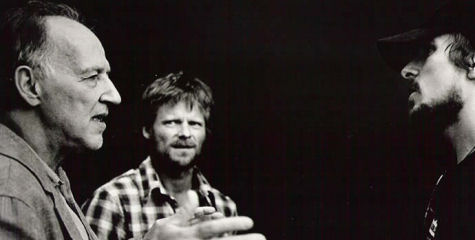
Werner Herzog, Steve Zahn, Christian Bale during filming of Rescue Dawn (Weinstein Co.)

Vanguard (5): 2:37, Bunny Chow, Chacun sa nuit, Drama/Mex, Election, Election 2, Hottest State, Jade Warrior, Macbeth, Renaissance, Shortbus, Sleeping Dogs Lie, Suburban Mayhem.
Visions (1): August Days, Bamako, Belle toujours, Big Bang Love, Juvenile A, Blessed are the Dreams of Men, Book of Revelation, Bugmaster, Building a Broken Mousetrap, Cages, Climates, Colossal Youth, D.O.A.P., Dans les villes, Day Night Day Night, Day on Fire, Fantasma, Flandres, Gathering the Scattered Cousins, In Between Days, Invisible Waves, Island, Khadak, Kinshasa Palace, No Place Like Home, NYC Weights and Measures, Sistagod, Takva – A Man’s Fear of God, Taxidermia, Ten Canoes, Time, Zidane: Un Portait du XXIeme Si√É∆í√Ǭ®cle.


Summer Palace

Derby Girl

Derby Girl

I know award-quality when I see it, and Sienna Miller‘s capturing of Edie Sedgwick — the doomed mid ’60s scenester and Andy Warhol girl who died in ’71 at age 28 — in George Hickenlooper‘s Factory Girl (Weinstein Co.) totally rates. It may be the most eerily accurate reviving of a dead person I’ve ever seen in a film. And yet Miller projects dimension and gravitas in spades — an unmistakable sadness and snap and aliveness like nothing I’ve gotten from an actress in any movie so far this year.


Sienna Miller as Edie Sedgwick in George Hickenloooper’s Factory Girl (Weinstein Co.)

If and when the Weinstein Co. puts Factory Girl into theatres before 12.31 (which may happen, I’m now hearing), Miller will be right in there against Prada‘s Meryl Streep, The Queen‘s Helen Mirren, Notes on a Scandal‘s Judi Dench and maybe Running With ScissorsAnnette Benning. She’s playing the only tragic figure in the group — the only one who goes to her doom with mascara running down her face.
Miller isn’t just a dead ringer for the real McCoy — she gets her fluttery debutante laugh, that mixture of Warholian cool and little-girl terror, the giddy euphoria, the cracked voice. It’s more than convincing — it’s a kind of rebirthing. (I feel I can say this with some authority having seen the real Sedgwick in John Palmer and David Weisman‘s Ciao Manhattan! way back when, and having looked at her photos for years.)
< ?php include ('/home/hollyw9/public_html/wired'); ?>
Hickenlooper’s film is a kind of rebirthing also. Most of it feels like a mid to late ’60s Paul Morrissey film. It has a grungy Manhattan, Collective for Living Cinema, 16mm street quality, like it was shot two or three years before Flesh and Lonesome Cowboys and maybe a year or two after Empire State and Blow Job.
Hickenlooper gives it discipline and tension, working from a tight script by Captain Mauzner but styling in the realm of the Warhol-Morrissey aesthetic, which could be summed up as “don’t recreate anything, just behave and let it happen.”
This is obviously a nervy approach (the person who recently informed a WWD writer that Factory Girl is “kind of a mess” has probably never seen a Warhol -Morrisey film) but with nerve comes a feeling of other-ness. For my money the raw-funk approach works without the viewer needing a NYU degree in Film Studies.


Guy Pearce as Andy Warhol

I’m not going to do a review because the disc I saw was rough and incomplete — there’s plenty of time to get into it down the line. But I should at least mention Guy Pearce‘s Warhol portrayal, which for me is much drier and colder and more delicious than Jared Harris‘s portrayal in I Shot Andy Warhol or Crispin Glover‘s in The Doors. The rumble in the jungle is that Weinstein Co. execs feels Guy’s performance is Oscar-worthy also.
And Hayden Christensen‘s performance of an obviously Bob Dylan-ish figure is, for me, the most engaging thing he’s ever done.
Here are some thoughts from a critic friend who caught Factory Girl under similar circumstances:
“Sienna Miller’s performance is a revelation on several levels — most importantly of her great solar talent; she’s riveting and charismatic in every instant, whether Edie is in meteor-mode or downfall. Hickenlooper was so right to fight for her to play the role. I’m a highly dedicated devotee of the real Edie so I began watching the film with the bar of expectation set extra-high. Well, old Sienna not only vaulted that bar, she blasted the tiles right out of the ceiling and kept going. Edie Lives.

“I’m also still marveling at Guy Pearce’s otherworldly Andy Warhol — a breathtaking creation of a man whose ghost haunts himself. I’m also deeply impressed with Hayden Christensen’s osmosis of the Mystery-Tramp-Who-Shall-Remain- Nameless. I’ve always thought highly of this young actor — he’s still developing, but his instincts are first-rate. As one who has long loved Dylan, I deeply respected where Hayden was able to fish within himself to bring that very difficult prodigy to light.
“I think of Factory Girl as a kind of female Lawrence of Arabia. I’m serious. Edie is an opaque, enigmatic figure by definition, just as T.E. Lawrence was. There is never any ‘explaining’ such a character — we can only experience them, the way anyone who loved them in life might have. That way we can love Edie. Start slow, and people will adore the rush as the film takes off, and maybe even feel a bit scared on her behalf as we lose sight of the girl she is in the film’s beginning moments.
“I feel quite highly of the energy and verve of Mauzner’s screenplay, and feel that Hickenlooker has gone one better and energized the story. Hickenlooper and Mauzner have located Edie in a kind of ‘permanent present-tense’ (as opposed to a period), and I’m willing to bet audiences will embrace her anew, and with her, the film.”


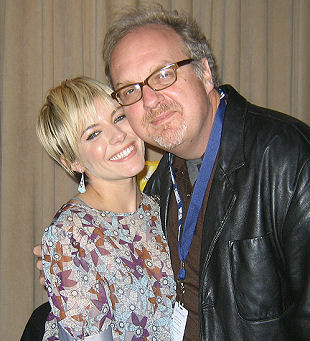
Sienna Miller, George Hickenlooper at the Spirits Awards last March

Oscar Mashing at Paramount

Oscar Mashing at Paramount

Here it is not even Labor Day, and it’s looking more and more likely that the two strongest Best Picture contenders are going to be Flags of Our Fathers and Dreamgirls, which in itself is going to make this a phenomenal Oscar campaign year for Paramount /DreamWorks (a.k.a. “Dreamamount”), which is distributing both.


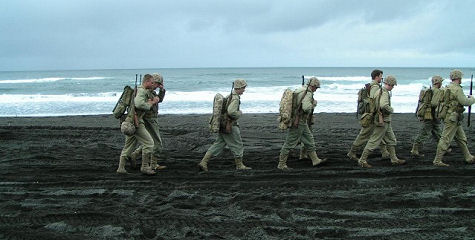
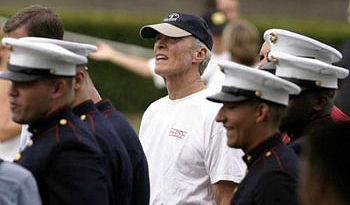
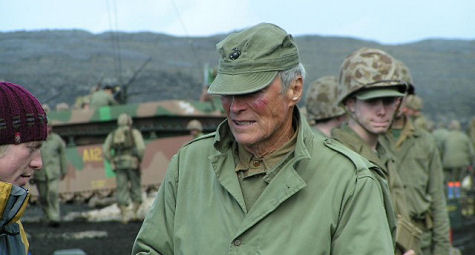
Shot during the filming of Clint Eastwood’s Flags of Our Fathers (DreamWorks/Paramount, 10.20)

Keep in mind also that one other Paramount release — Alejandro Gonzalez Innaritu‘s Babel (Paramount Vantage) — is also regarded as a probable awards- level thing. Not to mention the possibility of Paramount’s World Trade Center eeking into one of the five slots as a kind of sentimental favorite. Four Best Picture finalists from the same studio — it could happen.
But I’m all but convinced it’s going to come down to a Flags vs. Dreamgirls thing — a mano e mano on Melrose Ave. I’m saying this because of fresh perceptions of extremely strong emotional currents in both. And because, as one strategist notes, “there’s such a shallow pool of obvious [Best Picture] contenders from our current vantage point of mid-August.”
< ?php include ('/home/hollyw9/public_html/wired'); ?>
Some surprise movie may come along in a month or two and rewrite the picture — “”it happens every year,” the strategist says — but right now no one can see what film that might be. And I spend every damn day trying to figure this stuff out.
How do I know it’ll be Dreamgirls vs. Flags of Our Fathers? I don’t as far as Flags is concerned, having only read the script and seen this morning’s Japanese combo trailer (i.e., Flags plus Letters from Iwo Jima).
But count on this : (a) the personal-anguish-of-soldiers factor, which Flags is full of top to bottom, is going to resonate to some extent (maybe a large extent) in the hinterlands among the support-our-troops-in-Iraq contingent, and (b) this big-scale tribute to the World War II generation is going to sink in big with boomer-aged Academy members.

I wouldn’t be saying this if Flags was just standing on its own — it could fade or come up short, you never know — but the Flags-plus-Letters from Iwo Jima factor (joined-at-the-hip movies using the same history and locale) is going to impress the hell out of Academy members for the same reason that actors who gain weight or put on fake noses or speak in exotic accents always tend to get Oscar-nomina- ted — because the effort that went into it is so obvious, and because no director has ever done something like this before.
And having seen portions of Bill Condon‘s knockout Dreamgirls again last night I’m dead certain it’s a Best Picture lock. Four scenes were shown, and each was emotional, exuberant, tight as a drum, perfectly staged and performed, and edited with the skill of a diamond-cutter.
And yet when you think about the Flags vs. Dreamgirls competish, it feels like a bit of a muddle because their Oscar campaigns are going to be run by two execs collecting Paramount paychecks — DreamWorks marketing executive Terry Press and Paramount marketing chief Gerry Rich — and who will have to split their loyalties and energies in two directions.
Flags and Dreamgirls originated as DreamWorks projects, of course, and Press is going to be handling the marketing for both, but she and Rich will be making the Oscar campaign moves — and this may look to some like an operation at cross purposes.
Press listened to my questions and declined official comment, but let’s look at this situation as best we can.
One, there’s a huge influx of Miramax and DreamWorks marketing veterans on the Paramount lot these days, and these people know their way around the Academy rodeo. Paramount is a studio, remember, that hasn’t been in a major Oscar campaign since Titanic, which was nine years ago.

Two, there’s no Paramount logo on the Flags of our Fathers one-sheet. Think about that.
And three, Warner Bros. is is the international distibutor and co-financier of Flags of our Fathers, and Warner Bros. will be the the domestic distributor of Letters From Iwo Jima…so there’s that element to consider.
Simultaneous Oscar campaigns for films released by the same studio have happened before, of course. Miramax had its own Life is Beautiful vs. Shakes- peare in Love competing for the Best Picture Oscar in ’98. Disney had The Insider running against The Sixth Sense in ’99. Miramax had The Aviator vs. Finding Neverland in ’04. Universal had Field of Dreams vs. Born on the 4th of July in ’89.
But Life is Beautiful was never considered a Best Picture front-runner, and neither was The Sixth Sense or Finding Neverland. The only analogy that really fits is the Field of Dreams vs. Born on the Fourth of July one.
If it comes down to a Flags vs. Dreamgirls standoff, the ideal situation, of course, would be for Press and Rich to push both with equal vigor. Press is a pro and will naturally strive to do that. She seems to be making the right moves by hiring outside Oscar campaign consultants for both films — Amanda Lundberg for Dreamgirls and a not-yet-finalized hire for for Flags.

But one studio insider who also knows his way around the racetrack sees other forces at work.
“It’s really not Terry Press making the call here,” he said. “This is about Spielberg and Katzenberg and Geffen…this is Geffen’s movie, Dreamgirls…and it’s about how these guys are joined in the planning the future of this studio. Dreamgirls is going to get the big push — it’s a non-contest.
“And I think Eastwood knows that, and I’m not so sure he even cares about playing this game at this stage in his life. But look at the power DreamWorks has at Para- mount these days, and you have to consider the hard reality, which is that from the DreamWorks/Paramount perspective, Clint is a 76 year-old director who’s basically a Warner Bros. guy on hiatus.”
The other strategist says “the reality is not Clint’s age but the fact that he’s won twice” — i.e., Best Picture Oscars for Unforgiven and Million Dollar Baby — “and that he won last year.”

Japan Gets Clint Better Than We Do

Japan Gets Clint Better Than We Do

This Japanese trailer — short and hard but quite intriguing, especially in its use of desaturated, close-to-monochome color — is very clearly promoting Clint Eastwood‘s Flags of Our Fathers and Letters from Iwo Jima (i.e., formerly known as Red Sun, Black Sand) as war films joined at the hip — as an epic-scaled, double-dip, you-can’t-see-just-one experience.
The emphasis in the Japanese trailer, naturally, is on star Ken Watanabe — he has the longest dialogue clip — and other Japanese actors who will (apparently) appear only in Letters. (The Flags of Our Fathers script I read earlier this year has no Japanese speaking parts.) The trailer shows glimpses of American cast members — Jesse Bradford, Adam Beach, etc. — but that’s all.


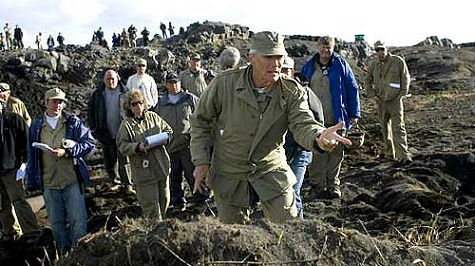
Clint Eastwood during shooting of Flags of Our Fathers (DreamWorks/Paramount, 10.20)

What’s especially interesting are the Japanese release dates, as confirmed on the Japanese website: 10.28.06 for Fathers (which is odd because 10.28 is a Saturday) and 12.9.06 for Letters . The U.S. release dates, however, are 10.20.06 and sometime in January 2007, respectively. There’s no locked-in date for Letters at this point, or so I’ve been told.
DreamWorks/Paramount has kibboshed the idea of both films coming out on these shores in the same year — they want Letters to mainly be regarded as aesthetic support for Flags of Our Fathers, which, of course, is what the Oscar effort will be all about.
< ?php include ('/home/hollyw9/public_html/wired'); ?>
Flags is the primary film in Eastwood’s head — a time-trippy art movie about how Iow Jima veterans feel about the notions of heroism and standing with their buddies — as well as the American side of the Iwo Jima issue, and DreamWorks/Paramount thinks (or so I gather) that Academy members will be confused as to which film to vote for if both films are released in late ’06.
Maybe DreamWorks/Paramount also figured Academy members would complain about having to digest two movies as a single thing. And that they might complain about sore rears. That sounds shallow, but you wouldn’t believe how some Academy members talk about moviegoing during Oscar season. Their irreverence is amazing.


Clint Eastwood directing Ken Watanabe during shooting of Letters from Iwo Jima

Maybe DreamWorks/Paramount is right but I don’t agree — cluelessness and shallowness should never be catered to — and I’ve been saying so for a while now.
I’ve thought all along that these films should both be released in late ’06, because they need to be absorbed as one big single war epic and regarded as a single entity by Academy members. I think these films should be released just as they’re being released in Japan — in late October and early December — and that they should appear on the Oscar ballot togetherFlags of Our Fathers & Letters from Iwo Jima as a one-vote, one-movie deal.
That’s out the window, of course, and too bad but that’s that. But sooner or later the films will be offered together as a double-disc DVD, and it would be fascinating to see them shown as a big double-feature in theatres. I don’t think they can be cut together like Francis Coppola cut Godfather I and II into The Godfather Saga (i.e., that piece that ran on TV in the late ’70s) but maybe that’ll happen down the road…who knows?
I know that in my head, at least, I’ll always see Flags of Our Fathers and Letters from Iwo Jima as the ultimate Siamese twin World War II movie.

The Old Toronto Sidestep

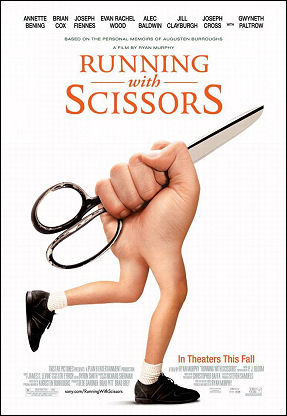
I didn’t realize this until a few hours ago, but Ryan Murphy‘s Running with Scissors (Columbia, 10.11 limited, 10.27 wide) will be joining Nicholas Hytner‘s The History Boys in not visiting the Toronto, Telluride, Venice or New York film festivals. And given what it seems to be, it seems fair to wonder why.


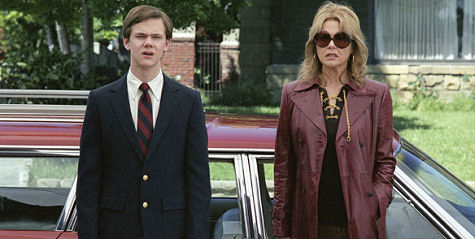
Joseph Cross, Annette Bening in Ryan Murphy’s Running With Scissors (Columbia, 10.11 limited, 10.27 wide)

A darkly comedic dysfunctional-family flick that’s been seen and liked by exactly one guy I happen to know, Scissors looks like a natural to play at one of the elite festivals for the simple reason that it sounds very much like a film that would do well by them. It’s supposed to be pretty good in an oddball edge-movie way, and the early-bird handicappers (who know nothing as this stage) are talking about Annette Bening‘s performance as an unstable mom being derby-quality.

Scissors isn’t required by law to show itself to critics and entertainment media at one of the September festivals, but that guy — a movie hound — told me it’s quite appealing and pretty damn good, etc., so why not? Why sidestep a chance to get the word out on a presumably good film only a month before it opens limited (on 10.11)?

Like I said in that piece last week about the History Boys bypass, there are three reasons that fall releases with high-pedigree trappings don’t make the trip to Telluride, Toronto, Venice or New York: (a) The film doesn’t quite have the chops that everyone’s expecting; (b) it has the chops and then some, and its handlers are figuring they don’t need early-fall festival buzz to start things off; or (c) it has the chops but for some reason they don’t want reactions percolating for eight or ten weeks before it opens.

Occasionally a film won’t go to Toronto if big-name talent isn’t available to do interviews, but this, apparently, isn’t a decisive Scissors factor. Bening aside, the costars are Joseph Cross, Gwyneth Paltrow, Jill Clayburgh, Brian Cox, Joseph Fiennes, Evan Rachel Wood and Alec Baldwin.

And of course, December releases don’t necessarily hit the September festivals either unless they’re something on the order of Brokeback Mountain (which opened limited on 12.9.05) and they need all the great advance buzz they can get. And Xmas holiday movies (like Notes on a Scandal say, which comes out 12.22) pretty much never go. And Clint Eastwood “doesn’t do festivals” (as one guy put it earlier today) so Flags of Our Fathers (Paramount/DreamWorks, 10.20) isn’t going to Toronto-Venice either.

Oscar Balloon Best Picture likelies that are going to Toronto are Babel (Paramount Vantage, 10.27) Stranger than Fiction (Columbia, 11.10), Little Children (New Line, 10.6), Catch a Fire (Focus Features, 10.27) and The Fountain (Warner Bros., 11.22). All October-November openers, all choice pedigree, all moderately budgeted.

Infamous (Warner Independent, 10.13) may or may not go to Toronto — a decision will be known this week — but it’s definitely going to Telluride.

Aside from Running with Scissors, the not-yet-opened Oscar Balloon Toronto- Venice no-gos are Flags of Our Fathers (Clint factor); Dreamgirls (Xmas holiday, not a festival film); The Pursuit of Happyness (ditto); Children of Men (holiday, newly positioned), Blood Diamond (mid-December), The Good German (early December limited, holiday wide) , Notes On a Scandal (holiday) and The History Boys (11.22).

A Summer It Was

A Summer It Was

August is toast in two and a half weeks so I guess it’s time for a summer ’06 wrapup piece. I don’t feel like doing a typical why-they-failed-or-succeeded analysis, so I’m just going to run a listing of the stories that felt like standouts in terms of my weekly Elsewhere agonistes. There were 25 punchers in 14 weeks.
I will, however, reiterate what I felt was the most welcome and most dramatic story of the season: the out-of-the-blue “just say no” decisions of some big-studio chiefs about some hugely expensive big-star vehicles & fee deals (Used Guys, Ripley’s Believe It Or Not), which may be harbingers of a trend.

This felt welcome because big budgets always diminish the entertainment factor, on top of which this seemed like the first breath of upper-level fiscal sanity in this business in a long time. To me it felt analogous to the chain-reaction topplings of socialist governments in 1989. Suddenly studio honchos seemed to be saying, “Sorry, dudes, but you’re going to have share more of the risk and make do with two vacation homes instead of three or four.”
This attitude is also part of the industry cutbacks and contractions going on right now, at least tangentially, and of course this has everybody terrified or at least biting their nails. And I say this: Fear is not a pleasant thing but it’s a good thing to wade into every so often. It cleans out the blood, sharpens the mind and usually results in needed change and discipline and re-thinks.
< ?php include ('/home/hollyw9/public_html/wired'); ?>
Hollywood’s summer begins in late April these days, but let’s kick back and be liberal and call it April 8th so I can link once more to that Flags of Our Fathers piece I ran just over four months ago.
1. What Is Flags of Our Fathers, and How Will It Play? (“Regarding Fathers“, 4.8)
2. HE Inaugurates Reader-Comments Feature, which was up and rolling as of 5.3. One of the liveliest and most enjoyable things to happen to this site in a long time.
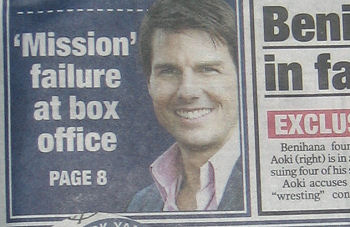
3. The End of Super-Tom as signalled by the un-terrific domestic grosses for Mission: Impossible: III The piece was called “The Upside of Taps“, and it ran Sunday, 5.7. The next day came links to Nikki Finke and Mark Ebner‘s stories about scientologists buying up M:I:3 tickets. Still later came news that the South Park Cruise-in-the-closet episode had been Emmy-nominated, which never would have happened if Cruise wasn’t perceived as vulnerable and not-the-man-he-was five years earlier.

4. Runnng With Babel, first in a 5.14 interview with Alejandro Gonzalez Inna- ritu called “Bullet Time” and then in a 5.23 Cannes Film Festival review of the film.
5. The DaVinci Code Blows, as conveyed in “Hissing Balloon“, a Cannes Film Festival review than ran on Tuesday, 5.17. Not that anyone cared. It was soon after kicking worldwide box-office ass, and it didn’t quit until early August. The U.S domestic tally alone was $216,385,837 by late July.
6. The Bitch-Slapping of Southland Tales at Cannes Film Festival, as sadly reported in this 5.21 review/article called “California Dreamin“. A regrettable thing because I know director-writer Richard Kelly slightly and consider him a good hombre.
7. The Booing & Despising of Marie Antoinette at Cannes, as contained in a review that than ran Wednesday, 5.24, called “Blood of a Lady“.

8. Surprise — The Break-Up Isn’t Half Bad (Saturday, 6.3). I’m not sure that running a positive review helped mitigate my running tracking numbers that were accurate as far as they went but which forecast the wrong financial future for this film. This episode highlighted, properly, the less than 100% reliability of tracking, certainly without understanding timing isses and demographic factors in their right proportion.
9. The Up, Down & Really Down Ride of Superman Returns, starting with my initial 6.19 review, written from my Las Vegas hotel room while visiting Cinevegas. Followed by a Superman Returns may-actually-be-a-little-long piece. Which was followed by a 6.30 piece about Superman Returns fighting for its life and possibly being in trouble. The whole cycle was over in the space of less than three weeks
10. Nacho Libre Ain’t Half Bad Either (Mexican Goof Ride” on 6.13).
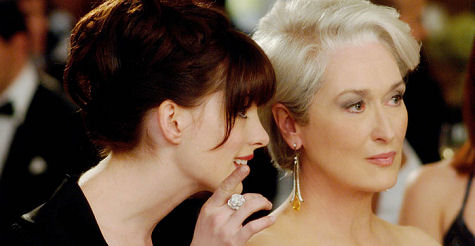
11. The Devil Wears Prada is a Smart, Above-Average Chick Flick with Two Especially Good Performances (“Fashion Abrasion” on 6.25).
12. Pirates 2 Eats It (“The Big Empty” on 6.29). Which mattered not, of course, as acknowledged in this 7.8 item.
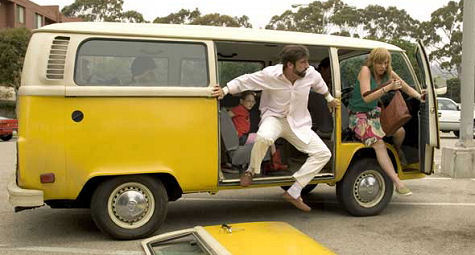
13. Little Miss Sunshine is the Best Comedy of the Summer (“Sunshine Is It“, Monday, 7.3)

14. The De-Hippifying & Dumbing-Down of Snakes on a Plane Hype (the dumbed-down U.S. one-sheet, 7.5 — the dumbed-down Euro one-sheet, 7.6 — The Fun’s Over, 7.23 — Snakes Checklist.
15. Dupree and the GenX Arrested-Development Syndrome (“Party On“, 7.6 — “The Legend of Owen Wilson, a True Original“, 7.9 — “Down on Dupree“, 7.12.
16. M. Night’s Confession and the Subsequent Drowning of Lady in the Water (“Feel Night’s Pain“, 7.9 — “Soggy All Over“, 7.20).
17. Love and Respect for Miami Vice (“Nice Vice“, 7.11) — although the public pretty much said ‘fuck this’ — “Vice Aftermath“, 8.6)
18. Talladega Nights Is Okay, Even If It’s Not Funny (“As I Lay Dying“, 8.3)
19. A Surprisingly Strong Sandler Film Surfaces… (“Men Apart“, 7.24) …And Is Soon After Bumped Into ’07 (“Why Reign Is On Hold“).
20. The Official De-Oscarfying of Martin Scorsese’s The Departed (“Forget the Toronto Film Festival“, late July)
21. The Gibson Mess (“Goony Bird“, 7.28 — “Terrible News“, 7.29). I wrote so much stuff about this that I’m sick of it now and don’t feel like linking to each and every item.

22. The Solid Crafting of Oliver Stone (“Comfort Blanket“, 7.31).
23. Robert De Niro and Eric Roth’s De-Wackifying of James Jesus Angleton (“Sussing Shepherd“, 8.9).
24. The Proceed-With-Caution History Boys Campaign (“Art of the Dodge“, 8.11).

Art of the Dodge

Art of the Dodge

What’s up with Fox Searchlight’s cards-to-the-chest History Boys campaign?
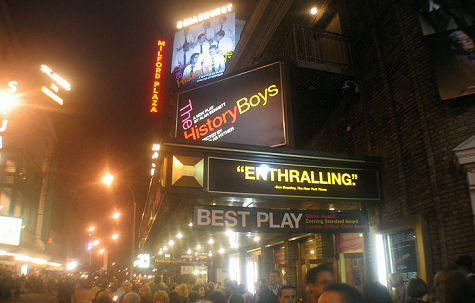
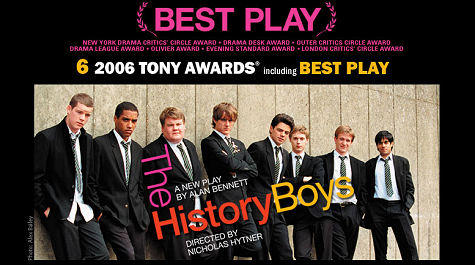
London publicists are preparing for a 10.13 opening, and so Nicholas Hytner‘s film is starting to screen for the press next week. With the pic opening stateside on 11.24, nothing’s doing here now. And yet — this is the unusual part — there are no plans to show the film version of Alan Bennett‘s Tony Award-winning play at the Telluride, Toronto, or Venice Film Festivals.


Portion of invitation to next week’s London screenings of The History Boys (Fox Searchlight, 11.24)

One interpretation is that Fox Searchlight marketers are so confident about Boys having the goods that they’re figuring they don’t need Toronto, Telluride or Venice.
Fox Searchlight COO Stephen Gilula wouldn’t respond to this, but said, “We want to do the right thing for the film itself, rather than satisfy expectations of the press and of conventional industry wisdom. We’re not playing a ‘game’ with this movie. Our first priority is to position it for the public, and not for the award community.”
< ?php include ('/home/hollyw9/public_html/wired'); ?>
Another speculation is that homoerotic content in The History Boys is making Fox Searchlight nervous, and they’re figuring it’s better to keep the talk down for now.
Gilula says that “content is not a concern for us…we have absolutely not had that conversation. We’re the company, remember, that distributed The Dreamers with an NC-17 rating, and also released Quills.”
One reason for not showing The History Boys in Toronto, Gilula says, is that “it’s a British play and a national icon there and they wanted the world premere to happen there. Plus the show is still playing on stage and we want to respect that.”
If you respect the pedigree of the Tony Awards and especially if you’re an avid reader of Movie City News, you’re probably assuming that The History Boys is in the running for possible Oscar awards — Best Picture, Best Director (Hytner), Best Adapted Screenplay (Bennett, who wrote the play), Best Actor (Richard Griffiths), etc.

Because the currently-running Broadway play won six Tony Awards last June (including Best Play), and you have to figure at least some of the lustre will rub off on the film version. And because David Poland has link-blurbed The History Boys as a possible Oscar contender once or twice, and because MCN “Voices” contrib- utor Stephen Holt all but proclaimed The History Boys a multi-Oscar nominee in a piece that ran on MCN last June.
The Tony Awards sweep “paves the way for the film version of The History Boys to score heavily in the Oscar race, breaking out fast as an early favorite,” Holt enthused. “And Fox Searchlight execs on both coasts are understandably ecstatic about [the Tony Award win] and are going to focus all their Oscar-savvy energy on a major campaign for the film, which opens in the U.K. in October.”
But not showing a film of this type at one of the big prestigious September festivals is a definite eyebrow-raiser.
The rulebook says if you have a high-pedigree film opening in the mid-to-late fall that looks like a possible Oscar contender (like last year’s Brokeback Mountain or Capote), you take it to Toronto or Venice or Telluride. Period. You couple your openings at Telluride and Toronto, or at Toronto and Venice, or you go for a trifecta.
If you don’t do this, you either (a) don’t quite have the quality everyone’s expecting, or (b) you do have this and you’re figuring you don’t need early-fall festival buzz to start things off, or (c) you have the goods but something’s holding you back. A concern, say, about a subplot involving an iconoclastic middle-aged teacher who has an occasional thing about fondling the genitals of his male students.

A Fox Searchlight rep told me this morning that one reason for The History Boys not going to Toronto is that the mostly all-male cast can’t get out of their daily performances in the Broadway show. Except nobody in the press knows the cast members very well, and the general public doesn’t know them at all. In any event the press would much rather talk to Hytner or Bennett.
And if the cast is really the reason, why not show The History Boys movie at the New York FIlm Festival, which would eliminate the can’t-travel issue?
I’m told that Telluride honcho Tom Luddy made an overture about seeing The History Boys for possible consideration, but that he was told no-go.
“If you really have something, you don’t have to take it to Toronto,” an Oscar campaign consultant said earlier today. “If you feel you need to prove yourself, and if you really want people to talk about your film, you take it to Toronto or Venice or Telluride…but if you’re absolutely sure that you’ve got the goods, you don’t need a festival.”
And if this isn’t what’s going on…well, here it is again.
After the Tony sweep it seemed as if The History Boys had instant credibility as a year-end Oscar contender. I wrote, however, that “I don’t think that’s necessarily true.”
I saw The History Boys last May, and it’s a brilliant and impassioned tribute to the glories of inspired teaching, and of passing along those things that truly matter in life.
In the film, Griffiths (best known as Harry Potter’s mean-spirited Uncle Vernon) will repeat his Tony-winning stage performance as an eccentric history instructor in an English boys’ school who’s expected to prepare them as best he can for university entrance exams, but is forced to leave his post when the school’s headmaster learns about his erotic fondling of some of the students.
There’s a longstanding homoerotic tradition in dramas about English schoolboys and boarding schools (reflections of this were in Lindsay Anderson’s If) and it’s certainly no big deal to X-factor types.
The idea seems to be if you’re broadening a student’s mind with profound teachings (as Griffith’s History character certainly does), copping a discreet feel is a forgivable impulse/indulgence, but it’s a different story if you’re a priest passing along repressive Catholic dogma.
“Toronto is over two months before the History Boys [U.S.] opening,” the consult- ant says. “And when you have a film with complicated issues or feelings that you don’t want percolating for too long, you don’t want to show it too early.

“Everything is a moving target these days. The media changes, people’s tastes change…and maybe the world is ready for a fondling teacher. But the American public’s interest in sexual content is nil. They can’t handle sexual content, and maybe [Fox Searchlight] doesn’t want it out there too early because of this. They don’t know what the reaction is going to be.”

A gay guy who attended the same History Boys performance that I saw last May confided that he was mildly offended by the genital-fondling aspect. I figured if this guy was slightly put off…
“If it’s somewhat challenging material, no one’s going to fire you for saying no and not exposing it early,” the consultant concluded. “It may be better to be safe than sorry. Challenging material is just that…challenging. And there ‘s no projecting what’s going to happen. Maybe everybody took a step back and said, ‘Let’s not.’ Why give it two months to percolate before it opens?”
I read this to Gilula and he repeated, ” There’ s been absolutely no conversation about content at all regarding plans plans for the film. We’re not concerned about that. Content is not an issue.”

Sussing “Shepherd”

Sussing Shepherd

Take this with a grain, but early murmurings about Robert De Niro‘s The Good Shepherd (Universal, 12.22) indicate it’s less of a story of how a real-life CIA counter-espionage ace (Matt Damon) gradually succumbs to obsessiveness and paranoia, and more of a…well, the readings are a bit vague. Positive but varying — how’s that?
Damon plays Edward Wilson, a character modelled on legendary super-spook James Jesus Angleton. And Shepherd, a verite spy thriller, is more or less his story. It’s said to be dense and labrynthian and exacting — all positive things — and also that it’s a wee bit long (or was when the film was screened a while back) and that it needs a few trims.


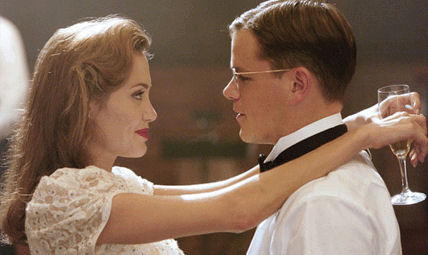
Matt Damon and Angelina Jolie in Robert De Niro’s The Good Sherpherd (Universal, 12.22)

There’s a bit of a “hmmm” factor though. I haven’t heard that much, but I’ve heard enough to wonder if the film has soft-pedalled or even bypassed who and what Angleton became as he got older and more caught up in the rigors of counter- espionage.
The studio-supplied synopsis on Coming Soon says Shepherd is about “the tumultuous early history of the Central Intelligence Agency” so maybe it doesn’t even touch the ’70s. How old could Damon play? A guy in his late 30s or early 40s? That would take Wlson/Angleton story into the early ’60s.
< ?php include ('/home/hollyw9/public_html/wired'); ?>
One guy called Shepherd a kind of Godfather-like epic about the CIA from the mid ’40s to whenever (i.e., it doesn’t stay with Wilson/Angleton until the end of his career or life). Another said the Godfather analogy is off-base, and called it a rich, fascinating inside-the-CIA drama with a side serving of Wilson/Angleton gradually “paying a price” for being ultra-obsessive about counter-sleuthing.
And yet if you know anything about Angleton, you know he’s mainly known for having become a bit of a wackjob, especially in the ’70s. Go to Angleton’s Wikipedia biography and you’ll read that Angleton’s “excesses as a counter- intelligence czar, arising from extreme paranoia that may have been clinical, had adverse effects on the agency, especially during the 1970s.”


(l.) Damon as Wilson; (r.) the real James Angleton

You’ll also read that the term “Angletonian” is an adjective meaning something conspiratorial, bizarre, eerie or arcane.
And yet one of the Good Shepherd viewers I spoke to said flat-out that Wilson doesn’t turn into a nutter. Maybe he was just downplaying it — maybe Damon just turns hyper and rigid as opposed to foaming at the mouth — or maybe the Shepherd plot doesn’t advance that far.
But if De Niro (working from a script by Eric Roth) has de-accentuated Wilson’s wackazoid aspects, that would be a bit like making a movie about boxer Jake La Motta and downplaying the fact that he eventually turned into an overweight, wild-mannered Miami club owner who wound up on the skids.
The Good Shepherd costars include Angelina Jolie, De Niro, William Hurt, John Turturro, Alec Baldwin, Billy Crudup, Keirr Dullea, Michael Gambon, Gabriel Macht and Joe Pesci.


Jolie, Robert De Niro on set of The Good Shepherd

Wikipedia’s opening graph reads as follows: “A poetry aficionado with known ties with the likes of Ezra Pound and T.S. Eliot, and an avid fly-fisherman and orchid- grower, Angleton was an unofficial adviser to successive directors of the CIA, most notably Allen Dulles and Richard Helms. His creative genius for scenario- building and thoroughly penetrating understanding of espionage, deception and false flag operations remain uneclipsed to this very day.
“Considered by many within the intelligence profession as the single most polari- zing, most controversial and admittedly most revered spymaster bar none, Angle- ton had lived spy tradecraft with mad passion. Even the KGB used much of his tradecraft as training tools for their case officers and assets.”

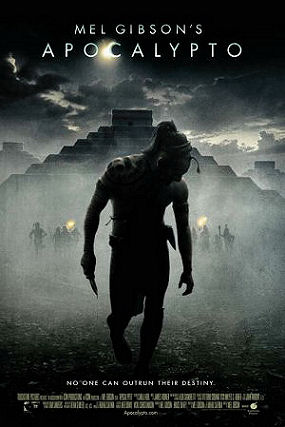
“Apocalypto” Later?

Apocalypto Later

The Mel Gibson mess seems to be getting heavier all around, like fog. People will eventually get sick of it, but they’ll never forget about it. I’ve gotten used to the idea of news stories flaring brightly for a week or two and then going away, but there’s something deeper and skunkier about this one. Fame lasts 15 minutes; memories of racial hatred tend to linger a bit longer.
And that probably means that Gibson’s Apocalypto (Disney, 12.8) may have to push back its release date. April ’07, I’m thinking. Maybe. I don’t know. I’d like to hear opinions. But I’m starting to think that bumping it makes sense.


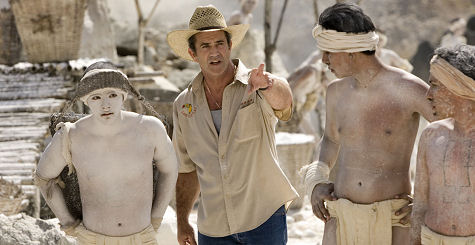
Mel Gibson giving direction during shooting of Apocalypto (Touchstone, 12.8)

There are lots of indications out there about how deep-seated the public’s anger at Gibson may be over his reported anti-Semitic blurtings, but the thing that got me was a story about Gibson’s troubles (“Mel to Pay?”) in the News & Notes section of this week’s Entertainment Weekly.
I don’t remember any story in this section ever drawing a hard moral line in the sand. Views and attitudes are hinted at left and right every week, but never in a declarative, plain-spoken way. But right after saying that attempts at rehabbing Gibson’s image (including “the Official Talk Show Contrition Tour””) are probably in the works, writer Daniel Fierman concludes with these words: “We’re here to tell you it’s not going to work — at least right now. The violence of Gibson’s [anti-Semitic] words won’t allow it.”
< ?php include ('/home/hollyw9/public_html/wired'); ?>
The words “we’re here to tell you” tells me something is going on. Anything that goads EW editors into growing a pair and actually allowing something to be said in their magazine is a significant seismic indicator. And I’m starting to think there’s no way Disney’s Touchstone division can put Apocalypto (12.8) into theatres only four months from now.
The pre-release p.r. campaign would obviously have to begin sometime around mid October, and no matter how many Larry King and Diane Sawyer confessionals Gibson does on the tube (and he’ll probably have to wait until late September or early October to do these or he’ll look too craven), any Apocalypto interview he gives will turn into a referendum on racism.
I strongly doubt that the Gibson moral rehab effort can work if it’s hurried along. And I doubt it can be managed successfully (if it can be managed at all) over the next two months.

The public needs to chill about this, and the media needs to get sick of writing about it. We all know that as long as editors and reporters think there’s any juice in this story, they’ll keep hammering. Everyone has to get completely bored of dissing Mel-the-bigot — it’s the only way — and that can only be achieved through endless repetition.
The Gibson thing will cool down naturally by the end of this month, but it’ll spark up again like a wounded panther if and when the Apocalypto campaign starts up in the mid fall.
I have an idea that if Touchstone pushes Apocalypto back and lets the boiling water cool down, it’ll be less difficult to release it in early April, or possibly late March. Or maybe a bit earlier. I’m not sure. People are going to bring up anti- Semitism no matter when Apocalypto comes out, but they’ll probably be a bit more tired of it six or seven or eight months from now.
I’m leaving film fanatics like myself out of the equation. I’d much rather see Apocalypto sooner than later. Gibson is a nervy hard-core filmmaker, and I’ve been reading all along that he’s got something to say about parallels between ancient Mayan culture and our own. My vote, personally, is open it sooner, not later. But I’m from Mars.
I was talking with some guys in a video store last night about Apocalypto‘s release, and one guy in his early 40s said he thinks the Malibu racism thing will increase interest in people wanting to see it, and that nobody will give that much of a damn in four months’ time.
I suspect this may be a minority view, but what does everyone think?

Freshly Perverse

Freshly Perverse

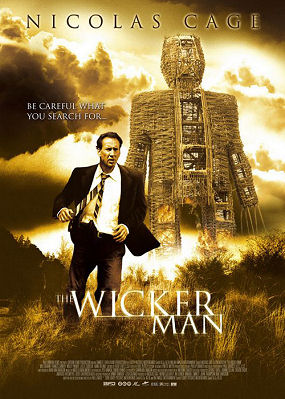
In anticipation of Neil LaBute‘s The Wicker Man (Warner Bros., 9.1), yesterday I rented a DVD of Robin Hardy‘s ’73 classic of the same name. (The extended version, of course.) Sharply written by playwright Anthony Shaffer (Sleuth), it has a reputation of being an exceptionally creepy piece. Which it is, although it contains only one big jaw-dropper at the finale. Which there’s no forgetting. And yet it’s far from a horror film.
Boiled down, Shaffer and Hardy’s Wicker Man is a correctly mannered, somewhat dry parlor drama with an undercurrent of female eroticism and faint malice. It’s pretty much all talk and inference, but in the service of something quite strange.


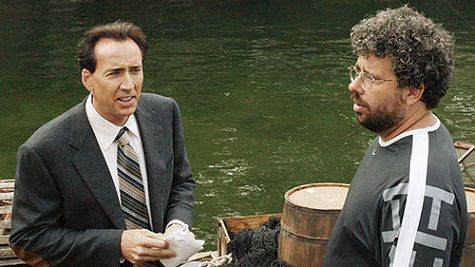
Nicolas Cage, director-writer Neil LaBute during filming of The Wicker Man (Warner Bros., 9.1)

It’s about a rigid, devout, clearly uptight Christian policeman (Edward Woodward) visiting a pagan society on an island off the Scottish coast in search of a missing girl, and his being constantly deceived by the locals in a strangely uniform way. Every last islander is either blank-faced or oddly cheerful, which seems especially weird in view of what they’re all planning. Lo, how righteousness spirals upward to the heavens, contained in a twisting plume.
The Wicker Man wouldn’t work nearly as well without the hammer-like energy and fierce conviction that Woodward brings to his role of Sgt. Howie. There’s no ques- tioning this cop’s intense Christian convictions — he’s all about discipline, rectitude and butt-plug righteousness. And, of course, sexual repression.
< ?php include ('/home/hollyw9/public_html/wired'); ?>
What happens to Howie at the end is what The Wicker man is all about — a metaphor about the fast-eroding influence of traditional Christianity in the face of the newborn spiritual currents of the late ’60s and early ’70s (LSD mysticism, Bhagavad Gita, Tom Wolfe‘s “third great awakening”) and the general shirking of tradition.
What will the metaphor of the new Wicker Man be? Labute wrote the script (naturally), and one of his changes is that the remote island society is now matriarchal instead of patriarchal, as it was in the ’73 film. (In this light, Ellen Burstyn is the new Christopher Lee.) LaBute said at Comic-Con a couple of weeks ago that the film is at least partly about the fact that “women scare me more than men,” or words to that effect.
With men’s social dominance eroding over the last 35 or 40 years, their powers increasingly diluted and on the downswing and guys feeling less and less vital, it seems reasonable to assume that LaBute has made tthe growing stength and independence of women (and the way this has made some guys feel) the focus of his film.

What’s for sure is that LaBute hasn’t made a standard-issue Lionsgate shocker. More assaultive than the ’73 film, but relatively restrained by the standards of 21st Century jolts and gore. And however it turns out, something his and is alone.
In a piece by Charles Lyons in today’s , LaBute says, “Even if there are a few people who are pushing you in saying, `We would love it if this movie was Saw for the first weekend, and it was The Sixth Sense for the next five weeks, you ultimately have just one film that you can create.”
The Wicker Man “probably has a number of scenes that are bloodier than anything in the original,” Lyons reports, adding that LaBute “deliberately exercised restraint in using special effects that, as he put it, provide only a ‘moment’s pleasure.'”
LaBute’s film, says Lyons, “will echo its forebear’s intelligence, even if that means making the contemporary audience work a little harder than usual. ‘If The Wicker Man is a thinking person’s horror film,” says LaBute, ‘that’s great.'”
Like Sgt. Howie, Cage’s cop — called Edward Maulis in Labute’s film — is conservative-minded but more “suave” than Woodward’s character, or so Lyons reports.


This lewd and leering shot is from a scene always mentioned in any discussion of the ’73 Wicker Man — a musical number (yes, a musical number) featuring Britt Eklund, whose singing voice was dubbed by either Annie Ross or Rachel Verney.

One curious thing: Lyon’s article devotes five paragraphs to the fragile ego of Hardy, the original Wicker Man‘s director, specifically his conviction that he was slighted by the producers of the new version when they failed to show him a copy of LaBute’s script and/or declined to let him see the film. Five paragraphs out of 22 — more than 20% of the piece.
The point, I guess, isn’t that Hardy’s feelings are hurt as much as the Wicker Man team doesn’t want anyone knowing what they’re up to.
This seems to be so. The Warner Bros. marketing plan doesn’t seem to include letting guys like me see The Wicker Man early and possibly writing about it. I’ve been trying to get an early peek since early July, but the word all along has been, “We know that you’re a Labute fan but not yet…we’ll let you know.”

Brando Bounty

It took them several years, but Warner Home Video is finally about to release a big swanky DVD of the 1962 Marlon Brando version of Mutiny on the Bounty. The film has been re-mastered from the original 65mm elements and will be presented in the original 2.76 to 1 Ultra-Panavision aspect ratio. This version hasn’t been seen by anyone since Bounty‘s big-city, reserved-seat showings some 44 years ago.

It’ll be part of a spiffy new Marlon Brando Collection box set hitting stores on 11.7.06. The set will also include a purist remastering of John Huston‘s Reflections in a Golden Eye (’67) that will recreate the golden pinkish hues that this disturbing film was presented with during its initial run. It’ll also include a remastered version of Joseph L. Mankiewicz‘s Julius Caesar (’53), which I wrote an item about just a few days ago.


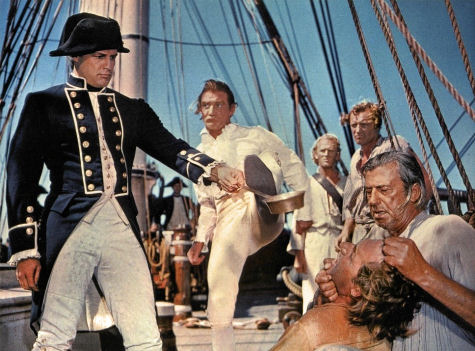
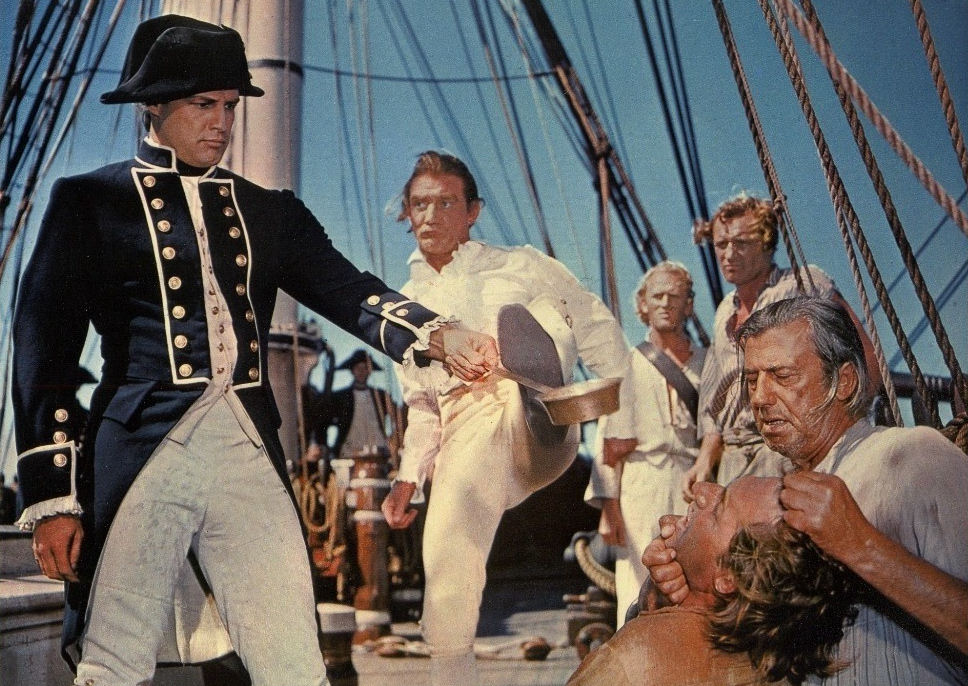
(l. to r.) Trevor Howard, Marlon Brando, Richard Harris and Percy Herbert in Lewis Milestone’s Mutiny on the Bounty

The lesser titles in the set are Teahouse of the August Moon (’56), which features Brando’s strange performance as a cheerful Taiwanese translator named Sakini, and John Avildsen’s The Formula (’80), in which a fat, white-haired Brando plays a no-good oil company mogul.

Say what you will about the ’62 Bounty‘s problems — historical inaccuracies and inventions, Brando’s affected performance as Fletcher Christian, the floundering final act. The fact remains that this viscerally enjoyable, critically-dissed costumer is one of the the most handsome, lavishly-produced and beautifully scored films made during Hollywood’s fabled 70mm era, which lasted from the mid ’50s to the late ’60s.

Roger Donaldson‘s The Bounty (’84) is probably a better Bounty flick (certainly in terms of presenting the historical facts), but the ’62 version has more big-buck, oom-pah swagger. The sets seem flusher and more carefully varnished and arranged, Robert Surtees‘ widescreen photography is more vivid and precisely lit and generally more eye-filling than Arthur Ibbetson‘s for The Bounty, and Bronislau Kaper‘s orchestral score is more deep-down stirring than the quieter ’84 score by Vangelis.

The Brando Bounty is a dated film in some ways (okay, a lot of ways), but it has a flamboyant “look at all the money we’re spending” quality that’s half-overbaked and half-absorbing. It’s pushing a kind of toney, big-studio vulgarity that insists upon your attention.

There’s a way to half-excuse Bounty for doing this. It was made, after all, at a time when self-important bigness was regarded as a kind of aesthetic attribute unto itself, with large casts, extended running times, dynamic musical scores (overtures, entr’actes, exit music) and intermissions all par for the course. And there’s no denying that a lot of skilled craftsmanship and precision went into this manifestation.


The act that ignites the mutiny scene as Brando’s Fletcher Christian tries to give fresh H20 to a thirsty seaman, and Howard’s Cpt. Bligh expresses his opposition.

Bounty definitely has first-rate dialogue and editing, and three or four scenes that absolutely get the pulse going (leaving Portsmouth, rounding Cape Horn, the mutiny, the burning ship). And I happen to like and respect Brando’s performance — it gets darker and sadder as the film goes along — and you can’t say Trevor Howard‘s Captain Bligh doesn’t crack like a bullwhip. (I read a review that said his emoting was made from “wire and scrap iron”, and that Brando’s came from “tinsel and cold cream”.) And Richard Harris and Hugh Griffith are fairly right-on. And everybody likes the topless Tahitian girls.

You could argue that this Bounty is only nominally about what happened in 1789 aboard a British cargo ship in the South Seas. And you could also say that its prime fascination comes from a portrait of colliding egos and mentalities — a couple of big-dick producers (Aaron Rosenberg was one), several screenwriters, at least two directors (Lewis Milestone, Carol Reed) and one full-of-himself movie star (Brando) — trying to serve the Bounty tale in ’60, ’61 and ’62, and throwing all kinds of money and time and conflicting ideas at it, and half-failing and half-succeeding.

Seen in this context, I think it’s a trip.

I frankly expected WHV to go with a 2.55 to 1 aspect ratio. 2.76 to 1 is fairly radical. It means you’ll be looking at thicker-than-normal black bars above and below the image. (If you want an example, check out the most recent DVD of Ben-Hur.) This means you’d better watch it on a fairly large screen.

Here’s are four samples from Kaper’s score — the overture, an unused overture, a romantic idyll piece on Tahiti and a replay of the main theme.

The Bounty DVD is a two-disc affair, but apparently it won’t offer a “making of” documentary. (The doc on the second disc is called “After the Cameras Stopped Rolling: The Journey of the Bounty”, which obviously isn’t about what happened before and during the rolling of the cameras.) That’s a shame because Bounty‘s production history is one of the most tortured in Hollywood history, marked as it was by constant tempest (Reed was let go, Milestone quit), cost overruns and Brando’s brash big-star behavior. It was almost as costly and disastrous as the shooting of Cleopatra, which opened seven months after Bounty.

(Fox Home Video’s two-disc Cleopatra DVD has a doc that covers the making-of story in fascinating detail, and is actually much more engrossing and entertaining than the film.)

The DVD will also include a prologue and epilogue that was attached to the film for showings on TV in the late ’60s and/or ’70s, but never seen theatrically.

John Huston’s visual scheme for Reflections in a Golden Eye was created with cinematographer Oswald Morris, with whom he created the steely monochrome-ish color for Moby Dick and the rose-tinted, Toulouse Lautrec-ish color for Moulin Rouge.

It used a look of desaturated color with an emphasis on gold and pink. It was supposed to make you feel the perversity and the creepiness that permeates this adaptation of Carson McCullers’ novel, which is about a gay, heavily repressed Army Major (Brando) who ignores his hot-to-trot wife (Elizabeth Taylor) but has a thing for a hunky young private (Robert Forster).

The color succeeded in complementing the vaguely icky mood. Too well, I mean. Viewers complained that it made them feel queasy, and so the color reverted to conventional tones later in the run. The “normal” color also turned up on the VHS version that was sold way back when. WHV’s DVD of the gold-and-pink version will be the first time anyone has seen it in nearly 40 years.

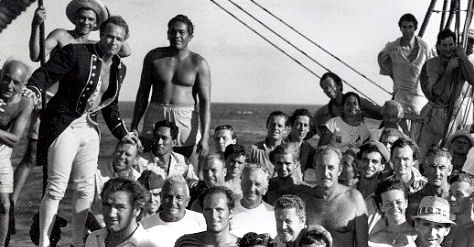
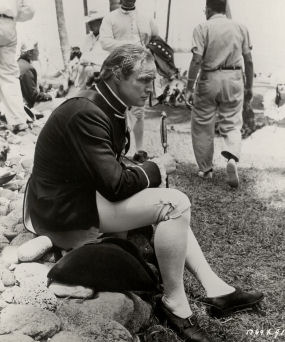
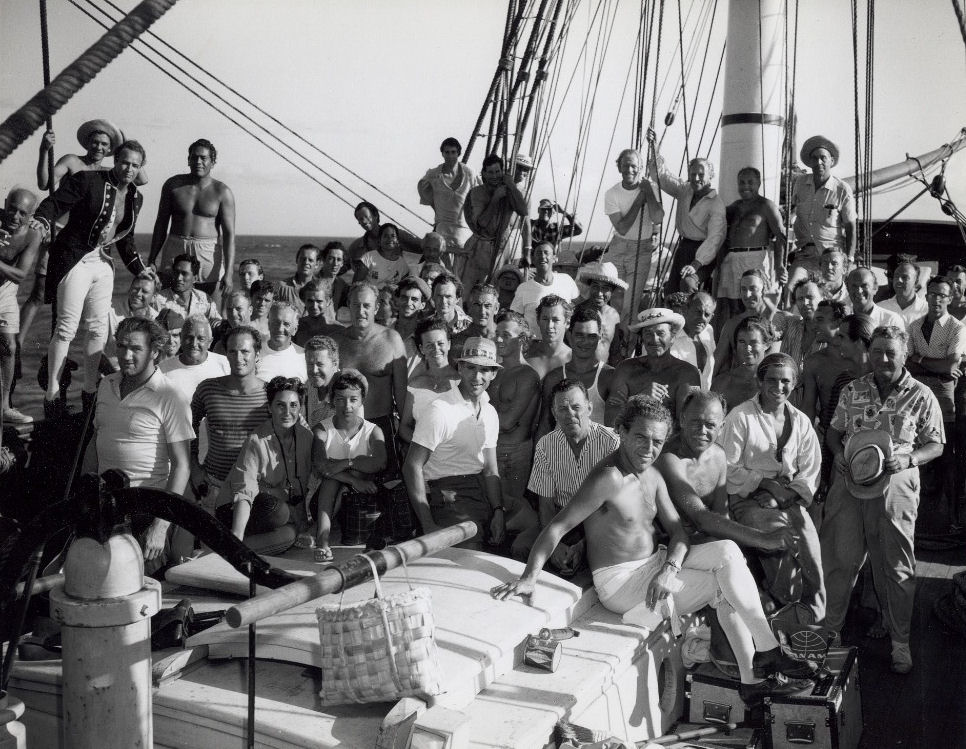
The black-and-white Mutiny stills were sent to me by Roy Frumkes, a friend of restoration guru Robert Harris.


Brando posing with Mutiny crew and costars aboard newly constructed Bounty ship during filming

Tarita Teriipia, Brando shooting love scene. Tarita later had two children with Brando, including a troubled daughter, Cheyenne, who committed suicide in 1995.