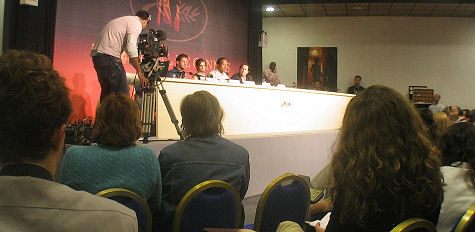
Late to “Wordplay”

Late to Wordplay

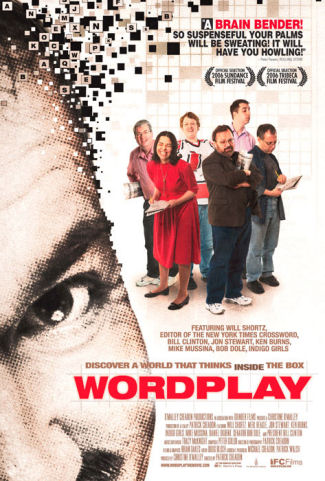
I’d been hearing good things about Patrick Creadon’s Wordplay since it played at last January’s Sundance Film Festival, but missing the subsequent screenings. So I leapt at the chance to see it last night (i.e., Tuesday) at Santa Monica’s Aero as part of Pete Hammond’s KCET screening series.
I expected something smart, engaging, amusing (Jon Stewart being one of the talking heads), but I wasn’t expecting a Mensa-style “heart” movie about an extended family. That’s what Wordplay is, and why it ought to keep playing and playing in urban blue-state areas, and — who knows? — maybe all over.


Wordplay gang: (l. to r. foreground) Trip Payne, Ellen Ripstein, Al Sanders; (l. to r. background) Tyler Hinman, Jon Delfin, Will Shortz, Merl Reagle

I never thought I could get so caught up in the lives of intellectual game-players and puzzle fanatics, but there’s an emotional current to their existence that’s just as real and embracable as anything you’ve seen or felt on The Waltons or Malcom in the Middle or any other hokey family TV series.
I feel nothing but loathing for the family-relationship pablum in those two Cheaper by the Dozen films, but Wordplay is the real deal — a movie about a family of engaging eccentrics whose brains cross paths every morning via The N.Y. Times crossword puzzle, and who bond with each other every year in a very warm and fraternal way at an annual Crossword Players tournament in Stamford, Connecticut.
< ?php include ('/home/hollyw9/public_html/wired'); ?>
Wordplay started out as a profile of N.Y. Times crossword page editor Will Shortz, but gradually expanded into a group portrait of six hardcore types — crossword constructor Merl Reagle, pudgy not-quiter Al Sanders, congenial former champion Ellen Ripstein, super-brilliant Trip Payne, a 20 year-old whiz kid named Tyler Hinman, and a bespectacled Tin Pan Alley piano player named Jon Delfin.
The Philadelphia Inquirer‘s Carrie Rickey calls them “word nerds.”
I’ve always felt so intimidated by the N.Y. Times crossword puzzle. Some of the words and clues are so arcane and obscure. Until I saw Wordplay I was totally unaware that there’s a kind of grass that grows in the wide-open midwest areas called “redtop.” But now I feel like becoming a crossword addict regardless. The movie is that infectious.
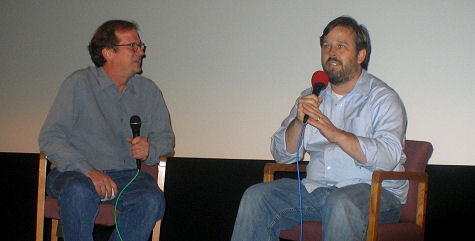

KCET screening series host Pete Hammond (l.) and Wordplay director Patrick Creadon after last night’s screening at Santa Monica’s Aero/American Cinematheque theatre — 6.20.06, 8:55 pm.

Wordplay sure is fantastic publicity for the New York Times and longtime editor Shortz.
Celebrity guests besides Stewart include the charming Bill Clinton (who’s constantly grinning and filling out a crossword puzzle as he talks with Creadon), Bob Dole (who finally consented to be in the film when Clinton called and urged him to do so), documentarian Ken Burns, the Indigo Girls, and Yankee hurler Mike Mussina.
Everyone in the film worships the daily Times puzzle as the “gold standard.” No other puzzles from any source are even mentioned except for USA Today‘s, and when it comes it’s a put-down.
Wordplay ends, predictably, with the March 2005 championship tournament. The suspense kicks in when the final three contestants go up against each other in front of an audience, writing their answers on large-sized posterboard crossword grids. You can figure out who’s probably going to win, but you’re never 100% sure.
Skeptics should understand that while Wordplay is about some very smart people with phenomenal vocabularies, it’s not a snob movie at all. The Wordplay Seven are good people with containable egos who care about crossword puzzles like others care about baseball or basketball or going to church.
There’s some fairly terrific graphic work by Brian Oakes that brings the viewer into various crossword games that are played throughout the film, creating a play-along excitement that most audiences will find extremely cool.
I suggested during last night’s q & a with Creadon that a smarty-pants reality TV series could be created out of the day-to-day lives of the Wordplay family. It could crescendo each week — on Sunday night, naturally — with the six or seven principals jumping into the Times Sunday crossword puzzle.
IFC Films opened Wordplay in Manhattan last weekend on four screens and took in $32,847 for an $8200 average. The film goes out nationwide this Friday (6.23).

Six Months In

Six Months In

We’re just about at the ’06 halfway mark, and it’s time for a basic sum-up.
By this site’s yardstick there have been 10 A-listers, 15 honorable B-listers, and 9 half-decents. A total of 34 films — a bit more than one per week since the year began — that were either excellent or very good or respectable, or at the very least mildly pleasing.


An Inconvenient Truth

My choice for the best film of the year so far, no question, is Paul Greengrass’s United 93 — a film that many, many people still don’t want to see, but is truly a pulse-pounder for the ages, in part because it’s so stunningly well-made, but mainly because the extraordinary craft manifests in all kinds of haunting ways.
Composed of a thousand details and a thousand echoes, United 93 is a film about revisiting, recapturing, reanimating…about death, loss and a portrait of heroism that, for me, was too much to absorb in a single viewing. I’ve seen it five times, and I can’t wait to watch and re-watch the DVD.
< ?php include ('/home/hollyw9/public_html/wired'); ?>
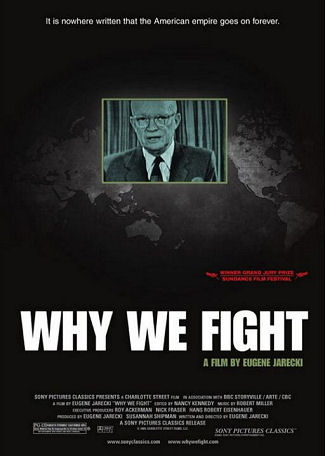
The first runner-up is Eugene Jarecki’s Why We Fight. It’s not the first doc to ask and explore why so many people around the world despise the U.S. of A., but it’s surely one of the most precise and persuasive. By delivering a cleanly composed, ultra-perceptive explanation of how the American military-industrial complex runs the whole foreign policy show, from the leanings of the U.S. President to the Congress and right on down the food chain, it burns right through to the nub.
The third best so far is Bryan Singer’s Superman Returns, a revisiting that feels freshly felt as well as a heart movie with a personal stamp that just happened to cost $260 million (or whatever the actual figure is) to compose. It’s a deeply satisfying upgrade, a reverent nostalgia piece, an above-average chick flick, a sumptous and harmonious piece of work and, frequently enough, a solid action thriller.

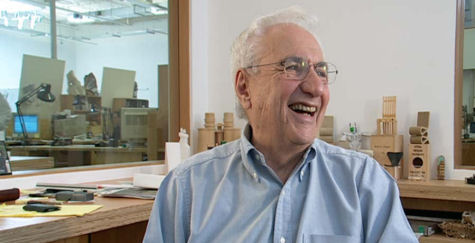
Fourth on the list is Sydney Pollack’s Sketches of Frank Gehry — a stirring, hugely likable portrait of the most daring and exciting architect of our time. I wrote this during the Toronto Film Festival, and nine months later I feel the same way: “Corny as this sounds, Sketches left me with a more vivid feeling of celebration and with more reasons to feel enthused and excited about life than anything I’ve seen [in a long while].”
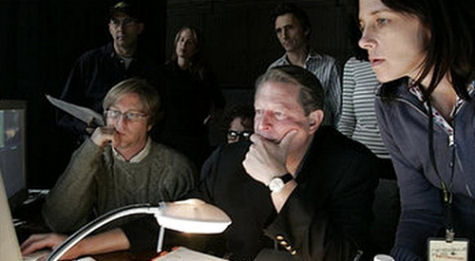
Fifth in line is Davis Guggenheim and Al Gore’s An Inconvenient Truth, and yes, I’m applying special criteria here. It’s among the five best not just because it’s a movie that stirs and sinks into your soul (if you don’t feel this movie there’s some- thing seriously detached inside), but because it’s flat-out the most important flick of the year.
I’m listing it among the top five, in short, because more people need to see it because the sell is far from complete, especially with so many skeptics and corporate doubt-spreaders spinning against it as we speak.
I’m just going to list the ’06 films that have popped through over the last two or three hours. I’ve only listed 28 films on top of the 34 in the first three categories. I’m sure I’ve forgotten a gem or two, and I’ve probably overlooked some half-worthies.


Frank Gehry

Scoldings and admonishings are, of course, necessary and welcome.

TEN BEST SO FAR: United 93, Why We Fight, Superman Returns, Sketches of Frank Gehry, An Inconvenient Truth, Tsotsi, Find Me Guilty (a triumphant return to form for director Sidney Lumet), V for Vendetta, The Three Burials of Melquiades Estrada, Bob Dylan: No Direction Home (the best Martin Scorsese film since Goodfellas).
GOOD, STURDY, HONORABLE (15, in no particular order): Neil Young: Heart of Gold, Inside Man, Running Scared, The Devil Wears Prada, Leonard Cohen: I’m Your Man, The Break-Up, Favela Rising, Mission Impossible 3, Ask the Dust, Akeelah and the Bee, Bubble, Thank You for Smoking, Our Brand is Crisis, Sophie Scholl — The Final Days, Mozart and the Whale.
OKAY, PASSABLE, TOLERABLE (9, in no particular order): Down in the Valley, Nacho Libre, The Omen, Poseidon, Glory Road, Firewall, Imagine Me & You, Kinky Boots, Free Zone.
UNDERWHELMING (8): X-Men: The Last Stand, Tristram Shandy: A Cock and Bull Story, 16 Blocks, The Notorious Bettie Page, Lonesome Jim, Cars, Friends with Money, Lucky Number Slevin.
DIMINISHES A BIT MORE EVERY TIME I THINK ABOUT IT (1): The Road to Guantanamo.

OVERRATED IN SOME QUARTERS (5): The Proposition, Lady Vengeance, Battle in Heaven, Brick, The Devil and Daniel Johnston.
DISAPPOINTING (especially coming from a brilliant writer-director who’s done much better work): Looking for Comedy in the Muslim World.
NOT VERY GOOD…KINDA BAD, ACTUALLY (1): The Da Vinci Code.
WORST (3): RV, Basic Instinct 2, American Dreamz.
BEYOND DISSECTION (1): Tyler Perry’s Madea’s Family Reunion.

Mexican Goof Ride

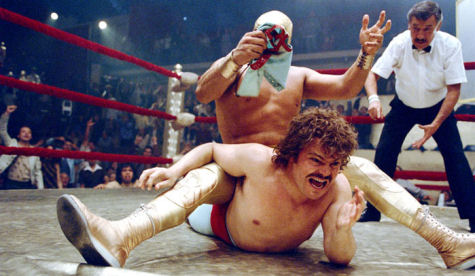
At the risk of sounding brusque, Jared Hess’s Nacho Libre (Paramount, 6.16) is to Napoleon Dynamite, his breakout debut film, as Wes Anderson’s The Life Aquatic is to Rushmore or Bottle Rocket.
I know, I know — that’s a damning thing to say. But I’m only trying to qualify what’s right and (only occasionally) wrong with it. It’s really not that much of a letdown.


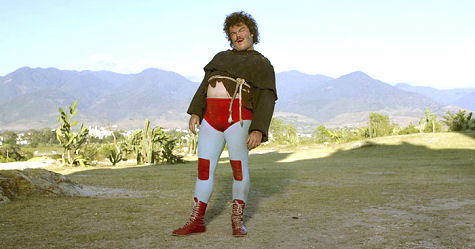
Jack Black in Jared Hess’s Nacho Libre (Paramount, 6.16)

Let’s acknowledge once again that Jack Black is an authentic genius — it’s not just the manic-volcanic energy inside him, but the way he ladels it out just so, like a mad scientist pouring liquids into glass beakers — and I so enjoyed being in his and Hess’s good company that I didn’t feel that put off during the slack parts.
What’s wrong with Nacho Libre? The style and consistency of attitude are there in full bloom, but you can feel a lack of story tension manifesting around the halfway mark, and it starts to get a tiny bit enervated. And yet it’s a tonally together film, and the funny stuff that works (only about a third of the movie feels “off”) is screamingly nutso, so it all kind of balances out.
< ?php include ('/home/hollyw9/public_html/wired'); ?>
I was basically down with it because of the consistency of the Jared Hess signa- ture. I muttered to myself at one point, “Thank God this movie wasn’t directed by Jay Roach.” Every scene, shot, line and edit in Nacho Libre tells you it was made by a very sharp, ultra-disciplined director who’s in touch with his own particular brand of static flaky-weird humor, and who totally gets the Black trip.
Will Nacho Libre‘s reception be a replay of Napoleon Dynamite‘s? Dismissed by some (I remember all those boomer-aged distribution execs going “naaah” after the first Library screening in Park City) but embraced as a cult thing? I don’t know (kinda doubt it), but there were three or four guys sitting behind me at yesterday’s Nacho Libre screening in Las Vegas who were howling at every bit.
You could argue that Hess’s problem as a director is that he’s too much into the idea of a movie as a series of scenes and statements, and in maintaining the deadpan-ironic attitude at all costs, but not enough into the basics of telling a good story.

Written by Hess, Mike White and Jerusha Hess (and Black, of course, whose sensibility is all over this film), Nacho Libre is basically one big Mexican joke — an affectionate but at the same time snide and smart-assed portrait of that country’s culturally primitive traditions. Apologies to my Latin friends, but I enjoyed the impudence of this.
Black plays a be-robed Catholic monk named Nacho who doesn’t like living a life of denial and humility. This isn’t revealed right away, but Nacho’s basic yearning is to make money, be a wresting star (a “luchadore”), and make it with the very hot Sister Encarnacion (Ana de la Reguera)…the only problem being their mutual vows of celibacy.
Nacho’s job in the old Oaxaca monastery he shares with other priests is to prepare meals for the orphans who also live there. But there’s no money for basics so all Nacho can do is throw together plates of flavorless bean dip and tortilla chips.
Nacho gradually takes the bull by the horn when he hooks up with a girlyman thief named Esqueleto (Hector Jimenez) — shades of Napoleon hooking up with Pedro — and proposes that they become a luchadore wrestler team, and then use their earnings to buy better ingredients for the orphan meals and white patent-leather shoes for Black to wear as he’s putting the moves on de la Reguera.

Black carries the whole thing, and the story basically breaks down as follows: (a) Black having a special relationship with fat orphan kid who gets his trip and believes in him, (b) his sneaking out of the monastery to wrestle in the evenings, (c) gradually sharing his inner feelings with Reguera, (d) making inroads into the world of the luchadore with Jimenez at his side, (e) dealing with the unmasking of his luchadore deception, and (f) a final spurt of dejection, despair and then triumph.
I loved Jimenez’s performance — freaky, quasi-feminine, hilarious. I got into the steady supportive gaze coming from the fat kid (can’t identify his real name from online cast lists). I especially enjoyed Black’s performing of two Mexican-flavored tunes, one a spur-of-the-moment ditty he sings at a party, the other a kind of inspirational Tejano love song.
And I generally loved tripping through Black’s beautifully measured performance, which is most likely going to be seen as politically incorrect — offensive — by some in the Latin sector. Applause to Black for having the cojones to not be afraid of this.
Said it before, saying it again: Black should have made a movie with Stanley Kubrick. If Kubrick’s health hadn’t given out and these two had somehow hooked up with the right project, it might have been like Kubrick and Peter Sellers all over again.

Drive Me Nuts

John Ford‘s movies have been wowing and infuriating me all my life. A first-rate visual composer and one of Hollywood’s most economical story-tellers bar none, Ford made films that were always rich with complexity, understatements and undercurrents that refused to run in one simple direction.


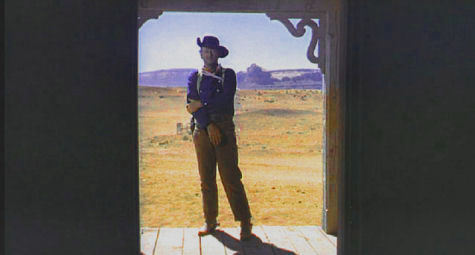
The closing shot of John Ford’s The Searchers

Ford’s films are always what they seem to be…until you watch them again and re-reflect, and then they always seem to be something more.
But the phoniness and jacked-up sentiment in just about every one of them can be oppressive, and the older Ford got the more he ladled it on.
The Irish clannishness, the tributes to boozy male camaraderie, the relentless balladeering over the opening credits of 90% of his films, the old-school chauvinism, the racism, the thinly sketched women, the “gallery of supporting players bristling with tedious eccentricity” (as critic David Thomson put it in his Biographical Dictionary of Film) and so on.
The treacliness is there but tolerable in Ford’s fine pre-1945 work — The Informer, Stagecoach, Young Mr. Lincoln , Drums Along the Mohawk, They Were Expendable , The Grapes of Wrath and My Darling Clementine .

But it gets really thick starting with 1948’s Fort Apache and by the time you get to The Searchers, Ford’s undisputed masterpiece that came out in March of 1956, it’s enough to make you retch.
Watch the breathtaking beautiful new DVD of The Searchers, and see if you can get through it without choking. Every shot is a visual jewel, but except for John Wayne‘s Ethan Edwards, one of the most fascinating racist bastards of all time, every last character and just about every line in the film feels arch and ungenuine.
The phoniness gets so pernicious after a while that it seems to nudge this admittedly spellbinding film toward self-parody. Younger people who don’t “get” Ford (and every now and then I think I may be turning into one) have been known to laugh at it.
Jeffrey Hunter‘s Martin Pawley does nothing but bug his eyes, overact and say stupid exasperating lines all through the damn thing. Nearly every male supporting character in the film does the same. No one has it in them to hold back or play it cool — everyone blurts.

Ken Curtis‘s Charlie McCorry, Harry Carey Jr.’s Brad Jorgensen, Hank Worden‘s Mose Harper…characters I’ve come to despise by way of the grating artistry of John Ford.
I’ll always love the way Ford handles that brief bit when Ward Bond‘s Reverend Clayton sees Martha, the wife of Ethan’s brother, stroking Ethan’s overcoat and then barely reacts — perfect — but every time Bond opens his mouth to say something, he bellows like a bull moose.
You can do little else but sit and grimace through Natalie Wood‘s acting as Debbie (the kidnapped daughter of Ethan’s dead brother), Vera Miles‘ Laurie Jorgenson, and Beulah Archuletta‘s chubby Indian squaw (i.e., “Wild Goose Flying in the Night Sky”)…utterly fake in each and every gesture and utterance.
I realize there’s a powerful double-track element in the racism that seethes inside Ethan, but until he made Cheyenne Autumn Ford always portrayed Indians — Native Americans — as a kind of creepy, sadistic sub-species. The German-born, blue-eyed Henry Brandon as Scar, the Comanche baddie at the heart of The Searchers…’nuff said.


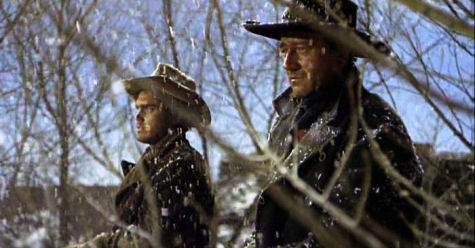
Jeffrey Hunter, John Wayne

That repulsive scene when Ethan and Martin look at four or five babbling Anglo women whose condition was caused, we’re informed, by having been raised by Indians, and some guy says, “Hard to believe they’re white” and Ethan says, “They ain’t white!”
I don’t know how to enjoy The Searchers any more except by wearing aesthetic blinders — by ignoring all the stuff that drives me up the wall in order to savor the beautiful heart-breaking stuff (the opening and closing shot, Wayne’s look of fear when he senses danger for his brother’s family, his picking up Wood at the finale and saying, “Let’s go home, Debbie”).
All I’m saying is, for a great film it takes an awful lot of work to get through it.

Coming Home

Coming Home

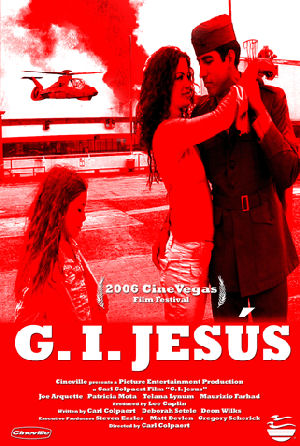
Carl Colpaert’s G.I. Jesus is the first truly exceptional Cinevegas film I’ve seen so far.
Compared to the pickings over the last two days, this psychological domestic drama almost feels miraculous. The reception may be more muted out in the real world…who knows? But it’s certainly good enough to play at the Telluride or Toronto Film Festivals, and with some minor refinements it could even end up being distributed.


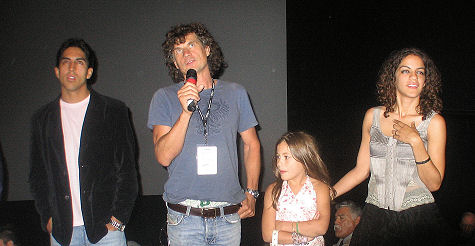
(l. to r.) G.I. Jesus costar Joe Arquette, director-writer Carl Colpaert, costars Telana Lynum and Patricia Mota following Sunday night’s screening — 8:05 pm.

This is a partly real, partly hallucinatory homecoming story that feels connected to a guilt current that seems to be popping up left and right these days among Iraqi War veterans. At times G.I. Jesus plays like a kind of Coming Home for the 20-something veterans of that conflict.
You know the drill: war veteran comes home, feels alienated and haunted, doesn’t relate, picks up evidence of marital infidelity, freaks out. But G.I. Jesus is trippier and more complex than that.
< ?php include ('/home/hollyw9/public_html/wired'); ?>
G.I. Jesus doesn’t unfold from a perspective of a conservative career officer like Bruce Dern’s Cpt. Bob Hyde, the Coming Home character who was heavily invested in the rightness of U.S. handling of the Vietnam War. It stems, rather, from the head of an obviously intelligent young Mexican-American Marine Corporal named Jesus Feliciano (Joe Arquette) who’s haunted by his actions during his time in Iraq.
G.I. Jesus is basically about ghosts from that conflict hovering around Jesus, and a growing feeling of betrayal and apartness between himself and his “Dominican princess” wife Claudia (Patricia Mota), whose materialistic ambitions seem, from his perspective, to be creating a gulf between them.

The signatures at work here are “honest,” “unforced,” “thoughtful.” G.I. Jesus has been shot on live video stock (so that it would blend with some real Iraqi war tapes provided by the BBC), which I found exciting, and it’s been extremely well cut by Wayne Kennedy and Nick Nehez, and nicely scored by Carlos Durango.
But there’s a dreamscape element running through the film (as it’s largely happening in Jesus’s head), and because of a decision by director-writer Colpaert to jettison a certain narrative line at the two-thirds mark, the ending, for me, doesn’t quite bring it all home.
I’m always a little bit thrown by movies that inject fantasy into a reality that’s been carefully constructed. Maybe there’s more to it than I realized and I need to see it again.
The key thing, it seems, is that Jesus’s Iraq memories haven’t been erased at the finale (far from it) and the hauntings continue. I’m not entirely sure if all the story strands have been fully dealt with by the finish, but it’s at least a debatable call, and there’s no dismissing the things in G.I. Jesus that succeed.

The film is an unquestioned triumph in the matter of Arquette (a very young Latino who’s costarring in Andrew Davis’s forthcoming The Guardian) and Mota’s performances. I believed every word and gesture from these two; everything they say and feel seems genuine.
Probably because the investment seems so complete. Jesus and Claudia have a young daughter, Marina (played by a 9 year-old firecracker named Telana Lynum), a home in a trailer park, and a texture to their characters — sexual attraction, emotional ties, credible backstory.
G.I. Jesus is certainly probing and complex, and the politics behind it are obviously of a leftist humanitarian bent. There’s a shot at one point of a painting meant to evoke the glories of the Bush policy in Iraq. I, for one, found it extremely spooky.
The program notes call G.I. Jesus “an ethereal journey of one man’s struggle…to let go of the pain and agony suffered in combat in order to get on with his life.” That’s not bad, but check out the trailer on the Cineville site for a better taste of it.
Colpaert is the founder of Cineville, and has executive produced several above-average films, including Swimming with Sharks, The Whole Wide World, Hurlyburly, One-Eyed King and The Velocity of Gary. Born in Europe (Belgium, I think) and an American Film Institute grad, Colpaert began as an editor working for legendary producer Roger Corman.


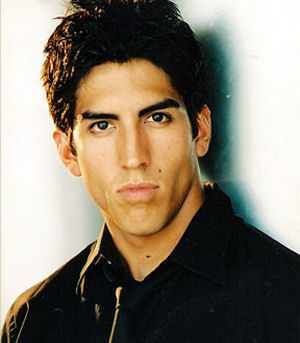
G.I. Jesus costar Joe Arquette. (The only decent shot I could find of the equally dynamic Patricia Mota is on the IMDB, and they don’t allow you to copy and paste.)

I’ve never heard of anything Colpaert has directed before this, but now that I’m stoked I’d like to see The Affair, which he directed and released in ’04.
I mentioned “minor refinements” at the beginning of this piece. Just cosmetic stuff, mainly.
There’s a white Fu Manchu moustache worn in the film by a uniformed American Colonel that I didn’t believe for a second. (Conservative Oliver North types wear only Clark Gable-type moustaches.) Another wrinkle is a young Marine recruitment officer whose hair is too long in the back. Maybe these style choices can be rectified digitally.
I took some pictures of the cast and crew at the Brenden Theatre #5 last night, and I was going to hit the after-party. But I made the mistake of going back to the room to start writing this and took a break on the bed for a second. That was it…out like a light.

Blue, Baby…Blue

Blue, Baby…Blue

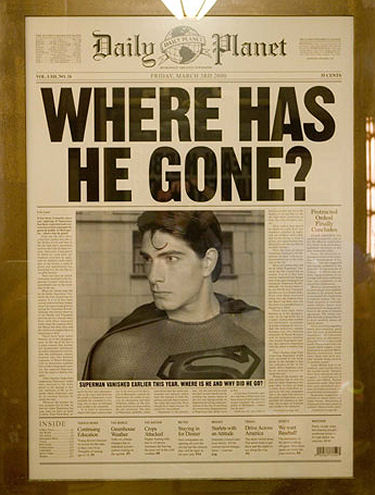
I strongly hinted Friday morning that Bryan Singer’s Superman Returns (Warner Bros., 6.28), which I’d seen the night before, is a very good film. One thing I felt free to actually say at the time (there was a review embargo in effect) is that it delivers in terms of emotionality and a palpable theme. Now that it’s okay to write something, we need to admit something: Superman Returns is perhaps not a vital movie for our times. We all know it’s primarily an attempt to re-launch a franchise so a bunch of fat guys can make a lot of dough…guys who have more than enough as is.
But despite this uninspired raison d’etre, Superman Returns still feels like a truly personal film that came from somebody’s heart. And this, to me, is an extraordin- ary thing, and why it surprised me as much as it did.


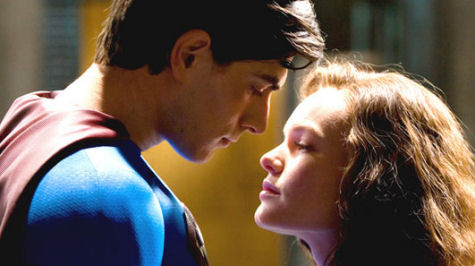
Brandon Routh, Kate Bosworth in Bryan Singer’s Superman Returns

It’s a hell of an upgrade (it refines and deepens in the tradition of Christopher Nolan’s Batman Begins), an extremely reverent nostalgia piece, an above-average chick flick, an extremely sumptous and harmonious piece of work (Singer is a masterful technican and film “composer”) and, frequently enough, a solid action thriller.
For many Superman Returns will probably have to be seen twice — once in a regular theatre and a second time in 3D IMAX. Only about 20 minutes’ worth will be in 3D, but it’ll be worth the price, trust me.
< ?php include ('/home/hollyw9/public_html/wired'); ?>
I said Friday morning that the film has a breathtaking 3D airborne action sequence that delivered the greatest sensory thrill I’ve ever gotten from a mainstream movie in my life. What’s striking is that this sequence is obviously a replay of the finale of Paul Greengrass’s United 93, and that Singer has to be aware what this sequence delivers in a fantasy sense.
The almost bizarre time-trip element in Superman Returns feels curious at first. With Brandon Routh obviously chosen to play Superman/Clark Kent because he resembles Christopher Reeve in his late ’70s heyday….with not only John Williams’ theme music from Richard Donner’s 1978 original Superman but the same kind of blue-laser graphics used in the opening credits…with the return of Lois Lane (Kate Bosworth), Jimmy Olsen (Sam Huntington), Perry White (Frank Langella), a bald- headed Lex Luthor villain (Kevin Spacey), the voice and image of Marlon Brando as Jor-El and even Glenn Ford as Clark Kent’s dad (deceased in the film but with his photo sitting on a mantlepiece in the Kent home)…this is really old-home week.
But it’s more than just a return to the Carter years mentality, and more than an attempt to recreate the fascination that the first two Superman flicks enjoyed over that two-year period.

(Fans will recall that Superman II, released in ’80, was partly directed by Donner and partly by Richard Lester, who went on to direct part III entirely.)
Superman Returns feels as if Singer and his team loaded up the finest 2006 CG technology in a big suitcase and time-tripped back to 1982 and ’83 in order to make the Superman III that should have happened (instead of the Richard Pryor version that did).
And yet Singer has made a much better film than part I or part II — craftier, a bit dryer, more fully rendered, less comic book-y, and more deeply felt.
Singer makes movies about gifted outcasts, and this is easily his saddest and most personal to date — not just about a superhero who’s forced to live in his own realm and walks around with a broken heart, but one who’s more or less doomed to stay that way. The poor guy (Routh) is good and gentle, simple but generous of heart…and yet he’s stuck in that blue suit and wine-red cape forever. And either you get the sadness of that situation or you don’t.

If you don’t you may go out the weekend after Superman Returns opens and join the nationwide spirit-of-Cancun party that will happen in theatres playing Pirates of the Caribbean: Dead Man’s Chest…great.
But if you feel that interior stuff and emotional currents are what make movies whole, and if the wafer-thin attitude dance that was Gore Verbinski’s Pirates of the Caribbean felt like a problem (I say this recognizing that for the vast majority, this emptiness is a celebrated asset), you’re may be more on the Superman Returns side of the fence.
The story is basically about unrequited love — the subtitle should be Love Stinks.
It begins with Superman returning to earth after a five-year absence out in space (a voyage of self-discovery) to find Lois, whom he abandoned when he left the planet, living with Perry White’s nephew Jack (James Marsden) and raising a son.
There are complications, naturally, presented by Mr. Luthor and his latest scheme to destroy and dominate the U.S. and its economy, blah, blah, and I’m not dismissing the generic hero vs. villain material …it’s fine. But the current that matters — the thing that has Singer’s interest — is about Clark, Lois, Jack and the boy…about trust, intimacy, emotional consistency and what it takes to make a family.
At first I didn’t recognize Noel Neill, who played Lois Lane in the 1950s “Superman” TV series, playing a rich lady being fleeced by Luthor at the moment of her death, but there’s no missing Jack Larson, the TV series’ Jimmy Olsen, as a bartender in a scene with the new Jimmy and Clark.

There’s genuine beauty and majesty in the visuals of Routh (who’s a good actor but more noticably a very beautiful man) tearing around in the sky, and particularly as he soars 40 or 50 miles above the globe. There’s one special moment when he’s not exactly flying but orbiting, meditative and statue-like as he looks down at the dull-diamond glow of the clustered cities below, and then he “sees” something and he’s off like a bullet.
I loved especially that Singer ends the film in almost the exact same way that Donner’s does, and yet Singer holds back on one particular bit — the difference between a re-do and a recreation.
Superman Returns is dedicated to poor Chris Reeve, who died in October ’04, and his late widow Dana, who passed last March from lung cancer.

“Break-Up” Ain’t Half Bad

Not Half Bad

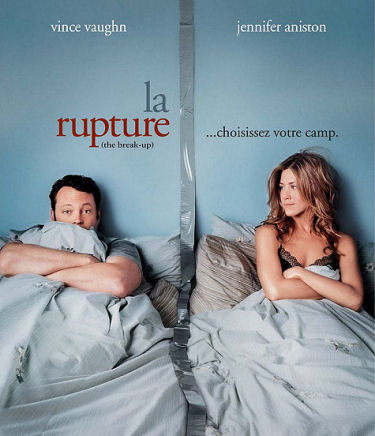
The Break-up, which I saw yesterday in Paris under the title of La Rupture, is a much better film than I heard and read it would be, and one of my thoughts as I left the UIP screening room is that Universal has lied its ass off by selling this film the way they have.
Deceptive ads and trailers are respected, of course, because they tend to sell tickets. Last Thursday’s figures projected that The Break-Up would earn about $25 million or so domestically, a drop from an earlier projected figure of $30 million. But that turned out to be wrong — the film will earn a rocking $37 million by Sunday night.


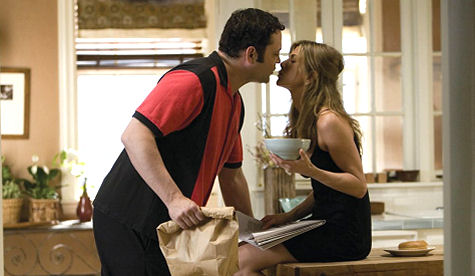
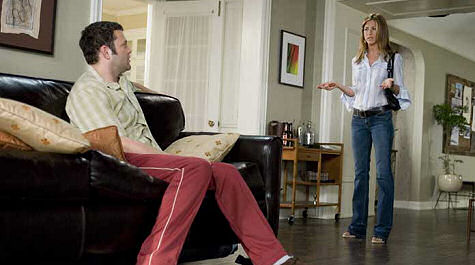
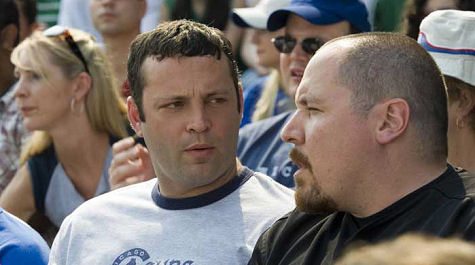
Vince Vaughn, Jennifer Aniston in The Break-Up

The Break-Up isn’t a great film or one you could even say to a friend with an enthusiastic straight face, “It’s exceptionally good and nourishing…definitely go see it!” But it’s not that bad and is by and large a decent effort. It has some problems here and there, but relatively minor ones — I was never doubled over in pain.
The story could have used some more depth (i.e., not just at the end) and could have used stronger secondary characters and a bit more plot texturing. It would have been way better, actually, if someone had said, “Let’s really toss out the idea of satisfying the emtional-formula date crowd and try to make an Ingmar Bergman movie…let’s make Scenes from a Break-Up!”
< ?php include ('/home/hollyw9/public_html/wired'); ?>
But even as is, The Break-Up deserves a measure of credit for being a somewhat ballsy drama by having gone “real”, especially given the date-movie demographic and the escapist expectations that star-cowriter Vince Vaughn, director Peyton Reed and screenwriters Jeremy Garelick and Jay Lavender obviously knew were out there.
It’s about a break-up, all right…just not a breakup and then a reconciliation. Not a whole lot transpires except for some typical Mars-and-Venus mis-readings between a Chicago couple (Vaugh, Jennifer Aniston). This leads to a relationship meltdown that gets worse and worse, and finally peters out just as their defenses come down. Too bad.

But the film gets thoughtful and grounded towards the end, and the ending is half-decent. And not the ending they reportedly re-shot, with Vaughn and Anistonrunning into each other months later with new opposite-sex partners who look almost exactly like they do. It’s something else.
Vaughn delivers some zingers here and there (especially in the beginning) and a playful tone kicks in every so often, but despite Vaughn’s Wedding Crashers rep and the ads and trailers indicating that The Break-Up some kind of comedy, no one but those full-of-shit Pinocchio-nose Universal marketers is ever going to call it one.
Accept this and you’ll be okay: there are no laughs after the first third of The Break-up, and there’s no bouncy comic energy or pacing in any of it. Not by the standards I know and suscribe to, at least. (I definitely regard Some Like It Hot as a comedy, but The Apartment as a relationship drama with schtick…okay?)
The Break-Up isn’t funny because it’s not intended to be. It’s a decently made, reasonably mature, well-acted relationship drama with humorous punctuation from time to time (i.e., mostly in the early portions). Vaughn and Jennifer Aniston do well by their roles, given the material. Take no notice to any critic who says they bomb out in this thing because they absolutely don’t. They’re just not going for the Big Laughs.

Vaughn does his mouthy-guy schtick for somewhere between two-thirds and three-quarters of the film, but then the movie turns solemn and introspective in the final quarter, and Vaughn follows suit in what I felt was a dug-in, rooted way.
The only thing bothersome is that Vaughn is really packed it on prior to shooting this film. (Incessant partying over the huge success of Wedding Crashers?) He’s just physically not the same guy he was last summer, and I don’t mean to sound weird about this but I was disturbed by the inevitable metaphor that sits astride any character with a bull neck and a bloated puffy face. (He is somewhat slimmed down in the final scene, which Aniston remarks upon.)
I was also seriously taken with Aniston’s performance. I was moved, convinced, persuaded — I believed her all the way. For me her work in this film signifies the end of her losing streak, whether The Break-Up makes big moolah or not.
My supporting cast favorites are the always on-target Jon Favreau as Vaughn’s easy-rolling but perceptive best-buddy, who brings the film into a bottom-touching mode in the third act, and Vincent D’Onofrio as his older worry-wart brother (Favreau, curiously, is also hugely bulked up in this thing.)


I won’t run a humiliating, side-by-side comparison photo showing how these guys looked when they made Swingers eleven years ago, but….

Joey Lauren Adams and Judy Davis have vivid if under-developed roles as, respectively, Aniston’s good friend and a neurotic threatening employer.
This is a non-mainstream mainstream movie that’s taking a Big Risk. It’s obviously much more of a fall movie than a summer movie, just as it’s clearly a dramatic Anti-Date movie being sold as a comedic Date Movie in a cynical attempt to attract Wedding Crashers fans.
Hats off to Vaughn, Aniston, Reed, Garelick and Lavender…not for making a wonderfully fantabulous film, but for at least taking a stab at something relatively honest and real-life-ish, and for not copping out to the usual romantic-comedy formula crap.
And…well, I’m not exactly saying thumbs-down to Universal marketers for peddling a Big Effin’ Lie so the studio could earn a massive $37 million pot this weekend. Good for them, I guess, even if it stinks.
But defiitely a big task-tsk also to Universal publicity team for not reaching out early to critics who might have understood what the film was really about and might appreciate the integrity that went into it, which could have generated some thoughtful buzz early on.

War is Cruel

War is Cruel

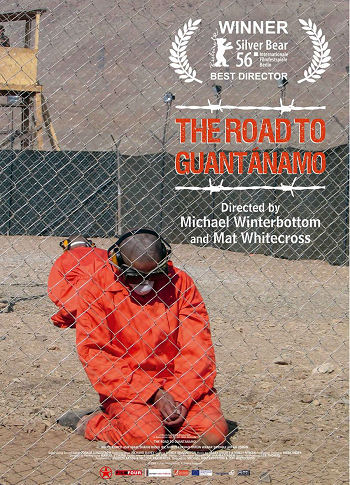
I finally caught up this morning with Michael Winterbottom and Mat Whitecross’s The Road to Guantanmo (Roadside, 6.23). I realize that I’m expected to jump up and down like many critics did when this half-doc, half-recreated drama had its debut last February at the Berlin Film Festival, but I don’t quite feel it…sorry.
I never felt less than absorbed by Guantanamo. I respected and believed what I was seeing…but I didn’t feel all that heavily caught up in it for reasons I’ll soon explain.


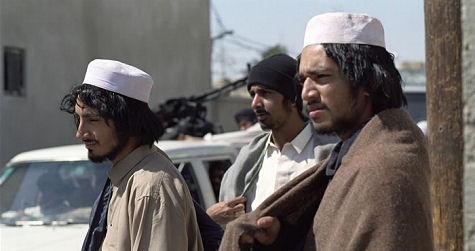
Rizwan Ahmed, Farhad Harun and Afran Usman, although not necessarily in left-to-right order. (If anyone can help…)

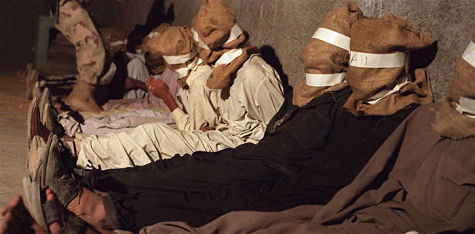
Guantanamo is an anti-American political horror film. It’s a true story of three young British Muslims who made an ill-advised visit to Afghanistan after celebrating a wedding in neighboring Pakistan in October 2001. The upshot was that they were rounded up as suspected Al Queada collaborators and later flown to the U.S military base in Guantanamo, Cuba, and then detained for over two years.
I don’t mean to say that the film has an anti-American attitude — the facts about what happened to these guys are damning in and of themselves.
< ?php include ('/home/hollyw9/public_html/wired'); ?>
It’s a sad portrait of what undoubtedly happened to many innocent Muslims unlucky enough to get caught up in America’s Mideast assault on all suspected 9/11 collaborators and/or supporters, in the weeks that followed the World Trade Center attacks.
The stories of Shafiq Rasul, Ruhel Ahmed and Asif Iqral (who recount their saga in talking-head footage while being portrayed in the dramatic sections by Rizwan Ahmed, Farhad Harun and Afran Usman) are shocking, pathetic, appalling. Their brutal treatment at the hands of American troops and various U.S. intelligence officers smells like stupidity, ignorance and racism every step of the way.
The heart of the film is the depiction of their abusive treatment at Guantanamo’s Camp X-Ray and Camp Delta. Geneva Convention be damned — America was enraged and hell-bent on vengeance after 9/11, and these poor guys caught the brunt of it.

But I have to say I felt a certain distance from their story, despite the repellent nature of their treatment and the deplorable behavior of their captors, because their decision to travel to Afghanistan in the first weeks after 9/11 was awfully reckless.
The real guys say to the camera that no one expected American troops to come thundering into Afghanistan so they were caught unawares…to which one can only say, “Come again?” The entire world knew that US forces were going to hit Afghanistan in a search for Osama bin Laden. Anyone watching CNN knew that Afghanistan was definitely not a smart place to be back then, especially if you were a Muslim from England.
Nonetheless, with all manner of military Armageddon being predicted to slam into Afghanistan by CNN’s Wolf Blitzer and every other media guy in the U.S. and Britain, these three dudes decided to visit that beleagured country because it seemed like a good idea at the time.
A little perspective, if I may: Berlin women were raped by Russian soldiers. Those conquered by Roman troops in the ancient days were humiliated and slaughtered by God-knows-how-many-thousands? Innocent people have been getting victimized, bludgeoned and chewed up by wars for thousands of years. The conquering army marches in, looking to punish and subjugate (or interrogate), and those too weak or old or dumb to get out of their way catch hell.

So Lord knows it’s a horrid world when warriors pick up the sword, but only a careless person walks into a potentially lethal situation without fully considering the consequences.
I’m not saying that the “Tipton 3” (the victims were all from the British town of Tipton) were stupid, but they sure didn’t think things through.
In fact, given the worked-up state that Americans were known to be in after 9/11 and the virtual certainty that bombs would soon be falling upon Taliban forces and suspected Al Queada sympathizers in that region, why didn’t the Pakistani woman that the British-residing groom (a guy named Monir, who later disappeared) intended to marry come to England instead, so both parties would be out of the danger zone?
The first half-hour of Guantanamo, which quickly intros the trio and begins the renactment of their story, immediately pulls you in. Their initial visit, fleeing the bombs, seeing dead victims being buried…all of it feels authentic and then some.
The pace slows, naturally, after their capture by British troops in Afghanistan, their being handed over to the U.S. military and taken first to Kandahar Air Base (where the beatings and interrogations start) and then flown to Guantanamo in January 2002.

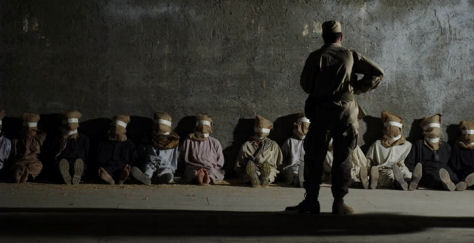
The poor guys are kept inside chain-linked cells that are always lit and resemble dog kennels. No sleep, constant inspections, berated and brutalized…all depicted with terrible realism.
They’re interrograted by careless intelligence officers who claim to have video footage of them attending an Osama bin Laden speech, which of course the three guys deny.
And they’re beaten up and shat upon in all kinds of grotesque ways. The most Orwellian torture they’re put through involves being tied up and forced to absorb super-loud heavy metal music with incessant strobe lights flashing.
Their innocence is eventually discovered in 2004 and they’re slowly, gradually freed. Winterbottom and Whitecross remind us, however, that 500 or so prisoners are still sweating it out in Guantanamo.
But my basic problem remains: I didn’t identify with the Tipton 3 because if I were Muslim, I certainly wouldn’t have travelled to the Middle East for a wedding in the immediate wake of 9/11. I mean, who would? Think about it.

Blood of a Lady

In a reflection of a scene in Marie-Antoinette (Columbia, 10.13) in which French agitators shout angry epithets outside the bedroom of the reviled French queen, loud boos were heard inside the Grand Lumiere theatre this morning as Sofia Coppola‘s film ended. Boos have greeted Cannes screenings before, but not even Richard Kelly‘s heavily trashed Southland Tales got this kind of reception.


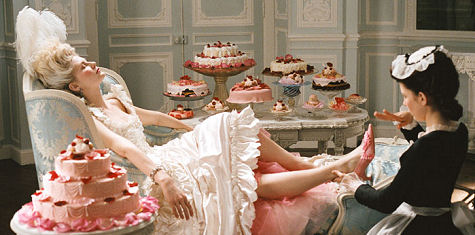
Kirsten Dunst in Sofia Coppola’s Marie-Antoinette, which showed this morning at the Cannes Film Festival

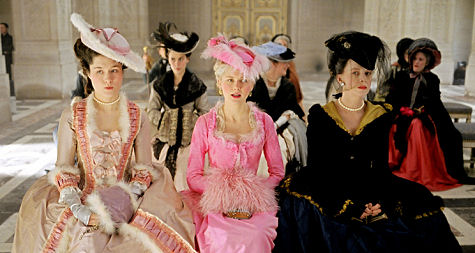
I don’t know how to avoid calling this an absolute p.r. disaster for the film, which has the ironical distinction of being almost completely devoid of interest (unless handsome photography, authentic sets, knockout 18th Century garb and a first-rate Rip Torn performance are enough for you) and yet rather well made.
This will certainly rank as a stain upon Coppola’s reputation, as she has arguably made the shallowest and dullest historical biopic of all time.
It seems fair to ask if this movie is on some level a subconscious attempt at self-portraiture. Coppola knows (or should know) about being part of a privleged family and being surrounded by enablers and enjoying the benefits of living in a protective membrane…and here she’s made a movie about a polite, agreeably- mannered bimbo living more or less the same kind of life and never getting a clue about anything outside of her own realm.
Lady Antonia Fraser‘s biography, which Coppola’s film is based upon, argued that there was more to the Austrian princess who became the Queen of France than her reviled reptuation has indicated all these centuries, and that she’s been misunderstood and her mettle undervalued. And yet Coppola’s film says next to nothing about Marie Antoinette’s intestinal fortitude.
This is a profoundly boring film and a politically inert and careless one to boot — quite deliberately, it seems.


Director Sofia Coppola and Dunst on set of Marie-Antoinette

Coppola doesn’t even relate the story of Antoinette’s final four years, which is the period in which, after years of profligate indulgence at the expense of the French treasury, the queen was said to have shown real dignity and character as she faced the kiss of steel. The fact that Antoinette was caught up in the French revolution and finally had her head sliced off in 1793 is — hello? — the reason she’s (in)famous, the reason Fraser wrote the book, and the reason people might conceivably want to see Marie-Antoinette …and yet Coppola blows it off.
I didn’t conduct a straw poll, but this morning’s boos probably had a bit to do with this.
And yet, from a perspective or whether or not Coppola has fulfilled her take on the the life of one of the most loathed women in history (i.e., the ultimate example of royalist arrogance), she’s actually done a good job.
The emptiness aside, Marie-Antoinette is a very well-made piece in terms of overall composition, pacing, consistency of tone, acting, production design, etc. There’s an obvious discipline at work here, even if it’s in the service of always keeping everything shallow and insulated, shallow and insulated, shallow and insulated.
The use of ’80s music (Bow Wow Wow, New Order, etc.) is actually one of the better things about it, because at least you have something to groove on when the tracks are playing.
The not-well-made aspects — and these are crucial — are the lack of spiritual resonance, rooting interest and dramatic tension.

I am paying Coppola respect by saying it appears to have been her vision to make an exquisitely-composed dead movie about a group of priveleged, narcotized, all-but-dead people (i.e., King Louis XVI, Marie Antoinette and all the Counts, Countesses and social-political hangers-on at the Versailles Palace in the 1770s, ’80s and early ’90s) who couldn’t have cared less about life outside their gilded cocoon.
She might even have a subtle social-scolding scheme up her sleeve. “This is how life was for the Versailles royals back then,” her film seems to be saying. “And you know what? These people were just as shallow, spoiled and self-absorbed as many of you are. Consider this and the notion that history repeats itself.”
But the showing of empty lives of leisure without elements of action or dramatic choice has its limits.
There was all kinds of intrigue going on in Antoinette’s life back then (as this Wikipedia history of Antoinette’s life makes clear). Any director with any interest in the twists and turns of her political drama from the time of the storming of the Bastille in 1789 until her death by guillotine in 1793 could have made a very gripping film. And yet almost everything of consequence that happened during this period has been ignored.
There isn’t even a brief mention of “the Affair of the Necklace”, which did more to sully Antoinette’s reputation with the French anti-royalists than anything else. (Charles Shyer devoted almost an entire film to this very episode in 2001, called The Affair of the Necklace.)


Unknown actress, Dunst, Judy Davis in Marie-Antoinette

As far as it goes, Kirsten Dunst’s performance as Antoinette feels like it came from some emotional investment and plays, on a certain level, as a half-sympathetic portrait. Jason Schwartzman’s King Louis XVI is a total one-noter, but Coppola hasn’t given him anything to do or say that doesn’t exude the personality of a precocious man-child.
Torn, however, is amusing and spunky as King Louis XV. Snappy perfs are also delivered by Judy Davis, Asia Argento, Steve Coogan (whose characters surround Antoinette at Versailles) and Marianne Faithful (as Antoinette’s mother).
In a way I almost admire the gutsiness of Coppola’s decision to make this into a wafer-thin movie. You might hate Marie-Antoinette , as I did, but at least Coppola developed a thematic approach and then shot it that way and stuck to her guns. She deserves a kind of credit for this.
Cinematical’s James Rocchi just walked by inside the Orange Wi-Fi Cafe and shared a killer line in his review, which he just sent in:
“Marie Antoinette is famous for having said of her subjects, ‘Let them eat cake.’ Sofia Coppola’s view seems to be, ‘Let them eat icing.'”

Babel is Booming

Alejando Gonzalez Innaritu’s Babel, which press-screened this morning, is, I believe, a lock to win the Palmes D’Or. Everyone seems to be feeling this, spreading it around. If it doesn’t win, fine — it’ll still be an incredibly vivid and brilliant film — but I’ll be greatly surprised.
Babel (Paramount Vantage, 10.6) is an incredibly shrewd work in the sense that it’s shaped in a way that keeps you fully absorbed, and yet gradually awakened to the fact that there’s a greater whole coming together than what is indicated by gathering sum of story and scenes.


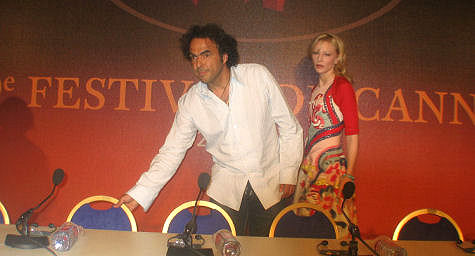
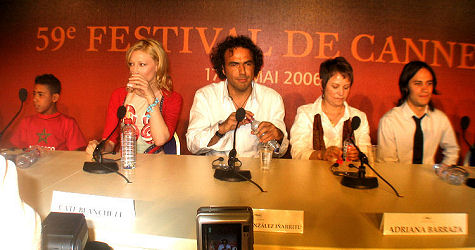
(l. to r.) Cate Blanchett, Alejandro Gonzalez Innaritu, Gael Garcia Bernal at this morning’s Babel press conference — 5.23.06, 11:33 am.

In the most rudimentary sense it’s a film about how one bullet out of a rifle causes damage and hurt to many people in various tangential roundabout ways. But it’s more deeply about how we’re all affected by everything and everyone…how no one is an island, we’re all in this together and everything we say or do echoes all over the place.
It’s about interconnectedness, aloneness, and human frailty, and is especially about parents and children. It radiates compassion and precision and refined artistry with every last frame, shot, edit and line of dialogue.
< ?php include ('/home/hollyw9/public_html/wired'); ?>
That last line sounds like breathless film-critic crap, so let’s go over the basics again…
Guillermo Ariagga’s script tells four stories that take place in three countries — Tunisia, Mexico and Japan — and several disparate characters (four played by Brad Pitt, Cate Blanchett, Gael Garcia Bernal and a young unknown Japanese actress, Rinko Yakusho).
The Tunisian section has two stories — that of a married American tourist couple (Pitt, Blanchett) and their encounter with a bullet, and a story about how that bullet is haphazardly fired from a long distance away by a pair of youths playing with a newly-purchased rifle, and about the consequences of this.


Innaritu, Blanchett as they entered the Salles de Presse inside the Palais this morning (5.23.060) at 11:25 am.

The Mexican section is about this couple’s nanny (Adriana Barraza) and her taking Pitt and Blanchett’s kids (Elle Fanning, Nathan Gamble) across the border into Mexico for a wedding, which leads to bad things all around, particularly for her nephew (Gael Garcia Bernal).
The Japanese portion is about the relationship between a wealthy businessman (Koji Yakusho) and his deaf daughter (Rinko Kikuchi), and the daughter’s encounters with various men, among them a visiting police detective.
They and many other are linked in the same way that the characters in Inarritu’s Amores Perros and 21 Grams are linked — by a single violent act.
This one of those “small” portraits of humanity writ large…and like I mentioned in my Inarritu interview a week and a half ago, it becomes larger and richer and more poignant the more you think about it.

Some journalists in the post-screening press conference were asking Innaritu, “So…what’s it all about, really?” That plus the hearty applause and whoo-whoos from the press at the end of the screening tells me it’s one of those film that resonates in a way that’s fuller and deeper than any concisely worded “meaning” or “explanation.”
Innaritu answered by saying the film “has no lesson — I don’t do films to give lessons. It is a film about human beings…not Moroccans, not Mexicans, not Japanese, not Americans. It’s not about what separates us, but what binds us.”
The teeming energy before the packed press conference began, and the respectful applause given to each player when they were announced at the press conference got underway…you can just feel that this film has connected in a big way.
“The connections between the characters [in Babel] are not about coincidence,” Innaritu went on. “What makes us happy varies with each culture, with each person, but what makes us sad and miserable is something that everyone knows and shares.

“I can say the film is about incommunication, misunderstanding and loneliness,” Inarritu said in an interview we did on 5.5, or about eighteen days ago.
“But for me, the bottom line DNA of this film is about how fragile and vulnerable we are. How do you say, this is a chain, this is a little piece of the chain? A link? For me when a link is broken then the chain is broken. And that, for me, is what this film is about.
Babel was an idea I had when I first arrived in the United States,” he recalled. “This film would have been impossible without me being a director in exile, I would say. Because what comes from this is that you have a consciousness…a very strange perspective of your country and of yourself.
“I’m speaking of a complex relationship between a citizen of a Third World country” — Inarritu was born, raised and launched his career in Mexico — “and this country, and the traveling that I have done in the last six years, the way you understand things. So I guess that was what [led] to the necessity of making this film.
“So I started working on this thing with Carlos Cuaron [the brother of Alfonso Cuaron and screenwriter of Y Tu Mama Tambien]. In the beginning. He would be the writer. But we began it as an argument and never took it beyond that, so we decided that he would do another project that we were developing.


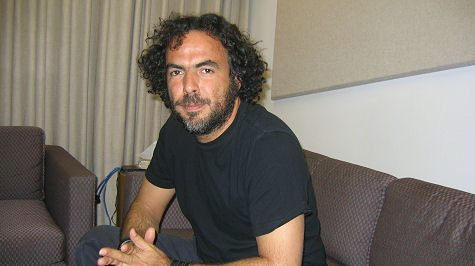
Babel director Alejandro Gonzalez Innaritu during interview at CBS Radford — Wednesday, 5.3.06, 1:10 pm.

“At this point I invited Guillermo to participate in this story, and we obviously…as part of that process, we decided to share a lot of things.”
“I think Babel is different from Amores perros and 21 Grams because the range of this film is completely different, style-wise, than the other ones. Because every story has a particular narrative and personality, and I feel that this is a more cinematic piece.
“I tried to combine the realistic aesthetic that normally I have been working in, but qualitating from an imaginary world where the music and the sound is a guiding force. There are a lot of sound elements in Babel. I was really taking the audio seriously. Using it to try and be inside a character.
“I stripped down so many things in the script by myself, and I was constantly adjusting and adapting and rewriting a lot of things based upon the culture and the situation I was in. It was a very difficult and informative process.
“I feel it is a very different film from the other ones in tone and style. It’s more cinematic. I can only put only one line in the script, but in the shooting I can make a ten-minute piece out of a whole interior consciousness [trip] by one of the characters.


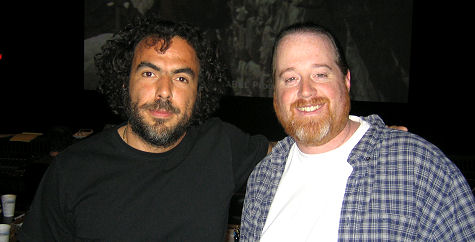
Inarritu, Babel editor Stephen Mirrione — Wednesday, 5.3.06, 1:17 pm

“I had to make a lot of decisions. In a good way. I added some things, and I also took out some things. I was shaping a lot and learning a lot and learning the limitations of the actors. So in the end I took out like 30% of the script down, in the editing. So there have been a lot of changes.
“We shot in Morocco, and then pre-production in Mexico, and then we shot in Mexico, and then over to Japan for pre-production and then we shot there. It was the same as doing four separate films, which was intellectually and emotionally very difficult. To shoot something in Morocco and at the same time think about the likelihood that a scene would cut directly into a scene I know I will shoot in Japan seven or eight months later. It was an exercise.
“And it was such a struggle, about going or not going to Cannes,” he added. “But we finally decided that Cannes is a good platform for this kind of film. It’s a four-language film, a very personal film, a very complicated film, and this festival exists for that…for this kind of film.

Babel is Booming

Alejandro Gonzalez Innaritu’s Babel, which press-screened this morning, is, I believe, a lock to win the Palmes D’Or. Everyone seems to be feeling this, spreading it around. If it doesn’t win, fine — it’ll still be an incredibly vivid and brilliant film — but I’ll be greatly surprised.

Babel (Paramount Vantage, 10.6) is an incredibly shrewd work in the sense that it’s shaped in a way that keeps you fully absorbed, and yet gradually awakened to the fact that there’s a greater whole coming together than what is indicated by gathering sum of story and scenes.


(l. to r.) Cate Blanchett, Alejandro Gonzalez Innaritu, Gael Garcia Bernal at this morning’s Babel press conference — 5.23.06, 11:33 am.

In the most rudimentary sense it’s a film about how one bullet out of a rifle causes damage and hurt to many people in various tangential roundabout ways. But it’s more deeply about how we’re all affected by everything and everyone…how no one is an island, we’re all in this together and everything we say or do echoes all over the place.

It’s about interconnectedness, aloneness, and human frailty, and is especially about parents and children. It radiates compassion and precision and refined artistry with every last frame, shot, edit and line of dialogue.

That last line sounds like breathless film-critic crap, so let’s go over the basics again…

Guillermo Ariagga’s script tells four stories that take place in three countries — Tunisia, Mexico and Japan — and several disparate characters (four played by Brad Pitt, Cate Blanchett, Gael Garcia Bernal and a young unknown Japanese actress, Rinko Yakusho).

The Tunisian section has two stories — that of a married American tourist couple (Pitt, Blanchett) and their encounter with a bullet, and a story about how that bullet is haphazardly fired from a long distance away by a pair of youths playing with a newly-purchased rifle, and about the consequences of this.


Innaritu, Blanchett as they entered the Salles de Presse inside the Palais this morning (5.23.060) at 11:25 am.

The Mexican section is about this couple’s nanny (Adriana Barraza) and her taking Pitt and Blanchett’s kids (Elle Fanning, Nathan Gamble) across the border into Mexico for a wedding, which leads to bad things all around, particularly for her nephew (Gael Garcia Bernal).

The Japanese portion is about the relationship between a wealthy businessman (Koji Yakusho) and his deaf daughter (Rinko Kikuchi), and the daughter’s encounters with various men, among them a visiting police detective.

They and many other are linked in the same way that the characters in Inarritu’s Amores Perros and 21 Grams are linked — by a single violent act.

This one of those “small” portraits of humanity writ large…and like I mentioned in my Inarritu interview a week and a half ago, it becomes larger and richer and more poignant the more you think about it.

Some journalists in the post-screening press conference were asking Innaritu, “So…what’s it all about, really?” That plus the hearty applause and whoo-whoos from the press at the end of the screening tells me it’s one of those film that resonates in a way that’s fuller and deeper than any concisely worded “meaning” or “explanation.”

Innaritu answered by saying the film “has no lesson — I don’t do films to give lessons. It is a film about human beings…not Moroccans, not Mexicans, not Japanese, not Americans. It’s not about what separates us, but what binds us.”

The teeming energy before the packed press conference began, and the respectful applause given to each player when they were announced at the press conference got underway…you can just feel that this film has connected in a big way.

“The connections between the characters [in Babel] are not about coincidence,” Innaritu went on. “What makes us happy varies with each culture, with each person, but what makes us sad and miserable is something that everyone knows and shares.

“I can say the film is about incommunication, misunderstanding and loneliness,” Inarritu said in an interview we did on 5.5, or about eighteen days ago.

“But for me, the bottom line DNA of this film is about how fragile and vulnerable we are. How do you say, this is a chain, this is a little piece of the chain? A link? For me when a link is broken then the chain is broken. And that, for me, is what this film is about.

Babel was an idea I had when I first arrived in the United States,” he recalled. “This film would have been impossible without me being a director in exile, I would say. Because what comes from this is that you have a consciousness…a very strange perspective of your country and of yourself.

“I’m speaking of a complex relationship between a citizen of a Third World country” — Inarritu was born, raised and launched his career in Mexico — “and this country, and the traveling that I have done in the last six years, the way you understand things. So I guess that was what [led] to the necessity of making this film.

“So I started working on this thing with Carlos Cuaron [the brother of Alfonso Cuaron and screenwriter of Y Tu Mama Tambien]. In the beginning. He would be the writer. But we began it as an argument and never took it beyond that, so we decided that he would do another project that we were developing.


Babel director Alejandro Gonzalez Innaritu during interview at CBS Radford — Wednesday, 5.3.06, 1:10 pm.

“At this point I invited Guillermo to participate in this story, and we obviously…as part of that process, we decided to share a lot of things.”

“I think Babel is different from Amores perros and 21 Grams because the range of this film is completely different, style-wise, than the other ones. Because every story has a particular narrative and personality, and I feel that this is a more cinematic piece.

“I tried to combine the realistic aesthetic that normally I have been working in, but qualitating from an imaginary world where the music and the sound is a guiding force. There are a lot of sound elements in Babel. I was really taking the audio seriously. Using it to try and be inside a character.

“I stripped down so many things in the script by myself, and I was constantly adjusting and adapting and rewriting a lot of things based upon the culture and the situation I was in. It was a very difficult and informative process.

“I feel it is a very different film from the other ones in tone and style. It’s more cinematic. I can only put only one line in the script, but in the shooting I can make a ten-minute piece out of a whole interior consciousness [trip] by one of the characters.


Inarritu, Babel editor Stephen Mirrione — Wednesday, 5.3.06, 1:17 pm

“I had to make a lot of decisions. In a good way. I added some things, and I also took out some things. I was shaping a lot and learning a lot and learning the limitations of the actors. So in the end I took out like 30% of the script down, in the editing. So there have been a lot of changes.

“We shot in Morocco, and then pre-production in Mexico, and then we shot in Mexico, and then over to Japan for pre-production and then we shot there. It was the same as doing four separate films, which was intellectually and emotionally very difficult. To shoot something in Morocco and at the same time think about the likelihood that a scene would cut directly into a scene I know I will shoot in Japan seven or eight months later. It was an exercise.

“And it was such a struggle, about going or not going to Cannes,” he added. “But we finally decided that Cannes is a good platform for this kind of film. It’s a four-language film, a very personal film, a very complicated film, and this festival exists for that…for this kind of film.”

California Dreamin'

California Dreamin’

Richard Kelly’s Southland Tales, which had its first public screening this morning inside the Cannes Grand Palais, is a very long throw of a surreal wackazoid football — a stab at a great, sprawling GenX apocalyptic nightmare about an Orwellian police state running things a couple of years from now.
I liked portions of Kelly’s film here and there (especially the musical numbers and the wild fantasy stuff that kicks in toward the end), but mostly it felt like a struggle and a muddle. I’m sorry to say this because I think Kelly is one of the best younger filmmakers around, but this is the kind of difficult film that only an audacious visionary could make.


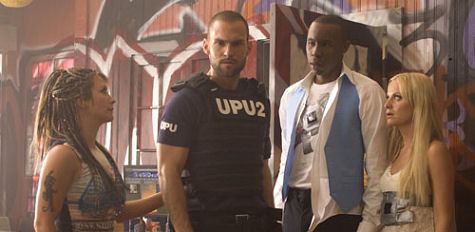
Seann William Scott (center, shaved head) as Hermosa Beach cop Roland Taverner in Richard Kelly’s Southland Tales. (I’ll figure out the other actors’ names later on.)

Set mostly in the beach communities of Los Angeles (with a final act that happens above the streets of downtown Los Angeles) over a July 4th weekend, it’s about various permutations of frenzy, delusion, egoistic fame-seeking, and underground anti-government activity, all of it running rampant after a second 9/11-type attack (a much worse one) occurs in Texas.
There weren’t that many walkouts during the screening (I noticed about 12 or 13) but they were almost all people with soft bellies and gray hair. I don’t know how many tickets Southland Tales (Universal, mid-fall) is going to sell when it opens, but if it makes out at all it’ll be largely due to the GenX-ers and GenY-ers who turned Kelly’s Donnie Darko into a cult hit after it opened in October ’01, despite many critical pans.
< ?php include ('/home/hollyw9/public_html/wired'); ?>
Southland Tales is absolutely not a movie for your average 55 year-old. I’m not saying all younger people will like it, but you can almost certainly scratch the boomers.
I was of two minds. I felt distanced and frustrated by the lack of a clear through-line and a not-simple-enough unfolding (especially in the beginning), and by the sense of insufficient refinement in the story strokes.
But I also felt dazzled and delighted by some of the flights of fancy and fantasy that Southland veers into, especially during the final act. This is a crazy, no-holds-barred, go-for-it Richard Kelly film. And I think vigorously challenging mind-scrambling movies are good for the soul, even if you don’t get everything about them.


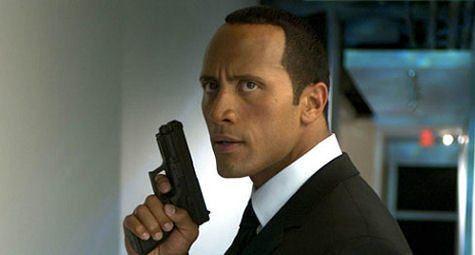
Duane “the Rock” Johnson

Kelly himself admitted in the post-screening press conference that the film is “a tapestry of ideas” and “an experience of a puzzle,” and that perhaps it will take “a second viewing to comprehend all the intricacies.”
That’s the problem with the film — it’s too dense and complex and ambitious by half.
And the actors — Duane “The Rock” Johnson, Sarah Michelle Gellar, Seann William Scott and Justin Timberlake have the lead parts — have been directed to perform with arch and mannered deliveries, or to act ultra-serious and alarmed with constantly shocked expressions, and so it doesn’t connect on an emotional level. Nothing is allowed to sink in and touch you.
Southland Tales is meant to be a black comedy, but the jokes are on the dry side and under-delivered (which is usually the kind of humor I prefer…except here) and they’re frankly not very funny.

The film is also supposed to be a kind of half-musical, but Kelly doesn’t work enough songs in (only Timberlake has an out-and-out musical number) and Southland could have really used the anchor effect of characters occasionally singing and dancing their butts off.
My opening paragraph makes Southland Tales sound like a bad oppressors vs. good revolutionaries story, but it’s not that simple.
All kinds of ideas, echoes and story elements have been thrown into this puppy, mostly stemming from post-9/11 attitudes and intrigues.
Armed soldiers are on the street, a privately-run big brother outfit called USIDent is checking up on everyone, the environment is heating up badly, two pairs of identical twins (or twin souls) are part of the general plot swirl, and there are a lot of folks getting shot at the end.
There’s also a decelerating globe, a political alliance between an ex-porn star and an action star (i.e., Gellar and Johnson), a conniving neocon political candidate and his flunkies, a power-mad company called Fluid Karma that delivers ocean-driven energy, Santa Monica-based neo-Marxist revolutionaries blackmailing politicians, a mood-altering substance that various characters inject into their necks with a high-tech syringe, veterans of the Iraq War suffering post-traumatic stress disorder…and that’s just for starters.


This morning’s press conference — Monday, 5.22.06, 12:55 pm

Southland tales is probably going to get a rough reception from the Cannes critics. I talked to a few of them as we shuffled out of the screening, and I don’t think it’ll be pretty.
Here’s what Kelly has written in the press notes: “Southland Tales is a comedic spin on the apocalypse, as it should occur in the great city of Los Angeles. Trust me on this one…if the end is indeed upon us (apparently 59% of Americans believe that it is), it is going to happen in Los Angeles.”
I thought it a bit odd that only Duane Johnson, Sarah Michelle Gellar and Kelly’s producer Sean McKittrick were on the dais with Kelly at the press conference. The no-shows included Seann William Scott, Justin Timberlake, Chris Lambert, Jon Lovitz and Kevin Smith (who is close to unrecognizable in the film due to a heavy makeup job).


Sarah Michelle Gellar

Reservations aside, this is one of those films you have to see just to see how much you can get on the first take. I’m definitely going to take Kelly’s advice and see it a second time.
But Kelly should consider doing a re-edit before showing it again at a major festival. I think there’s a slightly better movie inside the one I saw this morning. And if he does a re-edit, he should consider cleaning up the beginning and make it simpler and more straight-arrow and with less plot thrown at the audience so early on.