Hissing Balloon

Hissing Balloon

Ron Howard’s The DaVinci Code, which screened for the press Tuesday night at the Salle Debussy, has its intriguing moments. But it’s a fairly flat sit. A camera crew came up to me after the screening and I said, “It’s not that deep. In fact, it’s not that good. In fact, it’s kind of plodding. In fact…”
I shrugged my shoulders and said it wasn’t painful, because it isn’t. But it sure as hell doesn’t lift off the runway. I didn’t hate it, but I was never that aroused.


Audrey Tatou, Tom Hanks in Ron Howard’s The DaVinci Code

I can see devout Christians seeing it this weekend out of natural curiosity, or maybe to piss themsleves off. I can see it hooking those who aren’t hip to the story. (There must be a few people who don’t know it.)
It has a few chases, a couple of killings, one or two 180 character turns…but it’s Howard’s worst film since Far and Away.
< ?php include ('/home/hollyw9/public_html/wired'); ?>
The story is about a massive coverup, but Columbia Pictures’ decision not to screen it until tonight was a coverup also. A smart one. They knew (even if they don’t admit it) that critics would piss on it and there was nothing to be gained, etc.
The fact that it’s a faithful translation of a pulp best-seller will satisfy many millions, I realize. But it doesn’t doesn’t do what Clint Eastwood’s The Bridges of Madison County did for Robert Waller’s novel, or what Coppola’s The Godfather did for the original Mario Puzo novel.


On the steps of the Salle Debussy after the DaVinci Code screening — Tuesday, 5.16.05, 11:08 pm.

The DaVinci Code is basically a very brainy Hardy Boys or Nancy Drew-styled mystery movie that gradually leads to a debunking of the myth of Jesus Christ’s divinity, and a corresponding salute to the power and spiritual connectedness of women…two in particular.
A critic friend was calling it tedious and boring, but it’s not that bad. It putters along and does the thing that the 50 million people who’ve read Dan Brown’s novel are probably expecting it to do.
For all the controversy and anti-Christian establishment stuff and the discussion of Jesus and Mary Magdeleme’s relationship and their having had a daughter it’s just not that echo-y, and it’s talky as shit for two and a half hours. Sifting through clues, seeing past the obvious…wait, another clue! How could I have missed that?
There’s a pretty good explanation-of-the-biggest-coverup-in-history scene that Ian McKellen (doing his usual rascally eccentric nutter thing) pretty much nails on his own. McKellen! Boss man!


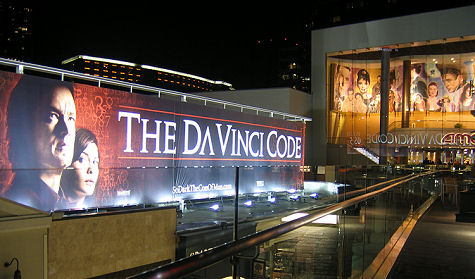
Festival guys putting up DaVinci Code banners in main lobby of Grand Palais — Tuesday, 5.16.06, 3:45 pm.

Tom Hanks does a decent job — he’s a very likable and self-assured actor — and is good at maintaining his dignity and handling some fairly clunky dialogue at times. (Akiva Goldsman has to take some responsibility.) Audrey Tatou handles herself fairly well in the awkwardly-written role of Sophie. Better than I thought she would, I mean.
Paul Bettany as a maniacal, self-flagellating Opus Dei whack job in monk’s robes gets very trying after his first couple of scenes. (It may be those Alaskan husky contact lenses he’s wearing.) Jean Reno plays the world’s most boringly obsessed, one-note Parisian cop.
There’s a big surprise that I won’t divulge, but anyone who doesn’t guess it at least an hour before it comes isn’t paying attention.
I can report that when the big surprise is divulged (by Hanks, in a single line of tepid, on-the-nose dialogue), the smarty-pants audience laughed.
It was the only laughing-at-the-movie moment, but when I heard the chuckles and guffaws, I knew. This movie is going to be toast with discriminating movieogers as the word starts to get out and it moves along into the second and third week. It’s not going to make money hand over fist with urban blues after the initial curiosity surge.


Paul Bettany, Audrey Tatou

We all know DaVinci is going to make a shitload this weekend — $60 million, $70 million. Everyone has decided to see it and that’s that. A lot of people are pretty taken with mysteries and a lot of them are devout Christians. But even the die-hards are going to say to themselves, “Man, this movie is not cooking.”
There was zero applause when it ended, and very few stayed in their seats to watch the credits.
It’s 1:30 a.m. Wednesday and I’m whipped — I have a headache and my vision is hazy-misty from fatigue and my ass hurts from sitting on a too-low, too-hard couch — but I wouldn’t sleep very well if I didn’t tap something out.
The screening ended two and a half hours ago, or about 11 pm. The press rooms are closed at that hour, so I had to scrounge around Old Town for an hour before I found a working wi-fi location. I went to two places that claimed to have good wi-fi but didn’t…pain in the ass.

Who Dies?

Not to take disaster or ensemble action films too seriously, but there are cultural reasons why certain characters die in films of this sort. There’s a literal pecking order, in fact, and Poseidon — a casualty itself — shows how it works.
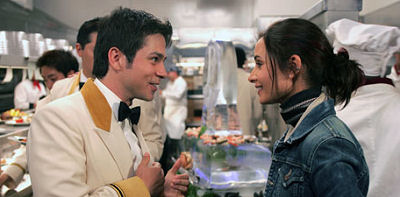
The bottom line (and here comes the SPOILER that I warned readers about twice last week) is that two of the four people who die among Poseidon‘s small survivor group — Freddy Rodriguez and Mia Maestro — are Hispanic, and I think their blood is what seals their fate.


Poseidon‘s Freddy Rodriguez, Mia Maestro

I could shilly-shally all over the place about unconscious racism and how Poseidon‘s screenwriter Mark Protosevich and director Wolfgang Petersen are probably more forward-minded than most of us about racial matters, but I still say that Rodriguez and Maestro die in this film not just because they’re not big-enough stars, but also because Hispanics are considered to be culturally expendable.
I forget the name of the black comic (is it Chris Rock?) who does a routine about any time there’s a black guy among a group of kids in a horror film, you can count on his getting killed fairly quickly. This routine always gets a laugh because people know that it’s true, and I think a similar attitude has come through in Poseidon about Latinos.
< ?php include ('/home/hollyw9/public_html/wired'); ?>
Here’s how the disaster-film death system works, more or less…
The highest ranked is the self-sacrificing hero. He is always male, always played by a star, and he always buys it in the third act while trying to save others. Gene Hackman died this way in the original 1972 Poseidon, and a name-value actor dies this way in the present version.
The second death level is shared by two types — the selfish lout and the weak second-banana who can’t hack it.


Mia Maestro

Kevin Dillon is Poseidon‘s resident blowhard, and you can tell he’s a goner from the moment he takes out his hip flask and takes a sip. If Maestro was not Agentinian she would be a good death candidate anyway because she plays the weakling of the group (i.e., unable to handle being in tight places). And yet Carol Lynley played a weakling in the 1972 version and lived.
The third candidates for the Great Beyond, as noted, are culturally expendable non-whites.
Gays used to be considered expendable or disposable — you can feel this attitude in genre movies of the ’60s — but they’ve moved up in the world to the extent that screewriters don’t dare kill them off or make them dislikable or villainous.
Rodriguez’s death inside an elevator shaft is arguably Poseidon ‘s most jarring moment.
His character, a busboy, is shown to be a brave and intelligent man, but then a metal table he’s standing on inside an elevator shaft gives way and he’s forced to cling to the leg of Richard Dreyfuss, a broken-hearted gay industrialist. Dreyfuss, in turn, is being held by star Josh Lucas. Lucas isn’t strong enough to pull Dreyfuss and Rodriguez to safety so he says to Dreyfuss, “Shake him off or you’ll both die!” And Dreyfuss finaly does.


Freddy Rodriguez, Eva Longoria

What if it had been Rodriguez shaking Dreyfuss off? That would have made for an even more startling scene. But Dreyfuss is a better-known actor than Rodriguez at this stage of the game ( Six Feet Under aside), and he probably got paid more, and he’s white…so Rodriguez had to die. But the way he’s gotten rid of is not just sadistic but disrespectful.
I was hoping that one of Poseidon‘s attractive white youths would die — Emmy Rossum, Jacinda Barret, Mike Vogel — or even the token kid, played by Jimmy Bennett. But the Death Rules state that the young must survive in order to go out in the world and procreate and propulgate the species.
A friend sold me on the culturally expendable idea a couple of weeks ago. I was initially skeptical but the more I thought about it the more convinced I became.
I ran it by Alejandro Gonzalez Innaritu and he said, “Of course! Of course!” I also ran it by a few Hispanic media types and journalists (American Entertainment Marketing’s Yvette Rodriguez, Jorge Camara of La Opinion, the National Hispanic Media Coalition’s Alex Nogales, Miami Herald film critic Rene Rodriguez) but we missed each other or they didn’t have much to say.
If anyone wants to chime in…

Bullet Time

Bullet Time

Alejandro Gonzalez Innaritu’s Babel, which will have its debut at the Cannes Film Festival on Tuesday, 5.23, regrettably hasn’t been seen by yours truly. But I did read a late ’04 version of Guillermo Ariagga’s script four or five weeks ago, and the good part was that I didn’t get the “all” of it until the morning after I finished it.
That’s what finally sold me. Anything that takes a day to kick in, anything that gains upon reflection…

Spare and precise, the Babel script tells four stories that take place in three coun- tries — Tunisia, Mexico and Japan. Clearly an exotic element here, and yet the film uses a plot device (and in fact a thematic strategy) that fans of Inarritu’s last two films will immediately find familiar.
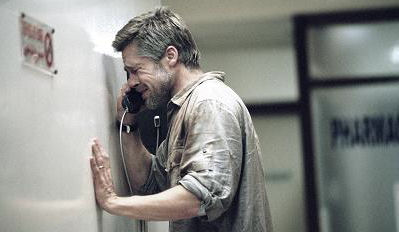
The story’s about several disparate characters (four of them played by Brad Pitt, Cate Blanchett, Gael Garcia Bernal and a young unknown Japanese actress, Rinko Yakusho) who are linked, in the same way that the characters in Inarritu’s Amores Perros and 21 Grams are linked, by a single violent act.
< ?php include ('/home/hollyw9/public_html/wired'); ?>
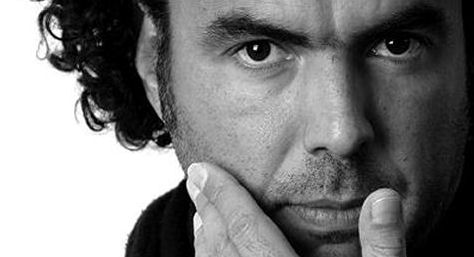
“I can say the film is about incommunication, misunderstanding and loneliness,” Inarritu said in an interview we did on 5.5, or about twelve days ago.
“But for me, on a personal level, being such a multi-dramatic film, the bottom line DNA of this film is about how fragile and vulnerable we are. How do you say, this is a chain, this is a little piece of the chain? A link? For me when a link is broken then the chain is broken. And that, for me, is what this film is about.”
The Tunisian section has two stories — that of a married American tourist couple (Pitt, Blanchett) and their encounter with a bullet, and a story about how that bullet is haphazardly fired from a long distance away by a pair of youths playing with a newly-purchased rifle, and about the consequences of this.


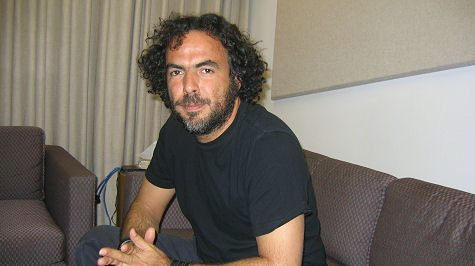
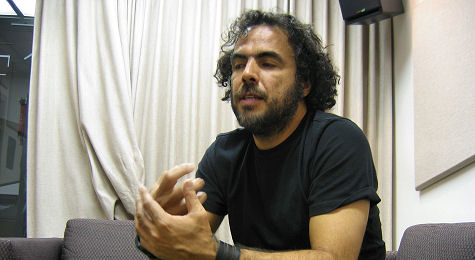
Babel director Alejandro Gonzalez Innaritu during interview at CBS Radford — Wednesday, 5.3.06, 1:10 pm.

The Mexican section is about this couple’s nanny (Adriana Barraza) and her taking Pitt and Blanchett’s kids (Elle Fanning, Nathan Gamble) across the border into Mexico for a wedding, which leads to bad things all around, particularly for her nephew (Gael Garcia Bernal).
The Japanese portion is about the relationship between a wealthy businessman (Koji Yakusho) and his deaf daughter (Rinko Kikuchi), and the daughter’s encoun- ters with various men, among them a visiting police detective.
I wasn’t allowed to see Babel as part of my interview deal, but as I waited to speak with Inarritu I saw a bit of footage on the large editing-room screen.
It showed a hyper, frenzied, salt-and-pepper-haired Pitt, playing, as Inarritu described, “a 49 year-old…a guy who’s been through some tough times.” The footage showed Pitt’s character, who is called Richard, helping to carry his wounded bleeding wife (Blanchett) through the streets of a small Tunisian village.
I began our chat with my observation that the script feels good and strong at first, but smallish and concise and a bit less plot-driven than Amores perros and 21 Grams Then it sinks in a bit, and then it really kicks in the next morning.


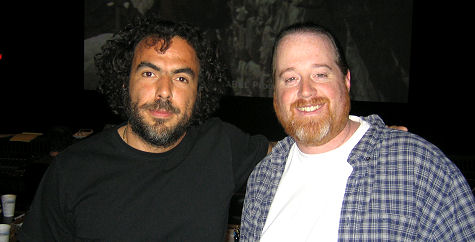
Inarritu, Babel editor Stephen Mirrione — Wednesday, 5.3.06, 1:17 pm

“That’s a good wine you’re describing,” said Innaritu. “I agree — it’s a very multi- layered film. I’m still looking to it. Every time, as I am seven months with this, every time I discover more layers, more things…it’s true what you are saying.”
Babel‘s similarity to Amores perros and 21 Grams — all three being about a violent blow shattering many lives — may suggest that Guillermo Ariagga, the screenwriter of all three as well as author of the Tommy Lee Jones western The Three Burials of Melquiades Estrada, had something to do with shaping Babel‘s basic plot. But Inarritu says it was pretty much his own.
Babel was an idea I had when I first arrived in the United States,” he recalls. “This film would have been impossible without me being a director in exile, I would say. Because what comes from this is that you have a consciousness…a very strange perspective of your country and of yourself.
“I’m speaking of a complex relationship between a citizen of a Third World country” — Inarritu was born, raised and launched his career in Mexico — “and this country, and the traveling that I have done in the last six years, the way you understand things. So I guess that was what [led] to the necessity of making this film.
“So I started working on this thing with Carlos Cuaron [the brother of Alfonso Cuaron and screenwriter of Y Tu Mama Tambien]. In the beginning. He would be the writer. But we began it as an argument and never took it beyond that, so we decided that he would do another project that we were developing.


Babel costar Rinko Kikuchi

“At this point I invited Guillermo to participate in this story, and we obviously…as part of that process, we decided to share a lot of things.”
“I think Babel is different from Amores perros and 21 Grams because the range of this film is completely different, style-wise, than the other ones. Because every story has a particular narrative and personality, and I feel that this is a more cinematic piece.
“I tried to combine the realistic aesthetic that normally I have been working in, but qualitating from an imaginary world where the music and the sound is a guiding force. There are a lot of sound elements in Babel. I was really taking the audio seriously. Using it to try and be inside a character.
“I stripped down so many things in the script by myself, and I was constantly adjusting and adapting and rewriting a lot of things based upon the culture and the situation I was in. It was a very difficult and informative process.
“I feel it is a very different film from the other ones — you will see this soon — in tone and style. It’s more cinematic. I can only put only one line in the script, but in the shooting I can make a ten-minute piece out of a whole interior consciousness [trip] by one of the characters.


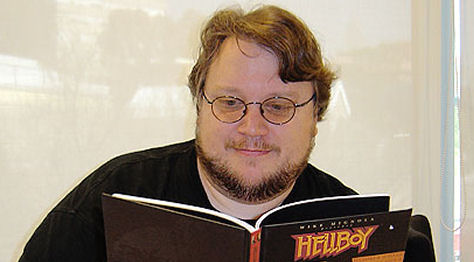
Inarritu ally and pally Guillermo del Toro, director of Pan’s Labrynth

“I had to make a lot of decisions. In a good way. I added some things, and I also took out some things. I was shaping a lot and learning a lot and learning the limitations of the actors. So in the end I took out like 30% of the script down, in the editing. So there have been a lot of changes.”
We spoke of Rinko Kikuchi, a non-hearing-impaired Japanese actress that Inarritu cast as a sexually provocative teenager who has a hang-up about male attention, or a lack of.
“I first went to Japan in December 2004…just by myself, the trip being self-financed like always,” Innaritu said. “I was looking for a Lolita kind of star, not quite attractive in an obvious way but one that you can really have some bad thoughts about her, but not quite in that way. It was difficult.
“I saw Rinko once, and then again nine months later when I returned, and I had never prom ised anything but she had studied sign language all by herself and signed as well the other girls. I can tell you she was better than the deaf girls. It was really impressive.
At what point did he sign Pitt, Blanchett and Bernal?
“I approached Brad and Cate in, I think, January or February of ’05, and they said yes and we were shooting by May 2nd. It was a very fast process. Brad is playing an older character. I want to give him a kind of gravity so he looks older. No more boyish, and I think he looks great. I told him, I think you will be a very interesting old man.


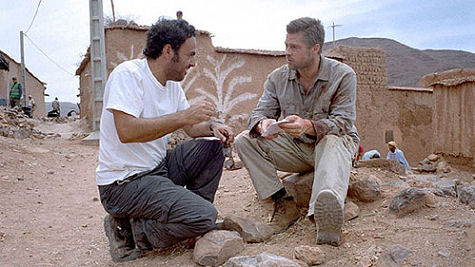
Inarritu, Pitt during filming in Morocco, late May 2005.

“Gael, I always wanted We originally had just two stories…the Moroccan kids story [he used Morocco as a Tunisian substitute] and the Americans who receive the shot, which originally, by the way, was the man who received the shot…we changed it later to the woman…but this was a very, very early stage in the argument I had with Cuaron.
“But we needed two more stories, I said. We need to tell a story about Mexico, about a nanny. The story about Mexico and the border because I am very affected by that. The nanny who works with me at my home is called Julia, and she has told me the saddest stories you’ve ever heard. So for the border sequence, I always felt that would be best to have Gael. Partly because he is a master of accents and people in the north talk very differently. Always I have him in mind.
“We went into pre-production in Morocco in March ’05, and we started shooting May 2nd. All three countries in sequence. The last day of filming was December 1, 2005.
“We shot in Morocco, and then pre-production in Mexico, and then we shot in Mexico, and then over to Japan for pre-production and then we shot there. It was the same as doing four separate films, which was intellectually and emotionally very difficult. To shoot something in Morocco and at the same time think about the likelihood that a scene would cut directly into a scene I know I will shoot in Japan seven or eight months later. It was an exercise.
“And it was such a struggle, about going or not going to Cannes,” he added. “But we finally decided that Cannes is a good platform for this kind of film. It’s a four-language film, a very personal film, a very complicated film, and this festival exists for that…for this kind of film.

“Now, I’m not sure exactly who is going to be in Cannes. Perhaps with Brad and his baby coming he will not be there…I’m not sure. But possibly Cate will come. And all the other actors. We are working on getting visas for the little [Moroccan] kids.”
I mentioned the cliche about filmmakers facing the inevitable pit of depression after they have finished a long project. To avoid this some directors develop one, two or three films at the same time so they can jump right into the something fresh after one is finished.
“The only way I can conceive films like this is being quiet and being alone,” Inarritu replied. “If I go into the machinery, into the factory thing, it’s good but I don’t know that I have the skills to have three girlfriends. I’m a one-woman man.
“From Amores perros to 21 Grams I needed two years. It is always that. That is the time I need to assimilate, to be working the characters, to know who they are. It’s a very conceptual and quiet internal process, and I need that time to develop it.”
I mentioned Inarritu’s excellent BMW commercial, “Powder Keg,” which was made in ’01 and co-starred Clive Owen, and then asked if he had been approached to do one of those idiosyncratic American Express commercials that M. Night Shyamalan and Wes Anderson have directed.


Wednesday, 5.3.06, 1:12 pm

“They offered me to do one, and I reject,” Inarritu replied. “I reject because, first of all, for me, to expose myself with a crowd like that…it’s like a capitalist statement. I worry about that statement. It’s not safe in Mexico to be the American Express guy. That’s not a smart thing for me.”
Inarritu took part in that recent, very large Latino demonstration in Los Angeles (which also happened in other cities) against a proposed change in U.S. immigration and labor laws that would adversely affect the economy and culture of Latin communities all over.
“I didn’t send my kids to the school that day — I took them with me [to the demonstration],” Inarritu said. “The guys in the editing room were shouting bad things at me. We were facing a deadline, they said. I said, ‘Guys, a man is defined not just by work but by what he believes.’ They were furious at me.
“The kids and I took a taxi and arrived on Broadway downtown, and we spent four hours there and the kids loved it. It was peaceful, not angriness. You need us, we need you. It was a beautiful experience. An amazing experience.”
It seemed to me like the biggest and best organized demonstration by Latinos in this country ever, I said. “Mexico doesn’t have that kind of organization,” he replied. “If we had that power in Mexico we would throw out the president. This is a human rights thing.”

We discussed his director friend Guillermo del Toro, who has advised Inarritu about pruning his films in the editing room, and who has his own film, Pan’s Labrynth (Picturehouse), showing at Cannes this year. Inarritu calls it “very sad.”
“I helped him finish it,” he explained. “He helped me to take out three minutes from my film, and I helped him take out nine minutes from his.”
He then switched back to Babel by asking, “Did you like the script?” Very much, I repeated. I guess I hadn’t really said that in my initial comments.
“The other ones were more plot driven,” Inarritu said. “This one is more character driven. One of the things I liked the most about it is the Japanese section, because there’s nothing happening. There is no plot in it. It is the undercurrent thing that, little by little, begins to take you somewhere.”

Upside of Taps

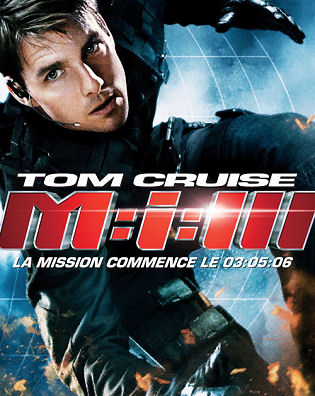
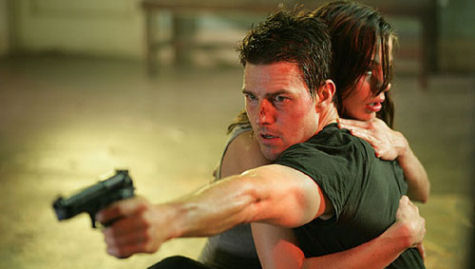
From Risky Business to Mission: Impossible III, Tom Cruise had a good 23 year run…and now it’s over.
Not his career, obviously, or the power that comes from being a big star with a huge fan base — Cruise is still fairly secure in these realms. But something fundamental changed this weekend with the somewhat disappointing earnings of Mission: Impossible III. What’s over and finished now is Cruise’s rep as a nearly invincible box-office powerhouse.

He may rebound in a year or two — not financially, but perhaps with a really good film and a superb performance. Maybe. He could luck into it. What he needs is to make another Jerry Maguire or another Born on the 4th of July — something that exudes sweat and struggle and personal growth.
But he’ll never be Mr. Financial King Shit again. Not in the realm he’s enjoyed for the last 15 years or so. Not after the bruising he took this weekend.
< ?php include ('/home/hollyw9/public_html/wired'); ?>
With the $46 to $47 million brought in by M:I:3, there is solid numerical proof that Cruise’ drawing power has diminished. The $57 million earned by John Woo’s M:I film in 2000 means a drop of $10 or $11 million for the just-opened film.
But if you adjust for roughly a 15% inflation in ticket prices since 2000, M:I:3‘s 2000 ticket price earnings is more like $40,000,000. So it’s really $57 million vs. $40 million — same franchise, same Cruise, same everything. That’s significant.

“His career is far from over and he’s still a player…but he’s not where he was,” says a veteran marketer. “I know that the people at Paramount wanted to see $300 million last summer out of War of the Worlds, and that they were disappointed with the $234 million it wound up with. It was all the Scientology shit and jumping on the couch and criticizing Brooke Shields.
“With these grosses and all the competition to come this summer I would say M:I:3 won’t do much more than $125 to $150 million in this country. It’ll be off a minimum of 40% next weekend. There’s no way it can crack $200 million domestically.”
If I know Cruise he’ll be making smart, well-rigged films for at least another two to two and a half decades, and perhaps longer than that. He’ll just have to take less money, is all. He’s been making films on a percentage-of-the-gross payment basis for a while now, and he will probably continue to do that.
Cruise is an extremely wealthy man. He and whomever he’s with as a domestic ally and his daughter Suri can live in the lap of luxury for the rest of their lives without Cruise working another day in his life. Which is an absurd proposition, of course. The guy is an energizer bunny. He’ll never stop. He can’t.

But he’s melted himself down over the last year or so. Women are said to have gone cold on him. His image isn’t quite that of a Michael Jackson-esque freak, but he seems to be in that ballpark. For now, at least. If he’s smart (and he is), he can damage control his way out of this, to some extent. Just downplay the weirdo stuff and focus on the work, the work, the work.
Next up (according to what I’ve read): the Glenn Ford role in James Mangold’s remake of 3:10 to Yuma, and (according to the IMDB) the role of renegade American pilot Billy Fiske in Michael Mann’s The Few.
Onward and upward. He’ll earn a bit less, but what’s that? This a big opportunity for the guy. He’s begun of those life passages that can lead, with the right attitude, to non-material riches.

From This End…

From This End…

It’s Sunday evening (4.30) and Worldfest-Houston 2006 has come to a close. Earnest apologies for not providing more reports about the films I saw here and the filmmakers I conversed with over the last two days, but something got into me on Saturday — either the same lazy virus that attacks me at odd intervals like the flu, or some hair-brained whimsy or delusion about having some kind of weekend downtime for a change.
Worldfest had its big awards ceremony Saturday night at the Renaissance hotel, which I half-wanted to go to but decided to blow off at the last minute. I don’t mean to sound cavalier, but keeping tabs on the fest’s winners, near-winners and also-rans didn’t seem, in the final analysis, as important as going to The Stables, an old Houston restaurant near Rice University, and ordering a sizzling peppercorn steak.


Jack Nicholson and Shirley MacLaine’s homes in Terms of Endearment, sitting on Locke Lane in Houston’s River Oaks section. MacLaine’s home (r.) has had a brick facade added that wasn’t in the film, and Nicholson’s has been remodelled also.

Anyway, nearly 24 hours have passed since the the ceremony finished and there’s no news account or official press release listing the winners that I can find. The winners will eventually be posted on this Worldfest page.
I briefly observed the last third of the ceremony at the Renaissance hotel, and I can report that lots and lots of filmmakers were given Remi awards. I spoke to two or three satisfied winners (one of them being Chris Buchholz, director of a documen- tary about his late father called Horst Buchholz, My Papa) in a lobby near the ball- room, and I felt something like a contact high coming from them. Recognition of merit from any film festival of note lends a measure of credibility and marketability to their film, and hand-to-mouth indie filmmakers need all the pats on the back they can get.
< ?php include ('/home/hollyw9/public_html/wired'); ?>
I had a sit-down on Saturday with movie-book author, film scholar and Houston- based Variety critic Joe Leydon. Naturally we went over the ins and outs of Worldfest, and out of this came an analogy that I thought sounded fair.
Ask any music critic about garage bands and he/she will tell you they’re an important part of the process of creating music that’s raw, vital and unfiltered. Many of the films shown at Worldfest, Leydon said, are garage-band movies. This implies they aren’t all first-rate achievements in each and every way, but that they deserve a measure of respect. I agreed with him.
Leydon mentioned that I’ve been the only out-of-town film journalist to fly into Hous- ton and report about Worldfest in quite a few years. I’m not sure if that’s true, but so what if I am? I sniffed around and dug in and gave it a whirl. I don’t know what that means, but I saw six or seven half-decent, fairly intriguing films — Letia Miller’s In the Dark, Matthew Marconi’s Truce, Shira-Lee Shalit’s The A-List, Paul Richards’ Pamplona: Running with the Bulls, Chris Page’s Into the Wind, and Robert Peters’ Half Empty. I’ll be seeing the Buchholz doc on Monday.
A week before leaving for Houston I spoke to Page, whose Into The Wind doc is about a few spirited Texans (i.e., Page and his friends) pursuing their love of powered paragliding. The charm is in the unassuming home movie-ish feel of it. Here’s an MP3 file of our conversation


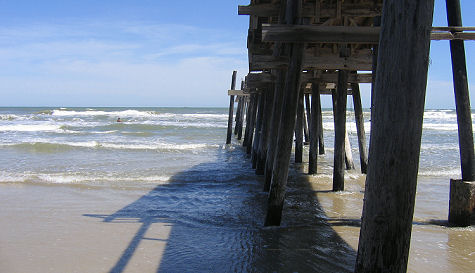
Beach view to the southwest of Galveston, Texas — Sunday, 4.30.06, 2:10 pm.

The Houston Chronicle has been running a lot of Worldfest film reviews, mostly written by Louis Parks. Maybe 15 or so films have been reviewed, and yet my choice for the best film of them all — Eric Anderson’s Way of the Puck — wasn’t reviewed. There’s irony in that.
I’d like to modify my diss about Houston being an “arid corporate hee-haw town.” It still is that, I feel, but there are rich people here who financially support opera and ballet and the fine arts, so the city isn’t all indoor shopping malls, fast cars, oil refineries, Tex-Mex food and strip joints.
I’ll take another swing at this piece on Monday morning before I fly back to Los Angeles — maybe something else will come to mind. Part of the weekend was about working on the brand new design of Hollywood Elsewhere — there’ll be a whole new bloggy look to it, with a series of WIRED-type items plus beginnings of features linked to pages with the entire article. I’ll also be hanging on to the current design by offering a link to it — it’ll be called “Elsewhere Classic” — on the new page.
I’m back for three days in Los Angeles and then I’m off again on 5.3 — Boston for three or four days, Manhattan and Connecticut for eight days, and then off to the Cannes Film Festival.

Grabs


Large southern-style home sitting on sprawling grounds in Houston’s River Oaks section.

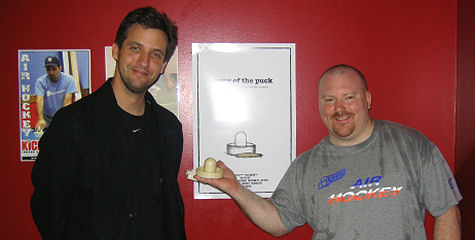
Way of the Puck director Eric Anderson (l.) playing air hockey with champion player Danny Hynes.

Houston-based book author, film professor and Variety critic Joe Leydon at Renaissance hotel — Saturday, 4.29.06, 1:25 pm.

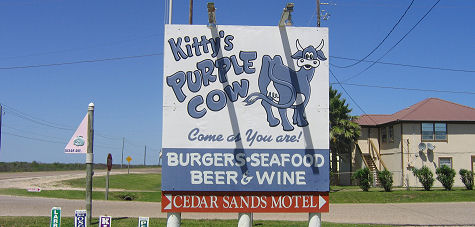
Short-order joint in Surfside, Texas — Sunday, 4.30.06, 2:45 pm.

Sign outside a jazz joint on Houston’s Richmond Avenue.

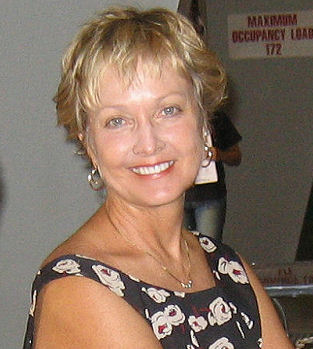
Worldfest publicist Cherry Kutac, one of those perky attitude-and-sparkling personality types with a totally committed attitude…worth her weight in gold

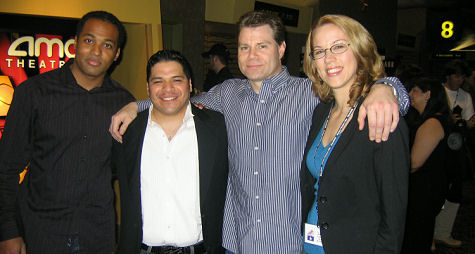
The In The Dark team — costars Lionel Carson, Brian Luna, Steven A. Brennan and director-costar Letia Miller.

Way of the Puck director Eric Anderson, air hockey champ Danny Hynes.

The A-List director Shira-Lee Shalit.

Texas Time

I’m staying in a soul-less, corporate-style hotel in Houston between now and Mon- day morning in order to dive into Worldfest, which I’ve never been to before. I was invited to visit a few weeks ago by its founder, Hunter Todd, and it seemed like an agreeable idea, and it felt even better as I flew the hell out of Los Angeles Wednes- day morning.
Worldfest is a friendly, funky-ass film festival that’s mainly about smallish, hand- crafted (as opposed to machine- or committee-crafted) indie films — some of them made by or starring Texans, and others from here and there.


The entrance to the big lounge at Houston’s Renaissance Houston hotel, just off the scenic Southwest Freeway.

Todd, who started this homegrown festival way back in the ’60s (only the New York and San Francisco festivals have been around longer), is the principal bequeather of the “friendly” stuff, although everyone I’ve met here so far — staffers, bus drivers, fast-food servers — has been warm, professional, considerate.
The funky-ass elements are…well, the movies. Pretty-good funky, I mean. Funky different. The better ones (and there are plenty I have yet to see) have a certain face-up quality. Not radically sophisticated and maybe a little average Joe-ish at times, like a hand-painted sign on Main Street or like tight jeans with cool-ass patches. One that’s a tad off-center, another that’s “there” but not 100% realized, but all with a certain non-Sundance-y apartness.
I’m saying it can be a refreshing thing to sample movies that haven’t been made by absolute cream-of-the-crop, front-of-the-pack types. Refreshing as in, “Oh, yeah… movies can tell stories this way too. And that way. Find your way through it…okay, I get it now.”
I’m not sure that the term “Worldfest” is entirely appropriate. It seems as if “Peoplefest” would be more on the mark. Movies by, about and for regular folks who love movies enough to see films with a few speed-bump elements (but not too many), and who enjoy the hell out of their Texas popcorn. (I had several handfuls last night, and it’s a lot more buttery than the popcorn in Los Angeles.)
I can think of three Worldfest films that are about Texans, or made by Texans, or featuring or costarring Texans. Lorraine Senna’s Paradise, Texas, the festival opener, about a middle-aged actor (Timothy Bottoms) on his way down who gets a chance to show what he’s made of. Matthew Marconi’s Truce, a not-bad drama about a weary old cowboy (Buck Taylor) trying to settle some life issues. And a documentary called Into the Wind about four or five Texans who are into power- paragliding.


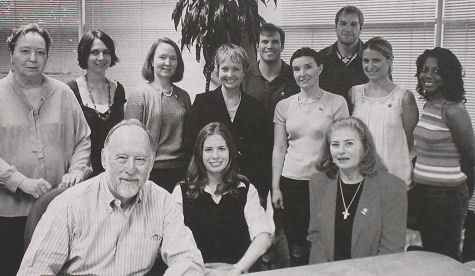
Worldfest Houston generalissimo Hunter Todd (lower left), daughter Katy Lea Todd (front, middle), wife and partner Kathleen Haney-Todd (lower right); staffers June Pennington, Alicia Granvaud, Valerie Blair, Cherry Kutac, Jason May, Ariane Hannaford, Christopher Schecter, Sara Albert, Kerrie Pegues.

And then there’s In the Dark, a drama set in L.A. about a young Hispanic guy trying to become an agent, which can be called half-Texan by way of Brian Luna, an appealing actor from from San Antonio, playing the Hispanic guy. (I’m stretching it, I realize.) And then there’s Eric Anderson’s Way of the Puck, an air-hockey doc that I wrote about a couple of weeks ago, that’s kind of a Houston movie because a strong concentration of air-hockey enthusiasts live here.
Oh, and a doc about Gulf Coast surfers called Miles to Surf, which focuses in part on “tanker surfing,” which is about riding the wash generated by oil tankers head- ing up the Houston ship channel from the gulf.
There’s something mildly exciting about rummaging through a bunch of films that no one’s told you need to see or avoid, movies that may be excrutiating or a blin- ding revelation or somewhere in between…but it’s all a dice-roll.
The only beef is that the theatre where the Worldfest features are showing is way the hell down the road — four, five miles — from festival headquarters at the Renais- sance Houston. There are three shuttles that travel to and fro, but I’m the captain of my own ship. I’d rather walk, drive a car, peddle a bike, take a bus.

I said it felt really good to fly out of Los Angeles yesterday. But I’ll be honest — I started to have second thoughts minutes after I touched down in Houston.
There are good people all over this town but with the exception of a visit Wednes- day night to River Oaks, where the really rich folks live and where the oak trees are huge and the grass is moist and fragrant, Houston seemed less than abundant with down-home charm. And if you’ve been to New York or Paris or London or Rome, it feels lacking in cultural refinement.
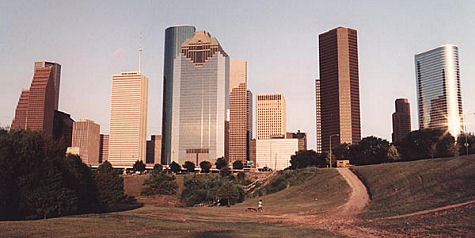
To me, it’s an arid corporate hee-haw town. Not enough sidewalks. Cavernous malls. Lots of middle-aged guys with monster beer bellies. Expensive cars tearing around like they’re in the Monte Carlo Grand Prix. Not enough trees. Women with vaguely predatory vibes and long jaws and all those revolting glass-and-steel towers. And the strip clubs — strip clubs! — as prominent and well located as the better restaurants, music stores and markets…nothing covert about them.
A friend (a blonde whose presence and personality are the best things about being here so far) told me before I came that Houston is like L.A. but without the soul, and I think that just about nails it.
Early tomorrow morning I’m going down to the courthouse where the Enron trial is happening. And then I’ll drive by St. John’s, the private school where Wes Ander- son shot Rushmore, and maybe visit Shirley MacLaine’s Terms of Endearment house.

Grabs


Artificial falls in front of Williams Tower

View from my hotel room, looking out on the beautiful Southwest Freeway.

Pond at twilight, south of Houston’s Williams Tower

Texas Time

I’m staying in a soul-less, corporate-style hotel in Houston between now and Mon- day morning in order to dive into Worldfest, which I’ve never been to before. I was invited to visit a few weeks ago by its founder, Hunter Todd, and it seemed like an agreeable idea, and it felt even better as I flew the hell out of Los Angeles Wednesday morning.
Worldfest is a friendly, funky-ass film festival that’s mainly about smallish, hand- crafted (as opposed to machine- or committee-crafted) indie films — some of them made by or starring Texans, and others from here and there.


The entrance to the big lounge at Houston’s Renaissance Houston hotel, just off the scenic Southwest Freeway.

Todd, who started this homegrown festival way back in the ’60s (only the New York and San Francisco festivals have been around longer), is the principal bequeather of the “friendly” stuff, although everyone I’ve met here so far — staffers, bus drivers, fast-food servers — has been warm, professional, considerate.
The funky-ass elements are…well, the movies. Pretty-good funky, I mean. Funky different. The better ones (and there are plenty I have yet to see) have a certain face-up quality. Not radically sophisticated and maybe a little average Joe-ish at times, like a hand-painted sign on Main Street or like tight jeans with cool-ass patches. One that’s a tad off-center, another that’s “there” but not 100% realized, but all with a certain non-Sundance-y apartness.
I’m saying it can be a refreshing thing to sample movies that haven’t been made by absolute cream-of-the-crop, front-of-the-pack types. Refreshing as in, “Oh, yeah… movies can tell stories this way too. And that way. Find your way through it…okay, I get it now.”
I’m not sure that the term “Worldfest” is entirely appropriate. It seems as if “Peoplefest” would be more on the mark. Movies by, about and for regular folks who love movies enough to see films with a few speed-bump elements (but not too many), and who enjoy the hell out of their Texas popcorn. (I had several handfuls last night, and it’s a lot more buttery than the popcorn in Los Angeles.)
I can think of three Worldfest films that are about Texans, or made by Texans, or featuring or costarring Texans. Lorraine Senna’s Paradise, Texas, the festival opener, about a middle-aged actor (Timothy Bottoms) on his way down who gets a chance to show what he’s made of. Matthew Marconi’s Truce, a not-bad drama about a weary old cowboy (Buck Taylor) trying to settle some life issues. And a documentary called Into the Wind about four or five Texans who are into power-paragliding.


Worldfest Houston generalissimo Hunter Todd (lower left), daughter Katy Lea Todd (front, middle), wife and partner Kathleen Haney-Todd (lower right); staffers June Pennington, Alicia Granvaud, Valerie Blair, Cherry Kutac, Jason May, Ariane Hannaford, Christopher Schecter, Sara Albert, Kerrie Pegues.

And then there’s In the Dark, a drama set in L.A. about a young Hispanic guy trying to become an agent, which can be called half-Texan by way of Brian Luna, an appealing actor from from San Antonio, playing the Hispanic guy. (I’m stretching it, I realize.) And then there’s Eric Anderson’s Way of the Puck, an air-hockey doc that I wrote about a couple of weeks ago, that’s kind of a Houston movie because a strong concentration of air-hockey enthusiasts live here.
Oh, and a doc about Gulf Coast surfers called Miles to Surf, which focuses in part on “tanker surfing,” which is about riding the wash generated by oil tankers head- ing up the Houston ship channel from the gulf.
There’s something mildly exciting about rummaging through a bunch of films that no one’s told you need to see or avoid, movies that may be excrutiating or a blinding revelation or somewhere in between…but it’s all a dice-roll.
The only beef is that the theatre where the Worldfest features are showing is way the hell down the road — four or five miles — from festival headquarters at the Renaissance Houston. There are three shuttles that travel to and fro, but I’m the captain of my own ship. I’d rather walk, drive a car, peddle a bike, take a bus.

I said it felt really good to fly out of Los Angeles yesterday. But I’ll be honest — I started to have second thoughts minutes after I touched down in Houston.
There are good people all over this town but with the exception of a visit Wednesday night to River Oaks, where the really rich folks live and where the oak trees are huge and the grass is moist and fragrant, Houston seemed less than abundant with down-home charm. And if you’ve been to New York or Paris or London or Rome, it feels lacking in cultural refinement.
To me, it’s an arid corporate hee-haw town. Not enough sidewalks. Cavernous malls. Lots of middle-aged guys with monster beer bellies. Expensive cars tearing around like they’re in the Monte Carlo Grand Prix, and all those revolting glass-and-steel towers. Not enough trees. Women with vaguely predatory vibes and long jaws. And the strip clubs — strip clubs! — as prominent and well located as the better restaurants, music stores and markets…nothing covert about them.
A friend (a blonde whose presence and personality are the best things about being here so far) told me before I came that Houston is like L.A. but without the soul, and I think that just about nails it.
Early tomorrow morning I’m going down to the courthouse where the Enron trial is happening. And then I’ll drive by St. John’s, the private school where Wes Ander- son shot Rushmore, and maybe visit Shirley MacLaine’s Terms of Endearment house.

Grabs


Artificial falls in front of Williams Tower

View from my hotel room, looking out on the beautiful Southwest Freeway.

Pond at twilight, south of Houston’s Williams Tower

Rollover

I don’t want to say too much about Wolfgang Petersen’s Poseidon (Warner Bros., 5.12) because this isn’t a regular “review” or anything. Maybe if I begin by talking about the 1972 Ronald Neame film (a piece of big-budget schlock that was a major blockbuster in its day), it’ll seem like less of one.
The original The Poseidon Adventure, which I just saw on a new double-disc DVD, was a bit rough to begin with — cornball characters, lumpy dialogue, cheesy special effects — and time has not helped. It’s almost painful by today’s standards — a movie with a two or three strands of silver hair growing out of its ear and some wretched acting here and there, and that putrid theme song, “(There’s Got To Be) A Morning After.”

Gene Hackman’s combover hair style looks awfully weird, and Shelley Winters’ fat Molly Goldberg character is enough to make anyone groan. And the effects…forget about it. The opening credits are laid over a slow-motion shot of what looks like a three-foot model of the S.S. Poseidon cruising along in a studio tank.
Poseidon, which I saw Tuesday afternoon, is a much better film. I didn’t see the reviled TV-movie version that aired last November with Steve Gutenberg, but it’s probably a lot better than that also. Lots of excitement. Much better special effects all around. No bullshit sentiment or emotional fat lathered onto the story or the characters. Streamlined, adrenalized…at least one action-suspense sequence that is arguably classic. And only 100 minutes long vs. 117 minutes for the ’72 version.
It moves right along and kicks ass according to the rules of the game it’s playing. There is no basis for any substantive quarrel with any movie that does what it sets out to do, and this $150 million action thriller does that. It is what it is, take it or leave it, etc.
Less than fifteen minutes of character set-up and along comes the rogue wave. (I adore the fact that there’s no explanation or set-up except for everyone’s memory of the Southeast Asian tsunami.) And then it’s just a matter of staying with a small team of survivors (Josh Lucas, Kurt Russell, Richard Dreyfuss, Emmy Rossum, Jacinda Barrett, etc.) trying to climb down — up — to the ship’s hull to find a way out.


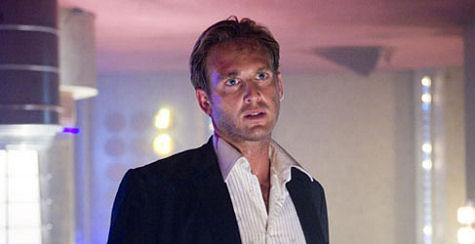
Josh Lucas in Wolfgang Petersen’s Poseidon (Warner Bros., 5.12)

What could be simpler? And no one, thank fortune, talks about their fears or longings or what’s wrong with their life, or how much they love or miss their wife, husband or kids. I felt truly delighted — I think I can say I was overjoyed — that Petersen and screenwriter Mark Protosevitch made the decision not to go in this direction.
Remember those desperate survival sequences in Titanic with Leonardo DiCaprio and Kate Winslet sloshing and swimming around and trying not to drown in the lower areas of the ship as the water gets higher and higher? It’s all like that but cranked up a bit more.
In fact, speaking of Titanic, one of the things intensifying the suspense in Petersen’s film is the fact that this new super-sized S.S. Poseidon is sinking (which wasn’t a factor in the ’72 film).
And I love the eye-filling CGI aerial shot of the big ship that opens the film. It swoops around and goes on for a long while, and I think Petersen did this in part so people will remember that a similar shot in Titanic, released eight and a half years ago, was much cruder…cartoony even.

I’ve probably gone on too long so I’ll wrap it up by saying if Warner Bros. doesn’t give it a big nationwide sneak this weekend (which they apparently aren’t planning on) they’re making a big mistake. They’ve got a quality package — they should let people see it and react. I only know that the TV ads and trailers haven’t sold it sufficiently thus far.
For the first time ever, by the way, I found myself warming to Josh Lucas, although his character — a selfish professional gambler — isn’t exactly “likable.” What got me is the ferocious life-force energy that Lucas exudes once the crawling-through- the-ship action begins. He’s an unstopppable survivalist.
I said to myself early on, “I’m with this guy…I’d want him with me if I were in a tough spot.” I’ve never felt much liking for Lucas before, so this is (somewhat) significant.

Rocket Man

The great critic F.X. Feeney told me the other day about a short film about 9/11 called The Falling Man, and that it was about to be shown at the Tribeca Film Festival. With Paul Greengrass’s United 93 set to open the festival on Tuesday, 4.25, I thought right away, whoa…I should see this. So I did on Friday afternoon (4.21), and I went “whoa” again.
Directed and written by Kevin Ackerman, The Falling Man is an M. Night Shyama- lan-styled spooker about a real-life guy who bought it on 9/11…probably the best known of the 200-something people who jumped from the burning towers because his picture was in the New York Times and everywhere else the next day.
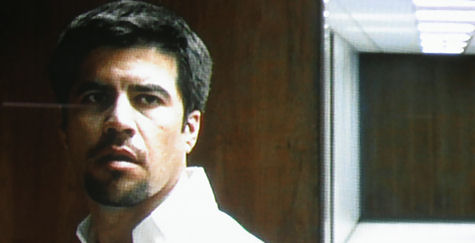

Rick Ojeda as Windows on the World employee Jon Briley in Kevin Ackerman’s The Falling Man

Taken by AP veteran Richard Drew, it showed a tallish, goateed, light-skinned African-American guy, falling upside down in a white shirt, orange T-shirt, black pants and black high-tops, dropping at close to 150 mph in a perfectly vertical posture, not flailing (in this particular shot, at least) and seemingly resigned to his fate, or at least not desperately fighting it.
Part flashback and part flash-forward, The Falling Man is a trippy life-death riff, and well worth seeing.
It’s about a waiter (Rick Ojeda) working at Windows on the World, the restaurant on the top floor of the north tower, who’s sent down to the 103rd floor to the offices of Cantor Fitzgerald to deliver some food, but he can’t find anyone. Vacant. Empty desks, papers on the floor, silhouettes behind smoked glass but no one there. He’s Earl Holliman in “Where Is Everybody?”, anxious and starting to freak out.
Then he runs into a woman with gray skin who looks like a zombie out of George Romero’s Dawn of the Dead, and it hits you after a second or two that her skin isn’t zombie-gray but ash-gray. And then spookier things happen, all leading to a realization.
It’s September 11, 2001, of course. Sometime around 9:41 am…or in some nether place made of memory, premonition, and flashbacks thrown together. But most of it is happening in the mind of the waiter, who existed and was named, in all likeli- hood, Jon Briley.

There was natural curiosity in the public mind about who he was because of the photo, but Briley’s identity was in question for the better part of two years, partly because his body was destroyed, partly because the photo was pulled from circulation, and partly because his father and others in his family didn’t want to know or deal with it.
But then Esquire‘s Tom Junod wrote a piece about the photo called “The Falling Man“, which ran in the September ’03 issue (with Colin Farrell on the cover). Junod came to the conclusion it was probably Briley, and then a British documentary, also called The Falling Man, ran last month and concluded it was probably Briley too. The makers based their findings on testimony from a top chef who worked at Windows on the World named Michael Lomonaco as well as Briley’s older sister, Gwendolyn.
Then came a filmmaking contest sponsored by Esquire a few months later in which contestants had to make a short film based on one of a selection of short stories and features that had appeared in the magazine.
Ackerman, who had recently directed a low-budget noir called Lonely Place, decided to make a film about Junod’s piece. The idea has come to him in a flash during a visit to the downtown LA set of In Good Company, when he realized that a suite of offices in a tall building he was standing in could double for the offices of Cantor Fitzgerald.
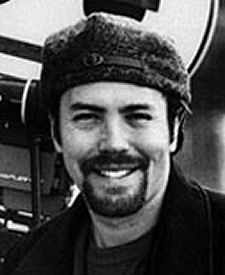
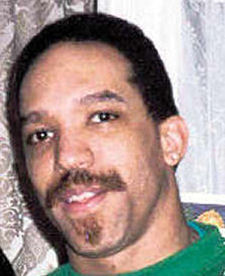
Falling Man director-writer Kevin Ackerman; 9/11 victim Jon Briley

Ackerman shot the film in April 2004 over a couple of days, just before the contest deadline. It cost him about $6000 at the end of the day. Ojeda and Ron Sanford produced it with him. It was shot by John Hale and Steve Smith and edited by David Miller.
Although Esquire‘s contest specified that the shorts be no longer than five minutes, Ackerman’s ran eight minutes. It meant he couldn’t win the prize money (a piddly $2500) but the judges — among them director Alexander Payne (Sideways), former Paramount Classics chief Ruth Vitale and Endeavor agent (and Paramount Clas- sics honcho-to-be) John Lesher — saw it anyway, and were impressed.
By September 2004 Ackerman had moved on to other things, but Payne got in touch that month and said he was really taken with The Falling Man (“This film is fantastic”) and urged Ackerman to shoot additional footage in order to round it out and fulfill his vision.
So Ackerman did that. He added some new footage (a sequence with a 9/11 memory wall was a significant addition, I can say) and finished the extra lensing in September 2005. Naturally, he felt the Tribeca Film Festival was the best place to premiere it, especially given a stated interest by festival honcho Robert De Niro in wanting to see 9/11-themed films submitted. De Niro saw a rough cut of The Falling Man last December and it was accepted soon after.


Falling Man admirer and supporter Alexander Payne

Ackerman just finished the final, fussed-over version — transferred to 35mm film, in anamorphic scope — earlier this week. He flew to New York this weekend with the print.
The Falling Man will have four showings during the festival — on Sunday, 4.30, 9 pm at the Museum of Jewish Heritage, on Tuesday, 5.2, 6 pm at Pace University’s Schimmel Center, on Wednesday, 5.3, 10 pm at AMC Loews Village VII, and on Friday, 5.5, 11 pm at Regal Cinemas Battery Park 5.
It’s not an absolute masterwork but it’s a very penetrating film, obviously because it draws on 9/11 emotions, but also because it adds a surreal, Twilight Zone-ish feel- ing to a familiar canvas, supplying a kind of fresh echo…producing a result that’s unnerving but on some level very “real.”
Ackerman can be reached via Tried & True Productions at 323.466.1602. His email is citizenack@aol.com.

Rollover

Rollover

I don’t want to say too much about Wolfgang Petersen’s Poseidon (Warner Bros., 5.12) because this isn’t a regular “review” or anything. Maybe if I begin by talking about the 1972 Ronald Neame film (a piece of big-budget schlock that was a major blockbuster in its day), it’ll seem like less of one.
The original The Poseidon Adventure, which I just saw on a new double-disc DVD, was a bit rough to begin with — cornball characters, lumpy dialogue, cheesy special effects — and time has not helped. It’s almost painful by today’s standards — a movie with a two or three strands of silver hair growing out of its ear and some wretched acting here and there, and that putrid theme song, “(There’s Got To Be) A Morning After.”

Gene Hackman’s combover hair style looks awfully weird, and Shelley Winters’ fat Molly Goldberg character is enough to make anyone groan. And the effects…forget about it. The opening credits are laid over a slow-motion shot of what looks like a three-foot model of the S.S. Poseidon cruising along in a studio tank.
Poseidon, which I saw Tuesday afternoon, is a much better film. I didn’t see the reviled TV-movie version that aired last November with Steve Gutenberg, but it’s probably a lot better than that also. Lots of excitement. Much better special effects all around. No bullshit sentiment or emotional fat lathered onto the story or the characters. Streamlined, adrenalized…at least one action-suspense sequence that is arguably classic. And only 100 minutes long vs. 117 minutes for the ’72 version.
< ?php include ('/home/hollyw9/public_html/wired'); ?>
It moves right along and kicks ass according to the rules of the game it’s playing. There is no basis for any substantive quarrel with any movie that does what it sets out to do, and this $150 million action thriller does that. It is what it is, take it or leave it, etc.
Less than fifteen minutes of character set-up and along comes the rogue wave. (I adore the fact that there’s no explanation or set-up except for everyone’s memory of the Southeast Asian tsunami.) And then it’s just a matter of staying with a small team of survivors (Josh Lucas, Kurt Russell, Richard Dreyfuss, Emmy Rossum, Jacinda Barrett, etc.) trying to climb down — up — to the ship’s hull to find a way out.


Josh Lucas in Wolfgang Peterseon’s Poseidon (Warner Bros., 5.12)

What could be simpler? And no one, thank fortune, talks about their fears or longings or what’s wrong with their life, or how much they love or miss their wife, husband or kids. I felt truly delighted — I think I can say I was overjoyed — that Petersen and screenwriter Mark Protosevitch made the decision not to go in this direction.
Remember those desperate survival sequences in Titanic with Leonardo DiCaprio and Kate Winslet sloshing and swimming around and trying not to drown in the lower areas of the ship as the water gets higher and higher? It’s all like that but cranked up a bit more.
In fact, speaking of Titanic, one of the things intensifying the suspense in Petersen’s film is the fact that this new super-sized S.S. Poseidon is sinking (which wasn’t a factor in the ’72 film).
And I love the eye-filling CGI aerial shot of the big ship that opens the film. It swoops around and goes on for a long while, and I think Petersen did this in part so people will remember that a similar shot in Titanic, released eight and a half years ago, was much cruder…cartoony even.

I’ve probably gone on too long so I’ll wrap it up by saying if Warner Bros. doesn’t give it a big nationwide sneak this weekend (which they apparently aren’t planning on) they’re making a big mistake. They’ve got a quality package — they should let people see it and react. I only know that the TV ads and trailers haven’t sold it sufficiently thus far.
For the first time ever, by the way, I found myself warming to Josh Lucas, although his character — a selfish professional gambler — isn’t exactly “likable.” What got me is the ferocious life-force energy that Lucas exudes once the crawling-through- the-ship action begins. He’s an unstopppable survivalist.
I said to myself early on, “I’m with this guy…I’d want him with me if I were in a tough spot.” I’ve never felt much liking for Lucas before, so this is (somewhat) significant.

Rocket Man

The great critic F.X. Feeney told me the other day about a short film about 9/11 called The Falling Man, and that it was about to be shown at the Tribeca Film Festival. With Paul Greengrass’s United 93 set to open the festival on Tuesday, 4.25, I thought right away, whoa…I should see this. So I did on Friday afternoon (4.21), and I went “whoa” again.
Directed and written by Kevin Ackerman, The Falling Man is an M. Night Shyama- lan-styled spooker about a real-life guy who bought it on 9/11…probably the best known of the 200-something people who jumped from the burning towers because his picture was in the New York Times and everywhere else the next day.


Rick Ojeda as Windows on the World employee Jon Briley in Kevin Ackerman’s The Falling Man

Taken by AP veteran Richard Drew, it showed a tallish, goateed, light-skinned African-American guy, falling upside down in a white shirt, orange T-shirt, black pants and black high-tops, dropping at close to 150 mph in a perfectly vertical posture, not flailing (in this particular shot, at least) and seemingly resigned to his fate, or at least not desperately fighting it.
Part flashback and part flash-forward, The Falling Man is a trippy life-death riff, and well worth seeing.
It’s about a waiter (Rick Ojeda) working at Windows on the World, the restaurant on the top floor of the north tower, who’s sent down to the 103rd floor to the offices of Cantor Fitzgerald to deliver some food, but he can’t find anyone. Vacant. Empty desks, papers on the floor, silhouettes behind smoked glass but no one there. He’s Earl Holliman in “Where Is Everybody?”, anxious and starting to freak out.
Then he runs into a woman with gray skin who looks like a zombie out of George Romero’s Dawn of the Dead, and it hits you after a second or two that her skin isn’t zombie-gray but ash-gray. And then spookier things happen, all leading to a realization.
It’s September 11, 2001, of course. Sometime around 9:41 am…or in some nether place made of memory, premonition, and flashbacks thrown together. But most of it is happening in the mind of the waiter, who existed and was named, in all likeli- hood, Jon Briley.

There was natural curiosity in the public mind about who he was because of the photo, but Briley’s identity was in question for the better part of two years, partly because his body was destroyed, partly because the photo was pulled from circulation, and partly because his father and others in his family didn’t want to know or deal with it.
But then Esquire‘s Tom Junod wrote a piece about the photo called “The Falling Man“, which ran in the September ’03 issue (with Colin Farrell on the cover). Junod came to the conclusion it was probably Briley, and then a British documentary, also called The Falling Man, ran last month and concluded it was probably Briley too. The makers based their findings on testimony from a top chef who worked at Windows on the World named Michael Lomonaco as well as Briley’s older sister, Gwendolyn.
Then came a filmmaking contest sponsored by Esquire a few months later in which contestants had to make a short film based on one of a selection of short stories and features that had appeared in the magazine.
Ackerman, who had recently directed a low-budget noir called Lonely Place, decided to make a film about Junod’s piece. The idea has come to him in a flash during a visit to the downtown LA set of In Good Company, when he realized that a suite of offices in a tall building he was standing in could double for the offices of Cantor Fitzgerald.


Falling Man director-writer Kevin Ackerman; 9/11 victim Jon Briley

Ackerman shot the film in April 2004 over a couple of days, just before the contest deadline. It cost him about $6000 at the end of the day. Ojeda and Ron Sanford produced it with him. It was shot by John Hale and Steve Smith and edited by David Miller.
Although Esquire‘s contest specified that the shorts be no longer than five minutes, Ackerman’s ran eight minutes. It meant he couldn’t win the prize money (a piddly $2500) but the judges — among them director Alexander Payne (Sideways), former Paramount Classics chief Ruth Vitale and Endeavor agent (and Paramount Clas- sics honcho-to-be) John Lesher — saw it anyway, and were impressed.
By September 2004 Ackerman had moved on to other things, but Payne got in touch that month and said he was really taken with The Falling Man (“This film is fantastic”) and urged Ackerman to shoot additional footage in order to round it out and fulfill his vision.
So Ackerman did that. He added some new footage (a sequence with a 9/11 memory wall was a significant addition, I can say) and finished the extra lensing in September 2005. Naturally, he felt the Tribeca Film Festival was the best place to premiere it, especially given a stated interest by festival honcho Robert De Niro in wanting to see 9/11-themed films submitted. De Niro saw a rough cut of The Fall- ing Man last December and it was accepted soon after.
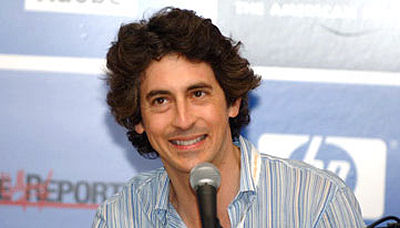

Falling Man admirer and supporter Alexander Payne

Ackerman just finished the final, fussed-over version — transferred to 35mm film, in anamorphic scope — earlier this week. He flew to New York this weekend with the print.
The Falling Man will have four showings during the festival — on Sunday, 4.30, 9 pm at the Museum of Jewish Heritage, on Tuesday, 5.2, 6 pm at Pace University’s Schimmel Center, on Wednesday, 5.3, 10 pm at AMC Loews Village VII, and on Friday, 5.5, 11 pm at Regal Cinemas Battery Park 5.
It’s not an absolute masterwork but it’s a very penetrating film, obviously because it draws on 9/11 emotions, but also because it adds a surreal, Twilight Zone-ish feel- ing to a familiar canvas, supplying a kind of fresh echo…producing a result that’s unnerving but on some level very “real.”
Ackerman can be reached via Tried & True Productions at 323.466.1602. His email is citizenack@aol.com.

Aroma, Sizzle, Steak

I used to love movie poster art, but there are so few today that pop through in any kind of sexy or distinctive way that the fun, for me, just isn’t there any more. Or not enough.
Take five or ten minutes and browse through this British website devoted to classic one-sheets, and you’ll see what I mean. (Make sure you check out the Saul Bass page.) A lot of them were standard primitive sells, but the better ones from the ’50s, ’60s and ’70s had flair, smarts, suggestiveness…a kind of art-gallery urbanity.
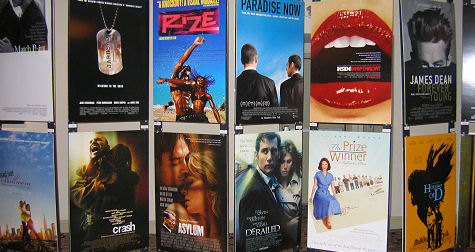

Movie posters that were hanging in Hollywood Museum on Thursday, 4.20…but are gone now because it was just a one-day, one-shot deal.

Many of today’s posters, of course, are geared to mall-heads. They get your attention but in a much more rudimentary way. Many of them are basically about emphasis over enticement, and always seem to use the primary colors, emotions and attitudes that are likely to appeal to younger, less educated viewers with shorter attention spans.
But I figured I’d go down to the Hollywood Museum anyway to check out the 2005 posters that have been submitted for the 2006 Hollywood Reporter Key Art Awards. The winners will collect their trophies at a big swanky ceremony held June 16 at the Kodak Theatre, with Kevin Nealon serving as m.c. (Click here for more info.)
I got there around 12:30 on Thursday, and ten minutes later I was almost ready to leave.
The first and second floors were stuffed to the gills with posters and standees for cinema primitivo — primarily big-budget action, horror, FX and teen-market crap. Precisely the kind of films I loathe. I read books, I’ve been to college and I’ve stood inside the Pantheon in Rome, and every poster and standee on those floors said, “C’mon, man…you’re a gorilla. You know you are. Here, have a banana.”
Then my hosts — Hollywood Reporter publicists Lynda Miller and Alisha Maines, and mPRm’s Shari Mesulam and Wendy Martino — took me to the third floor and finally…some good stuff! Posters with a semblance of art and finesse and sophis- tication.
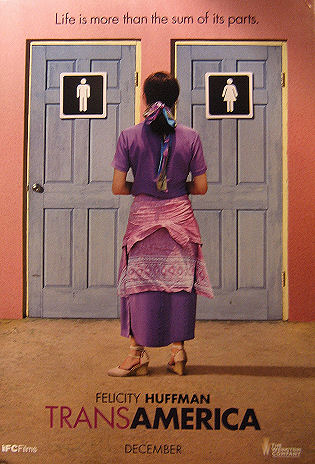
My choice for the best one-sheet is the one pictured above, for Transamerica. I’m also a fan of the one-sheets for Capote, Jarhead, Inside Deep Throat, et. al. But very few of them had that capturing-the-essence, vaguely highbrow approach. I mean, a few did.
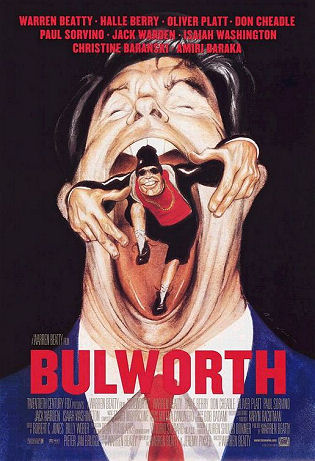
The one-sheet for Warren Beatty’s Bulworth (1998) had that element, that way of compressing the soul or attitude of a film into a single chord.
I asked what percentage of the posters submited were from the indie sector and and big-studio distributors. An answer never came back, but Key Art Awards Coordinator Marc Romeo, who’s been facilitating the entry and judging process for six years, says that 70% of this year’s 1,423 entries received (in 29 categories) have been submitted by agencies and vendors and 30% were submitted by studios.
I happened to notice two posters hanging on a stairwell for a couple of broadly commercial films from the ’50s that no one wants to see these days, that aren’t on DVD and that I’ve either forgotten about or never heard of. One was All Hands on Deck, a 1961 Navy comedy with Pat Boone and Buddy Hackett, and You Can’t Run Away From It, a remake of It Happened One Night with Jack Lemmon and June Allyson.
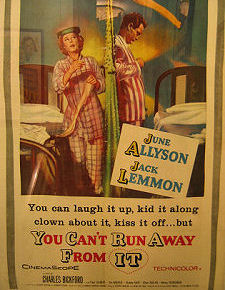
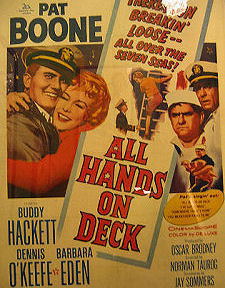
These movies may have been popular in their day but they’re dead now — unknown and unwatched by even the cultists. I mean, you could send a messenger with a basket of fruit, a bottle of champagne and a new DVD of All Hands on Deck to my door, and I really doubt if I’d watch it.
We all have ideas, I’m sure, about which films playing today are not only disposable by today’s standards but certain to be forgotten by history. Most of the films that have come out over the last couple of months belong in this category, February, March and early April releases being what they are. It’s a desert out there.
Anyway, my four hosts took me to Mel’s after our tour, and we all sat down and ordered the healthiest foods we could find on the menu. And then mPRm honcho Mark Pogachefsky dropped by to say hello, and then Hollywood Reporter ad sales exec Lynn Segal came in with friends for some lunch. And it was basically a nice visit.
But it would have been nicer if Saul Bass had been there.

Rocket Man

Rocket Man

The great critic F.X. Feeney told me the other day about a short film about 9/11 called The Falling Man, and that it was about to be shown at the Tribeca Film Festival. With Paul Greengrass’s United 93 set to open the festival on Tuesday, 4.25, I thought right away, whoa…I should see this. So I did on Friday afternoon (4.21), and I went “whoa” again.
Directed and written by Kevin Ackerman, The Falling Man is an M. Night Shyama- lan-styled spooker about a real-life guy who bought it on 9/11…probably the best known of the 200-something people who jumped from the burning towers because his picture was in the New York Times and everywhere else the next day.


Rick Ojeda as Windows on the World employee Jon Briley in Kevin Ackerman’s The Falling Man

Taken by AP veteran Richard Drew, it showed a tallish, goateed, light-skinned African-American guy, falling upside down in a white shirt, orange T-shirt, black pants and black high-tops, dropping at close to 150 mph in a perfectly vertical posture, not flailing (in this particular shot, at least) and seemingly resigned to his fate, or at least not desperately fighting it.
Part flashback and part flash-forward, The Falling Man is a trippy life-death riff, and well worth seeing.
< ?php include ('/home/hollyw9/public_html/wired'); ?>
It’s about a waiter (Rick Ojeda) working at Windows on the World, the restaurant on the top floor of the north tower, who’s sent down to the 103rd floor to the offices of Cantor Fitzgerald to deliver some food, but he can’t find anyone. Vacant. Empty desks, papers on the floor, silhouettes behind smoked glass but no one there. He’s Earl Holliman in “Where Is Everybody?”, anxious and starting to freak out.
Then he runs into a woman with gray skin who looks like a zombie out of George Romero’s Dawn of the Dead, and it hits you after a second or two that her skin isn’t zombie-gray but ash-gray. And then spookier things happen, all leading to a realization.
It’s September 11, 2001, of course. Sometime around 9:41 am…or in some nether place made of memory, premonition, and flashbacks thrown together. But most of it is happening in the mind of the waiter, who existed and was named, in all likeli- hood, Jon Briley.

There was natural curiosity in the public mind about who he was because of the photo, but Briley’s identity was in question for the better part of two years, partly because his body was destroyed, partly because the photo was pulled from circulation, and partly because his father and others in his family didn’t want to know or deal with it.
But then Esquire‘s Tom Junod wrote a piece about the photo called “The Falling Man“, which ran in the September ’03 issue (with Colin Farrell on the cover). Junod came to the conclusion it was probably Briley, and then a British documentary, also called The Falling Man, ran last month and concluded it was probably Briley too. The makers based their findings on testimony from a top chef who worked at Windows on the World named Michael Lomonaco as well as Briley’s older sister, Gwendolyn.
Then came a filmmaking contest sponsored by Esquire a few months later in which contestants had to make a short film based on one of a selection of short stories and features that had appeared in the magazine.
Ackerman, who had recently directed a low-budget noir called Lonely Place, decided to make a film about Junod’s piece. The idea has come to him in a flash during a visit to the downtown LA set of In Good Company, when he realized that a suite of offices in a tall building he was standing in could double for the offices of Cantor Fitzgerald.


Falling Man director-writer Kevin Ackerman; 9/11 victim Jon Briley

Ackerman shot the film in April 2004 over a couple of days, just before the contest deadline. It cost him about $6000 at the end of the day. Ojeda and Ron Sanford produced it with him. It was shot by John Hale and Steve Smith and edited by David Miller.
Although Esquire‘s contest specified that the shorts be no longer than five minutes, Ackerman’s ran eight minutes. It meant he couldn’t win the prize money (a piddly $2500) but the judges — among them director Alexander Payne (Sideways), former Paramount Classics chief Ruth Vitale and Endeavor agent (and Paramount Clas- sics honcho-to-be) John Lesher — saw it anyway, and were impressed.
By September 2004 Ackerman had moved on to other things, but Payne got in touch that month and said he was really taken with The Falling Man (“This film is fantastic”) and urged Ackerman to shoot additional footage in order to round it out and fulfill his vision.
So Ackerman did that. He added some new footage (a sequence with a 9/11 memory wall was a significant addition, I can say) and finished the extra lensing in September 2005. Naturally, he felt the Tribeca Film Festival was the best place to premiere it, especially given a stated interest by festival honcho Robert De Niro in wanting to see 9/11-themed films submitted. De Niro saw a rough cut of The Fall- ing Man last December and it was accepted soon after.


Falling Man admirer and supporter Alexander Payne

Ackerman just finished the final, fussed-over version — transferred to 35mm film, in anamorphic scope — earlier this week. He flew to New York this weekend with the print.
The Falling Man will have four showings during the festival — on Sunday, 4.30, 9 pm at the Museum of Jewish Heritage, on Tuesday, 5.2, 6 pm at Pace University’s Schimmel Center, on Wednesday, 5.3, 10 pm at AMC Loews Village VII, and on Friday, 5.5, 11 pm at Regal Cinemas Battery Park 5.
It’s not an absolute masterwork but it’s a very penetrating film, obviously because it draws on 9/11 emotions, but also because it adds a surreal, Twilight Zone-ish feel- ing to a familiar canvas, supplying a kind of fresh echo…producing a result that’s unnerving but on some level very “real.”
Ackerman can be reached via Tried & True Productions at 323.466.1602. His email is citizenack@aol.com.

Aroma, Sizzle, Steak

I used to love movie poster art, but there are so few today that pop through in any kind of sexy or distinctive way that the fun, for me, just isn’t there any more. Or not enough.
Take five or ten minutes and browse through this British website devoted to classic one-sheets, and you’ll see what I mean. (Make sure you check out the Saul Bass page.) A lot of them were standard primitive sells, but the better ones from the ’50s, ’60s and ’70s had flair, smarts, suggestiveness…a kind of art-gallery urbanity.


Movie posters that were hanging in Hollywood Museum on Thursday, 4.20…but are gone now because it was just a one-day, one-shot deal.

Many of today’s posters, of course, are geared to mall-heads. They get your attention but in a much more rudimentary way. Many of them are basically about emphasis over enticement, and always seem to use the primary colors, emotions and attitudes that are likely to appeal to younger, less educated viewers with shorter attention spans.
But I figured I’d go down to the Hollywood Museum anyway to check out the 2005 posters that have been submitted for the 2006 Hollywood Reporter Key Art Awards. The winners will collect their trophies at a big swanky ceremony held June 16 at the Kodak Theatre, with Kevin Nealon serving as m.c. (Click here for more info.)
I got there around 12:30 on Thursday, and ten minutes later I was almost ready to leave.
The first and second floors were stuffed to the gills with posters and standees for cinema primitivo — primarily big-budget action, horror, FX and teen-market crap. Precisely the kind of films I loathe. I read books, I’ve been to college and I’ve stood inside the Pantheon in Rome, and every poster and standee on those floors said, “C’mon, man…you’re a gorilla. You know you are. Here, have a banana.”
Then my hosts — Hollywood Reporter publicists Lynda Miller and Alisha Maines, and mPRm’s Shari Mesulam and Wendy Martino — took me to the third floor and finally…some good stuff! Posters with a semblance of art and finesse and sophis- tication.

My choice for the best one-sheet is the one pictured above, for Transamerica. I’m also a fan of the one-sheets for Capote, Jarhead, Inside Deep Throat, et. al. But very few of them had that capturing-the-essence, vaguely highbrow approach. I mean, a few did.
The one-sheet for Warren Beatty’s Bulworth (1998) had that element, that way of compressing the soul or attitude of a film into a single chord.
I asked what percentage of the posters submited were from the indie sector and and big-studio distributors. An answer never came back, but Key Art Awards Coordinator Marc Romeo, who’s been facilitating the entry and judging process for six years, says that 70% of this year’s 1,423 entries received (in 29 categories) have been submitted by agencies and vendors and 30% were submitted by studios.
I happened to notice two posters hanging on a stairwell for a couple of broadly commercial films from the ’50s that no one wants to see these days, that aren’t on DVD and that I’ve either forgotten about or never heard of. One was All Hands on Deck, a 1961 Navy comedy with Pat Boone and Buddy Hackett, and You Can’t Run Away From It, a remake of It Happened One Night with Jack Lemmon and June Allyson.

These movies may have been popular in their day but they’re dead now — unknown and unwatched by even the cultists. I mean, you could send a messenger with a basket of fruit, a bottle of champagne and a new DVD of All Hands on Deck to my door, and I really doubt if I’d watch it.
We all have ideas, I’m sure, about which films playing today are not only disposable by today’s standards but certain to be forgotten by history. Most of the films that have come out over the last couple of months belong in this category, February, March and early April releases being what they are. It’s a desert out there.
Anyway, my four hosts took me to Mel’s after our tour, and we all sat down and ordered the healthiest foods we could find on the menu. And then mPRm honcho Mark Pogachefsky dropped by to say hello, and then Hollywood Reporter ad sales exec Lynn Segal came in with friends for some lunch. And it was basically a nice visit.
But it would have been nicer if Saul Bass had been there.

Glub-Glub

What are the odds that Wolfgang Petersen’s Poseidon (Warner Bros., 5.12) will be an above-average thrill ride? Pretty good, I’d say. And if you scan the saleable elements it looks like something a lot of people are going to want to see.
The trailer tells you the effects are going to be cool. (That rogue wave gives me the creeps.) Petersen is nothing if not a dependable craftsman, and the movie he’s made, to judge by the trailer, has the look and feel of something fairly well-rigged.
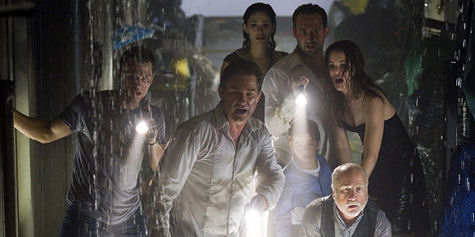

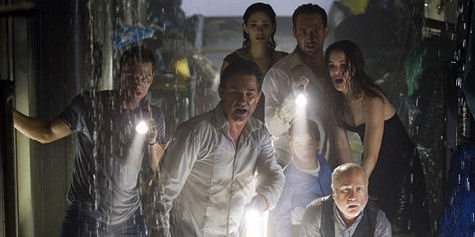
Kurt Russell (front & center)), Josh Lucas (behind Kurt), Emmy Rossum (rear) and Richard Dreyfss (lower right) in Wolfgang Petersen’s Poseidon (Warner Bros., 5.12)

I tend to shy away from big-budget effects movies, but even I’m half into seeing this thing. I really like Kurt Russell, I’ve always enjoyed Richard Dreyfuss (especially if he gets angry) and I’m cool with Josh Lucas playing the lead. If I didn’t expect to see it at a press screening within a week, I’d be okay with buying a ticket.
Why, then, are the Poseidon tracking figures in the toilet?
This is a very expensive film ($150 million? more?) and it needs to have a huge opening weekend. And yet recent figures say the overall general awareness is 54% compared to 92% for Mission: Impossible III , which opens a week earlier. The definite interests are at 23% — they should be somewhere around 40% at this stage. And the respondents calling Poseidon their first choice are around 3% when this group should be more around 10% or 11% (M:I:3‘s first-choicers are currently at 13%).
Warner Bros. has three weeks to rectify things, but right now they have reason to be worried.
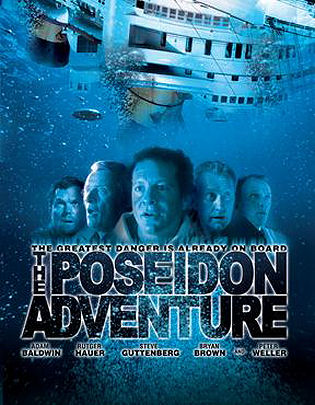
They’ve been advertising on TV, the trailer is playing in theatres all over, and that upside-down-and-underwater-ship one-sheet is already iconic. (If you ask me it deserves to be a nominee at the Key Art awards next year.) And yet so far, the audience waiting to see it doesn’t seem hefty enough.
So what’s happening? Are audiences saying no to big loud disaster movies for some reason? Are people seeing some kind of 9/11 echo in this thing? (It’s not that much of a stretch.) Maybe the same folks who are frowning at the idea of seeing United 93 are doing the same here?
I think you have to lay at least some of the blame on that lousy TV movie, Hall- mark Entertainment’s The Poseidon Adventure, that aired last November. It was critically trashed, it didn’t draw that many viewers and it may have poisoned the well. It was produced by Larry Levinson, directed by Jon Putch and starred Rutger Hauer, Adam Baldwin, Bryan Brown, Steve Guttenberg, Peter Weller and C. Thom- as Howell.
I wonder who greenlit their Poseidon first — Levinson and Hallmark or the Warner Bros. people?
The cast of the Wolfgang Petersen film is of a higher calibre than the TV movie, but not that much higher. Russell will always be Mr. Cool in my book but he’s a long way from his Snake Plissken heyday. And Lucas didn’t show much drawing power last summer when Stealth , a $130 million Rob Cohen thriller that he starred in, ended up with $31,704,4316 (domestic) last September.
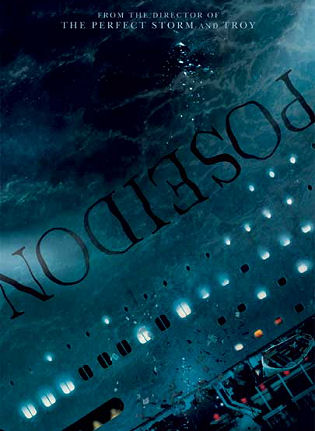
Warner Bros. obviously decided to sink most of the money into special effects rather than big-star salaries, but this may not be enough at the end of the day.
This isn’t a matter of how good the film will be. It’s a matter of marketing, about how many millions of people can be persuaded to pay to see this film on opening weekend based on ads, interest levels, trailers, TV spots, anticipation…whatever.
If the movie plays well and sells itself, it would probably help to sneak it across the country a week before. I mean, that’s as far as my thinking takes me.

Grabs

Paramount Studios parking lot, snapped just after Wednesday morning’s Mission: Impossible III screening — 4.19.06, 1:15 pm.

J.J. Gittes: “Not that Mulwray?” Evelyn Mulwray: “Yes, Mr. Gittes…that Mulwray.”

Bunny Rabbit

I saw Mission: Impossible III (Paramount, 5.3) this morning at screening room #5 at Paramount Studios, and I’m not dissing anyone or anything with the title of this piece. Not even a little bit.
The MacGuffin of J.J. Abrams’ power-packed thriller, after all, is a smallish device called “rabbit’s foot”, and Tom Cruise’s hard-wired performance as IMF agent Ethan Hunt feels, to me, like something new: he’s made himself into the energizer bunny of action heroes. And it works.
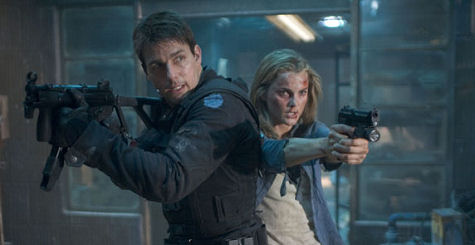

Keri Russell, Tom Cruise in J.J. Abrams’ Mission: Impossible III (Paramount, 5.5)

The advance buzz about M:I:3 being awfully damned good has turned out to be true, I’m afraid — as shallow but very expensive action films go, this is about as good as it gets. But I would hold up on the talk about Phillip Seymour Hoffman stealing the picture from Cruise.
Philly is super-cool — cold and snarly with style to burn — but he hasn’t been given enough ammo — not enough scenes or killer lines — to help him stand up against M:I:3‘s 43 year-old star.
It’s no secret Cruise has been getting (“generating” is closer to the truth) a lot of bad press over the last year or so, with most of it centering on the perception that he’s become overly manic…that his stability is perhaps open to question on some level.
Well, guess what? Cruise answers that perception straight-on in this frenzied summer action film and then rolls right over it like a tank.
He’s made Hunt into a kind of mirror image of hard-core tabloid Tom. It’s like he’s saying, “Okay, fine…you guys think I’ve gone around the bend? All right, then I have! And I’m into it! Being hard-core, I mean.” And this leaves you with feelings of respect for the guy. He may be this or that, but is standing his ground. No backing off! I am what I am!
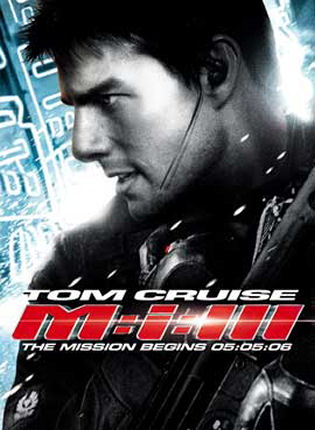
Hunt is a “character,” yes, but based more than ever on the pumping piston rods of Cruise’s personality. A guy who’s all about focus, juice, intensity, endorphins. Sca- ling walls, rapelling down walls. Plotting strategy, eyeballing his costars, running for his life (in more ways than one) and turning tomato red in the face. Neck veins! Neck veins!
And you’re fine with all of this because…I haven’t said this in so many words, have I?…Mission: Impossible III is easily the best of the three M:I‘s. No, I’ll go further: it’s one of the best high-torque summer action films ever.
Brian De Palma’s Mission: Impossible (1996) had two or three brilliantly staged sequences, especially the CIA break-in-and-robbery and the chunnel-train sequence, but some of it was in and out and a lot of people felt confused by the plot.
John Woo’s Mission: Impossible II (2000) was an okay spin on Notorious with Thandie Newton as Ingrid Bergman and Dougray Scott as Claude Rains, and my memories of it aren’t that vivid, so it couldn’t have been that great.
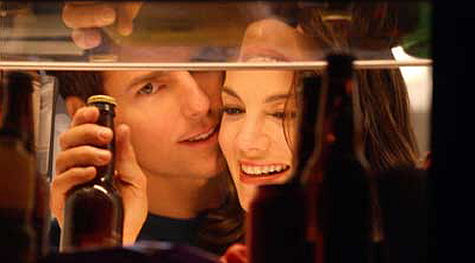

Costar Michelle Monaghan, Cruise

This new one, directed and written by Abrams, is far more relentless and slam- bammy than its predecessors. You’re supposed to give your audience a little downtime between action beats, but this sucker won’t rest. You know the old analogy that action films are like musicals? Mission: Impossible III is almost an opera.
Okay, there’s a mildly relaxing party sequence in the beginning and one or two dialogue-with-Laurence-Fisburne-as-the-obligatory-company-asshole-riding-the- IMF-team scenes, but that’s pretty much it. The rest is all on the treadmill running at 10.
There are four beautifully composed set pieces — a rescue mission in a factory in a Berlin suburb, a kidnapping in the Vatican, an aerial attack on a causeway over Chesapeake Bay, and a break-in and a rescue in Shanghai. But there are always tangents and side-shows connected to these main events, and something riveting is always going on.
This is the kind of summer “ride” movie that even sourpusses like me can sit back and roll with. Shrewd, inventive and into punching the gas. It’s empty, yes — it’s basically just one technical challenge after another, with arguments and a couple of “I love you”‘s thrown in — but this is one of those films in which depth would get in the way.

Jonathan Rhys-Meyers, Maggie Q, Ving Rhames

When I hear a film is a “check-your-brain-at-the-door” thing, I know I’m going to hate it. This is not that. It exemplifies what a good geek-level action film should be. Abrams, the director-writer, keeps playing to slightly higher intelligence levels than these films are usually geared to.
Harry Knowles has called M:I:3 “the best damn retooling of True Lies that will ever be done.” Funny, but the only thing I remember about True Lies is liking Tom Arnold’s dialogue and attitude and Bill Paxton’s character begging for mercy in front of Arnold Schwarzenegger by saying he had a “little dick.”
Hold on…it’s coming back to me. Arnold was a secret operative who hadn’t told Jamie Lee Curtis what he really does, and then a job he’s on turns bad and Jamie Lee gets brought into it and so on. Michelle Monaghan is the Jamie Lee character, I guess, but…you know what? Screw this analogy. I’ve never once seen True Lies on DVD, and for a reason.
M:I:3 is about the IM force trying to shut down a ruthless arms and technology dealer named Owen Davian (Hoffman), who’s about as lethal as they come. The story is basically a tit-for-tat game. I’ll kidnap and try to squeeze you for inform- ation, and then you’ll come after me or my girlfriend and try to squeeze me for information, and we’ll see who’s smarter and craftier.

Rhys-Meyers, Rhames, Cruise, Maggie Q in, I think, Shanghai

Abrams starts things off an extremely fierce and intense tone. Right away you’re saying to yourself, “This is good…Abrams clearly knows what he’s doing.” As far as hero-being-tortured, tell-me-what-I- need-to-know-or-else scenes go, I would say it’s up to the level of Laurence Olivier pulling Dustin Hoffman’s teeth out in Marathon Man.
Hoffman’s Damian is the torturer, and it’s a little odd that this is his best scene in the film. He’s nearly spellbinding in just about every scene he’s in, but after Capote and all you’re kind of waiting for Philly to really step up with something climactic and classic…and it never comes. He kicks ass with the lines and scenes he’s been given, but somebody wanted this to be Tom Cruise’s film.
The IMFers — Ving Rhames, Jonathan Rhys Meyers, Maggie Q — hold up their end. Billy Crudup is perfunctory as Cruise’s home-office ally. Simon Pegg (last in Shaun of the Dead) has the obligatory computer-geek-who-saves-the-day-with- crucial-key-punching-in-the-last-act role.
Michelle Monaghan has the meatiest female role as Ethan’s initially clueless wife. Keri Russell burns through strongly in the first act. Maggie Q (Around the World in 80 Days, Rush Hour 2) is…well, she’s fine, but the best thing she does is wear a very hot red dress to a black-tie affair at the Vatican.

Phillip Seymour Hoffman as Owen Davian

I laughed three times out loud — not at anything “funny” but because I was really enjoying the moxie that went into the writing or acting. I won’t spoil them by sharing.
I had a good enough time with this that I’m going back to see it a second time this evening.
Too many cheerleading pieces and people will start to think I’m a professional kiss-ass, but I have to say it: Tom Cruise’s image problems aren’t going to vanish like that when Mission: Impossible III opens 16 days from now, but they’re probably going to be put on hold.

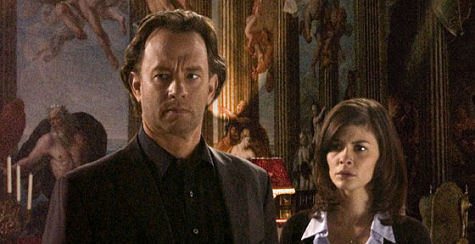
Aroma, Sizzle, Steak

Aroma, Sizzle, Steak

I used to love movie poster art, but there are so few today that pop through in any kind of sexy or distinctive way that the fun, for me, just isn’t there any more. Or not enough.
Take five or ten minutes and browse through this British website devoted to classic one-sheets, and you’ll see what I mean. (Make sure you check out the Saul Bass page.) A lot of them were standard primitive sells, but the better ones from the ’50s, ’60s and ’70s had flair, smarts, suggestiveness…a kind of art-gallery urbanity.


Movie posters that were hanging in Hollywood Museum on Thursday, 4.20…but are gone now because it was just a one-day, one-shot deal.

Many of today’s posters, of course, are geared to mall-heads. They get your attention but in a much more rudimentary way. Many of them are basically about emphasis over enticement, and always seem to use the primary colors, emotions and attitudes that are likely to appeal to younger, less educated viewers with shorter attention spans.
But I figured I’d go down to the Hollywood Museum anyway to check out the 2005 posters that have been submitted for the 2006 Hollywood Reporter Key Art Awards. The winners will collect their trophies at a big swanky ceremony held June 16 at the Kodak Theatre, with Kevin Nealon serving as m.c. (Click here for more info.)
< ?php include ('/home/hollyw9/public_html/wired'); ?>
I got there around 12:30 on Thursday, and ten minutes later I was almost ready to leave.
The first and second floors were stuffed to the gills with posters and standees for cinema primitivo — primarily big-budget action, horror, FX and teen-market crap. Precisely the kind of films I loathe. I read books, I’ve been to college and I’ve stood inside the Pantheon in Rome, and every poster and standee on those floors said, “C’mon, man…you’re a gorilla. You know you are. Here, have a banana.”
Then my hosts — Hollywood Reporter publicists Lynda Miller and Alisha Maines, and mPRm’s Shari Mesulam and Wendy Martino — took me to the third floor and finally…some good stuff! Posters with a semblance of art and finesse and sophis- tication.

My choice for the best one-sheet is the one pictured above, for Transamerica. I’m also a fan of the one-sheets for Capote, Jarhead, Inside Deep Throat, et. al. But very few of them had that capturing-the-essence, vaguely highbrow approach. I mean, a few did.
The one-sheet for Warren Beatty’s Bulworth (1998) had that element, that way of compressing the soul or attitude of a film into a single chord.
I asked what percentage of the posters submited were from the indie sector and and big-studio distributors. An answer never came back, but Key Art Awards Coordinator Marc Romeo, who’s been facilitating the entry and judging process for six years, says that 70% of this year’s 1,423 entries received (in 29 categories) have been submitted by agencies and vendors and 30% were submitted by studios.
I happened to notice two posters hanging on a stairwell for a couple of broadly commercial films from the ’50s that no one wants to see these days, that aren’t on DVD and that I’ve either forgotten about or never heard of. One was All Hands on Deck, a 1961 Navy comedy with Pat Boone and Buddy Hackett, and You Can’t Run Away From It, a remake of It Happened One Night with Jack Lemmon and June Allyson.

These movies may have been popular in their day but they’re dead now — unknown and unwatched by even the cultists. I mean, you could send a messenger with a basket of fruit, a bottle of champagne and a new DVD of All Hands on Deck to my door, and I really doubt if I’d watch it.
We all have ideas, I’m sure, about which films playing today are not only disposable by today’s standards but certain to be forgotten by history. Most of the films that have come out over the last couple of months belong in this category, February, March and early April releases being what they are. It’s a desert out there.
Anyway, my four hosts took me to Mel’s after our tour, and we all sat down and ordered the healthiest foods we could find on the menu. And then mPRm honcho Mark Pogachefsky dropped by to say hello, and then Hollywood Reporter ad sales exec Lynn Segal came in with friends for some lunch. And it was basically a nice visit.
But it would have been nicer if Saul Bass had been there.

Glub-Glub

What are the odds that Wolfgang Petersen’s Poseidon (Warner Bros., 5.12) will be an above-average thrill ride? Pretty good, I’d say. And if you scan the saleable elements it looks like something a lot of people are going to want to see.
The trailer tells you the effects are going to be cool. (That rogue wave gives me the creeps.) Petersen is nothing if not a dependable craftsman, and the movie he’s made, to judge by the trailer, has the look and feel of something fairly well-rigged.


Kurt Russell (front & center)), Josh Lucas (behind Kurt), Emmy Rossum (rear) and Richard Dreyfss (lower right) in Wolfgang Petersen’s Poseidon (Warner Bros., 5.12)

I tend to shy away from big-budget effects movies, but even I’m half into seeing this thing. I really like Kurt Russell, I’ve always enjoyed Richard Dreyfuss (especially if he gets angry) and I’m cool with Josh Lucas playing the lead. If I didn’t expect to see it at a press screening within a week, I’d be okay with buying a ticket.
Why, then, are the Poseidon tracking figures in the toilet?
This is a very expensive film ($150 million? more?) and it needs to have a huge opening weekend. And yet recent figures say the overall general awareness is 54% compared to 92% for Mission: Impossible III , which opens a week earlier. The definite interests are at 23% — they should be somewhere around 40% at this stage. And the respondents calling Poseidon their first choice are around 3% when this group should be more around 10% or 11% (M:I:3‘s first-choicers are currently at 13%).
Warner Bros. has three weeks to rectify things, but right now they have reason to be worried.

They’ve been advertising on TV, the trailer is playing in theatres all over, and that upside-down-and-underwater-ship one-sheet is already iconic. (If you ask me it deserves to be a nominee at the Key Art awards next year.) And yet so far, the audience waiting to see it doesn’t seem hefty enough.
So what’s happening? Are audiences saying no to big loud disaster movies for some reason? Are people seeing some kind of 9/11 echo in this thing? (It’s not that much of a stretch.) Maybe the same folks who are frowning at the idea of seeing United 93 are doing the same here?
I think you have to lay at least some of the blame on that lousy TV movie, Hall- mark Entertainment’s The Poseidon Adventure, that aired last November. It was critically trashed, it didn’t draw that many viewers and it may have poisoned the well. It was produced by Larry Levinson, directed by Jon Putch and starred Rutger Hauer, Adam Baldwin, Bryan Brown, Steve Guttenberg, Peter Weller and C. Thom- as Howell.
I wonder who greenlit their Poseidon first — Levinson and Hallmark or the Warner Bros. people?
The cast of the Wolfgang Petersen film is of a higher calibre than the TV movie, but not that much higher. Russell will always be Mr. Cool in my book but he’s a long way from his Snake Plissken heyday. And Lucas didn’t show much drawing power last summer when Stealth , a $130 million Rob Cohen thriller that he starred in, ended up with $31,704,4316 (domestic) last September.

Warner Bros. obviously decided to sink most of the money into special effects rather than big-star salaries, but this may not be enough at the end of the day.
This isn’t a matter of how good the film will be. It’s a matter of marketing, about how many millions of people can be persuaded to pay to see this film on opening weekend based on ads, interest levels, trailers, TV spots, anticipation…whatever.
If the movie plays well and sells itself, it would probably help to sneak it across the country a week before. I mean, that’s as far as my thinking takes me.

Grabs


Paramount Studios parking lot, snapped just after Wednesday morning’s Mission: Impossible III screening — 4.19.06, 1:15 pm.

J.J. Gittes: “Not that Mulwray?” Evelyn Mulwray: “Yes, Mr. Gittes…that Mulwray.”

Bunny Rabbit

I saw Mission: Impossible III (Paramount, 5.3) this morning at screening room #5 at Paramount Studios, and I’m not dissing anyone or anything with the title of this piece. Not even a little bit.
The MacGuffin of J.J. Abrams’ power-packed thriller, after all, is a smallish device called “rabbit’s foot”, and Tom Cruise’s hard-wired performance as IMF agent Ethan Hunt feels, to me, like something new: he’s made himself into the energizer bunny of action heroes. And it works.


Keri Russell, Tom Cruise in J.J. Abrams’ Mission: Impossible III (Paramount, 5.5)

The advance buzz about M:I:3 being awfully damned good has turned out to be true, I’m afraid — as shallow but very expensive action films go, this is about as good as it gets. But I would hold up on the talk about Phillip Seymour Hoffman stealing the picture from Cruise.
Philly is super-cool — cold and snarly with style to burn — but he hasn’t been given enough ammo — not enough scenes or killer lines — to help him stand up against M:I:3‘s 43 year-old star.
It’s no secret Cruise has been getting (“generating” is closer to the truth) a lot of bad press over the last year or so, with most of it centering on the perception that he’s become overly manic…that his stability is perhaps open to question on some level.
Well, guess what? Cruise answers that perception straight-on in this frenzied summer action film and then rolls right over it like a tank.
He’s made Hunt into a kind of mirror image of hard-core tabloid Tom. It’s like he’s saying, “Okay, fine…you guys think I’ve gone around the bend? All right, then I have! And I’m into it! Being hard-core, I mean.” And this leaves you with feelings of respect for the guy. He may be this or that, but is standing his ground. No backing off! I am what I am!

Hunt is a “character,” yes, but based more than ever on the pumping piston rods of Cruise’s personality. A guy who’s all about focus, juice, intensity, endorphins. Sca- ling walls, rapelling down walls. Plotting strategy, eyeballing his costars, running for his life (in more ways than one) and turning tomato red in the face. Neck veins! Neck veins!
And you’re fine with all of this because…I haven’t said this in so many words, have I?…Mission: Impossible III is easily the best of the three M:I‘s. No, I’ll go further: it’s one of the best high-torque summer action films ever.
Brian De Palma’s Mission: Impossible (1996) had two or three brilliantly staged sequences, especially the CIA break-in-and-robbery and the chunnel-train sequence, but some of it was in and out and a lot of people felt confused by the plot.
John Woo’s Mission: Impossible II (2000) was an okay spin on Notorious with Thandie Newton as Ingrid Bergman and Dougray Scott as Claude Rains, and my memories of it aren’t that vivid, so it couldn’t have been that great.


Costar Michelle Monaghan, Cruise

This new one, directed and written by Abrams, is far more relentless and slam- bammy than its predecessors. You’re supposed to give your audience a little downtime between action beats, but this sucker won’t rest. You know the old analogy that action films are like musicals? Mission: Impossible III is almost an opera.
Okay, there’s a mildly relaxing party sequence in the beginning and one or two dialogue-with-Laurence-Fisburne-as-the-obligatory-company-asshole-riding-the- IMF-team scenes, but that’s pretty much it. The rest is all on the treadmill running at 10.
There are four beautifully composed set pieces — a rescue mission in a factory in a Berlin suburb, a kidnapping in the Vatican, an aerial attack on a causeway over Chesapeake Bay, and a break-in and a rescue in Shanghai. But there are always tangents and side-shows connected to these main events, and something riveting is always going on.
This is the kind of summer “ride” movie that even sourpusses like me can sit back and roll with. Shrewd, inventive and into punching the gas. It’s empty, yes — it’s basically just one technical challenge after another, with arguments and a couple of “I love you”‘s thrown in — but this is one of those films in which depth would get in the way.


Jonathan Rhys-Meyers, Maggie Q, Ving Rhames

When I hear a film is a “check-your-brain-at-the-door” thing, I know I’m going to hate it. This is not that. It exemplifies what a good geek-level action film should be. Abrams, the director-writer, keeps playing to slightly higher intelligence levels than these films are usually geared to.
Harry Knowles has called M:I:3 “the best damn retooling of True Lies that will ever be done.” Funny, but the only thing I remember about True Lies is liking Tom Arnold’s dialogue and attitude and Bill Paxton’s character begging for mercy in front of Arnold Schwarzenegger by saying he had a “little dick.”
Hold on…it’s coming back to me. Arnold was a secret operative who hadn’t told Jamie Lee Curtis what he really does, and then a job he’s on turns bad and Jamie Lee gets brought into it and so on. Michelle Monaghan is the Jamie Lee character, I guess, but…you know what? Screw this analogy. I’ve never once seen True Lies on DVD, and for a reason.
M:I:3 is about the IM force trying to shut down a ruthless arms and technology dealer named Owen Davian (Hoffman), who’s about as lethal as they come. The story is basically a tit-for-tat game. I’ll kidnap and try to squeeze you for inform- ation, and then you’ll come after me or my girlfriend and try to squeeze me for information, and we’ll see who’s smarter and craftier.


Rhys-Meyers, Rhames, Cruise, Maggie Q in, I think, Shanghai

Abrams starts things off an extremely fierce and intense tone. Right away you’re saying to yourself, “This is good…Abrams clearly knows what he’s doing.” As far as hero-being-tortured, tell-me-what-I- need-to-know-or-else scenes go, I would say it’s up to the level of Laurence Olivier pulling Dustin Hoffman’s teeth out in Marathon Man.
Hoffman’s Damian is the torturer, and it’s a little odd that this is his best scene in the film. He’s nearly spellbinding in just about every scene he’s in, but after Capote and all you’re kind of waiting for Philly to really step up with something climactic and classic…and it never comes. He kicks ass with the lines and scenes he’s been given, but somebody wanted this to be Tom Cruise’s film.
The IMFers — Ving Rhames, Jonathan Rhys Meyers, Maggie Q — hold up their end. Billy Crudup is perfunctory as Cruise’s home-office ally. Simon Pegg (last in Shaun of the Dead) has the obligatory computer-geek-who-saves-the-day-with- crucial-key-punching-in-the-last-act role.
Michelle Monaghan has the meatiest female role as Ethan’s initially clueless wife. Keri Russell burns through strongly in the first act. Maggie Q (Around the World in 80 Days, Rush Hour 2) is…well, she’s fine, but the best thing she does is wear a very hot red dress to a black-tie affair at the Vatican.


Phillip Seymour Hoffman as Owen Davian

I laughed three times out loud — not at anything “funny” but because I was really enjoying the moxie that went into the writing or acting. I won’t spoil them by sharing.
I had a good enough time with this that I’m going back to see it a second time this evening.
Too many cheerleading pieces and people will start to think I’m a professional kiss-ass, but I have to say it: Tom Cruise’s image problems aren’t going to vanish like that when Mission: Impossible III opens 16 days from now, but they’re probably going to be put on hold.
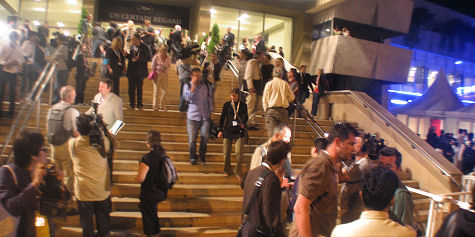
Glub-Glub

Glub-Glub

What are the odds that Wolfgang Petersen’s Poseidon (Warner Bros., 5.12) will be an above-average thrill ride? Pretty good, I’d say. And if you scan the saleable elements it looks like something a lot of people are going to want to see.
The trailer tells you the effects are going to be cool. (That rogue wave gives me the creeps.) Petersen is nothing if not a dependable craftsman, and the movie he’s made, to judge by the trailer, has the look and feel of something fairly well-rigged.


Kurt Russell (front & center)), Josh Lucas (behind Kurt), Emmy Rossum (rear) and Richard Dreyfss (lower right) in Wolfgang Petersen’s Poseidon (Warner Bros., 5.12)

I tend to shy away from big-budget effects movies, but even I’m half into seeing this thing. I really like Kurt Russell, I’ve always enjoyed Richard Dreyfuss (especially if he gets angry) and I’m cool with Josh Lucas playing the lead. If I didn’t expect to see it at a press screening within a week, I’d be okay with buying a ticket.
Why, then, are the Poseidon tracking figures in the toilet?
< ?php include ('/home/hollyw9/public_html/wired'); ?>
This is a very expensive film ($150 million? more?) and it needs to have a huge opening weekend. And yet recent figures say the overall general awareness is 54% compared to 92% for Mission: Impossible III , which opens a week earlier. The definite interests are at 23% — they should be somewhere around 40% at this stage. And the respondents calling Poseidon their first choice are around 3% when this group should be more around 10% or 11% (M:I:3‘s first-choicers are currently at 13%).
Warner Bros. has three weeks to rectify things, but right now they have reason to be worried.

They’ve been advertising on TV, the trailer is playing in theatres all over, and that upside-down-and-underwater-ship one-sheet is already iconic. (If you ask me it deserves to be a nominee at the Key Art awards next year.) And yet so far, the audience waiting to see it doesn’t seem hefty enough.
So what’s happening? Are audiences saying no to big loud disaster movies for some reason? Are people seeing some kind of 9/11 echo in this thing? (It’s not that much of a stretch.) Maybe the same folks who are frowning at the idea of seeing United 93 are doing the same here?
I think you have to lay at least some of the blame on that lousy TV movie, Hall- mark Entertainment’s The Poseidon Adventure, that aired last November. It was critically trashed, it didn’t draw that many viewers and it may have poisoned the well. It was produced by Larry Levinson, directed by Jon Putch and starred Rutger Hauer, Adam Baldwin, Bryan Brown, Steve Guttenberg, Peter Weller and C. Thom- as Howell.
I wonder who greenlit their Poseidon first — Levinson and Hallmark or the Warner Bros. people?
The cast of the Wolfgang Petersen film is of a higher calibre than the TV movie, but not that much higher. Russell will always be Mr. Cool in my book but he’s a long way from his Snake Plissken heyday. And Lucas didn’t show much drawing power last summer when Stealth , a $130 million Rob Cohen thriller that he starred in, ended up with $31,704,4316 (domestic) last September.

Warner Bros. obviously decided to sink most of the money into special effects rather than big-star salaries, but this may not be enough at the end of the day.
This isn’t a matter of how good the film will be. It’s a matter of marketing, about how many millions of people can be persuaded to pay to see this film on opening weekend based on ads, interest levels, trailers, TV spots, anticipation…whatever.
If the movie plays well and sells itself, it would probably help to sneak it across the country a week before. I mean, that’s as far as my thinking takes me.

Grabs


Paramount Studios parking lot, snapped just after Wednesday morning’s Mission: Impossible III screening — 4.19.06, 1:15 pm.

J.J. Gittes: “Not that Mulwray?” Evelyn Mulwray: “Yes, Mr. Gittes…that Mulwray.”

Bunny Rabbit

I saw Mission: Impossible III (Paramount, 5.3) this morning at screening room #5 at Paramount Studios, and I’m not dissing anyone or anything with the title of this piece. Not even a little bit.
The MacGuffin of J.J. Abrams’ power-packed thriller, after all, is a smallish device called “rabbit’s foot”, and Tom Cruise’s hard-wired performance as IMF agent Ethan Hunt feels, to me, like something new: he’s made himself into the energizer bunny of action heroes. And it works.


Keri Russell, Tom Cruise in J.J. Abrams’ Mission: Impossible III (Paramount, 5.5)

The advance buzz about M:I:3 being awfully damned good has turned out to be true, I’m afraid — as shallow but very expensive action films go, this is about as good as it gets. But I would hold up on the talk about Phillip Seymour Hoffman stealing the picture from Cruise.
Philly is super-cool — cold and snarly with style to burn — but he hasn’t been given enough ammo — not enough scenes or killer lines — to help him stand up against M:I:3‘s 43 year-old star.
It’s no secret Cruise has been getting (“generating” is closer to the truth) a lot of bad press over the last year or so, with most of it centering on the perception that he’s become overly manic…that his stability is perhaps open to question on some level.
Well, guess what? Cruise answers that perception straight-on in this frenzied summer action film and then rolls right over it like a tank.
He’s made Hunt into a kind of mirror image of hard-core tabloid Tom. It’s like he’s saying, “Okay, fine…you guys think I’ve gone around the bend? All right, then I have! And I’m into it! Being hard-core, I mean.” And this leaves you with feelings of respect for the guy. He may be this or that, but is standing his ground. No backing off! I am what I am!

Hunt is a “character,” yes, but based more than ever on the pumping piston rods of Cruise’s personality. A guy who’s all about focus, juice, intensity, endorphins. Sca- ling walls, rapelling down walls. Plotting strategy, eyeballing his costars, running for his life (in more ways than one) and turning tomato red in the face. Neck veins! Neck veins!
And you’re fine with all of this because…I haven’t said this in so many words, have I?…Mission: Impossible III is easily the best of the three M:I‘s. No, I’ll go further: it’s one of the best high-torque summer action films ever.
Brian De Palma’s Mission: Impossible (1996) had two or three brilliantly staged sequences, especially the CIA break-in-and-robbery and the chunnel-train sequence, but some of it was in and out and a lot of people felt confused by the plot.
John Woo’s Mission: Impossible II (2000) was an okay spin on Notorious with Thandie Newton as Ingrid Bergman and Dougray Scott as Claude Rains, and my memories of it aren’t that vivid, so it couldn’t have been that great.


Costar Michelle Monaghan, Cruise

This new one, directed and written by Abrams, is far more relentless and slam- bammy than its predecessors. You’re supposed to give your audience a little downtime between action beats, but this sucker won’t rest. You know the old analogy that action films are like musicals? Mission: Impossible III is almost an opera.
Okay, there’s a mildly relaxing party sequence in the beginning and one or two dialogue-with-Laurence-Fisburne-as-the-obligatory-company-asshole-riding-the- IMF-team scenes, but that’s pretty much it. The rest is all on the treadmill running at 10.
There are four beautifully composed set pieces — a rescue mission in a factory in a Berlin suburb, a kidnapping in the Vatican, an aerial attack on a causeway over Chesapeake Bay, and a break-in and a rescue in Shanghai. But there are always tangents and side-shows connected to these main events, and something riveting is always going on.
This is the kind of summer “ride” movie that even sourpusses like me can sit back and roll with. Shrewd, inventive and into punching the gas. It’s empty, yes — it’s basically just one technical challenge after another, with arguments and a couple of “I love you”‘s thrown in — but this is one of those films in which depth would get in the way.


Jonathan Rhys-Meyers, Maggie Q, Ving Rhames

When I hear a film is a “check-your-brain-at-the-door” thing, I know I’m going to hate it. This is not that. It exemplifies what a good geek-level action film should be. Abrams, the director-writer, keeps playing to slightly higher intelligence levels than these films are usually geared to.
Harry Knowles has called M:I:3 “the best damn retooling of True Lies that will ever be done.” Funny, but the only thing I remember about True Lies is liking Tom Arnold’s dialogue and attitude and Bill Paxton’s character begging for mercy in front of Arnold Schwarzenegger by saying he had a “little dick.”
Hold on…it’s coming back to me. Arnold was a secret operative who hadn’t told Jamie Lee Curtis what he really does, and then a job he’s on turns bad and Jamie Lee gets brought into it and so on. Michelle Monaghan is the Jamie Lee character, I guess, but…you know what? Screw this analogy. I’ve never once seen True Lies on DVD, and for a reason.
M:I:3 is about the IM force trying to shut down a ruthless arms and technology dealer named Owen Davian (Hoffman), who’s about as lethal as they come. The story is basically a tit-for-tat game. I’ll kidnap and try to squeeze you for inform- ation, and then you’ll come after me or my girlfriend and try to squeeze me for information, and we’ll see who’s smarter and craftier.


Rhys-Meyers, Rhames, Cruise, Maggie Q in, I think, Shanghai

Abrams starts things off an extremely fierce and intense tone. Right away you’re saying to yourself, “This is good…Abrams clearly knows what he’s doing.” As far as hero-being-tortured, tell-me-what-I- need-to-know-or-else scenes go, I would say it’s up to the level of Laurence Olivier pulling Dustin Hoffman’s teeth out in Marathon Man.
Hoffman’s Damian is the torturer, and it’s a little odd that this is his best scene in the film. He’s nearly spellbinding in just about every scene he’s in, but after Capote and all you’re kind of waiting for Philly to really step up with something climactic and classic…and it never comes. He kicks ass with the lines and scenes he’s been given, but somebody wanted this to be Tom Cruise’s film.
The IMFers — Ving Rhames, Jonathan Rhys Meyers, Maggie Q — hold up their end. Billy Crudup is perfunctory as Cruise’s home-office ally. Simon Pegg (last in Shaun of the Dead) has the obligatory computer-geek-who-saves-the-day-with- crucial-key-punching-in-the-last-act role.
Michelle Monaghan has the meatiest female role as Ethan’s initially clueless wife. Keri Russell burns through strongly in the first act. Maggie Q (Around the World in 80 Days, Rush Hour 2) is…well, she’s fine, but the best thing she does is wear a very hot red dress to a black-tie affair at the Vatican.


Phillip Seymour Hoffman as Owen Davian

I laughed three times out loud — not at anything “funny” but because I was really enjoying the moxie that went into the writing or acting. I won’t spoil them by sharing.
I had a good enough time with this that I’m going back to see it a second time this evening.
Too many cheerleading pieces and people will start to think I’m a professional kiss-ass, but I have to say it: Tom Cruise’s image problems aren’t going to vanish like that when Mission: Impossible III opens 16 days from now, but they’re probably going to be put on hold.

Gotta Have It

I finally finished reading I Wake Up Screening: What To Do Once You’ve Made That Movie (Watson-Guptill) last week, and it’s one of the most easily processed, best written, most thoroughly sourced books ever written about how to get your indie movie seen (and maybe even distributed!) once it’s more or less finished.
I’m not going all kiss-ass on this book because I’m friendly with its authors, critic- journo John Anderson and Warner Independent marketing exec Laura Kim, or because I know just about every distribution exec, producer’s rep, indie publicist, film festival director, critic and entertainment journalist they’ve quoted.


Park City’s Main Street during the ’04 Sundance Film Festival

I’m saying this because it’s a sharp, cleanly written, well-organized thing, and because it contains lessons that I know are wise and based on hard experience, and because I’ve never read anything of its type quite as good. Really.
L.A. Times critic Kenneth Turan, Magnolia Pictures’ Eamonn Bowles, filmmakers Bill Condon and Kirby Dick, Picturehouse’s Bob Berney, New York Times critic Manohla Dargis, Cinetic’s John Sloss, exhibitor Gregg Leammle, N.Y. Times reporter Sharon Waxman, producer Ted Hope, Sundance honcho Geoff Gilmore, publicist Jeff Hill, Sony Classics’ Michael Barker, Telluride Film Festival director Tom Luddy, Variety‘s Tom McCarthy…these guys and maybe 50 others are quoted.
And there’s a minimum of attitude and self-referential blah-blah in this thing. Every page contains a set-up graph or two plus quotes, quotes, quotes…a set-up graph plus quotes, quotes, quotes. Solid, thoughtful…a very smooth, sans-bullshit read.
The specific advice/lessons for nascent filmmakers include (1) evaluating your film, (2) putting together the perfect team, (3) legal matters, (4) using the right launching pad, (5) sussing Sundance, (6) dealing with the media, (7) the right materials, (8) screeners, (9) the elements of buzz, (10) how not to alienate potential supporters, (11) doing things yourself, (12) finding your audience, and (13) various case studies.

I Wake Up Screening is a how-to manual, but the inside school-of-hard-knocks aroma sets it apart. One or two pages and you’re sold. Trust levels go right up and stay up.
I seriously believe it’s in the realm of choice inside-the-industry books like The Ultimate Film Festival Guide by Chris Gore; The Whole Equation by David Thomson; Easy Riders, Raging Bulls: How the Sex-Drugs-and-Rock ‘N’ Roll Generation Saved Hollywood by Peter Biskind; The New Biographical Dictionary of Film by David Thomson; Final Cut: Art, Money, and Ego in the Making of “Heaven’s Gate” by Steven Bach; The Devil’s Candy: “The Bonfire of the Vanities” Goes to Hollywood by Julie Salamon; The American Cinema: Directors and Directions 1929-1968 by Andrew Sarris; Adventures in the Screen Trade by William Goldman; You’ll Never Eat Lunch in This Town Again by Julia Phillips; and Edward Jay Epstein’s The Big Picture
Every so often I found myself wishing Anderson and Kim had included some ruder, more Peter Biskind-type material (i.e. the kind of quotes and stories that result in certain people refusing to talk to you for four or five years).
And I was a wee bit irritated that they only spoke to (or wrote about) old-media critics and reporters. You’d never know from reading I Wake Up Screening that there are such things as online critics, journalists and buzz-spreaders who wake up and wail every damn day.


I Wake Up Screening co-author Laura Kim

“Think of yourself running in a mile-long race,” Bradford Patrick writes on the book’s Amazon.com page writes. (Sorry, but this guy’s a fairly good writer.) “You kill yourself to finish the mile, and when you can see the tape, you find out you have four more miles to go!
“That’s exactly how the authors frame the problem for a filmmaker. You got the money scraped together, you shot your film, you’ve been in post cutting the film, and then (and perhaps only then) do you become aware of the millions of details, hurdles, and pitfalls that lie between you and bliss — a theatrical release.
“The authors love film, and want nothing more than for your film to find an audience…but how? This is where the step-by-step analysis of dealing with PR, producer-reps, attorneys, media and buyers all get outed in fascinating detail.”
Anderson and I spoke about the book and the business last weekend, and here’s the recording of it. We got going and our chat lasted about 44 minutes.
Anderson is the chief film critic at Newsday, a past member of the selection committee of the New York Film Festival and a two-time past chair of the New York Film Critics Circle, a member of the National Society of Film Critics, and a member of the National Book Critics Circle.


Screening co-author John Anderson, whose eyes rarely glare like they do here

Kim is exec vp of marketing and publicity for Warner Independent Films. Previously the senior vp of mPRm, she’s worked on such films as (I’m taking this right from the book) American Splendor, Dirty Pretty Things, The Pianist and Being John Malkovich.
Buy it or borrow it from a friend…but if you’re even half into the idea of being a serious filmmaker (now, soon, eventually), definitely read I Wake Up Screening.
(Since tapping this out Monday afternoon I’ve learned that “I Wake Up Screening” was also a title of a 1993 book about indie filming, written by director-writer Frank Gilroy.)

Lost Bash


Fantastic jump-up Cuban sounds at Monday night’s after-party following the Hollywood premiere of Magnolia’s The Lost City, a tale of pre-Castro and post-Castro Cuba in the late ’50s and early ’60s, directed by and starring Andy Garcia.

Pretty lady at the party — born in Uruguay, dad was a journalist — who was with Lost City costar Steven Bauer. (I think.)

Andy Garcia during the concert portion of the Lost City after-party.

Curiously mesmerizing pool water

Bunny Rabbit

Bunny Rabbit

I saw Mission: Impossible III (Paramount, 5.3) this morning at screening room #5 at Paramount Studios, and I’m not dissing anyone or anything with the title of this piece. Not even a little bit.
The MacGuffin of J.J. Abrams’ power-packed thriller, after all, is a smallish device called “rabbit’s foot”, and Tom Cruise’s hard-wired performance as IMF agent Ethan Hunt feels, to me, like something new: he’s made himself into the energizer bunny of action heroes. And it works.


Keri Russell, Tom Cruise in J.J. Abrams’ Mission: Impossible III (Paramount, 5.5)

The advance buzz about M:I:3 being awfully damned good has turned out to be true, I’m afraid — as shallow but very expensive action films go, this is about as good as it gets. But I would hold up on the talk about Phillip Seymour Hoffman stealing the picture from Cruise.
Philly is super-cool — cold and snarly with style to burn — but he hasn’t been given enough ammo — not enough scenes or killer lines — to help him stand up against M:I:3‘s 43 year-old star.
< ?php include ('/home/hollyw9/public_html/wired'); ?>
It’s no secret Cruise has been getting (“generating” is closer to the truth) a lot of bad press over the last year or so, with most of it centering on the perception that he’s become overly manic…that his stability is perhaps open to question on some level.
Well, guess what? Cruise answers that perception straight-on in this frenzied summer action film and then rolls right over it like a tank.
He’s made Hunt into a kind of mirror image of hard-core tabloid Tom. It’s like he’s saying, “Okay, fine…you guys think I’ve gone around the bend? All right, then I have! And I’m into it! Being hard-core, I mean.” And this leaves you with a feeling of respect for a guy who may be this or that, but has stood his ground. No backing off! I am what I am!

Hunt is a “character,” yes, but based more than ever on the pumping piston rods of Cruise’s personality. A guy who’s all about focus, juice, intensity, endorphins. Sca- ling walls, rapelling down walls. Plotting strategy, eyeballing his costars, running for his life (in more ways than one) and turning tomato red in the face. Neck veins! Neck veins!
And you’re fine with all of this because…I haven’t said this in so many words, have I?…Mission: Impossible III is easily the best of the three M:I‘s. No, I’ll go further: it’s one of the best high-torque summer action films ever.
Brian De Palma’s Mission: Impossible (1996) had two or three brilliantly staged sequences, especially the CIA break-in-and-robbery and the chunnel-train sequence, but some of it was in and out and a lot of people felt confused by the plot.
John Woo’s Mission: Impossible II (2000) was an okay spin on Notorious with Thandie Newton as Ingrid Bergman and Dougray Scott as Claude Rains, and my memories of it aren’t that vivid, so it couldn’t have been that great.


Costar Michelle Monaghan, Cruise

This new one, directed and written by Abrams, is far more relentless and slam- bammy than its predecessors. You’re supposed to give your audience a little downtime between action beats, but this sucker won’t rest. You know the old analogy that action films are like musicals? Mission: Impossible III is almost an opera.
Okay, there’s a mildly relaxing party sequence in the beginning and one or two dialogue-with-Lawrence-Fisburne-as-the-obligatory-company-asshole-riding-the- IMF-team scenes, but that’s pretty much it. The rest is all on the treadmill running at 10.
There are four beautifully composed set pieces — a rescue mission in a factory in a Berlin suburb, a kidnapping in the Vatican, an aerial attack on a causeway over Chesapeake Bay, and a break-in and a rescue in Shanghai. But there are always tangents and side-shows connected to these main events, and something riveting is always going on.
This is the kind of summer “ride” movie that even sourpusses like me can sit back and roll with. Shrewd, inventive and into punching the gas. It’s empty, yes — it’s basically just one technical challenge after another, with arguments and a couple of “I love you”‘s thrown in — but this is one of those films in which depth would get in the way.


Jonathan Rhys-Meyers, Maggie Q, Ving Rhames

When I hear a film is a “check-your-brain-at-the-door” thing, I know I’m going to hate it. This is not that. It exemplifies what a good geek-level action film should be. Abrams, the director-writer, keeps playing to slightly higher intelligence levels than these films are usually geared to.
Harry Knowles has called M:I:3 “the best damn retooling of True Lies that will ever be done.” Funny, but the only thing I can remember about True Lies is liking Tom Arnold’s dialogue and attitude and Bill Paxton’s character begging for mercy in front of Arnold Schwarzenegger by saying he had a “little dick.”
Hold on…it’s coming back to me. Arnold was a secret operative who hadn’t told Jamie Lee Curtis what he really does, and then a job he’s on turns bad and Jamie Lee gets brought into it and so on. Michelle Monaghan is the Jamie Lee character, I guess, but…you know what? Screw this analogy. I’ve never once seen True Lies on DVD, and for a reason.
M:I:3 is about the IM force trying to shut down a ruthless arms and technology dealer named Owen Davian (Hoffman), who’s about as lethal as they come. The story is basically a tit-for-tat game. I’ll kidnap and try to squeeze you for inform- ation, and then you’ll come after me or my girlfriend and try to squeeze me for information, and we’ll see who’s smarter and craftier.


Rhys-Meyers, Rhames, Cruise, Maggie Q in, I think, Shanghai

Abrams starts things off an extremely fierce and intense tone. Right away you’re saying to yourself, “This is good…Abrams clearly knows what he’s doing.” As far as hero-being-tortured, tell-me-what-I- need-to-know-or-else scenes go, I would say it’s up to the level of Laurence Olivier pulling Dustin Hoffman’s teeth out in Marathon Man.
Hoffman’s Damian is the torturer, and it’s a little odd that this is his best scene in the film. He’s nearly spellbinding in just about every scene he’s in, but after Capote and all you’re kind of waiting for Philly to really step up with something climactic and classic…and it never comes. He kicks ass with the lines and scenes he’s been given, but somebody wanted this to be Tom Cruise’s film.
The IMFers — Ving Rhames, Jonathan Rhys Meyers, Maggie Q — hold up their end. Billy Crudup is perfunctory as Cruise’s home-office ally. Simon Pegg (last in Shaun of the Dead) has the obligatory computer-geek-who-saves-the-day-with- crucial-key-punching-in-the-last-act role.
Michelle Monaghan has the meatiest female role as Ethan’s initially clueless wife. Keri Russell burns through strongly in the first act. Maggie Q (Around the World in 80 Days, Rush Hour 2) is…well, she’s fine, but the best thing she does is wear a very hot red dress to a black-tie affair at the Vatican.


Phillip Seymour Hoffman as Owen Davian

I laughed three times out loud — not at anything “funny” but because I was really enjoying the moxie that went into the writing or acting. I won’t spoil them by sharing.
I had a good enough time with this that I’m going back to see it a second time this evening.
Too many cheerleading pieces and people will start to think I’m a professional kiss-ass, but I have to say it: Tom Cruise’s image problems aren’t going to vanish like that when Mission: Impossible III opens 16 days from now, but they’re probably going to be put on hold.
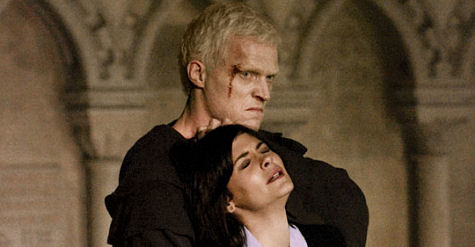
Gotta Have It

I finally finished reading I Wake Up Screening: What To Do Once You’ve Made That Movie (Watson-Guptill) last week, and it’s one of the most easily processed, best written, most thoroughly sourced books ever written about how to get your indie movie seen (and maybe even distributed!) once it’s more or less finished.
I’m not going all kiss-ass on this book because I’m friendly with its authors, critic- journo John Anderson and Warner Independent marketing exec Laura Kim, or because I know just about every distribution exec, producer’s rep, indie publicist, film festival director, critic and entertainment journalist they’ve quoted.


Park City’s Main Street during the ’04 Sundance Film Festival

I’m saying this because it’s a sharp, cleanly written, well-organized thing, and because it contains lessons that I know are wise and based on hard experience, and because I’ve never read anything of its type quite as good. Really.
L.A. Times critic Kenneth Turan, Magnolia Pictures’ Eamonn Bowles, filmmakers Bill Condon and Kirby Dick, Picturehouse’s Bob Berney, New York Times critic Manohla Dargis, Cinetic’s John Sloss, exhibitor Gregg Leammle, N.Y. Times reporter Sharon Waxman, producer Ted Hope, Sundance honcho Geoff Gilmore, publicist Jeff Hill, Sony Classics’ Michael Barker, Telluride Film Festival director Tom Luddy, Variety‘s Tom McCarthy…these guys and maybe 50 others are quoted.
And there’s a minimum of attitude and self-referential blah-blah in this thing. Every page contains a set-up graph or two plus quotes, quotes, quotes…a set-up graph plus quotes, quotes, quotes. Solid, thoughtful…a very smooth, sans-bullshit read.
The specific advice/lessons for nascent filmmakers include (1) evaluating your film, (2) putting together the perfect team, (3) legal matters, (4) using the right launching pad, (5) sussing Sundance, (6) dealing with the media, (7) the right materials, (8) screeners, (9) the elements of buzz, (10) how not to alienate potential supporters, (11) doing things yourself, (12) finding your audience, and (13) various case studies.

I Wake Up Screening is a how-to manual, but the inside school-of-hard-knocks aroma sets it apart. One or two pages and you’re sold. Trust levels go right up and stay up.

I seriously believe it’s in the realm of choice inside-the-industry books like The Ultimate Film Festival Guide by Chris Gore; The Whole Equation by David Thomson; Easy Riders, Raging Bulls: How the Sex-Drugs-and-Rock ‘N’ Roll Generation Saved Hollywood by Peter Biskind; The New Biographical Dictionary of Film by David Thomson; Final Cut: Art, Money, and Ego in the Making of “Heaven’s Gate” by Steven Bach; The Devil’s Candy: “The Bonfire of the Vanities” Goes to Hollywood by Julie Salamon; The American Cinema: Directors and Directions 1929-1968 by Andrew Sarris; Adventures in the Screen Trade by William Goldman; You’ll Never Eat Lunch in This Town Again by Julia Phillips; and Edward Jay Epstein’s The Big Picture
Every so often I found myself wishing Anderson and Kim had included some ruder, more Peter Biskind-type material (i.e. the kind of quotes and stories that result in certain people refusing to talk to you for four or five years).
And I was a wee bit irritated that they only spoke to (or wrote about) old-media critics and reporters. You’d never know from reading I Wake Up Screening that there are such things as online critics, journalists and buzz-spreaders who wake up and wail every damn day.


I Wake Up Screening co-author Laura Kim

“Think of yourself running in a mile-long race,” Bradford Patrick writes on the book’s Amazon.com page writes. (Sorry, but this guy’s a fairly good writer.) “You kill yourself to finish the mile, and when you can see the tape, you find out you have four more miles to go!
“That’s exactly how the authors frame the problem for a filmmaker. You got the money scraped together, you shot your film, you’ve been in post cutting the film, and then (and perhaps only then) do you become aware of the millions of details, hurdles, and pitfalls that lie between you and bliss — a theatrical release.
“The authors love film, and want nothing more than for your film to find an audience…but how? This is where the step-by-step analysis of dealing with PR, producer-reps, attorneys, media and buyers all get outed in fascinating detail.”
Anderson and I spoke about the book and the business last weekend, and here’s the recording of it. We got going and our chat lasted about 44 minutes.
Anderson is the chief film critic at Newsday, a past member of the selection committee of the New York Film Festival and a two-time past chair of the New York Film Critics Circle, a member of the National Society of Film Critics, and a member of the National Book Critics Circle.


Screening co-author John Anderson, whose eyes rarely glare like they do here

Kim is exec vp of marketing and publicity for Warner Independent Films. Previously the senior vp of mPRm, she’s worked on such films as (I’m taking this right from the book) American Splendor, Dirty Pretty Things, The Pianist and Being John Malkovich.
Buy it or borrow it from a friend…but if you’re even half into the idea of being a serious filmmaker (now, soon, eventually), definitely read I Wake Up Screening.
(Since tapping this out Monday afternoon I’ve learned that “I Wake Up Screening” was also a title of a 1993 book about indie filming, written by director-writer Frank Gilroy.)

Lost Bash


Fantastic jump-up Cuban sounds at Monday night’s after-party following the Hollywood premiere of Magnolia’s The Lost City, a tale of pre-Castro and post-Castro Cuba in the late ’50s and early ’60s, directed by and starring Andy Garcia.

Pretty lady at the party — born in Uruguay, dad was a journalist — who was with Lost City costar Steven Bauer. (I think.)

Andy Garcia during the concert portion of the Lost City after-party.

Curiously mesmerizing pool water

Gotta Have It

Gotta Have It

I finally finished reading I Wake Up Screening: What To Do Once You’ve Made That Movie (Watson-Guptill) last week, and it’s one of the most easily processed, best written, most thoroughly sourced books ever written about how to get your indie movie seen (and maybe even distributed!) once it’s more or less finished.
I’m not going all kiss-ass on this book because I’m friendly with its authors, critic- journo John Anderson and Warner Independent marketing exec Laura Kim, or because I know just about every distribution exec, producer’s rep, indie publicist, film festival director, critic and entertainment journalist they’ve quoted.


Park City’s Main Street during the ’04 Sundance Film Festival

I’m saying this because it’s a sharp, cleanly written, well-organized thing, and because it contains lessons that I know are wise and based on hard experience, and because I’ve never read anything of its type quite as good. Really.
L.A. Times critic Kenneth Turan, Magnolia Pictures’ Eamonn Bowles, filmmakers Bill Condon and Kirby Dick, Picturehouse’s Bob Berney, New York Times critic Manohla Dargis, Cinetic’s John Sloss, exhibitor Gregg Leammle, N.Y. Times reporter Sharon Waxman, producer Ted Hope, Sundance honcho Geoff Gilmore, publicist Jeff Hill, Sony Classics’ Michael Barker, Telluride Film Festival director Tom Luddy, Variety‘s Tom McCarthy…these guys and maybe 50 others are quoted.
< ?php include ('/home/hollyw9/public_html/wired'); ?>
And there’s a minimum of attitude and self-referential blah-blah in this thing. Every page contains a set-up graph or two plus quotes, quotes, quotes…a set-up graph plus quotes, quotes, quotes. Solid, thoughtful…a very smooth, sans-bullshit read.
The specific advice/lessons for nascent filmmakers include (1) evaluating your film, (2) putting together the perfect team, (3) legal matters, (4) using the right launching pad, (5) sussing Sundance, (6) dealing with the media, (7) the right materials, (8) screeners, (9) the elements of buzz, (10) how not to alienate potential supporters, (11) doing things yourself, (12) finding your audience, and (13) various case studies.

I Wake Up Screening is a how-to manual, but the inside school-of-hard-knocks aroma sets it apart. One or two pages and you’re sold. Trust levels go right up and stay up.

I seriously believe it’s in the realm of choice inside-the-industry books like The Ultimate Film Festival Guide by Chris Gore; The Whole Equation by David Thomson; Easy Riders, Raging Bulls: How the Sex-Drugs-and-Rock ‘N’ Roll Generation Saved Hollywood by Peter Biskind; The New Biographical Dictionary of Film by David Thomson; Final Cut: Art, Money, and Ego in the Making of “Heaven’s Gate” by Steven Bach; The Devil’s Candy: “The Bonfire of the Vanities” Goes to Hollywood by Julie Salamon; The American Cinema: Directors and Directions 1929-1968 by Andrew Sarris; Adventures in the Screen Trade by William Goldman; You’ll Never Eat Lunch in This Town Again by Julia Phillips; and Edward Jay Epstein’s The Big Picture
Every so often I found myself wishing Anderson and Kim had included some ruder, more Peter Biskind-type material (i.e. the kind of quotes and stories that result in certain people refusing to talk to you for four or five years).
And I was a wee bit irritated that they only spoke to (or wrote about) old-media critics and reporters. You’d never know from reading I Wake Up Screening that there are such things as online critics, journalists and buzz-spreaders who wake up and wail every damn day.


I Wake Up Screening co-author Laura Kim

“Think of yourself running in a mile-long race,” Bradford Patrick writes on the book’s Amazon.com page writes. (Sorry, but this guy’s a fairly good writer.) “You kill yourself to finish the mile, and when you can see the tape, you find out you have four more miles to go!
“That’s exactly how the authors frame the problem for a filmmaker. You got the money scraped together, you shot your film, you’ve been in post cutting the film, and then (and perhaps only then) do you become aware of the millions of details, hurdles, and pitfalls that lie between you and bliss — a theatrical release.
“The authors love film, and want nothing more than for your film to find an audience…but how? This is where the step-by-step analysis of dealing with PR, producer-reps, attorneys, media and buyers all get outed in fascinating detail.”
Anderson and I spoke about the book and the business last weekend, and here’s the recording of it. We got going and our chat lasted about 44 minutes.
Anderson is the chief film critic at Newsday, a past member of the selection committee of the New York Film Festival and a two-time past chair of the New York Film Critics Circle, a member of the National Society of Film Critics, and a member of the National Book Critics Circle.


Screening co-author John Anderson, whose eyes rarely glare like they do here

Kim is exec vp of marketing and publicity for Warner Independent Films. Previously the senior vp of mPRm, she’s worked on such films as (I’m taking this right from the book) American Splendor, Dirty Pretty Things, The Pianist and Being John Malkovich.
Buy it or borrow it from a friend…but if you’re even half into the idea of being a serious filmmaker (now, soon, eventually), definitely read I Wake Up Screening.
(Since tapping this out Monday afternoon I’ve learned that “I Wake Up Screening” was also a title of a 1993 book about indie filming, written by director-writer Frank Gilroy.)

Lost Bash


Fantastic jump-up Cuban sounds at Monday night’s after-party following the Hollywood premiere of Magnolia’s The Lost City, a tale of pre-Castro and post-Castro Cuba in the late ’50s and early ’60s, directed by and starring Andy Garcia.

Pretty lady at the party — born in Uruguay, dad was a journalist — who was with Lost City costar Steven Bauer. (I think.)

Andy Garcia during the concert portion of the Lost City after-party.

Curiously mesmerizing pool water

Disturbance

I don’t think Tom Cruise is a nutter. He has the nature of someone intensely driven, plus an emphatic personality that can seem a little manic to some. But among the hoi polloi there’s definitely an idea that he’s a wack-jobber. Or at least a view that sometime last spring or summer he got too cranked up over Scientology, lost it, jumped into a barrel and went over the falls.
If you were hiding under a rock and missed the whole Oprah couch-jump, Brooke Shields-bashing, Katie Holmes-proposal-of-marriage-on-the-Eiffel-Tower meltdown, you can go to a theatre this weekend and see it lampooned in Scary Movie 4 (The Weinstein Co.), specifically in Craig Bierko’s performance as the eccentric “Tom Ryan.”


As Ethan Hunt in Mission: Impossible III (Paramount, 5.5)

And if you add this impression to some new NRG tracking numbers about Mission: Impossible III (Paramount, 5.5), you’ve got what any p.r. professional would call an issue of concern.
The NRG statistics indicate that Cruise’s box-office appeal isn’t what it used to be. The term is probably “dented” as opposed to “injured.” This allows, in any event, for a possible scenario in which M:I:3, directed and written by J.J. Abrams, may wind up with earnings that analysts will describe as “impressive,” “muscular” or “respectable” rather than “phenomenal,” “spectacular” or “record-breaking.”
There won’t be anything tragic about this. Mission: Impossible III, the first big summer film of 2006, is going to sell a shitload of tickets. I’m half into it myself, having been encouraged by what Kevin Smith said a couple of days ago (“as good if not better than the first [Mission]…Philip Seymour Hoffman plays the most believable bad guy since Anthony Hopkins in Silence“) as well as others.
And even if it’s not the greatest action movie since sliced bread, M:I:3 will still be the Big Thing to see from early to mid May until The DaVinci Code opens on 5.19.
I tried and failed to reach people who attended an exhibitor screening of M:I:3 two days ago — Wednesday, 4.12. Then I heard from a friend who said he’d spoken to two who were there. They liked it, he said, although “I didn’t get the sense that they were absolutely blown away.”

Still, if I were on Cruise’s team, I wouldn’t be feeling very good about that stupid Scary Movie 4 parody. David Zucker’s comedy earned a little over $40 million this weekend…that’s a lot of laughing kids streaming in and out…and I don’t see how those Tom Cruise wackazoid gags can do anything but mess with M:I:3‘s revenue.
There are indications all over the map that a portion of the public doesn’t believe that the 43 year-old Cruise is Tom Terrific anymore — they think he’s Tom Wacko.
I got going on this jag after hearing some National Research Group numbers that were released on Thursday, 4.13. They supposedly indicate the public’s interest in seeing Mission: Impossible: 3. I got them from a single source (I tried double- confirming with other marketing people but nobody was around due to the Good Friday holiday) but “they’re straight from the NRG report,” I was told, and “in black and white.”
Two figures got my attention: the 37% who said they’re definitely interested and the 9% who said they’re definitely not interested. My source says that at this same point before the opening of John Woo’s Mission Impossible: 2 — almost exactly six years ago — the definite interest number was in the mid 40s and that the definite non-interests were more like 2%.



Phillip Seymour Hoffman as super-baddie Owen Davian

Paramount spokespersons said the NRG figures on M:I:3 are wrong, claiming instead that the definite interests are in “the low 40s.” (When told about this, my source said, “They’re defending the company position”).
If you go by the NRG figures, there’s clearly diminished interest in M:I:3 compared to the readings for Mission: Impossible 2, and the negatives are obviously higher also.
9% definite non-interest now vs. 2% defininite non-interest then — that’s a different climate. But a Paramount spokesperson disputed the 9% definite non-interest figure, contending that it’s actually “30% lower.”
I’m not saying NRG is the end-all and be-all (their “methodology is terrible,” an industry-watcher contended today), but if the public is feeling somewhat cooler about M:I:3 than they were about the previous two Mission films (and I say “if”), it’s probably safe to assume this isn’t due to global warming.
The Paramount spokesperson reiterated that “this movie is going to make a lot of money,” that the definite interest percentage is “where it should be” at this stage, “our first choice figures are already over 10%” and that “we haven’t even started our [advertising] campaign yet.” Fine, fine.


Director J.J. Abrams, Cruise on set of Mission: Impossible III

How does the HE readership feel about this? Is the want-to-see on M:I:3 just as strong as it was with the last two? How much has the wacko-Tom factor entered into things, if at all? Or is this just some NRG-industry journalist circle-jerk issue that has nothing to do with what real people are thinking?
I for one don’t give a damn about off-screen behavior. Cruise can do double somer- saults and one-armed push-ups on every talk show he goes on and it doesn’t mat- ter. I mean, not as long as the movie he’s selling kicks ass.

So Big


A big new AMC plex (stadium seating in all the houses) plus a big fat second-story food court opened a few weeks ago in Century City, and I finally dropped by Saturday night for a looksee. Something inside me flinches just a bit when I see an outdoor monster banner ad like this one for The DaVinci Code. It’s funny but I can feel myself inching towards feelings of vague dislike for this thing, sight unseen. No reason for this…but in the words of HAL 9000 as David Bowman was removing his memory cells, “I can feel it.”

Sensible Responses

“I’m much more excited about the third Mission than I was about the first two. Why? Because it looks like a better movie.
“And the Cruise kookiness doesn’t dissuade me in the slightest. If I didn’t boycott Val Kilmer for allegedly flicking a burning cigarette at the face of an Island of Dr. Moreau crew member (loved him since in The Salton Sea, Spartan and Kiss Kiss Bang Bang), I sure as hell am not going to lose it for Cruise because he’s passionate about something — even insanely passionate.
“The guy’s a movie star and sometime actor. If he’s an Operating Thetan 7 or whatever it is offscreen, I’m with him as long he keeps up the quality output like his work in Collateral, War of the Worlds, Magnolia and Eyes Wide Shut.” — Colin Moriarty , Canton, Ohio.

“I’m with you on how Cruise’s behavior influences my interest in seeing his movies: it doesn’t. Maybe if would if he had less of a quality track record (like Will Smith or Mel Gibson), but Cruise consistently picks interesting projects and talented directors: Kubrick, Spielberg, P.T. Anderson, Brian DePalma, Michael Mann, Cameron Crowe, etc. Devotion to Scientology can’t override that.
“Add in Mission: Impossible III having the best cast assembled in the series so far, my appreciation of J.J. Abrams’ work on TV, and both trailers so far kicking ass and getting my blood going. Put that together, and M:I:3 is actually the big May movie I’m most confident will be decent or better (because I realize my hopes for X3 may be in vain). A bit of creepy behavior from Cruise can’t change that.
“However, I fear that I may be in the minority on this. I don’t read People or Us or In Touch Weekly , but lots of people do. I know some of my co-workers have expressed a feeling of ickiness regarding Cruise in general and his new sequel in particular, and I have a feeling that the argument that Cruise has shown admirable interest in making good movies in the past won’t fly with everyone.
“In short, this is another case of the general public approaching things from a point-of-view not exactly guided by a love of movies, but rather an interest in celebrity culture and gossip. M:I:3 can probably still bank on at least $180 mil or so, but the gossip-rag backlash that was too late to really harm War of the Worlds may be in effect.” — Jesse Hassenger


Cruise, Michelle Monagahan in Mission: Impossible III

“Who knows how big the wacko-Tom factor will play, but the solid majority of my Lost-addicted friends (college aged, guy-guys) are sold on M:I:3 based solely on writer/director J.J. Abrams. They remember the 2-hour Lost series premiere that Abrams directed, and tune in along with 20 million other viewers each week.
“And as far as I’m concerned — wacko, schmacko. Cruise usually gets the job done with intensity and control. Chef Boyardee may very well have been a nut (this is pure speculation), but dude knew how to can some delicious pasta.” — Kevin Costello
“I was contacted last night by the AC Nielsen people about upcoming films, and I responded with a ‘definitely’ about my desire to see M:I:3. I was then asked about my feelings about M:I:3 costars Tom Cruise, Ving Rhames and Keri Russell, and I said I’m in the camp of believing Cruise’s appeal isn’t what it used to be.
“I found it strange that the surveyor never inquired about the only M:I:3 participants who are solely responsible for my desire to see ot — actor Philip Seymour Hoffman and director J.J. Abrams. I would be skipping this third installment if not for the opportunity to see J.J. flex on the big screen and watch P.S.H. go bad-guy.

“I might be alone in my feelings, but I feel the best way to keep people interested in a fourth installment of this franchise would be a Dr. Lecter-like victory for Hoffman’s character over Cruise’s Agent Hunt.” — Lucas Ross, Oklahoma City, OK.
“The MI films present a conundrum. They’re just ‘movies’ vs. actual aesthetic experiences. Both of these kinds of film can use the power of film, but the desired payoff is different. The aesthetic films we expect to challenge us, nourish us, and, one hopes, maybe even make us better (I know that’s asking a lot). A movie…well, it’s a pleasant way to have a shared experience with some friends that doesn’t involve exchanging bodily fluids.
“For those of us who like a little aesthetics/intelligence with our ass-kicking, M:I:3 seesm like a disappointment in advance. For all the money spent making them, for all the flash and technology, the MI films are more than disposable — they’re forgettable.
“That said, M:I:3 does have my interest for one reason: Phillip Seymour Hoffman. You know he’ll bring it when he shows up, and that alone could put me a theatre seat.” — Roy “Griff” Griffis
“I like Tom Cruise. He’s no Paul Giamatti, but he constantly delivers in an above-average, movie-star-charisma kinda way. He’s got a certain amount of acting talent, but it’s that weird star-wattage thing that defines a Tom Cruise performance.

“Is he crazy? And does that affect the box office? Uhm, he may be a bit nutty, yeah…but quite frankly, that’s how I like my Hollywood stars. Let’s face it, Angelina Jolie was a lot more interesting when she was wearing a vial of Billy Bob Thornton’s blood around her neck.” — David S.
“The best thing Paramount can do to get me to see Mission: Impossible 3 is break my air conditioning on opening weekend.
“Otherwise, what’s unappealing to me about Cruise at this stage is not that he’s a cult member living in his own hermetic cocoon but that his control-freakishness has erased any human interest he once had back in Risky Business or even Jerry Maguire days. He’s as sleekly machine-tooled and inhuman as the T2000.
“Even when he tries to play a character part (Collateral, let’s say) he’s so erased of imperfection that he’s unrecognizable as one. His War of the Worlds character had human imperfections like a Calvin Klein model has stubble.
“Maybe the day will come when, as with Gary Cooper or Randolph Scott, age puts some character into his boyish face and he starts depicting human frailty, not superhuman relentlessness, on screen.” — Mike Gebert

Grabs


Car wash on Pico Blvd. near Beverly Glen– Thursday, 4.13, 5:20 pm.

Photos hanging just above counter and near the jelly beans in the big glass jars in foyer of Sunset Screening Room — Thursday, 4.13, 9:20 pm. Photos were given in tribute to Walter, the guy who’s owned and run the room for years. Pic was taken during a late-inning recess I took from Chen Kaige’s The Promise, a flamboyant Chinese-costume adventure film — arch, bullshit-stuffed, pageantry-for-its-own-sake — that I watched for a half-hour or so but mainly slept through. I hated, hated, hated the parts that I saw.

I’ve never seen a guy sleeping in front of a building with such a nice-looking sleeping bag in my life. He had a nice bag with him instead of the usual plastic garbage bag or shopping cart, and his beard was semi-trimmed and not that long. This seems to indicate he’s a semi-responsible guy who’s run into hard times and is sincerely homeless, as opposed to most of the homeless people I’ve seen, who seem to fit the general definition of “bums.” Taken on Monday, 4.10, just after the first screening of United 93

Hanging in window of a Beverly Hills store…I forget where. The French-made poster is for a 1917 Fatty Arbuckle film called Oh, Doctor!