Soderbergh’s Atlantic Crossing

Let Them All Talk (HBO Max, 12.10) is a smart, reasonably engrossing, better-than-mezzo-mezzo character study that largely takes place aboard the Queen Mary 2 during an Atlantic crossing.

It’s primarily about Alice, a moderately famous, sternly self-regarding novelist (Meryl Streep) and her somewhat brittle relationship with two old college friends, Susan and Roberta (Dianne Wiest, Candice Bergen), whom she’s invited along on a New York-to-Southhampton voyage, courtesy of her publisher.

Also tagging along are Tyler (Lucas Hedges), Alice’s 20something nephew, and Karen (Gemma Chan), an anxious book editor whom Tyler takes an unfortunate shine to.

Also aboard is a David Baldacci-like airport novelist (Dan Algrant) whose books Roberta and Susan adore, and who’s far more engaging and emotionally secure than Alice any day of the week.

Working from a script by Deborah Eisenberg and literally shot during a seven-day crossing in 2019, Let Them All Talk features Soderbergh in standard three-hat mode — director, cinematographer (as Peter Andrews) and editor. All I can say without spoiling is that he manages to keep things sharp, interesting and slicey-dicey for the most part. Streep is playing an aloof, mostly unlikable character, Hedges a somewhat gullible one, and Algrant the most amiable.

But Bergen’s Roberta, who’s fallen upon difficult economic times due to a divorce, is the most interesting character by far. It affords Bergen an opportunity to give her best performance in I don’t know how many years. Since Gandhi or even Carnal Knowledge?
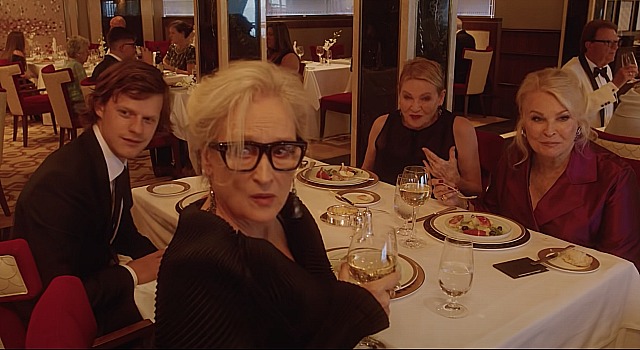

Roberta is a frustrated boomer-aged woman who works in lingerie retail and who wants more money in her life. Alas, she hasn’t any economic opportunities to speak of and hasn’t a prayer of landing a rich boyfriend or husband because she’s “old meat” (all the eligible 60something guys, it seems, have 20something girlfriends) and far from svelte. And yet she’s on her game at all times, attuned and thinking and assessing. Plus she has a testy, unresolved relationship with Alice, who years ago used Rebecca’s ruptured marriage as raw material for her biggest-selling book, “You Always/You Never.”

And then her big opportunity comes when something happens that I can’t disclose, and Roberta…let’s just say her life takes a potential turn for the better.

I’m presuming that Let Them All Talk is regarded as a theatrical feature that had to accept an HBO Max debut because of the pandemic, and therefore Oscar-qualifying. If so, Bergen is definitely a Best Supporting Actress nominee waiting to happen. I just wish she’d somehow held onto her Murphy Brown-ish appearance. I only know that when she turned up in Warren Beatty‘s Rules Don’t Apply, my first reaction was “wait…who’s that? I know her but I can’t place her.”

I really liked Algrant’s novelist. A very sharp, no bullshit, calmly transactional character. Savvy, frank, classy. Somewhat resentful, Alice looks down her nose at him but he’s a pro with a good gig and no pretensions.

Question: If a book isn’t working out, what kind of writer would wipe it off his/her hard drive and throw away a printed manuscript? Writers don’t do that. They hold onto the material and use it for something else down the road. Sometimes you can find a new way in…nobody throws half-written books away.

Chan has a good scene in which she tells the story of her long engagement suddenly falling apart. And another when Tyler (Hedges) places his emotional cards face up on the table.

Honestly: How could this highly intelligent 20something even fantasize that Chan would be interested in him romantically? He’s supposed to be, what, 24 or 25? And he thinks that a 30something editor whose job is on the line, who’s trying to keep tabs on Alice…he thinks that this woman might be interested in a little trans-Atlantic boning?


Read more

Basic Truth About “Soul”

Earlier this month I wrote that “if there’s been one steady-drumbeat message that has thundered across the Twitterverse for several weeks now, it’s that Pete Docter‘s Soul (Disney +, 12.25) is a truly exceptional animated feature…an emotional, spiritual, jazz-embroidered film so rich and resonant and full-hearted that it deserves to be in Best Picture contention.”

That, trust me, will never happen. Best Animated Feature, sure, but not Best Picture. Because I finally saw Soul last night, and despite an absolute avalanche of charm and energy and whimsical, wild-ass associations, it’s just not good enough. Too fast and busy, too scattered, too all over the place, too hyper. And because it pushes a fundamentally false or at least conflicted concept of life. And because (this is minor but significant) it tries to normalize obesity with the casting of the fattest animated cat you’ve ever seen in your life.

I knew something was up a few weeks ago when Variety‘s award-season columnist Clayton Davis, known for his extra-friendly instincts when it comes to multicultural Oscar bait, tweeted on 11.10 that he wasn’t a Soul fan.

<

And yet a general impression remains that Soul is a major Pixar creation with a big Oscar future. Some HE commenters have insisted that it should leap over its own category and compete for the Best Picture Oscar. (Hah!) Partly because they love the many winning aspects (heart, humanity, cleverness, abundant energy), but also because it’s about a black character and a black community.

In line with this, the critical response has been, I feel, fairly cowardly. They’re terrified of saying anything even slightly negative about such a film. And so right now Soul has a 100% RT rating and the Metacritic number is at 91%.

This morning I tapped out a spoiler-laden assessment of Soul. I realize, of course, that dozens of critics have already reviewed it at length. But please understand (repeating myself) that my remarks INCLUDE SPOILERS.

But before reading this, here’s Pixar’s boilerplate synopsis: “Joe Gardner (Jamie Foxx), a middle school music teacher, has long dreamed of performing jazz music onstage, and finally gets a chance after impressing other jazz musicians during an opening act at the Half Note Club. However, an untimely accident causes Gardner’s soul to be separated from his body and begin to proceed to the Great Beyond.

“And yet Gardner manages to escape to the Great Before, a world where souls develop personalities, quirks, and traits before being sent off to Earth. There, Gardner must work with souls in training at the Great Before, and in particular a soul named ’22’ (Tina Fey), a pre-spectral spark with a dim view on the concept of life, in order to return to Earth before his body dies.”

Read more

Smooth Enough

I saw Sofia Coppola‘s On the Rocks (A24/Apple, 10.23) about a week ago, and I’ve been waiting for the spirit to seize. But nothing’s happened, and the reason is that it’s fine as far as it goes. I didn’t dislike it and don’t feel the slightest urge to put it down. It’s an occasionally amusing, reasonably decent father-daughter relationship film (Bill Murray, Rashida Jones), but it does leave you wishing it had put a little more on the plate.

It’s a marital-suspicion dramedy (“Is my husband cheating on me?”) served in a faintly bouncy, mildly entertaining fashion…okay, sometimes more than mildly. It looks good, Coppola’s script feels smooth and assured, it looks and feels well produced and has a cool Mexican detour section toward the end (i.e., a visit to Las Alamandas Resort in Jalisco, which is between Puerto Vallarta and Manzanillo) and it’s a little jaunty now and then, which is fine.

But if Murray wasn’t playing the wealthy, soft-spoken, amiably rakish dad, On The Rocks probably wouldn’t work all that well. When Murray’s on screen, it’s a fun film. When he’s not, you’re waiting for him to return. The other two principals — Jones and Marlon Wayans as Jones’ successful husband — don’t have the X-factor. They’re sufficient but Murray is the only one with any real charisma.

The best scene is when a couple of Manhattan cops pull Murray over for driving recklessly in a classic red sports car (Jones is riding shotgun) and…okay, no spoilers.

Honestly? I understand that Coppola has more or less written about her own life on some level and that Jones is the stand-in and all, and that the film is self-portraiture to some degree. I get all that. But On The Rocks would’ve been better if it had been mainly about Murray and if Jones and her possibly unfaithful husband had been a side-plo of some kind.

Incidentally: Murray’s all-white hair looks perfect, but he’s also wearing a partial rug of some kind; his trademark bald spot is missing. That or he’s been to my Prague guy.

I’m still giving On The Rocks a passing grade because it’s pretty good. It never pissed me off or made me feel irritable or bored. I’m giving it an affectionate B-minus. It’s agreeable.

Ringing Your Curtain Down

The reviews are correct, the rumors are true: Michelle Pfeiffer has lucked into the best role of her life in Azazel JacobsFrench Exit (Sony Pictures Classics, 2.12.21), a sardonic “comedy” with a gently surreal quality around the edges.

Which means that it’s not all that surreal, or at least not to me. A talking deceased husband (Tracy Letts) inhabiting the body of a cat or cryptically conversing with his widow and son during a seance…whatever. What French Exit is really about is dry gallows humor by way of a certain kind of “I won’t back down” resignation. And within that particular realm it’s very, very good.

If you’re going to make a bitter-end comedy with this kind of attitude or philosophy, you need to own it — no excuses or mitigations, no second thoughts, no third-act softenings. If nothing else French Exit is self-aware and highly confident, and therefore by any fair standard a first-rate effort. Is it “funny”? Well, not actually but it’s good company as far it goes. I was smirking. I was never bored. At the very least I was intrigued.

Exit is about Pfeiffer’s Frances Price, a suddenly destitute, formerly wealthy widow in her mid ’60s who decides to move into a friend’s Paris apartment with her extremely passive son Malcolm (Lucas Hedges) after learning that her once-ample bank account is all but empty. It’s also about how she does absolutely nothing to save herself. In fact she hurries the inevitable along.

But Pfeiffer really goes to town. She delivers every line with just the right shadings of jaded indifference, except it’s not a cold performance. It’s sly and fetching. You could almost say that Frances is a little bit like the Margo Channing role was for Bette Davis in All About Eve (’50) — a snooty bitch with nearly all the great lines. It absolutely represents a Best Actress Oscar nomination, and perhaps even a win. She’s as much of an assured contender as The Father‘s Anthony Hopkins.

The difference is that Davis was full of bite and gusto in Joseph L. Mankiewicz‘s 1950 classic while Pfeiffer is, like, really laid back in Jacobs’ film. So laid back that the only real observation or question about Frances is “okay, she’s having her fun because she really doesn’t give a shit and is comfortable with Parisian finality, so what method will she choose?”

Imagine that all of your money and marketable skills are somehow gone in a flash, and you have around 40K left in the bank. What would the HE community do?

Most of us would probably say, “Okay, I have to find a job or create a new income stream of some kind. The days of monetary comfort and treadmill engagement may be over, but it’s better to live and strive and hope for a better future than to collapse in a heap and give up.”

But a small minority might say, “The good times are over? I’ll have to sweat and struggle and use public transportation in order to survive? Okay, fuck it. Fuck it all. Let’s fly to Paris or Hanoi or Rome, rent a nice pad somewhere, eat well and enjoy the city, and when the money’s gone I’ll off myself with an overdose of heroin or something.”

You could describe the first response as noble or admirable — the classic “when the going gets tough, the tough get their asses in gear” approach that Jane Darwell shared at the end of John Ford‘s The Grapes of Wrath (’40). The second response is basically “if you think I’m gonna stick around while my life gets more and more desperate, you’ve got another think coming.”

Based on a same-titled 2018 novel by Patrick deWitt, French Exit is definitely about the second option. It’s about throwing in the towel, but always with a deliciously baroque attitude, a witty bon mot, a raised eyebrow or a frozen glare of some kind. It may be about extreme detachment but the deadpan nihilism is front and center and loaded for bear.

Read more

Geniuses Are Complicated

“You pick a fight with Willy, you are finished.”

But of course, Herman J. Mankiewicz (Gary Oldman) didn’t actually pick a fight with publishing tycoon William Randolph Hearst when he wrote (or co-wrote) Citizen Kane. It was headstrong director-cowriter Orson Welles who did that, no? He chose the subject, sold it to RKO, assembled the forces, poked at the hornet’s nest, etc. Mank was just the pithy writer-for-hire who created the structure and made the dialogue sing, and who later won a (shared) Best Screenplay Oscar for his troubles.

The just-posted Mank teaser is about the trials and tribulations of good old Mank and his frenemy Orson and their mutual antagonist Mr. Hearst….about a truly gifted screenwriter who wrote delicious dialogue and one of the greatest films of all time despite — aye, the rub — a close-to-suicidal drinking problem.

As played by Oldman, Mank is a bleary-eyed, chubby-faced consumer of spirits who stumbles around and occasionally falls down and does all the usual things that theatrically inclined alcoholics do. But — but! — he was as brilliant and heaven-sent as screenwriters come, and oh what a fine fellow when all the ledgers are balanced and the final checks have been cut.

I’m still expecting to do handstands over this thing, but my understanding or absorption of The Great Herman J. is about who he was as a man of prolific letters and visions…words, arias, screenplays…his typewritten soul. Teasers obviously have to be brief and succinct, and all this one does is convey the colorful but unfortunate fact that Mankiewicz was often in his cups.

Was he really this louche, this bleary, this soused? Speaking as a dedicated vodka-and-lemonade man in the mid ’90s and a slurpy Pinot Grigio guy in the aughts until my 3.20.12 vow of sobriety, and speaking also as the son of a witty, functioning alcoholic until the formidable James T. joined AA in ’75, my understanding of the disease is that drunks don’t flaunt it. They do everything they can, in fact, to hide it.

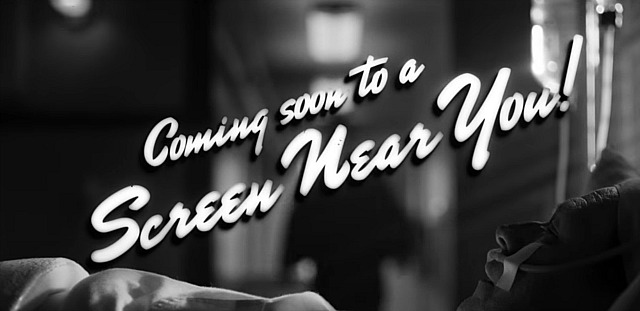
All that aside, nothing thrills me to the bone like a grade-A, 131-minute David Fincher film in the wings. And I love “coming to a screen near you.” Your TV screen, they mostly mean, as a limited theatrical release (which would thrill me to no end) is due for November, but only in the big towns.

The last seven months have been a saga of continual heartbreak, deflation and despair. I remain convinced that Mank will provide a brief respite.

Thieves’ Paradise

Last weekend I saw HBO’s Bad Education, a somewhat riveting, fact-based drama about a bizarre heist in plain sight. The focus is the infamous Roslyn embezzlement scandal of the early aughts. But I couldn’t get it up when I tried to write about it. This was because I couldn’t quite comprehend the insanely self-destructive acts of administrative thievery that this film is…well, partly about.

It’s also about the generally insane notion that living high on the hog is everything in life, and that all you need to sleep through this kind of brazen flim-flamming is a little vial of denial.

I understand Butch and Sundance robbing banks in the old days. I understand the gangs who stole jewels in Rififi and Topkapi. I can relate to the British thugs who pulled off the Great Train Robbery of 1963. Because they all thought they had a decent chance of getting away with it. Why rob anyone or anything if you can’t escape the law, right? But I can’t fathom how or why a pair of senior school administrators expected to get away with stealing over $6 million from a prosperous school district in Roslyn, Long Island — the largest public school embezzlement in American history.

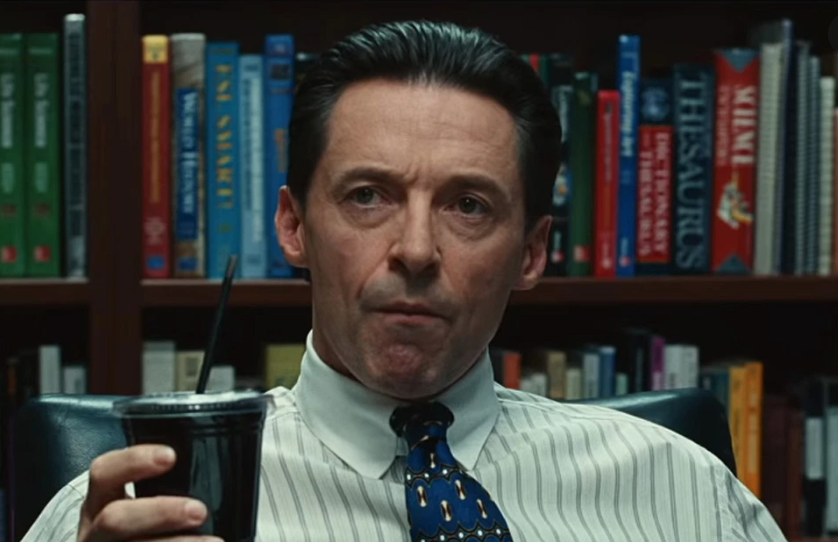
Bad Education is about Roslyn’s secretly gay and deeply frustrated school district superintendent Frank Tassone (Hugh Jackman) and his assistant superintendent and business administrator Pamela Gluckin (Allison Janney) using taxpayer money to buy homes, travel all over, wear swell duds, drive pricey cars, get plastic surgery touch-ups (although not in Prague) and so on. And then wave it all off when questioned by whomever

When Gluckin’s embezzling was exposed, Tassone forced her to resign and surrender her license. But then a reporter for the school’s newspaper uncovered what she thought was a $250K embezzlement scheme involving both of them. The actual figure was much higher. Tassone had pocketed $2.2 million from school district coffers, and Gluckin admitted to stealing almost double that — $4.3 million.

In ’06 Tassone was sentenced to four to 12 years in prison, although he was released in 2010. Gluckin, sentenced to 3 to 9 years in ’06, was released a year later. She died in 2017. Tassone is living comfortably on a lifetime annual pension of $173,495.

Yes, Jackman’s portrayal of Tassone is slick and sad and altogether engaging, and the role is one of his best-written. But he’s playing an incomprehensible sociopath, and I kept asking myself “who believes they can get away with this kind of pilfering? Stuff like this always comes out in the wash sooner or later. It’s all tracable, all on the books…just a matter of time.”

Cory Finley‘s direction is so confident and smooth that it’s invisible. Mike Makowsky‘s highly arresting script is based on “The Bad Superintendent,” a 9.17.04 New York article by Robert Kolker. I read Kolker’s piece as soon as my viewing ended, of course. Here’s an excerpt:

Brilliantly Told, Captured, Acted…Everything

I’ve now watched four episodes of Mrs. America, the nine-episode FX/Hulu miniseries about the ’70s battle over the Equal Rights Amendment, and particularly the conflict between second-wave feminists (Gloria Steinem, Betty Friedan, Shirley Chisholm, Bella Abzug, Jill Ruckleshaus) who fought for passage and the primly conservative Middle American coalition (led by Phyllis Schlafly) who opposed and, sad to say, ultimately won.

All I can say is that I’m hooked, and that I wouldn’t dare miss an episode from here on. It’s a vital watch. There’s a right and a wrong way to make a miniseries out of a blend of recent history and an issue that was once hot-button but has since been bypassed by time and circumstance, and Mrs. America knows exactly how to deal the cards. It’s a model of tight narrative focus, convincing period realism and absolute grade-A performances from the leads — Cate Blanchett (Schlafly), Rose Byrne (Steinem), Tracey Ullman (Friedan), Uzo Aduba (Chisholm), etc. Hell, from the whole cast.

Blanchett will be Emmy-nominated, I’m presuming, but so will Ullman in a supporting category.

A creation of screenwriter Dahvi Walker (Desperate Housewives, Madmen, Eli Stone), Mrs. America just tells the story on a chapter-by-chapter basis — no tricks or curve balls, straight and plain — a story of how the ERA didn’t quite get there, I mean, and how the personalities of all of these high-powered women clashed and grooved and accommodated or didn’t, etc.

Everything really looks and feels like the ’70s in this series. Not pretend-faux ’70s, but the actual genuine decade as it talked, walked, smelled and tasted. The opening credits sequence nails the zetgeist cold.

Plus I feel as if I’ve learned a few things. I didn’t know Betty Friedan was that much of a drinker. I didn’t know Schlafly’s son was gay. I didn’t know about Steinem’s black boyfriend, Franklin Thomas.

The trailers and copy led everyone to believe that Blanchett is the centerpiece of Mrs. America, but Phyllis Schlafly isn’t that much of a dominating force. She’s the steely villain of the piece, the troublemaker, the Midwestern monster. But Blanchett mainly serves a strong ensemble. Byrne and Ullman make just as strong of an impression.

Walker’s primary strategy is to use each episode (nine in all, ending on 5.27) to explore the views and vantage points of the leads — Schlafly, Steinem, Chisholm, Friedan, Abzug, et. al.

Anna Boden & Ryan Fleckk have directed four episodes. Amma Asante and Laure de Clermont-Tonnerre have directed two each. A singe episode (#8) was directed by Janicza Bravo.

I loved the big debate scene between Schlafly and Friedan at Illinois State University in Bloomington, which happened in ’73. Schlafly repeats a much-quoted remark aout por-ERA feminists being “a bunch of bitter women seeking a constitutional cure for their personal problems.” Friedan responds by calling out Schlafly for “hypocrisy” and telling her “I’d like to burn you at the stake” and “I consider you a traitor to your sex…I consider you an Aunt Tom.”

At no time during the first four episodes was I even slightly bored or distracted or checking my watch. It holds, engages, feels right.

Read more

Never Forget Rogen’s Stinker

A handful of films starring Seth Rogen, or those cowritten by or co-produced by Rogen and Evan Goldberg, have felt unbelievable (i.e., posing a strenuous or obstinate argument with reality or any kind of internal logic) in this or that way. Often in many ways. Knocked Up, The Green Hornet, Zack and Miri Make a Porno, Neighbors, Neighbors 2, The Interview, Sausage Party, Long Shot — all surreal fantasy bullshit devoid of any relationship to human behavior as most of us understand it. Even the wildly hilarious Pineapple Express steps into absurdity quicksand toward the end.

Rogen’s best films and performances — 40 Year-Old Virgin, Superbad, Funny People, 50/50, The Disaster Artist — have happened when he played supporting characters.

The disaster trigger (for me at least) is when an attempt is made to sell Rogen as a sexual being who scores or at least gets lucky. That is a total stopper. If I was some kind of Supreme Hollywood Dictator I would say “keep those dopey Rogen-Goldberg films coming but Rogen can never get laid again with an attractive woman…that scenario is OUT for the rest of his career. Rogen is 38 but looks 49 if a day, and the idea of him participating in any sexual scenario with anyone or anything (including a love doll) doesn’t work for me…that is my final edict.”

All to say that streaming Long Shot was recently suggested, just for the goofy fun of it. And I said “no, no…I can’t, I really can’t. Because it farts in the face of reality at every turn, and because I sat there like a sphinx when I saw it in a theatre.”

My review posted almost exactly a year ago. Here’s most of it:

“What if a bearded, bulky-bod, hairy-chested journalist with an extremely blunt and adolescent writing style and a name (i.e., Fred Flarsky) that says “I’m a dork”…what if the current U.S. Secretary of State, a 40ish foxy type named Charlotte Field (Theron), used to babysit Flarsky (Rogen) when he was 10 or 11 and she was 16 or thereabouts, and is now thinking about running for President because the current Oval Office occupant wants to become a bigtime movie actor?

“And what if Flarsky suddenly meets Field at a party and (a) they recognize and reminisce, (b) she decides to hire him as a speechwriter because she needs a guy who writes like a pissedoff seventh grader but also (c) quickly develops an attraction for Flarsky, and before you know it is doing him six ways from Sunday? And then love enters the picture and the movie is suddenly about values.

“Given the extremely improbable story line in Long Shot, I figured they’d try to aim it at a late-teen sensibility, perhaps even at 20 or 22 year-olds. Low and semi-coarse and therefore ‘funny’, but occasionally sounding and behaving like, say, a Seth Rogen-flavored In The Loop. Remember that Armando Iannucci film? How fast and sharp it was? How skillful and sure-footed?

“Well, guess what? In The Loop isn’t stupid enough for the Long Shot crowd. It isn’t stoned or digressive or downmarket or druggy enough. (There’s a scene in which Seth and Charlize drop some ‘Molly‘ in Paris.)

Long Shot, alas, is aimed at a 13 year-old mentality. Okay, a 14 year-old mentality. Every line, every scene save for three or four half-decent moments (did I hear a Brett Ratner joke in there somewhere?) plays to the stoners and dipshits in the cheap seats, otherwise known as the Seth Rogen crowd.

“This would be totally forgivable, of course, if Long Shot was funny, but it’s not. When you play it this broadly and this coarse, when every bit and line is written and played on an obviously farcical but brainless jackoff level without the slightest respect for the venal but semi-grown-up political milieu out there or for human behavior as most of us know it, IT’S NOT FUCKING FUNNY.

Read more

One Time Only

I don’t remember very much about The Last Tycoon (’76) except that it stunk. Okay, maybe that’s a little harsh but but it certainly seemed inert. Robert DeNiro was almost comically miscast as coolly arrogant studio exec Monroe Stahr, whom original author F. Scott Fitzgerald had based upon legendary MGM exec Irving Thalberg.

De Niro played Thalberg as a relatively uncultured New York street guy (i.e., Travis Bickle wearing nice suits) with those Lower-East-Side Italian vowels of his. The real-deal Thalberg came from Brooklyn and never attended college, but I’ve always read he was a man of discipline and exactitude — a classy gent with a highly concentrated mind. I didn’t believe DeNiro’s “Travis” Thalberg for an instant. That idiot grin of his was pure loony Bickle. For what it’s worth I enjoyed the two or three scenes that De Niro shares with Jack Nicholson, who plays a commie union leader.

How could a film directed by Elia Kazan, based on a 1941 Fitzgerald novel, adapted by Harold Pinter, produced by Sam Spiegel, scored by Maurice Jarre and shot by Victor J. Kemper…how could a movie made by such an ace-level team turn out badly? But it did. It just sat there.

The Last Tycoon was DeNiro’s first shortfaller. He’d previously made five excellent films (Bang The Drum Slowly, Mean Streets, The Godfather, Part II, Taxi Driver, 1900). After Tycoon he starred in another failure (Scorsese’s New York, New York) but then rebounded with The Deer Hunter, Raging Bull, True Confessions, The King of Comedy, Once Upon A Time in America and Falling in Love.

Luis Bunuel’s “Parasite”

Director friend who finally saw Parasite two or three days ago: “I thought Parasite started off quite well. It was intriguing, darkly comedic, and well-paced. Even when it got into the house for an extended period of time, I never felt bored.

“As I was watching the film, I started wondering ‘where have I seen this kind of film before?’ Where have I seen the class struggle play out in this kind of suspenseful fashion? I thought first of Akira Kurosawa’s kidnapping drama, High and Low. The rich old man on top of the hill overlooking the squalor down below and the kidnapper who resides there, who infiltrates his life sanf wants to take away his spoils…but that was much too serious a film while Parasite was definitely more satirical and comedic.

“Then it hit me…of course, Bunuel! The great Don Luis was always mocking the upper classes using his acerbic wit and absurdist point of view.

Here are some Bunuel homages/references from Parasite:

1. Viridiana. To me, this is the most obvious one. The Mother figure, like Viridiana, is described as “simple” and also “gullible”. The most visually telling scene is when the rich family goes camping leaving the servant family to the house where they of course make a mess of things. This is shown in Viridiana when the peasants take over the household of the dead Uncle and begin to defile it (with the infamous Last Supper scene).

2. Exterminating Angel. The husband kept in the basement seems a very strange plot device but that’s what sets in motion the entire second half of the film. In Bunuel’s film it’s the bourgeoise and upper class folks who can’t find their way out the house and soon begin to resort to their basest natures. This is what happens to the poor husband who seems to accept his place in the house and can’t leave either (though he’s more restricted by his prison-like existence). When he does “escape” at the end it’s to wreck vengeance but not on the wealthy patriarch (who he seems to strangely worship) but on the conniving family members.

3. Diary of a Chambermaid. Although less known as his more audacious films, this one has a direct plot parallel with Jeanne Moreau as the lower class maid taking a job with a rich family to manipulate her way to a higher station in life by working for a wealthy family of “hypocrites and perverts” (not my quote).

4. Discreet Charm of the Bourgeoisie. This would be a comparative film in overall tone before it goes off the rails in the final act. I suppose just as Bunuel couldn’t help himself with his subversive atheistic jabs at the Church, Boon Jong Ho can’t help himself but to revel in gory confrontations.

I will agree that the one sloppy bit of plot construction is letting the fired maid back in the house during the rainstorm. That could’ve been fixed very easily but without it there would be no third act…still, could have been an easy fix.

White-Haired Holy Men

Catholicism and the Pope are concepts that millions still cling to worldwide. Because they offer a feeling of steadiness and security in a tumbling, tumultuous world. Included among the faithful, one presumes, are thousands of movie-worshipping Catholics, and so Fernando Meirelles and Anthony McCarten‘s The Two Popes (Netflix, 11.27) is, not surprisingly, faring well as a potential Best Picture nominee. The fact that it won the Audience Award at the 2019 Middleburg Film Festival is an indication of this.

I saw The Two Popes for the second time last night, and I felt slightly more charmed and moved than I did during my initial viewing in Telluride.

I have nothing but respect and admiration for the film, and particularly for McCarten’s script (which is based on McCarten’s 2017 play, The Pope). In my humble opinion McCarten should definitely be nominated for Best Adapted Screenplay. And it seems increasingly likely that Jonathan Pryce‘s performance as the future Pope Francis (aka Cardinal Jorge Mario Bergoglio) will be Best Actor-nominated as well.

But honestly? I still feel emotionally removed from The Two Popes (as I wrote in my 9.1.19 Telluride review). Because I don’t feel any sort of kinship, much less a profound one, with the Catholic Church. I never have and I never will.

I don’t believe in holiness. I don’t believe in the Vatican carnival. I don’t believe in robes. I don’t believe in red shoes. I believe in Michelangelo’s Sistine Chapel frescoes and in Charlton Heston‘s performance in The Agony and the Ecstasy, but I haven’t the slightest belief in those Vatican City guard uniforms or the mitre or the scepter of any of the theatrical trappings. I believe in humanity and simplicity. I’m not exactly saying that I believe in Pope Lenny more than Pope Francis, but in a way I kind of do. Almost.

I don’t believe in the Bible…not really. I certainly don’t believe in celibacy for priests, and I despise the thousands of priests who’ve molested children worldwide and the countless bishops and cardinals who’ve protected them from the consequences. I believe that women should definitely be admitted into the priesthood. And while I understand and respect the fact that millions believe in the Catholic mission and its hierarchy, I myself don’t. Catholicism is more against things than for them.

Robe, Mitre, Scepter,” posted from Telluride on 9.1.19:

Fernando MeirellesThe Two Popes is an interesting, mildly appealing two-hander as far as it goes. I had serious trouble with the refrigator temps as I watched, but I probably would have felt…well, somewhere between faintly underwhelmed and respectfully attentive even under the best of conditions.

It’s a wise, intelligent, non-preachy examination of conservative vs progressive mindsets (focused on an imagined, drawn-out discussion between Anthony Hopkins‘ Pope Benedict and Jonathan Pryce‘s Pope Francis a few years back) in a rapidly convulsing world, and I could tell from the get-go that Anthony McCarten‘s script is choicely phrased and nicely honed. But I couldn’t feel much arousal. I sat, listened and pondered, but nothing ignited. Well, not much.

Possibly on some level because I’ve never felt the slightest rapport with the Catholic church, and because for the last 20 or 30 years I’ve thought of it in Spotlight terms, for the most part.

I love that Pope Francis (formerly or fundamentally Cardinal Jorge Bergoglio of Argentina) is a humanist and a humanitarian with simple tastes, and I was delighted when he jerked his hand away when Donald Trump tried to initiate a touchy-flicky thing a couple of years ago. And I’m certainly down with any film in which two senior religious heavyweights discuss the Beatles, “Eleanor Rigby” and Abbey Road, etc.

Read more

“Dolemite” Approval

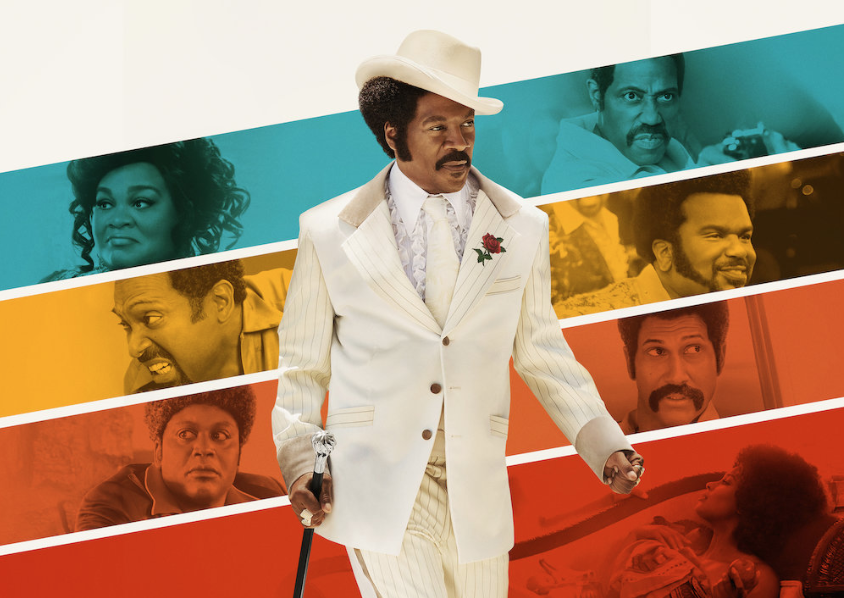
Yesterday afternoon I finally saw Craig Brewer and Eddie Murphy‘s Dolemite Is My Name (Netflix, currently streaming). Loved it, very cool, super-likable, at times hilarious. Call it a reconsecration of the Larry Karaszewski-Scott Alexander brand, and a definite bounce-back for Brewer and especially Murphy.

Let’s clearly understand that first and foremost this is a Scott and Larry film, and is basically a blaxploitation version of Ed Wood — same spirit, same or similar arc for the main character, same pluck and never-say-die determination, same indifference to (or an inability to recognize) the basic concept of quality, same naive but dedicated crew of co-conspirators.

The difference between Ed Wood and Dolemite is that a sizable African-American audience responds with enthusiasm and joy to the crappy cinematic creations of the real-life Rudy Ray Moore (played by Murphy) while nearly everyone despised Plan 9 For Outer Space (except for purveyors of camp a decade or two later).

The slight downside is that Dolemite Is My Name doesn’t have its own Bela Lugosi character, much less someone like Martin Landau portraying him, and it doesn’t have a facsimile of that gay Bill Murray character.

Then again Ed Wood didn’t have the open-hearted Lady Nancy Reed (played by Da’Vine Joy Randolph).

Dolemite is My Name is a tribute to tenacity and one man’s relentless belief in himself, despite his utter lack of talent and/or inspiration, and especially his absolute lack of respect for the craft of cinema, let alone any artistic potential.

Shitty, low-rent filmmaker makes good because he won’t quit, and because people with no taste ** like what he’s selling!

The funniest scene, for me, is when Rudy and his Dolemite homies are reading the initjal reviews. One critic, Earl Calloway of the Chicago Defender, wrote that “Dolemite is not fit for a blind dog to see…it’s coarse, bold, crude, and rude.” For whatever reason I started laughing uncontrollably when I heard this, and I’m what you might call an LQTM type.

Another critic called it “Dull-emite.”

Read more