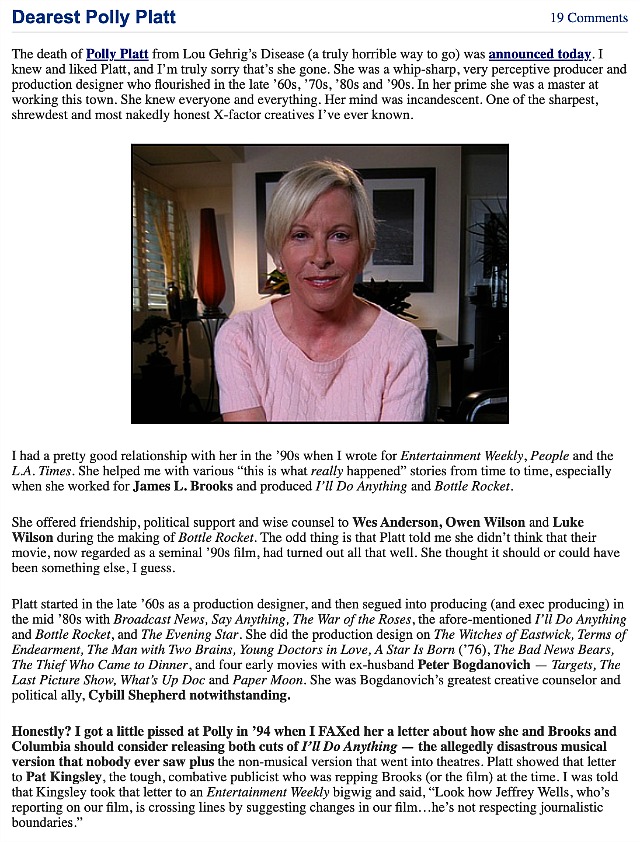
For her You Must Remember This podcast, Karina Longworth has created a ten-episode tribute to legendary producer, production designer and Pretty Baby screenwriter Polly Platt. It’s called “Polly Platt, The Invisible Woman.” I haven’t had a chance yet. I’m thinking of catching the first two episodes on the drive back to Los Angeles later today.
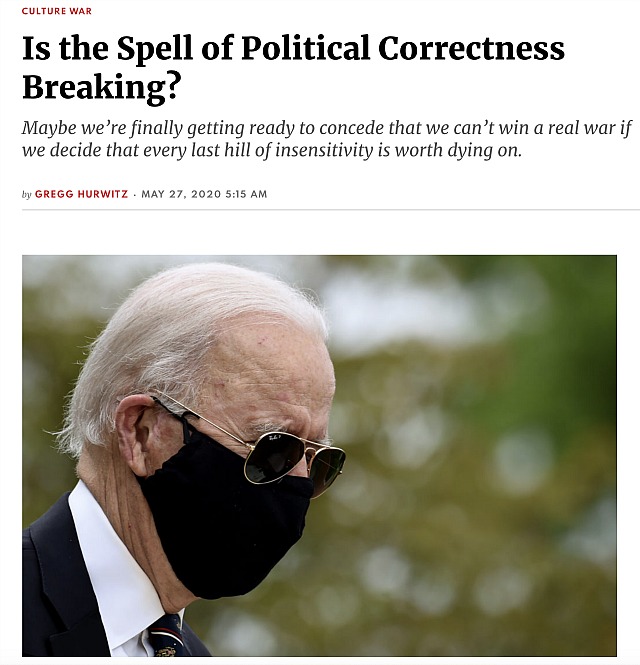
Excerpt: “All women are not to be believed any more than all men are. To suggest that females are magical truth-telling creatures isn’t just insulting; it’s objectifying.
“And of course the leaders of #MeToo knew that.
“But the biosphere of social and mainstream media no longer responds to — or has any interest in — nuanced positions. So ‘Women will no longer be silenced just because they lack relative power in certain circumstances, an injustice that now demands we give equal weight to those who’ve been victimized’ became ‘Believe all women.’
“Which then, by its very lack of nuance, set off a firestorm of cancel culture, circumventing due process and harming people of both genders. And when members of the left said nothing or responded with glee to the one-size-fits-all mob sentencing guidelines, they ended up condoning the same sort of overzealous nonsense that the right does when pretending that cancel culture rules the day.”
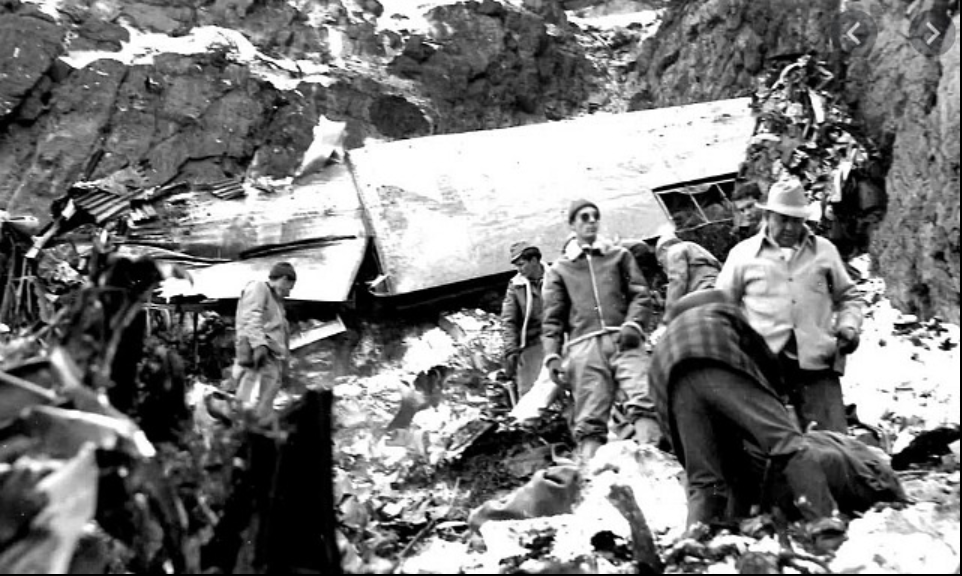
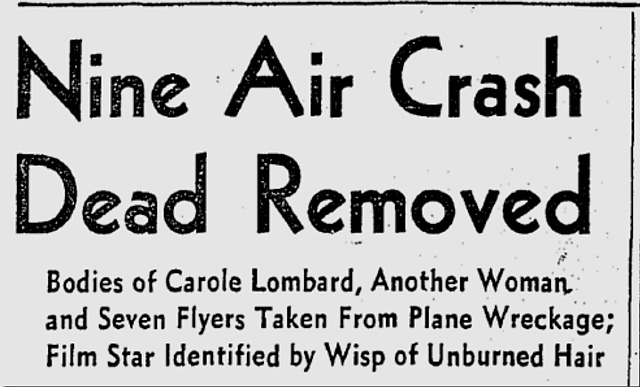
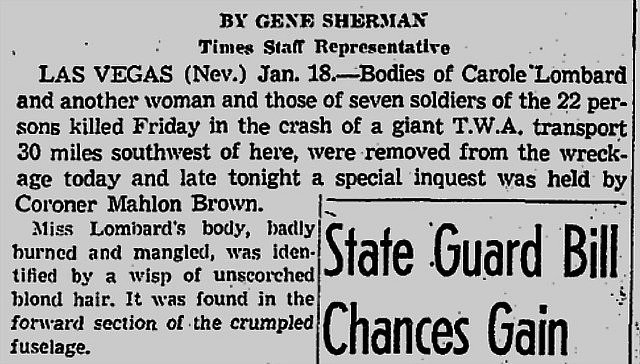
Sherman reported that formidable MGM fixer Eddie (i.e., “Edgar J.”) Mannix had identified Lombard’s “charred and burned” body, relying on his familiarity with her blonde hair “as well as the general contours of her face.” Mannix was memorably portrayed by Josh Brolin in Joel and Ethan Coen‘s Hail Ceasar!.
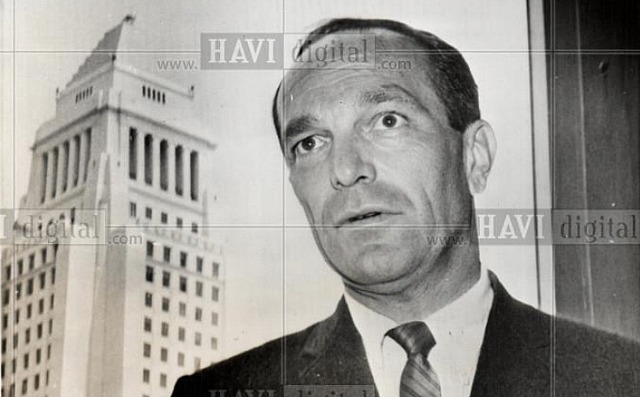
Like any driven big-city reporter, Sherman knew most of the angles and could write a mean paragraph. In 1960 the 45 year-old Sherman won the Pulitzer Prize for Public Service. In a bid to strengthen the L.A. Times‘ influence on the world stage, Sherman opened the paper’s London bureau in ’64. The “hard-working, fast-living” Sherman died in 1969, at age 54.
Somewhere in the middle of Die Hard (’88) John McLane (Bruce Willis) says he’s “kinda partial” to Roy Rogers as a walkie-talkie handle. That’s because McLane was a boomer who’d watched The Roy Rogers Show (’51 to ’57) as a toddler. No GenXer, Millennial or Zoomer would have a clue who Rogers was if it wasn’t for that one line in Die Hard. Ashes to ashes, dust to dust.
This morning I found a Rogers-related sentiment on Facebook, probably written by some crusty codger: “We [boomers] were born at the right time. We were able to grow up with these great people even if we never met them. In their own way they taught us about patriotism and honor. We learned that lying and cheating were bad, and that sex wasn’t as important as love. We learned how to suffer through disappointment and failure and work through it. Our lives were drug-free. So it’s good-bye to Roy and Dale, Gene and Hoppy (Hopalong Cassidy), the Lone Ranger and Tonto.
<
“Farewell to Sky King (and Penny) and Superman and Sgt. Joe Friday. Thanks to Capt. Kangaroo, Mr. Rogers and Capt. Noah and all those people whose lives touched ours, and made them better. Happy Trails. It was a great ride through childhood.”
The words “drug-free” brought me up short. What kind of boomer who lived any kind of life went through his or her teens and 20s without at least a touch of pot or hashish or, if they were truly adventurous of spirit, without dabbling in psychedelia?
HE reply: Boomer kids who marinated in the lore of the above-named TV heroes were also raised under the suffocating influence…I’m sure you guys remember this…of a tidy, suburban, rule-dominated culture that Robert Redford, an unhappy teenager in the mid ‘50s, once described as “the bland leading the bland.” (Not an original quote but we’ll let that go.)
This is why “the ‘60s” happened…right? The steam pressure had gathered and gathered, and it finally just blew the doors open, starting sometime in ‘64 (or perhaps more precisely on 11.22.63) and certainly by ‘65 and especially with the release of “Rubber Soul.”
Captain Kangaroo, the Lone Ranger, Ward Cleaver, Sgt. Joe Friday and other totemic figures of that era were about decency and kindliness and a certain kind of conservative, modestly measured approach to life — I get that. And what about the influence of Elvis, James Dean, Little Richard, Marlon Brando and Jerry Lee Lewis?
The plain hard truth (sorry to be the bearer) is that Sky King, Superman, Ozzie Nelson and others in that hallowed realm (and I’m trying to put this gently) were basically kind-hearted prison guards. And here you are saying “ohh, those kindly and morally upstanding prison guards…they raised us with the right kind of values!”
And I guess they did to some extent, but boomers (who became the “We generation” only to turn into the “Me generation” and then Reagan-era yuppies and then the most destructively selfish generation ever in terms of totally ruining the economy for Millennials and Zoomers) were never about “sex isn’t as important as love.” If I recall correctly, the anthem of the late ’60s, ’70s and early ’80s was “sex is just as important as love, and above all women need to learn to own their own orgasms.”
I’m sorry but as soon as I read the above I felt I needed to open the French windows and air the place out…no offense and have a happy Memorial Day.
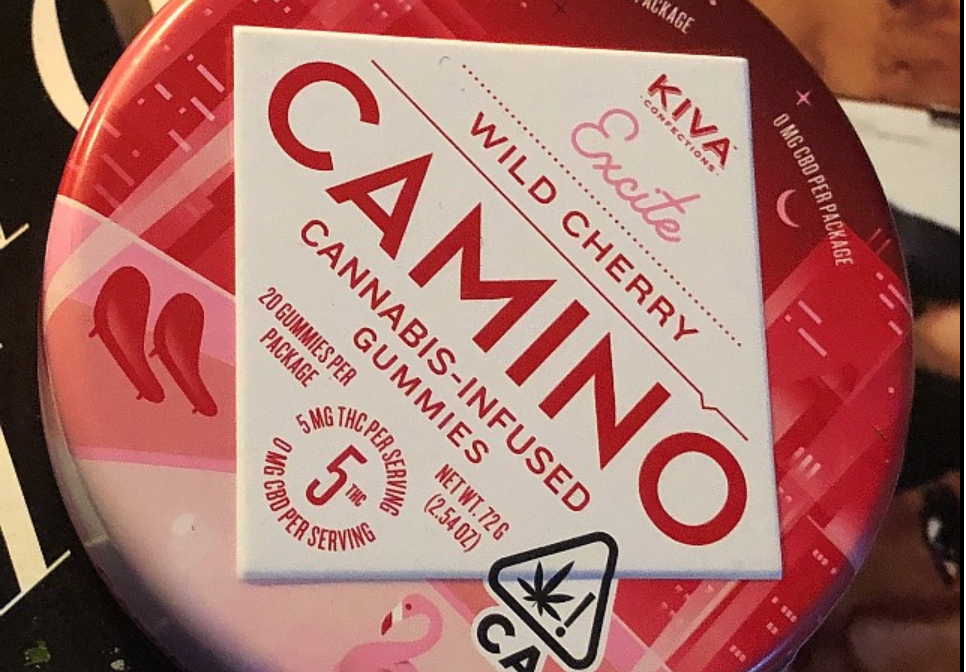
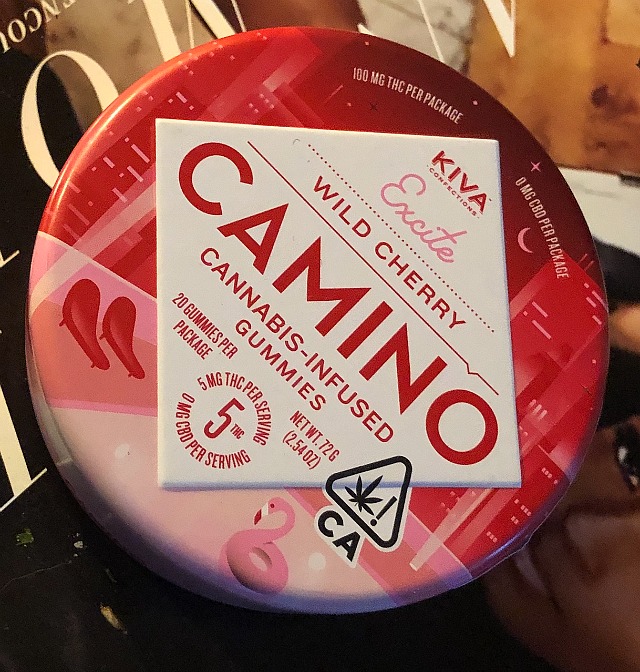
For the first time in 17 or 18 years, I got rip-roaring stoned last night. By way of a single cannabis gummy bear, manufactured by CAMINO. It was a steady. bump-free high, but my God, the strength of it! It was like I was suddenly atop a galloping racehorse, but the horse knew the realm and was fairly cool about it. And it was like I’d been shot…shot with a diamond bullet, right through my forehead. (Kidding.) On the other hand I was scared that it might be too much for my psyche to handle (I’m basically a candy-ass in this realm), and this was why I decided to drop a Tapentadol to mellow things down.
All I know is that my senses and my free-associating mind and especially my imagination became more and more alive and attuned, and yet I was concurrently sensing how frail and delicate everyone is, myself included. I was doing everything I could to speak as softly and gently as possible. Music, colors, aromas, our Siamese cat…everything suddenly had an extra quality. If you’ve ever galloped on a horse, you know that it’s all about becoming one with the charging steed and not fretting about falling off…you have to be fearless and go with it. Last night I was half-fearless and half “uh-oh”, at least until the Tapentadol kicked in.
I’m basically saying that the THC in my system felt, from my vantage point at least, very, VERY strong for a while. I was half amazed that I’d allowed myself to get this ripped (which was actually Tatyana’s fault — she popped one of the candies into my mouth and I meekly went along with it), and half intrigued that this kind of cannabis high was a lot smoother and stronger than the pot I used to suck down in the ‘70s. It was quite the ride — lemme tell ya.
From “Don’t Monkey Around,” posted on 11.29.15: I stopped getting high as a rule in the mid ’70s, partly because I’d begun to hate the sense of weird isolation I was feeling when fully ripped. Pot is not a social drug — it’s about having giggly fits about tickly notions that are mostly in your head alone. And then it’s about spiralling down through the looking glass and becoming a flying monkey. And then about succumbing to the munchies.
I stopped getting high decades ago because pot opened the door to “the fear” — that mounting panic anxiety state that led to wild inconsolate hell and nerve-jangled insanity from which there could be no return. During a visit to Cinevegas in ’02 or ’03 I stupidly ate a super-potent pot brownie and got so ripped I had to down an entire fifth of Jack Daniels to keep the anxiety at bay.
But I really loved my early experiences of getting seriously baked, and particularly that odd time-loss thing that would happen every so often. I would be riding in the backseat of a friend’s car and just leave the planet for places unknown, and then I would suddenly awake and be somewhere new…how did I get here? I could have been space-tripping for five minutes or five seconds — I couldn’t tell but I had left the realm. I’ll never forget that “whoa, what just happened?” feeling.
Michael Winterbottom‘s The Trip to Greece is the fourth luxuriously quirky travel doc costarring Steve Coogan and Rob Brydon…exotic climes, duelling impressions, expensive gourmet dishes, cryptic insult humor.
I loved the first installment (2010’s The Trip, mainly because of their great duelling Michael Caine impressions), enjoyed the second (The Trip To Italy) and didn’t see the third (The Trip to Spain). But I adore Greece, which I saw last night. The island scenery, to-die-for food, biting guy humor, diseased laughter, pine needles and a slight sense of gnawing reality.
Maybe the pandemic helped, but cruising through sunny, colorful Greece (which I’ve never visited) did wonders for my spirit, especially in glorious HD.
God, I miss roaming around Europe so badly. Sometimes it hurts to think about it, and other times not. But generally my heart aches.
One, Greece made me laugh out loud four or five times, and that’s highly unusual for an LQTM type.
Two, their impressions of Dustin Hoffman and Laurence Olivier doing the “is it safe?” scene from Marathon Man melted me down like cheese, particularly Brydon’s imitation of a dentist drill.
Three, I’m not sure what to trust or distrust but interesting stuff happens in this one — Coogan gets laid, Brydon feels a touch of trepidation about his wife, Coogan’s dad dies, Brydon’s wife joins him at the end, etc.
And four, Brydon (who stands all of 5’7″) has gotten his gaping bald spot repaired (did he visit my Prague micro-plug guy?). I can’t tell you how gratifying it was not to contemplate that empty patch.
Brydon mentions at the end of one meal that the tab is 300 euros. Tatyana, having been to Greece and Cyprus, says you can eat magnificent meals in that region for much, much less.
Quibble: Coogan, 54, is now silver-haired for the most part. Brydon, I have to say, uses a little too much kindness when he says that Coogan is aging well. He’s aging okay, but his hair is way too short — he needs to grow it out, Byron-style. (Or did when they were shooting last year.)
The Trip to Greece is such an upper I’m planning to watch it again tonight. How’s that for an endorsement? I’m also thinking of re-watching The Trip to Italy.
Brydon: “What would you say is the thing you’re the most proud of?” Coogan: “My seven BAFTAs.” Brydon: “For me, it would be my children.” Coogan: “Yeah, well, that’s ’cause you haven’t got any BAFTAs.” Brydon: “Though you have got children, which is interesting.”
I’d like to be able to watch the whole Trip to Greece series, which used to be purchasable on DVD. The series ran 168 minutes; last night’s feature stopped at 103.
Garrett Hedlund and Kelly Macdonald play Luther and Georgie. At the very least Sam Chiplin‘s cinematography seems appealing. We all understand that some books simply don’t translate to the screen, and sometimes they’re not adapted in quite the right way.
Either way you can’t help but wonder what might have happened if the original Dirt Music team — director Philip Noyce, costars Heath Ledger and Rachel Weisz, and screenwriters Justin Monjo and John Collee — had made their version a decade or so ago.
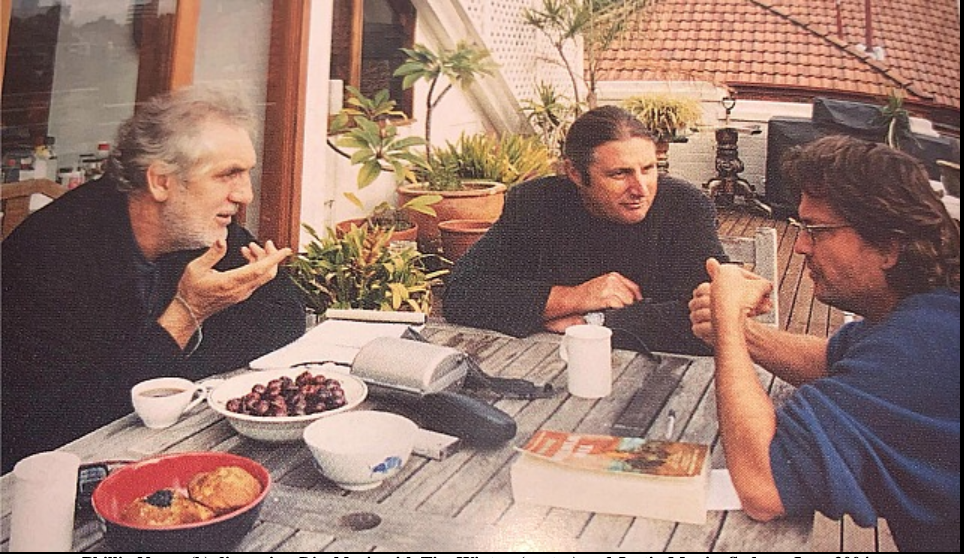
Phillip Noyce (l.) discussing Dirt Music with Tim Winton (center) and Justin Monjo. Sydney, June 2004.
Noyce had been working on a Dirt Music flick even before Winton’s novel became an Australian best-seller in ’02. He had the option to make a film version for roughly 11 years, from before publication until sometime in 2012. Noyce had wanted Rachel Weisz to play Georgie — she wound up being attached to the project for several years. In February ’07, with the project very much alive and ready to roll, Noyce ran into his leading man.
“One morning, walking with my coffee in Sydney, a Range Rover pulled up at a pedestrian crossing,” Noyce recalls. “Down came the window, and there was Heath Ledger. We agreed on the spot to shoot the film in Western Australia eight months later with Rachel.”
But the usual delays occured, and then Ledger died of an accidental overdose on 1.22.08. He was 28 years old.
“And I could never find the same spark for making the film with anyone else,” Noyce laments. “Not with Colin Farrell nor with Russell Crowe. No one could be the Luther Fox that Health showed me that morning in Sydney.”
In November 2011 Noyce asked Chris Hemsworth to play Luther for a shoot that would have begun in March 2013. That didn’t pan out either. Noyce’s option expired.
Along came Gregor Jordan. Jack Thorne (The Eddy) was engaged to write a new script. In August 2018 Hedlund and Macdonald were announced as the costars. Filming eventually happened in Kimberley, Western Australia, as well as Perth and Esperance.
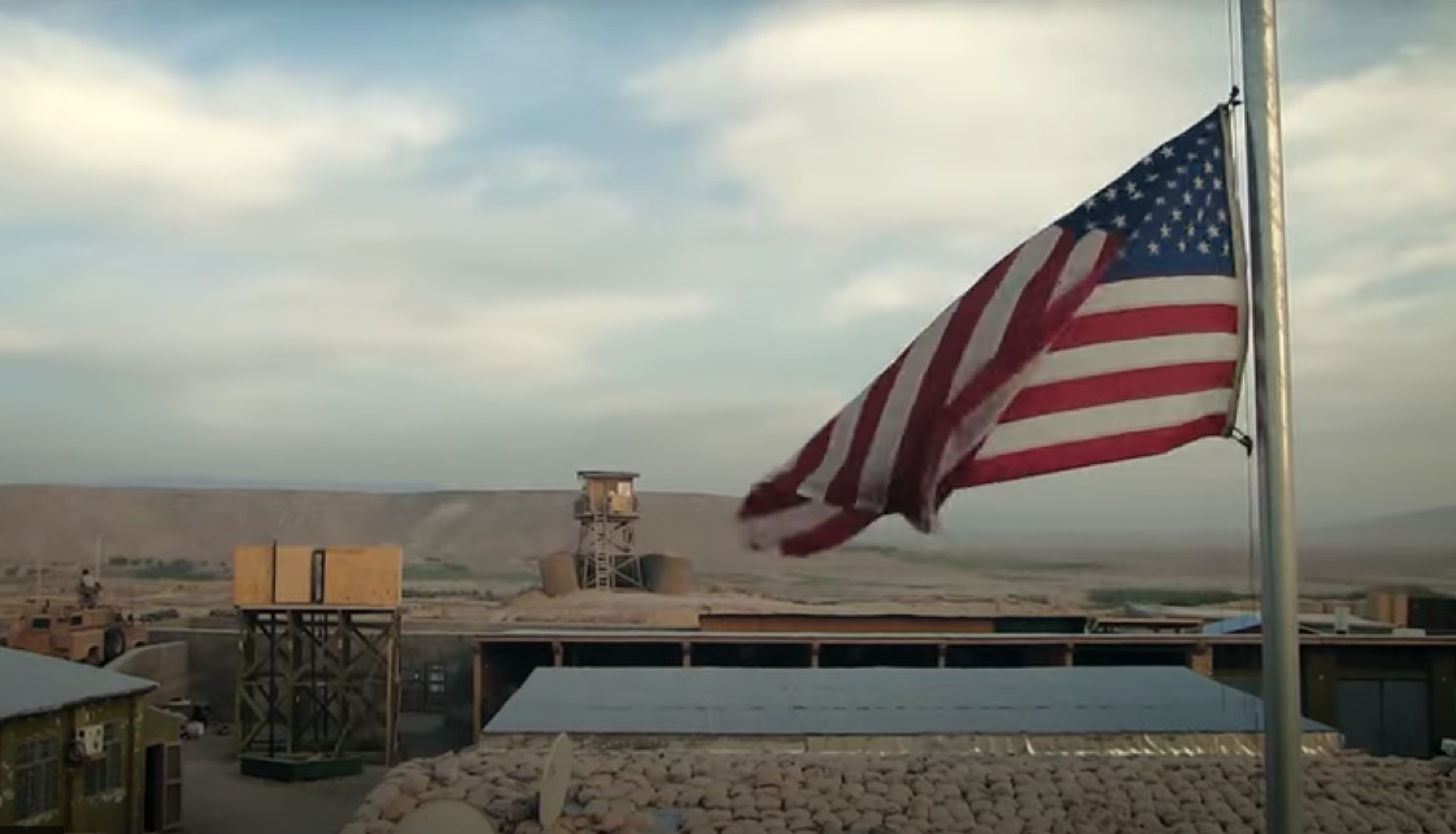
I’ve seen and sunk into Rod Lurie‘s The Outpost (Screen Media, 7.3), and I’ve tasted the panic and anxiety and sweat of it, and damned if this beautifully cut trailer doesn’t make me want to see the whole thing again. That’s salesmanship. Perhaps Michael J. Duthie cut this? Or some ad agency? Hats off to whomever.
So it appears that along with Russell Crowe‘s Unhinged Lurie’s Afghan war flick is going to be the first film “back”…right?
From “Good Film, Tough Break,” posted on 3.6.20: “A U.S. forces-vs.-the-Taliban war flick based on Jake Tapper’s book, The Outpost is a rousing, highly emotional drill into another tough battle that actually happened, and another example of the kind of combat flick to which we’ve all become accustomed — one in which the U.S. forces get their asses kicked and barely survive.
“Tapper’s same-titled book, published in 2013, is about the ordeal of U.S. troops defending Combat Outpost Keating. Located at the bottom of a steep canyon and absurdly vulnerable to shooters in the surrounding hills, the outpost was attacked by Taliban forces on 10.3.09. For a while there it was very touch-and-go. The base was nearly overrun. Eight Americans and four Afghans defenders were killed.
“Staff Sergeant Clint Romesha and Specialist Ty Michael Carter (respectively played in Lurie’s film by Scott Eastwood and Caleb Landry Jones) were awarded the Medal of Honor.
“The Outpost starts off, naturally enough, with a subdued queasy feeling of ‘okay, how long before the bad stuff starts?’ And then things start to go wrong vaguely, gradually, in small measures. Then it upshifts into unsettling (a name-brand actor buys it) and then bad to worse, and then worse than that. And then the bracing, teeth-rattling 30- to 40-minute finale.
“Lone Survivor, Hamburger Hill, Black Hawk Down, The Hurt Locker, In The Valley of Elah, Platoon, We Were Soldiers, Pork Chop Hill — American forces go to war for questionable or dubious reasons and the troops engaged get shot and pounded all to hell. Those who barely survive are shattered, exhausted, gutted. War is bad karma.
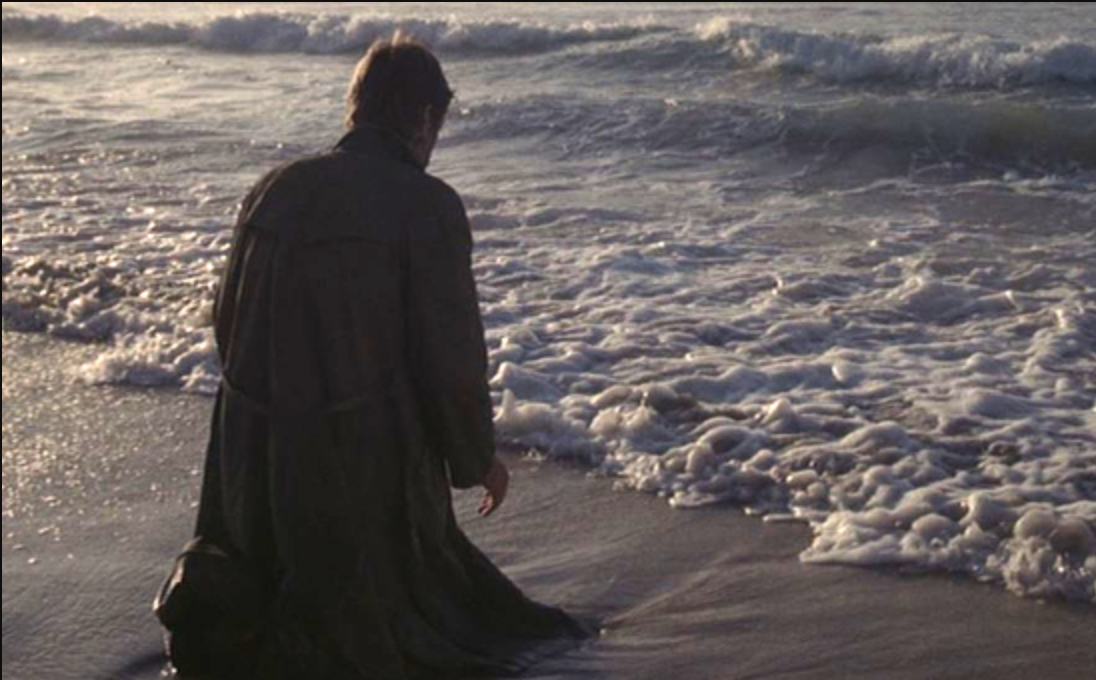
The night before last I was hook, line and sinkered by Peter Weir‘s The Last Wave (’77), which I’d found on the Criterion Channel. The last viewing was in January ’79, which is when it opened stateside. I remember calling a radio talk show that month from my Sullivan Street apartment and praising The Last Wave as “a thinking man’s disaster film.” Which it is.
It’s about an Australian tax attorney (Richard Chamberlain) engaged to defend four tribal Aboroginal males (one of them played by Walkabout‘s David Gulpilil) of a strange murder that didn’t involve weapons of any kind. The victim (another Aboriginal male) may have drowned, but another explanation is that he may have been spooked or hexed to death.
But the film isn’t about the charges as much as a sense of approaching catastrophic doom on a Biblical scale, and how the defendants seem to be much more in touch with the hums and portents of nature and how Chamberlain, who’s been “seeing” apocalyptic visions of floods and frog plagues, seems to understand this more and more as the film moves on.
It’s also about how Australia’s professional-class white-man culture is not only oblivious to what may be coming, but is perhaps the cause of it on some level.
In short, The Last Wave was one of the first “black man pure-of-spirit vs. white man corroded and evil” metaphor dramas. It’s very subtle and quiet for the most part, but at the same time quite spooky.
When a baseball game is delayed due to weather, the implication is that ticket holders should hang around as the wait will be relatively brief. But if a game is postponed, it means collect your stuff and head for the parking lot. Delay and postpone are technically synonymous, but the former means a presumably brief stall while a postponement sounds like someone has either thrown in the towel or is seriously thinking about it. Hence the title of this post.
HE to Academy: In this, the spring of our solitude and COVID discontent, the coming Oscar season is something we really need to celebrate and put our hearts into, now more than any other time in the Academy’s 93-year history. Especially with things starting to open up a bit and with the recent ruling that streaming-only films are Oscar-eligible.
We all need to adapt and stand up and gather round and support each other as best we can under the circumstances. It is our absolute responsibility to the industry and to ourselves to celebrate and champion and promote the hell out of the best movies being released by whatever means, now and forever, under any circumstances but especially in this, our time of industry need.
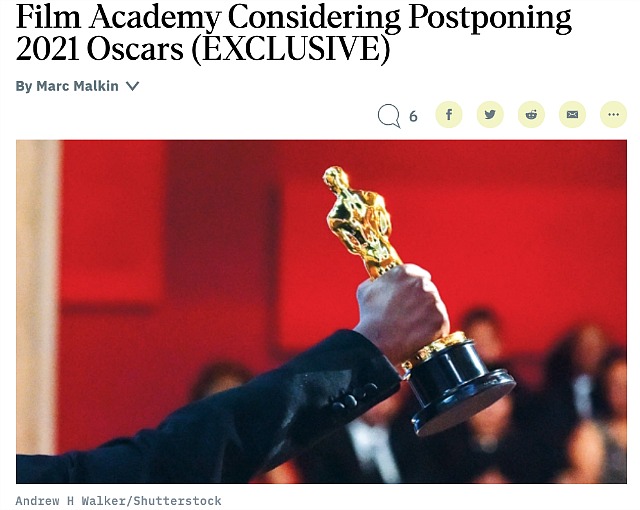
I am saying this because of a completely unacceptable Variety story by Marc Malkin that claims that “the Academy of Motion Picture Arts and Sciences is considering postponing the big night, according to multiple sources.”
Postponed until when? Delaying for a couple months, maybe, but otherwise no, no, no, no…NO! That is totally out of the question.
Malkin: “The sources, who spoke on the condition of anonymity, say definitive plans are far from being concrete at this juncture. The telecast is currently set for Feb. 28, 2021, on ABC.
“’It’s likely they’ll be postponed,’ one of the sources familiar with the matter told Variety.”
Malkin: “However, that person cautioned that the details, including potential new dates, have not been fully discussed or formally proposed yet. Another source says the date is currently unchanged at ABC.
“When new temporary rule changes for Oscar eligibility were announced in April because of COVID-19, Academy president David Rubin told Variety it was too soon to know how the 2021 Oscar telecast could change in the wake of the pandemic.
“’It’s impossible to know what the landscape will be,’ he said. ‘We know we want to celebrate film but we do not know exactly what form it will take.'”
HE to Academy: If and when COVID seriously inferferes until, say, mid-fall, one option would be to extend the 2020 Academy year until 1.31.21 or even 2.28.21. And then hold the Oscars in April, like they used to do in the early ’60s. Just this one year.
Malkin: “It’s unclear if postponing the Oscars will also mean that the Academy will allow films released after the year-end deadline to qualify for the 2021 Oscars.”
After filming in early ’18, Sony, Aaron Schneider and Tom Hanks‘ Greyhound, a CG-propelled WWII action thriller, was looking like a possible problem. Schneider fiddled and faddled in post for well over a year, and then came the COVID concerns. Sony’s initial plan was to release it on 3.22.20, then 5.8.20, and finally 6.12.20. Today TheWrap‘s Brian Welkreported that rather than sweat a streaming release, Sony has decided to sell the film to Apple TV for $70 million.
Sony honcho: “Let’s at least be frank with each other in the privacy of the conference room — our confidence in Greyhound isn’t what it could be.” Sony marketing team: “Arguably it has problems, but we need to give it the old college try. The glass is half full, not half empty.” Apple TV management (on speaker phone): “We’ll give you $70 million for it.” Sony honcho: “Sold!”
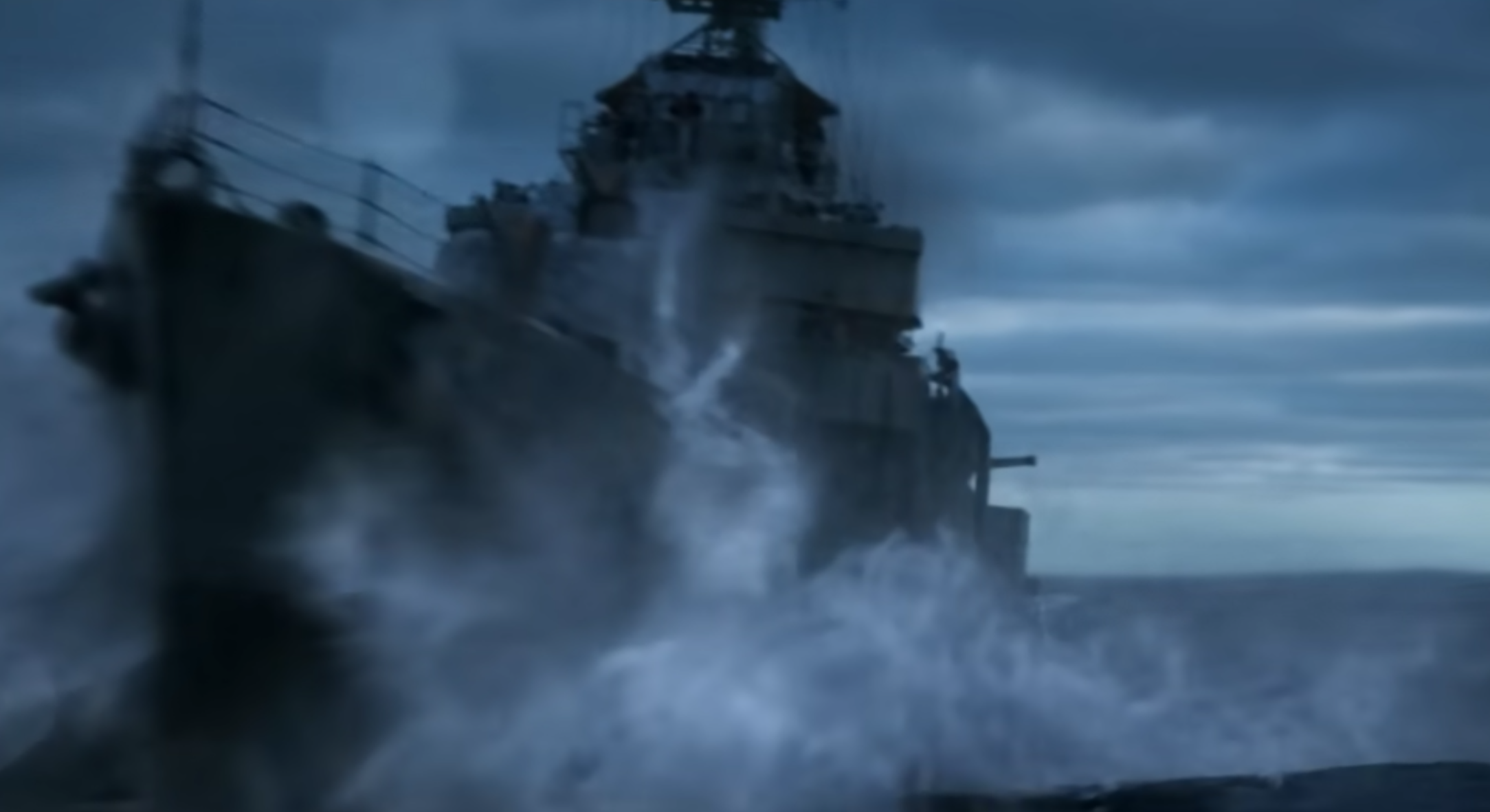
From “CG Action in the North Atlantic,” posted on 3.5.20: “Remember the mostly organic realism of Saving Private Ryan (’98)? Well, you can forget that aesthetic as far as Aaron Schneider‘s Greyhound (Sony, 6.12) is concerned. Yeah, it’s another Tom Hanks ‘dad’ movie (stolid guy, old-fashioned values, facing adversity and tough odds, grace under pressure) but if you ignore the interior shots, the Greyhound trailer looks like a damn CG cartoon.
“The phrase that’s coming to mind is ‘Call of the Wild on the North Atlantic’ — another digitally created, steroid-injected World War II film a la Roland Emmerich‘s Midway.
“Remember Mark Robson‘s The Bridges at Toko-Ri (’54)? Or Humphrey Bogart‘s Action on the North Atlantic? Or Cary Grant‘s Destination Tokyo? They were all mostly or partially shot on sound stages and ‘faked’ to a significant degree, but they nonetheless conveyed a certain tactile reality — a feeling that is plainly lacking in Aaron Schneider’s video-game fantasy, at least as presented in this trailer.
“Remember The Enemy Below? Or Otto Preminger‘s In Harm’s Way? Or Sink The Bismarck? Or Alfred Hitchcock‘s Lifeboat, which was shot entirely in a studio tank? These and other films presented at least a semblance of reality on the high seas during World War II. Real ships, real submarines, real salt water, real waves — not a Sony Playstation recreation.