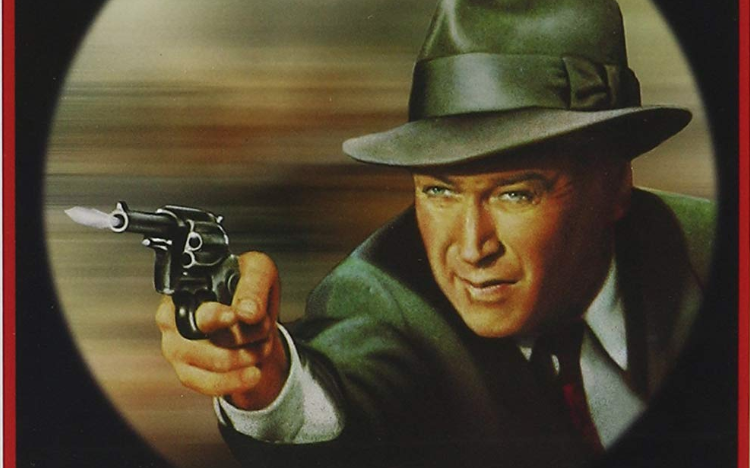
Serious Film Buff Hotel

A couple of days ago Paul Schrader suggested the idea of a movie-themed hotel. Some kind of flush establishment, he meant, that would offer exact duplicates of famous hotel rooms from classic films — the climatic 2001 hotel suite, The Shining‘s room 237, the bare-bones Phoenix hotel room where Marion Crane and Sam Loomis met for a lunch-hour quickie, “cabin” 1 at the Bates Motel, Eve Kendall‘s room at Chicago’s Ambassador East, etc.

A cool notion, Schrader concluded. Then he mentioned that he googled it and found that “someone else already had the same idea.”


Overlook Hotel’s room 237.

Actually, not quite. The movie-themed hotel suites profiled in Claire Trageser‘s 2.14.18 Travel & Leisure article (“These Movie-themed Hotel Rooms Will Bring Your Favorite Fantasy to Life“) were actually created for the rube tourist crowd. She describes rooms inspired by Talledega Nights, Star Trek and Spongebob Squarepants. She also describes some Harry Potter wizard chambers and Lord Vader‘s quarters (with a kid’s bunk bed?). You wouldn’t have to be an Okie from Muskogee to enjoy one of these abodes, but it would probably help.

In short, a serious film-theme hotel doesn’t exist.

If and when it ever happens, it should be located in the Hollywood Boulevard and Highland Ave. area. Hollywood Elsewhere would gladly consult on the particulars for a reasonable month-to-month fee. But it probably won’t happen because while the boobs may like movie-themed rooms, their prime concern is staying somewhere slick and swanky, and sometimes the concept would argue with that.

Which would mean no Touch of Evil motel room (i.e., the one in which poor Janet Leigh is taunted and almost raped by gang members) and no Psycho rooms (either the Bates motel or the Phoenix flophouse). And no replica of the cheap Times Square hotel where Jon Voight stayed until his money ran out. And no Judy Barton hotel room from Vertigo with green neon glaring through the window. Only deluxe accommodations!

Read more

A Lousy 14 Days?

Filed at 12:41 pm by Variety‘s Gene Maddaus: “Felicity Huffman was sentenced on Friday to 14 days in prison for the crime of paying $15,000 to boost her daughter’s SAT score. Judge Indira Talwani also ordered her to serve 250 hours of community service and a year of probation, and pay a $30,000 fine.

“’Trying to be a good mother doesn’t excuse this,’ Talwani said in issuing her verdict. ‘The outrage in this case is a system that is already so distorted by money and privilege in the first place…you took the step of having one more advantage to put your child ahead.’

“Huffman was ordered to report to prison on October 25.”

In order to prepare for the terrible trauma of serving a 14-day sentence, Huffman will submit to a special program of psychological boosting and positive-aura counselling. She’ll also take a crash course in defensive martial arts techniques in order to protect herself from vicious inmates. She’ll also watch several 1930s prison dramas starring James Cagney, George Raft, Humphrey Bogart and Spencer Tracy; she’ll also watch several babes-behind-bars exploitation films, including Jonathan Demme‘s Caged Heat. She’s also exploring writing a book about the ghastly horror of a two-week jail term. Her publisher has already inquired about promotional appearances on The View and The Ellen Show, and a possible endorsement by Oprah Winfrey’s Book Club.

Robert Mitchum to Felicity Huffman: “The prosecutors originally wanted you behind bars for two or three months, right? And then they dropped their recommendation to 30 days, and yet somehow your lawyer persuaded the judge to give you 14 days. And you’re crying? Back in ’48 I did 60 days in county for smoking a joint, and I did the time like water off a duck’s ass. Hell, I could’ve done 14 days while doing yoga handstands. I know that was 70 years ago and that admonitions like ‘be a man’ don’t fit into the 21st Century sensibility, but the more you just chill and take your medicine, the better you’ll look in the long run.”

Real-Time Battleground

Even though the teaser suggests otherwise, it’s generally understood that Sam Mendes1917 (Universal 12.25) will be presented in a single unbroken take a la Birdman. But until this morning, I didn’t realize that the film will also occur in “real time” — the running time corresponding more or less precisely to the time span of the depicted action.

I realized this when a friend sent me a 4.26.18 PDF draft of the script, co-written by Menzes and Krysty Wilson-Cairns, and I saw the following on page 3:

1917 is therefore joining a small fraternity of distinguished real-time films. Here’s a list of the best known, starting with the most highly regarded and working down. I’ve thrown in an estimate of the stopwatch accuracy of each:

1. Fred Zinneman‘s High Noon (’52) — The action doesn’t occur in actual, real-deal, stop-watch time, but it comes close. Will Kane and Amy Fowler’s marriage ceremony ends at around 10:35 am on a Sunday, and the telegram notifying Kane about the pardoning of Frank Miller is delivered at 10:40 am. The climactic shoot-out happens right after the arrival of the noon train, and by my calculations Kane throws his star into the dust about 12 minutes later. Add the opening-credits footage of the Miller gang meeting up and riding into town (roughly 140 seconds) and High Noon should last a minimum of 102 minutes, give or take. And yet it only runs 85 minutes.

2. Sidney Lumet‘s 12 Angry Men (’57) — The judge reads instructions to the jury sometime in the late afternoon, the jury retires to the deliberation room, and after some small talk and bathroom time they get down to business about 10 minutes later. They deliberate long enough for the sun to go down, for a rainstorm to hit and pass, for a discussion about ordering dinner, and for Jack Warden to miss out on his early-evening ball game. By my calculations this would take a minimum of two hours if not three, and yet the film runs 96 minutes.

3. Paul Greengrass‘s United 93 (’06) — In actuality the flight of United 93 from Newark Airport to Shanksville, Pennsylvania lasted 81 minutes — departure at 8:42 am, ground-slam at 10:03 am. The film lasts 110 minutes but that covers the hijackers saying early-morning prayers, the passengers waiting in the lounge and being seated, and the flight being delayed before takeoff. If you forget about the morning prayers the real-time count is fairly precise and on the money.

Read more

Gentle Reminder

On 6.30.16, or just before the opening of Justin Lin and J.J. AbramsStar Trek Beyond, I posted an imaginary chat between Abrams and Albert Brooks about who and what Lin really was. (The dialogue was mostly stolen from a scene between Brooks and Holly Hunter in Broadcast News.) I’m mentioning this because I’ve taken a fresh look at Lin’s track record since his brilliant 2002 break-out film, Better Luck Tomorrow, and over the course of 17 years he’s either directed or is set to direct seven (7) fast-car movies…seven! In other words, with one or two exceptions Lin has almost always gone for the high-octane, bucks-up jizz whizz. If I was harsh or mean-spirited I would conclude that such a fellow is spiritually lacking on some level, but I wouldn’t want to sound too on-the-nose.

Demented Critical Judgment

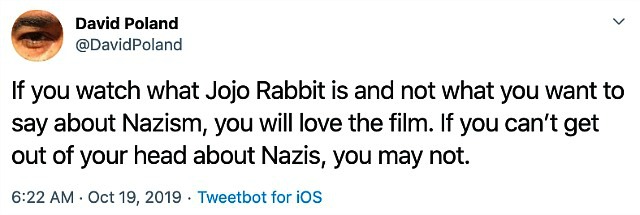
Strangely, curiously, some Toronto-attending journos have suggested that critically shellacked JoJo Rabbit might somehow become an Oscar hottie. The reason, apparently, is because it takes a bold stand against hate!

This is demented, of course. So many critics these days are willfully forsaking considered critical judgment in favor of yea/nay responses about whether or not a film is saying the right thing according to preferred political currents. And it’s nuts. We’re living through such derangement.

Most sage observers (i.e., myself among them) are sensing that Jojo Rabbit is probably finished as a potential awards nominee. Not with an aggregate Metacritic rating of 50…no way. A potential hit with younger viewers? Maybe.

THR‘s Scott Feinberg: “For some potential viewers, Waititi’s association with Jojo Rabbit is enough to get them to show up to see and, in some cases, to gush over the film, as many certainly did at its world premiere, where it was very warmly received.

“But the next day it clocked in at a terrible 55 percent on Rotten Tomatoes (not helped by the fact that all of the characters seem to speak with different accents), a range from which very few films have ever emerged to receive major Oscar recognition (it is now up to 75 percent, which is better but still not great). There are certainly aspects of the film that are strong — Sam Rockwell‘s crazy performance and Thomasin McKenzie‘s quiet one, the colorful production design, etc.

“But at the end of the day, I just cannot see Academy members gravitating to the film itself in large numbers.”

4K “Vikings” Climax

“The other thing that still works in The Vikings‘ favor is the film’s refusal to dramatically amplify the fact that Kirk Douglas‘s Einar and Tony Curtis‘s Eric, mortal enemies throughout the film, are in fact brothers, having both been sired by Ernest Borgnine‘s Ragnar.

“Ten minutes from the conclusion Janet Leigh‘s Princess Morgana begs Douglas to consider this fraternity, and he angrily brushes her off. But when his sword is raised above a defenseless Curtis at the very end, Douglas hesitates. And then Curtis stabs Douglas in the stomach with a shard of a broken sword, and Douglas is finished.

“The way he leans back, screams ‘Odin!’ and then rolls over dead is pretty hammy, but that earlier moment of hesitation is spellbinding — one of the most touching pieces of acting Douglas ever delivered.

“I’m not trying to build The Vikings up beyond what it was — a primitive sex-and-swordfight film for Eisenhower-era Eloi. But it did invest in that submerged through-line of ‘brothers not realizing they’re brothers while despising each other’, and the subtlety does pay off.” — originally posted on 3.27.06, on the occasion of Richard Fleischer‘s passing.

Too Weird To Win Best Actor Oscar?

Or, to put it another way, is Joaquin Phoenix too honorably eccentric to play the old Academy kiss-ass game during the season? He obviously hates it already and it hasn’t even begun.

[3:37 mark] “I don’t know who’s really giving me this award or why. In fact, I don’t care. My publicist said somebody wants to give me an award and I said, ‘I’m in, let’s do it.’ Honestly, I thought I was gonna come out and just make a lot of tasteless jokes at my expense and yours, but watching those clips — I’m so embarrassed to admit this, but — I feel overwhelmed with emotion, because I just think about all the people that had such a profound influence on me throughout my career.”

“What?”

It is my firm conviction that Willem Dafoe‘s performance as “Thomas Wake” (aka the 50ish bearded salty dog who talks in colorful, 19th Century Herman Melville-ese) in Robert Egger‘s The Lighthouse (A24, 10.18) will absolutely become a nominee for Best Supporting Actor — mark my words.

From “This Way Lies Madness”, posted on 5.19.19: “Robert EggersThe Lighthouse “is an absolute masterpiece — a tale of slowly burgeoning madhouse by way of isolation, booze, demons and nightmares. It contains Robert Pattinson‘s finest role and performance ever, but Willem Dafoe‘s old bearded sea dog matches him line for line, glare for glare, howl for howl.

“This 35mm black-and-white masterwork (projected in a 1.2:1 aspect ratio) is really about a battle of performances as well as a fight between earthly duties and the madness of shrieking mermaids and visions of King Triton. Nightmares au natural but full of ancient myths and fables. Totally 19th Century in terms of atmosphere, set design and especially in the Melville-like dialogue, co-written by Egger and his brother Max. Jarin Blaschke‘s cinematography is an instant classic in itself.”

A24 will release The Lighthouse on Friday, 10.18.

On The Toronto Demise of “Jojo Rabbit”

The press and marketing hype that has been inflating expectations for Taika Waititi‘s Jojo Rabbit (Fox Searchlight/Disney, 10.18) collapsed in a heap after last night’s Toronto Film Festival screening. Early reviews suggest that the broad “anti-hate satire” may find favor among younger audiences and perhaps the New Academy Kidz, but the over-40 contingent will be frowning and tut-tutting for the most part.

Right now Jojo has a 55% rating at Rotten Tomatoes and 49% score with Metacritic. Do those numbers indicate an Academy contender or perhaps a box-office go-getter? I don’t want to be the one to say it.

Jojo is a totally irresponsible movie. The amount of anti-Semitic and Holocaust jokes played for laughs is disturbing.” — World of Reel’s Jordan Ruimy.

“This spectacularly wrongheaded ‘anti-hate satire‘ (as per the how-the-hell-do-we-market-this-thing? ad campaign) is the feature-length equivalent of the ‘Springtime for Hitler’ number from Mel BrooksThe Producers, sans context and self-awareness. It takes place in a goofball period la-la land of its own creation, with sets as minutely detailed and shots as precisely composed as those in a Wes Anderson fantasia. Indeed, Jojo Rabbit suggests what that dapper hipster auteur might generate if he was to remake Elem Klimov’s hallucinatory, horrifying World War II epic Come and See, and that’s not a compliment.” — Slant‘s Keith Uhlich.

“Taking straight from the Chaplin playbook, Waititi’s Hitler is a Mr. Bean-esque figure, hammed up to eleven as the invisible friend of young Jojo Betzler (Roman Griffin Davis). He leaps around, talks in a thick approximation of a German accent and encourages young Jojo to be the best little Nazi in the whole of the Third Reich. He is, undoubtedly, the worst thing about the film — distracting and one-note. It is possible to parody Hitler successfully, but in leaning too heavily on basic mockery, there’s nothing new that this performance brings to the table.” — Little White LiesHannah Woodhead.

“[Waititi’s decision to play a fantasy Adolf Hitler buddy figure] often feels like a way of distracting us from the truth, an elaborate smoke and mirrors act to fool us into believing Jojo Rabbit has something new to offer. Because while there are some initially amusing moments given the outlandish conceit, Waititi doesn’t really know what to do with his imaginary Hitler past an increasingly repetitive cycle of decreasingly funny acts of idiocy. He’s essentially a single sketch character and while Waititi plays him well, there’s only so much we need of him.” — The Guardian‘s Benjamin Lee.

Read more

Historical Aromas

West Hollywood has several classically designed apartment buildings (old Spanish, brick and stucco, shaded patios with fountains). I’m speaking of the area south of the Strip, north of Fountain and west of Fairfax, and principally on Laurel, Hayvenhurst, La Jolla and Harper Avenues. You can really feel the history and the ghosts, especially if you do a little research beforehand. The Strip was definitely cooler back in the ’20s, ’30s, ’40s and early ’50s. Preston SturgesThe Players, the Garden of Allah apartment complex, etc.

After eating last night at the decent but unremarkable Wokcano (Sunset and Crescent Heights, site of the old Schwab’s Pharmacy), Tatyana and I did a little strolling around. We didn’t do the whole classic-era tour but we hit three buildings.

First was the Villa d’Este, a beautiful Spanish-style apartment complex (arched entrance way, lots of palm trees, centrally located patio fountain) located at 1655 No. Laurel. Then we visited the 90-year-old Villa Primavera courtyard apartments (corner of Harper and Fountain), otherwise known as the In A Lonely Place residence where director Nicholas Ray actually lived. And then across the street to the Romanesque Villas (1301 No. Harper), where Marilyn Monroe lived around the time of The Asphalt Jungle.

The Villa d’Este was the setting of Under The Yum-Yum Tree (’63), a negligible Jack Lemmon horndog comedy. Never seen it, never will. The trailer is very convincing.

Lemmon was the hottest guy in Hollywood after starring in the one-two punch of Some Like It Hot (’59) and The Apartment (’60), both directed and co-written by Billy Wilder. Because the latter mixed ascerbic humor and frankly sexual situations, Lemmon was offered almost nothing but frothy sex comedies for five years following The Apartment. The only decent film he made during this period was Blake EdwardsDays of Wine and Roses(’62).

The sex comedies were The Wackiest Ship in the Army (’60), The Notorious Landlady (’62), Irma la Douce (’63, minor Wilder), Under the Yum Yum Tree (’63), Good Neighbor Sam (’64) and How To Murder Your Wife (’65). He also costarred that year in The Great Race, a period costume comedy about arch humor, empty artifice and scenic splendor.

Lemmon finally broke out of that shallow, synthetic cycle with Wilder’s The Fortune Cookie (’66). Not grade-A Wilder but certainly half-decent, and a great boost for Walter Matthau. And then Luv, The Odd Couple, The April Fools, The Out-of-Towners, Kotch, Avanti! and Save the Tiger. And then he hit another wall with Wilder’s The Front Page.

Read more

Many Indiewire Reviews Are Woke-Filtered

The common assessment is that Indiewire‘s Eric Kohn is absolutely top tier — one of the most sage and sophisticated critics out there. He has long been recognized as such. And David Ehrlich is also quite the steady and perceptive fellow, and generally an excellent writer — engaging copy just pours out of the guy. And Kate Erbland is…well, consistent.

But I have to be honest and admit to certain premonitions that kick in before I read almost any Indiewire review, and certainly reviews of films that lay claim to any degree of social realism.

My gut belief is that Indiewire assessments of films are first and foremost about “how woke is this?” and secondly about “how good is this?” I realize that to some HE regulars this may sound like one of the biggest “duhhh” observations I’ve ever posted, but it never hurts to reiterate. On top of which this is Sunday.

Kohn, Ehrlich and Erbland may vigorously dispute this view (I’d be hugely surprised if they didn’t) but I’ve been sensing over and over that Team Indiewire is always asking itself “are the attitudes and perceptions in this film sufficiently enlightened by SJW virtue-signalling standards?”

I believe this mindset is a big part of how they see things. Call me overly cautious or even timid for phrasing this viewpoint as carefully as I have here. To some Indiewire‘s “totally in the woke tank” approach is as obvious as the sky.

I fully admit that this impression could be proven erroneous if someone were to conduct an exhaustive inventory of all their reviews over the last two or three years (and certainly since the advent of the movement that was largely ignited by the historic 10.5.17 N.Y. Times story that brought about the fall of Harvey Weinstein.

I’m just saying that one way or the other I can always feel the presence of a woke measurement stick every time I read a Kohn, Ehrlich and Erbland review.

Should woke sticks be put aside when reviewing a film or anything else? Of course not. Every interesting or pertinent consideration under the sun should be included in any intelligent, fully considered review, column-inches warranting. I just happen to feel that a film’s wokeness (of lack thereof) isn’t the meat of the matter. But it sure seems to be a big deal at the woke-iest movie site on the planet.

If someone were to write a woke reassessment of all significant Hollywood-generated films of the 20th Century and the first 15 years of the 21st Century, would it sell? Maybe or maybe not, but reading such a book would almost certainly give me a headache.