“Vice” on a Sunday Morning

Adam McKay‘s Vice (Annapurna, 12.25) is a brilliant, slash-and-burn, hellzapoppin’ portrait of deliciously ruthless schemin’, schemin’, schemin’ like a demon. And it’s great rightwing fun for the most part — witty, wicked and wonderfully cruel. How we fucked ourselves and bought the WMD bullshit and murdered tens of thousands and bombed the hell out of Iraq and created ISIS in the bargain, etc.

The primary object of scorn and fascination, of course, is former vp Dick Cheney (fully inhabited and reanimated by Christian Bale, as you may have heard) but the film teems with a whole cavalcade of conservatives…a whole kill-or-be-killed universe of conniving super-serpents who’ve risen and slithered over the last half-century (George W. Bush, Donald Rumsfeld, Scooter Libby, Paul Wolfowitz, Antonin Scalia, Frank Luntz) along with Dick’s go-getter wife Lynne (Amy Adams) and their daughters Mary and Liz (Allison Pill, Lily Rabe).

Really and truly, the gang’s all here and it’s all fun, fun, fun. Or it was for me, at least.

Vice costar Amy Adams, director-writer Adam McKay following this morning’s screening at the SVA theatre on West 23rd street.

“Fun” in a downishly deadpan sort of way, of course, because we’re talking about the balls-out career of a really shitty, cold-blooded human being as well as the collapse of the twin towers, the imagining of WMDs and the invasion of Iraq and all the horrors and cold-cockings and focus-groupings and flat-out lying that followed. Not to mention the smirking and jaw-clenching.

And it’s all so precise and scalpel-like, so dry and cutting and laser-focused. It’s a movie that says “Dick, Dick…what a dick!” As well as “you guys out there, the ones eating the popcorn…you fucked yourselves and our country by electing these assholes…you know that, right?”

And stylistically Vice is all over the place so you don’t know where the hell to turn. It fully cops to being a “movie” from the get-go, offering a narrator while reversing and fast-forwarding, delivering a blatantly phony ending at the halfway mark, always smirking, full of self-regarding commentary, double-backing and hop-scotching around…it’s instructional with a bullwhip.

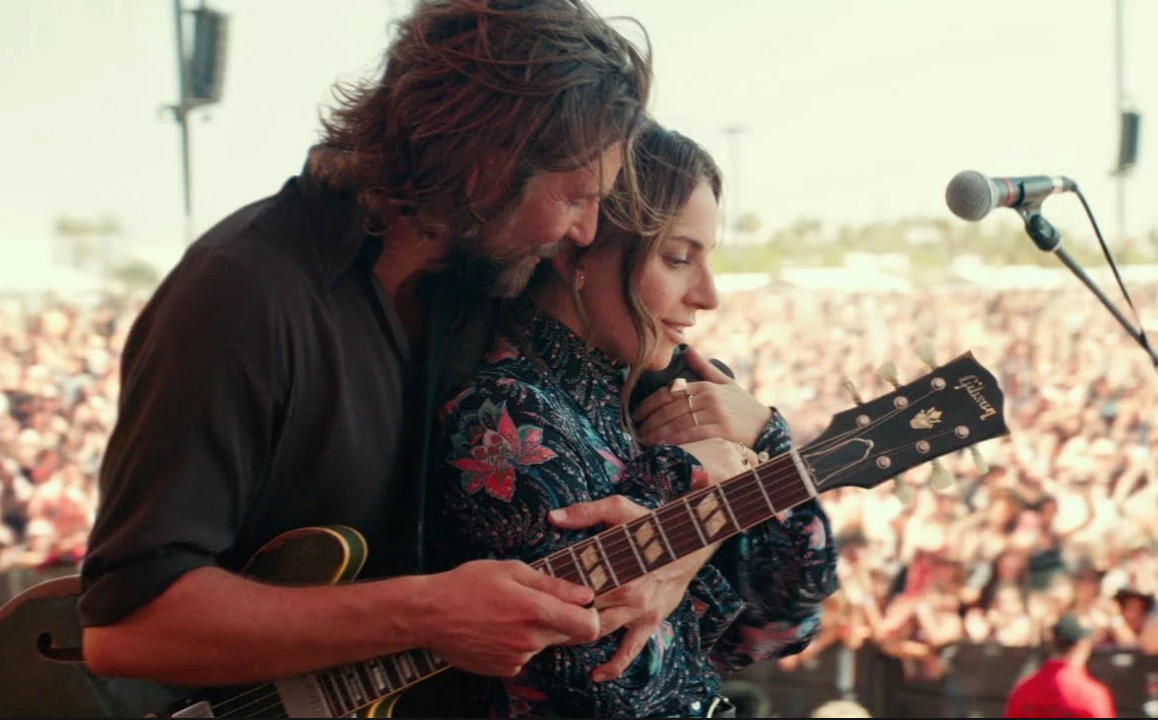
Bale will land a Best Actor nomination and deserves to win it, if you ask me. You can’t help but marvel at the voice, the attitude, the physical transformation…all of it. Bale sure as hell has done more than deliver a first-rate impression of Kris Kristofferson in the ’76 version of A Star Is Born, which is arguably what his principal competitor has been praised for.

Adams, count on it, will definitely be nominated for Best Supporting Actress. She glares, she snaps, she takes no shit.

Read more

Tropical Island Movies Are A Dead-End

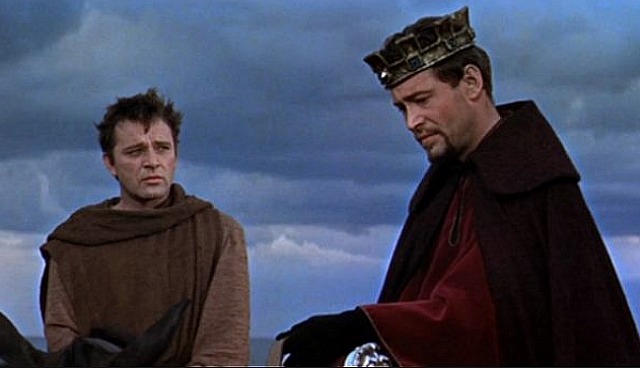
Director Nicolas Roeg has passed at age 90. Hugs and condolences to all concerned. Then again he lived a long, colorful life (born in ’28) and enjoyed a good creative period as a cinematographer during the ’60s (Lawrence of Arabia, Doctor Zhivago, Petulia) as well as a flush directing streak in the early to mid ’70s. No sadness in that.

Roeg’s finest three films, of course, are Walkabout, Don’t Look Now and The Man Who Fell to Earth. And also, don’t forget, Performance, which he partly directed with Donald Cammell. I’m sorry but I was never down with the creepy Bad Timing or the twitchy Alaskan prospector flick, Eureka, which starred Gene Hackman. Nor was I into Insignificance, his light-hearted Albert Einstein movie.

I was, however, half-taken with Castaway, which I wrote the press notes for while working for Cannon publicity. My phone interview with Oliver Reed didn’t go well — I tried not to rub him the wrong way but I said something about his character being a bit of a lazy sod. Things went downhill from there on.

Kael vs. Eastwood

Clint Eastwood made his bones in the ’60s and ’70s with brutal, emotion-less dispensations of violence — by projecting a capability and willingness to drill the bad guys between the eyes without blinking an eye and certainly without giving it much thought. He wasn’t as much two-fisted as big-gunned, and he sure as hell blam-blammed a whole lot of guys during his “Man With No Name” meets Dirty Harry heyday, and with rightwing justifications, of course. “You fuck with me, you’ll pay the price.”

He was never anyone’s idea of a great or highly skilled actor, but he always knew how to deliver that silent, steaming-radiator thing and was certainly effective within his range. I think his Unforgiven performance (i.e., the snarly Bill Munny) was actually pretty close to great, partly because of (a) “helluva thing, killin’ a man,” “(b) “we all got it comin’, kid” and (c) how that final shoot-out scene draws upon our collective memory of the snarly guy he was in the Nixon, Ford and Carter eras.

But when we think of Eastwood we mainly sink into a soothing impression that took hold in the early to mid ’90s, which was when he suddenly became this exalted, almost mythical-level actor and director — one on hand with his aging, guilt-ridden secret service agent in Wolfgang Petersen‘s In The Line of Fire (’93) and on the other as the director who delivered the one-two punch of Unforgiven (’93) and The Bridges of Madison County (’95).

And at the same time his reputation as a likable, laid-back, salty-haired guy who always shot films fast and unfussy and who occasionally described himself as an Eisenhower Republican…all of that sunk in too. Even his briefly warming to Sarah Palin + talking to the empty chair thing…even that didn’t dispel the genial vibe.

And here we are on the 2018 home stretch and still no word of any Mule screenings, which reenforces suspicions that it’s probably nothing too special, even with Eastwood giving what may be his last performance…who knows?

Animation Is Animation

I saw Disney’s 1994 animated-cartoon Lion King (decent enough but calm down), and then I took the kids to see the Lion King Broadway musical sometime in the spring or summer of ’98 (okay but enough already). Now I’m supposed to get excited 20 years later over yet another version of the ’94 original because the CG animation techniques are live-actiony?

The family crowd will pour into the plexes, but the “lion cub destined to be king of the animals gets banished by his evil uncle” story has always been ridiculous. Lions are predators who are out to fill their bellies so why the hell should various African species bow down to a killing beast who would just as soon eat them as look at them? Bambi made some kind of sense — this doesn’t.

Yeah, yeah…I get it. This is a movie about proud African heritage and manifest destiny — a talking-animal version of Black Panther.

Read more

What Happened To Poor “Widows”?

So Steve McQueen’s Widows underperformed last weekend. On 11.15 The Hollywood Reporter‘s Pamela McClintock wrote that Widows was “tracking to bring in between $12 million and $18 million in its domestic launch.” It wound up making $12.3 million in 2803 theatres for a per-screen average of $4388, or something close to that. If it earns triple that amount in domestic theatres it’ll wind up with $37 million and change. It cost $42 million to make, not to mention the marketing.

I’ve said a few times that Widows is one of the best heist films I’ve ever seen and that Viola Davis delivers an award-calibre performance. But those numbers are disappointing. Who saw it last weekend, and what was the takeaway?

Sugar Pain

In an 11.19 Criterion essay on Some Like It Hot, Sam Wasson writes that director-cowriter Billy Wilder had relatively simple things on his mind. “[He] thought cross-dressing was funny. He thought Americans, dizzy in the rat race, were funny.” Like when Tony Curtis says to Jack Lemmon, “You’re a guy, and why would a guy want to marry a guy? and Lemmon answers “Security.”

“That’s Wilder capitalism speaking,” says Wasson. “Not love or lust or even man or woman.”

But then Wasson screws up. “Some Like It Hot isn’t Tootsie,” he declares. “It’s not interested in how the experience of being a woman can make men better men.” Nope — exactly wrong.

Curtis’s Joe is a rake and a cad — a “love ’em and leave ’em” type, a nookie hound, literally the kind of guy who might borrow money from a girlfriend in order to bet on horses.

Then, dressed as “Josephine”, he meets Marilyn Monroe‘s Sugar Kowalczyk on the train, and she tells him about her run of bad boyfriends, and how one threw cole slaw in her face and left her with a squeezed-out tube of toothpaste.

Undaunted, a couple of days later Joe cons Sugar into falling for him by pretending to be an oil millionaire (i.e., “Junior”). Another notch on the bedpost.

But when Joe and Jack Lemmon‘s Jerry are forced to lam it (Spats Columbo!), Joe feels badly about lowering the boom. He gives Sugar the diamond bracelet that Joe E. Browne‘s Osgood had given to “Daphne.” A couple of hours later Joe (dressed as Josephine) sees Sugar singing “I’m Through With Love” on the bandstand, and the guilt sinks in. Wilder’s camera holds a very long shot of Curtis feeling quite badly about breaking Sugar’s heart. So badly that he risks his life by walking up on stage and kissing her goodbye.

Saxophone Joe would’ve never risked his neck for a dame, but “Josephine” does. After playing the field and treating women like shit he’s seen “how the other half lives,” and becomes, you’d better believe, a better man for that.

HE to Wasson: Sydney Pollack got the above-referenced idea for Tootsie from Some Like It Hot.

The Haters Are Due on Maple Street

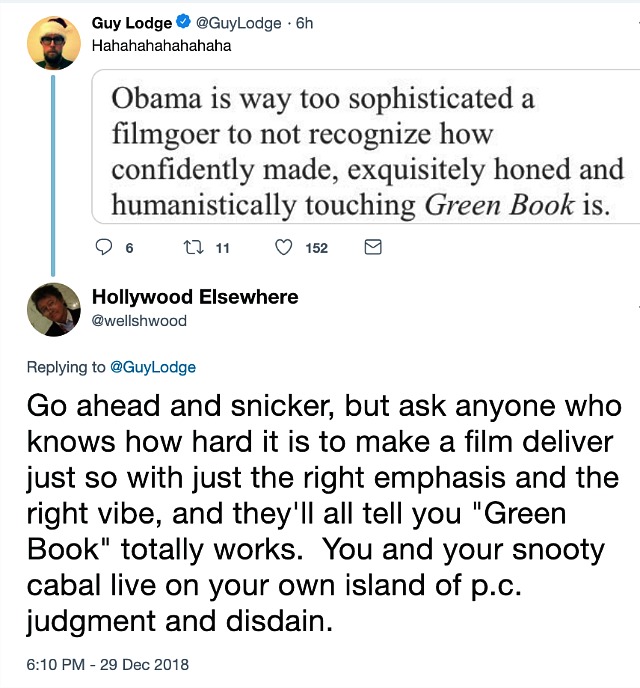
The film-snob knives are out for poor Green Book, and what an experience it is to read what some of these politically correct assassins have to say…delightful!

God, what it must be like to live in their heads, to snort derisively at an old-fashioned buddy film that isn’t out to hurt or diminish anyone or to roll back the culture in any way, shape or form, and which — burn it at the stake! — deals dry, straight, under-stated cards.

Shadow and Act‘s Brooke Obie has called Green Book a “poorly titled white savior film,” and Slate‘s Inkoo Kang is more or less on the same page.

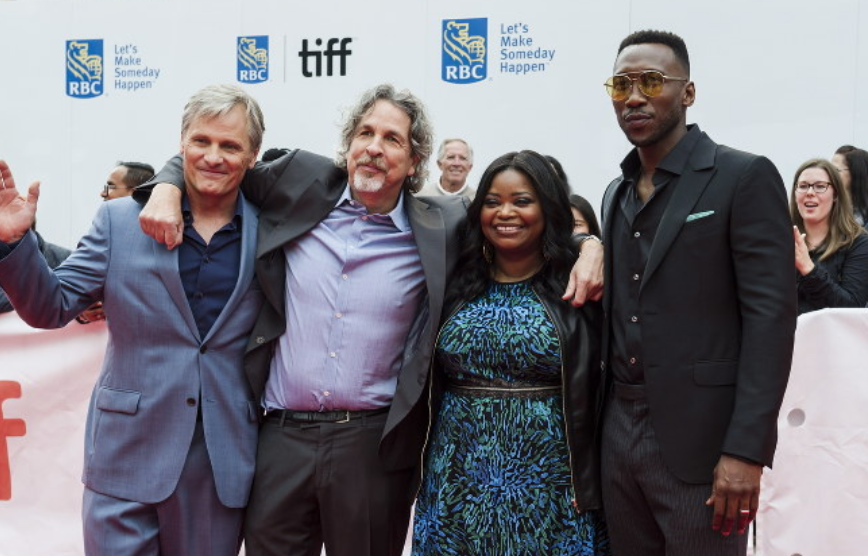
I don’t hold with the idea of anyone saving anyone else in this modest little flick, but if we must go there it’s Mahershala Ali‘s Don Shirley who rescues Viggo Mortensen‘s Tony Lip and not the other way around. I don’t personally think Peter Farrelly‘s film is about salvation as much as plain old respect, kindness and compassion. But that’s me.

[Click through to full story on HE-plus]

Shame on Gold Derby Gang

All through the season the Gold Derby no-accounts have refused to include Paul Schrader‘s First Reformed, easily and absolutely one of the year’s ten-best, on their Best Picture spitball lists. Worse, they’ve also declined to list Ethan Hawke‘s landmark performance as a projected Best Actor nominee. Both for the perfectly idiotic reason of isolating any film that opened before Labor Day as a non-starter.

And now their cavalier, herd-following way of thinking has been embraced by the 2018 Spirit Awards nominations with four or five nominations having gone to First Reformed. Which of course seals its Oscar fate.

From here on guild and Academy members will be saying to each other, “Yeah, Schrader’s film is obviously striking and quite the career comeback and Hawke may have delivered his career-best performance, agreed, but First Reformed is a Spirit Awards thing….not in our realm.”

Shame on the Gold Derby-ites for ghetto-izing this great Bressonian film and kicking it downstairs.

Get Over It!

In case some Academy members haven’t noticed, mainstream theatrical fare has severely devolved over the past 15 years. Almost everything made by the big studios is aimed at families and submentals, and almost all adult material (except during Oscar season) has been shunted off to cable and streaming. So out of this desert comes (among other streaming companies) Netflix, which believes in backing ambitious, adult-level features…hooray!

Netflix has recently even caved on its standard financial scheme of streaming films right off the bat from day #1, to the extent that it won’t be streaming its prize Oscar pony, Alfonso Cuaron‘s Roma, until it’s played in select theatres for a couple of weeks. I’m sorry but that’s a highly significant concession for a company like this.

And some people are giving Netflix shit over this? Somebody actually accused their willingness to go theatrical of being a “con” because they’ll be four-walling?

Netflix is investing in real movies, for God’s sake. They’ve produced the latest Coen brothers film, which at the very least is diverting and handsome as hell to look at. They backed that problematic Orson Welles film, The Other Side of the Wind, and Morgan Neville‘s They”ll Love Me When I’m Dead. They may not be the most theatrical-minded people in the industry, okay, but we’re living in a streaming world now, for God’s sake…wake up! There’s a distinct shortage of good-guy outfits in the business right now, and Netflix is certainly one of them

I was inspired to post this by two recent irritating articles — Erich Schwartzel‘s 11.17 Wall Street Journal piece, “Netflix Sees Oscar Gold in Roma, but Hollywood Isn’t So Sure,” and Rebecca Keegan‘s 11.14 Hollywood Reporter essay, “How the Oscar Race Became a Referendum on Netflix.”

Bill Maher Is Allowed To Say This

The across-the-board worshipping of the late Stan Lee and the corresponding corporate Marvel-ization of mainstream motion picture fare cannot be separated. Deny it or not, but these two things have happened due to an outgrowth of mass infantilization and the increasing influence of fanboy culture, which has been happening since the explosion of wide-release, teenage-catering entertainments (Jaws, Star Wars) in the mid ’70s.

It is therefore allowable for Bill Maher to have written what he wrote this morning about the Stan Lee effect. Just shut up and take it. We’re supposed to be be okay with differing opinions in our country so act that way.

“The guy who created Spider-Man and the Hulk has died, and America is in mourning,” Maher wrote. “Deep, deep mourning for a man who inspired millions to, I don’t know, watch a movie, I guess.

“Someone on Reddit posted, ‘I’m so incredibly grateful I lived in a world that included Stan Lee.’ Personally, I’m grateful I lived in a world that included oxygen and trees, but to each his own. Now, I have nothing against comic books — I read them now and then when I was a kid and I was all out of Hardy Boys. But the assumption everyone had back then, both the adults and the kids, was that comics were for kids, and when you grew up you moved on to big-boy books without the pictures.

“But then twenty years or so ago, something happened — adults decided they didn’t have to give up kid stuff. And so they pretended comic books were actually sophisticated literature. And because America has over 4,500 colleges — which means we need more professors than we have smart people — some dumb people got to be professors by writing theses with titles like ‘Otherness and Heterodoxy in the Silver Surfer‘. And now when adults are forced to do grown-up things like buy auto insurance, they call it ‘adulting’ and act like it’s some giant struggle.

“I’m not saying we’ve necessarily gotten stupider. The average Joe is smarter in a lot of ways than he was in, say, the 1940s, when a big night out was a Three Stooges short and a Carmen Miranda musical. The problem is, we’re using our smarts on stupid stuff. I don’t think it’s a huge stretch to suggest that Donald Trump could only get elected in a country that thinks comic books are important.”

HE context entry #1: Remember what Watchmen creator Alan Moore said nine years ago, to wit: “The average age of the audience now for comics, and this has been the case since the late 1980s, probably is late thirties to early fifties — which tends to support the idea that these things are not being bought by children. They’re being bought in many cases by hopeless nostalgics or, putting the worst construction on it, perhaps cases of arrested development who are not prepared to let their childhoods go, no matter how trite the adventures of their various heroes and idols.”

Read more

Goldman Ascends

I’m very sad and sorry about the passing of William Goldman, whom I respected enormously as a screenwriter and book author, and whom I actually knew on a personal basis.

We were hardly “close” — we never talked about the difficulty of writing or women problems or anything personal. But I felt that I genuinely knew Bill as a human being, at least to some degree. I always felt settled and relaxed in his presence. And he seemed to have a certain regard for me also. At least to the extent that he took me to lunch four or five times, and always at the same elegant Upper East Side eatery that was near his apartment.

I felt profoundly honored that the writer of Butch Cassidy and the Sundance Kid, The Hot Rock (one of my all-time favorite ’70s films), Marathon Man and All The President’s Men read and admired my column. I once told myself “Jesus, I’ve gotta be doing something right if Goldman likes what I’m doing.”

We began our occasional correspondence (a phone call now and then, back-and-forth emails when something had happened) sometime in the early to mid ’90s, or when I was writing and reporting for Entertainment Weekly and the L.A. Times Syndicate. But we didn’t actually sit down and break bread until ’06 or ’07, or after Goldman became a regular Hollywood Elsewhere reader.

The only time our relationship hit a ditch was when I told Goldman that I didn’t much care for Hearts of Atlantis (’01), the Anthony Hopkins film based on a Stephen King novel. He didn’t speak to me for several months after that.

He always called me “Jeffrey” — never Jeff. He invited me up to his place once, and I remember there was a kind of shrine to Butch Cassidy as you walked through the main door. And who could blame him?

The last time I saw Goldman was at a press luncheon at 21, maybe six or seven years ago. He was sitting at a table with Joan Didion. The room was noisy and chattery and it was hard to say anything that mattered, but I belted out a hale and hearty “hey, Bill!” He looked at me with a slight smile and a slight nod. And that was it. We didn’t correspond again. And I’m sorry about that.

There’s a DVD documentary about Gunga Din, and Goldman’s commentary about that 1939 film is so eloquent when he explains why some people are so moved by that film, and particularly by the “stupid courage” shown at the very end by Sam Jaffe‘s titular character.

Famous quote: “I [don’t] like my writing. I wrote a movie called Butch Cassidy and the Sundance Kid and I wrote a novel called The Princess Bride and those are the only two things I’ve ever written, not that I’m proud of, but that I can look at without humiliation.”

Read more

It Hurts To Watch This Film

It hit me yesterday that Josie Rourke, who made her bigtime feature directing debut with Mary, Queen of Scots, has been absent from the Hollywood realm since Mary opened in late ’18. There are reasons for that, of course. One is that people like me were nearly driven to tears by Mary, an overbearing exercise in woke presentism.

It Hurts To Watch This Film,” posted on 11.16.18: Josie Rourke‘s Mary, Queen of Scots is a slog and a drag — a hard-to-follow, sometimes infuriating attempt to make a 16th Century tale of conflict between willful cousins (the titular, flinty Mary vs. Queen Elizabeth of England) into something relevant to the convulsive culture of 2018.

I found it a slog because I didn’t give a flying fuck about anyone, and because the damp air (which wafted out from the screen) and chilly-looking Scottish exteriors made me want to wrap myself in scarves and sweaters. Why would anyone want to live in Scotland in the first place? It’s all fog and peat and stone castles. I just wanted to build a fire and huddle.

I spent the entire 124-minute running time trying to understand why I hated this film almost immediately. Have you ever walked into a crowded room and decided on the spot that you really don’t care for the vibe of a certain person standing near the punch bowl? It was like that. Within minutes I was seething with irritation. There were several factors, I gradually realized.

I felt alienated by Rourke’s attempt to impose a woke social atmosphere upon 16th Century Scotland and England — by applying a strong women-vs.-sexist pig narrative and going with multicultural casting choices. I’m not saying it’s invalid to adopt this approach (knock yourselves out), but I did find it numbing to sit through.

Early on I was telling myself I need to see Charles Jerrot‘s same-titled 1971 version with Vanessa Redgrave and Glenda Jackson. I don’t recall this film at all, but I was muttering to myself that it has to be better than the newbie…it HAS to be.

I resented having to wade through the thick Scottish accents, and realized early on that I’d have to wait for a subtitled screener to understand all of the plot intrigues. It’s one of those historical flicks in which nothing is fully clear until you go to Wikipedia and read the actual histories.

I admired Saoirse Ronan‘s feisty performance as the titular character (she’s always good) but hated the blatant “acting” by the secondary characters. Every actor explicitly conveys how their character is feeling about what’s going on — whether they’re pleased, unhappy, sad, suspicious, unsettled or whatever — and after 15 minutes of this I was ready to scream. Please, assholes…stop “acting”!

I felt especially hostile to James McArdle‘s performance as the Earl of Moray, Mary’s resentful half-brother. My second most despised performance was Jack Lowden‘s as Lord Darnley — he preens, he poses, he goes down on Mary, etc.

Beau Willimon‘s screenplay is overly complex and labyrnthian — I gave up trying to follow all the twists, turns and betrayals, especially toward the end.

Read more