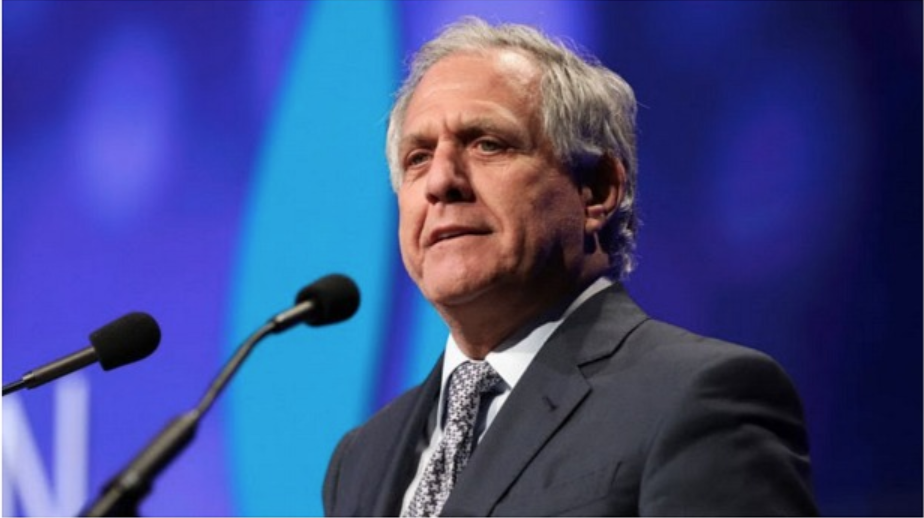
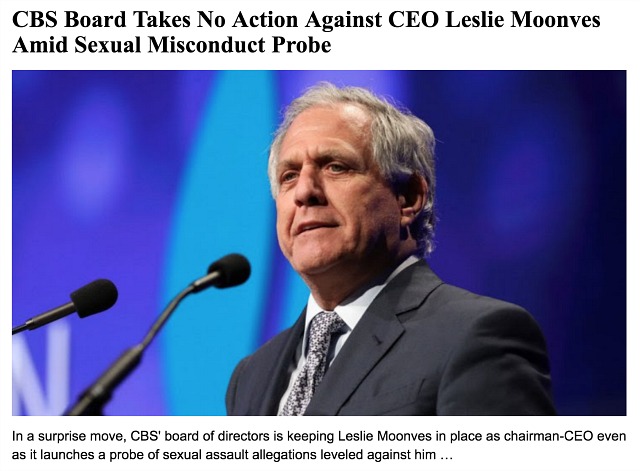
I’m recalling a David Poland tweet from two or three days ago, one that predicted that the CBS board of directors wouldn’t oust chairman, president and CEO Les Moonves over the sexual harassment complaints contained in a recently published article by The New Yorker‘s Ronan Farrow. Or suggest a leave of absence or anything.
The thinking was that the alleged incidents (Ileana Douglas, et. al.) all happened in the ’90s and ’80s. Not to mention that Moonves, married since 2004 to Julie Chen, has been contrite, apologetic and diplomatic. There is irony in the fact that Moonves is a founding member of the Commission on Sexual Harassment and Advancing Equality in the Workplace, formed in late 2017 to “tackle the broad culture of abuse and power disparity” but whatever.
The feeling among the board of directors, apparently, is that what happened in the ’80s and ’90s is distant water under the bridge.
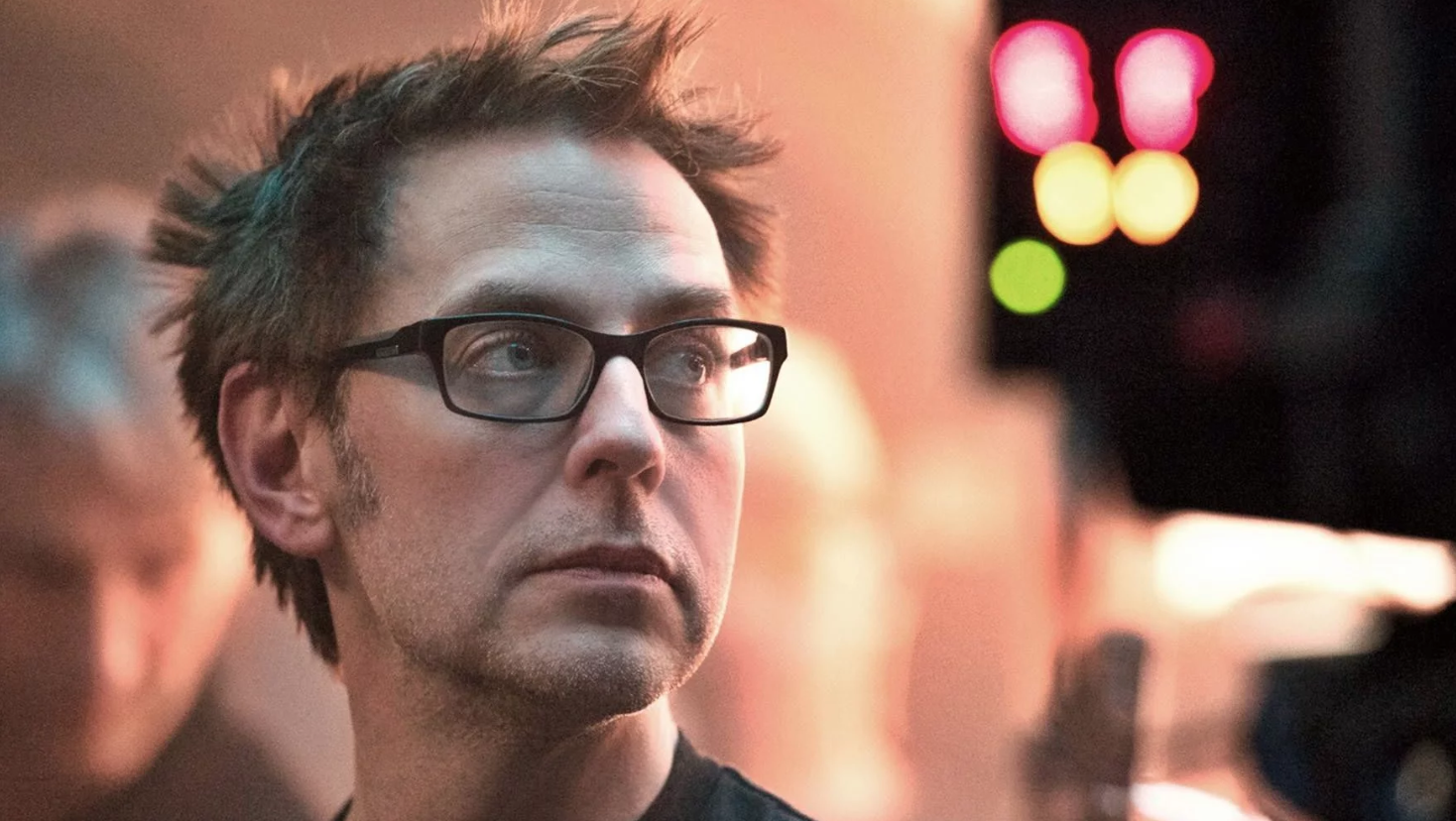
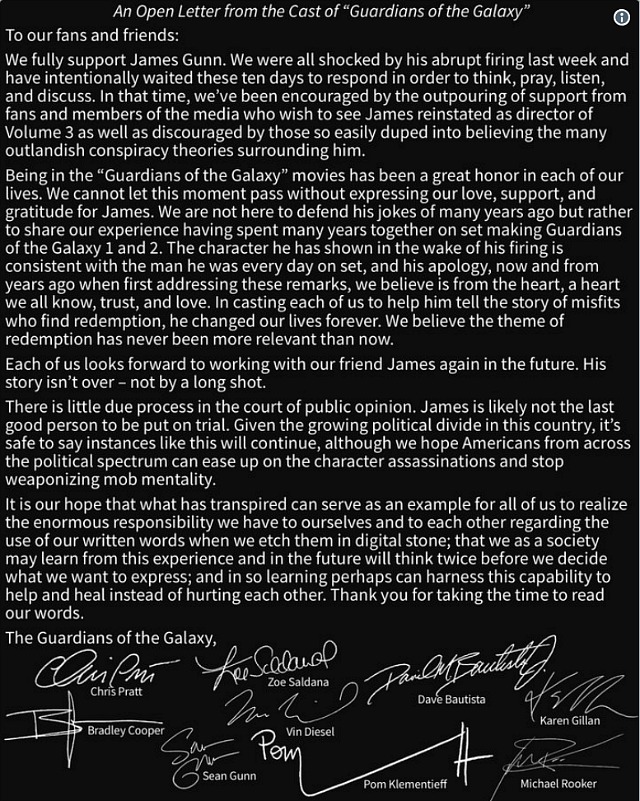
11 days after Disney fired James Gunn off the third Guardians of the Galaxy installment for having posted vulgar tweets a decade ago, the cast — Chris Pratt, Zoe Saldana, Bradley Cooper, Dave Bautista, Vin Diesel, Sean Gunn, Pom Klementiff, Michael Rooker and Karen Gillan — has issued a statement that basically says they have Gunn’s back.
As I understand it, the cast is telling Disney they might not be willing to appear in Guardians of the Galaxy 3 unless Disney reconsiders and hires Gunn back. They’re not saying this in so many words, of course, but what’s the point of standing by Gunn unless they’re prepared to back this up with deeds?
“We fully support James Gunn,” the statement says. “We were all shocked by his abrupt firing last week and have intentionally waited these ten days to respond in order to think, pray, listen, and discuss. In that time, we’ve been encouraged by the outpouring of support from fans and members of the media who wish to see James reinstated as director of Volume 3 as well as discouraged by those so easily duped into believing the many outlandish conspiracy theories surrounding him.”
“His story isn’t over, not by a long shot,” the statement declares. If I’d had a hand in the writing of the statement, I would have said “not by a damn sight.” That sounds more Ving Rhames.
Five and one-third years ago Woody Allen saved George Stevens‘ Shane from an aspect-ratio slicing that would have rocked the classic cinema universe and resulted in a great hue and cry from the Movie Godz. When all is said and done and the Chalamets of the world have all been put to bed, this is one of the events that will burnish and solidify Allen’s legacy.
On 3.16.13 I revealed that George Stevens, Jr. and Warner Home Entertaiment restoration guy Ned Price were intending to release a Bluray of the classic 1953 western using a 1.66:1 aspect ratio, which would have cleavered the tops and bottoms of the original 1.37 photography by dp Loyal Griggs. I howled and screamed in my usual way, but nothing seemed to change until Allen, the only top-dog, world-class director to step into this fray, shared his opinion on 4.4.13.
Three versions of Shane were included in a 2015 Masters of Cinema Bluray (Griggs’ original 1.37:1 capturing on disc one + 1.66:1 theatrical presentation + an alternate 1.66:1 framing optimized for this ratio, supervised by George Stevens, Jr., on disc two).
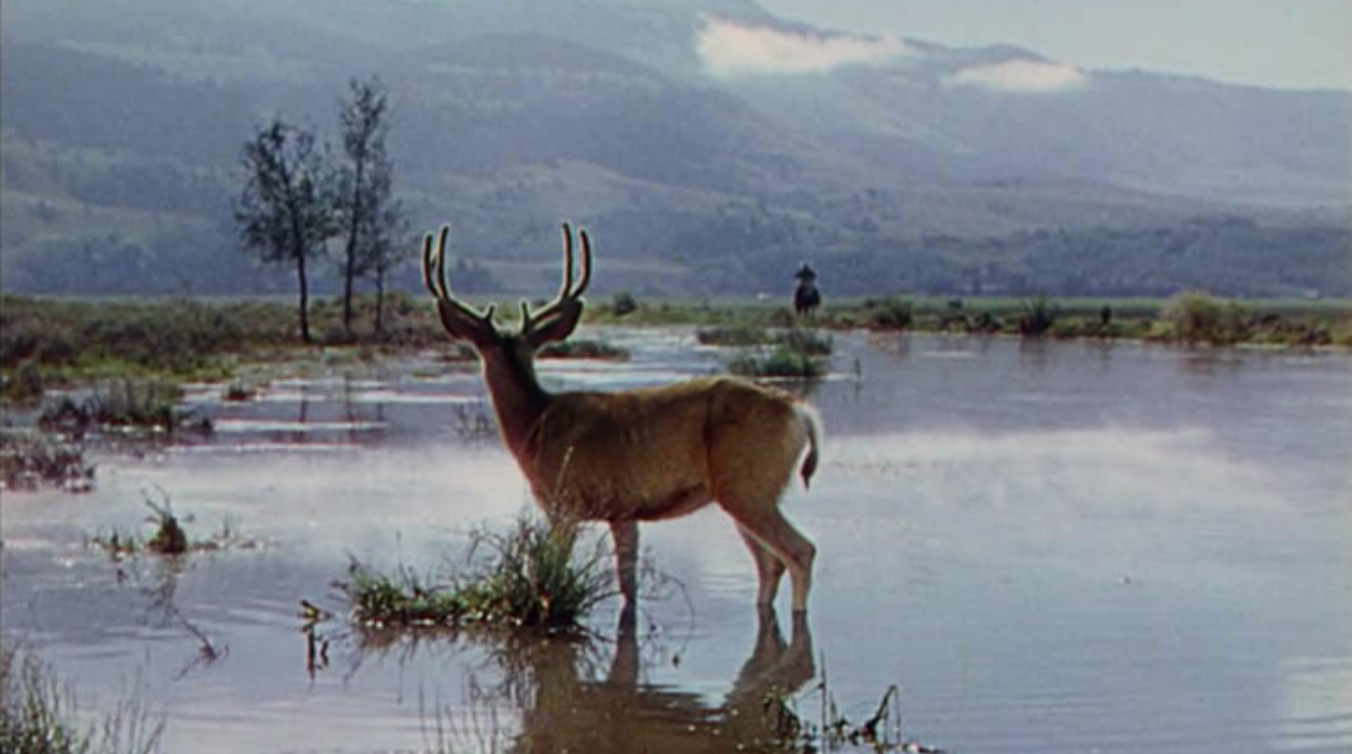
Below is Shane‘s bar fight scene in the original 1.37 a.r.; further below is the same scene sliced down to 1.66.
A friend and I wandered around downtown Ridgefield, Connecticut yesterday afternoon. It’s a little more culturally complex than it used to be, but it’s still a whitebread town for the most part. Victorian homes, huge front and side lawns, super-tall trees that have been here since the Revolutionary War. Ridgefield hasn’t become an outdoor mall like Westport; it still has a certain leafy, affluent, quirky-liberal personality.
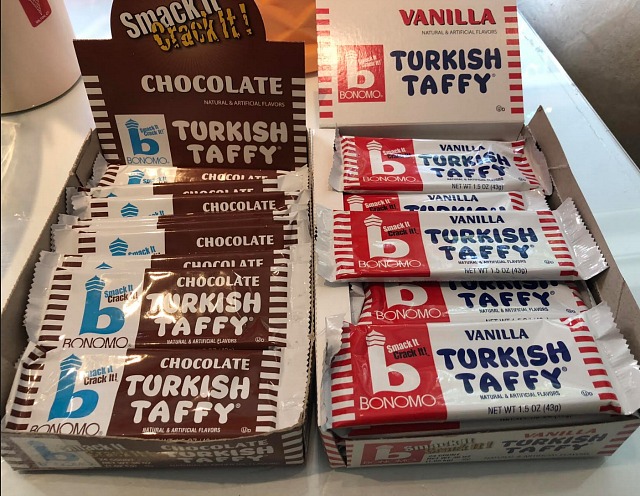
Not that I’ve ever given a damn, but Bonomo Turkish Taffy peaked in the ’50s and ’60s, was discontinued in 1989 and returned to the market in 2010.
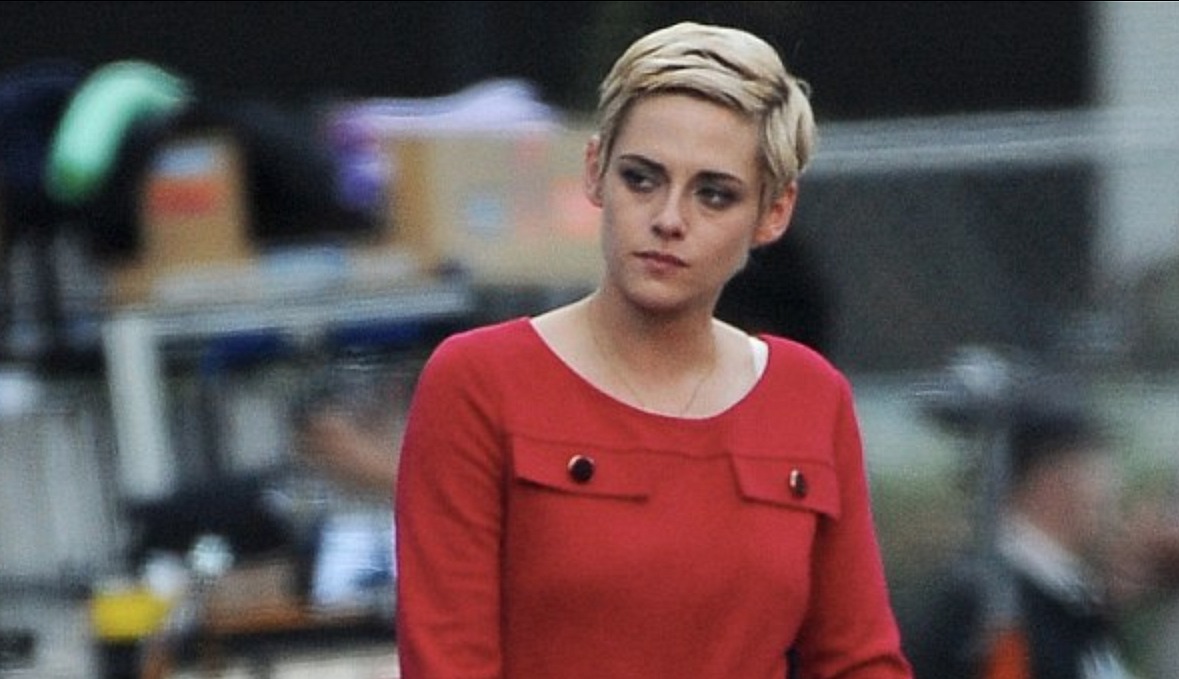
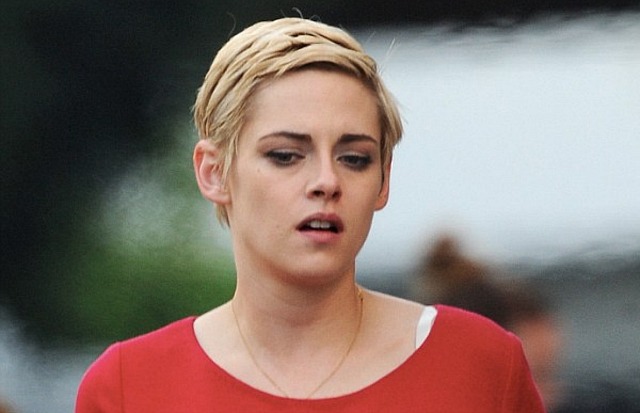
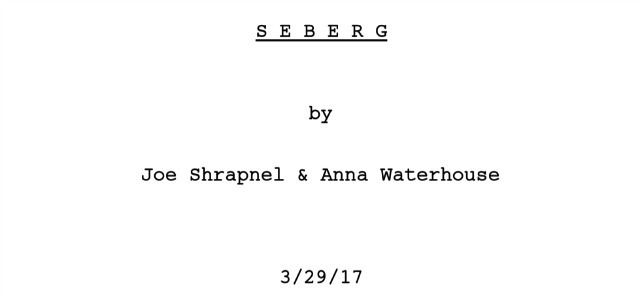
Benedict Andrews‘ Against All Enemies, a political thriller about the FBI’s harassment of Jean Seberg (Kristen Stewart) over her support of the Black Panthers and sexual involvement with black power activist Hakim Jamal (Anthony Mackie), has been shooting since late June. The screenplay is by Joe Shrapnel and Anna Waterhouse; the dp is Rachel Morrison (Black Panther, Mudbound). Pic costars Jack O’Connell, Margaret Qualley, Colm Meaney, Zazie Beetz, Vince Vaughn and Yvan Attal as Romain Gary, whom Seberg was more or less married to at the time of her death in Paris on 8.30.79, at age 40. An all-but-guaranteed presence a year from now at Venice, Telluride or Toronto, one would think.
I’m too consumed with loathing for the habits of Average Joe moviegoers (texters, noisy eaters, drink-slurpers, constant bathroom-breakers, late arrivers, chit-chatters) to be interested in catching commercial screenings with any regularity. Hence my lack of interest in Sinemania, AMC Stubs-a-List, the all-but-defunct Moviepass, et. al. Attending all-media screenings in New York and Los Angeles is coarse enough. Otherwise give me elite film-festival screenings, press viewings in the usual small private rooms, streaming on the 65″ Sony HDR, etc.
During the first half-hour of Mission: Impossible — Fallout (Paramount, 7.27), there’s a sequence in which Tom Cruise and Henry Cavill do a HALO jump (high altitude low open) over Paris. Before Monday night’s Lincoln Square screening director Chris McQuarrie explained that the sequence was shot for real — Cruise and a dp with a head-mounted camera did over 100 jumps at magic hour. The sequence is awesome in just about every respect.
Hollywood Elsewhere totally salutes this kind of commitment to realism, and especially Cruise’s moxie. The man is a machine. But let’s also be honest — this scene probably could have been faked with wires and green screen and nobody would have known the difference. Nobody trusts visual effects and stunts any more. Over the last quarter-century the trust factor has been totally blown. Everyone assumes they’re being deceived, at least to some extent. Especially in a big-studio adventure thriller.
In 2005, Werner Herzog said the following about conveying physical reality on-screen: “I tried to explain that I wanted to have the audience know that at the most fundamental level it was real. Today when you see mainstream movies, in many moments, even when it’s not really necessary, there are special effects. It’s a young audience, and at six and seven kids can identify them…they know it was a digital effect, and normally they even know how they were done. But I had the feeling I wanted to put the audience back in the position where they could trust their eyes.”
This is what McQuarrie and Cruise tried to do in the HALO scene — get us to trust the fact that the physical performing is 100% genuine, right there in the moment, three or four miles high. HE fully respects and salutes this effort, even if it doesn’t quite feel all-the-way honest.
Example: Cruise and Cavill’s plan is to parachute right onto the roof of the Grand Palais des Champs-Élysees. No high-pressure undertaking ever goes precisely according to plan, and yet they do exactly this. A more realistic scenario would have one of them missing the Palais and splashing into the Seine, or maybe landing in a nearby city park (Square Jean Perrin) and alarming a couple of pedestrians.
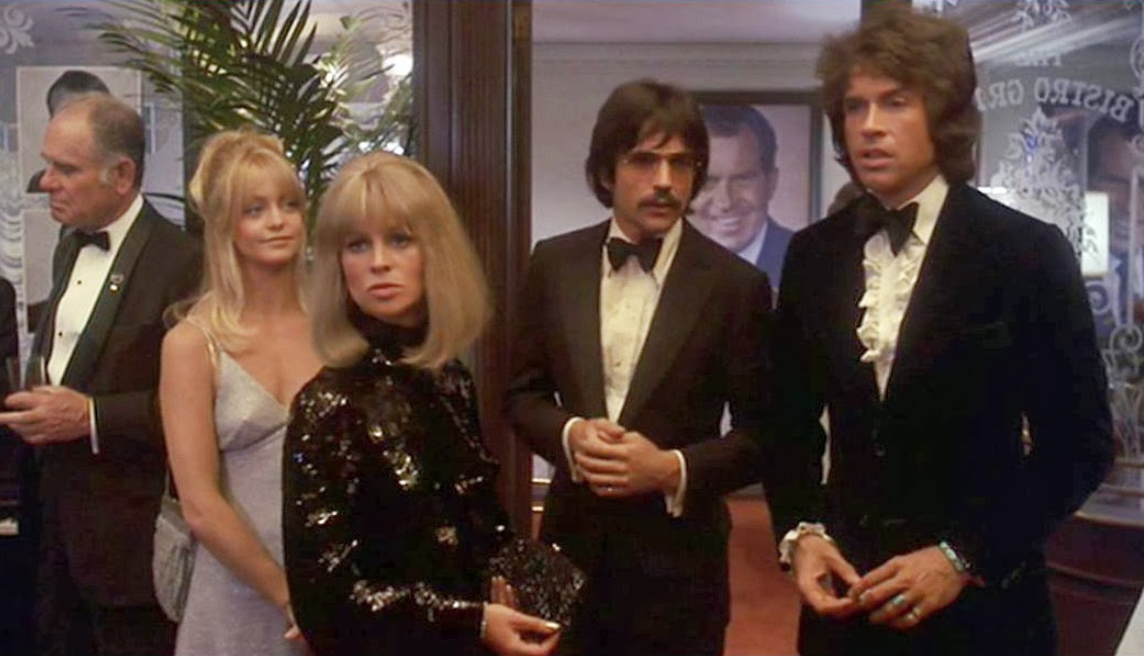
A high-def version of Hal Ashby‘s Shampoo has been streamable on Amazon for about three years, but on 10.16, for the first time, a Criterion Bluray of a “4K digital restoration” will go on sale. Given what’s recently happened with Criterion’s Midnight Cowboy and Bull Durham Blurays, I’m honestly scared that Criterion will add a strong teal tint to the color. Is a brand-new Warren Beatty interview among the extras? Or perhaps with screenwriter Robert Towne? Of course not. It will, however, include a video chat between critics Mark Harris and Frank Rich plus an essay by Rich.
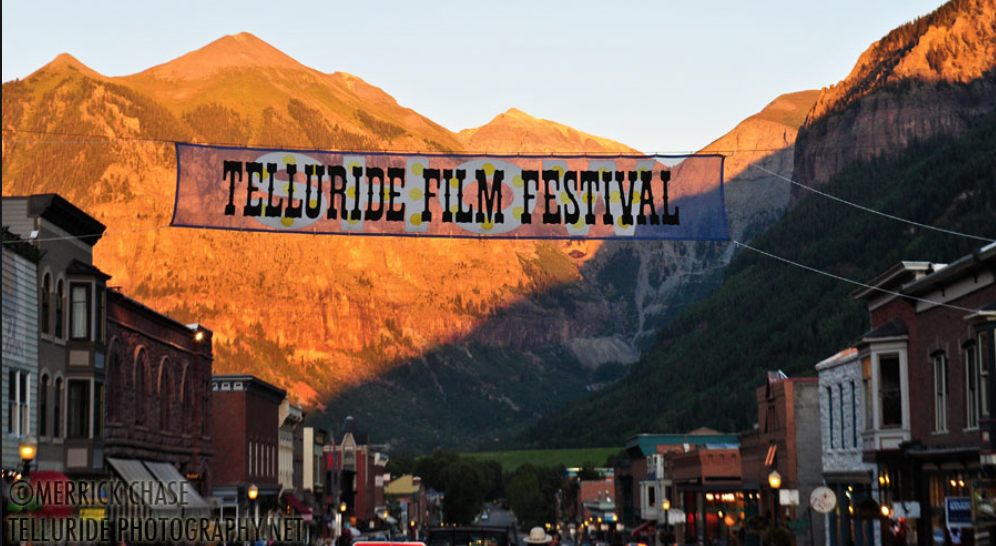
According to the calculations of World of Reel’s Jordan Ruimy, the following Canadian and international premieres at the 2018 Toronto Film Festival are probably Telluride-bound: Alfonso Cuaron‘s Roma, Pawel Pawlikowski‘s Cold War, Damien Chazelle‘s First Man, Olivier Assayas‘ Non-Fiction, Hirokazu Kore-eda‘s Shoplifters, Marielle Heller‘s Can You Ever Forgive Me?, Matteo Garrone‘s Dogman, Jason Reitman‘s The Front Runner, David Lowery‘s The Old Man and the Gun, Elizabeth Chomko‘s What They Had (an international premiere in Toronto because it premiered at Sundance, not because of Telluride) and Yann Demange‘s White Boy Rick.
Apparently not going to Telluride because they’re listed as TIFF world or international premieres: Barry Jenkins‘ If Beale Street Could Talk (a surprise given that Jenkins is a longtime Telluride friend and former volunteer), Steve McQueen‘s Widows (latest pic from the winner of 2013 Best Picture Oscar gets the brushoff), Felix Von Groeningen‘s Beautiful Boy, Bradley Cooper‘s A Star Is Born (Tom Luddy and Julie Huntsinger have reservations?), Lee Chang-dong‘s Burning, Nadine Labaki‘s Capernaum, Asghar Farhadi‘s Everybody Knows, Dan Fogelman‘s Life Itself, Laszlo Nemes‘ Sunset and Jacques Auduiard‘s The Sisters Brothers.
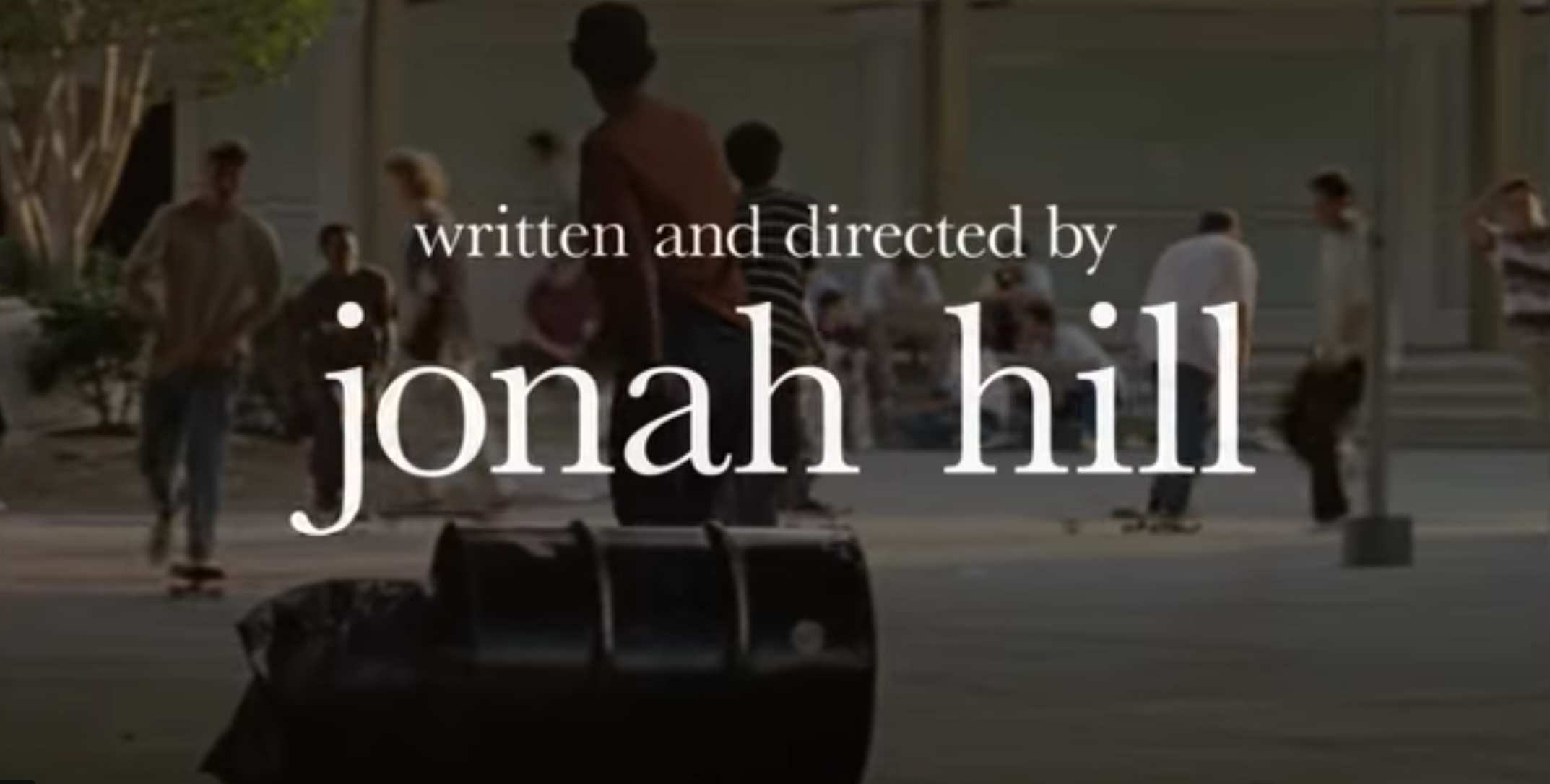
You can tell right off the bat that Jonah Hill‘s Mid ’90s (A24, 10.19) is an exception of one kind or another. It sure doesn’t feel like just another Los Angeles skateboard flick. You can sense a focus on character and kid culture and ’90s minutiae. Fast and loose and raggedy — the rhythms and the atmosphere feel right.
Pic is set in the lower West L.A. region — Palms, Culver City, Venice — and partly focused on a Motor Ave. skateboard shop. (Born in ’83, Hill grew up in the Cheviot Hills neighborhood or just north of these regions.) Sunny Suljic (The Killing of a Sacred Deer) has a certain X-factor thing going, and I love that Hill has Lucas Hedges playing a bit of a domineering-shit older brother instead of the usual gentle-sensitive guy from Lady Bird, Boy Erased and Manchester By The Sea. Katherine Waterston plays Suljic’s somewhat unstable mom.
Directed and written by Hill; shot by Christopher Blauvelt (Indignation) in HE’s own 1.37 aspect ratio (boxy is beautiful) and edited by Nick Houy.
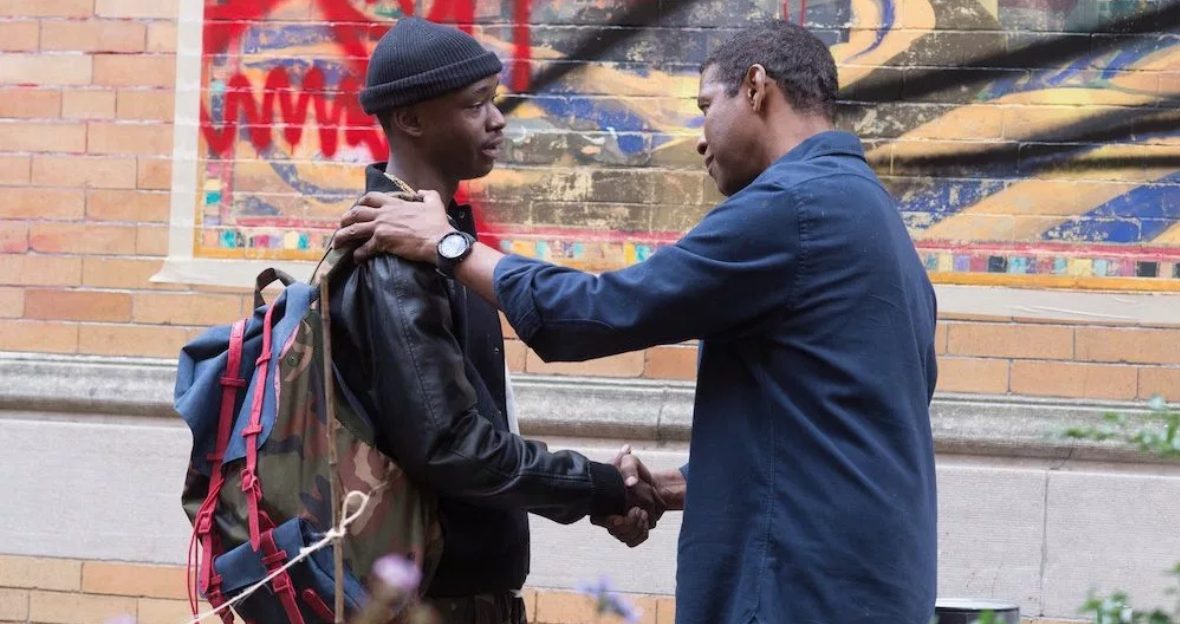
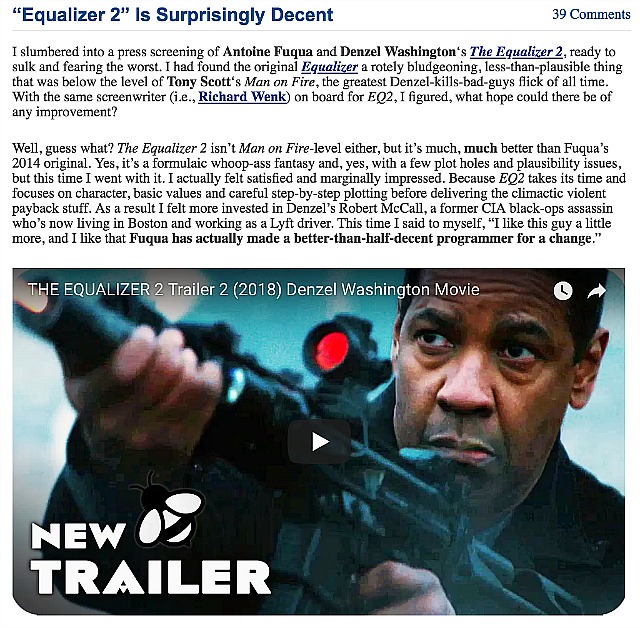
Now that Antoine Fuqua and Denzel Washington‘s Equalizer 2 has earned a solid CinemaScore A and landed in first place with an estimated $35.8 million (which slightly tops the $34.1 million opening for the original Equalizer four years ago), the Hollywood Elsewhere community is free to assess the cinematic value. How right or wrong was I in callingEQ2 “much, much better than Fuqua’s 2014 original…this time I actually felt satisfied and marginally impressed…this time I said to myself, ‘I like this guy a little more, and I like that Fuqua has actually made a better-than-half-decent programmer for a change.'”