Funny & Zippy, But Somehow Insubstantial

Peyton Reed‘s Ant-Man and the Wasp (Disney, 7.6) isn’t a problem unless you’re determined to complain about it not being as good as the original Ant-Man (’15). Which it’s not. But it’s still fleet, funny, disciplined, carefully honed, occasionally dazzling, light-hearted, pleasingly absurd…112 minutes worth of cool cruisin’ as you chow down on the overpriced crap. And those 112 minutes feel like 80 or 85, by the way. There are no significant downshiftings or speed bumps, or none that I noticed.

Please don’t let me (or any other sourpusss types) stop you from seeing it, but I’m telling you straight and true that Ant-Man and the Wasp is not quite as affecting, highly charged and/or head-turning as I wanted it be. It’s fairly proficient in the ways you might expect but at the same time it’s a bit of a slight letdown. You may feel the same way when you see it, but you’ll probably survive.

Why should anyone care if Ant-Man and the Wasp registers as an entertaining but inoffensive letdown? There are bigger fish to fry and meditate upon. See it or don’t see it. But don’t weep for the Marvel and Disney empires — they’re fine. On top of which the Rotten Tomatoes whores having given it a 96% approval rating.

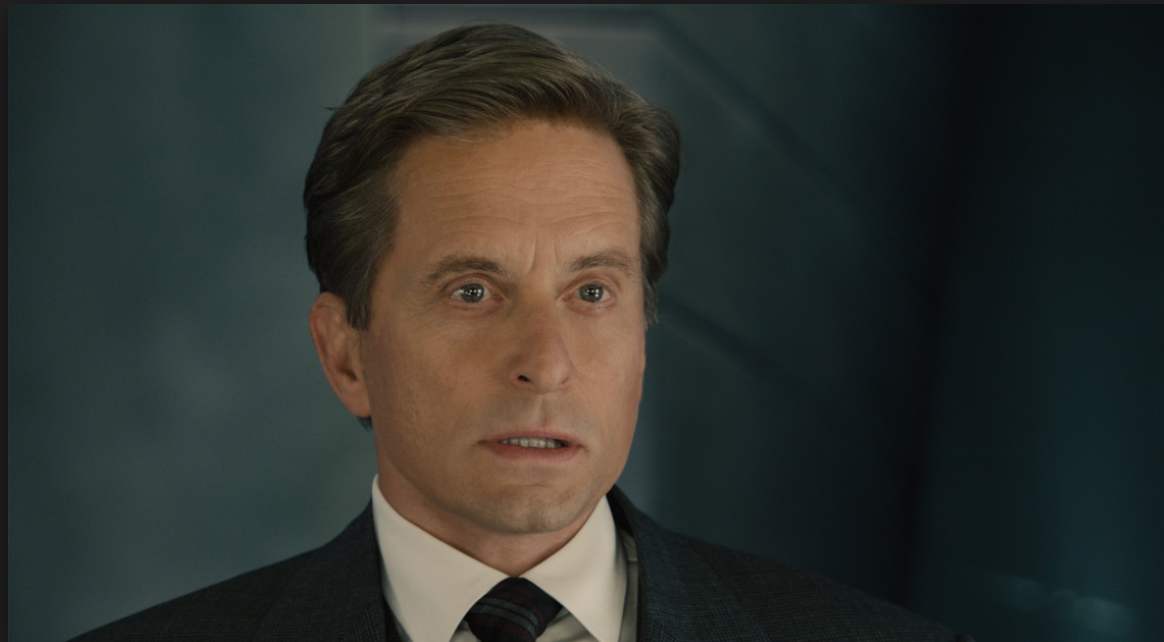
What exactly is missing from Ant-Man and the Wasp that wasn’t missing from Ant-Man? The dopey subversive humor in Reed’s three-year-old original felt fresher, for one thing. And the story was more emotionally affecting as far as Paul Rudd‘s Scott Lang was concerned. He was in a fairly dark and despairing place as it began — ex-con, low-rent loser, not much of a role model for his daughter — so morphing into Ant-Man by way of Michael Douglas‘s (i.e., Hank Pym’s) brilliance and reluctant largesse really meant something. This time, not so much. But at the same time I didn’t feel burned by the story or journey or whatever you want to call it. I felt placated.

Good, occasionally amusing work by Rudd, Evangeline Lilly (Hope van Dyne / Wasp), Michael Douglas, Michael Pena, Walton Goggins (fated to play pain-in-the-ass, low-rent villains for the rest of his life), Bobby Cannavale, Judy Greer, Hannah John-Kamen (Ghost), Abby Ryder Fortson (Rudd and Greer’s daughter Cassie), Randall Park, Michelle Pfeiffer (Janet van Dyne — rescued in Act Three from the sub-atomic, micro-quantum realm or whatever you want to call it), Laurence Fishburne (punching the clock), etc.

The fact that Rudd is pushing 50 and Lilly is pushing 40 are not interruptions, but I’d be lying if I said I wasn’t aware of their biological earth-time factors.

Vulnerable Hollywood Buckaroos

Quentin Tarantino has described the pairing of Leonardo DiCaprio and Brad Pitt in Once Upon A Time in Hollywood as a Butch-and-Sundance, Redford-and-Newman type deal. Maybe, but the wardrobes and hair stylings tell you everything you need to know about their characters.

A dead ringer for Adam Roarke (Play It As It Lays, Dirty Mary, Crazy Larry) in the late ’60s, Pitt’s Cliff Booth is a down-to-basics, rough-and-ready stuntman. DiCaprio’s Rick Dalton is basically Robert Culp, a successful TV actor (I Spy) who began in the tradition-minded ’50s but struggled to find his footing when the industry pivoted toward youth fare in the late ’60s. Is that a peace medallion Leo is wearing? The mustard-colored turtleneck reminds me of a lounge shirt John Vernon wore in Point Blank (’67). If Dalton’s career was on a faster, more upward track, he might have landed Culp’s role in Paul Mazursky‘s Bob & Carol & Ted & Alice (’69).


Brad Pitt’s Cliff Booth, Leonardo DiCaprio’s Rick Dalton in Quentin Tarantino’s Once Upon A Time in Hollywood.

Natalie Wood and Robert Culp in Bob & Carol & Ted & Alice.

“Vertigo” May Be Finished

Six years ago, Alfred Hitchcock‘s Vertigo overtook Orson WellesCitizen Kane in the once-per-decade Sight & Sound poll as the greatest film ever made. The next big vote won’t be for another four years, but in the view of esteemed critic David Thomson Vertigo‘s dominance may not last.

He sounds the warning in a 6.21 London Review of Books entry called “Vertigo after Weinstein.” The basic shot is that Vertigo is too much about obsessive male hunger for women and too dismissive of their feelings, too sexually perverse and generally too icky to remain the champ in this #MeToo and #TimesUp era.

Thomson’s last three paragraphs (which I’ve broken into five) sum things up:

“We have to be clear-eyed about Vertigo, and about what its power and influence tell us. It isn’t just that Alfred Hitchcock was devious, a fantasist, a voyeur and a predator. It isn’t just that no matter how many Harvey Weinsteins are exposed, it could never be enough to deliver justice to those who have been wronged and exploited. It isn’t even that men invented and have dominated the command and control of the movies, both as art and business: that they have been the majority of directors, producers and camera people despite, over the years, being a minority of the audience.

“Is what Vertigo has to tell us, beyond this history of male control, that the medium itself is in some sense male? Is there something in cinema that gives power to the predator, sitting still in the dark, watching desired and forbidden things? Something male in a system that has an actress stand on her mark, in a beautifully lit and provocatively intimate close-up, so that we can rhapsodize over her?

“In 2012, the Sight & Sound poll was urged on by a feeling that we’d all had enough of Citizen Kane. Welles’ film had been voted the best ever from 1962 to 2002. Few felt that the verdict had been unjust, but in a young medium was it proper for the champ to be a pensioner? Didn’t cinephiles deserve a more mercurial model, made in their lifetime? But the new winner was Vertigo, not very much younger than Citizen Kane, and its triumph was acknowledged as a rueful commentary on the ambivalent glory of being a film director, the auteur status that Sight & Sound was pledged to uphold.

Read more

Dreaming Of Blunt-Free “Sicario”

I wonder if anyone has tried to re-edit Sicario with all of Emily Blunt‘s scenes removed, or at very least with her character reduced to a marginal figure. Sicario runs 121 minutes. A Blunt-free or Blunt-reduced version, if it exists or if someone assembles it, would maybe run…what, 80 or 90 minutes? I’m imagining this because I was so turned around by Sicario: Day of the Soldado. I didn’t have a Blunt problem in Sicario because I don’t like women in Mexican drug-dealing dramas. At all. The young Isabela Moner is awesome in Soldado — she owns almost every scene she’s in. But I don’t care for female FBI agents who are better at registering naive emotional responses to grim situations (weeping, shuddering, taking showers, picking up strangers in bars) than doing their job.

Howling Man

You almost don’t have to read Julia Ioffe’s GQ profile of Donald Trump, Jr. Because Nigel Buchanan‘s illustration pretty much says it all. Final paragraph: “Like Republican populists of the past decade, Don speaks of ‘real Americans,’ people he defines as ‘the forgotten people between New York City and Malibu.’ It’s an improbable notion: that the billionaire’s kid from 66 stories above Fifth Avenue is the one who speaks for the disaffected and the overlooked. But it’s no less surprising than the faint rumors suggesting that he might someday run for office — a way to finally, perhaps, make a name for himself.”

Contemplative, Astringent, Sardonically Amusing

Mike Molloy‘s cinematography for The Hit (’84) was sufficient but unexceptional — it might have been shot on 35m but looked like 16mm. Which wasn’t a problem — it was what it was. So buying the just-released French Bluray doesn’t seem worth it. I’d rent a streaming HD version but that’s not an option. The Criterion DVD is good enough.

John Hurt‘s performance as Braddock is grim and taciturn but entirely readable — he barely moves a facial muscle but you can sense what he’s feeling and struggling with and is scared of at every turn. As minimalist performances go it’s masterful — right up there with Steve McQueen‘s Jake Holman in The Sand Pebbles and Kristin Scott Thomas‘s acting in I’ve Loved You So Long.

Read more

“Roma” Is For Real

I’ve relentlessly shared enthusiasm for the idea of Alfonso Cuaron‘s Roma, which will almost certainly debut at the Venice and Telluride festivals, or about ten weeks hence. (As well as Toronto in mid-September.)

Roma is Cuaron’s first film since Gravity, which debuted six years ago. The only 2018 film that even begins to sound like serious Best Picture rocket fuel, as in allegedly “beyond great” (i.e., a second-hand quote from a publicist who saw it). A Spanish-language film, yes, and digitally shot in radiant black-and-white. A year in the life of a middle-class family in Mexico City in the early 1970s, more specifically about the Corpus Christi Massacre of 6.10.71.

Team Roma will launch a balls-out, take-no-prisoners Best Picture campaign, as well as (I’m hearing) a Best Supporting Actress campaign for Marina De Tavira, a 44 year-old actress who apparently plays the maternal heart and soul of said middle-class family.

Will the Netflix factor (i.e., the company’s reluctance to commit to a serious theatrical exposure prior to streaming) get in the way? Ask the Mudbound people who managed four Oscar noms last year (Best Supporting Actress, Best Adapted Screenplay, Best Cinematography, Best Song). So probably not.

What about the foreign-language factor? Michael Haneke‘s Amour was Best Picture nominated six years ago so why not Roma? I’m presuming that, like Amour, Roma will aim for simultaneous Best Picture and Best Foreign Language Feature noms.

Wine, Wine, Wine

Remember when Buzz Gunderson (Corey Allen) explained the knife-fight rules to Jim Stark (James Dean) in Nicholas Ray‘s Rebel Without A Cause? “Now there’s no stabbing,” Buzz said. “Just a little sticking.”

A half day ago Rolling Stone published “The Trouble With Johnny Depp“, which is subtitled “Multimillion-dollar lawsuits, a haze of booze and hash, a marriage gone very wrong and a lifestyle he can’t afford — inside the trials of Johnny Depp.” It was written by the smooth and silky Stephen Rodrick. Less than exacting but a hugely skilled writer, Rodrick is no assassin. But he likes to “stick” his subjects with little cuts.

I know because he profiled me in a 2009 Los Angeles piece titled “the Blog Whisperers.” He implied something that struck me as unfair, and there were three or four inaccuracies. Rodrick also stuck it to Bill Maher, slightly, in a 2017 Esquire profile.

I could’ve told Depp to watch out before agreeing to Rodrick visiting his home in London. I’m not suggesting Rodrick hasn’t reported exactly what he saw and heard. Depp is almost certainly the louche, vaguely ruined fellow described in the piece, a guy who lives in his own psychological realm and who slurps red wine like it’s going out of style.

I love this early passage:

“Depp is dressed like a Forties gangster, jet-black hair slicked back, pinstripes, suspenders and spats. His face is puffy, but Depp still possesses the fixating brown eyes that have toggled between dreamy and menacing during his 35-year career.” Technically 34 years — Deep’s first film was Wes Craven‘s A Nightmare on Elm Street (’84), made when he was 20.

“‘So are you here to hear the truth?’ asks Depp as [his chef] Russell brings him a glass of vintage red wine. ‘It’s full of betrayal.’

“We move to the dining room for a three-course meal of pad thai, duck and gingerbread with berries. Depp sits at the head of the table and motions toward some rolling papers and two equal piles of tobacco and hash, and asks if I mind. I don’t. He pauses for a second. ‘Well, let’s drink some wine first.’

“This goes on for 72 hours.

Read more

All Hail The Masterful “Cold War”

If you search Rotten Tomatoes for “Cold War,” you’ll find seven titles. But there is only one Cold War — the latest Pawel Pawlikowski masterpiece, destined to win the Best Foreign Language Feature Oscar, HE’s favorite Cannes film by a country mile. Jewel-perfect, exquisitely photographed, tight as a drum.

Amazon will release Cold War on 12.21.

5.19 HE blurb: “Cold War is so perfectly composed, a masterwork on every level. Pawlikowski’s story-telling instincts couldn’t be more eloquent or understated. Every plot point is always conveyed in the most discreet and understated terms, but you’ll never miss a trick. And the economy! A story that spans 15 year sis handled within 84 minutes, and you never sense that you’re being rushed along.”

On 6.2.18 I posted my latest best-of-2018 piece — i.e., “Ten Serious Winners.” I was restricting myself to films that have commercially opened. If I were to include the Cannes entries, my list would read as follows: Cold War, First Reformed, Hereditary, A Quiet Place, The King, You Were Never Really Here, Filmworker, Happy as Lazzaro.

A 5.23.19 IMDB comment from “Lucywalkercats“: “There is perhaps no greater example in recent memory of a film that so successfully makes the political personal and vice versa. It is moving without ever once feeling contrived. This deserves the next Foreign Film Oscar by a longshot.”


Read more

Scotty’s Time Is Nigh

I’ve posted a few times about Matt Tyrnauer‘s Scotty and the Secret History of Hollywood (Greenwich, 7.27), a 98-minute doc about Scotty Bowers, the amiable, formerly unsung go-between who wrote about servicing Hollywood’s gay and bisexual community during the ’40s, ’50s and beyond. His six-year-old memoir is called “Full Service: My Adventures in Hollywood and the Secret Sex Lives of the Stars.”

I will once again share what I came to believe during the watching of it, which is that Bowers, whose tell-all book has been challenged and mocked and who’s been described here and there as highly imaginative, isn’t lying about anything.

For most of Tyrnauer’s surprisingly intimate, low-key, non-gossipy film is about old Scotty — a 90something, white-haired pack rat who owns two or three homes in the Hollywood hills and lives with a good-natured, seen-and-heard-it-all wife who loves him — and only intermittently about the mostly gay and bi movie stars and celebrities (Cary Grant, Spencer Tracy, Walter Pidgeon, Vivien Leigh, Charles Laughton, Vincent Price, Katharine Hepburn, Noël Coward, James Dean) who regarded Scotty as a trusted pimp and pleasure-giver who could and did set them up with same-sex lovers.

After studying Bowers for 98 minutes and listening to him talk about how terrifying things were for gay and bi actors in the intensely homophobic big-studio era, and considering the affection he has for his old gay friends and the strong feelings and immense respect they have for him…after the film is over you’ll probably be convinced, as I was, that Scotty is no bullshitter.

Read more

Benevolent Dragonfly Aliens

Next week Fox Home Entertainment’s Schawn Belston and James Finn are presenting a special 70mm screening of James Cameron‘s The Abyss (’89). I asked if they’re showing the original 140-minute theatrical version or the 171-minute special edition (i.e., the version that ends with shots of huge tidal waves) — no answer thus far.

I began to recall The Abyss in detail after receiving the invite. I can’t attend due to a screening conflict (the Sicario: Day of the Soldado all-media in Burbank) but even if I could I’m not sure I’d be all that enthused. It’s been 29 years, but I have two strong recollections: (a) The first two thirds are fairly riveting but (b) the last third drops the ball, especially when Mary Elizabeth Mastrontonio is brought back to life by Ed Harris after clearly drowning, and especially that dippy ending with the aquatic alien butterflies.

There’s never been a Bluray of either version of The Abyss, and you can’t stream them in high-def. Abyss Wikipage: “In July 2016, while promoting the 30th anniversary Bluray release of Aliens at Comic-Con, Cameron confirmed that he was working on a remastered 4K transfer of The Abyss and that it would be released on Bluray for the first time in early 2017. ‘We’ve done a wet-gate 4K scan of the original negative, and it’s going to look insanely good,’ Cameron said.” Okay, but something kept this from happening.

Read more

Elvis Mirror Reflection

The main thing about Eugene Jarecki‘s The King is that it’s less of a “rise and fall of Elvis” film than a meditative road-trip essay about the cultural decline of the U.S. of A. over the last…oh, call it 60 years. But with doses of music and feeling and irony and currents of straight talk. It’s a stirring musical sermon. How did we get here? Then vs. now. The bloat, the denial, the loathing…a nation arguably more at war with itself than at any time since the Civil War. Paul Simon rewrite: “We’re empty and aching and don’t know why.”

Well, actually we do. The same forces that gradually enveloped that young and jumpy Memphis rocker who exploded in the South in ’55 and then nationally in 1956 with a blend of rockabilly and white-boy soul…the musical-spiritual aura that defined him gradually dispersed, and then selling out became the be-all, the chimes of irrelevance…shitty movies, Las Vegas gigs instead of touring the country, Dr. Feelgood medication, endlessly beholden to Colonel Tom Parker, huddling with the Memphis mafia behind Graceland gates. A flamboyant, increasingly perverse, go-for-the-dough lifestyle that pretty much drained and ate him.


13 year-old country blues singer Emi Sunshine, who takes a ride in Elvis’s silver Rolls Royce and sings some tunes in Jarecki’s doc, and Mr. Jarecki himself — Tuesday, 3.6, following screening at UTA.

It can’t hurt to repost the official synopsis: “A musical road trip across America that explores how a country boy lost his authenticity and became a king while his country lost its democracy and became an empire.” 27 words. Marketers would say trim it down. “A half-musical, all-visual poem about how the Las Vegas aesthetic swallowed America in the same way it swallowed Elvis Presley.” Still too long?

As noted everywhere, The King itself was trimmed after its world debut at the 2017 Cannes Film Festival, when it ran 117 minutes. Now it’s around 97.

My first viewing of The King happened three and a half months ago inside United Talent Agency headquarters. In a HE piece that posted on 3.6 (“King of Drain“), I said I was “pretty close to knocked out — touched and shaken to the depths of whatever — and I’ll eat my black Kenneth Cole desert boots if it doesn’t become a Best Feature Documentary nominee next January. It’s that good, that bell-ringy, that profound.”

Now the hour is nigh — The King (Oscilloscope) opens on 6.22.

The King isn’t the least bit grim or draining or forlorn — as you watch there’s a feeling that all the cultural threads and fibres have been woven just so. Not an Elvis doc, not an Elvis doc, not an Elvis doc…but a telling of his story (which most of us know backwards and forwards) in a way that expands and deepens and makes you lean forward.

Every talking head has two or three sage things to say: Greil Marcus, James Carville, Chuck D, Alec Baldwin, Roseanne Cash, Ethan Hawke, Emmylou Harris, Van Jones, Ashton Kutcher, Mike Myers, Dan Rather, Luc Sante, David Simon, Linda Thompson. My favorites are Hawke, Jones and Public Enemy’s Chuck D.

I was actually a tiny bit sorry when The King ended.

Read more