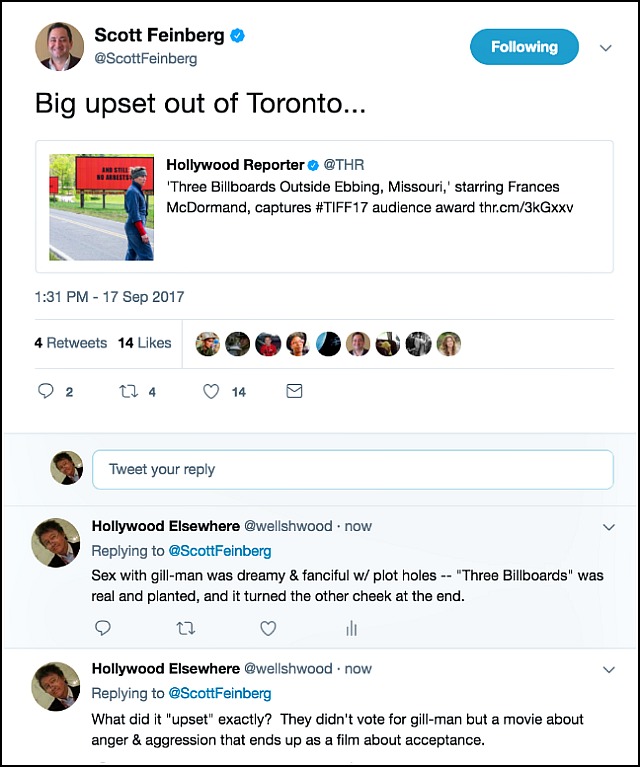
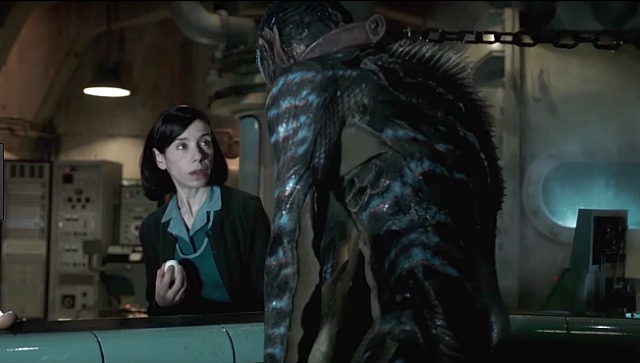
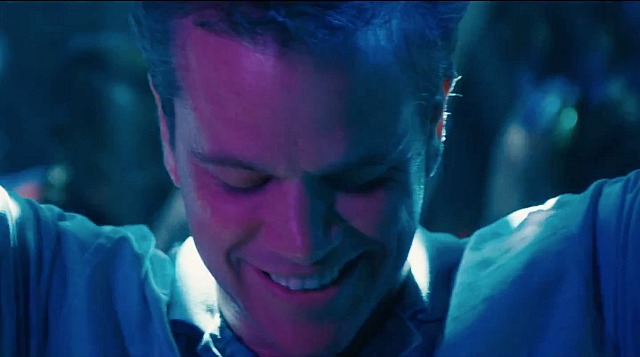
Hollywood Reporter award season pulse-taker Scott Feinberg called the Three Billboards win an “upset” because he’d been predicting Guillermo del Toro‘s The Shape of Water for the win. I suspect that TIFF audiences appreciated Shape as far as it went (i.e., sex with gill-man) but they really liked where Three Billboards went at the end — away from anger, turning it down, acceptance.
The Midnight Madness Award went to Joseph Kahn’s Bodied (winner), Craig Zahler’s Brawl in Cell Block 99 and James Franco’s The Disaster Artist.
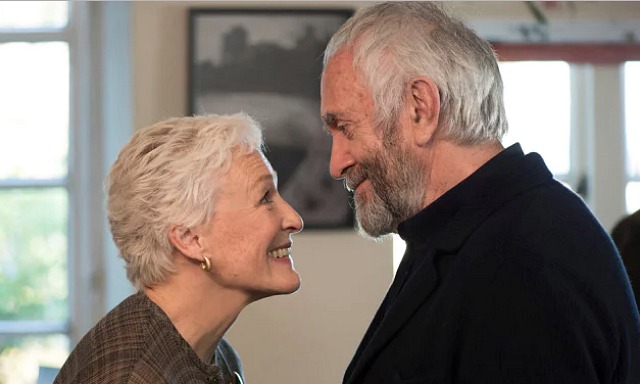
I didn’t attend this morning’s 8:45 am screening of Bjorn Runge‘s The Wife, but The Guardian‘s Peter Bradshaw did, and his review goes nuts for Glenn Close‘s performance as a “charming, enigmatically discreet and supportive wife” of a world-famous author and New York literary lion (played by Jonathan Pryce.
Close’s performance as Joan Castleman “may be [her] career-best,” Bradshaw says, and “a portrayal to put alongside Close’s appearances in Dangerous Liaisons and Fatal Attraction.” He describes her character as “unnervingly subtle, unreadably calm, simmering with self-control…a study in marital pain, deceit and the sexual politics of prestige.”
That sounds like something strong enough to launch Close into the Best Actress derby, but we’ll need to hear from a few more critics before going down that path. No Rotten Tomatoes entries as we speak.
Hollywood Elsewhere is going to try to attend a 6:30 pm screening of The Wife on Thursday evening at Roy Thomson Hall. So dar I can’t find a publicist who’s repping the film. If anyone knows anything and could lend a hand, please get in touch.
Close and Pryce aside, The Wife costars Christian Slater, Annie Starke, Max Irons, Elizabeth McGovern and Harry Lloyd.
Abuse begets more abuse, and abused victims sometimes (often?) seek out fresh replacement abusers. And so Tonya Harding‘s bitter, chain-smoking mom, Lavona, beat and belittled her daughter from age of 7 onward, and as teenaged and then 20-something Tonya ascended in the figure-skating realm she became a ferociously angry abuser herself with a huge chip on her shoulder…what else?
Tonya married and then separated from an abusive, moustache-wearing asshole, Jeff Gillooly, who conspired to have Harding’s skating rival Nancy Kerrigan temporarily disabled with a police-baton blow to the knee, and with many presuming, fairly or unfairly, that Harding was aware of Gillooly’s plan and was more or less down with it.
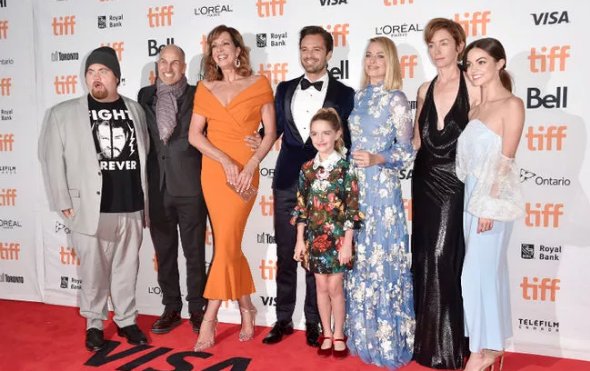
Craig Gillespie‘s I, Tonya, an exaggerated, pugilistic black farce that some are calling grimly comedic, is all about the Harding catastrophe, and it’s definitely the Toronto Film Festival movie to see and get walloped by right now.
I, Tonya press-screened this morning at 10:45 am. Well, actually 11:05 am because it took so long to get everyone in. I was there and dealt with the long, horrible, hope-crushing line that stretched east along Richmond and south down John Street. I saw it and I ate it, suffering the blows and bruises and the eye-popping realization that I, Tonya currently has a 100% Rotten Tomatoes rating.
The cool kidz love it, but I’m telling you that unless you have a strange liking for the company of losers, abusers and total dipshits, you’ll definitely want to steer clear of this cesspool exercise. It lasts 119 minutes, and it feels, trust me, like 139 or 149.
When it ended I turned to the guy next to me and said, “How long was that?” “Two hours,” he said. “Good God,” I replied.
Am I the only honest, straight-shooting journo-critic in Toronto right now? I, Tonya is cinematic abuse, pure and simple. It’s an ugly pill from hell — a violent, vulgar, relentlessly profane assembly of lower-middle-class white-trash types beating on each other and smoking and swearing and losing their tempers and causing cuts and swellings. It’s a tacky portrait of American self-loathers, brawlers, grotesques, hungry-for-famers, human garbage, etc.
I tweeted the following just after 1 pm today: “I, Tonya is an ugly, abusive, lower-class tale about a demimonde of ugly, abusive, lower-class people. A movie full of rage and resentment. A toilet-bowl downswirl of wretched, lower-middle-class misery.
Thirteen months ago I threw some praise at a 5.11.16 draft of Taylor Allen and Andrew Logan‘s Chappaquiddick. I tore through it in no time. It’s the kind of well-finessed backroom melodrama that I love — no bullshit, subdued emotions, no tricks or games. It’s tense and well-honed, and, like I said on 8.18.16, a nightmare that had me shaking my head and muttering “Jesus H. Christ”.
Like the script, the film (which I saw this morning at 8:30 am) is a damning, no-holds-barred account of the infamous July 1969 auto accident that caused the death of Kennedy family loyalist and campaign worker Mary Jo Kopechne, and which nearly destroyed Sen. Edward Kennedy‘s political career save for some high-powered finagling and string-pulling that allowed the younger brother of JFK and RFK to more or less skate.
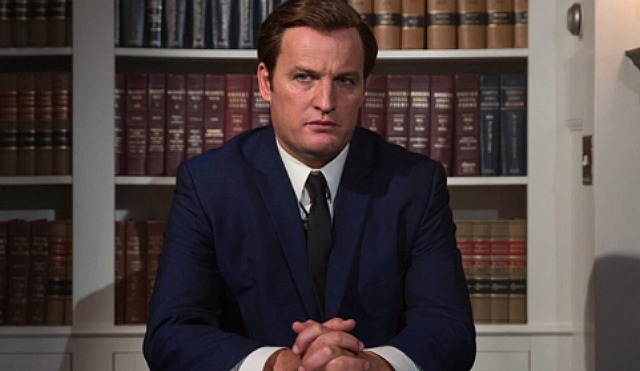
Jason Clarke as the late Senator Edward M. Kennedy in John Curran’s Chappaquiddick.
Just about every scene exudes the stench of an odious situation being suppressed and re-narrated by big-time fixers, many of whom are appalled at Ted’s behavior and character but who do what’s necessary regardless.
There’s no question that director John Curran, dp Maryse Alberti and editor Keith Fraase are dealing straight, compelling cards, and that the film has stuck to the ugly facts as most of us recall and understand them, and that by doing so it paints the late Massachusetts legislator and younger brother of JFK and RFK in a morally repugnant light, to put it mildly.
All along I’ve been hoping that Curran would just shoot the script efficiently, minus any kind of showing off or oddball strategies that might diminish what was on the page. This is exactly what he’s done. Curran has crafted an intelligent, mid-tempo melodrama about a weak man who commits a careless, horrible act, and then manages to weasel out of any serious consequences.
Chappaquiddick may not be the stuff of monumental cinema (stylistically it feels like a respectable HBO-level thing), but it’s a frank account of how power works (or worked in 1969, at least) when certain people want something done and are not averse to calling in favors. EMK evaded justice by way of ingrained subservience to the Kennedy mystique, a fair amount of ethical side-stepping and several relatively decent folks being persuaded to look the other way.
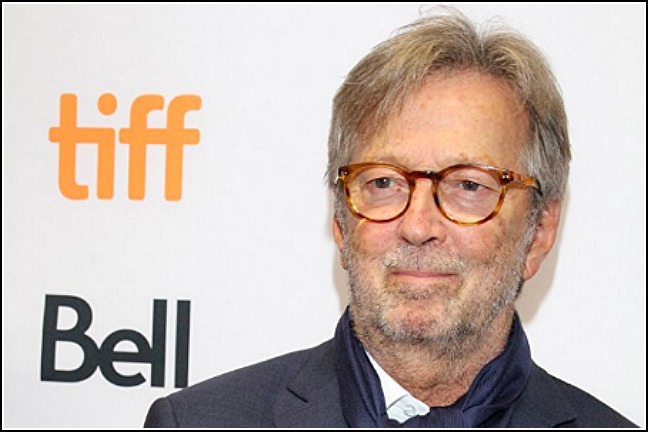
Lili Fini Zanuck‘s Eric Clapton: A Life in 12 Bars illustrates a rule about documentaries and particularly talking-head footage that bears repeating.
If you have an ample supply of alluring, great-looking, non-grainy footage, you’re free to forego talking heads. Just hire a top-tier editor, overlay some wise, insightful narration and you’ll probably be fine. But if your footage is mainly composed of grainy, shitty-looking photos mixed with black-and-white TV footage, you definitely need to intercut with well-recorded, high-def color footage of this and that knowledgable, insightful authority.
The reason, obviously, is that you’ll want to occasionally free the viewer from the prison of fuzzy, shitty-looking stills and black-and-white TV footage, and you’ll also want to heighten the impact of your vocal observations as a way of adding intellectual intrigue and fighting the general monotony.
I’ve just walked out of a screening of Eric Clapton: A Life in 12 Bars because the portion I saw (a) was almost all grainy, shitty-looking photos and black-and-white TV footage (it really needs a roster of well-lighted talking heads) and because (b) the cutting felt uninspired and inelegant and (c) I began to feel hugely irritated and then angry from the generally sloppy, substandard feel of it.
Granted, I only lasted from the beginning of Clapton’s guitar-playing career to the dawn of musical psychedelia, or from late ’63 to early ’67 (Yardbirds, John Mayall & the Bluesbreakers, Cream). But Zanuck didn’t even touch upon the musical influence of pot and LSD and particularly the mystical-psychedelic consciousness that began to spread all through the music industry starting in late 1965, and which flourished in ’66, ’67 and beyond.
Cream wasn’t just another band for Clapton (or Jack Bruce or Ginger Baker) — it represented a whole spiritual changeover, a new way of living and seeing…everything top to bottom. To quickly transition from being a hard-core blues purist to a psychedelic pioneer was huge for a guy like Clapton, and yet the doc just cuts from shitty-looking black and white stills and footage of Clapton hanging and playing with Mayall and the gang to shitty-looking black and white film of Clapton, Bruce and Baker playing “I Feel Free,” which was among the strongest cuts from Fresh Cream.
All of a sudden I said to myself, “Fuck this movie…Zanuck and her producers and editors are just going through the motions, running footage, hanging wallpaper.” I suddenly needed to feel free, and so I got up and left.
I may catch the rest of Eric Clapton: A Life in 12 Bars when it plays on Showtime. Maybe. If I feel like it. We’ll see how that goes.
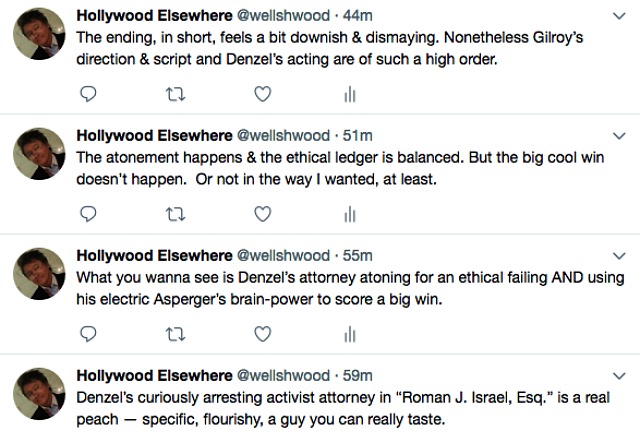
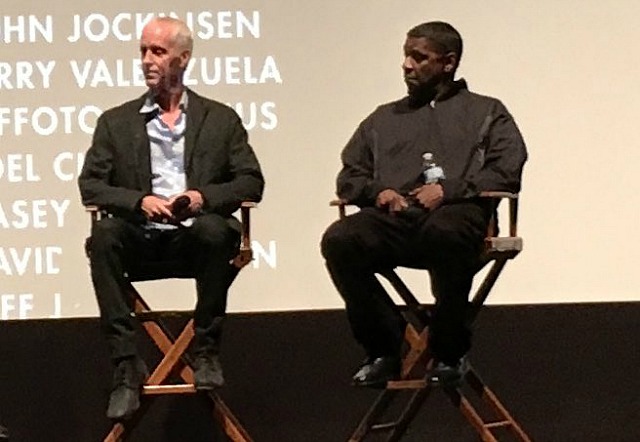
Dan Gilroy‘s Roman J. Israel, Esq., which screened on late Sunday night at the Ryerson, is a whipsmart, cunningly performed, immensely satisfying film in so many ways. Such a skillful job of character-building on Gilroy’s part, layer upon layer and bit upon bit, and such a finely contoured performance by the great Denzel Washington.
My only hang-up is that I wanted a different ending. Not that Gilroy’s ending is “bad”, per se, but I didn’t agree with it. I didn’t want it.
Otherwise this is such a brilliant, invigorating and fully believable film for over-30s — milieu-wise, legal minutiae-wise, Asperger’s-wise. It’s my idea of pound cake topped with whipped cream and strawberries…give it to me. You can take a terrific bath in this film and never feel unsatisfied that the story isn’t quite delivering the way you want it to.
Until the last 25 or 30 minutes, that is, but even then it’s not a fatal problem, just an air-escaping-the-balloon one.
Alas, I have to awaken at 6:30 am for an 8:30 am screening of Chappaquiddick, which I hear is quite good, and it’s 1:28 am now.
7:01 am update: Variety‘s Owen Gleiberman agrees with me — a wonderfully detailed Gilroy character, superb Washington acting but with a less-than-satisfying third act:
“The way Roman J. Israel, Esq. is set up, the film should be building to a moral-legal confrontation that tests everyone involved. Instead, it’s content to be a character study; but the audience, after a while, may not be so content.
“Roman gets assigned to the case of a young man (Niles Fitch) accused of murder (he tagged along when his buddy killed a convenience-store clerk). After a while, Roman goes through with an action that seems, in movie terms, to be justified: He turns the identity of the killer over to the victim’s relatives, gathering a private reward of $100,000. Legally, it’s a dicey thing to do, but no one innocent has gotten hurt, and Roman uses the money to put himself through a transformation that feels good.
“He buys real suits. He rents a fabulous apartment. He brushes back his hair. He scarfs honey-and-turkey-bacon donuts. He goes on a date with Maya (Carmen Ejogo), who runs a non-profit and, in her small way, is carrying on the dream of Roman’s formative era. The audience surveys all of this and approves, because Roman J. Israel, Esq. looks like a guy who could use a break.
“But the reward money comes back to haunt him. And that seems, in the end, a little facile. The movie turns into a war of signifiers, an archetypal L.A. battle pitched between going-for-the-bucks and holding-on-to-your-values. We’ve seen that battle before, a few too many times, and Roman J. Israel, Esq. doesn’t play it out in a particularly satisfying way. It leaves us with a character you won’t soon forget, but you wish that the movie were as haunting as he is.”
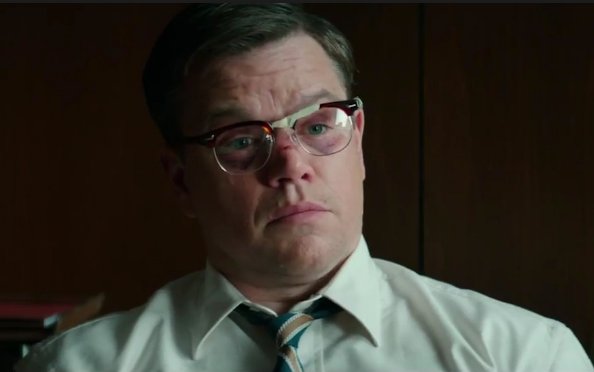
I saw George Clooney‘s Suburbicon earlier today…wow. Fargo-ish, it’s not. But it should have resembled Joel and Ethan Coen‘s 1996 classic at least somewhat, I was telling myself, because the original Suburbicon script, written by the Coens in ’86 and set in the mid ’50s, was their first stab at a Fargo-like middle class crime noir. Nine or ten years later the Coens went back to the same James M.Cain well and created Fargo, and the rest is history.
In Suburbicon, Clooney and producer and co-screenwriter Grant Heslov have reworked things, keeping the Fargo noir stuff but also, it seems, diluting or ignoring that sardonic deadpan wit that we all associate with the Coens, and deciding to paint the whole thing with a broad, bloody brush.
When it comes to tales about greed, murder and doomed deception, there’s nothing duller than watching a series of unsympathetic, unwitting characters (including the two leads, played by Matt Damon and Julianne Moore) play their cards like boobs and then die for their trouble. There’s just no caring for any of them.
Most significantly, Clooney and Heslov have added a side-plot about how Eisenhower-era white suburbanites were racist and venal to the core, and how things really aren’t much different today.
The Suburbicon victims are the just-arrived Meyer clan (Karimah Westbrook, Leith M. Burke, Tony Espinosa), and from the moment they move into their new, ranch-style home in a same-titled fictitious hamlet (i.e., an idyllic real-estate development right out of Martin Ritt‘s No Down Payment) their cappuccino skin shade incites ugly pushback from just about everyone. But the situation doesn’t develop or progress in any way. The Meyers keep absorbing the ugly, and that’s pretty much it.
Remember how those small-town citizens greeted the arrival of Cleavon Little in Blazing Saddles? Nearly the same broad-as-fuck tone prevails here. There isn’t a single non-racist white adult in Suburbicon. With the exception of Noah Jupe‘s Danny, who’s about ten, and the Meyers clan everyone in Clooney’s film has horns, hooved feet and a tail.
Clooney and Heslov to progressive industry hipsters and Twitter banshees: “We get it…whiteys carry the demon seed…a pox upon humanity…they totally sucked in the Eisenhower era and are probably no better right now…down with the curse of Anglo Saxon gene pools except, you know, for a certain small sliver of enlightened humanity that includes Glenn Kenny, Ellen DeGeneres, Greta Gerwig, Phillip Noyce and a few thousand others.”
Suburbicon is about a married middle-management milquetoast (Damon’s Gardner Lodge), obviously a close relative of William H. Macy‘s Jerry Lundegaard, scheming with his wife’s sister (Julianne Moore plays both roles) to scam a pile of dough by hiring a couple of thugs to kidnap and “accidentally” kill his wife. All kinds of hell breaks loose when the plan goes wrong.
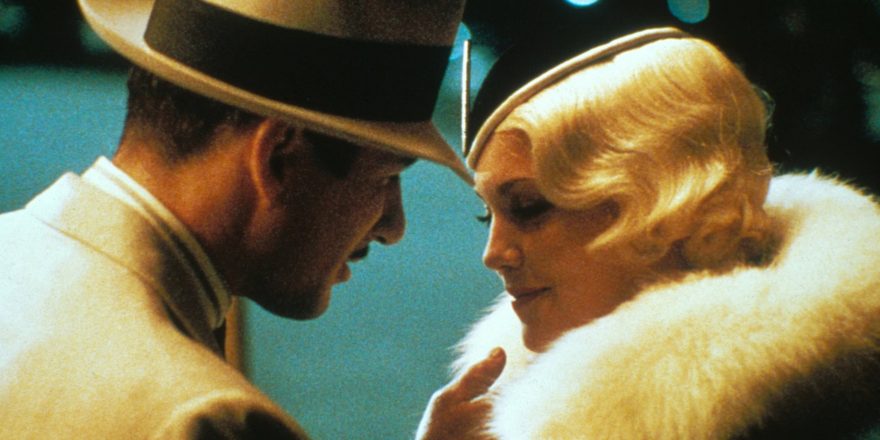
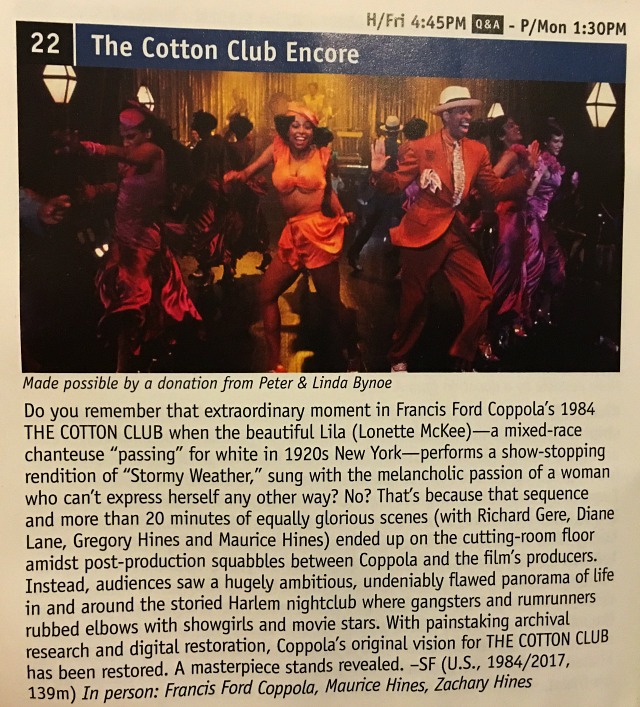
Francis Coppola‘s The Cotton Club Encore, an expanded and allegedly improved 139-minute version of the original 1984 film, played twice at last weekend’s Telluride Film Festival. I couldn’t fit it into my schedule, and I can’t find any reviews from any reputable or tough-minded critics whom I respect. Nor can I trust Jim Hemphill’s enthusiastic 9.6 review, which claims that the new cut is a “masterpiece”. But I’m certainly intrigued.
I didn’t care much for the original version, which I saw only once about 33 years ago. But Coppola’s new cut is said to feature more music and dancing, and to be less white, and less focused upon the romantic relationship between the two lead characters, played by Richard Gere and Diane Lane. It may do the trick and it may not, but who wouldn’t want to see it?
Coppola spent $500,000 out of his own pocket to create this new version. The restoration effort took four years, I’ve been told, and was completed about six months ago. Coppola was inspired after seeing an old Betamax version of an original cut that he liked better than the ’84 theatrical version.
Coppola archivist James Mockoski explained this morning that Coppola removed about 13 minutes of footage for the original 127-minute version, which took it down to 114 minutes or thereabouts. Roughly 25 minutes of new footage was added for a grand total of 139 minutes.
So why isn’t The Cotton Club Encore playing at the Toronto Film Festival or the forthcoming New York Film Festival? You’re not going to believe this, but the reason is MGM CEO Gary Barber, the same obstinate asshole who has blocked Robert Harris‘s long-hoped-for restoration of John Wayne‘s The Alamo.
MGM is the Cotton Club rights-holder, you see, and Barber, true to form, has not only objected to the film being shown in any kind of commercial venue (such as TIFF or NYFF) but is also uninterested in distributing or streaming Coppola’s expanded version, even though Coppola has paid for the whole thing.
Barber could theoretically (a) allow for a brief theatrical re-release of The Cotton Club Encore or (b) issue it on Bluray or via Amazon/iTunes streaming or (c) at least sub-license the home video rights to Criterion or some other dedicated, film-loving outfit. But the South African-born executive reportedly has no interest, just as he’s refused to even discuss the Alamo situation with Harris.
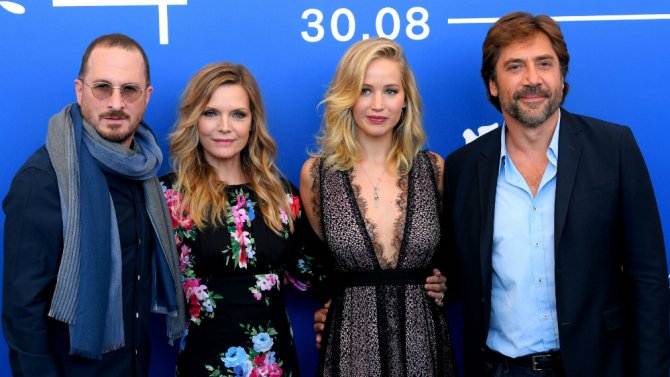
Attention Darren Aronofsky loyalists: The word has gone out that mother! is an allegory about something or other. Climate change, haunted Biblical prophecy, invasive social-media malevolence, a personal Aronofsky confession…you tell me. It’s not about the images, behaviors and disturbances presented on the screen, but whatever may be suggested or implied by same. Go to town and kick it around, but don’t limit yourself solely to the visual and aural content.
Ben Croll’s 9.6 Indiewire review (“Aronofsky’s Audacious and Rich Cinematic Allegory Is His Most Daring Film Yet”) is one manifestation of this mode of absorption. As Croll writes, “Come for the house that bleeds; stay for the reflections on parenthood and the difficulty of living with fame.”
Excerpt #1: “Awash in both religious and contemporary political imagery, Aronofsky’s allusive film opens itself to a number of allegorical readings, but it also works as a straight-ahead head rush. Not just another baroquely orchestrated big-screen freak-out in the vein of Black Swan (though it is very much that), the film touches on themes that — if too hazily figurative to be in any way autobiographical — at least tread on factors in the director’s own life.
Excerpt #2: “The film is divided into two parts that roughly parallel one another for reasons that eventually make themselves clear. Both follow married couple Jennifer Lawrence and Javier Bardem (and yes, their nearly 20-year age gap is an important and oft-commented upon plot point), who go unnamed as a way of telegraphing that they’re meant to represent Bigger Things.”
Excerpt #3: “Aronofsky and Paramount have launched one of the more secretive marketing campaigns in recent memory, which is odd because “mother!” is a not a particularly twisty-turny affair. Both parts of the film play out like the first few chapters of The Hobbit, where a growing number of unexpected guests pop in to break the leads’ bucolic solitude, and twist them toward different ends.”
A few hours ago a critic friend took me to task for what he regarded as a slightly-too-friendly review of Guillermo del Toro‘s The Shape of Water, which I posted on 9.3. Here’s our conversation:
Critic friend: “I’m a decided non-fan of The Shape of Water, which puts me squarely in the minority. Which is fine.
“But I was struck by this paragraph in your write-up: ‘Alas, Shape isn’t perfect. It’s a full emotional meal but saddled, I regret to say, with an implausible story, even by the measure of a fairy tale. It contains unlikely occurences, curious motives and logical roadblocks, all of which have to be elbowed aside by the viewer in order to stay within the flow of it. Which — don’t get me wrong — I was totally willing to do because I so loved the overall.’
“Frankly, the qualifications you have — implausible story (even by the standards of a fairy tale), curious motives, etc. — sound much more major than your reasons for liking it. Why on earth is this glorified piece of production design “a full emotional meal”? If you found it so, go with God, but please explain.
“It doesn’t sound like you were even bothered by my #1 reason for not responding to it: The gill-man is…a blank!! A rubbery body suit in search of a single character trait.”
HE response: “I liked that GDT was once again off in his realm, confidently occupying his own patch, indifferent to the expectations of someone like you or me. He’s NEVER cared that much, never given a hoot about anything but the purely visual, the ripely sensual, the monster mash, the phantasm, the fangoria, etc.
“Seriously, I just decided early on that once again here was another GDT film that I would have to accept or reject. So I chose ‘okay, mostly yes.’ I decided to throw up my hands, shrug and accept it. I kept pushing away the bothersome stuff…push away, push away…because I fell in love with Sally Hawkins and her journey. I should have been tougher, I suppose, but I just didn’t have the heart to start chipping away and complaining.
“Remember that I also wrote the following: ‘If you ask me Guillermo has adhered too strictly to a black-and-white moral scheme here. I for one am always looking to find a couple of minor smudges or failings in a good character, and a sympathetic or slightly redeeming quality or two in a villain, but this kind of complexity is not, I regret to say, in the Shape of Water cards.”
Greta Gerwig‘s Lady Bird (A24, 11.10), which I finally saw last night after absorbing all the buzz and praise for the previous two days, is by far the pizazziest, wisest, smartest, most emotionally resonant and complete film I’ve seen at Telluride ’17. And it’s going to keep happening after it opens two months hence, and by this I mean it will stir the award-season pot.
Lady Bird vibrates with pluck, wit and smartypants energy, but it’s not some indie outlier that will peak in terms of awards recognition with a Spirit trophy or two. It’s a Best Picture contender if I ever saw one, and Saoirse Ronan‘s lead performance — essentially a portrayal of the young, Sacramento-imprisoned Gerwig at age 18 or thereabouts — is a locked-down Best Actress contender.
Lady Bird star Saoirse Ronan, director-writer Greta Gerwig during filming in Sacramento.
A comically anguished piece of self-portraiture in which the 34 year-old Gerwig recalls and reconstructs (and to some extent re-invents) her life in ’02, when she was finishing high school and dying to get the hell out of Sacramento, Lady Bird is the only serious Telluride break-out, the only film that has really cast one of those spells…an amusing, touching, smallish knockout that truly glistens and scores and pushes that special massage button.
Lady Bird is Rushmore’s Daughter — a whipsmart, girl-centric indie that deals emotionally rounded cards, a Wes Anderson-type deal (sharply disciplined, nicely stylized, just-right music tracks, grainy film-like textures) but without the twee, and with polish and English and all kinds of exacting, soulful self-exposure from director-writer Gerwig.
She’s passing along a half-funny, half-turbulent saga of high-school-senior angst, lust, parental friction, friendship, frustration, existential ambition and social longing.
Ronan’s performance is the take-home, for sure — a pushy, achey and vulnerable teen thing, almost but not quite in the Max Fischer-Jason Schwartzman mode. She’s also, of course, portraying the young Gerwig. You could say that Ronan is inhabiting Gerwig as much as Jesse Eisenberg played a generic Woody Allen-like figure in Cafe Society, only with more energy. In my book this is Ronan’s best performance yet, and that ain’t hay.
But Laurie Metcalf, as Ronan’s prickly and emotionally frustrated mom, is a stand-out also, and a likely contender for Best Supporting Actress.
From Todd McCarthy‘s Venice Film Festival review of Alexander Payne‘s Downsizing: “[This] is a wonderfully outsized movie for these times if there ever was one. Alexander Payne has taken a conceit heretofore used for gag-oriented sci-fi and comedy, that of shrinking human beings down to the size of a finger, and breathtakingly transformed it into a way of addressing the planet’s overriding long-term issue.
“Captivating, funny and possessed of a surprise-filled zig-zag structure that makes it impossible to anticipate where it’s headed, this is a deeply humane film that, like the best Hollywood classics, feels both entirely of its moment and timeless. It was a risky roll of the dice, but one that hits the creative jackpot.
“The rare director who has never made a bad film, Payne has now arguably created his best one with a work that easily accommodates many moods, flavors, intentions and ambitions.
“At its core, Downsizing grapples head-on with the long-term viability of humanity’s existence on this planet, but with no pretension or preachiness at all, while on a moment-to-moment basis it’s a human comedy dominated by personal foibles and people just trying to get by in life. It’s also a science-fiction film that not for a second looks or feels like one.
“As such, this is a unique undertaking, one centered on an unexceptional Everyman character who unwittingly embarks upon an exceptional life journey; in that sense, Matt Damon’s Paul Safranek is like the hero of a Frank Capra or Preston Sturges film of 75 years ago, an ordinary man who has a certain sort of greatness thrust upon him. At the same time, the movie is a highly sophisticated creation that, due to its off-hand, underplayed presentation of the future, essentially seems to be taking place in the present day.