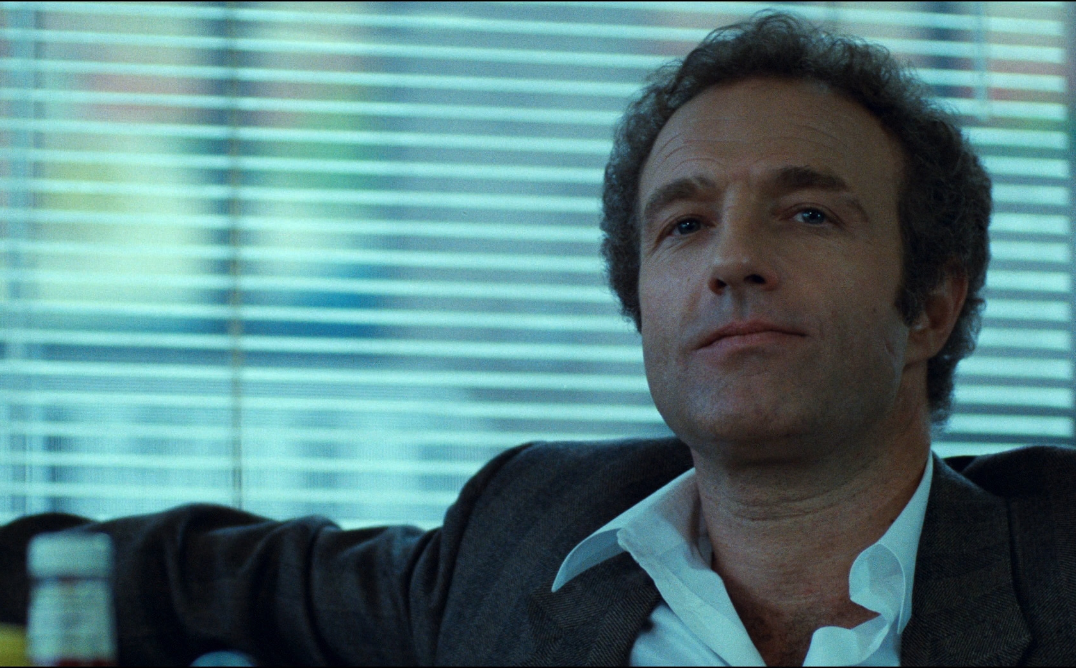
Down-on-my-knees respect for the legendary James Caan, who has sadly moved on to greener pastures at age 82.
Born in 1940 (three years younger than Warren Beatty and Robert Redford), Caan delivered fine performances in the ’60s and very early ’70s (especially in El Dorado, The Rain People, Brian’s Song and RabbitRun) but didn’t hit the jackpot until he played Sonny Corleone in The Godfather (’72).
For the rest of the ’70s and into the early ’80s it was smooth sailing and mostly glory glory glory for this Bronx-born son of German-Jewish immigrants.
Caan made 15 films during an eight-year hot streak — Slither, Cinderella Liberty, The Gambler, Freebie and the Bean, The Godfather Part II, Funny Lady, Rollerball, The Killer Elite, Harry and Walter Go to New York, A Bridge Too Far, Another Man, Another Chance, Comes a Horseman, Chapter Two, Hide in Plain Sight and Thief.
All but four or five were either grade-A or B-plus, and fully respectable.
Caan’s greatest performances, hands down and in this order: Axel Freed in The Gambler (’74), Frank in Thief (’81) and Sonny in The Godfather I & II (’72 and ’74).
He rebounded in Rob Reiner‘s Misery (’90), of course, and did commendable work in Honeymoon in Vegas (’92), as a senior-aged wise guy in Wes Anderson‘s Bottle Rocket (’95), in James Gray‘s The Yards (’00) and in Lars von Trier‘s Dogville (’03).
After succeeding Theresa May as Prime Minister nearly three years ago (7.24.19), Boris Johnson was quickly understood by those relatively few Americans who pay attention to British politics as a Donald Trump-like figure — brash, conservative, weird blond hair, a bullshitter, an elitist, swaggering, amoral, supported by low-information rurals, deeply loathed by the British left, etc.
And yet from an American perspective Johnson never seemed as utterly foul and rancid and sociopathic as Trump. As arrogant and entitled and indifferent to conventional political behaviors as he was and presumably still is, Johnson has at least, faced with the end of his party’s support and cornered on all sides, finally faced reality and submitted to the rules of the game. Plus he was and is well-educated, well-spoken, occasionally witty and amusing, etc. A woolly mammoth living and conniving by his own rules, if you will, but far more civilized and respectful of the system than Trump ever was or will be.
“As we’ve seen recently in Westminster, the herd instinct is powerful. And when the herd moves, it moves. In politics, no one is remotely indispensable. And [so] our brilliant and Darwinian system will produce another leader, equally committed to taking this country forward. I know that there will be many people who are relieved and perhaps quite a few will also be disappointed. And I want you to know how sad I am to be giving up the best job in the world. But them’s the breaks.”
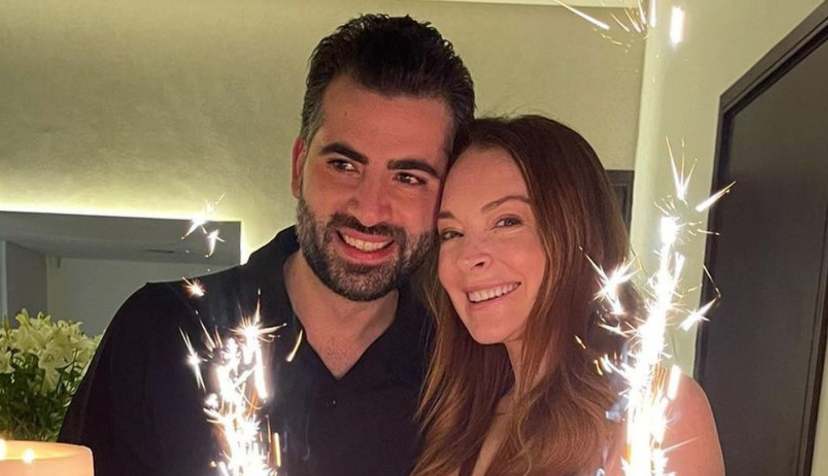
Best wishes to the just-marriedLindsay Lohan and Bader Shammas. The couple has been living in Shammas’ home city of Dubai, where he works as an assistant vp at Credit Suisse, for a couple of years.
I’ve never been to Dubai, but I’ve always understood it to be a kind of flamboyant wealth-porn city…high-rises, high temps, beaches, super-malls and devoid of anything that I would value culturally. Paris, Barcelona, London, Rome, Munich, Prague, Bern, Zurich…anywhere but effing Dubai, please.
Plus we all understand that Middle Eastern men and particularly those raised in the UAE are not exactly known for honoring 21st Century feminist values. They’re generally known, in fact, for being somewhat medieval-minded….be honest.
If you’re a fan of Sidney Lumet‘s Prince of the City (and what Lumet admirer isn’t?) and you haven’t seen FindMeGuilty (’06), which many have ignored or dismissed as a commercial failure, you need to buckle down and rent it.
I know that Find Me Guilty never seems to come up much in discussions of Lumet’s career, and yet it’s absolutely one of Lumet’s finest and is certainly one of the greatest films ever made by a director who’s over 80. (Lumet’s Before The Devil Knows You’re Dead, released in ’07, also belongs on that list.)
I haven’t re-watched Guilty since it opened 16 years ago, but I’ll be revisiting tonight.
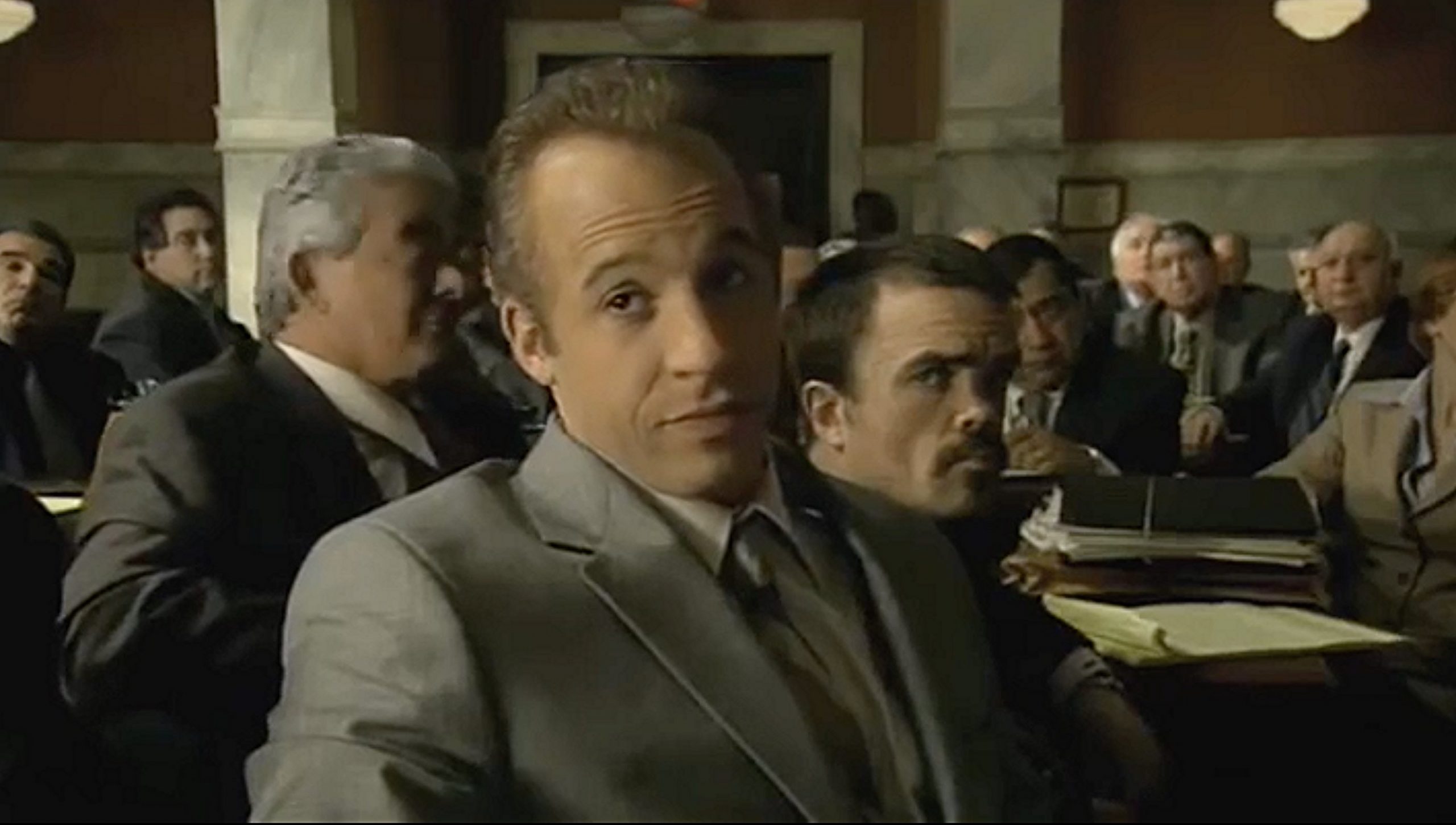
Guilty is a marvel of old-fashioned (i.e., ’80s-style) craftsmanship — Lumet’s superb direction, T.J. Mancini and Robert McCrea’s’s finely structured screenplay and skillfully pared-down dialogue, and Vin Diesel’s inescapably charming, sincerely felt performance that briefly put him back on the road map. It was the last first-rate performance he ever gave.
In my book Find Me Guilty was Lumet’s best film since Q & A (1990), and before that Prince of the City (1981). It’s a tight, no-nonsense court drama that’s not about legal maneuvers or discovering evidence or doing right by the system and justice being served, but mob family values.
It’s not without its amusements and gag lines from time to time, but Guilty is a fairly serious, rooted-in-reality court procedural about wise-guy morality, or the urban mythology about same..
There’s more time spent in a courtoom in this thing than in Lumet’s The Verdict, and for good reason: Find Me Guilty is about the longest-lasting federal criminal prosecution in history. From March ’87 to August ’88, 20 members of the New Jersey-based Lucchese crime family, each represented by his own lawyer, were brought to trial in Newark, New Jersey, on some 76 charges (dope smuggling, gambling, squeezing small businesses…the usual mob stuff).
The mob family values can be summed up by the words “don’t rat,” “don’t roll” and “family is everything.”
I’m talking about the values of a group of bad guys (i.e., men who live outside the law and occasionally enforce their ethical standards by whacking each other) who ostensibly care for and someitmes “take care of” each other, and about one particular bad guy — Diesel’s Jackie DiNorscio — who stood up for certain things over the course of this trial…loyalty, friendship, togetherness…even if the reality of Italian crime ethics, going by everything I’ve heard, is that everyone rats out everyone else sooner or later and a lot of these guys are just full-out sociopaths, or are viewed this way by the majority. And yet Guilty isn’t an invented story.
What’s really striking is that Find Me Guilty delivers pretty much the precise opposite moral message of Prince of the City, which is about the emotional torment that a corrupt cop puts himself through when he decides to tell the absolute truth and rat out his equally corrupt cop friends, and ends up despised and lonely and broken.
Guilty is about a wise guy who refuses to rat out his wise-guy friends, even when most of them shun him and treat him like a leper because of his court behavior, but who nonetheless holds to his own moral ethical course.
Has there ever been a major-league filmmaker besides Lumet who has made two films about the same culture — the New York-area criminal underworld — with both (a) based on a completely true story about courts and prosecutors and defendants, (b) both grappling with almost the exact same moral-ethical issue, and yet (c) coming to almost the exact opposite conclusions about ratting out your friends?
JesseCipollone, owner of a popular Wilton hot-dog eatery called DogDazecafe. has told Wilton Patch that he’s not much of a social media hound, having just celebrated his fourth decade and all.
The man was born in ‘82 (the year of E.T., Gandhi, TheThing and TheVerdict) and he’s already in love with being a past-his-prime, “internet who?” Gabby Hayes guy?
Let history record that Cipollone was the first Millennial (1981 to 1997) to self-identify this way. All my life I’ve thought of Millennials as internet whiz kids. I’ve never met one who isn’t.
Google has Dog Daze (713 Danbury Road, Wilton, CT) in 62nd place on its list of the 100 best hot-dog joints in the U.S.
The seller of Google’s #1-rated hot dog cuisine in the entire country is Billy’shot–dogcart, a Manhattan business which operates on Central Park West between the upper 80s and 90s.
I’m not finding the actualGooglelist, but the top 15 are all (or mostly) located in the New York area. What about Pink’s?
The tastiest hot dogs I’ve ever had are the spicy ones sold in Toronto. The dogs are sliced up to allow for fuller flavor.
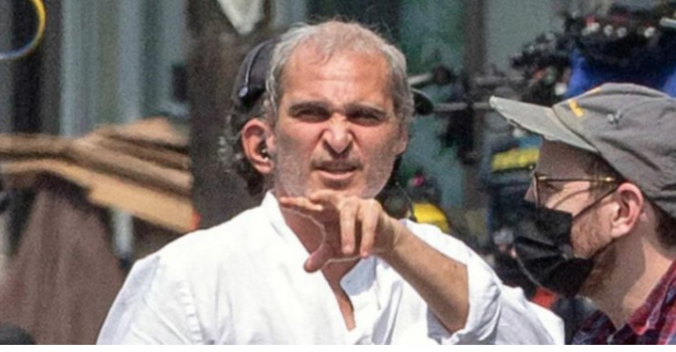
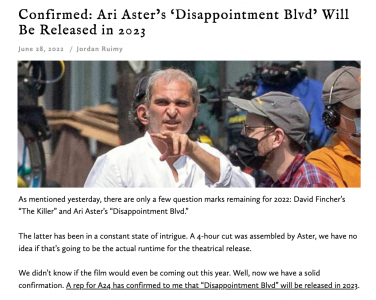
If A24 was smart, they would screen Ari Aster‘s four-hour version of Disappointment Blvd. at Venice and Telluride two months hence, and then release two versions a few weeks later — i.e., the shorter version that A24 management allegedly prefers plus the four-hour cut. They could release the shorter version theatrically while releasing the longer version via streaming. Or vice versa or any which way. It would become a huge thing to see both and debate the differences.
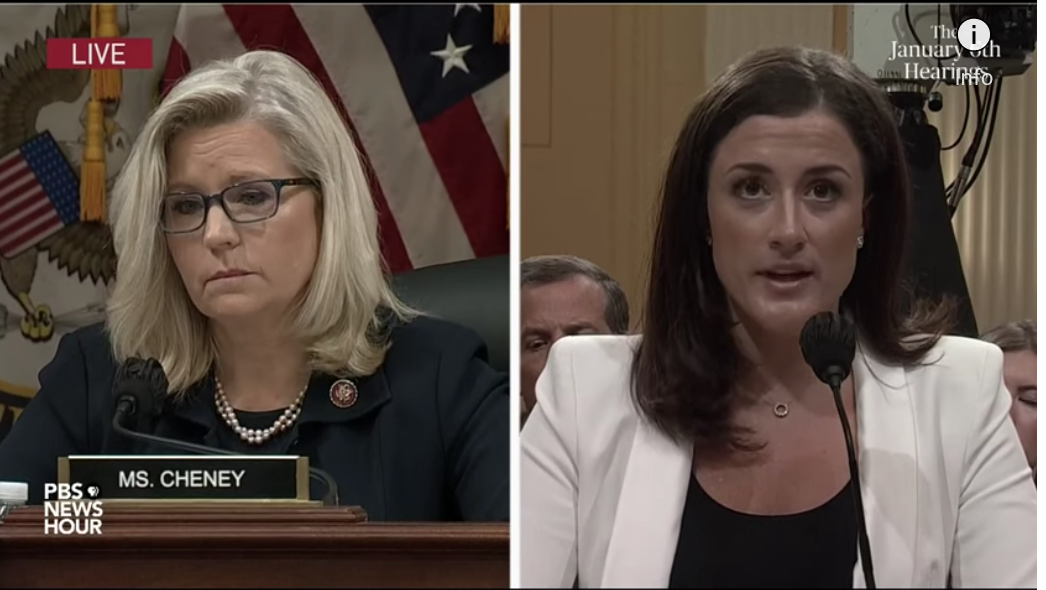
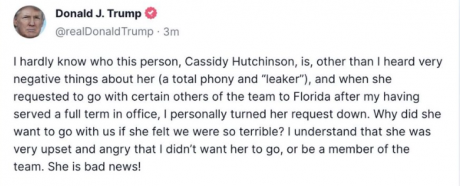
Today Cassidy Hutchinson became the new John Dean, and in so doing carved her name and testimony into the marble stone of history.
Today’s testimony from 26-year-old Hutchinson, who is either a young Millennial or an elderly Zoomer, is obviously fatal to Donald Trump. Cassidy has testified that Trump knew there was a clear potential for violence at the Capitol on January 6th, meaning that Trump knew that several in the crowd were planning to go armed to the Capitol. And that Trump lost it when he was told by the Secret Service he couldn’t go to the Capitol…grabbed the steering wheel, “I’m the fucking President!”, etc.
Who hasn’t known for years that Trump — pre-, during- and post-Presidency — has always been a deranged, intemperate, sociopathic ass-clown?
🚨🚨Wow. Trump knew his supporters had weapons and demanded metal detectors be removed.
“I don’t f-ing care that they have weapons. They’re not here to hurt me. Take the fucking mags away. Let my people in. They can march to the Capitol from here.”
— Bill Pascrell, Jr. 🇺🇸🇺🇦 (@BillPascrell) June 28, 2022
“I’m the f’n president. Take me up to the Capitol now” — Hutchinson testifies that Trump GRABBED AT THE STEERING WHEEL of a car to try to force the secret service to take him to the Capitol pic.twitter.com/k84BMa4cnN
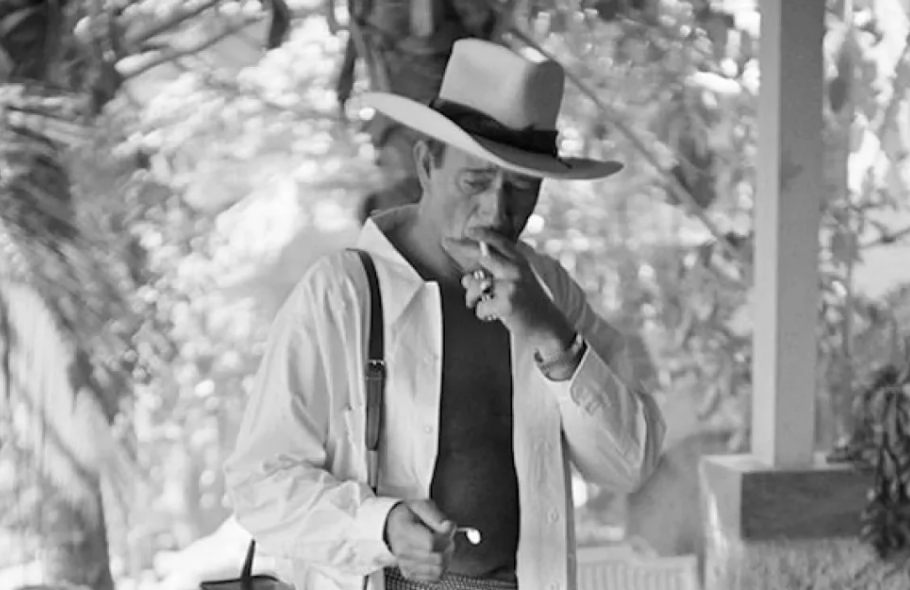
One of the most familiar and widely commented upon John Wayne photos to ever hit the internet. I don’t why I’m posting this, and I don’t even know what the above headline means. But it came to me a couple of minutes ago and it sounded good so I went with it.
If I was living in the left-side home, I probably wouldn’t have a BLM sign in my front yard as that would indicate that I’m living in the recent past (early summer of ’20).
I would instead post a political sign that points forward — forward to a sensible, fair-minded, left-center government, headed by a moderately charismatic, quick-witted, not-too-old President who isn’t owned by the wokesters and knows how to talk straight and plain to the hinterlanders.
That’s a dream, of course.
I’d like to think that the overturning of Roe v. Wade will energize voters and lead to a surge of support for at least some Democratic candidates, and that the left in general might not be heading for a general all-around slaughter in November. I’d love to see Beto O’Rourke win in Texas, for example. And Val Demmings in Florida.
Alas, Democrats are probably stuck with Biden running in ’24, and that means an almost certain loss. With Trump being discredited left and right that means Ron DeSantis might actually be elected President. Yes, bizarre as that sounds.
World of Reel‘s Jordan Ruimyreports that he’s been “assured” that Martin Scorsese‘s Killers of the Flower Moon will “indeed” be a 2022 release. Good to hear, but will it open in November or December? We all understand that an Oscar contender has to be screened no later than Thanksgiving and preferably earlier.
We all assume that Marty and Thelma Schoonmaker are working their fingers to the bone. They’ve been editing since the fall of ’21, then came the extra shooting, and now they’re back at it. How could they announce in good conscience “we can’t finish until ’23”? Where would be the honor in that?
Some may find it odd that handicappers are calling Lightyear (Disney, 6.17) dead meat despite earnings of $152 million worldwide and $88.7 million domestic. But you have to look at the details, and detail #1 is that Lightyeardropped 65% last weekend, earning a lousy $17.5 million after pulling down $50.5 million on opening weekend.
The Ankler‘s Sean McNulty is calling this the “worst-ever drop for a PIXAR film (not counting Covid-impacted Onward)….with Minions arriving on Friday, [Lightyear] was just a misfire. And cue the ‘PIXAR isn’t the same without Lasseter’ pieces in 3, 2… Just remember to include the reasons why Lasseter was ousted.”
Two days ago N.Y. Post columnist Kyle Smithspeculated that Lightyear was hurt by general audiences being fed up with films that secrete woke instruction. Not the brief lesbian kiss but a suggestion that Lightyear might have a hidden lecture or two up its sleeve.
“Hollywood was founded by, and for generations run by, pure showmen who were fanatically devoted to giving the audience what it wanted,” Smith wrote. “Today Hollywood’s message is, ‘Let us entertain you! But first, a brief lecture on what’s wrong with you, the audience…’
“One reason Top Gun: Maverick is such a huge success — the biggest movie of Tom Cruise’s career and probably the biggest movie of this year — is that it simply ignores all quarrelsome real-world issues. Maverick seeks merely to entertain, not to persuade you that the people who made it are virtuous.”
Remember hang-ups? In the ’60s accusing a person of being hung up was a fairly serious put-down. Hang-ups were a key definer of middle-class neurotics — people who were into guilt and maintaining appearances, who embraced shallow concerns and inhibitions — people who believed in scrubbing kitchen floors and mowing their lawns on Saturdays, who did’t get high or drop acid or listen to Bob Dylan or attend the Newport Folk Festival.
I’m not saying that people who did get high and wear buckskin fringe jackets and listened to Dylan and so on weren’t hung-up, but the cliche prevailed — strictly embraced middle-class values and lifestyles and prohibitions were seen as a kind of prison.
I’m asking because I haven’t heard anyone accuse anyone else of being hung-up for decades. Excluding Republicans and conservative psychos like Lauren Boebert, are people hung-up about anything these days?
I think they are, yeah.
The first Urban Dictionary definition of “hung-up” reads as follows: “When all you think about is one person, and you can’t stop thinking about them.” The fourth definition: “Stereotyped, repetitive and seemingly purposeless movements. Compulsive fascination with and performance of repetitive, mechanical tasks, such as assembling and disassembling, collecting, or sorting household objects.”
Here’s another definition: “When you’re locked into processing the world according to (I’m sorry to mention this but it just came to me) wokedoctrine….when all you can think about is whether this or that person or activity or political position is on the right side (i.e., yours)…when delivering or creating social justice for oppressed or less fortunate people and/or punishing their oppressors is pretty much everything.”