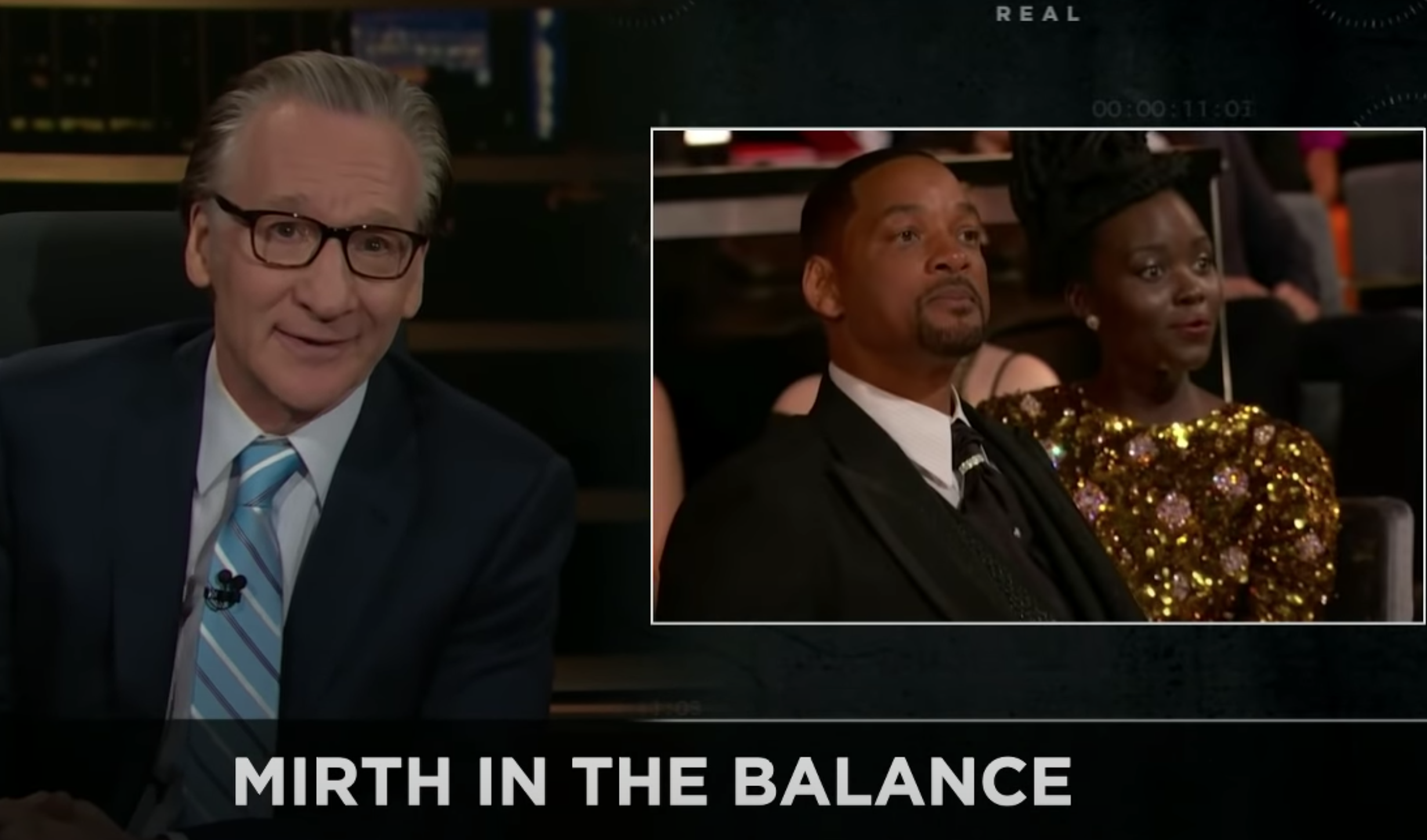
Maher: “I need to stick up for my tribe. This war on jokes must end. So let’s Zapruder this thing…”
slider
Match Game
Many relationships and marriages work out, sometimes for decades. They survive as long as the candle burns, fate warrants and patience persists; others wind down after four or five years. Or sooner. And that’s fine.
No, I’m not about to air some dirty Jeff-and-Tatiana laundry. It would be extremely gauche to do that. Neither Tatiana nor I are perfect, but our private stuff is not column fodder. Because I will not be that middle-aged married woman drunkenly hissing at her husband and angrily exposing her breasts during a party scene in John Schlesinger‘s Sunday Bloody Sunday (’71).
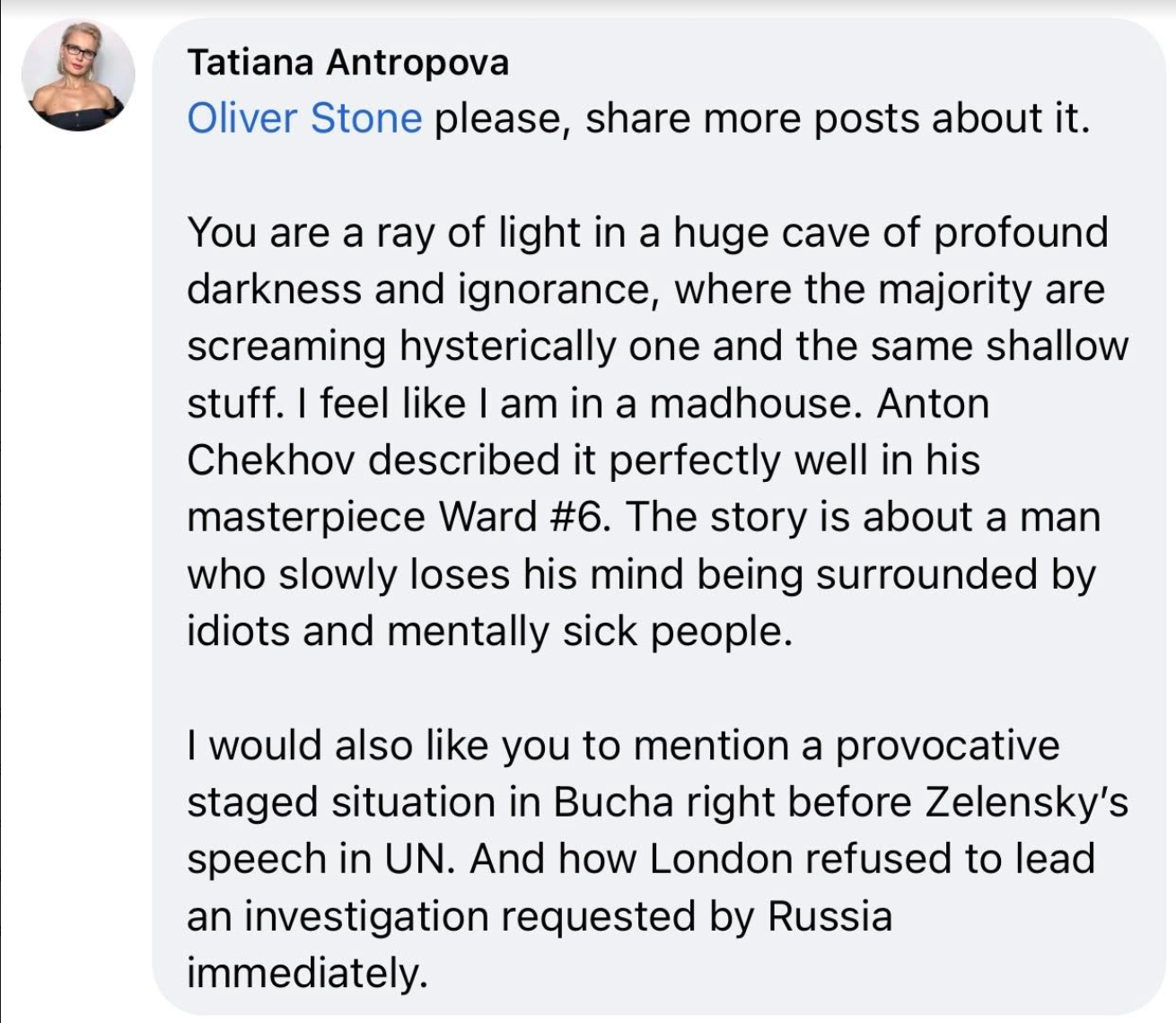
Over the past several weeks, however, I’ve been wincing over Tatiana’s respect and allegiance for Vladimir Putin, and especially her views about the ongoing Russian terror and genocide in Ukraine (which Vladimir Zelensky will discuss on 60 Minutes two days hence). I’ve kept my distance for the most part. It’s her deal, her background (born and raised in Edinet), her culture, her convictions.
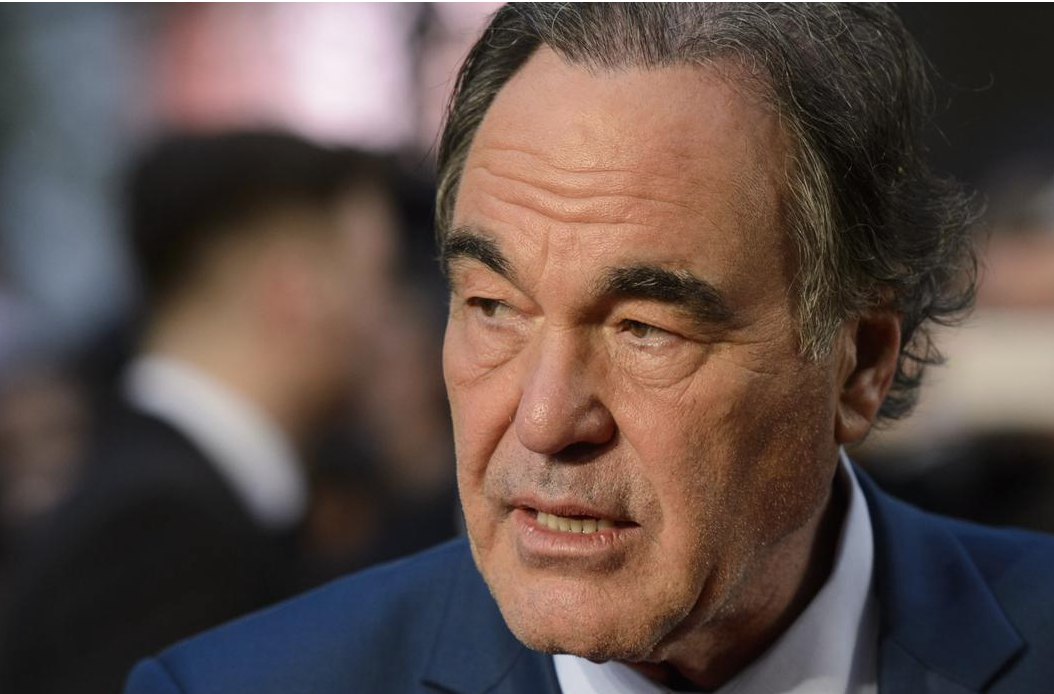
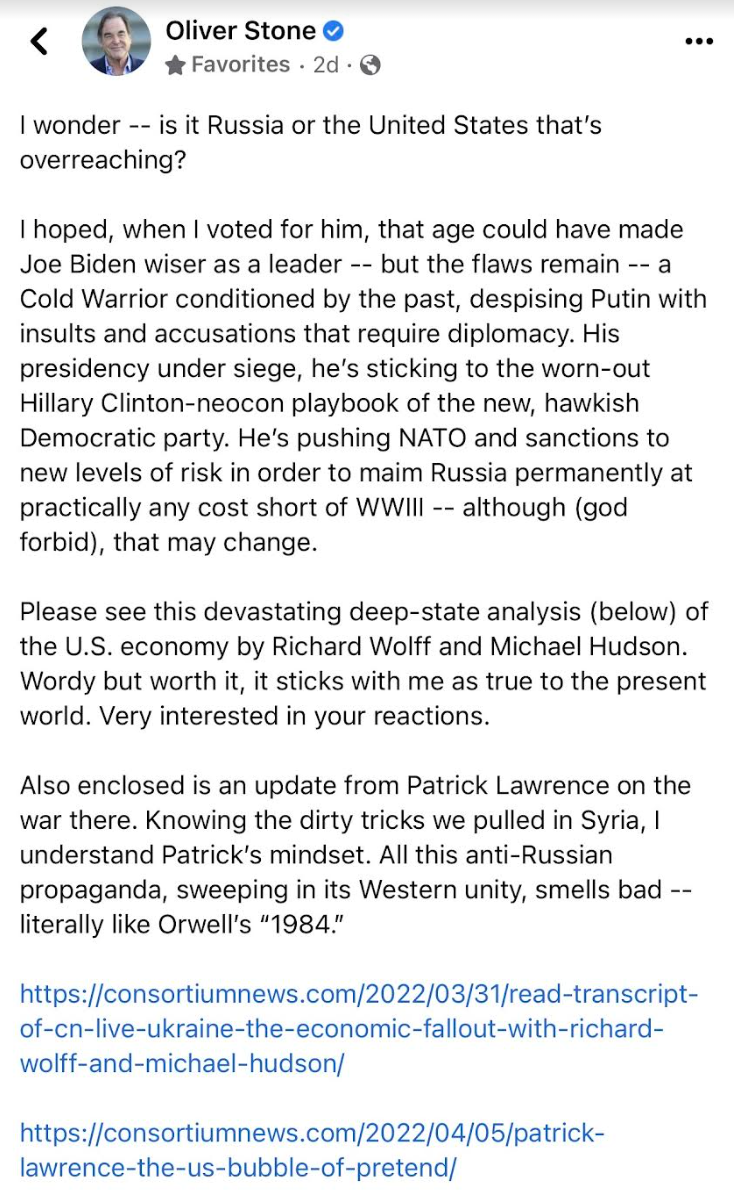
Given these recent opinions, Tatiana is a serious fan of Oliver Stone. His 2017 Putin interviews rang her bell and then some. Two days ago he achieved the same by posting a Facebook essay that that was highly skeptical of all the Russia-and-Putin bashing in the media.
Stone’s end quote: “All this anti-Russian propaganda, sweeping in its Western unity, smells bad — literally like Orwell’s ‘1984.’”
Tatiana loved Stone’s essay, and so she tapped out a cheering response to that effect. This led to thoughts about luck, love and the ways of surprising discoveries. If only she and Stone had somehow managed to meet a few years ago, and had kept in occasional touch and perhaps had gradually formed a bond that was about something more than just social-media rapport. I’m not saying what I seem to be saying. I’m saying Tatiana and Oliver almost seem, right now, like two peas in a pod — coming from a very similar place in terms of Ukraine-related perceptions and convictions.
Who develops admiration and affection for someone based on their cultural and political views? Well, all relationships start somewhere. And so much in life is about luck, timing and kismet. I do think Tatiana, whose views about the Ukraine War have drawn a lot of flak on this site, would feel more “heard” and respected right now if things had worked out for her in a different way. I for one would be fine with that. I am also cool — accepting — about our five years together, and in many some ways I am thankful. I’m committed to living in the now.
What Were Michigan Jurors Saying?

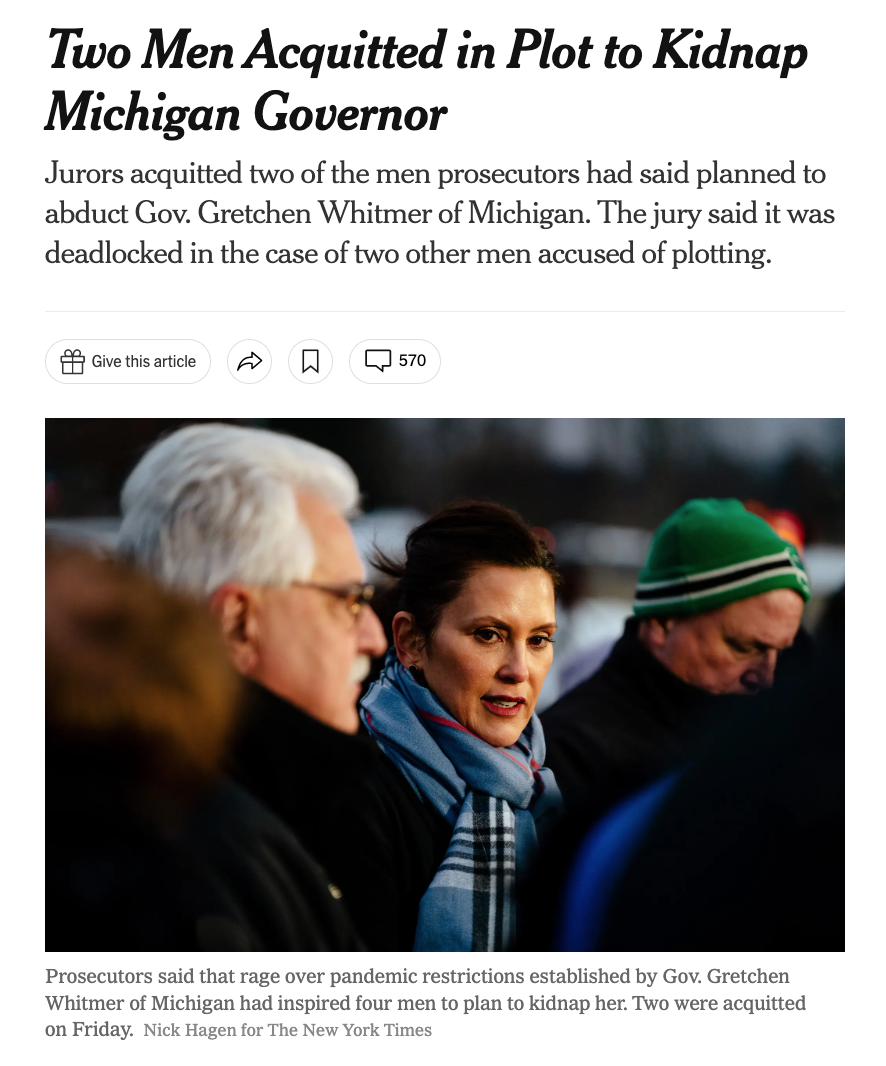
Jurors in the Gretchen Whitmer kidnapping case today acquitted two militant rightwing Michigan bumblefucks — Brandon Caserta and Daniel Harris — and said they were deadlocked on charges against two others, Barry Croft and Adam Fox.
The jurors seemed to be saying that these low-rent assholes were just rattling their online sabres, and that they didn’t actually intend to kidnap Whitmer. Not really.
All four had been accused of plotting to snatch Whitmer, Michigan’s Democratic governor, from her vacation home in 2020. You could also presume that the jurors felt a greater cultural kinship with these four louts than with Whitmer.
The bottom line, I suspect, is that the jurors knew these guys were (a) fairly serious about wanting to kidnap Whitmer, however half-assed and goon squad their plans and strategies might have been, and (b) that they’re definitely sociopaths — the same kind of rightwing animals who stormed the U.S. Capitol on 1.6.21.
And so, naturally, the jurors had problems with finding them guilty.
Thoughts?
A Leap Too Far?
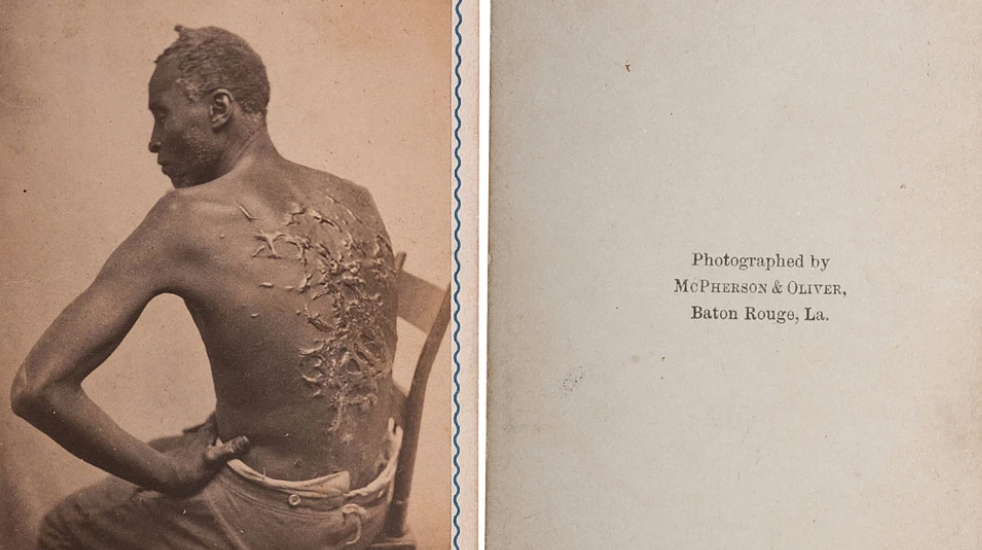
Serious question: If you were a senior Apple TV+ exec, would you advocate pushing full speed ahead for the late ‘22 release of Antoine Fuqua and Will Smith’s Emancipation, an historical chase thriller about a real-life slave named Gordon who had been whipped severely before fleeing a Louisiana plantation?
Or would you step back and furrow your brow and go “hmmm”? Or would you sell it off?
If it was my call, I would say “fuck it…release that sucker and let the chips fall. Smith is flawed, sure, but who isn’t? The press will jump all over him, but how many times can he say ‘I’m deeply ashamed that I did a brutish, asinine thing”? Walk on, stand tall, turn the page and keep saying ‘this is about Gordon, not Will Smith.'”
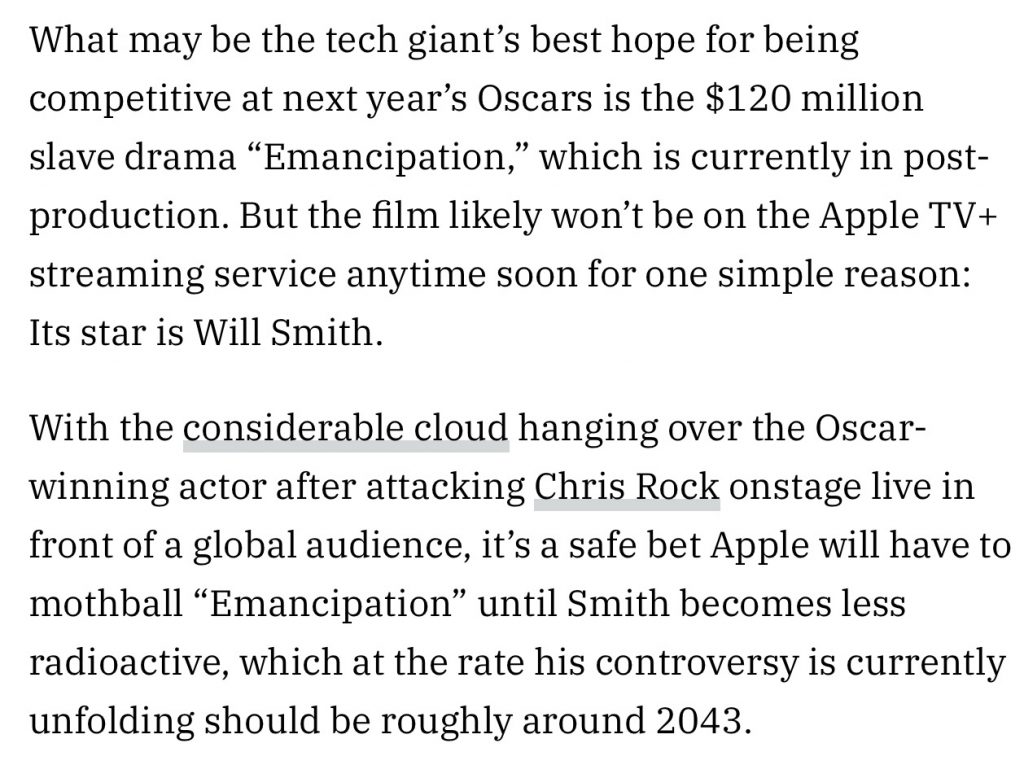
From Andrew Wallenstein‘s “What It Takes To Break Will Smith Out of Movie Jail“:
Woke Critics Out To Discourage Whiteness and Elgort-ness.
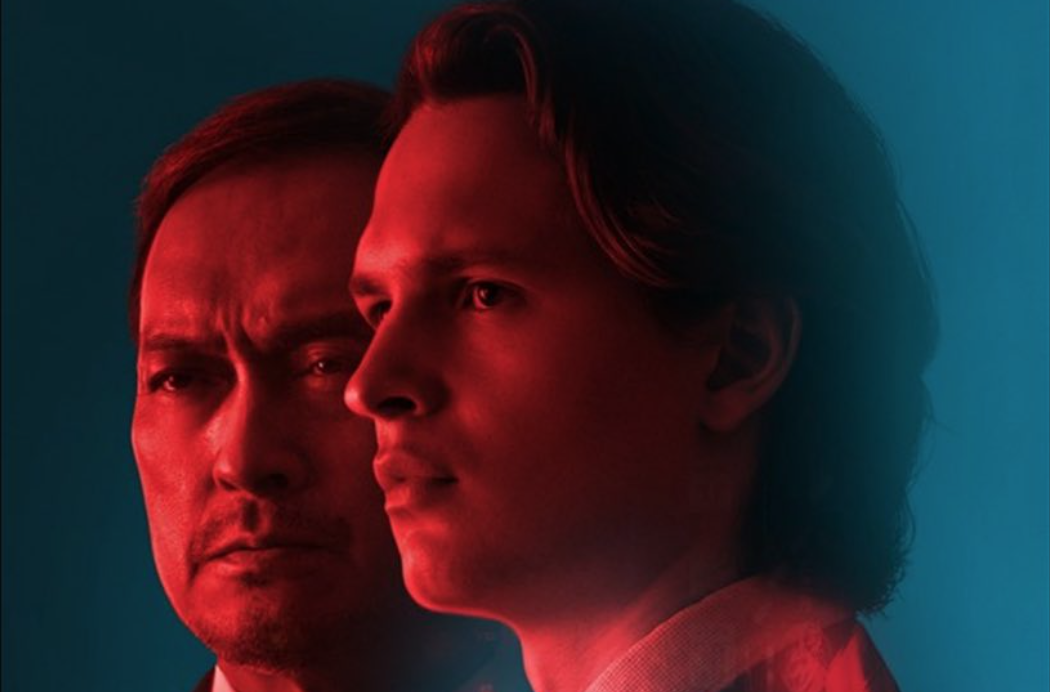
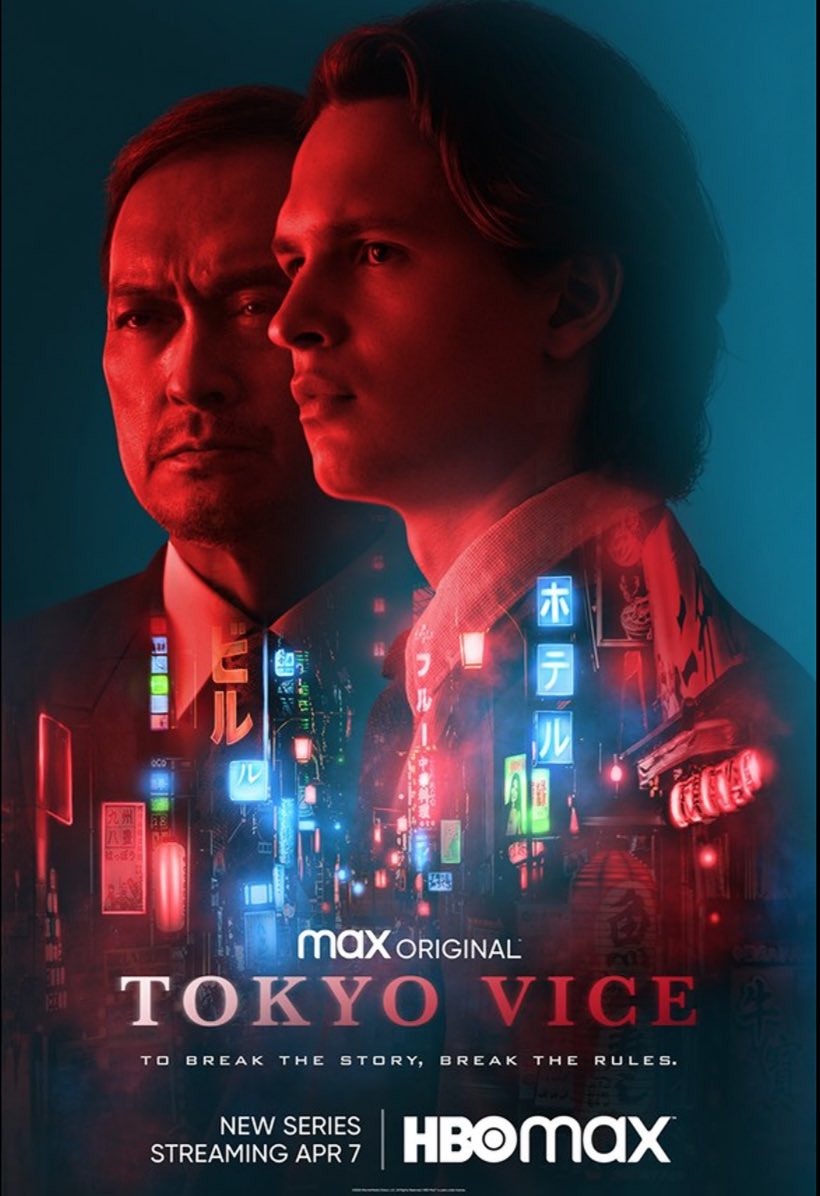
I still haven’t seen J.T. Rogers and Michael Mann‘s Tokyo Vice (HBO Max, 4.7), but I know two things.
One, it’s based on Jake Adelstein‘s “Tokyo Vice: An American Reporter on the Police Beat in Japan” (’09), and is about Adelstein’s working as the first non-Japanese reporter for one of Japan’s largest newspapers.
And two, it is therefore necessary and appropriate to cast a young American actor as Adelstein. Which is partly why Rogers and Mann hired Ansel Elgort for the role.
So far the Rotten Tomatoes score, based on six reviews, is 83% — a better-than-decent rating.
But the score would be higher if it weren’t for certain toxic critics complaining about the casting of Elgort, who continues to be idiotically tarnished by the woke community over non-factual, mob-rule accusations of “sexual assault” — a completely unsupported charge about Elgort having assaulted a 17 year-old named “Gabby” when he was 20, despite every piece of testimony (Twittered and otherwise) indicating that nothing resembling an assault ever happened and that the worst Elgort could be accused of was ghosting Gabby after being intimate with her.
The lowest score of the six is from Slashfilm‘s Josh Spiegel, who merges an anti-Elgort attitude along with some anti-white racism sauce.
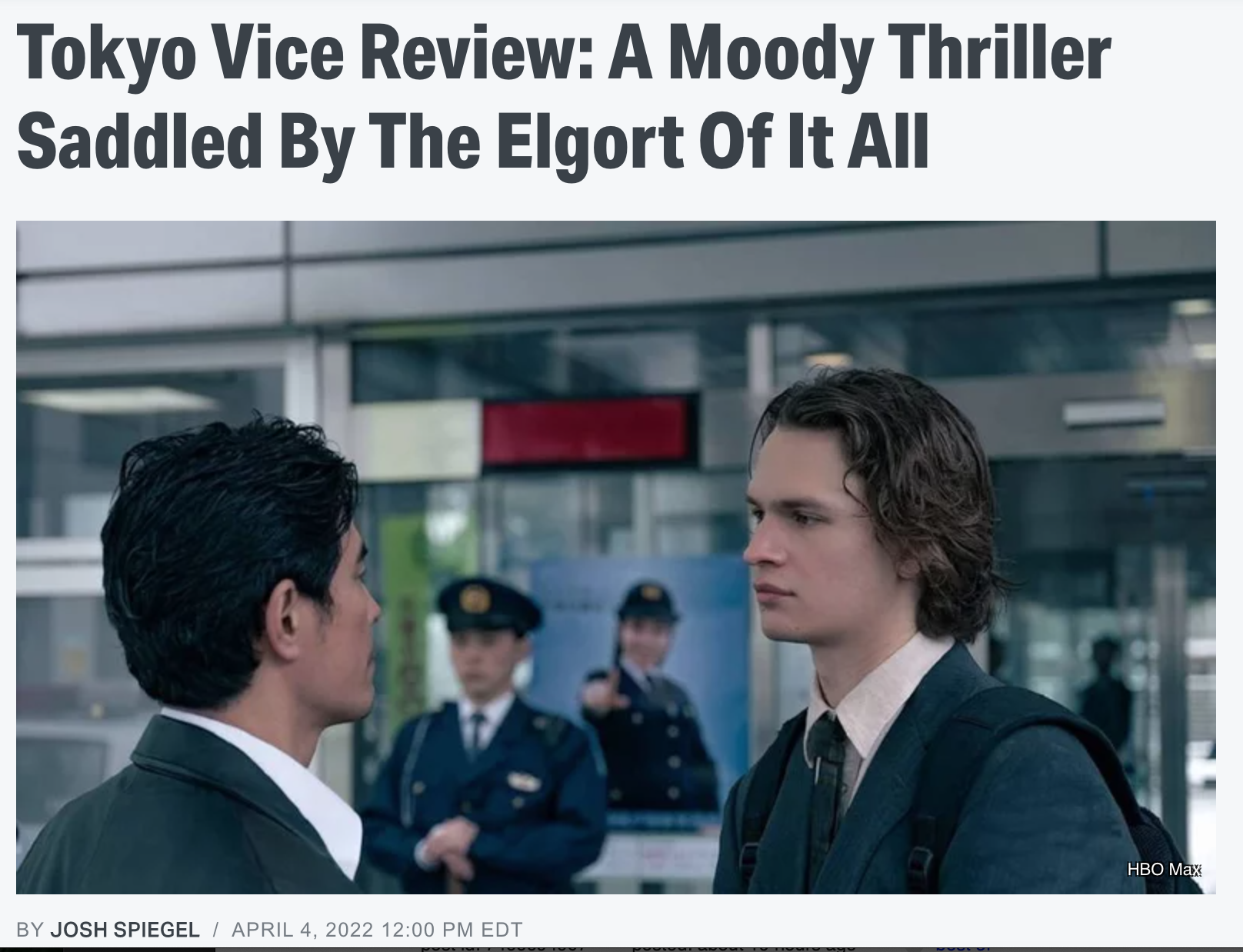
In a review titled “A Moody Thriller Saddled By The Elgort Of It All,” Spiegel claims that
Elgort “makes for a very dull and uninvolving lead actor here…when the show begins in 1999, Jake is already well ensconced in Tokyo, having moved from his home state of Missouri…while he has quickly fallen in love with Tokyo’s culture, he has a very specific goal: becoming a journalist, despite the general hurdle of…well, being a white American.”
In other words Spiegel, besides disliking the idea of Elgort starring, doesn’t care for the idea of a white guy playing the lead in a Tokyo-based journalism drama. Imagine if Mann had produced an HBO Max miniseries about an English-speaking Japanese reporter having been hired by the Los Angeles Times to cover the crime beat here. Would Spiegel have written that this fellow does his best “despite the general hurdle of…well, being Japanese”?
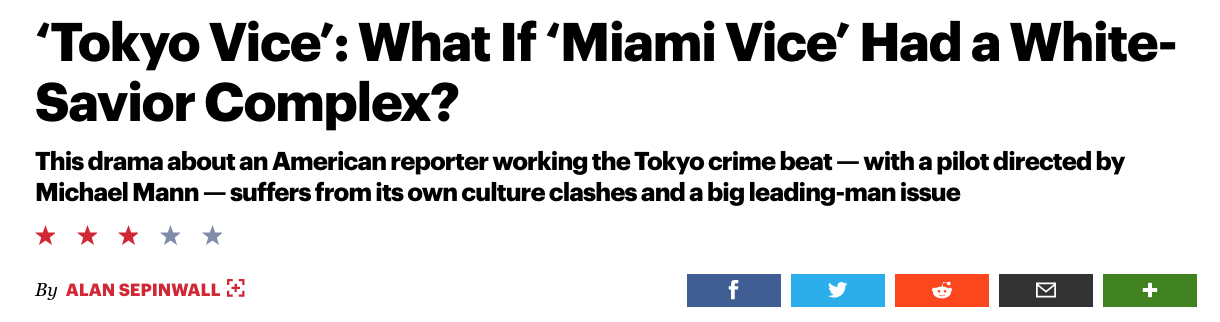
Rolling Stone‘s Alan Sepinwall follows a similar train of thought. In a review titled “What If Miami Vice Had a White-Savior Complex?“, Sepinwall states that “this is a decent show, but one that feels like it would be much better if it were willing to be more Japanese.”
Again, reverse the set-up (Japanese reporter covering the L.A. crime beat) and ask yourself if Sepinwall could or would have declared that L.A. Vice “would be much better if it were willing to be more American, and more specifically more Anglo Saxon.”
In short, Sepinwall and Spiegel are singing the same woke tune. Translation: “We don’t want to know from Jake Adelstein or his book, and we don’t like the idea of a white guy reporting about the Yakuza because white guys are basically bad news. And Elgort, in our humble and misinformed opinion, is double bad because he…uhm, well, he legally had it off with a 17 year-old in 2014 (when he was 20) and then hurt her feelings by ghosting her, and in our judgment Elgort should pay the Polanski price for this. And so we’re doing our part as morally-attuned critics to destroy the toxic bad guys out there…to not only lock arms with the #MeToo community but bring about the ruin of the heartless Elgort.”
Variety‘s Daniel D’Addario echoes the Sepinwall-Siegel mindset, but he’s a little more fair about it.
“Say this much for Elgort, a controversial figure off-screen after allegations of sexual assault surfaced in 2020: On screen, he’s able to avoid many of the pitfalls into which an actor who looks like him on a Japan-set series might have fallen,” he writes. “The show is aware of what’s potentially uncomfortable about Jake as savior figure, and undercuts the narrative, and its protagonist, accordingly, starting with the performance.”
It is unlikely but entirely possible that I will agree with Spiegel and Sepinwall when I see Tokyo Vice, but for now I think it’s fair to post the above-mentioned judgments and suspicions about their viewpoints.
Close To The Heart
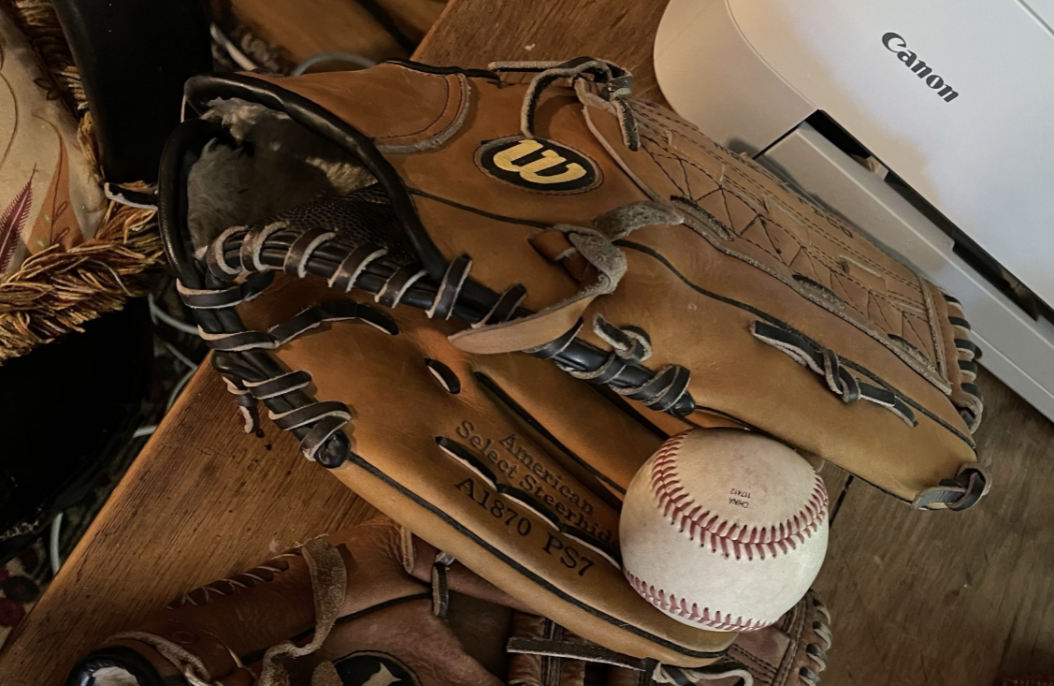
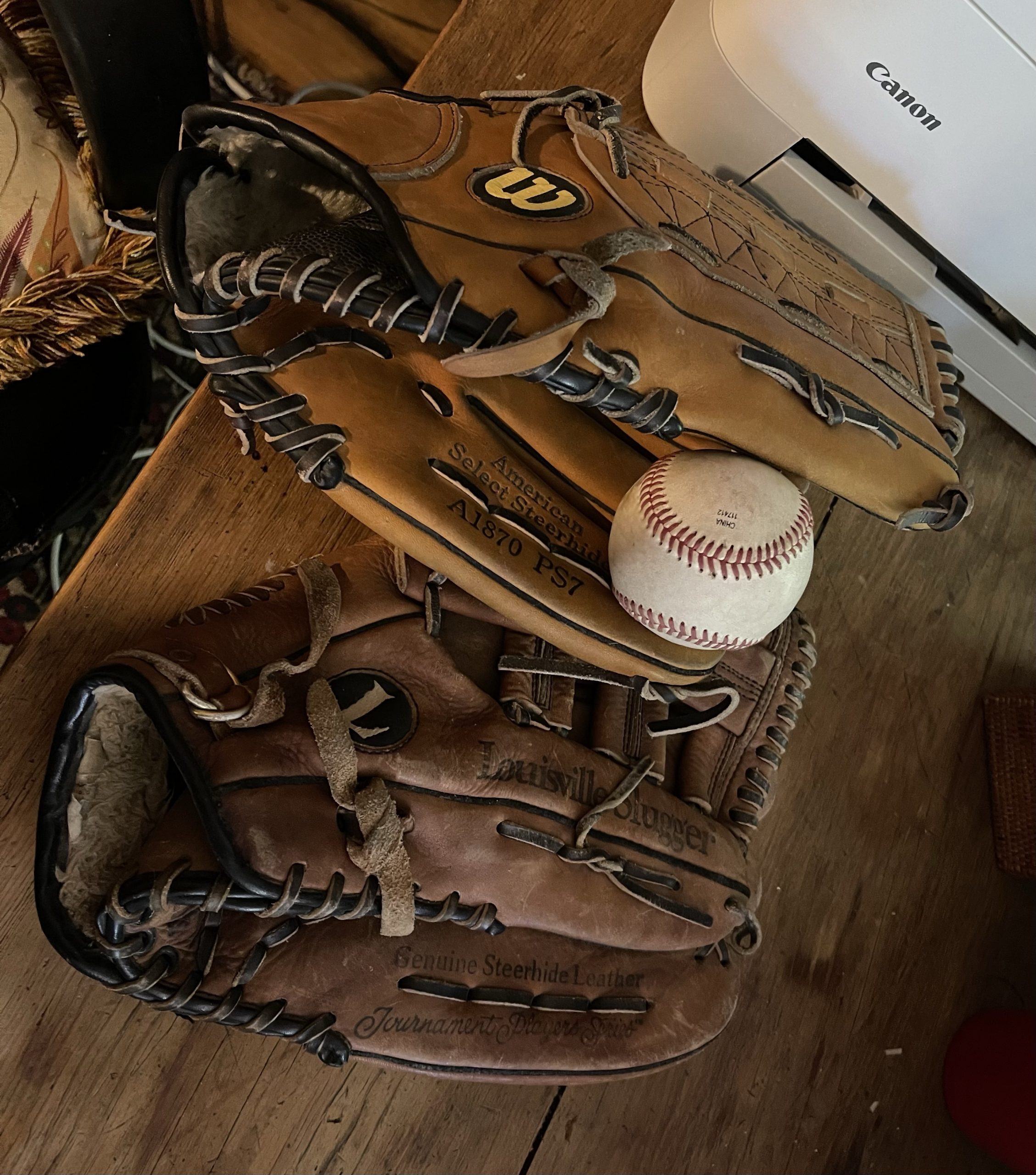
My old Wilson baseball glove means almost as much to me as my two Mac laptops (15″ Macbook Pro, 13″ Macbook Air). There’s something eternal and devotional about slightly worn baseball mitts. I’ll be driving the VW Passat back east before leaving for Cannes, and I’ll be bringing the Wilson along with a TPS first baseman’s mitt that Jett used in the old days.
Now Playing at Oswald Cinema
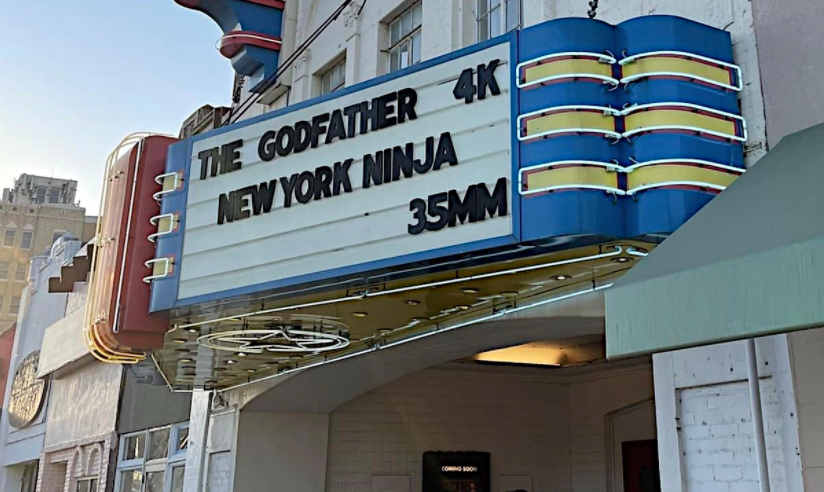
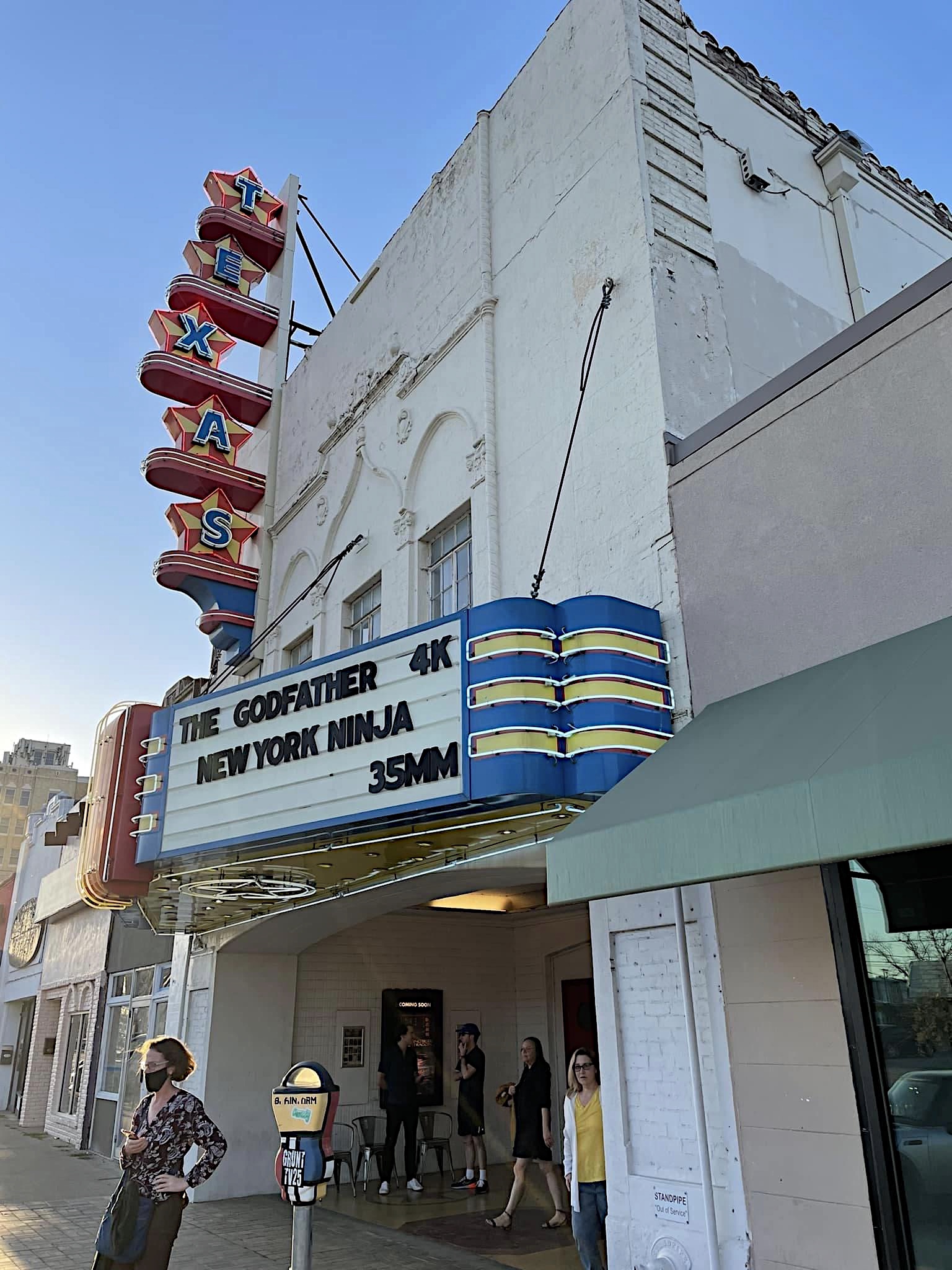
There’s something strangely synchronous in a classic American nightmare sort of way about the 4K Godfather playing (or having recently played) at the famous Texas theatre (231 W. Jefferson Blvd., Dallas, TX 75208), which is otherwise known as the Lee H. Oswald Memorial Cinema.
Okay, I’m kidding but the Oswald identification has stuck for decades.
It was during a showing of War Is Hell in this very theatre that Oswald was arrested by Dallas detectives roughly 80 minutes after the murder of President Kennedy on 11.22.63. And now, in the very same theatre, people are watching and contemplating the murders of (a) Khartuom, the black racehorse, (b) Luca Brasi, (c) Paulie Gatto, (d) Virgil Solozzo, (e) Cpt. McCluskey, (f) Sonny Corleone, (g) Appolonia, (h) Barzini, (i) Bruno Tataglia, (j) Moe Greene, (k) Carlo, etc.

Fascinating Marketing Plan

The Focus marketing team sat down and decided that the title doesn’t mean much — no one will remember it, they’re thinking, certainly when it comes to NYC subway riders — it’s the Viking vibe, the beards, the long hair, the axes, the wounds, the grayness and grimness.
To Avoid Suspension or Expulsion, Smith Quits
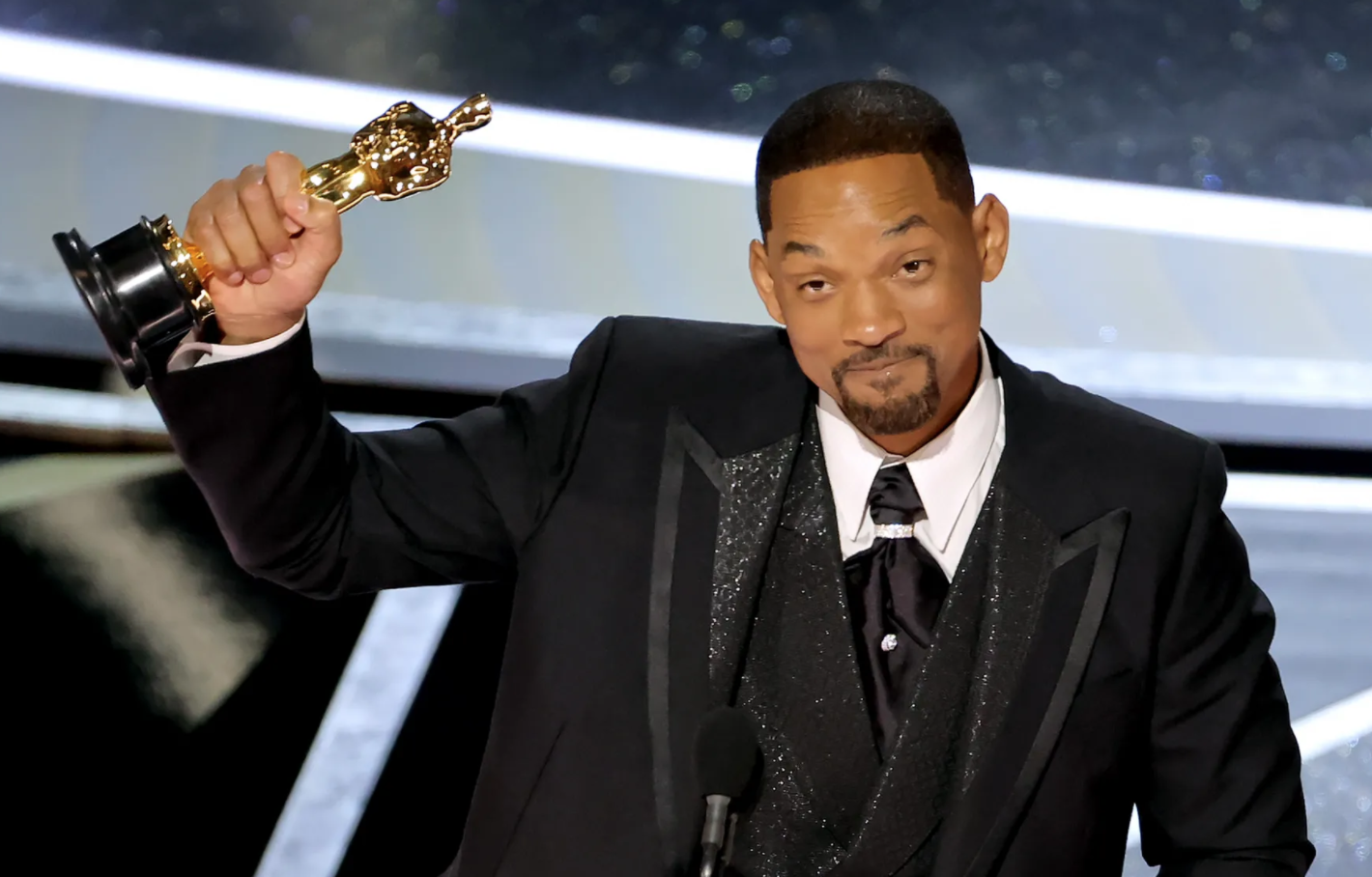
Posted today at 3:56 pm by The Hollywood Reporter‘s Scott Feinberg:
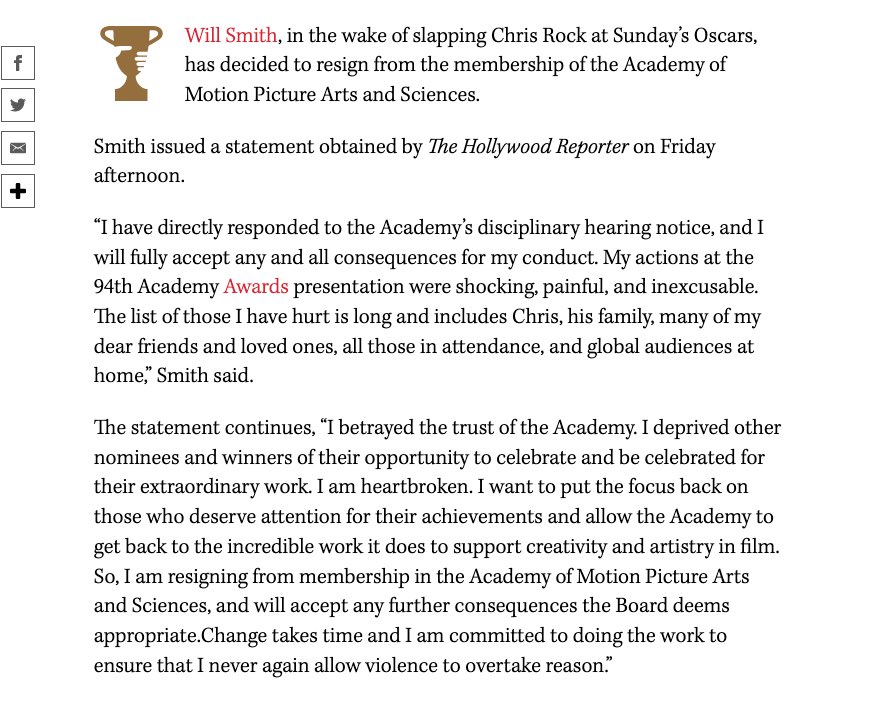
Not that Will Smith doesn’t feel genuine remorse about Slapgate, but when you know you’re about to get zotzed or downgraded by management, the face-saving thing is to quit before they lower the boom. A more positive way of looking at the resignation is that Smith was looking to decisively position himself as a man of character and conscience rather than cool his heels and wait for an outcome that would probably be negative.
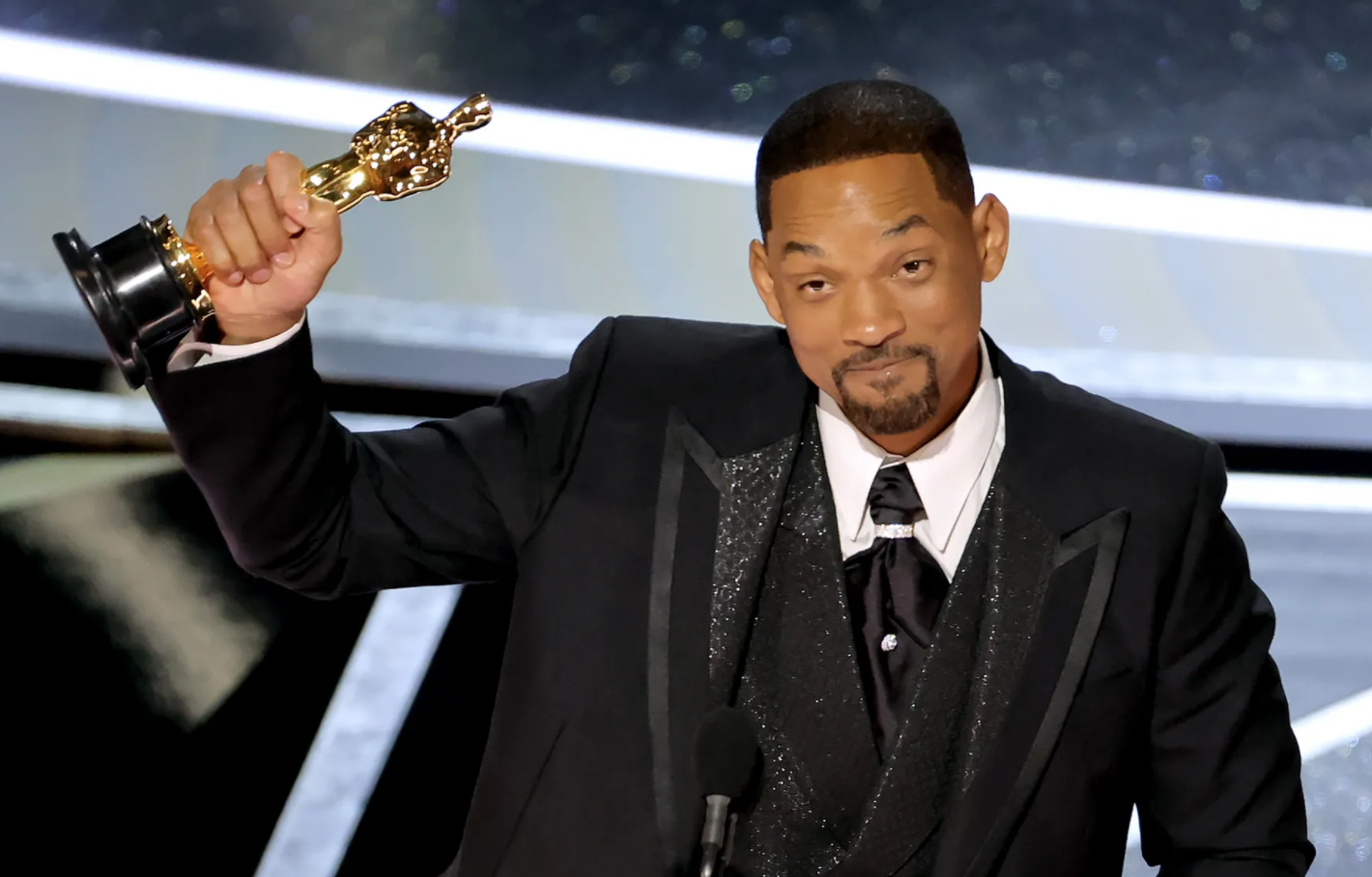
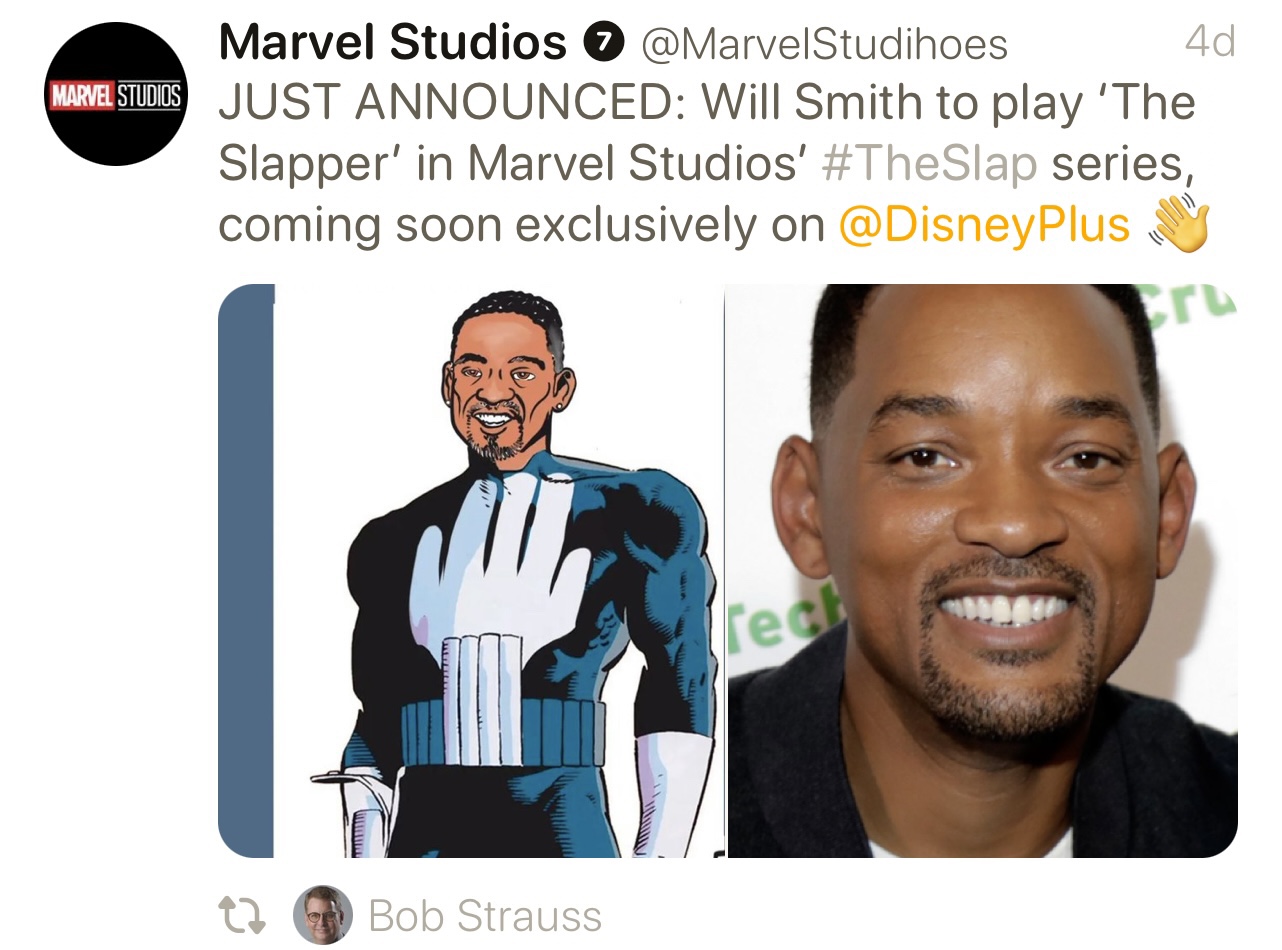
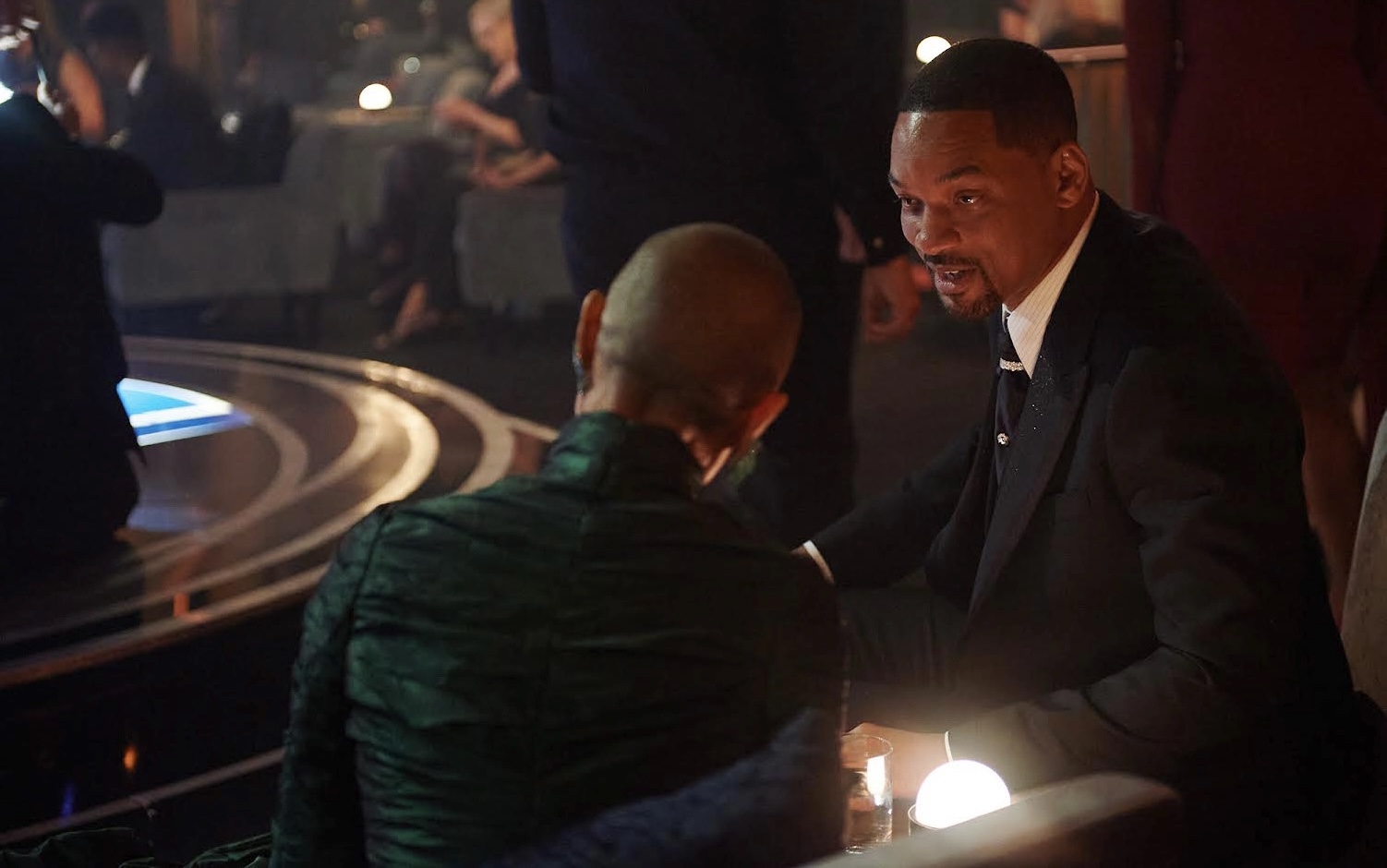
Bill Maher (@billmaher)
Everyone in America spent the entire week talking about #TheSlap heard around the world. So the whole “keep my wife’s name out of your mouth” didn’t work out too well. pic.twitter.com/Jy8Is5dkcY
Adrien Brody Did A Bad Thing…Right?
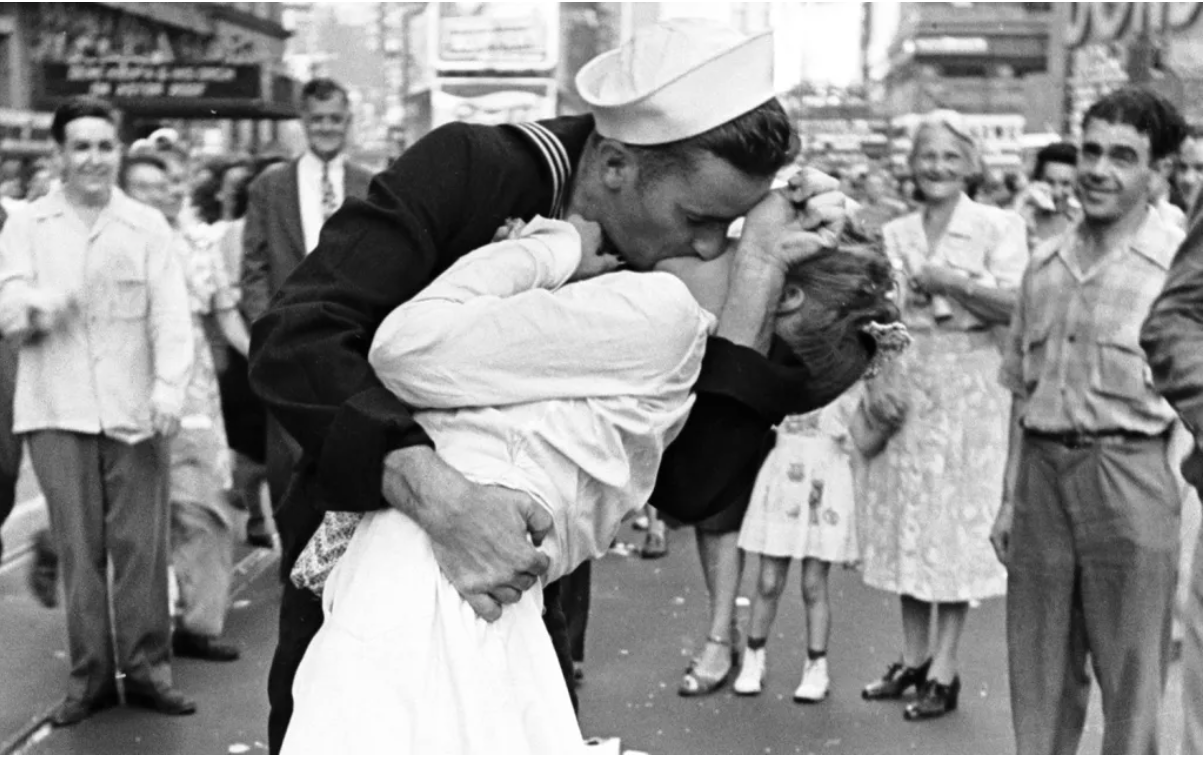
It wasn’t flat-out sexual assault, but certainly a show of aggressive sexual whateverism…if you feel it, do it….joyful Oscar humiliation…it happened 19 years ago (3.23.93) but the time has come to bring this insufferable cad to justice…right? That Times Square-sailor-kissing-the-nurse guy died some years ago so Brody’s the only famous impulse-kisser left. Yes, I’m being facetious.
I know EYE said no more slap-related discourse but I just remembered the time Adrien Brody kissed Halle Berry when accepting his award (for The Pianist, directed by Roman Polanski). That was literally sexual assault on stage & there was no anger. Here's Halle talking about it pic.twitter.com/mZ9JTJT6hZ
— Je suis Fatty-Gay (@TimeIsNotGiven) March 31, 2022
Happy 85th!
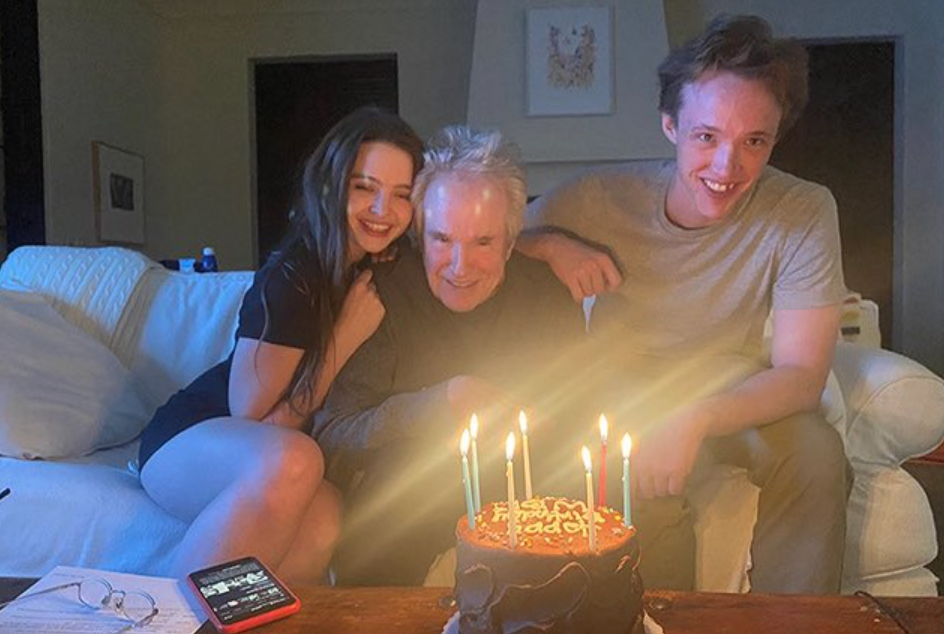
Birthday boy Warren Beatty with Isabella and Ben, snapped yesterday…cheers and salutations!

No “Bardo” in Cannes
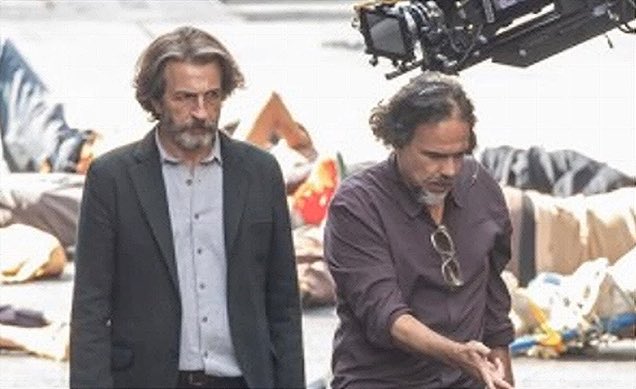
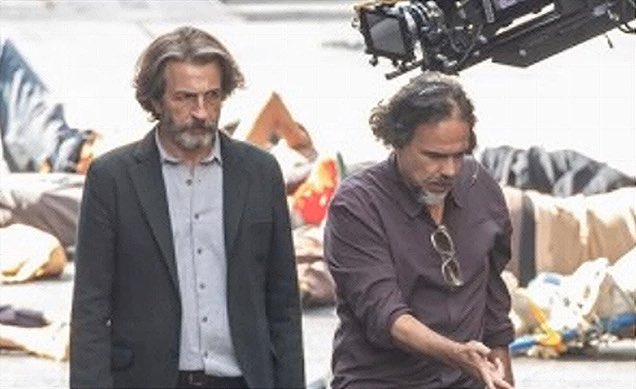
So that’s a firm ixnay on Alejandro Gonzalez Inarritu‘s Bardo (or False Chronicle of a Handful of Truths) debuting in Cannes a few weeks hence. Look for the premiere, instead, at Venice and Telluride. The Spanish-language comedy stars Daniel Giménez Cacho as a Mexican journalist; Griselda Siciliani costars.