This Al Jazeera video of Taliban cadres inside the now-abandoned Kabul presidential quarters reminds me of the 1.6 insurrectionists roaming around inside the U.S. Capitol building (or lounging around inside Nancy Pelosi‘s office) on 1.6.21. They sure do love their beards and turbans and automatic weapons, don’t they? Keep those fingers on the triggers, guys!
slider
“Capote” Days
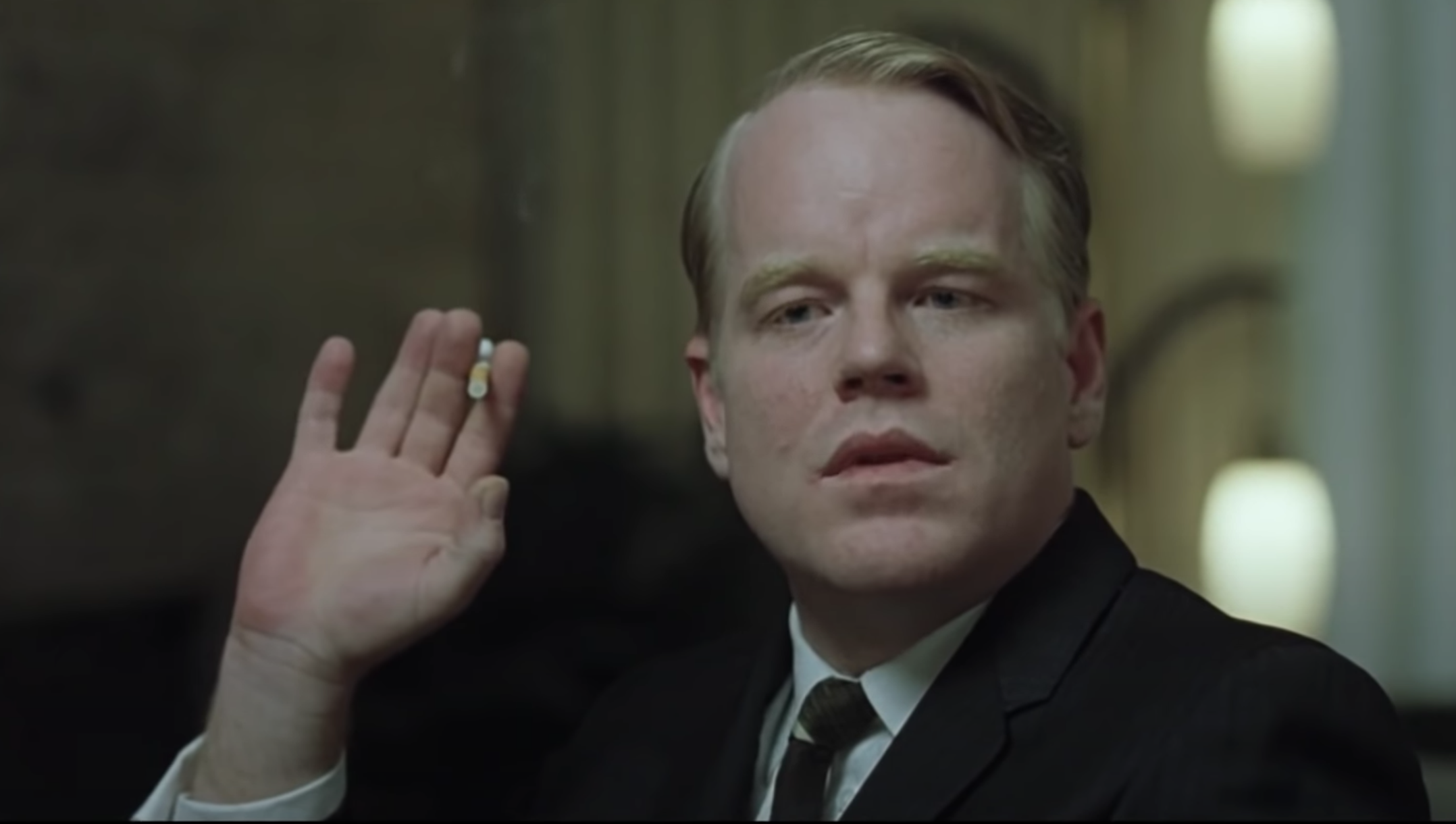
Bennett Miller‘s Capote cost $7 million to make, and earned just shy of $50 million worldwide. I’d forgotten that. It made $28,750,530 domestic, $21,173,549 overseas for an exact total of $49,924,079.
I was visiting Miller’s lower Manhattan loft apartment around the same time, maybe a few weeks hence…I forget exactly when. But I distinctly recall Bennett showing me some original Richard Avdeon contact sheet photos of Truman Capote, Perry Smith and Dick Hickock, and for whatever reason Bennett happened to call Phillip Seymour Hoffman about something, and as he was saying goodbye he called him “Philly.”
I loved the idea of a distinguished hotshot actor being called Philly, and so I used it myself a few weeks later. I knew it was inappropriate to project an attitude of informal affection with a guy I didn’t know at all first-hand, but I couldn’t resist. I was immediately bitch-slapped, reprimanded, challenged, castigated, stomach-punched, dumped on, stabbed, karate-chopped, slashed and burned….”How dare you call him that? Who the hell do you think you are, some kind of insider?…soak yourself with gasoline and light yourself on fire!”
HE review, posted three or four weeks before the 9.30.05 opening: “I’m taken with Capote partly because it’s about a writer (Truman Capote) and the sometimes horrendously difficult process that goes into creating a first-rate piece of writing, and especially the various seductions and deceptions that all writers need to administer with skill and finesse to get a source to really cough up.
“And it’s about how this gamesmanship sometimes leads to emotional conflict and self-doubt and yet, when it pays off, a sense of tremendous satisfaction and even tranquility. I’ve been down this road, and it’s not for the faint of heart.
“I’m also convinced that Capote is exceptional on its own terms. It’s one of the two or three best films of the year so far — entertaining and also fascinating, quiet and low-key but never boring and frequently riveting, economical but fully stated, and wonderfully confident and relaxed in its own skin.
“And it delivers, in Phillip Seymour Hoffman’s performance as Capote, one of the most affecting emotional rides I’ve taken in this or any other year…a ride that’s full of undercurrents and feelings that are almost always in conflict (and which reveal conflict within Capote-the-character), and is about hurting this way and also that way and how these different woundings combine in Truman Capote to form a kind of perfect emotional storm.
“It’s finally about a writer initially playing the game but eventually the game turning around and playing him.
“Hoffman is right at the top of my list right now — he’s the guy to beat in the Best Actor category. Anyone who’s seen Capote and says he’s not in this position is averse to calling a spade a spade.
“Respect” Didn’t Bother Me That Much
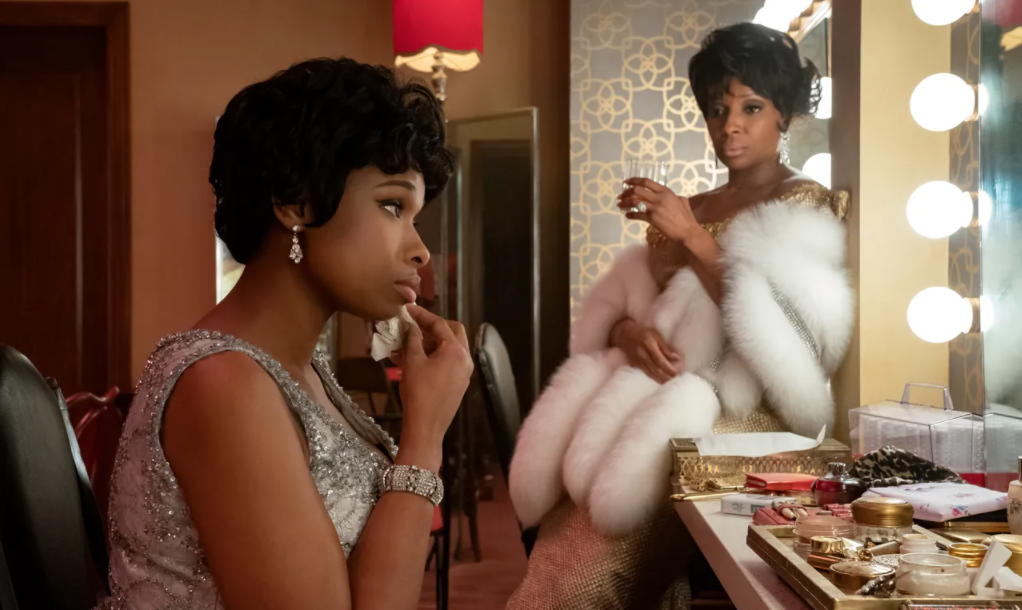
If you’ve heard that a film is underwhelming or mediocre, it will probably play better than expected when you get around to seeing it. If I’ve had this reaction once I’ve had it dozens of times, and this was more or less the shot when I caught Leisl Tommy‘s Respect at the Westside Pavillion last night.
I went in expecting to suffer or at least be bored by what I’d read would be a checklist of musical biopic cliches, delivered in paint-by-numbers fashion. But oddly enough, it didn’t depress me or annoy me or piss me off. I wasn’t knocked out or turned around or brought to tears, but I was more or less okay with it.
Mainly because of Jennifer Hudson‘s lead performance, of course, and her magnificent pipes.
I also knew that Respect is the friendly version of Aretha Franklin‘s story — the one that “the family” likes and supports. The shunned version is National Geographic’s four-part Genius: Aretha, which starred Cynthia Erivo. Experience has taught me to always be wary of a family-approved biopic, and there’s no question that Respect soft-pedals and sidesteps and does its best to make Aretha look as good as possible without totally lying. Respect delivers a few handfuls of “dirt” here and there, but not that much.
The bottom line is that even though I knew I was being sold a semi-sanitized bill of goods, I didn’t mind Respect. I occasionally muttered to myself “hmmm, yeah…not too bad.” I was quite taken by a couple of the musical performance scenes. And I was always seriously impressed by Hudson.
She’ll obviously be nominated for a Best Actress Oscar along with Will Smith as Best Actor. I can just see the two of them holding up their Oscars in front of press-room photographers.
Before she passed in ’18 Aretha said that David Ritz‘s “Respect: The Life of Aretha Franklin” (’14) was lies and trash and blah-dee-blah. That meant that at least some of Ritz’s book was accurate, and perhaps a bit more than that.
On the book’s Amazon page there’s a comment by “Occasional Critic,” to wit: “This book goes to remarkable depth in describing who Aretha really was. She was a wonderful person; she was a terrible person. She was incredibly generous; she was a cheap skinflint. She was a genius; she was dumber–than–a–stump. She was selfless; she was an egomaniacal narcissist. She was all that and more.
“But she was also indisputably one of the very best voices in the history of voices, and very, very human. This is a compelling read. Highly recommended if you want the good, bad & the ugly.”
If Respect had been made in the same spirit with which Ritz’s biography was written, if it had embraced a “tell it all, warts and all and let the chips fall” approach instead of trying to please the family and the fans and remind everyone what a glorious trailblazer she was (which is not an exaggeration), it would have been a better, tougher film.
Respect does acknowledge that Franklin was sexually molested and impregnated as child, and that her marriage to the territorial Ted White (Marlon Wayans) was turbulent, and that she developed an alcohol problem in the late ’60s, and that her relations with family and colleagues were often under strain, etc.
But from what I’ve read, a lot of the gnarlier stuff has been glossed over or flat-out ignored.
As played by Forrest Whitaker, her preacher father, Clarence Franklin, was a pious scold. But according to one biographical account he was a promiscuous hound who hosted orgies, and that Ray Charles allegedly described these orgies as a “sex circus.”
Marc Maron is especially good as legendary producer Jerry Wexler, who put Aretha together with the Muscle Shoals guys, which led to the seminal recording of “I Never Loved A Man (The Way I Love You)” — her first big hit.
Incidentally: A power surge hit the Westside Pavillion about 20 minutes into the film, and the sound totally went out. I rushed out and told management, and learned that each and every theatre had been affected. I went back in and watched the silent version, which has kind of interesting. Then the image froze and we were staring at a still of a couple of supporting players for six or seven minutes. Then a Landmark guy came in and announced that they were working on the problem. (No shit?) The movie finally resumed, and the show was finally over at the three-hour mark.
“There Is, Of Course, A Third Choice…”
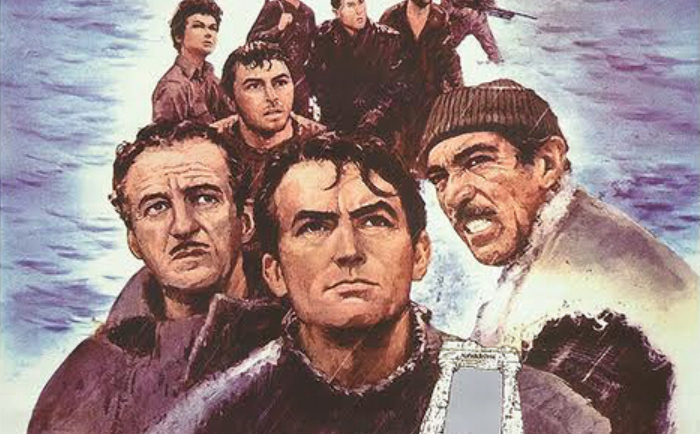
On Tuesday, 10.12, a 4K Ultra HD disc of The Guns of Navarone will be available from Sony. All hail the 60th anniversary of a classic that’s pretty great until Gregory Peck and the team reach the top of the cliff, and then the tension dissipates, the commandos start killing too many Germans, and it becomes an in-and-outer.
Three good scenes follow — interrogation with Anthony Quinn faking cowardice + the uncovering of the traitor + waiting for the elevator to make contact with the wires and explode the whole fortress. But they kill too many Germans.
I already own a 4K UHD digital version on Amazon so what’s the physical media version likely to yield? Perhaps a slightly richer resolution, but you can only uprez and refine 35mm materials so much.
Presented in 4K resolution from the original camera negative, with HDR10. A long list of extras, including a “narration-free prologue” and “a message from Carl Foreman.”
156 minutes. 4K UHD Feature Picture: 2160p Ultra High Definition, 2.35:1 4K UHD Feature Audio: English Dolby Atmos (Dolby TrueHD 7.1 Compatible) | English 5.1 DTS-HD MA | English 4.0 DTS-HD MA.
Baldwin Elaborates

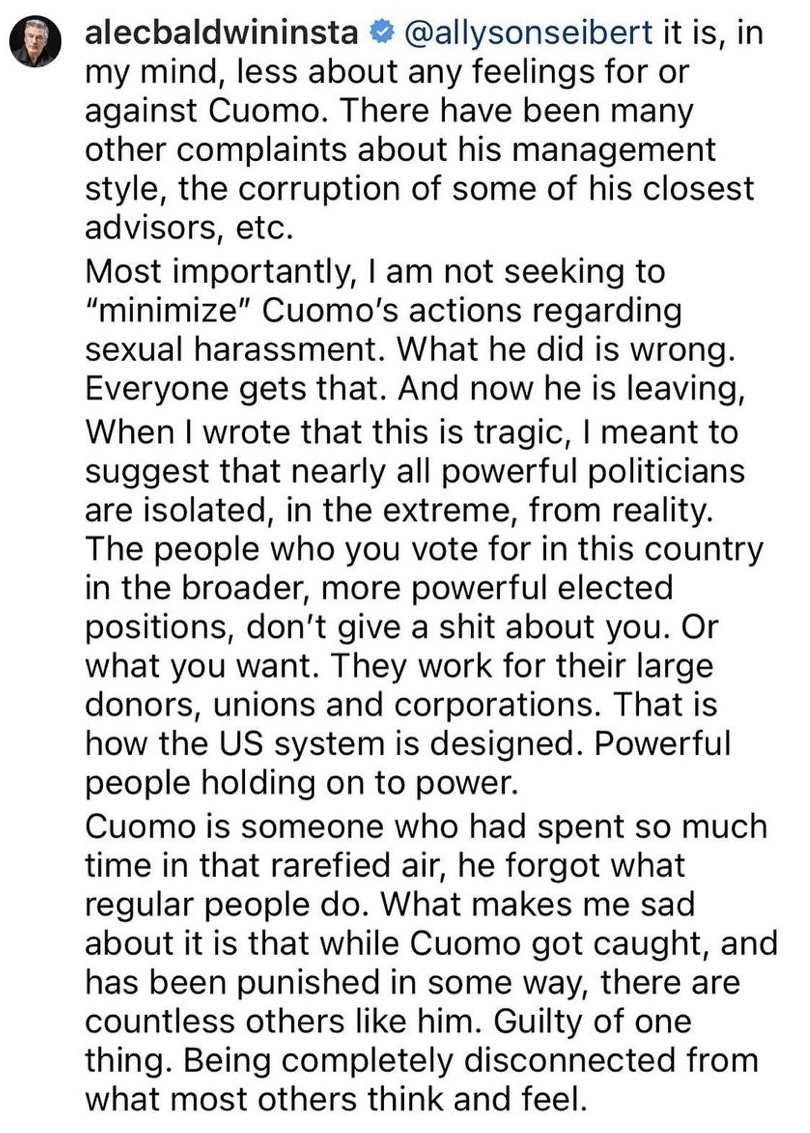
“Nearly all powerful politicians are isolated, in the extreme, from reality. Cuomo had spent so much time in that rarified air, he forgot what regular people do.” — Alec Baldwin on soon-to-be-ex-Gov. Andrew Cuomo.
But after the #MeToo movement blew up in late ’17, it had to be obvious to each and every handsy, massage-y, touchy-feely 50-and-older politician out there that icky, sexually aggressive behavior was totally over and done with. The culture was shouting over and over “don’t do this, don’t go there, things have changed” and Cuomo still ignored the signals?
Over-Acting vs. Exactly Right
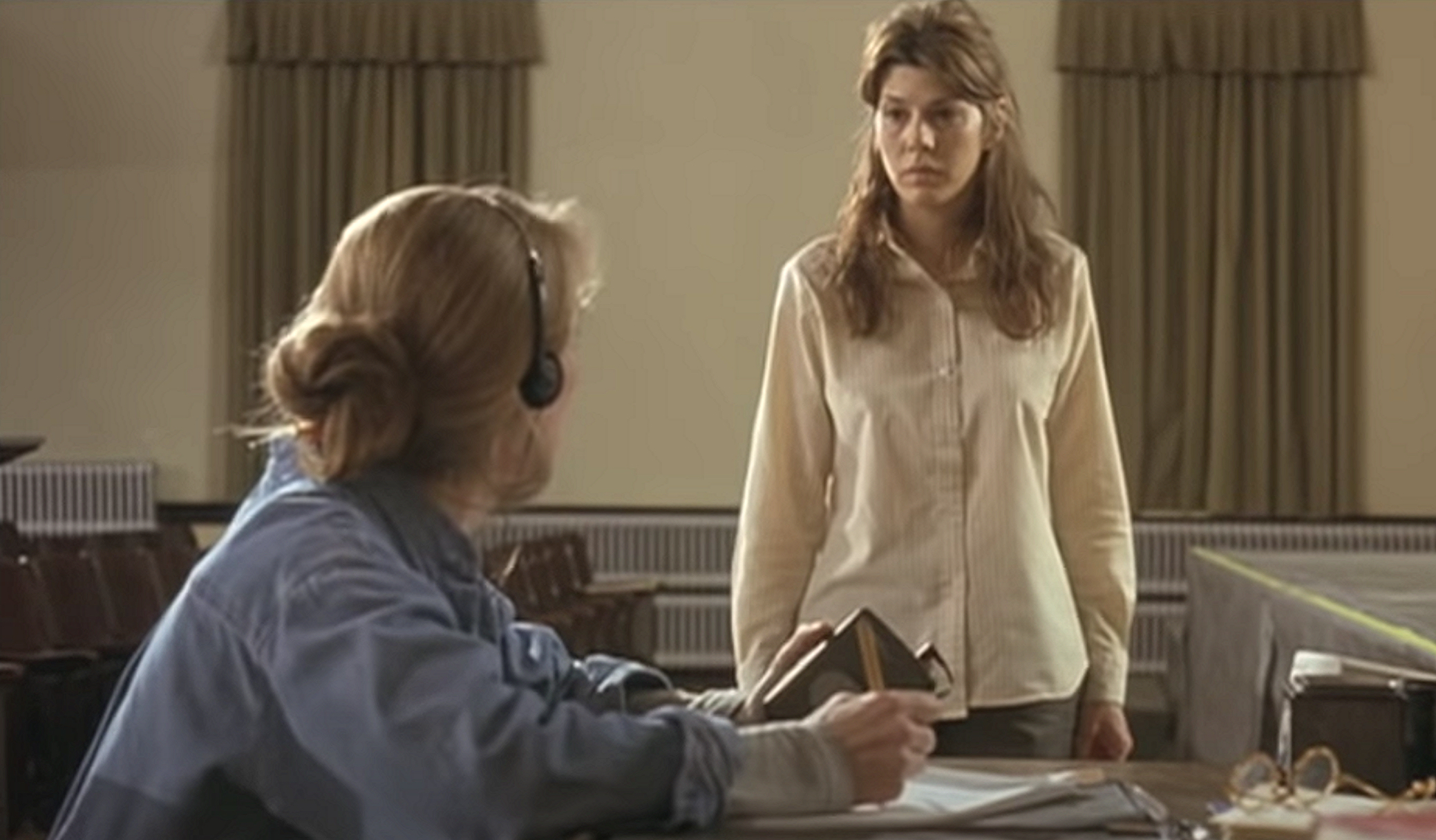
Todd Field‘s masterful In The Bedroom is almost exactly 20 years old — the anniversary is on 11.23.21. Just about every scene is perfect, but there’s one that’s slightly off because of Marisa Tomei‘s over-acting. It’s a court testimony scene in which her character, the bereaved Natalie Strout, recounts the day when her estranged abusive husband (William Mapother‘s Richard Strout) killed her boyfriend (Nick Stahl‘s Frank Fowler) with a pistol.
Delivering this kind of testimony would be painful for anyone, but most people would do what they can to grim up and keep it together in front a filled courtroom. Tomei’s slow testimony plus the constant weeping and sniffling is too actorish. You’re sitting there and going “Jesus, stop selling the emotion and get on with your testimony already…give it a rest.”
But the following scene in which Tomei awkwardly attempts to apologize to Fowler’s mother (Sissy Spacek) and is decisively, violently rebuffed, is perfect.
“There are things of which I may not speak / There are dreams that cannot die / There are thoughts that make the strong heart weak / And bring a pallor into the cheek, and a mist before the eye / And the words of that fatal song / Come over me like a chill / A boy’s will is the wind’s will / And the thoughts of youth are long, long thoughts.” — “My Lost Youth,” Henry Wadsworth Longfellow
“We Did Not Come To Blows But…”
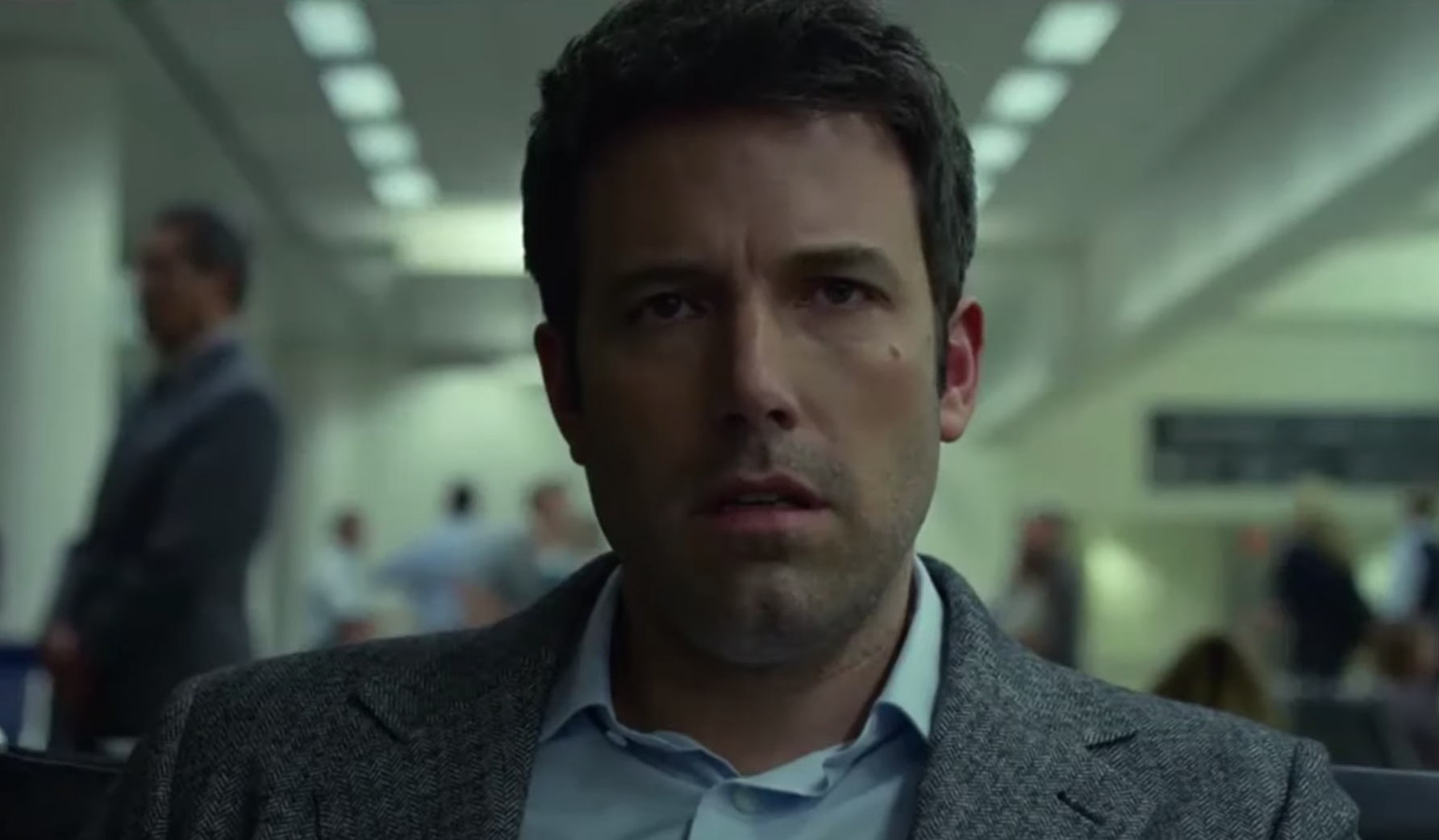
Everyone knows that Gone Girl director David Fincher wanted Ben Affleck to wear a Yankee cap for an airport scene in the film, and that it was a big hassle to get Affleck, a devotional Boston Red Sox fan, to wear the damn thing instead of a Red Sox cap. But I’d somehow forgotten that Gone Girl was shut down for four days because of this stupid argument. What did it cost to keep everyone on salary and pay for all the stuff that a movie needs to pay for on a daily basis…how much did it cost while Affleck and Fincher were at loggerheads on this? The problem was finally solved with Affleck wearing a Mets cap instead a Yankee one.
Father and Son


It was a warm midsummer evening in the small town of Walton, New York, probably in ’81 or ’82. I was staying that weekend with my dad, Jim Wells, at his country cabin on River Road, right alongside the West Branch of the Delaware River. Jim was an avid fly fisherman, and when dusk fell all he had to do was put on the rubber waders and stroll into the waist-deep water, which was less than 100 feet away. I’m not exactly the Henry David Thoreau type, but I have to admit that the cabin and the surrounding woods and the other atmospheric trimmings (crickets, feeding fish, fireflies) was quite the combination as the sun was going down.
Alas, I was frisky back then and accustomed to prowling. As a Manhattanite and Upper West Sider (75th and Amsterdam) my evening routine would sometimes include a 7 pm screening and then hitting a bar or strolling around or whatever. The “whatever” would sometimes involve a date with a lady of the moment or maybe even getting lucky with a stranger. It all depended on which direction the night happened to tilt.
So there we were, my dad and I, finishing dinner (maybe some freshly-caught trout along with some steamed green beans and scalloped potatoes) and washing the dishes and whatnot, and I was thinking about hitting a local tavern. I wasn’t a “sitting on the front porch and watching the fireflies” type. I wanted to get out, sniff the air, sip bourbon, listen to music.
So I announced the idea of hitting T.A.’s Place or the Riverside Tavern and maybe ordering a Jack Daniels and ginger ale on the rocks. If I’d been a little more gracious I would’ve asked Jim to join, but we weren’t especially chummy back then. Our relationship was amiable enough, if a little on the cool and curt side. Plus the idea of Jim and I laying on the charm with some local lassie seemed horrific.
I wasn’t seriously entertaining some loony fantasy that I might meet someone and luck out, not in a little one-horse town like Walton, but then again who knew? It was the early ’80s, the ’70s were still with us in spirit, I was looking and feeling pretty good back then, the AIDS era hadn’t happened yet, etc.
You had to be there, I guess, but singles had just experienced (and were still experiencing to a certain degree) perhaps the greatest nookie era in world history since the days of ancient Rome. Plus you could still buy quaaludes at the Edlich Pharmacy on First Avenue. It sounds immature to say this, but life occasionally felt like a Radley Metzger film.
Jim apparently had thoughts along the same lines, as he quickly suggested that we do T.A.’s as a team. I immediately said “uhm, that’s okay,” as in “I’m thinking about going stag and you’ll only cramp my style.” I shouldn’t have said that, and if my father is listening I want him to know that I’m sorry. It was brusque and heartless to brush him off like that. To his credit, Jim was gracious enough to laugh it off. I heard him tell this story to friends a couple of times.
Jim had bought the River Road cabin from Pam Dawber, who was pushing 30 and costarring in Mork & Mindy at the time. It was located outside of town about three or four miles. My father would send her a check every month, and was very punctual about it. Walton was roughly a 100-minute drive from Manhattan.

Minus The Style, “Orange” Is Sour Fruit
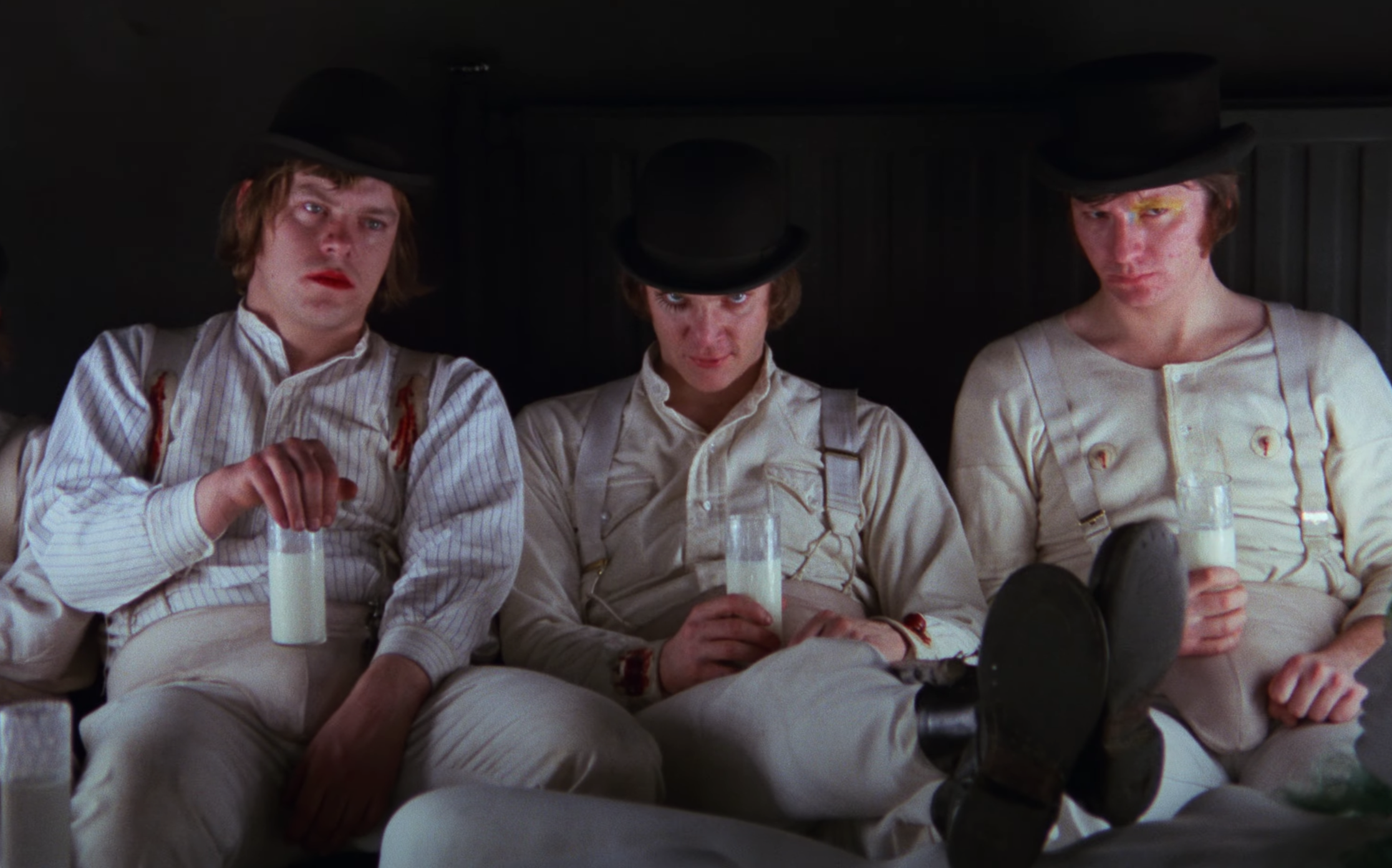
Stanley Kubrick‘s A Clockwork Orange will celebrate its 50th birthday on 12.19.21. I don’t know if I’ll be able to summon fresh interest as I’ve seen this cynical, ice-cold film too many times, but the new 4K Ultra HD Bluray from Warner Home Video — a fresh harvest, sure to look better than the current Bluray version — is too appetizing to refuse. I bought it today on Amazon. The street date is 9.21.21.
Orange remains a chilly, dead-on capturing of Anthony Burgess’s 1962 novel, and it seems doubly fascinating when you regard it as a portrait of the chilly, German-like social scientist that Pauline Kael imagined that Kubrick had become in ’71, and indeed the fellow that Kubrick had more or less evolved into since he made Dr. Strangelove seven or eight years earlier.
It’s still a crisp, clean, mesmerizing film, and I’ll never stop worshipping that final shot of those well-dressed 19th Century couples clapping approval as Alex and a scampy blond cavort in the snow. But man, it’s really cold and almost induces nausea from time to time. And yet at the same time it’s genuinely amusing here and there. Every line and gesture delivered by Michael Bates‘ chief prison guard is a hoot, and I chuckle every time I see that fat, middle-aged fuckface making kissy-face gestures at Malcolm McDowell‘s Alex in the prison chapel.
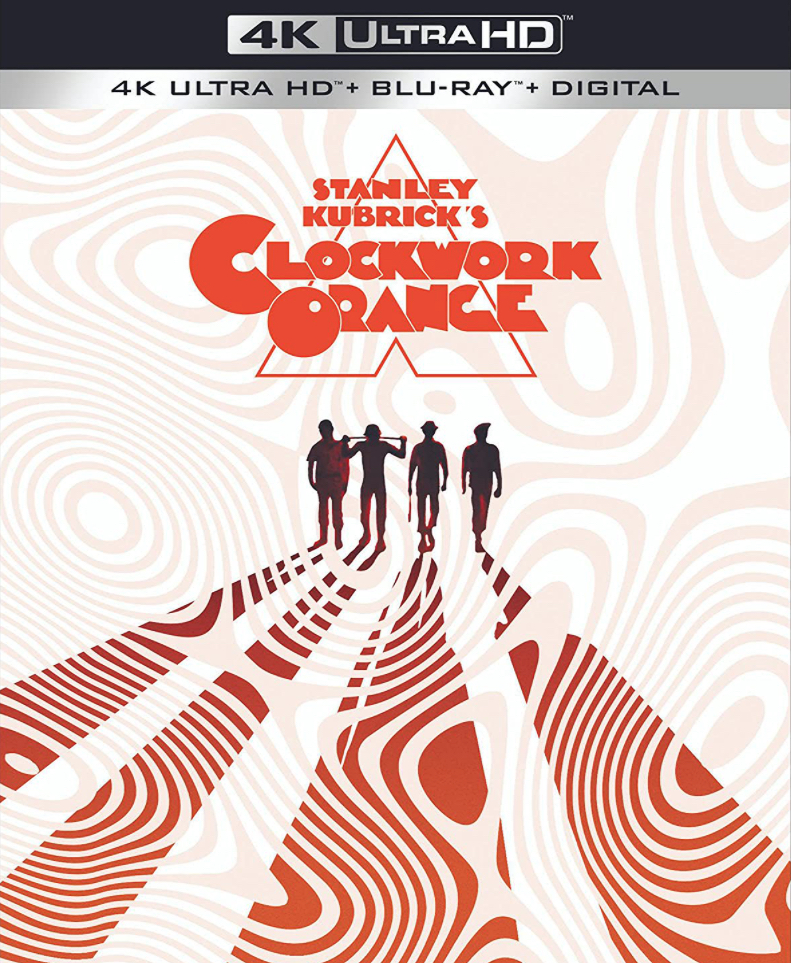
At the same time I can’t honestly say that I like A Clockwork Orange much any more. I was always more impressed with the scene-by-scene verve than what it all amounted to in the end. I still respect the visual energy and exquisite framings (John Alcott was the dp) and the Wendy Carlos meets Gene Kelly meets lovely lovely Ludwig Van musical score, and I still admire the ironic ruthlessness and even fiendishness, but I’m not even sure if I like McDowell’s performance any more. (I feel a much greater rapport these days with his Mick Travis character in Lindsay Anderson‘s If…) I respect Orange historically, of course, and I still love the stand-out moments from the flawless first act, but it hasn’t delighted me overall for years.
A Clockwork Orange was the first Kubrick film that felt truly misanthropic — a high-style show-off movie that sold audiences on the idea that Kubrick-stamped cruelty and brutality were palatable — that irony and arch acting styles somehow changed the game. But it was always more amoral than moral, and pretty much devoid of human compassion. Orange has 23 significant or otherwise noteworthy characters, and only one could be honestly described as decent or humane — Godfrey Quiqley‘s prison chaplain.
A Dickensian crime-and-punishment thing, Orange is composed of four acts or movements. The first act is about the wicked rush of sociopathic “fun”, but the second and third acts (applying the Luduvico technique + Alex suffering for his crimes after being released from prison) comprise a long and punishing slog. The film rebounds during its brief fourth act (the hospitalized Alex cuts a deal with Anthony Sharp‘s Minister of the Interior, and is restored to his old wicked self) and the ending shot, a sexual fantasy sequence, is the equal of Kubrick’s “We’ll Meet Again” finale in Dr. Strangelove.
Took ‘Em Long Enough
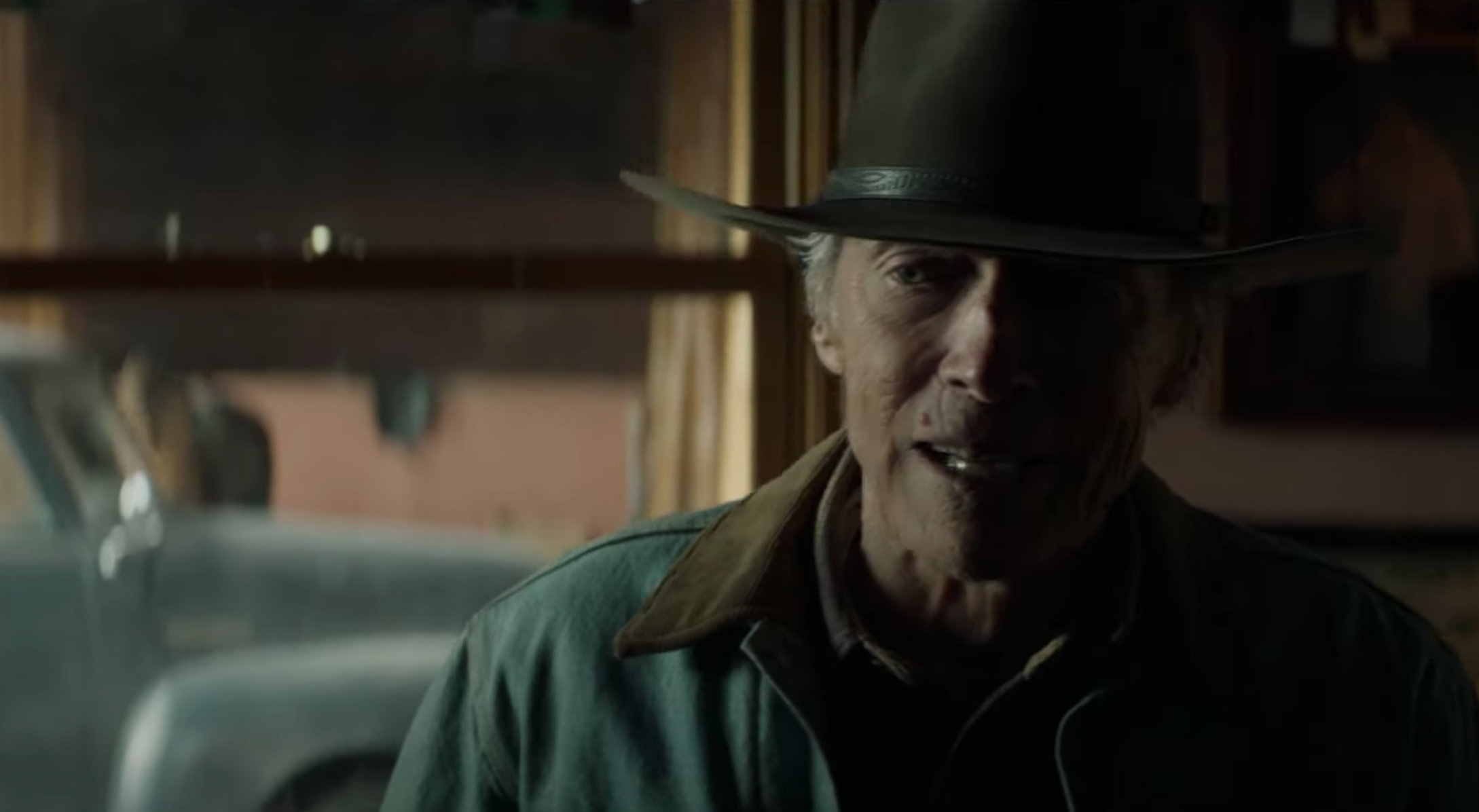
Many of us look forward to films directed by or starring Clint Eastwood because we know (a) they’ll feel as if they were made in 1984 or ’89 or ’96…way back before the superhero era, (b) they’ll basically be meditative and character-driven, and will most likely be peppered with sardonic humor, and (c) they’ll focus on values and decency and Clint’s ornery old cuss being challenged or put through the ringer by a bad guy or two. It’s also a safe bet that an attractive older woman (40s or 50s) will give Clint’s character a wink.
The Cry Macho trailer seems to suggest Gran Torino meets The Mule in Mexico…something like that.
I think Cry Macho (Warner Bros./HBO Max, 9.17) should be bannered as a milestone film. How many legendary, brand-name, Oscar-winning actor-hyphenates have directed and starred in a film at age 91? Has this ever happened in Hollywood history? The Macho script has been around for three-plus decades. Clint almost made it in the late ’80s and then backed away. It has to have something pretty good going on or why did it get made after all this time?
This film appears to have some kind of resonant quality…something that may stick to the ribs…maybe.
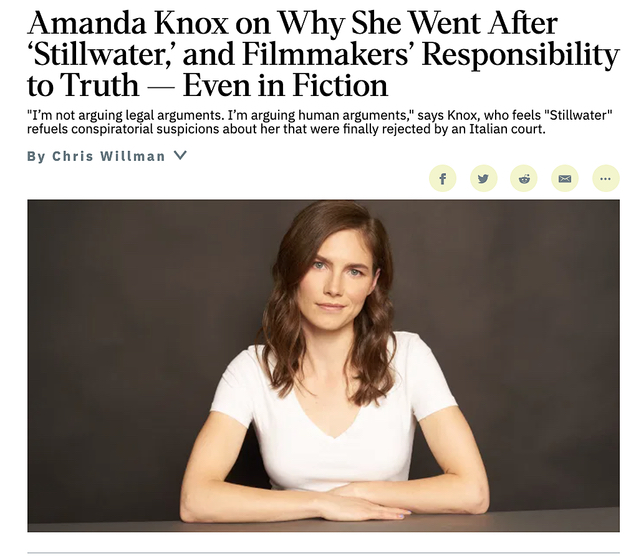
Knox Still Hasn’t Seen “Stillwater”?
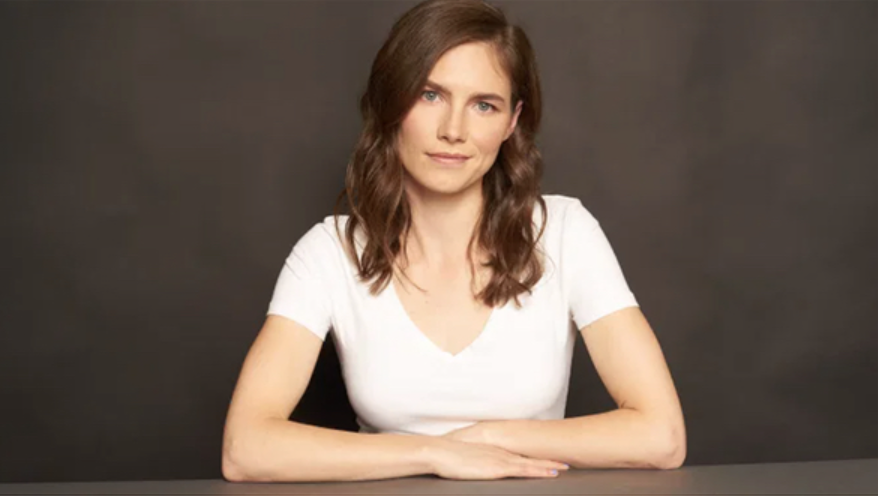
Everything Amanda Knox has been saying about Stillwater is sensible and fair.
In admittedly using Knox’s conviction, imprisonment and acquittal on a murder charge in Italy as a jumping off point for an otherwise fictional story, director and co-writer Tom McCarthy has somewhat callously dredged up a lot of bad business and has re-implanted the idea that there’s something possibly sketchy and wanton about Knox herself. And Knox resents this. Who wouldn’t in her position? I can’t imagine anyone telling Knox that her complaints are unwarranted.
It’s odd, however, that in an 8.4 interview with Variety‘s Chris Willman Knox states that (a) she hasn’t seen Stillwater yet (it opened last Thursday night) and yet (b) she would “absolutely go see it, especially if they invited me…that would be nice.”
Knox tells Willman she’s been informed how the story unfolds (“I did some invest-imigating”), but if you were Knox and giving interviews to everyone about a completely valid complaint about a just-opened film, wouldn’t you take the time to pop into a megaplex and see the damn thing already? Doesn’t that make basic sense?
For one thing it’s conceivable that Abigail Breslin‘s performance as the vaguely-Knox-resembling Allison Baker might radiate certain emotional currents that Knox might be receptive to and which might influence her general thinking…no? Experiencing a film is essential.
Where exactly was the upside in Knox not slipping into a showing last weekend? I really don’t get this part.
In mentioning the hypothetical idea of Focus Features inviting her to see the film, Knox seems to imply that this is her due. (“Since we’re stirring your life up and sending you back into a decade-old nightmare, it’s the least we can do.”) She also seems to be suggesting that personally paying to see the film would be adding insult to injury.
I wouldn’t futz around with this stuff if I were Knox. I would have bought a ticket to one of the very first commercial showings last Thursday night — no ifs, ands or buts. If you have a beef with a movie, you have to watch it.
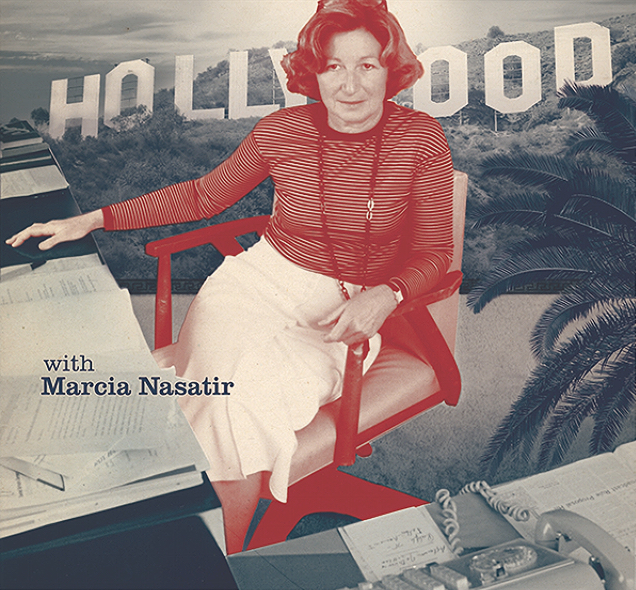
Saluting Marcia Nasatir

The great Marcia Nasatir, a brilliant, pioneering producer who nudged her way into the chauvinistic Hollywood culture of the ’70s and became, in ’74, the first female vp production at a major Hollywood studio (United Artists), has passed at age 95.
Nasatir’s proudest producing achievement, certainly the one for which she’s best known, was Lawrence Kasdan‘s The Big Chill (’83).
At UA Nasatir also had a hand in finessing and/or guiding along One Flew Over the Cuckoo’s Nest, Carrie, Coming Home, Three Days of the Condor, Rocky and Carrie. She moved to Orion in ’78, and then to Carson Productions, where she exec produced The Big Chill. As an independent producer, Nasatir oversaw and otherwise nurtured Hamburger Hill, Ironweed and Vertical Limit.
I knew Marcia to shmooze with at parties in the ’90s and aughts — always gracious, always witty and wise. And I loved “The Real Geezers,” her video movie-review series with Lorenzo Semple that ran in the mid to late aughts.
Please consider watching Anne Goursaud‘s A Classy Broad: Marcia’s Adventures in Hollywood, a 2014 documentary.