“1408” serves it up

I was genuinely unnerved last night — okay, somewhat scared — as the heavy-creepy stuff began to happen in Mikael Hafstrom‘s 1408 (MGM, 6.22). Roughly 30 minutes in, and people to the right and left of me were feeling it also. This is good, I said to myself. I’m feeling queasy and anxious and insecure, and I’m generally immune to the crap that scary movies tend to push.
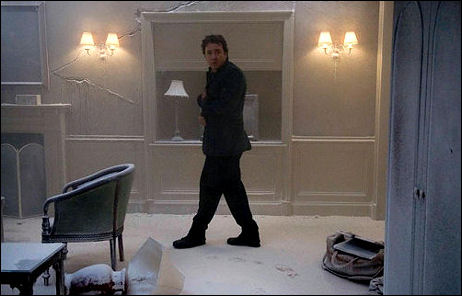
The difference is that 1408 isn’t peddling the usual usual — not your typical torture-porn, anything-goes, too-bad-if-it’s-not-credible shocker stuff, but seriously chilly vibes that are rooted in a believable psychological state that’s eating away at the main character. This, for me, is what makes it all workable and palatable, and that means it’s going to do pretty well. I mean, I’d be really surprised if it doesn’t.
An adaptation of a Stephen King short story, 1408 is primarily a one-set spook show with John Cusack as a paranormal book writer facing all kinds of demons (including his own) inside a haunted Manhattan hotel room. He gives something close to a one-man performance. But one of the things that scared me the most has to do with a roll of toilet paper. I just wanted to say that — a roll of damn toilet paper.
Entertainment Weeklys Owen Gleiberman has written that 1408 “doesn’t pretend to be a seismic Stephen King movie like Carrie or The Shining.” Except 1408 is a whole lot scarier than The Shining. They’re both haunted-hotel flicks but they exist in fairly different realms, and I prefer 1408‘s. Save for a few special effects moments, its main order of business is serving up old-fashioned fright. Something being in a room, and nobody knowing when, why or how the thing is going to happen and scare everyone shitless.
Eli Roth would probably be a little bit bored by this film, and I think that’s wonderful.
By the way: King apparently got the idea for 1408 from a real-life experience of parapsy- chologist Christopher Chacon when he visited room # 3502 at the Hotel del Coronado in Coronado, Calif.. He may have encountered the ghost of Kate Morgan, who died in the hotel in 1892 under dark circumstances. Chacon has described his visit to room # 3502 as a “classic haunting.” Using infrared cameras to track magnetic fields, humidity, temperature fluctuations and electronic emissions, he found 37 abnormalities in one day.
“Sicko” for free

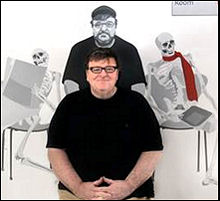
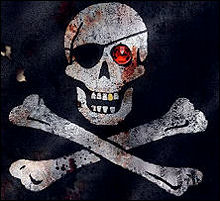
Two weeks before its 6.29 nationwide opening, Michael Moore‘s Sicko is grappling with a serious piracy problem, especially now with sites like Gawker and journalists like Ad Age‘s Claude Brodesser-Akner writing openly that illegal downloads on a certain peer-to-peer content site are now happening left and right.


At what point do you admit to mass piracy?

I wasn’t going to say anything and hope for the best as far as Sicko‘s distributor, The Weinstein Co., is concerned, but the Gawker and Ad Age postings have let the cat out of the bag and now it’s running all over the room and knocking over furniture. What am I supposed to do? Pretend this isn’t happening?
This morning I called Sarah Rothman, a spokesperson for The Weinstein Co. She got back to me a few hours later with this statement:
“Health care impacts everybody right in their homes and it is not surprising that people are eager to see Sicko and become part of a larger movement. While virtually every movie released these days faces a similar situation, Sicko is more than just a movie, it is a call to action.” Wait…what does that have to do with digital piracy?
Rothman also said that the Weinstein Co. is “responding aggressively to protect our film but from our research it is clear that people interested in the movement are excited to go to the theater so they can be part of the experience and fight to reform health care.”
I’ve been told that the Weinstein Co. has hired firms that specialize in combating piracy and that it’s “taking a very aggressive approach to protecting the film.”
But can the Weinstein Co. or its security agents do anything substantively to block the illegal downloads (I don’t know how many people have seen Sicko online, but a guy just wrote me saying he just saw it this way), or are they pretty much limited to flapping their wings in the water?
Just to see what would happen, I downloaded Sicko this morning and it’s not a problem at all. I didn’t watch any more than four or five minutes’ worth, but this seems like a catastrophic situation all around for Moore and Harvey Weinstein and their phone-call-averse spokespersons. I went to Moore’s site and he, too, is avoiding any mention or discussion of the problem.
Maybe only a few thousand people are watching the film via pirate sites and it won’t impact the box-office in any significant way….maybe. But a voice is telling me I’m kidding myself. Am I? Reactions, please.

1962 vs. 1982

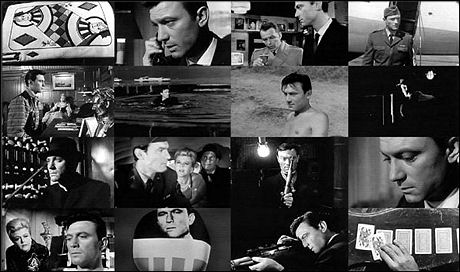
I mentioned twelve classic or very good 1982 films in the review just below of John Patterson‘s Guardian piece about the-year-when-things-started-to-go-wrong. Just for fun I threw together a list of similar quality films that opened 20 years earlier and they numbered 24, including ten bona fide classicsBilly Budd, Knife in the Water, Lawrence of Arabia, Lolita, Lonely are the Brave, The Manchurian Candidate, The Man Who Shot Liberty Valance, Ride the High Country, Shoot the Piano Player and To Kill a Mockingbird.

The 14 also-rans are nothing to snort at either: Birdman of Alcatraz, Cape Fear, Days of Wine and Roses, Dr. No, Hatari!, How the West Was Won, The Longest Day, The Miracle Worker, Mutiny on the Bounty, Requiem for a Heavyweight, The Longest Day, Sundays and Cybele, The Trial and What Ever Happened to Baby Jane?
24 vs. 12…am I missing something?

Downturn of the early ’80s

The Guardian‘s John Patterson has written a lament about the downturn of commercial cinema that manifested in 1982.
Despite the release of first-raters like Blade Runner, The Road Warrior, Diner, Missing, First Blood, E.T., the Extra-Terrestrial, 48 HRS., The Verdict, Sophie’s Choice, My Favorite Year, An Officer and a Gentleman and Tootsie, Patterson notes that “one can indeed foresee today’s mainstream Hollywood: special effects; science fiction replacing the moribund western; the rise of serious gore; one-dimensional worldviews and a paucity of powerful ideas.”
1982 was the year in which everyone realized that the move-brat generation “had helped kill off their own 1970s renaissance with big-budget flops that frightened the studios” — Cimino‘s Heaven’s Gate, Scorsese‘s New York, New York, Coppola‘s Apocalypse Now (wait…it’s made $91,383,841since opening in ’79…how could it be consdiered a loss-leader?), Spielberg‘s 1941, Beatty‘s Reds, Altman‘s Popeye, and John Landis‘s gargantuan The Blues Brothers, “a huge flop until video made it a hit.”
This left the field “clear for Steven Spielberg and George Lucas to solidify the foundations of the Temple of Dumb, and, well, here we all are today.”
Let it be said again that in 20 years the name “Steven Spielberg” will have far fewer positive associations that it does today. Spielberg deserves respect for being perhaps the greatest hack of all time, but once the memory of his having made truckloads of money for himself and thousands of other people fades, his true legacy will start to take shape. His Duel-to-E.T. surge and Schindler’s List aside, Spileberg’s record is undeniably spotty. Always, Amistad, A.I., Munich….the man has been a “problem director” for too many years.
I’m linked to this before, but Pauline Kael spotted all the bad trends in 1980 in this brilliant New Yorker piece called “Why Movies Are So Bad, or The Numbers.”

Better-looking “No Country” trailer

Much better looking, high-resolution versions of the No Country for Old Men trailer are now up on Rotten Tomatoes. My comment two days ago about the Miramax marketing guys having “made this marvelous film look like an action-horror flick about a stalking ogre” was, I think, fair. I only meant that the film is obviously upmarket — brilliant, nerve-wracking, melancholy, funny-creepy, meditative and engineered like a Swiss watch. And that the trailer (and I’m not saying this is unwise from a marketing standpoint) is pretty much aimed at the gorillas.

New Baddies of 2007

Six years and three months ago — on 3.21.01 — I considered a spate of dreadful early 21st Century youth-market pics like American Pie (has anyone re-watched this thing lately?), Saving Silverman, Head Over Heels, Say It Isn’t So, Tomcats, Josie and the Pussycats and American Pie 2. I then considered the young actors who’d starred in these films, and decided that they’d basically become (or were fated to be) shit magnets. As it turned out, I was mostly (or at least half) right.
My personal must-to-avoids in that pre-9.11 time pocket were Jason Biggs, Freddie Prinze Jr., Chris Klein, Amy Smart, Seann William Scott, Monica Potter, Tom Green, Mena Suvari, Jack Black and Amanda Peet.
Which of these actors has a reasonably vibrant, still-happening career today? One — Jack Black. The others are either marginal, sputtering or fizzled. Why? I think it’s at least partly because these actors made so many shallow/dreary/shitty movies, and people just got tired of submitting. Another reason is that anyone enjoying any kind of career flare-up these days is doomed to succumb to the 15-minute cycle because of the increasing velocity and volume of everything.
Question: which young actors today are cruising for a similar bruising? You see their names on the poster, and right away a voice tells you (however fairly or unfairly, accurately or inaccurately) it’s either so-so or mediocre or an outright stinker. Because of one factor and one factor alone — they’re in it.

“Four Months” yanked

Christian Mungiu‘s Four Months, Three Weeks and Two Days, which won the Palme d’Or prize at the Cannes Film Festival, may be the most ecstatically received Roumanian film in history. I missed it at Cannes myself, so naturally I was looking forward to seeing it at the upcoming Los Angeles Film Festival, where it had been booked by its Parisian producer-financier, The Wild Bunch.

But IFC, which acquired Four Months in Cannes with plans to open it sometime in the fall, has pulled it from the L.AFF, despite a prominent listing in the printed program. A source tells me “the film was committed to the L.A. Film Festival by Wild Bunch before it was sold….we wanted it to be a premiere….we’d just bought the movie, and there were no materials and nothing was ready….we don’t even have a print, and we weren’t ready to start working on it…we don’t even know when we’re going to open it….a lot of decisions have yet to be made..”

Havens on “Jesse James”

In relatively honest fashion, Film Jerk‘s Edward Havens attended a research screening of an allegedly “truncated” version of Andrew Dominik‘s The Assassination of Jesse James by the Coward Robert Ford (Warner Bros., 9.21.07), although it’s hard to think of any 140-minute film as truncated.

I have to confess to profound disappointment in reading that Jesse James, like Blade Runner, uses narration and, in Havens’ view, will be “a tough nut to crack if you’re not paying total attention, words I am certain the studio would never want to hear, even though they had to know exactly what they were getting into when they greenlit this film.” I hate, hate, hate narration. The only time I’ve really loved it was in Terrence Malick‘s Badlands and Days of Heaven and maybe four or five others.
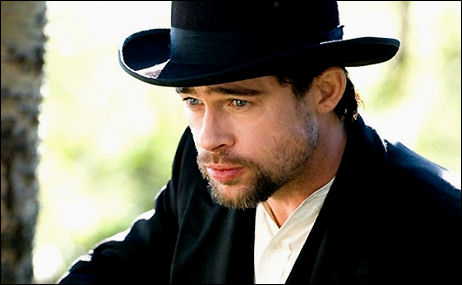
Nonetheless, Havens is a rapt admirer. He says it’s all but guaranteed a place on his list of ’07s Best Films of the Year upon its opening in late September. He says that Brad Pitt, as Jesse James, turns in the best performance of his career since 12 Monkeys, and yet ” this is not his film. It is Casey Affleck, as Robert Ford, who owns the screen by the time the film is over.”
The Assassination of Jesse James by the Coward Robert Ford “doesn’t try to reinvent the western as much as bring back to the same kind of timelessness which have made The Searchers or “The Wild Bunch or the westerns of Clint Eastwood favorites for generations. Twenty years on, Young Guns feels like even more like the tired ’80s movie we knew it was when it was first released. Twenty years from now, this film will not be a victim of its time. It will be still be watched and benefit from the attempt to not chase what is hip or hot today.
“No matter what shape the final film takes, I suspect it will emerge as the best film the genre has seen since the days of Sergio Leone and Sam Peckinpah. Yes, The Assassination of Jesse James by the Coward Robert Ford is better than Unforgiven. Better than Dances with Wolves. Better than Silverado or Wyatt Earp or any other Western in the past thirty years. I cannot wait to see it again.”

“Silver Surfer” review

“To some extent, the noncommital perfs, lazy dialogue and retro-cheesy visual effects could be chalked up to the pic’s refusal to take itself too seriously; one would be hard-pressed to recall the last time the apocalypse was treated this breezily onscreen. But at a certain point, even the most popcorn-hungry moviegoers may find themselves craving something in the way of real dramatic stakes. To defend Fantastic Four: Rise of the Silver Surfer on the grounds that it’s unpretentious is to make too generous an excuse.” — from Justin Chang‘s 6.14 Variety review.

Jolie’s anti-press maneuvers

Angelina Jolie didn’t want the wolf-vulture element trying to wheedle personal stuff out of her during the Mighty Heart junket, and she seems to be down on Fox News because…I don’t know why. Because of their political associations? So yeah, she’s trying to control things, and that obviously makes her a non-advocate of freedom of the press. But I don’t blame her that much for playing her cards this way.

Racial discrimination lawsuit

Universal Pictures has settled with Frank Davis, the African-American first assistant director who’d filed a racial discrimination lawsuit over his getting fired off 2 Fast 2 Furious. It’s rough getting canned — it can really hurt — but when I read the comments of Universal production executive Andrew Fenady, as passed along by L.A. Times reporter Lorenza Munoz, I couldn’t help but go “hmmm.”
Fenady testified that doubts about Davis’s work performance “arose before he was aware [he] was African American. Fenady said his concern mounted when he attended a meeting in August 2002, after Davis was hired, during which the first assistant director seemed to lack ‘command’ of how complex scenes would be coordinated.
“By September, when filming began in Miami, production staff told Fenady that Davis was ‘a weak link,’ and that the production was going to suffer, Fenady said. In a movie, the first assistant is a key liaison among the director, the crew and the production staff.
“Fenady said that on the third day of principal photography the set was in ‘sheer and total chaos.’
“But the clincher for him came when the studio’s transportation captain said to him that Davis was ‘going to get someone killed out here,’ Fenady testified.
“Fenady said he flew back to Los Angeles and immediately reported this to his boss. Davis was fired a few days later.”

Inescapable gunfire

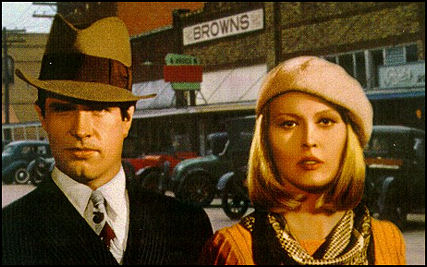
“As the light fades and the first stars come out, the movie begins. It is thrilling, larger than life, romantic — heightened by the night air, by the vastness of the screen. For the first time, I understand the concepts of sexiness and attraction — Faye Dunaway and Warren Beatty emanate both.

“In the beginning, there is something fun about the movie — madcap, Keystone Cops, outlaw heroes, the chase. I sit in the back seat with my brother eating penny candy: Pixie Stix, Atomic Fire Balls, root-beer barrels, Lik-m-aid. And then I am afraid, overwhelmed.
“During the parts of the film that I don’t like, I duck down in the seat; the sound of gunfire — blasting from the metal box just in front of my left ear, tinny, too loud — is inescapable.” — from a 6.11.07 New Yorker “Summer Movies” piece by A.M. Homes.