How Journalists Blew It on Iraq

It’s being claimed that “the most powerful indictment of the news media for falling down in its duties in the run-up to the war in Iraq” is contained in a 90-minute PBS broadcast called “Buying the War,” which marks the return of Bill Moyers Journal this coming Wednesday (4.25). Editor & Publisher was sent a preview DVD and a draft transcript for the program this week.

“While much of the evidence of the media’s role as cheerleaders for the war presented here is not new,” an E & P analysis reads, “it is skillfully assembled, with many fresh quotes from interviews (with the likes of Tim Russert and Walter Pincus) along with numerous embarrassing examples of past statements by journalists and pundits that proved grossly misleading or wrong.

“Several prominent media figures, prodded by Moyers, admit the media failed miserably, though few take personal responsibility.

“The war continues today, now in its fifth year, with the death toll for Americans and Iraqis rising again — yet Moyers points out, ‘the press has yet to come to terms with its role in enabling the Bush Administration to go to war on false pretenses.’

“Among the few heroes of this devastating film are reporters with the Knight Ridder/McClatchy bureau in D.C. Tragically late, Walter Isaacson, who headed CNN, observes, “The people at Knight Ridder were calling the colonels and the lieutenants and the people in the CIA and finding out, you know, that the intelligence is not very good. We should’ve all been doing that.”

“At the close, Moyers mentions some of the chief proponents of the war who refused to speak to him for this program, including Thomas Friedman, Bill Kristol, Roger Ailes, Charles Krauthammer, Judith Miller and William Safire.

“But Dan Rather, the former CBS anchor, admits, “I don’t think there is any excuse for, you know, my performance and the performance of the press in general in the roll up to the war√ɬ¢√¢‚Äö¬¨√Ǭ¶we didn’t dig enough. And we shouldn’t have been fooled in this way.”

Bob Simon, who had strong doubts about evidence for war, was asked by Moyers if he pushed any of the top brass at CBS to ‘dig deeper,’ and he replies, ‘No, in all honesty, with a thousand mea culpas√ɬ¢√¢‚Äö¬¨√Ǭ¶.nope, I don’t think we followed up on this.'”
Harvey replies to Patrick

Hollywood Wiretap‘s Tom Tapp has posted Harvey Weinstein‘s reply to Patrick Goldstein‘s “what happened to the old Harvey?” piece that ran a few days ago in the L.A. Times. Weinstein’s answer is published in today’s Calendar section but not online (and barely visible in the paper) so Tapp has reproduced it for everyone’s reading pleasure:

“Goldstein says he misses ‘the Harvey Weinstein (he) used to know,'” Weinstein begins, “claiming that ‘the Oscar impresario who…was truly, madly, deeply in love with movies’ has been replaced by a ‘slimmed-down mogul…who has lost his way.’

I never fell out of love with movies,” Weinstein insists. “I did have to spend time building the infrastructure of our new company, but we still produced films I’m extremely proud of, like Quentin Tarantino and Robert Rodriguez‘s daring Grindhouse, Anthony Minghella‘s beautiful Breaking and Entering“and the politically charged Bobby.”

Wells replies: Some of us found Breaking and Entering a bit lethargic, Harvey. And if Bobby had in fact been politically charged it might have been a whole different kettle of fish.

“Moreover, Patrick knows full well (because I told him) that I decided to rededicate myself to cutting-edge movies six months ago,” Weinstein continues. “That’s why I went to Sundance in January and bought La Misma Luna, Grace Is Gone, Dedication and Teeth. He also knows (because I told him) that as a result of my rededication, the Weinstein Co. (sic.) will have three movies in the official selection at Cannes next month — Michael Moore‘s Sicko, Quentin Tarantino‘s Death Proof, and Wong Kar Wai‘s My Blueberry Nights, which is being featured as the opening-night movie.

“In addition, we are co-financing the Portuguese-language Elite Squad (the same way we did City of God); Wayne Kramer‘s >Crossing Over starring Sean Penn and Harrison Ford; Denzel Washington‘s The Great Debaters; Richard Shepherd‘s Spring Break in Bosnia and Stephen Daldry‘s The Reader, written by David Hare.

“As I told Patrick, it was six months ago that my brother Bob told me, ‘It’s time for you to get back to making and acquiring movies — to the kind of movies you were once known for.’ Since then, I’ve been doing just that — and it’s just like the good old days.”

McCarthy dings “Spider-Man 3”

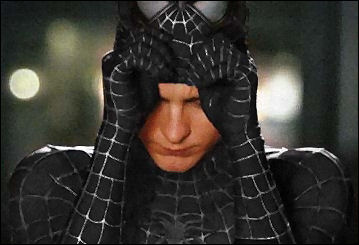
Defend your own fort and make your own judgments, but Todd McCarthy‘s review of Spider-Man 3 — “the three main characters and the film itself stuck in a rut…a dip in quality and enjoyment [from Part 2]” — strikes me as a bit more straight-from-the-shoulder than Michael Rechtstaffen‘s review in the Hollywood Reporter.

Am I saying this because McCarthy is saying what I’ve been suspecting would be the case all along? Yes. It’s no secret that I’m predisposed to trash Spider-Man 3. (And I don’t like living in this place at all, let me tell you. I wish there were reasons to expect something better. Harboring prejudicial feelings feels like you’ve got a cold in your chest.) But you don’t need to look into Professor Marvel’s crystal ball to formulate a pretty good idea of what’s coming.

McCarthy is a widely respected guy who, by my standards, gets it right fairly often. (His biggest boner was dissing The Big Lebowski when it had a special Sundance screening way back when.) His review and reviews like it will mean absolutely nothing to the fanboy hordes, of course, but at least they (as well as others of discerning taste) now have something to give them pause.

“The three main recurring characters get stuck in a rut and the same can be said of the film itself in Spider-Man 3,” he begins. “After the significant improvement of the second installment over the first, new entry reps a roughly equivalent dip in quality and enjoyment, with Spidey now giving off the faint odor of running on fumes.

“This devaluation shouldn’t hurt at the box office, at least at first, as the vast majority of the fans who turned the first two into $822 million and $784 million worldwide grossers, respectively, will cram multiplexes around the globe to see the first blockbuster of the summer.

A sense of strain envelops the proceedings this time around. One can feel the effort required to suit up one more time, come up with fresh variations on a winning formula and inject urgency into a format that basically needs to be repeated and, due to audience expectations, can’t be toyed with or deepened very much.”

No rave from Rechtstaffen

Spider-Man 3 may have more to deliver than the usual fan-wanking, simple-dick plotting and intravenous CG opium, to judge by this rave Michael Rechtshaffen review in the Hollywood Reporter. But I’ve had issues with Rechtstaffen before and I really don’t trust him much. Nobody should. He’s a “trade reviewer” who accepts the notion that he’s supposed to keep things fair and polite and balanced, which means that a lot of his reactions, in my view, tend to be a little too gracious.

Keep in mind that Rechtshaffen gave a friendly pass to The Last Mimzy — that should tell you a lot.

Besides, it you carefully examine Rechtshaffen’s prose, you’ll see that he’s not exactly trumpeting Spider-Man 3 as anything too wondrous.

He calls it “dazzling” — a rote adjective that’s syonymous with “eye-filling,” which is hardly a stunning achievement for a film of this sort. He says that “arachnophiles everywhere” — i.e., fans of the previous two Spider-Man films — “finally have cause to celebrate” after an absence of three years. What else are fans of a big franchise supposed to do when part 3 finally rolls out — vomit on the sidewalk?

Rechtstaffen’s most troublesome proclamation is that Spider-Man 3 “has done it again,” which is far from comforting news to this columnist.

Noting that the film is “certain to please the geek squad by remaining ever true to its comic book roots while retaining that satisfying emotional core that has registered with equal numbers of female fans,” Rechtstaffen declares that Spider-Man 3 “has all its demographic bases covered.” This is a trade review, all right — a few upbeat pat-on-the-back sentiments aimed at Columbia advertisers, confident clucking about how satisfied the fans will be (and how much money will be made), an attaboy marketing analysis.

Surprising as this may sound, Rechtstaffen allows a note of negativity to slip into paragraph #4. “While the picture as a contained whole might fall an itsy-bitsy short of the personal best set by Sam Raimi’s 2004 edition, the wow factor works overtime with state-of-the-art effects sequences that often are as beautiful as they are astonishing.”

Did everybody read that? A politically-minded Hollywood Reporter critic says Spider-Man 3 is not as good as the last one (i.e., the “Doc Ock” version with fat Alfred Molina) , which I thought was just okay and which I’ve never wanted to see a second time. I take it back — Rechtstaffen hasn’t written a rave. It just seems like one from the headline and the gushy first three graphs.

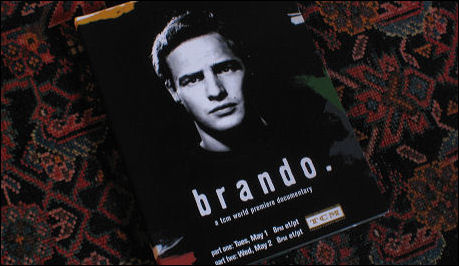
Brando doc


Weekend viewing material that’ll be shown at the Cannes Film Festival along with some kind of party being thrown (on top of the domestic TCM airings on 5. 1 and 5.2)

A long way to go

The Cannes Film Festival is “a long way to go to see Sicko a few weeks early. And it’s a rather expensive trip to see next year’s Robert Koehler Collection three months before the highlights all land in Toronto.” — from David Poland‘s 4.20 Hot Blog…funny. But does this mean Poland has figured out a way to see No Country For Old Men and My Blueberry Nights in Los Angeles sometime next month?

Auteur theory goes south

“The auteur theory, I’ve finally decided, can kiss my ass,” says Guardian columnist John Patterson. “I’m done with it. It bores me. I flee in great haste from the mere mention of its name. It’s a cult of personality. It’s a marketing scheme. It’s become a misleading umbrella-term falsely uniting a diverse body of collectively created work under a single name.

“And it just encourages the tacky, egomaniacal film-school cult of the writer-director as lone presiding genius. More and more I tend to find myself believing in what the writer Thomas Schatz called ‘the genius of the system.'”

Patterson is right in implying that if it hadn’t been for Andrew Sarris‘s The American Cinema, which popularized the French auteur theory after Sarris wrote his first seminal essay on the topic in ’62 or thereabouts, we might not have had the legend of Michael Cimino and therefore the debacle that was Heaven’s Gate.

Wait, I forgot: Heaven’s Gate has been elevated into semi-respectability (or is it full respectability?) by tireless Cimono pallies like F.X. Feeney and is now…what’s the party line?….a fascinating American pastoral piece that was judged too quickly and harshly when it first came out.

[Note: The Patterson essay was linked earlier today on Movie City News, which means that all linking rights from this point on are owned by David Poland. I am choosing to ignore this for reasons that presumably don’t need explaining.]

Bourne Ultimatum teaser

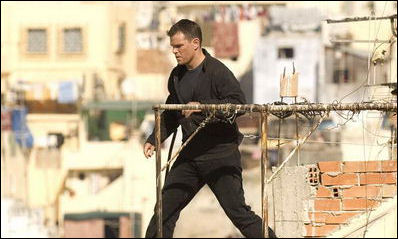
I’m not getting a significantly”different” vibe from this Bourne Ultimatum teaser, but it’s still the only summer three-quel I’m even half interested in seeing. I take that back — I’m fully interested because Matt Damon is a wee bit cooler than Daniel Craig, Bourne movies are the action-thriller gold standard these days, and because the gifted Paul Greengrass is once again directing.

Clark or Gallo

“The only thing the Cannes Film Festival lineup is missing [this year] is a film by Larry Clark. Or, failing that, one by Vincent Gallo.” — a recent e-mailed comment by a Hollywood publicist who’s none too charmed by this year’s roster.

King on psychos who could blow

“George was very quiet, and verbally inarticulate. It was only in his written work that he spewed these relentless scenes of gore and torture. His job was in the University Bookstore, and when I inquired about him once, I was told he was a good worker, but ‘quiet.’ I thought, ‘Whoa, if some kid is ever gonna blow, it’ll be this one.’ He never did. But that was in the days before a gun-totin’ serial killer could get top billing on the Nightly News and possibly the covers of national magazines.” — Stephen King on the Cho Seung-Hui syndrome, in a new edition of Entertainment Weekly.

Video editing tutor

If there’s anyone in L.A. who knows know to operate any Windows-friendly video-editing software that’s made for dummies and isn’t too costly (like Ulead Movie Studio 10, which I have a copy of), and (b) wants to earn a little tutoring money, please drop a line. I need to start posting some short video reports on Hollywood Elsewhere by the time of the Cannes Film Festival (if not before), and while I’m sure I could figure it out on my own eventually, I need to learn fast. My laptop, camera, software…will travel.

Remakes

This four-day-old Lewis Beale/Reeler piece about the do’s and don’ts of remakes (“Re-made in the USA”) is sensible and well-written, but the ultimate pearl of wisdom was delivered years ago by the great John Huston: “Don’t remake good movies — remake bad ones!” Or, to follow the train, “Don’t adapt brilliant books that are praised by Michiko Kakutani — adapt pulp and give it a bit of soul and embroidery.”