Masters on “Spider-Man 3” budget

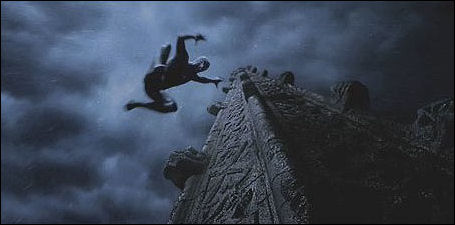
Despite an angry studio publicist’s denial, Radar‘s Kim Masters is reporting in a just-up Radar piece that Spider-Man 3 (Columbia, 5.4) has surpassed 1963’s Cleopatra as the most expensive movie ever made. With the enthusiastic go-go support of Sony chairperson Amy Pascal, Sam Raimi‘s third and presumably final Spider-flick cost $350 million, she writes, compared to Cleopatra‘s inflation-adjusted budget of $290 million.
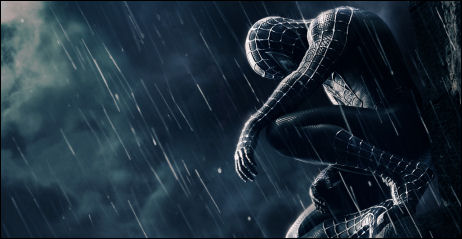
Add a guesstimated $150 million in marketing costs and Spider-Man 3‘s final tally will be $500 million, according to Masters’ calculations.

Spider-Man 3 is pretty much ding-proof — the fanboys are going to break down the doors no matter what — but Masters’ article will muddy the waters. Add this to the so-far tepid reviews and the spreading awareness and/or growing prejudice that revved-up, cranked-up CG extravaganzas are dead-end sits because of their constant war between their two halves (being 50% exciting in an obvious thrill-ride sense and 50% numbing in a sensory-overload sense, which leads to 100% depression by the time the third act rolls around), and the stage is set for U.S. ticket-buyers to go into it with a skeptical, perhaps even bordering-on-sourpuss attitude.

An absurdly expensive movie of this proportion — whether it cost $270 million or $300 million or more — means at the very least that Spider-Man 3 was a huge corporate pig-out for all the major creative players. And now you, Mr. and Mrs. Paycheck, are expected to show up at theatres on May 4th and pay your ten bucks so the machine can keep rolling and all the fat players can go to the trough again and again. Keep it rolling, keep it rolling…support the elite Hollywood profligates! They would be lost without you.

“On the surface, Spider-Man 3 has all the ingredients of a box-office slam dunk — √É‚Äö√Ǭ≠spectacular special effects, an obsessive fan base, and a roster of bankable stars,” Masters writes. “Moreover, its two previous installments have grossed $1.6 billion for the studio.
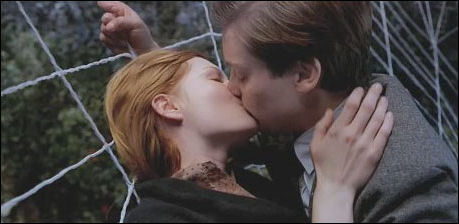
“Even before filming began in January 2006, [director] Sam Raimi promised to pull out all the stops for his third Spidey film (likely the last he’ll direct in the series). He wasn’t kidding. As production dragged on into late summer (it had been scheduled to conclude in June), stories about the project’s ballooning budget started popping up all over town. But in the end, even the most hyperbolic of observers may have underestimated the final tab.

“Industry insiders claim that Sony spent $350 million or more on production alone. With marketing and promotion factored in, the total price tag will approach half a billion dollars, positioning Spider-Man 3 as the most expensive movie of all time.

“Still reeling from a flurry of bad press on its PlayStation 3 gaming console, Sony isn’t eager to claim this honor. A studio spokesman angrily rejects the $350 million estimate as a ‘complete fabrication,’ insisting that production costs didn’t exceed $270 million. One of the film’s producers, Laura Ziskin, also disputes the higher total, albeit in a less forceful manner. “I refuse to say the [real] number because it makes me choke,” she tells Masters. “Spider-Man 3 was a super- expensive movie — the most expensive film we’ve ever made. But there’s no way you can get to $300 million.”

“Reports of Sony’s record-breaking gamble have created a stir among entertainment insiders, seeming to evoke some combination of schadenfreude and envy. “Those are crazy numbers,” remarks one leading industry figure.

“I don’t think this sets a great [precedent] for any of us,” complains a top executive at a rival studio. “It’s beyond the beyond. The problem isn’t that other studios will now feel liberated to drop $300 million on a movie. The real danger is that it makes the $200 million movie seem not quite so bad. And the risks of that can be absolutely devastating.”
“Noting Sony’s long and storied history of overspending, the head of another studio asks, “Where is the corporate oversight? Who’s demanding accountability? How is it that they’re repeatedly able to conduct themselves in this manner?”

“To be fair, Sony is hardly the only studio spending big bucks on tent-pole projects. Shrek the Third blows into multiplexes two weeks after the new Spidey film, with Pirates of the Caribbean: At World’s End right behind it. Next come the Fantastic Four sequel and Steve Carell‘s Evan Almighty. Then, on Independence Day weekend, Transformers hits the screen.

“None of these projects was cheap. Indeed, the third installment of Pirates may also sail past the $300 million mark. But in contrast to the Spider-Man series, the second Pirates film outperformed the original and grossed more than a billion dollars. (Spider-Man 2 took in $783 million, or about $40 million less than its predecessor.)

“Sony’s free-spending ways have been evident ever since the Japanese electronics giant acquired Columbia Pictures in 1989, causing much consternation among competitors who feel pressure to match the studio’s largesse. The first chairmen in the Sony era, Jon Peters and Peter Guber, spent so much money that the studio wound up taking a $3.2 billion write-down. The two were eventually fired, but business continued as usual. In 1996, chairman Mark Canton blew the roof off star salaries by awarding Jim Carrey an unprecedented $20 million for his role in The Cable Guy, a film that disappointed at the box office. Soon after, Canton was also gone.

“To many observers, though, the budget for Spider-Man 3 represents a terrifying new frontier, even for Sony. As other studios try to cut costs, Pascal has continued in Sony’s profligate tradition.

“The only woman currently heading up a major studio, she also happens to be one of the most popular executives in the business,” Masters concludes. “That’s largely because she seems to have a genuine love for movie-making at a time when many of her peers are fixated on the bottom line. ‘Amy’s greatest strength is her intuitive, creative ability,’ says a longtime associate. ‘Her greatest weakness is that she lets that same ability get completely separated from any sense of fiscal restraint.'”
Zinneman and “Jackal”

Was there any film that was truly, madly and absolutely Fred Zinneman‘s? He did High Noon proud, but that 1952 western wasn’t Zinneman’s as much as it was screenwriter-producer Carl Foreman‘s. From Here to Eternity was well assembled by Zinneman, but it’s hard to see him as the auteur with Montgomery Clift, Burt Lancaster, screenwriter Daniel Taradash, Frank Sinatra and Deborah Kerr being so perfectly on their game. Likewise, A Man for All Seasons seemed more particularly empowered by the brilliance of screenwriter Robert Bolt and actors Paul Scofield, Roy Kinnear, John Hurt and Robert Shaw than by Zinneman’s solid, somewhat rote direction.

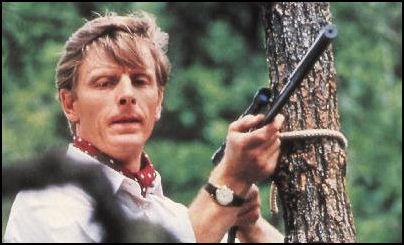
If there is a definitive Zinneman film, it is 1973’s The Day of the Jackal. I agree with David Poland that it was odd — curious — of Emanuel Levy to overlook this film in his Zinneman centennial essay. It is Zinneman’s best because it’s the most taut and well-honed film of his career. Its crisp, dry efficiency not only satisfies from an audience absorption perspective, but it also harmonizes with the arid efficiency of the “Jackal” assassin (Edward Fox). And don’t forget the exquisitely subtle sexiness of Delphine Seyrig as the 40ish woman of property whom Fox meets and beds at that small Southern France hotel.


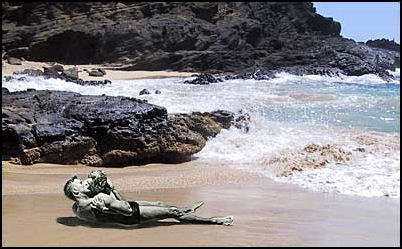
A shot I took in May 2001 of the exact same beach, located on the east coast of Oahu, where Burt Lancaster and Deborah Kerr had their famous tryst in From Here to Eternity

Cassel est mort

French actor Jean-Pierre Cassel died three days ago — Thursday, 4.19 — in Paris after a long illness. A statement was issued Friday, the Hollywood Reporter posted Rebecca Leffler‘s story a day after that, and some of us didn’t get around to reading the story until Sunday. The 74 year-old was Vincent Cassel‘s dad. The elder Cassel’s final film, Julian Schnabel‘s The Diving Bell and the Butterfly, will show at the Cannes Film Festival next month.

Langella in “Frost/Nixon”

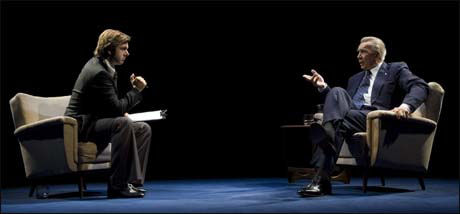
“From the moment he steps onstage, with his hunched walk and lumbering step, Frank Langella has avoided the obvious route of Rich Little-style impersonation of one of the most impersonated figures in history. What he delivers instead is an interpretation that, without imitation, still captures and exaggerates Richard Nixon‘s essential public traits: the buttered-gravel voice, the scowling smile, the joviality that seemed to contain an implicit threat.

“The friend with whom I saw the play asked me afterward if I had noticed how much better Langella’s Nixon impersonation became as the show progressed. Langella’s performance had not changed, but by evening’s end it had eclipsed the familiar photographic image of the real man. Like Helen Mirren‘s understated Elizabeth II in The Queen, this overstated Nixon seems destined forever to blend into and enrich the perceptions of its prototype for anyone who sees it.” — from Ben Brantley‘s review of Frost/Nixon in the 4.23 edition of the N.Y. Times.

And yet Ron Howard, fearful of moviegoers who may be not be innately aroused by Langella’s talent, wants to cast a “name” guy to play Nixon for his movie version, which starts shooting in August. Note to Ron: cast the best man and the hell with marquee value. Make the best film you can and make your next bundle from Angels and Demons. The Frost/Nixon film isn’t going to break records no matter who plays Nixon. Forget the Wild Hogs crowd, the airport-fiction readers, the Da Vinci Code mouth-breathers…forget ’em all.

Hating the Times

L.A. Observed is reporting (and I heard this independently today on my own) that about 70 L.A. Times newsroom jobs are being chopped, which will reduce the editorial staff “from 920 to around 850.” Okay, that’s rough and I’m sorry for those about to be put out to pasture, but if the the paper version of the Los Angeles Times were to disappear tomorrow, a part of me would truly rejoice. I’ve never loathed a newspaper in my life like I hate the Los Angeles Times with those wads and wads of ad supplements falling out all over the place when I read it in a cafe. I love reading a lot of the L.A. Times reporters and columnists, but I hate the paper Times with a passion. Save the forests and make it all cyber. Better yet, bring back the L.A. Herald Examiner.

“Sunshine ” in Europe

Danny Boyle‘s Sunshine (Fox Searchlight, 9.14), a sci-fier about a team of astronauts on a celestial mission to re-ignite a dying sun, won’t open stateside until after Labor Day, but it opened across Europe earlier this month. Some British and European critics have been groaning about the ending, but so far it’s got an above-average 88 % Rotten Tomatoes rating, so it doesn’t sound too problematic. It sounds excellent, in fact, if you leave out the equation of the finale.

I’ve asked the Fox Searchlight folks about seeing Sunshine here in Los Angeles before flying off to France and the Cannes Film Festival on 5.14, but so far they haven’t replied. If my suggestion continues to fall on deaf ears I guess I’ll just take a train to Nice and see it in some paid-ticket multiplex during the festival. (It runs from 5.16 to 5.27, and I’m guessing — hoping — that Sunshine, which opened in France on 4.11, will still be playing five weeks later.) I guess I could also see it somewhere in Italy since I’ll be going there for a few budget-conscious days after Cannes.

On one level it’s pain in the ass to have to chase down a movie this way, but it’ll also be kind of fun.

“Once” is coming

John Carney‘s Once, the most unassuming and wholesomely affecting love story in years that turned into the Big Find at Sundance ’07, opens on May 18th — a little less than four weeks off. Fox Searchlight, which acquired it last February, has launched its own Once website. (The Irish version has a little more pizazz.) Here, in any event, is a fairly decent trailer that catches the mood and tone of the feature.


Glen Hansard, Marketa Irglova in John Carney’s Once

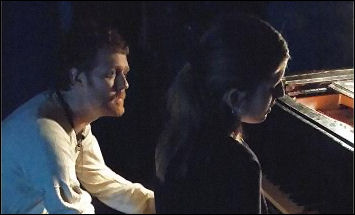
This little Dublin-shot film is about a couple of gifted but struggling musicians — a scruffy, red-bearded troubadour (Glen Hansard, best known for his Irish group The Frames) and a young Czech immigrant mom (pianist and singer Marketa Irglova) — falling for each other by learning, singing and playing each other’s songs. That’s it…the all of it. And it’s more than enough.

Calling Once a “musical” doesn’t quite get it because it’s really its own bird — it’s a tweaking (almost a reinvention) of the form in the vein of Cabaret, A Hard Day’s Night and Dancer in the Dark. On top of which it’s gently soothing in a low-budget, unforced way.. It’s about struggle and want and uncertainty, but with a kind of easy Dublin glide-along attitude that makes it all go down easy.

Once is about spirit, songs and smiles, lots of guitar strumming, a sprinkling of hurt and sadness and disappointment and — this is atypical — no sex, and not even a glorious, Claude Lelouch-style kiss-and-hug at the finale. But it works at the end — it feels whole, together, self-levitated.

Trust me — there isn’t a woman or a soulful guy out there who won’t respond to Once if they can be persuaded to just watch it. The trick, obviously, is to make that happen, and I admit there may be some resistance. Initially. But once people sit back and let it in (and they’d have to be made of second-rate styrofoam for that not to happen), the game will be more or less won. Settled, I mean.

Carney, Hansard and Irglova are starting a 15-market p.r. tour from April 30 to May 18. They’re in Manhattan on May 1st and Los Angeles on May 15th. In each city Fox will be holding special promotional showings followed by a performance and q & a in each market, which is the template that worked so well at each one of the Sundance screenings last January.

Diesel vs. Kassovitz

If you care about the Vin Diesel vs. Mathieu Kassovitz clash on the Prague set of Babylon A.D., here’s a rundown courtesy of “Page Six.” Diesel is starring as “a war vet-turned-mercenary escorting a woman from Russia to Canada,” blah, blah…and then “things get dangerous when it turns out the woman is carrying an organism that a bizarre cult wants to harvest to produce a genetically modified Messiah,” blah, blah. It co-stars Michelle Yeoh, Gerard Depardieu and Charlotte Rampling. Kassovitz, 39, has directed eight films prior to this one (including ’03’s Gothika) and is a fairly well-known actor(Munich, Amelie, Amen, Birthday Girl). The movie sounds like second-rate crap. Whatever happened to Diesel anyway? He was on his way to being Next Big Guy, and now he’s Jean Claude van Damme.

Brando doc reviewed

Brando, the two-part, four-hour Turner Classic Movies documentary that will air on May 1st and 2nd, is a relatively candid, nicely sculpted, entirely respectable portrait of the single most influential actor of the 20th Century, and probably also the greatest.

I was concerned that producer Leslie Greif and writer Mimi Freedman might make it too much of a valentine to the eminent Marlon Brando, and perhaps gloss over the tragedy of his life, but they consider and in some ways explore most of the substantive issues (i.e., the truth as most of his friends understood it) and gloss over the gnarly stuff only somewhat. There’s always pressure to deliver a love sonnet when you’re making one of these career-review docs, and Greif and Freedman are to be commended or at least given a pass for being as honest as the political climate probably allowed.

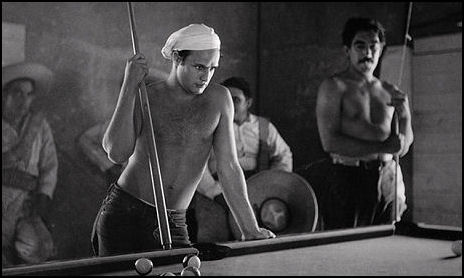
The glory of Brando is known to pretty much everyone except the under 25s, and anyone of that age who cares anything at all about movies or acting should definitely watch this. There’s a cornucopia of of wonder and ecstasy in Brando’s early performances (i.e., in five of his first six movies — The Men, A Streetcar Named Desire, Viva Zapata, Julius Caesar and On The Waterfront. I’ve always felt that his work in The Wild One was more iconic than rich.

The darkness of the Brando saga hangs on two hooks. One, that his last 30-plus years were all but wasted in terms of what he was capable of, and two, that the tragedies that claimed two of his children, Christian (the Dag Drollet murder, which led to Christian’s imprisonment) and Cheyenne (who hung herself) were strong indications that Brando was some kind of wretched, extremely wounding, self-absorbed father. The TCM doc acknowledges and discusses the first fairly throughly, but it tip-toes around the second.

Plus it doesn’t mention Brando’s longtime friend Wally Cox at all (a truly shocking omission) and it doesn’t get into the darker, kinkier stuff that was reported in Peter Manso‘s biography. It allows that Brando was an egoistic, self-absorbed mind- fucker at times (depending on who he was dealing with, or what the situation was) and it comes close to saying the poor man pretty much wasted his life after the early ’70s triumph of The Godfather and Last Tango in Paris. But it doesn’t bore in on this, and relatively few of the talking heads (Jane Fonda is an exception) are willing to say what they really thought about his dissolution.

The emphasis, in short, is on how much everyone loved and admired him, which is what these docs always do — Marlon was great, he changed acting, he shook the earth, he was a God, etc. But the doc has a lot of truth in it also, certainly the emotional truth of how Brando’s naturalistic acting style impacted so many of his peers and became such an important benchmark — i.e., “before Brando” and “after Brando” — and inspired so much love and excitement.

The talking heads include Al Pacino, James Caan, Edward Norton, Martin Scorsese, Maximillian Schell, David Thomson, Kevin McCarthy, Bernardo Bertolucci, Frederic Forrest, Martin Landau, Budd Schulberg, John Travolta and Jon Voiight, among many others.

Here’s how some of the wrap-up sentiments sound (there’s too much music mixed into it, making the words hard to hear) and here’s Brando’s riveting delivery of the “dogs of war” speech from Julius Caesar.

Poop on the grey Hulk

Collider.com‘s Steve Weintraub (a.k.a. “Frosty”) spoke to producer Avi Arad at the recent Spider-Man 3 junket about the apparently locked-in decision to have a grey-colored Hulk in the new Edward Norton movie. “While someone else may have posted the story earlier than me,” Weintraub writes, “I’m the one who asked the questions that got [Arad] to talk. You can listen to the audio and hear me asking the questions for the proof.”

In The Land of Women reviews

Jon Kasdan‘s In The Land of Women (Warner Bros., 4.20) has only managed a lousy 48% Rotten Tomatoes rating, but it’s picked some classy “cream of the crop” allies, including L.A. Times critic Kenneth Turan, the Philadelpha Inquirer‘s Carrie Rickey, the Toronto Star‘s Susan Walker, the San Francisco Chroncile‘s Mick LaSalle and Newsweek‘s David Ansen.

That said, many of the positive comments come from an attitude that say, in a nutshell, “Jon Kasdan is young and therefore his first-time-director mistakes are forgivable, on top of which it’s a little easier to cut him slack knowing that his dad, Lawrence Kasdan, has made several good films and that Jon will improve and…well, here’s to the family Kasdan!”