Corliss, thought, mass audience

“Hollywood’s marketers have become tremendously efficient at getting their core audience to see their big movies. They don’t need critics for that. But critics have a larger utility: to put films in context, to offer an informed perspective, to educate, outrage, entertain. We’re just trying to do what every other writer is doing: making sense of one part of your world. So, dear reader: If our opinions on a movie don’t coincide, I don’t care, and neither should you. I’m not telling you what to think. I’m just asking that you do think.” — Richard Corliss responding to Peter Bart’s 3.15 Variety column in which he trashed critics for being out of touch with the mob.

That final Corliss sentence is a hoot. The vast majority of moviegoers, of course, aren’t interested in thinking, and anyone who goes around presuming that “thought” is some kind of mass-market intrigue or tonic is truly living on a farway planet Movies are about delivering and receiving emotion — it’s what has always made them a mass art form. “Thought” is for the fringe. People today are mostly into being dumbly wowed (via CG flotsam movies like 300, Pirates of the Caribbean, Spider-Man 3, etc.), or being made to laugh or cry. I hate dumbass CG movies, but I’m just as susceptible as anyone else to the other two. Everyone is. But release a film that hints that a small expenditure of intellectual rigor may be needed to understand or enjoy it, and you automatically lose 90% of your potential audience.

Bart’s column was posted more than month ago, by the way. Shouldn’t there be a statute of limitations on response pieces? Shouldn’t you have to write them within, say, five working days?

Nervepop Burning

Those Nervepop guys — Bilge Ebiri, Phil Nugent, Paul Clark, Leonard Pierce, Faisal Qureshi — yesterday posted a two-parter about the Most Historically Inaccurate Films Ever Made, and one of the most deserving, they feel, is Alan Parker‘s Mississippi Burning. They’re not wrong, and yet no one ever gave a damn. For a very fundamental reason.

Basing their film on the FBI’s hunt for the killers of three Civil Rights workers (Michael Schwerner, James Chaney and Andrew Goodman) in 1964 Mississippi, Parker and Gerolmo “twisted the historical record in the service of what Pauline Kael called ‘a Charles Bronson movie’ ,” they write, “[and] turned the film√ɬ¢√¢‚Äö¬¨√¢‚Äû¬¢s FBI agent heroes” — played by Gene Hackman and Willem Dafoe — “into Dirty Harry-style vigilantes, trampling on due process in order to bring the guilty hayseeds to justice.

“[The film] even goes so far as to completely fabricate a scene in which a black FBI agent gets flown down to Mississippi with the specific purpose of terrifying a racist small-town mayor (R. Lee Ermey),” they add.

And I’ve never cared. No one has. I’ve always had a soft spot for Mississippi Burning for various reasons — Hackman’s performance (particularly his scenes with Frances McDormand), the cinematography, the editing, the ominous music — but paticularly because of Parker and Gerolmo’s bullshit plot. Because the lies they came up with are emotionally satisfying, and that’s always the bottom line.

I agree with Gore Vidal‘s old line that “the ends never justify the means because there are no ends, only means” and yet it feels very fulfilling to see vigilante tactics used against racist murderers. Especially after watching Hackman and Dafoe go through weeks of fruitless investigation while the guilty crackers smirk and drink cream soda and chew tobacco.

If audiences feel that a film is delivering a form of justice, be it emotional or legal, they’ll always buy it regardless of historical accuracy.

Side note: Why don’t the Nervepop guys use more Permalinks? And if they are using them, why are they so hard to find?

Why Woody isn’t coming

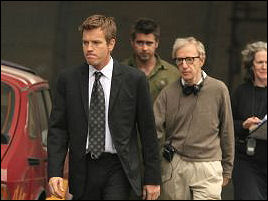
Variety‘s Allison James reported some inside dope this morning about why Woody Allen‘s Cassandra’s Dream wasn’t included in the Cannes Film Festival lineup: “The new British crimer, starring Ewan McGregor and Colin Farrell, was offered the closing night slot,” she wrote, “but discussions came to an end when Allen balked at that idea.”

Allen got pissy, in all likelihood, because being offered the closing-night slot is generally regarded as a friendly backhanded compliment. Draw your own conclusions about how Cassandra’s Dream stacks up in the eyes of the festival programmers compared to Allen’s Match Point, which was given a prime middle-of-the-festival slot two years ago.

I happened upon a massive plot spoiler on the Cassandra’s Dream Wikipedia page, and all I’ll say is that it’s a very dark piece — considerably darker than Match Point. Okay, one other thing: the most literal interpretation of the title is that it’s the name of a sailing craft.

Weekend tracking

Fracture is tracking at 58, 31 and 9….figure $10 to 12 million this weekend. Hot Fuzz is at 28, 35 and 7, but that’s a limited release (a few hundred screens) and I’m told it should do pretty well by that standard. In The Land of Women has been clocked at 43, 21 and 6. Vacancy is at 61, 28 and 6. Spider-Man 3 is way, way up there — 97, 67 and 35 with two weeks to go. It could earn over $100 million. The Spider-Man films are very popular and that’s fine, but how many millions will be paying to see the final chapter two weeks from now with any sense of real intrigue and excitement, and how many millions will be going because “whatever, dude… we’ve seen the first two and we might as well see the third.” The second group is to be congratulated for behaving like good little robots.

“Long Goodye” dissertation

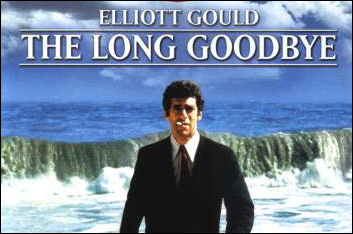
This Terrence Rafferty piece about Robert Altman‘s The Long Goodbye appeared in last Sunday’s N.Y. Times, but the film won’t be playing at Manhattan’s Film Forum until tomorrow so it’s still okay to discuss it. This casually-paced detective film, released in 1974, re-imagines Raymond Chandler‘s Phillip Marlowe as an old-fashioned man of honor with a zen slacker attitude. The intrepid but low-key Elliot Gould got under the skin of this loose-shoe’d shamus and gave the second-best performance of his life (after “Trapper John” in Altman’s M.A.S.H.).

The Long Goodbye‘s most noteworthy signature, I’ve always felt, is how Vilmos Zsigmond‘s widescreen camera is always slowly tracking in a very gentle arc to the right or left. I always saw this as a metaphor for the constant mobility and lack of roots that goes with life in Los Angeles, where the film takes place. I shared this view two or three years ago with Vilmos Zsigmond, the film’s illustrious cinema- tographer, during a q & a at the Newport Beach Film Festival. He agreed with the thought, he said, but remarked that Altman never discussed the “meaning” of the constant camera movement. He just said, “Just keep it moving.” That’s an artist for you — go with the instinct and leave the dissertations to others.

My two favorite dialogue portions: (a) Mark Rydell, playing a slick gangster, mentions to Gould that he was always afraid of getting undressed in the locker room at the end of gym class because he “never had any pubic hair until I was 15 years old,” and Gould deadpans “Oh, yeah? You musta looked like one of the Three Little Pigs”; and (b) a small-town Mexican official, speaking English with a very thick accent, refers to Gould’s friend, a morally sleazy guy named Terry Lennox (Jim Bourton) who may have committed suicide, as “the deceased,” and Gould immediately says, “The diseased…yeah, right.”

The Long Goodbye is purchasable on DVD for eleven or twelve bucks.

Hammer

Okay, so Virginia Tech killer Cho Seung-Hui was imitating the hammer bit in Old Boy in that video he sent to NBC. Big deal. Isn’t it fairly common for psychopaths to wax positive about iconic entertainers or movies that they feel represent them on some level? Didn’t John Dillinger allegedly admire this or that Hollywood gangster flick (i.e., James Cagney in Public Enemy)? Didn’t Joseph Goebbels, the top-dog Hitler propagandist, once talk about his admiration of Alfred Hitchcock‘s Foreign Correspondent for what he saw as expert pro-western propaganda?


(l.) Cho Seung-Hui; (r.) Choi Min-sik in Old Boy

Baldwin screaming

TMZ has a transcript and an audio file of Alec Baldwin ripping into his 11-year-old daughter, Ireland (he calls her a “thoughtless little pig” at one point) and trashing her mother Kim Basinger. The tape has either cost Baldwin his visitation rights or threatens to, but either way there are anger-management techniques that work, and there’s always standard psychotherapy.

It’s conceivable, of course, that Baldwin’s tirade may have been about daughter acting spoiled and dealing with him like a egoistic tweener prima donna…maybe. She wouldn’t be the only child of a celebrity to turn out this way. But Baldwin sounds like he can’t emotionally control himself on the tape, and that’s the bottom line.

This is worse for Baldwin than that YouTube yelling tape was for director David O. Russell because at least Russell was ranting at grown-ups.

Update: Baldwin’s rep put out a statement this afternoon, as reported by Extra:

“In the best interest of the child, Alec will do what the mother is pathologically incapable of doing…keeping his mouth shut and obeying the court order. The mother and her lawyer leaked this sealed material in violation of a court order. Although Alec acknowledges that he should have used different language in parenting his child, everyone who knows him privately knows what he has been put through for the past six years.”

Why “Spider-Man” Will Always Suck Eggs

Millions of people out there are probably counting the days before Spider-Man 3 opens and planning on jumping into the bath tub with all their friends and having a great old time no matter how good it is, and that’s fine. But some of them are saying I’m incapable of enjoying a summer popcorn movie because I don’t get them, and that I’ve therefore decided that Spider-Man 3 is going to suck no matter what, and this is is why I misread that Leo Lewis review that came out of the Tokyo junket.

First, I love a good summer popcorn movie as much as the next person. I really do. Except we all know that most of them have been so CG-dependent and drearily formulaic and unimaginative and badly written that “summer popcorn movie” has become a euphemism for “big-studio CG piece of shit that makes you feel like a sucker when it’s over.”

Second, Lewis was clearly adopting a lightly distanced, somewhat humorous tone in order to mask his deep-down feelings about sitting through Spider-Man 3. The man was obviously not delighted or turned on. He was basically saying “here we go with the same old crap.”

And third, I know Spider-Man 3 is going to make gazillions, and this certainly doesn’t change the fact that the franchise has always been and will always be about cardboard characterizations, difficult-to-sit-through dialogue, ploddy plotting (including turns you can see coming from a mile away) and a bottom-line interest in fortifying corporate coffers by delivering as many slick-empty, high falutin’ CG sequences as possible.

For me, there is almost no difference between watching a Spider-Man movie and reading a year-end profit-and-loss statement from the Sony corporation. They are about connecting the dots in order to connect the dots so the people who greenlighted and made them can make as much money as possible. The problem with that approach is, I don’t care about Sam Raimi or Amy Pascal or Tobey Maguire‘s bonus compensation deals.

Spider-Man movies are about sitting through two hours of passable eye candy without any kind of human-scale believability or Raimi-esque personality or anything really “real.” I tried watching the first one on DVD a while back and I couldn’t do it — it was awful. And I certainly don’t have any interest in watching Alfred Molina do his “Doc Ock” thing again in the second one.

Director’s Fortnight no-go’s

Forget any dreams about Todd HaynesI’m Not There and maybe even Paul Thomas Anderson‘s There Will Be Blood turning up as part of the Cannes Film Festival’s “Director’s Fortnight” section. A fairly connected source has called and said “it’s been clear for a while that there was no way in hell the Haynes’ film was going to be ready in time….it’s very [tapestry-like] and had to come down in length, but the nature of it with all these people playing [Bob] Dylan makes it difficult to trim down in the right way. I mean, they can’t just go in and whack out Cate Blanchett”s footage, so the Cannes people were never even shown it.” Same thing with the Paul Thomas Anderson, he says: “It wasn’t submitted and was never going to be….it just wasn’t ready.”

“Knocked Up” riff

For perversity’s sake or simply to alleviate boredom, I’m going to briefly riff on Judd Apatow‘s Knocked Up (Universal, 6.1) by sampling and counter-punching Joe Leydon‘s South by Southwest Variety review, which was (I want to describe it carefully) Niagara Falls orgasmic.


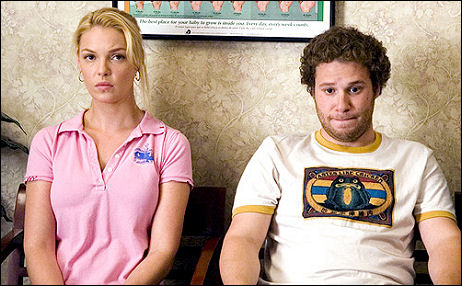
Katherine Heigll, Seth Rogen in Judd Apatow’s Knocked Up

I agree with many of Leydon’s reactions. Knocked Up is Apatow’s best film so far, it’s graced with Seth Rogen‘s star-is-born performance, and the fact that it’s a caring, human-scale look at growing up and coping with responsibility means it’ll probably connect with women as well as men. But the bearded Houston critic over-gushed here and there.

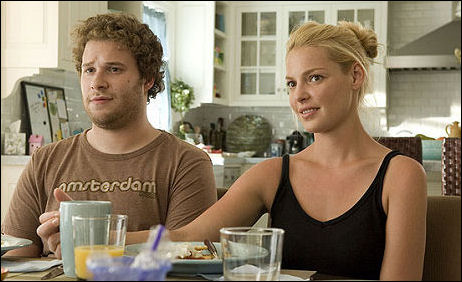
Knocked Up is not generically “uproarious.” It’s a gentle and amiable relationship comedy that is, yes, often funny and uproarious when it’s in the mood to be that, but to use “uproarious” as a bottom-line adjective is misleading. The film is often very funny when it wants to be (i.e., maybe two-thirds of the time), but Apatow’s goal is not to bust your seams and make you lose consciousness from rolling in the aisles and gasping for breath. I counted less than ten really big laughs. Then again I don’t get high any more, I don’t have back hair or a sandpaper fuzz beard, I don’t relate to guys who wear Fruit of the Loom T-shirts (especially ones that say “Amsterdam” on the front), and I try to keep my weight down

Leydon would have you think that Knocked Up is one of those comedies that builds and builds and get wilder and wiggier in some expertly constructed Billy Wilder-like fashion. It’s not. It’s a likably mellow and mostly believable “maintainer comedy” that goes from scene to scene and chapter to chapter with more or less the same energy and the same pacing.

All first-rate comedies are built upon deep-down emotional issues, and all second-rate comedies are just about trying to get laughs any way they can, no matter how cheap the tactic. Knocked Up has a lot of great stoner-gorilla “hoo-hoo” bits (there’s a moderately amusing riff on Steven Spielberg‘s Munich), but the best parts of it aim higher. It has a loutish streak and is definitely sloppy in certain respects, but don’t take Leydon’s claim that “line for line, minute to minute, [it’s] more explosively funny than nearly any other major studio release in recent memory” to the bank because the check will bounce.

That said, Leydon’s prediction that Knocked Up is “bound to generate repeat business among ticket-buyers who’ll want to savor certain scenes and situations again and again if only to memorize punchlines worth sharing with buddies” may turn out to be true. The jokes that work are very, very funny. It’s an obvious crowd-pleaser.

But it’s not one of those “stop whatever you’re doing and go see this thing right now” movies. It doesn’t blow your mind or reinvent the wheel. I was happy watching it, but can’t say I ever said “wow, this is amazing.” Because it plays to both sexes, Knocked Up will probably be very commercial, but I wonder about Leydon’s claim that it will “remain in megaplexes throughout the summer and, possibly, into the fall.”

That’s all I’m going to say for now. I’ll get into Knocked Up a bit more next month — just before the Cannes Film Festival begins, or maybe even during — but there’s obviously plenty of time before it opens on 6.1.

Cannes films confirmed

The good Cannes Film Festival announcement news is that many of the predictions came true and a lot of high-profile titles and big-name directors will be in attendance at the 60th anniversary gathering next month. I’ve got an initial count of at least 23 must-sees, including (thank the movie gods) Joel and Ethan Coen‘s No Country For Old Men, Michael Moore‘s Sicko, Gus Van Sant‘s Paranoid Park, Wong Kar Wai‘s My Blueberry Nights, Michael Winterbottom‘s A Mighty Heart and Abel Ferrara‘s Go-Go Tales.
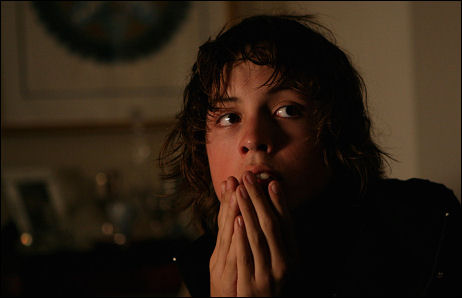

a still from Gus Van Sant’s Paranoid Park — the name of the young actor is undetermined, but it could be Gabe Nevins…maybe.

The disappointing news is that Todd HaynesI’m Not There, his long-awaited Bob Dylan movie slated for release in late September, either wasn’t ready or didn’t make the cut (presumably the former), and Paul Thomas Anderson‘s There Will Be Blood, a Paramount release opening in November, was, despite Anderson’s favored-director status among festival honchos, also MIA.

But the Cannes competition slate alone is very strong with at least 10 newbie stand-outs: No Country For Old Men, My Blueberry Nights, Bela Tarr‘s The Man From London, Julian Schnabel‘s The Diving Bell and the Butterfly, Paranoid Park, Emir Kusturica‘s Promise Me This, Marjane Satrapi and Vincent Paronnaud‘s Persepolis (locked down by Sony Classics last year), Carlos Reygada‘s Silent Light, Catherine Breillat‘s Une Vieille Maitresse and James Gray‘s We Own The Night.

Two high-profile U.S. hangover entries — Quentin Tarantino‘s expanded (i.e., lap-dance supplemented) version of Death Proof, and David FIncher‘s Zodiac — will also show in competition.
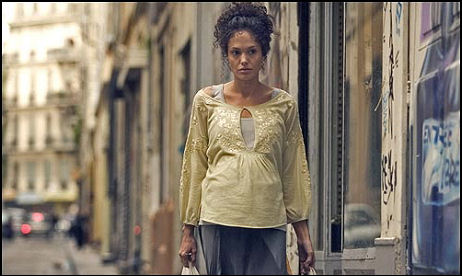

Angelina Jolie in A Mighty Heart

Plus there will be three very prominent out-of-competition screenings (among them two Brad Pitt ventures): Winterbottom’s A Mighty Heart, (the Daniel Pearl movie with Angelina Jolie and Dan Futterman), Sicko (the long-in-gestation healthcare documentary) and Steven Soderbergh‘s previously announced Ocean’s Thirteen.

Plus a pair of essential midnight titles — Ferrara’s Go-Go Tales and Catherine Owens and Mark Pellington‘s U2 3D.

At least two Un Certain Regard standouts — Barbet Schroeder‘s L’Avocat de la terreur and Harmony Korine‘s Mister Lonely — will screen. Also listed are two Special Screenings with a significant vibe — 11th Hour, the Leonardo DiCaprio gobal-warming doc that Leila Conners Petersen and Nadia Conners co-directed, and Ken BurnsThe War, a seven-episode PBS miniseries about how various people from four quintessentially American towns experienced World War II, both on the battle and the home front.

The festival will also host three accomplished documentaries about filmmakers — Mimi Freedman and Leslie Greif‘s Brando, Mike Kaplan‘s Lindsay Anderson, Never Apologize, and Anne-Marie Faux and Jean-Pierre Devillers’ Maurice pialat l’amour existe — along with Todd McCarthy‘s Pierre Rissient, about an extraordinary cineaste who’s been everywhere, met everyone and done everything within rarified film circles over the past 50 years.
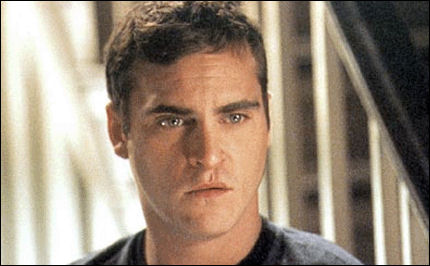

Joaquin Pheonix as he allegedly appears in James Gray’s We Own The Night

Add the 10 competition must-sees (12 if you count the Tarantino and the FIncher) plus the out-of-competition trio and the two midnight titles and that’s 15 films (17 avec Tarantino-Fincher). Plus the two Un Certain Regard entries, the two Special Screenings and the four filmmaker docs and that’s 23 films just for starters. This obviously omits many others, and ignores whatever possible left-field surprises may be in store.

Anyone who knows something I don’t (I know, I know…a long list) is hereby urged to get in touch and tell me what I should be seeing and talking about in addition to the above. Please…I only have eight hands and two heads.

National is definitely toast

That item I ran last Monday about Mann’s National theatre closing its doors this weekend is true, says a Variety story that went up this evening. The Mann exhibition execs who should have announced or at least confirmed the closing of this historic Westwood landmark chose not to because…I don’t know, you tell me. Because they’re assholes? Because they couldn’t deal with their feelings of grief?