Denby on “Big Pictures”

“People over fifty make up 30% of the population but only 20% of the audience. The trouble is that grownups are less likely than kids to go on opening weekends (they wait for reviews and reports from friends), so, apart from the fall awards season, when most of the serious movies are released, they don’t pull their weight in terms of what gets made. As a result, the studios have conceived grownup moviegoing behavior in such a way that confines it to an enclosed circle.


New Yorker film critic David Denby

“When the adult audience does go to a low- or mid-budget movie released in winter or in spring — say, Crash or Inside Man — the studios consider the hit an anomaly, a ‘non-repeatable event.’ In the jargon of the trade, such movies are ‘execution dependent’ (they have to be good to succeed), rather than ‘audience dependent’ (the audience will show up regardless of the quality).
“Some execution-dependent movies, such as Inside Man, The Devil Wears Prada and Sideways, are hits by any standard. Some, like The Squid and the Whale and Capote, haven’t made big money but are still counted as successes in relation to their costs. Others, like Little Children, are financial failures, although that film, a stubborn and prickly plant, played through the fall to loyal audiences, and may pick up some awards attention and, with it, added box-office.
“Many more people go to bad movies than go to good ones, but the good small movies that do well, like Brokeback Mountain and Borat, are, in relation to cost, among the most successful movies ever made.” — from an Olympic-sized David Denby/New Yorker piece called “Big Pictures: Holywood Looks For a Future,” about where movies are going, how they’re evolving and what’s being lost as this happens — an article roughly similar to Pauline Kael’s 6.23.80 New Yorker piece called “Why Movies Are So Bad, or The Numbers.”

Lane on “Men”

“Mass infertility…is an extraordinary premise for a film — a childless world — and it will leave some viewers feeling restive and underinformed. How, they will want to know, did this catastrophe arise? To director Alfonso Cuaron, however, the first rule of storytelling is: Go with the given. Don’t waste space on deep background, and don’t delay the action with a preface — remember Ben Kingsley, intoning like a royal robot at the start of Steven Spielberg‘s A.I.?
“Cuaron respects his audience, presuming that we are grown up enough (or ground down enough) to work out the horrors for ourselves.
“The people I know who have seen Children of Men have admired its grip, but they had to be dragged to the theatre; it’s a film that you need to see, not a film that you especially want to. I guess it should it be logged as sci-fi, yet by 2027 mankind is clearly beyond the reach of science, and the roughened pace of the film — photographed by Emmanuel Lubezki — leans away from fiction and toward the natural stutter of reportage.
“When a bomb explodes in Tony Scott‘s Deja Vu, it is tensely prepared for and filmed with a lingering gloat; when a bomb explodes in Children of Men, it bursts from nowhere on a dreary street. Even if you don’t buy the main conceit, the scumbled texture of the movie makes it feel not just plausible but recognizable, and Cuaron takes care never to paint the future as consolingly different.” — from Anthony Lane‘s review in the 1.8.07 issue of The New Yorker.

“Factory” explanation

Hickenlooper Butt-Boy Dispatch #7b: The unfortunate haste with which Factory Girl has been thrown together has meant that some critics have seen slightly different versions. Some — critics for L.A. City Beat, L.A Weekly and Box-Office, apparently — were shown the very first rough cut that included most of the newly-shot footage but did not include the Santa Barbara psychiatric interview stuff (i.e., a brunette-y Sienna Miller recalling her Warholian adventures with a middle-aged female shrink). This is indicated by Wade Major‘s Box-Office review referring to the use of documentary interview footage (a la Reds), which was included for one screening but was finally not used. (The interviews were originally scattered all through the film. The final version uses snippets during the closing credits.)

SOAP Noms, Awards

I think we can all agree that the culture really and truly needs right now another media-related group getting together to hand out year-end awards. Hence, SOAP — the newly-formed Society of Online Awards Prognosticators, the brainchild of And The Winner Is blogmeister Scott Feinberg with members including myself, Sasha Stone and Anne Thompson — has electrically come into being.
The SOAP’s 2007 nominations will post on Sunday, 1.14 — nine days before the Academy noms are announced — with SOAP winners to be announced on Wednesday, 2.21, i.e., four days before the 2.25 Oscar telecast.
The other members: Johnny Alba, The Oscar Igloo; Mark Bakalor, Oscar Central; Carlos Reyes, Oscar Diary; Nathaniel Rogers, The Film Experience; Andy Scott, Everything Oscar; and Giovanni Tagliaferri, The Oscar Jam.

New Year’s Eve pics


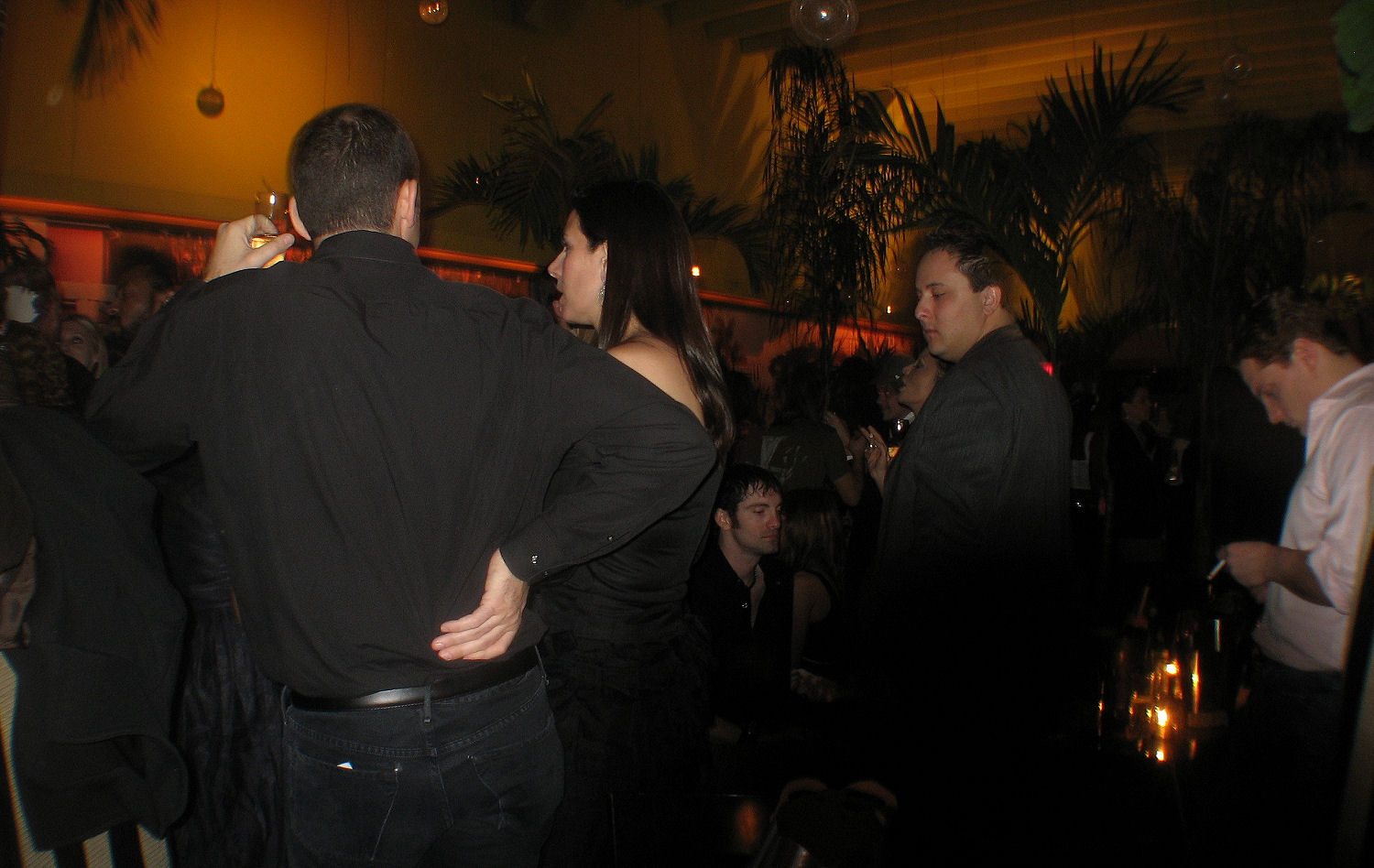
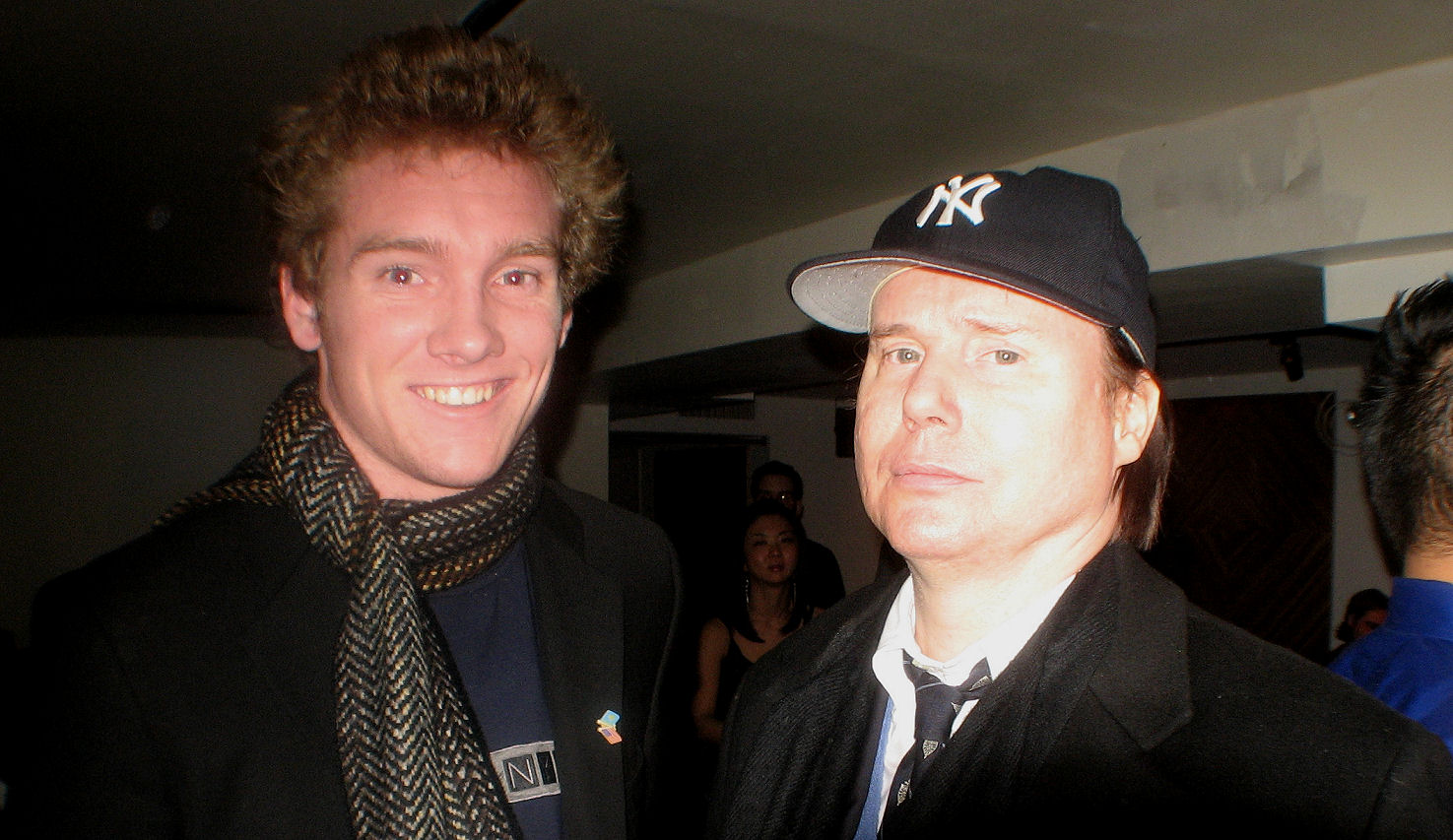
Snapped at Bungalow 8 around 1:45 this morning….notice the young portly guy eyeballing whatever, and the thinner guy sitting down alone and feeling momentarily adrift and wondering what his life has amounted to; former Rush & Molloy go-getters Jett Wells and Baird Jones at Fusion on West 28th — 12.31.06, 9:50 pm; at Koi, a restaurant inside the Bryant Park hotel — 12.31.06, 10:55 pm

Incorrection

Contrary to Anne Thompson‘s recent Risky Biz blog impression, there is not and never was “an ongoing blog wrangle between Hollywood Elsewhere‘s Jeffrey Wells and Factory Girl director George Hickenlooper having to do with the suggestion that the director may have been pushed off his problem-riddled late-awards-season entry,” etc. The wrangle was between Hickenlooper and a guy who calls himself JWEgo who’d posted some reader replies that I’m not going to get into here. I was a mere bystander.

Foreboding

“For the last two months, no snow has fallen on Central Park, and it probably won’t fall anytime soon, forecasters say. Indeed, not since April 8th has there been even a flurry.
“The National Weather Service said that last month appeared to be the first December without a snowflake here since 1877, when Rutherford B. Hayes was president. Moreover, New York City is not alone. Warsaw, Budapest, Berlin, Vienna and Stockholm report little or no snow this season.
“It has been so warm in Yaroslavl, a city about 150 miles northeast of Moscow, that Masha the bear, a resident of the city zoo, woke up last month from his hibernation after only a week.
In Central Park on Saturday, where children were gliding along on roller skates and rumbling around on three-wheelers, Rob Flanagan, 35, a general contractor from Hoboken, N.J., was peeved.
“Global warming!” he said. “Al [Gore] might be right!” The mild weather stinks, he said. “I like the snow!”
Julianne Warren, 40, a conservation biologist visiting New York from Lexington, Va., is concerned. She said she heard a white-throated sparrow in Central Park and saw an azalea blooming.
“Things seem a little…” she said, and then wiggled her outstretched right hand as if it were an airplane in turbulence. “It may mean the flowers don’t bloom at the right time and birds may not know to migrate at the right time.” — from a story by Anthony Ramirez in today’s N.Y. Times.
Observations and comments like these, which one hears often these days, are the reason An Inconvenient Truth is going to win the Oscar for Best Feature Documentary. Partly because doing so will assuage people’s guilt about not really doing anything about an obviously worsening situation, and because giving an award is a lot easier than changing carbon consumption habits.

Rabbit Holes

“I’ve always been a media junkie,” producer Michael London (Sideways) tells L.A. Times writer Rachel Abramowitz in a good piece called “Admit It — We’re All Video Junkies Now.” Digital- media junkies, I think she meant to say.

down the rabbit hole,” London continues. “When the rabbit hole has gotten bigger and deeper through the internet, for people like me who multitask, it’s created a real danger. It creates a perfect meltdown scenario to people who are vulnerable to trying to do too much at once.
“You can sit in your office, and you can be having a phone conversation while reading Variety online, and answering your e-mail and having an IM chat with somebody. It sounds crazy, but it’s not an exaggeration.”
“The thing that suffers,” London says, “is your focus and your creativity. It limits the time you have for sitting and watching a movie, or reading a script, or thinking about an idea. The things that suffer and get thrown away are the things that require the most sustained thought.”
“Which is why I’ve trying in my own humble way to disconnect a little bit. You have to force yourself to go cold turkey. I literally tried to listen through an entire album a couple of weeks ago, to try to get back to that space where you listen to things as a whole instead of just sample. We live in a culture where everyone is sampling.”
This columnist lives in the rabbit hole, which is where all focus and creativity that I’m able to harness manifest. There is awareness, of course, of the ground and the grass above, and of the surrounding open-air, blue-sky environment and all the organic tactile things that go with that. Sometimes I even climb up and go out and do things in that environment — eating out, walking, seeing movies in theatres, patrolling the aisles of Koontz hardware or Best Buy, bike-riding, etc.
But I only do these things for four- or five-hour periods — six is pushing it. I used to live in that world but no longer and never again. The rabbit hole is home, hearth, nourishment, a playground, a temple….life itself. Such as it is.
London is right, of course: rabbit-holing does limit the time we have for the things that require the most sustained thought. Which is why I do my best thinking while (a) taking a shower, (b) driving in Los Angeles without the radio on or (c) walking the streets of Manhattan or Brooklyn.
And I’m proud to say, by the way, that unlike a good 30 to 40% of the people I see in Manhattan, I don’t indulge in the most hermetic, anti-life, anti-social rabbit hole thing you can do, which is walking around all the time listening to high- decibel iPod tunes with those little earplug headphones.

Greer on feisy broads

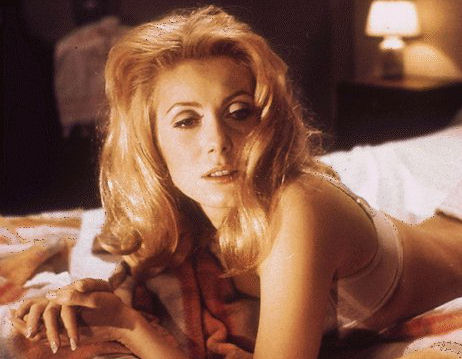
Luis Bunuel‘s Belle de Jour (1967) “has a reputation for being one of the sexiest films ever made, simply because Catherine Deneuve behaves throughout like a pre-adolescent girl. Through the prism of the 21st century, the film seems oddly contrived; what is now a cliche — the child who, subjected to the sexual advances of an adult, then becomes a frigid woman who is only turned on by squalor — is coyly exploited as a series of fetishistic images that juxtapose her fantasy life with her actual life.

“As Severine Serizy, Deneuve moves through the imagery of what are meant to be her own fantasies like a sleepwalker. By her own account, Bunuel could not relate to her at all and never told her what he wanted. Unconsciously, she gave him what he wanted, which was as little as possible. The fantasies were his, after all.
“The decision to have her dressed by Yves Saint-Laurent adds a bizarre dimension to the nonexistent plot; we seem to be living within the pages of a glossy magazine, with product placement everywhere. Everywhere Severine goes, she is conspicuous by her catwalk presence, from her shiny patent leather pumps to the helmet that holds in her mane of Barbie-doll hair.
“The sex scenes in the brothel consist of her stripping to the full armour of suspender-belt, knickers, stockings and padded brassiere, and allowing ugly men to kiss her. In one extraordinarily unsexy sequence, she is required to process through the rooms of a ducal chateau dressed in nothing but a cloak of black georgette and a crown of white roses. She trots ahead of the camera like a lamb to the slaughter. She should have used a body double; it is typical of her passive obedience that she didn’t.
Lauren Bacall would never have done that for anyone, would never have stripped and had them shoot her bare arse from the back as she trotted through take after take. The Hawksian woman would have decked any man who asked her.” — from a thoughtful, somewhat revisionist Guardian piece by Germaine Greer, the subject being the decline of the feisty broad.

New numbers

The projected holiday weekend numbers have been slightly revised. Night at the Museum is now expected to hit $46,497,000. The Pursuit of Happyness is looking at $25,529,000 by tomorrow night, and Dreamgirls should earn close to $18,284,000. Charlotte’s Web is looking at $14,943, The Good Shepherd $14,517,000, Rocky Balboa $14,265,000, Eragon $10,806,000, We Are Marshall $10411, Happy Feet $9,696,000 and The Holiday $8,526,000.