
L.A. Times guys John Horn and Patrick Goldstein in a series of podcast chats about Oscar snubs, the apparent chasm between Academy members and critics regarding Best Picture choosings, the Academy’s problem with violent movies, and the surgings of Volver and Penelope Cruz.
wired
O’Neil on crunch time
The Envelope‘s Tom O’Neil asks if too many year-end releases are causing distribs to crunch Oscar voters and thereby hurt their films’ chances. “With a glut of quality late-December releases this year, would-be contenders find themselves struggling to attract attention…and Academy and guild voters find themselves facing an onslaught of screenings and screeners,” etc. Tom talks to Hollywood Wiretap‘s Pete Hammond, the Hollywood Reporter coumnist Anne Thompson and…well, myself.
Manhattan pics #11

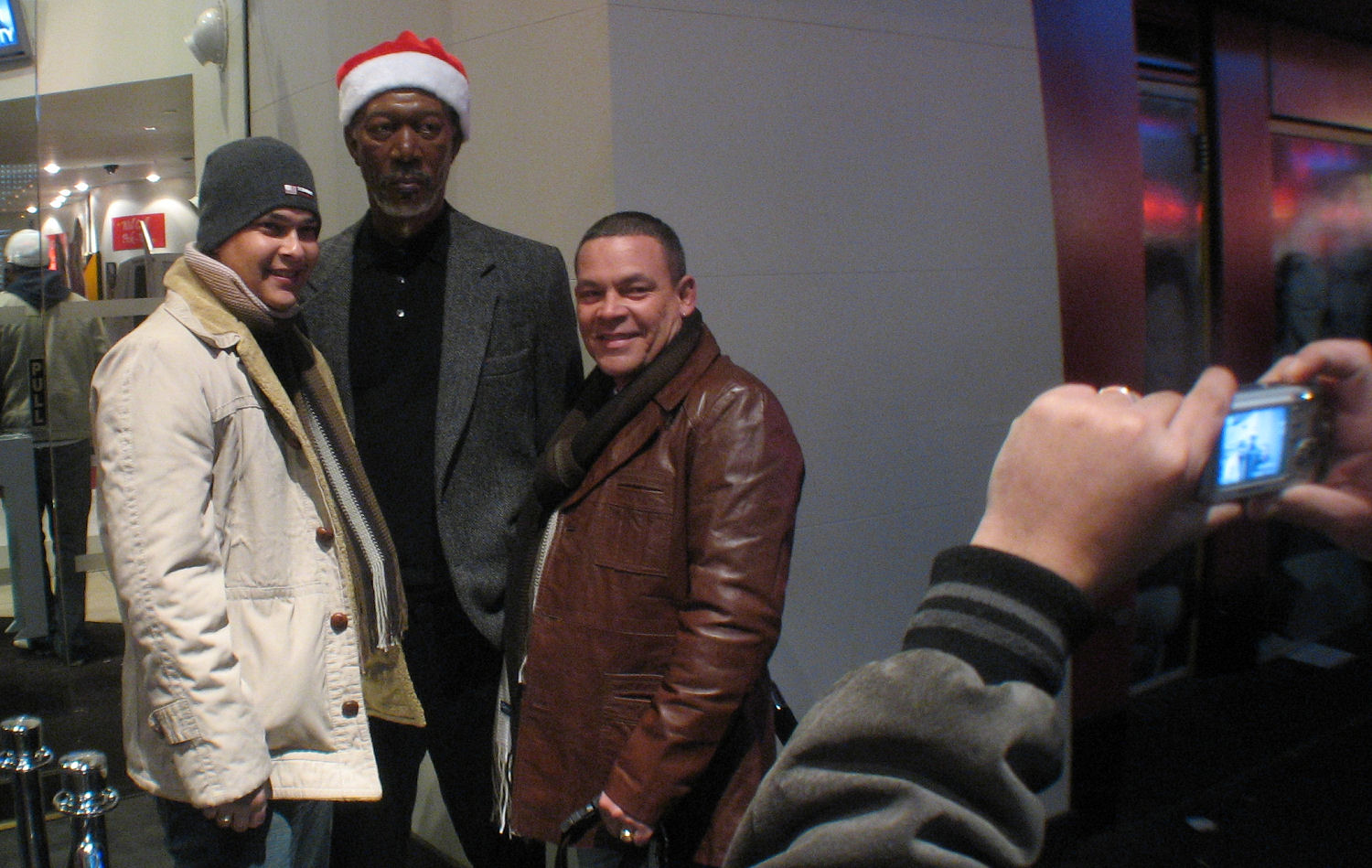
Southeast corner of 42nd Street and 7th Avenue — snapped as I waited for the curiously absent announcement of Saddam Hussein’s execution to show up on the news ticker, a good 45 minutes after it happened in Baghdad — Friday, 12.29.06, 10:40 pm; Morgan Freeman & friends; ditto; prior to seeing Notes on a Scandal for the third time, but this time no freebies — 12.29.06, 8:32 pm; staring across 7th Avenue; a sense of boredom; outside Bob Dylan exhibit at Morgan Library — 12.29.06, 7:10 pm






Douglas on COM expansion
Coming Soon’s Edward Douglas thought some of us might be interested to know that Universal is expanding Children of Men into 1200-plus theatres next Friday. We’ll all be curious to see how this expands, of course. Douglas predicts it will end up in the $5 million range for the weekend (i.e., about the same as Babel)
Masters on Geffen
“I’ve heard from multiple sources in Los Angeles, including an editor at the L.A. Times, that David Geffen told a Timesman that were he to succeed in buying the paper, his first order of business would be firing a reporter in the business section who had crossed him. If Geffen has that on his to-do list — much less at the top — he’s the wrong man at the wrong Times.

(r.) David Geffen with (l. to r.) Dreamgirls director Bill Condon, costars Jennifer Hudson, Anika Noni Rose and Beyonce Knowles
“Yes, he has a canny eye for quality, from Joni Mitchell to Jackson Pollock. But he could make Wendy McCaw, the multimillionaire owner who has decimated the Santa Barbara News-Press, look Pulitzer-obsessed.
“Those who have dealt with Geffen while covering [the Hollywood filmmaking] business should find that obvious. Geffen is famously vindictive. One reporter now at the Times once called me in tears after an encounter with him on the phone (one truly has to be on the receiving end of his verbal savagery to appreciate it). And does anyone think he’ll tolerate articles that annoy him or his friends? And he has lots of friends — from Hollywood to Washington, from Steven Spielberg to Hillary Clinton.” — Slate‘s Kim Masters dishing on Geffen and his possible purchase of the Times.
Dickerson on Obama
Slate‘s John Dickerson on that Barack Obama “Monday Night Football” spot that went up two weeks ago…funny and spot-on.
King on Jones
Here it is Friday night and I’m copping once again to missing a good article — Susan King‘s L.A. Times profile of Doug Jones, the guy who played the faun and the bald eyeless monster in Guillermo del Toro‘s Pan’s Labyrinth. “I consider myself an actor first, not a suit performer,” Jones tells her. He’s also had roles in del Toro’s Mimic and Hellboy.
Poland’s attack
David Poland indulged in some attractively debonair potty-mouth name-calling in his Hot Blog coverage of George Hickenlooper‘s angry HE post earlier today about JWEgo’s postings about Hickenlooper, etc. He referred to my column as “Hollywood El-Swear” and equated my output with internet pornography — what a pissy, pathetic little bitch Poland can be at times. He also referred to me as George Hickenlooper’s “buttboy.” That’s a really sophisticated way of saying I like George because I’ve liked several of his films, etc. David has, of course, never had any friendly relationships with any filmmakers whose work he’s written about with a kind, admiring, even-toned or gently circumspect brush. That’s because David is a special guy. Better than me, better than Patrick Goldstein, better than Tom O’Neil…more perceptive, ballsier…a principled prince among men.
Alfonso & Chivo
“With just three weeks before filming of [Children of Men‘s] four-day sequence was to start, Emmanuel Lubezki called Doggicam Systems‘ Gary Thieltges, a Los Angeles-based camera-rig guru.

“They removed the car roof and installed a rail system that allowed the camera to operate on a two-axis grid, controlled by a joystick. Lubezki, his focus puller and a dolly grip sat above the actors in an enclosed translu- cent loft. The car seats were modified so the actors could use levers to tilt and lower themselves out of the camera’s path as it zoomed in and out.
“The result is a remarkably intense chase scene in which the claustrophobic fear of the passengers in the car is palpable.” — from Sheigh Crabtree‘s 12.29 L.A. Times piece about the shooting of the already-legendary car-attack scene.
Reeler’s Ingrown Toenail
The Reeler‘s Stu VanAirsdale‘s Top 10 of Top 10 Lists of 2006, Part I — but where’s part 2? (He promises it’ll be up on Friday. Except it’s Friday right now, and a little after 2 pm.) He says the list is primarily about calling attention to “misconceived hype.”
Stacy’s Lament
Regrets and spiritual support extended to Orange County Weekly freelance film critic Greg Stacy, who was recently whacked after 11 years of regularly covering film for that paper. He was told a few days before Christmas that he’s “being let go as part of the Village Voice chain’s plan to stop using freelancers altogether,” etc. He wrote a column bitching about this situation that Media Bistro Fishbowl L.A. posted yesterday.
“Dreamgirls” at crossroads
No one has been a more passionate Dreamgirls supporter than The Envelope‘s Tom O’Neil, so his having written a 12.27 piece questioning whether it has the support to win the Best Picture Oscar is, I think, fairly significant. I don’t think there’s any question Dreamgirls will be nominated, but there’s a real sense of uncertainty out there about its final-heat chances. Read O’Neil’s piece and you’ll see what I mean. The winning of an Oscar never has anything to do with quality — it’s always about negative, anything-but votes (i.e., last year’s homophobic vote against Brokeback Mountain) will all hinge, I suspect, on how well it does with the mainstream rural types in theatres. I know that people are loving the musical vigor and splash (as I did, in spurts) but the key factor, as I speculated last week, is that lacks a strong and accessible common-to-all-cultures theme.