Holliday bitch ‘n’ moan

Jennifer Holliday, 46, the original “Effie” in the Broadway production of Dreamgirls, is whining to L.A. Times writer Greg Braxton that she isn’t getting enough coattail action off the forthcoming movie version, and that there’s too little respect/acknowledgment from the filmmakers and publicists behind the Dreamamount film. Gee, that’s tough.
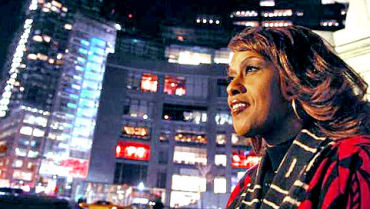
There’s a reason that Holliday, 200 pounds lighter than she was during the original play’s run, sounds like only a slightly tamer version of the well-known handful she was 25 years ago. She’s older and presumably wiser, but let’s face it — leopards don’t change their spots.
“She has worked steadily over the years but has never come close to matching her glory days as Effie,” writes Braxton. “Post-Dreamgirls,Holliday’s professional career and personal life could produce enough material for several Broadway shows: A suicide attempt at 30. Bankruptcy. Two failed marriages. Bouts with clinical depression.
“She dropped out of the public eye for years, drawing a startled reaction when she showed up in 1997 — 200 pounds lighter due to gastric bypass surgery — on Ally McBeal in a recurring role as a choir director.
“Although Dreamgirls has not had a major stage production for more than 20 years, Holliday said she had been the only one keeping the torch burning, performing ‘And I Am Telling You I’m Not Going’ at the private parties, corporate dates and engagements at gay nightclubs that have been her key source of income.
“Why is it necessary for them to wipe out my existence in order for them to have their success?” Holliday says of the Dreamamount team. “It’s scary that they can be so cruel. I know it’s business, but why do they have to go to this extreme? I’m a human being. I need to work too. Why do I have to die to make them a winner?”
“Some speculate that the filmmakers fear that comparisons to Holliday may dull the glow surrounding the performance of Jennifer Hudson, the former American Idol contestant who plays Effie in the film. Hudson has been considered an early favorite for an Oscar nomination.
“Wrote New York Post columnist Liz Smith: ‘Life is imitating art now. Jennifer Holliday, who was so incredible onstage in Dreamgirls as the original Effie, has incurred the wrath of Paramount for being uncooperative and not helpful in publicizing the movie. Word came down to omit any photo of her from the publicity for the movie version.’
Holliday “lives in Harlem and admits she is a bit of a recluse — she doesn’t go out much, doesn’t have a cellphone, doesn’t do e-mail,” Braxton relates.
“She is a ferocious reader of newspapers and magazines, loves courtroom shows on TV and watching movies — primarily musicals — until the sun comes up (‘”I am definitely not a morning person’). Holliday handles her own career — no agent, no publicist, no manager.”
These last two graphs say everything. Staying up all night watching movies, not getting up until noon or early afternoon, living on her own planet sans internet access and any sort of professional representation…forget it! She obviously wants to hide away, be excluded….lose.
Lane’s lament

“My saddest moment in a movie theatre came a month ago, when I screened All About Eve to a bunch of acquaintances, one of whom came up to me at the end. ‘What happened?’ she asked.
“‘Well,’ I replied, ‘Anne Baxter got the award, and Bette Davis sat there all steamed up, and George…’
“‘No,’ she said, tapping her foot, ‘what happened to movies like that? Movies with four great parts for women and lines you want to quote? Where did they go?’
“No idea, but they sure as hell aren’t coming back.” — from Anthony Lane‘s dispirited sum-up of 2006 movies, in the 12.18.06 in The New Yorker.

Stone’s Cuban bust

Nikki Finke today passed along a Miami New Times story about Oliver Stone‘s Ixtlan production company and four individuals agreeing to pay $6,322.20 to “resolve allegations of violations of the Cuban embargo” between February 2002 and May 2003, which is when Stone shot Looking For Fidel, his HBO documentary about Cuban dictator Fidel Castro. Finke’s story starts with the word “busted!” A $6322 fine? Whoooo….

Obama for the Bears

Here we go with another Barack Obama thing, but this one‘s really good — trust me. It ran, according to N.Y. Times political blogger Lisa Tozzi, “just before the start of the Monday Night Football matchup between the Chicago Bears and the St. Louis Rams on ESPN.”

S.F. Film Critics Circle honors “Children”

Todd Field‘s Little Children has scored its first Best Picture win of the season from the San Francisco Film Critics Circle, although United 93‘s Paul Greengrass took the Best Director prize. (Definitely a momentum thing happening here, but will Academy members give a hoot? I’d love to see enough of a turnaround by the “too-sooners” to change the odds, but does anyone see this happening?)

Borat‘s Sacha Baron Cohen was anointed Best Actor, Helen Mirren won the Best Actress prize (again) for her performance in The Queen, Little Children‘s Jackie Earle Haley scored a second Best Supporting Actor win after yesterday’s N.Y. Film Critics Circle win, and Babel’s Adriana Barraza was named Best Supporting Actress. Guillermo del Toro’s Pan’s Labyrinth was named Best Foreign-Language Film, and Davis Guggenheim and Al Gore‘s “An Inconvenient Truth won for Best Documentary.

Sarris’s bathroom break

“The producers of Happy Feet have Andrew Sarris‘ bladder to thank for their movie winning the New York Film Critics Circle’s prize for Best Animated Feature,” says a N.Y. Post “Page Six” item that doesn’t credit Bilge Ebiri’s nerve.com story as the source. “Sarris, of the New York Observer, was in the men’s room during the vote yesterday that gave the prize to the penguin musical, narrowly defeating Richard Linklater‘s A Scanner Darkly. Back from the toilet, Sarris said he meant to pick Scanner, thus making it the winner — but his choice was discounted because the result had already been announced.” What — the NYFCC couldn’t wait five minutes? Odd.

“Shepherd” Party at Time Warner Center

N.Y. Times Oscar columnist David Carr (a.k.a. “the Bagger”) has written a pretty amusing account of last night’s premiere and after-party for The Good Shepherd, including a zero-energy, zero-connection interview with director Robert De Niro.

Carr quotes Universal publicist Michael Moses (“a fast-talking…exec with amazingly animated hands”) saying that “this is a real movie…it’s not something you’d see on television. Maybe we should have put a song-and-dance number into it — I hear those are quite popular — but after 9/11, people are very much interested in the C.I.A. We are really, really proud of the movie Bob made.”

I also attended the Good Shepherd premiere and the after-party. The film didn’t play any differently for me the second time — muted, somber and funereal.

I mentioned the last adjective to a very bright director friend, who replied as follows: “I liked it, actually. That said, ‘funereal’, although not the word I would personally choose to describe it, is accurate. It has a funereal atmosphere, almost aggressively so.

“What I liked [about it] is that it doesn’t pander in any way. It almost defies you to like it. You’re sitting there saying ‘what is this shit?…you haven’t made me interested in the story or care about the characters’ and it’s very easy to ‘get out’ [of the movie] if you want to do that…it doesn’t deploy the strategies that almost all movies do to bring you in and engage your sympathies. And I respected that.”

The party was held in a huge, multi-tiered space inside the Time Warner Center with a huge glass-wall view of Columbus Circle and Central Park. The lighting was rose tinted, the food was scrumptious, and I wasn’t able to slip into the ultra- exclusive third-tier section where De Niro, Brad Pitt, Angelina Jolie and all the big New York journalist heavies were hanging so nonchalantly.

I asked my Universal publicist pallies for help in this regard but my ambivalence — I didn’t care that much about gaining entry, but on the other hand I did — resulted in my saying “fuck it” and just enjoying the company of others who shared my situation.

EDA Nudity Awards

I’m late to the party, but the Alliance of Women Journalists has announced the nominees for its 2006 EDA (Excellent Dynamic Activism) Awards, including citations for Best Depiction of Nudity or Sexuality, which presumably means the least exploitative of women and/or the most honest or natural. The five films that made the grade are Babel, Borat, Little Children, The Notorious Bettie Page and Sherrybaby.

Honry Manatees

Any predictions on how soon we’re going to read a Variety announcement about a forthcoming animated Horny Manatee movie, complete with a quest-for-the-perfect-sexual-partner plotline written by Judd Apatow or Sacha Baron Cohen along with expectations of stars (Julia Roberts? Gregg Kinnear?) voicing Manatee dialogue (not to mention groans)?

I’m referring to N.Y. Times writer Jacques Steinberg‘s report that by Monday afternoon (12.11) “hornymanatee.com — created by Conan O’Brien‘s staff and featuring images of such supposedly forbidden acts as ‘Manatee-on-Manatee’ sex (using characters in costumes) — had received approximately 3 million hits, according to NBC. Meanwhile several thousand of Mr. O’Brien’s viewers have also responded to his subsequent on-air pleas that they submit artwork and other material inspired by the aquatic mammals, and the romantic and sexual shenanigans they imagine, to the e-mail address conan@hornymanatee.com.”

Sienna’s sex scene

“There’s nothing worse than seeing a sex scene where someone’s got a T-shirt on because its unrealistic, so I think that if you’re going to do it, do it.” — Factory Girl star Sienna Miller talking to the U.K. Mirror‘s John Hiscock about “one the most explicit sex scenes ever seen in a mainstream movie.” Really? I don’t recall anything as steamy as Hiscock describes in the cut I saw last August. Perhaps it’s one of the recently-shot scenes?

New “Bugsy” DVD

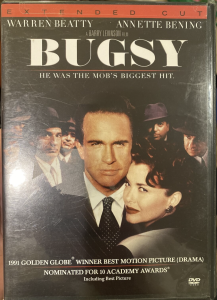
There’s no question that the extended version of Barry Levinson, Warren Beatty and James Toback’s Bugsy, which runs 151 minutes or 15 minutes longer than the original 136-minute theatrical version, is a distinctly superior work.

N.Y. Times DVD columnist Dave Kehr notes that “the extended version of Bugsy that Sony Pictures Home Entertainment is releasing today adds 15 minutes of material, restoring what most of its participants saw as the finished version of the film before it was reportedly recut by Mike Medavoy, then the chairman of TriStar Pictures.”

(This may be incorrect: Bugsy screenwriter James Toback told me this morning that Medavoy declared that an early cut was “too long”, but he didn’t seize the print and have it recut in defiance of director Barry Levinson or producer-star Warren Beatty. On the other hand, Kehr, an exacting critic, got his information from Toback also. Kehr says it was recut by TriStar, but did not report that the film was taken away and recut against anyone’s protest.)

“With the seamlessly restored shots and sequences,” Kehr remarks, “the picture plays much more smoothly and inexorably than it did in the edited version. Bugsy Siegel’s rise now has the classical contours of tragedy, complete with a hero whose hubris — his vision of founding a city in the desert — comes in conflict with the gods, or at least those East Coast capos who controlled the purse strings.

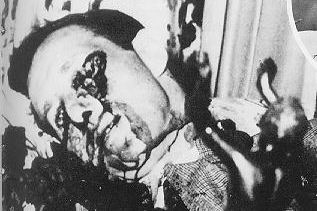
“The most striking addition comes after Siegel (Beatty), a New York hood who has gone to Los Angeles to conquer the local rackets, is forced to execute an old friend (Elliott Gould) for informing. Filled with self-loathing, he returns to his Hollywood home and puts a gun in his mouth. The sequence is the film’s most precise revelation of Bugsy’s fatal flaw: he’s a gangster cursed by self-awareness and a growing moral sense.

“Released in 1991, Bugsy may have been a film with too many fathers. Beatty, who co-produced this dark, sensual, morally conflicted biography [and] who played [Siegel] with a Tony Curtis-like striver’s elegance, was of course the director of the acclaimed Reds. Toback was (and is) a passionately first-person artist who drew freely on his experiences in films he had both written (The Gambler) and directed (Fingers, Exposed). And Levinson was then at the height of his commercial potency, having turned out Tin Men, Good Morning, Vietnam and Rain Man in dizzyingly quick procession.

Bugsy would not have been the densely detailed and complexly imagined film that it is without the contribution of any one of these men. But one wonders what might have resulted had the authorial strands been pulled apart and had Beatty been able to make another of his studies of an American naif (following Clyde Barrow of Bonnie and Clyde, George the hairstylist of Shampoo and John Reed, the radical journalist of Reds) blundering as best he can through the social upheavals of an era; or had Toback, with his fascination with sex, power and the romantic fatalism of the gambler; or had Levinson fully indulged his nostalgia for a lost era of sartorial elegance and tastefully lighted interiors.

“Levinson was the dominant force on the set, and the film duly reflects his fundamentally comic sensibility (even when the material dips into darkness) and affection for attention-grabbing period detail. Pulled in so many directions at once, Bugsy lost its center. Was it a steamy romance (with Beatty’s Siegel falling hard for a tough-talking bit player named Virginia Hill, played by his wife-to-be, Annette Bening), a harsh parable about American capitalism or a period film dripping in sweetly nostalgic detail?”