Hammond on the Globes

“If we are to believe that the Golden Globe nominations will have a direct effect on Academy (and Guild) voting patterns, then it must be said pictures like World Trade Center, The Good German, The Good Shepherd, Children Of Men, The Prestige, The Illusionist and The Painted Veil…have been voted off the island,” writes Hollywood Wiretap‘s Pete Hammond in his just-up Globe nom reaction piece.

Annette Bening, an early favorite would seem to be a dark horse now despite a Globe comedy nomination. Will Smith is the only thing keeping the high hopes of Pursuit of Happyness. Peter O’Toole, the sentimental favorite is now an underdog to emerging front-runner Forest Whitaker. In fact, Whitaker’s Last King and Helen Mirren’s Queen look like good bets to become Oscar royalty as well and have pretty much run the board proving critics, like Academy voters, are duly impressed when actors play well-known real life figures.
“In the battle of the 9/11 films, World Trade Center was dissed while Universal has steered United 93 into position with significant notice from N.Y., D.C., L.A. and S.F. critics groups, a mention on the AFI list and a BFCA nom but the lack of Globe nominations might be troubling in going forward to Oscar. United 93 boosters should take heart from The Thin Red Line which was completely shut out in the Globes but went on to 7 Oscar noms including Best Picture in 1998.
“But will the many reluctant Academy members who have resisted popping their screeners into their DVD players feel they have to watch now? The jury is out but at least one member told us that while he has given it some renewed thought he still has no interest in seeing the movie, critical acclaim or not.”

Read more

Dylan angered at “Girl”

Bob Dylan is reportedly concerned that George Hickenlooper‘s Factory Girl suggests that he was responsible for Edie Sedgwick‘s suicide, which, as far as the film is concerned, is horseshit. (That is, if the version that the Weinstein Co. is opening in early February bears any relation to the cut I saw last August.) The legendary singer-songwriter has told attorneys to go after producers Bob Yari and Holly Wiersma in order to ensure that he has a chance to see the film and assess the content before it’s shown any further.

Dylan’s lawyer Orin Snyder is demanding that the film’s theatrical release plans be halted and even for critics screening to cease “until [Snyder] and Dylan can see it to determine if Dylan, who they say has ‘deep concerns,’ has been defamed,” according to a 12.14 “Page Six” item.
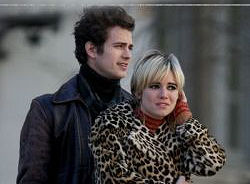
HE to Dylan: You’re worrying about next to nothing. In the version of Factory Girl I saw, the “Danny Quinn” character (Hayden Christensen) is obviously you through and through — same hair, same speech patterns, a brown suede (or leather) jacket that strongly resembles the one you wore on the cover of Blonde on Blonde…the whole shot. And yes, Quinn has an affair or close alliance of some kind with Edie Sedgwick (Sienna Miller). And yes, when he disappears out of her life she gets upset and starts to fall apart. But she’s mostly frazzled because Andy Warhol (Guy Pearce) has thrown her over for Nico, i.e., the model and Velvet Underground singer.
Here’s the thing: before “Danny” bids farewell, he warns Sedgwick that she’s being used by Warhol and that he’s not a friend, and that she should get back to her love of sculpture and invest in herself rather than just hang with Warhol’s Factory crowd, whom he regards as a band of cutthroat scenesters and poseurs. In short, you come off as a fairly compassionate and tender friend of Sedg- wick’s, and hardly the cause of her suicide, which happened a good four or five years after the mid ’60s New York period depicted in the film.

The letter sent to Yari and Wersma reportedly says, “You appear to be laboring under the misunderstanding that merely changing the name of a character or making him a purported fictional composite will immunize you from suit. That is not so. Even though Mr. Dylan’s name is not used, the portrayal remains both defamatory and a violation of Mr. Dylan’s right of publicity…Until we are given an opportunity to view the film, we hereby demand that all distribution and screenings …immediately be ceased.”
Snyder reportedly also contacted Factory Girl screenwriter Aaron Richard Golub. Hey, what about co-screenwriter Captain Mauzner? Doesn’t he rate a threatening letter also? And what about Hickenlooper and Harvey Weinstein? Everybody must get stoned.

Carr on Golden Globe noms

Here’s an upbeat (i.e., not cynical enough) but nonetheless cogent analysis of the Golden Globe nominations by N.Y. Times Oscar guy David Carr (a.k.a. “the Bagger”).
Basic conclusions: (a) Babel is back in the game, although the HFPA’s international constitution was undoubtedly a factor in its susceptibility to Alejandro Gonzalez Inarritu‘s “big, complicated movie…[which] some critics felt required too much assembly on the part of the audience”; (b) In Contention‘s Kris Tapley “gets the smartypants award for correctly guessing that the HFPA would not be able to resist the star quotient in Bobby; and (c) “One thing seems perfectly clear — things aren√ɬ¢√¢‚Äö¬¨√¢‚Äû¬¢t perfectly clear.”
This last line takes me back to Bill Duke‘s response to Terrence Stamp‘s rambling confessional monologue in Steven Soderbergh and Lem DobbsThe Limey: “There’s one thing I don’t get. The thing I don’t get is, every motherfuckin’ word you’re sayin’.” Okay, it’s not the same thought…but it’s funnier.

Beale on “Men”

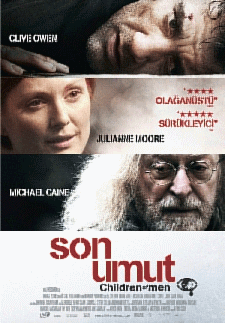
“I just saw Children of Men yesterday, and it’s a spectacular piece of work. Why is no one buzzing about it? What’s the problem? Could you address this on your site because for the life of me, I don’t get the silence on this flick.” — New York-based journalist Lewis Beale.
HE to Beale: The basic view seems to be that people think it’s too bleak — even though the story is about the return of life and natural creation into a world that has all but given up and is falling apart. And even though the cinematography alone (by Emmanuel Lubezki) delivers the strongest jolt of cinematic excitement I’ve experienced all year. Go figure…mainstream is as mainstream does.

Golden Globe noms

HE’s first reaction to the Golden Globes Best Picture nominations in the Drama category: Bobby? Say it again: Bobby? The HFPA didn’t need to persuade anyone that their motives and criteria are suspect from time to time, but they’ve sure as hell done it again. A tip of the hat to Harvey Weinstein for his usual backstage persuasions.
It’s well and good that nominations have also gone to Babel, The Departed, Little Children (the efforts of Russell Schwartz notwithstanding) and The Queen, and no surprise at all that the Hollywood Foreign Press ignored United 93 and the groundbreaking Children of Men…but of course. Likeliest winner(s) at this stage: The Queen, Babel, The Departed (in that order).
Babel, which had been seen as a fader over the last two or three weeks, is now back in the shit with seven GG nominations. That is, if you think that the Golden Globe nominations are in some way influential. Congrats to director Alejandro Gonzalez Inarritu, screenwriter Guillermo Arriaga, nominated costars Rinko Kikuchi , Adriana Barraza and Brad Pitt, and of course the Paramount Vantage team.
The Best Picture noms in the Musical or Comedy category are Borat: Cultural Learnings of America for Make Benefit Glorious Nation of Kazakhstan, The Devil Wears Prada, Dreamgirls, Little Miss Sunshine and Thank You for Smoking. Likeliest Winner(s) at This Stage: Dreamgirls, Borat.
Nominating Leonardo DiCaprio for both Blood Diamond and The Departed means, as it does with the BFCA noms, a possible cancel-out factor. The other three contenders in this category — Peter O’Toole (Venus), Will Smith (The Pursuit of Happyness) and Forest Whitaker (The Last King of Scotland) — were programmed into the communal consciousness weeks ago. Likeliest Winner(s) at This Stage: DiCaprio.
It’s good to see that an org has finally gotten behind The Lives of Others, which was nominated for Best Foreign Language film along with Apocalypto, Letters from Iwo Jima, Pan’s Labyrinth and Volver. Likeliest Winner(s) at This Stage: The Lives of Others.
Clint Eastwood snagged two Best Director noms (for Flags of Our Fathers and Letters From Iwo Jima) along with Stephen Frears (The Queen), Inarritu (Babel) and The Departed (Martin Scorsese). Likeliest Winner(s) at This Stage: Eastwood or Scorsese.
Best Actor, Musical/Comedy: Sacha Baron Cohen (Borat), Johnny Depp (Pirates of the Caribbean: Dead Man’s Chest….sure thing!), Aaron Eckhart (Thank You for Smoking), Will Ferrell (Stranger Than Fiction….forget it!), Chiwetel Ejiofor (Kinky Boots…rounding out the pack). Likeliest Winner(s) at This Stage: Cohen.
Best Supporting Actress: Adriana Barraza (Babel), Cate Blanchett (Notes on a Scandal), Emily Blunt (The Devil Wears Prada…good call), Jennifer Hudson (Dreamgirls), Rinko Kikuchi, (Babel). Likeliest Winner(s) at This Stage: Hudson.
Best Supporting Actor: Ben Affleck (Hollywoodland, Eddie Murphy (Dreamgirls ), Jack Nicholson (The Departed), Brad Pitt (Babel), Mark Wahlberg (The Departed). Likeliest Winner(s) at This Stage: Murphy or Pitt.
Best Screenplay: Guillermo Arriaga (Babel), Todd Field and Tom Perrotta (Little Children), Patrick Marber Notes on a Scandal), William Monahan, (The Departed), Peter Morgan (The Queen). Likeliest Winner(s) at This Stage: A toss-up. Queer Omission: Michael Arndt‘s screenplay for Little Miss Sunshine.
Best Actress, Drama: Penelope Cruz (Volver), Judi Dench (Notes on a Scandal), Maggie Gyllenhaal (Sherrybaby…good for her), Helen Mirren (The Queen), Kate Winslet (Little Children). Likeliest Winner(s) at This Stage: Mirren or Cruz.
Best Actress, Comedy or Musical: Annette Bening (Running with Scissors), Toni Collette (Little Miss Sunshine), Beyonce Knowles (Dreamgirls), Meryl Streep (Devil Wears Prada), Renee Zellweger (Miss Potter…go, Harvey!). Likeliest Winner(s) at This Stage: Streep.

Breaking and Entering

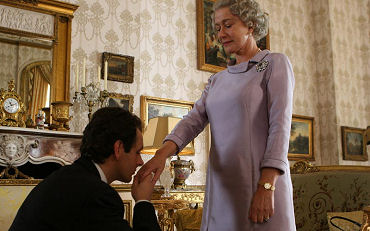
The ingredients in Anthony Minghella‘s Breaking and Entering (Weinstein Co.,12.15 in L.A.,1.27 limited) are explored and rotely disseminated in Sarah Lyall‘s 12.14 N.Y. Times profile piece. But here’s a fact that speaks volumes all on its own: Minghella’s mezzo-mezzo, not-bad drama is less than six weeks away from being seen in theatres, and the Weinstein Co. still doesn’t have a live website up and rolling to support it.

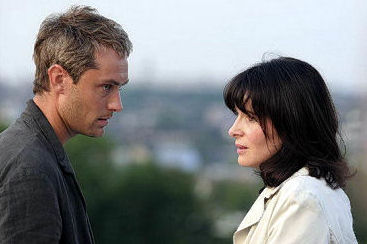
Minghella’s screenplay was inspired by his London studio flat having been repeatedly burgled three or four years ago when he was off making Cold Mountain in Roumania. Similarly, an office managed by a married architect (Jude Law) and his partner in London’s half-seedy, half-emerging King’s Cross district is repeatedly broken into and ripped off.
Law eventually spots the teenaged thief (Rafi Gavron), follows him home, and develops an immediate attraction for his Bosnian-refugee mom (Juliette Binoche). Curiously, despite Law’s well-known tabloid history and the fact that he may have portrayed one too many hounds over the past three or four years (Closer, Alfie), he and Binoche quickly sink into a steamy affair. As soon as it begins you can’t help but think, “Here we go again.”
Minghella is a major believer in volcanic currents between lovers, and it’s clear he feels more of an allegiance to Law’s affair with Binoche than Law’s marriage to a chilly Nordic blonde (Robin Wright Penn) who always seems vaguely pissed about something or other. There are no sex scenes between Law and Penn (naturally, given the nature of most marriages) but the action he shares with Binoche is intense and quite splendid. The fact that he gives her great oral sex seems to underline Minghella’s basic attitude, which is that he’s much more into exotic and uncertain alliances than steady and familiar ones.

Lyall says rather superficially that Breaking and Entering is about a “clash of cultures between the rich and the poor, the privileged and the disaffected, that churns beneath the surface of contemporary London.” This is certainly a part of it, but the movie eventually settles into a kind of guilty meditation piece that’s half about Law’s wandering penis and half about class disparity and liberal guilt.
Some people have been muttering that the film is inconclusive, half-“there” and indifferently off on its own beam. The biggest complaint is that it has a lousy ending, which it does. But it’s not a “bad”film, by which I mean it’s not, you know, boring. The performances by Law, Binoche, Gavron and Ray Winstone (as a detective) are more than absorbing for the most part, and the atmosphere seems recognizably “real.” But there’s not a lot of residue when you leave the theatre. The film does a fast fade in your head.

Golden Globe Predix

Dreamgirls will get the most nominations Thursday morning when the Golden Globe bids will be unveiled at 8:35 a.m. eastern, but I have a hunch that Mel Gibson will be the big media story,” writes The Envelope‘s Tom O’Neil.
“Look for the Hollywood bad boy to rebound from his recent scandal by being nominated for best director. Or if he’s not in that category, he’ll nab a bid as best producer if Apocalypto pops up in the race for best-foreign language film. Yes, foreign-language film, not best drama picture.
“Mel will probably surface in either category (or both) because he’s a Golden Globes darling. It was at the Globes of 1995 that he got launched Oscar-bound when he pulled off an upset to win best director for Braveheart. His Scottish battle epic lost the Globe for best drama picture to Sense and Sensibility, but it ended up slaying the latter literary sudser when both met up later at the Oscars.”

“Factory Girl” poster

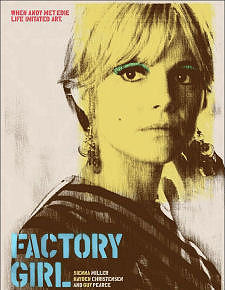
Posterwire.com is announcing that The Weinstein Company is running a movie-poster design contest to create a poster for Factory Girl — not with the idea of putting the winning entry in theatres, mind. I guess that means this is basically a meaningless chickenshit idea, but at least there’s ample precedent. “No major film studio has ever run a contest to design a movie poster where the winning entry was used as the domestic theatrical one-sheet for a film key art ad campaign,” the site explains.”

And yet the one-sheet that the Weinsteiners are going with isn’t very good, so maybe they should consider using one of the submitted entries. I’ve seen a rough version of the film, and while the Andy Warhol-ish silk-screen design of the one-sheet is effective, Sienna Miller‘s facial expression is neutral and stoic — which is totally at odds with what her performance as Edie Sedgwick is like. In the first half she’s jittery, impish, playful, teasing and crazy-girl plucky, and during the last third she’s on the downswirl and wiped out, her face full of stress and streaked with running mascara. In short, the Weinstein poster is a flub — a bland and pointless lie.

Luke Ford on N.Y. Times vs. L.A. Times

Luke Ford has provided terrific coverage of Tuesday night’s (12.12.06) discussion between N.Y. Times writers Sharon Waxman and Laura Holson and L.A. Times writers Patrick Goldstein and John Horn about who’s got the edge in covering Hollywood — the N.Y. Times, the L.A. Times or industry bloggers? (The chat was titled “L.A. vs. New York: Who’s Got the Scoop on Hollywood?”) Variety film editor Dana Harris moderated.
Ford has provided a sound file (very good listening) but here are some choice quotes (provided by Ford): (a) Goldstein: “The Envelope is about attracting Oscar advertising [and] Oscar prognostication is over-the-top and unhealthy”; (b) Horn: “It’s insipid”; (c) Goldstein: “It is almost impossible to beat the internet at the straightforward news game — we have to add analysis”; (d) Horn: “Putting Calendarlive.com behind a paywall was a disaster…a fiasco.”
Ford says he asked the first question of the night: “What makes you think David Geffen [understood to be a possible buyer of the L.A. Times] is a fan of free inquiry? The guy’s a bully. The guy is a blackmail artist. The guy’s a thug. The guy is a lowlife.”
Goldstein: “He’s a thug? I have a list on my wall of people I think of as thugs and David Geffen wouldn’t come close to being on that list.”
Waxman: “Patrick, come on. David Geffen is the one man…who you ask around town, people are afraid of him. They do not pick fights with him because David Geffen has nothing to do. He has a very long memory. He bears a grudge. He will mount a campaign against someone to get back…”

“Dreamgirls” ducats

We all know that anyone looking to see Dreamgirls at one of the platform engagements in New York, Los Angeles, San Francisco, et. al., starting on 12.15 will have to plunk down $25 bucks a pop. And in advance, actually, because advance sales are going pretty well, according to this N.Y. Daily News story by Van Pereira and Nicole Bode. “It’s supposed to be the best film of the year,” says Howard Goldberg, a Hell’s Kitchen businessman. “I would pay $25 dollars for this.”

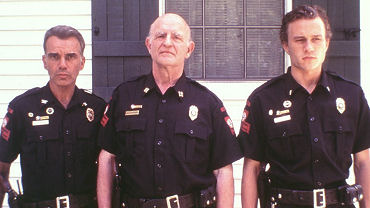
Adieu, Peter Boyle

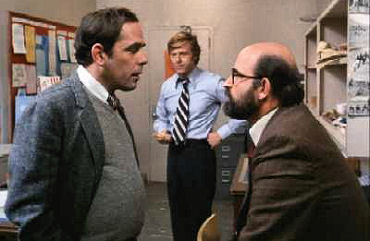
Thanks to reader Tommy Matolla for sending along a photo of the just-departed Peter Boyle as campaign manager Marvin Lucas in Michael Ritchie‘s The Candidate (1972) — my all-time favorite Boyle performance. When I heard of his passing this morning I thought immediately of how superbly on-target he was as the guy who managed, manipulated and mind-fucked Bill McKay (Robert Redford) in his California campaign for the U.S. Senate.

Well-mannered and nicely dressed in a trimmed beard and glasses, Lucas was a sly politico with a cynical heart and a whatever-works attitude, and Boyle’s air of witty refinement surprised a lot of people given his then-current rep as a thuggish meathead type — due, of course, to his breakout performance in John Avildsen‘s Joe (’70), in which he played a hippie-hating blue-collar guy.
And yet Boyle also portrayed Lucas with a subtle (and in my view, quietly hilari- ous) comedic edge. He delivers each line with total sincerity (as far as it goes) but at the same time lets the audience know that Boyle knows that Lucas is a kind of amiable devil — and at the same time just a practical pro with a job to do. It was this performance, I think, that made people realize he was much more than a one-trick blue-collar pony. (Few seemed to understand when it first opened that The Candidate was a very dry comedy — every scene has an oblique comic thrust.)
98% of the public thought of him as the cantankerous Frank Barone in Everybody Loves Raymond, which ran from ’96 to ’05 (while providing Boyle with much financial comfort) but his glory period was from ’70 to ’76: Joe, The Candidate, Steelyard Blues (another hilarious turn), The Friends of Eddie Coyle (as a sinister Boston bartender who handled the hit on Robert Mitchum), Mel BrooksYoung Frank- enstein (his legendary performance as a randy, tap-dancing, Wall Street Journal -reading monster with a huge schtufenhaufer) and lastly Martin Scorsese‘s Taxi Driver (in which Boyle played Wizard, the loutish, know-it-all cabbie).

He had a good career after this, but the quality of roles and films for the last 30 years were touch and go. Boyle’s last solid performance in a first-rate feature film was in Marc Forster‘s Monster’s Ball, in which he played Billy Bob Thornton‘s racist father.
In the summer of ’70 or ’71 a guy I used to know ran into Boyle one night at an outdoor bar on the grounds of the Tanglewood Music Festival. After a couple of pleasantries he offered Boyle a freshly-poured brew and said, “Have a Budweiser, king of beers!” — one of the signature lines from Joe. I don’t remember if Boyle accepted it or not, but as he walked off he said to my friend (or so I was told), “Thanks, kid — you’re all right.”

Villaca on Cuaron, “Men”

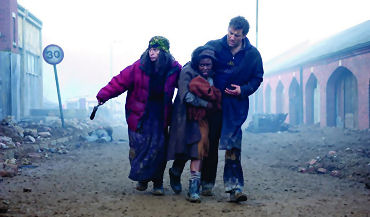
Alfonso Cuaron‘s Children of Men “has not one or two but three of the most spectacular shots ever conceived by a filmmaker,” writes MCN’s Pablo Villaca. “And the best thing is the film is more than technically marvelous; it tells a touching story full of significance. I fell deeply in love with this movie.

“But it’s also rich enough that it allows its fans to defend it from a more rational, cold and detached point of view as well. And if I’m going to succeed on making a case for why it’s the best film of 2006, that’s how we should proceed.”
Has anyone else besides Pablo Villaca and myself picked Children of Men as their Best Film of the Year? I don’t mind being a party of two — totally cool with that — but I’m curious.
“From a structural standpoint, Children of Men has characteristics of an action movie — a very good one. But what the audience will feel is that they’re watching an essentially dramatic and political narrative, for all the chase is part of very well con- structed plot and always plausible, and it doesn’t merely follows genre formulas.
“Cuaron proves his gifts as a storyteller when he manages to establish the univ- erse in which the story is set even before the title appears on screen. In a gray, chaotic and hostile London, we follow Theo while he barely escapes a terrorist attack — an incident that sets the tone of insecurity and violence that will dominate the whole film.

“Building a convincing portrait of the post-apocalyptic world and its social convul- sion, the film’s production design is phenomenal even in its small details, providing the audience with important information through scenic props such as newspaper clippings, photos and protests written with graffiti on city walls (which is how we’re introduced to the concept of an imminent uprising).
“Finally, the idea of showing Michelangelo’s David (rescued from a destroyed Italy) with a prosthetic leg reveals a curious — but appropriate — sense of humor by the filmmakers.”