Earlier today the Cannes Film Festival announced a decision to give a midnight slot to Ethan Coen and Tricia Cooke‘s Honey Don’t, a lesbian detective comedy and the second in a “lesbian B-movie trilogy.” Which sounds unfortunate.
Even without Joel on board, the Coen brand is a “thing” — a bona fide signifier of edge and substance, going all the way back to the premiere of Blood Simple 41 years ago. But perhaps not so much in this instance.
It seems to me that consigning Honey Don’t to the Midnight Section is the festival’s way of saying that Honey Don’t is, no offense, insubstantial. They’re basically acknowledging that it’s a goof-off movie.
I for one am sorry that Ethan is committed to such tripe. He’s obviously capable of a great deal more.
A 4.23 report from World of Reel‘s Jordan Ruimy is, like, bumming me out, bruh.
Ruimy wrote earlier today that David Fincher and Quentin Tarantino‘s The Continuing Adventures of Cliff Booth, the eight-years-later Netflix sequel to Once Upon A Time in Hollywood (’19) that will focus upon Brad Pitt‘s stunt-guy character — a performance that won a Best Supporting Actor Oscar, by the way…Ruimy has reported that “unlike the 2019 original, which was a major theatrical release, this sequel will be made for Netflix.”
Wait…what?
I’ve been assuming all along that Netflix would at least put Booth into theatres for two or three weeks and then go to streaming, if for no other reason than to satisfy popular demand. Ruimy seems to be reporting that Booth won’t have any (or a bare minimum of) theatrical playdates or will just appear on Netflix from the get-go…theatrical de-emphasized.
Could that really be the plan? If so, that would be terrible. I want to see this puppy with a pumped-up crowd inside a crowded theatre…c’mon!
Booth wouldn’t be a stunt guy this time, Ruimy reports, but an Eddie Mannix-type fixer — “a guy studios call when something—anything—needs to quietly disappear. Scandals, blackmail, problematic stars, even bodies. He operates in the shadows, loyal, unshakable, and totally unfazed by the dirt beneath Hollywood’s golden surface. It’s a natural evolution for a character already written as a war hero, stuntman, and possibly even a murderer.”
Also: “According to reports, it was Pitt himself who floated the idea of bringing Fincher on board. The pair have a strong creative history together, having previously collaborated on “Se7en,” “Fight Club,” and “The Curious Case of Benjamin Button.” Tarantino, who typically directs his own scripts, was reportedly open to stepping aside for Fincher—a rare shift that gives this project a distinct identity within the larger Tarantino-verse.
Cliff Booth will begin lensing in July, and probably open in the summer or fall of ’26.
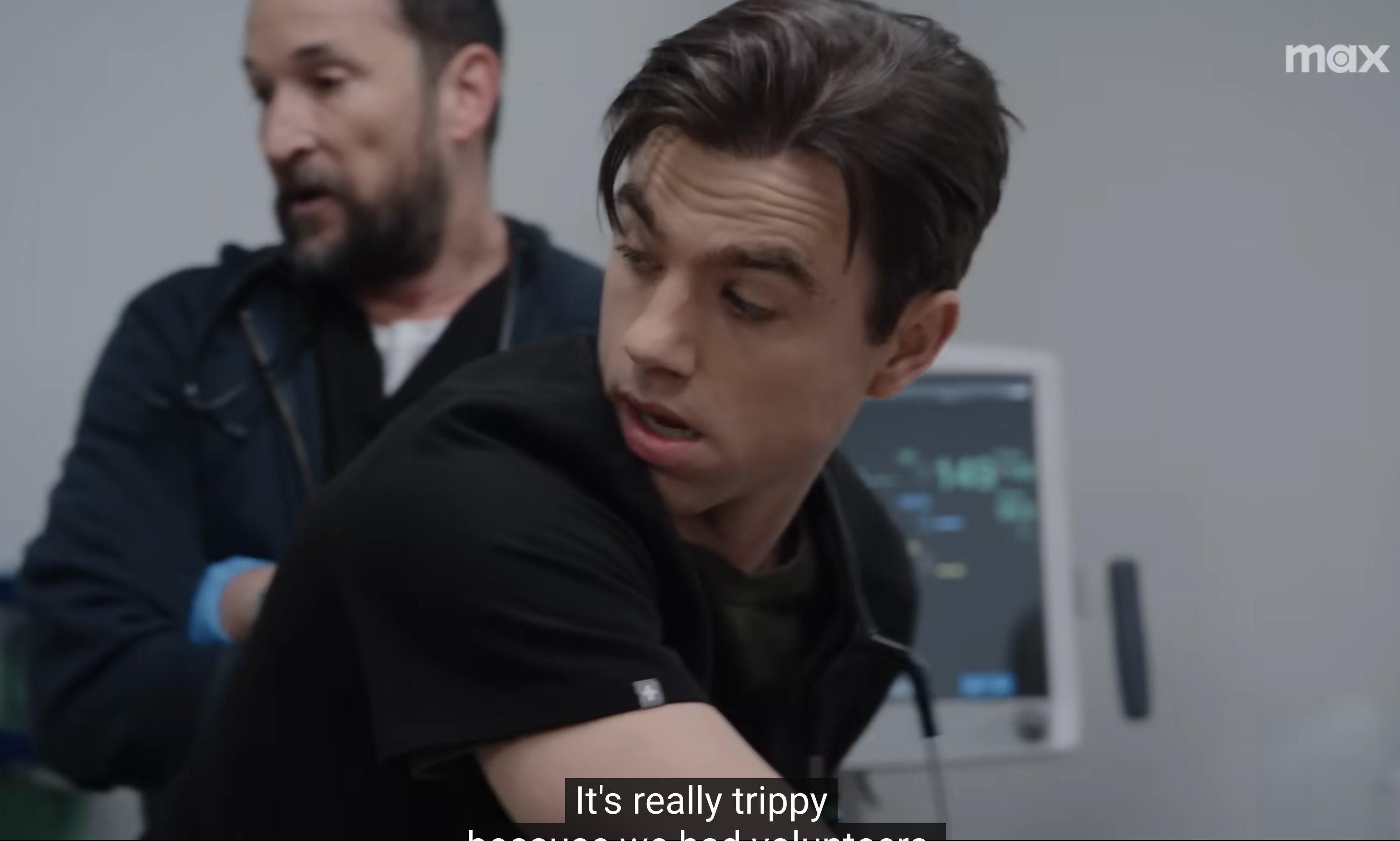
I was completely taken and fascinated with R. Scott Gemmill‘s The Pitt during the first nine episodes, but in episode #10 something happened that really pissed me off — something that felt a teeny bit wokey by way of anti-white-male bias. It made me pull back emotionally.
I’m speaking about Patrick Ball‘s Dr. Frank Langdon, a brilliant, highly-stressed, wrapped-too-tight E.R. doctor, having illegally and unethically used librium — a chill drug — to take the edge off.
Technically known as chlordiazepoxide, librium, according to WebMD, “produces a calming effect on the brain and nerves, which helps to reduce anxiety symptoms and promote relaxation.”
It was obviously not cool and a blatant violation of the Hippocratic Oath for Langdon to have occasionally dosed himself. But in the greater scheme of things, taking librium isn’t that different from popping an occasional valium. It didn’t strike me as that big of a deal.
Did Langdon need to face up to a potential health issue or worse? Yes, but aside from making him detour into stridency or excitability, taking lithium wasn’t interfering with his abilities or duties. Not as dramatized, at least. It would have been far worse if Langdon had been drinking, say, or taking morphine as a stress-alleviator. Langdon is a first-rate physician. He was just moderately medicating.
If I was a fellow doctor in this situation and I’d discovered what Langdon was up to, my first and only response would have been to speak with him after-hours. I would say “Frank,this really has to stop and not only that, you have to seek counsel from an outside doctor, or perhaps even from a psychologist. But it has to stop, and on a provable basis. You can’t jeopardize your career like this.”
I would add the following: “If you don’t take immediate steps to remedy this situation I’m definitely going to report this matter to our supervisor (Noah Wyle‘s Dr.’Robby’ Robinavitch). I don’t want to torpedo you, Frank — you’re too good of a doctor to just be thrown over the side by a mistake. But this has to stop now.”
So what happens? Langdon’s adverse relationship with a rookie female doctor quickly turns petty and vindictive, and the shit hits the fan.
Isa Briones‘ Dr. Trinity Santos, an assertive feminist firebrand who’s only been working in “the Pitt” for a few hours, gets wise to Langdon’s behavior. She and Langdon have already developed a dislike for each other, partly because he’s been overly critical and scolding of some of her judgment calls. So not long after she discovers his librium problem, she tattle-tales to Dr. Robby. And then Robby, ignoring the fact that Langdon is one of the two or three best physicians he has in the E.R., angrily tells Langdon to “go home”. No warnings, no scoldings….just “fuck you, you’re done.”
If someone is really good — brilliant, amazing — at a tough and demanding job, the fair-minded thing is to give him or her a chance to man up and fix a personal problem. If he/she fails to correct it, then you lower the boom. It would be one thing if Langdon’s librium-chipping was causing medical mistakes or jeopardizing the well-being of patients, but that’s not the case.
So now I don’t like Dr, Robby any more. Noah Wyle‘s performance is awesome and he’ll almost certainly win an Emmy, but I don’t like how Dr. Robby reacted. In my mind he threw a good man under the bus for insufficient cause.
And I really don’t like Isa Briones. And I’m not the only one who feels this way. When Briones/Santos confides her concern about Langdon’s unethical behavior to Dr. Samira Mohan (Supriya Ganesh), the latter says “I don’t want to hear about it…I don’t want to know this!” And then she adds, rather angrily, “You’re trouble.”
It happened yesterday (midday by the Pacific clock). Tail-end wrap-up sequence.
Carolla’s sardonic, regular-guy skepticism plus his standard-issue loathing of woke derangement syndrome meshes well with Sasha’s traumatic saga of ‘24 (incoming missiles launched by THR’s Rebecca Keegan led to a significant award-season income plummet) and her continuing discomfort with left-instructional content (i.e., all women, POCs and LGBTQs are glorious, all straight males are kinda bad), which I regard as healthy. The discomfort, I mean.
Did they discuss Sinners? Well, they might have but Sasha still hasn’t seen it. Did they get into the over-and-done-with AnoraOscars? Did they kick around Minecraft or Adolescence or season 2 of TheLastofUs? Or…whatever, the upcoming Cannes or Venice film festivals? Naaah, too elitist…too fringe!
Carollaboileddown: “Stop force-feeding us your woke shit!”
The fact that no one’s paying the slightest bit of attention to Andrew Ahn‘s The Wedding Banquet, I mean,
Seriously — it’s been in theatres since last Friday (4.18) and there hasn’t been so much as a teeny weeny peep out of anyone. This summarizes, I suppose, the ensemble drawing power of Bowen Yang, HE’s own Lily Gladstone, Kelly Marie Tran, Han Gi-chan and Joan Chen.
Wall Street Journal: “Ang Lee’s The Wedding Banquet (’93) is impressive for how it wrings something genuine out of what might, in other hands, have felt like little more than a sitcom.
“If Ahn’s The Wedding Banquet has now not fallen into those hands, exactly, it has nonetheless suffered a degeneration, courtesy of the director’s present-day remake of the same name.
“The new Wedding Banquet has been awkwardly contorted to fit the world of today, with flat direction and a cast that largely flounders in a muddled middle ground between antic comedy and sentimental drama.”
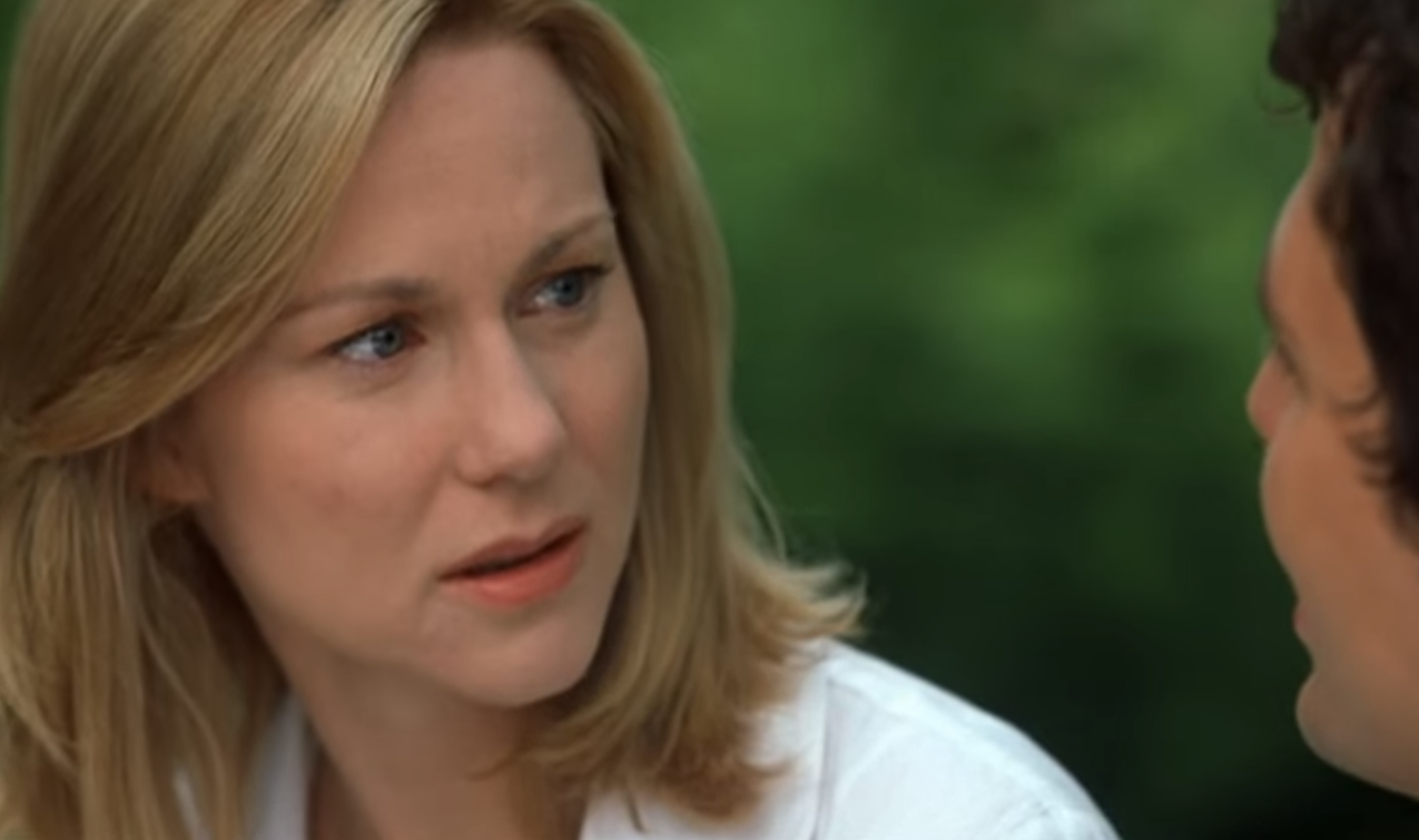
“…that wherever I am and whatever stupid shit I’m doing that you’re back at my home, rooting for me. (pause) It’s all going to be all right, Sammy…comparatively.”
Guys who talk and think like Mark Ruffalo‘s Terry character (my younger brother bore certain resemblances) don’t tend to live long lives, much less nourishing ones.
You need to start figuring things out by your 30th birthday if not sooner, and if you’re still floundering around at age 35 you may as well admit it — you’re in fairly big trouble.
The power of this scene comes from the obvious fact that poor Laura Linney is putting this grim scenario together in her head as Ruffalo (pushing 30 when You Can Count On Me was filmed) is rambling and rationalizing.
The truth? I was almost Terry. I came thatclose, and then I began to pull it together between age 26 and 27. I nearly went into the sinkhole.
Imagine a sprawling relationship story (two men and the women they get involved with) told in three in-depth, period-specific chapters — the late ’40s, the early and late ’60s, and the early ’70s. By today’s single-season streaming standards, this would be a ten-episode limited series, minimum. Or perhaps a two-season thing…20 episodes in all. If someone were to attempt, against all odds, a theatrical, stand-alone remake, it would run at least 120 minutes and more likely 130 or 140.
Which is why it’s fairly startling to realize that Mike Nichols‘ Carnal Knowledge runs all of 98 minutes.
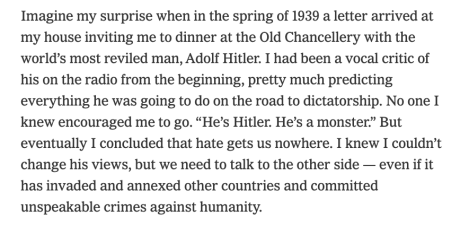
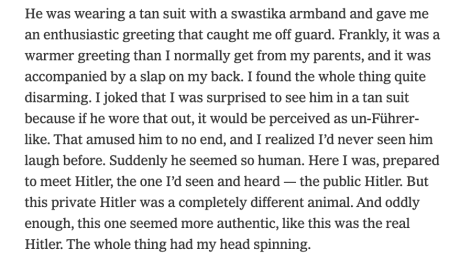
Whenever you use a Hitler or Nazi Germany parallel to make a point in a debate, the reaction is always the same: “You’ve just lost the argument…bringing up Hitler is a cheap shot…back to the drawing board.”
But I think Larry David‘s use of this analogy was fair. Plus we all understand how sociopaths are good at playing people so I don’t see the problem. Anybody can be nice at a dinner of social function. Which is why I’ve always felt irritation when someone says that some famous person they’ve hung with “is sooo nice!” My reaction is always “Yeah….so? They’re performing!”
“Vaudeville Rules“, posted on 4.20.17: There’s a strictly enforced system in Abbott and Costello Meet The Mummy (’55). Old-school mummies kill their victims by strangling them, but whenever Klaris the mummy (Eddie Parker) comes up behind Lou Costello, he can only stand 12 inches behind him with his arms out. When Costello takes a step, Klaris takes a step…but he can’t strangle Costello. He’s only allowed to give him a mummy bear hug.
Then again Klaris couldn’t be too toothless. I’m presuming that director Charles Lamont told Parker to make a scary noise every so often. Parker: “What kind of noise?” Lamont: “I don’t know. Some kind of growl.” Parker: “A Wolfman growl?” Lamont: “Of course not. A dead man’s growl..filtered through tana leaves, whatever…the roar of dessicated centuries and ancient pyramids and dry-mouth.” Parker: “Dessicated?” Lamont: “Just don’t sound like the Wolfman.” And so Parker came up with “yaaawwwhrrrrr!”
According to a 4.22 post by Deadline‘s Melanie Goodfellow, the late Pope Francis didn’t fully understand the famous “pebble scene” in Federico Fellini‘s La Strada (’54), which the pontiff repeatedly called his all-time favorite film.
Goodfellow: “As a child I saw many films by Fellini,” the pope said, “but La Strada always stayed in my heart. The film that begins with tears and ends with tears, begins on the seashore and ends on the seashore, but what stayed with me most was the scene with the madman and the stone in which he gives meaning to the life of the girl.”
Francis was referring to a dialogue scene between Richard Basehart‘s “Il Motto” and Giulietta Masina‘s Gelsomina. While the dialogue is all Basehart’s, he’s not playing a “madman” but a clownish tightrope walker with a big heart — a circus fool — and he’s not talking about a “stone” but a tiny pebble. If thrown hard a stone can break a window, after all, but a pebble can’t.
Basehart: “Everything in this world is useful for something. Here, take this pebble, for example. It has a purpose, but how should I know [what]? If I knew, do you know who I would be? The Almighty, who knows everything: when you are born, when you die. And who can know that? No, I don’t know what this stone is for, but it must be for something. Because, if this is useless, then everything is useless: even the stars. And even you, you are also useful for something, with your artichoke head.”
More Francis: “We too, little pebbles on the ground, in this land of pain, of tragedies, with faith in the Risen Christ, we have a purpose, amid so many calamities. The purpose of looking beyond, the purpose of saying: ‘Look, there is no wall; there is a horizon, there is life, there is joy, and there is the cross with this ambivalence. Look ahead, do not close yourself off. You, little pebble, have a purpose in life, because you are a pebble near that rock, that stone which the wickedness of sin has discarded.”
I’ll watch a Super Bowl game now and then, but am otherwise indifferent to the comings and goings of big-time football (NFL or college). I barely glance in its direction.
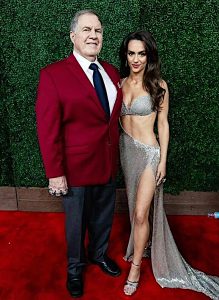
And yet even I know who the legendary Bill Bellichick is, and that he’s 73 and part Croatian and that he wears eight Super Bowl rings. And that his foxy girlfriend of two-plus years, Jordon Hudson, is 49 years younger. (Hudson’s previous boyfriend is around 40yearsolder.)
I say (a) “if they’re happy, fine,” (b) “it’s none of my damn business” and (c) “live and let live”.
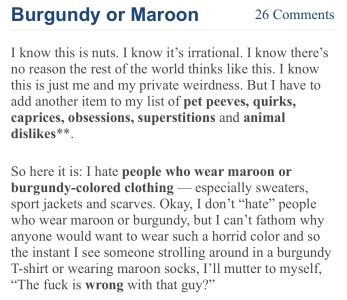
But Bellichick’s maroon or burgundy sport jacket is utterly impossible. No one of any taste comes within 100 yards of burgundy or maroon anything.