Another Steinem Or Two

Any film with a Rotten Tomatoes or Metacritic rating below 80% obviously has an issue or two. Especially if the aggregate is closer to 70.

I’ve yet to see Julie Taymor‘s The Glorias (Roadside, 9.20), but as far as the inhabiting and reanimation of Gloria Steinem is concerned, I was profoundly impressed by Rose Byrne‘s effort in Mrs. America, so there’s that hurdle.

It’s no surprise that costar Timothy Hutton, who plays Gloria’s travelling-antique-salesman dad, Leo Steinem, and who ran into some difficulty earlier this year, is absent from the trailer.

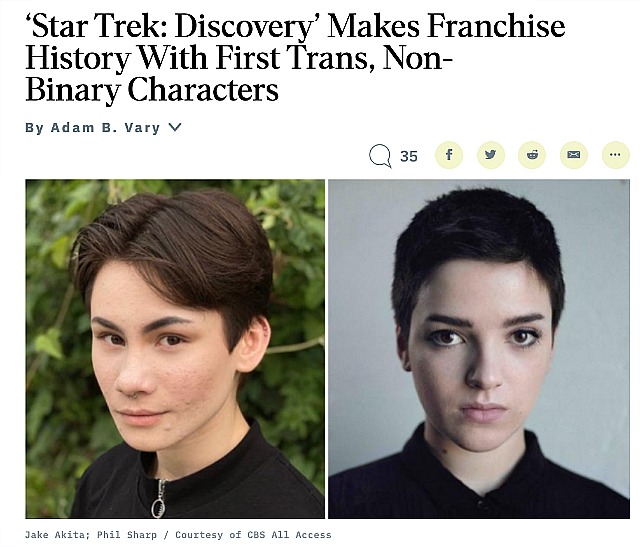
Non-Binary “Trek” Representation

Excerpt from “From Kant to Kirk: Star Trek‘s Philosophical Arguments,” posted in Newsweek on 7.9.16:

“In their book, ‘Star Trek and Philosophy: The Wrath of Kant’, Jason Eberl and Kevin Decker make it clear that from the very idea of the Federation to the foggy ethics of the Prime Directive, it’s been (a) philosophical quandaries as well as (b) priceless fight scenes that have kept fans hooked for half a century.

“But according to Decker, two schools of thought run through the entire Trek canon, present throughout both ongoing storylines and one-time episodics. ‘Every Star Trek series contains stories representing the ethical struggle between utilitarians like John Stuart Mill (who prioritize the maximization of good) and deontologists like Immanuel Kant (who subordinate the greater good to following the right principles),” he explains.

“The series are very much reflective of their times,” says Eberl. “Because the original series came out when it did, Gene Roddenberry wanted to touch on the social issues of the day in a way that you couldn’t in traditional TV formats. By putting things in a sci-fi context where social issues are couched in the issues of an alien world — the censors weren’t immediately able to say, ‘Oh, he’s talking about the Vietnam War’ or ‘That’s about civil rights or women’s rights or population control.’ These are touchy subjects, and they normally wouldn’t have been allowed to be discussed.”

Two or three years ago it was noted that among the new crop of Academy and SAG members, “representation isn’t an important thing — it’s the only thing.” Aesthetic standards change, social measurements evolve, etc.

Political Filter = A Realm Apart

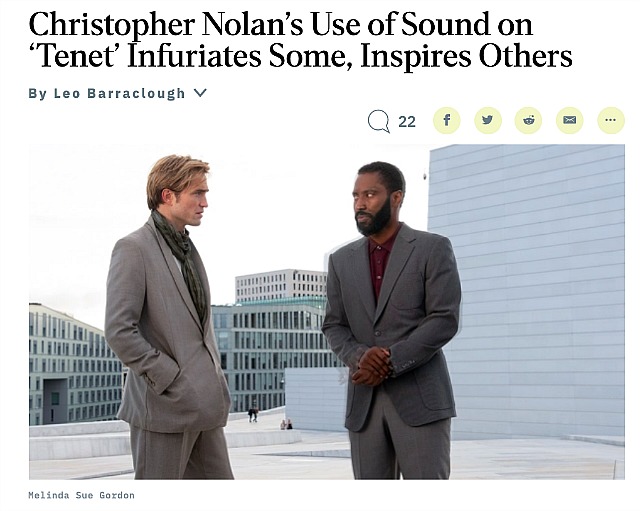
Joe Popcorn has spoken on Twitter and Reddit about the Tenet sound mix, and has largely disapproved. Ask anyone who’s seen it. The plotting is complex but at best you can hear half of the expository dialogue, and it’s allegedly maddening. (How could it not be?)

Undeterred, Variety‘s Leo Barraclough has posted one of those “Average Joes may feel frustrated but at the end of the day industry professionals probably know better, or at least are fearful of being candid” articles. The trades are brilliant at this sort of thing.

Different Skill Sets

Sorry to differ with the Berlin Film Festival’s recent decision to adopt gender-neutral performance awards. Ditto Tilda Swinton‘s belief, stated hours ago at the start of the 2020 Venice Film Festival, that getting rid of Best Actor of Best Actress awards is a good thing.

“Humans are so interested in division and compartmentalizing ourselves,” she said. “As we’re really getting to understand now, this is not the way to go — dividing people up and prescribing a path for them, whether gender or race or class.”

Hollywood Elsewhere calls “bullshit” as far as gender differences are concerned. Throughout all creation and with nearly all species of life, nature has insisted upon genderism and all the accompanying differences and distinctions. In the realm of screen acting, there are certain skill sets — basic postures and attitudes and inclinations — that divide male and female thesps. Tilda may dislike this, but they’re built into biology. She can try and Khmer Rouge her way around this, but it’s a no-go.

“It’s just such a waste of life,” Swinton explained. “Life is too short for all of this. I’m really happy to hear that about Berlin and I think it’s pretty much inevitable that everybody will follow. It’s just obvious to me. The whole idea of being fixed in any way, it just makes me claustrophobic.

“It just makes me sad to call yourself definitively heterosexual, definitively homosexual, definitively male, definitively female. It makes me want to go to sleep. So bravo, Berlin.”

Charles Durning‘s 60ish farmer character in Tootsie disagrees — “Bulls are bulls, and roosters don’t try to lay eggs.”

Wile Coyote X-treme Action Aesthetic

In Long Shot, Seth Rogen dives out of a second-floor window, crashes into a parked car, gets up, groans and runs down the street like it’s next to nothing. In No Time To Die, Daniel Craig, tethered to a rope, leaps off a medieval Italian bridge, falls 80 or 90 feet, slams into a wall, gets up, groans and shakes it off. Roberto Rossellini would have heartily approved.

I despise cyborg action sequences because they remove any sense of vulnerability, which is (profuse apologies for mentioning this) a factor that we all contend with daily.

If there’s one basic law that present-tense action directors despise, it’s the one that says “humans are not T-1000 mechanisms but flesh, blood and bone.”

Bond films respected this basic fact during the first two or three installments, but that was all but out the window by the time of Diamonds Are Forever. And then audiences fell too hard for the T-1000 action aesthetic with the release of James Cameron‘s Terminator 2: Judgment Day (’91).

I for one continue to pine for the physical realism of Steven Soderbergh‘s Haywire (’12), but an overwhelming majority has said “no” to that aesthetic.

Otherwise No Time to Die seems, to paraphrase Ray Liotta in Goodfellas, like “good Bond movie bullshit.”

Horse Latitudes

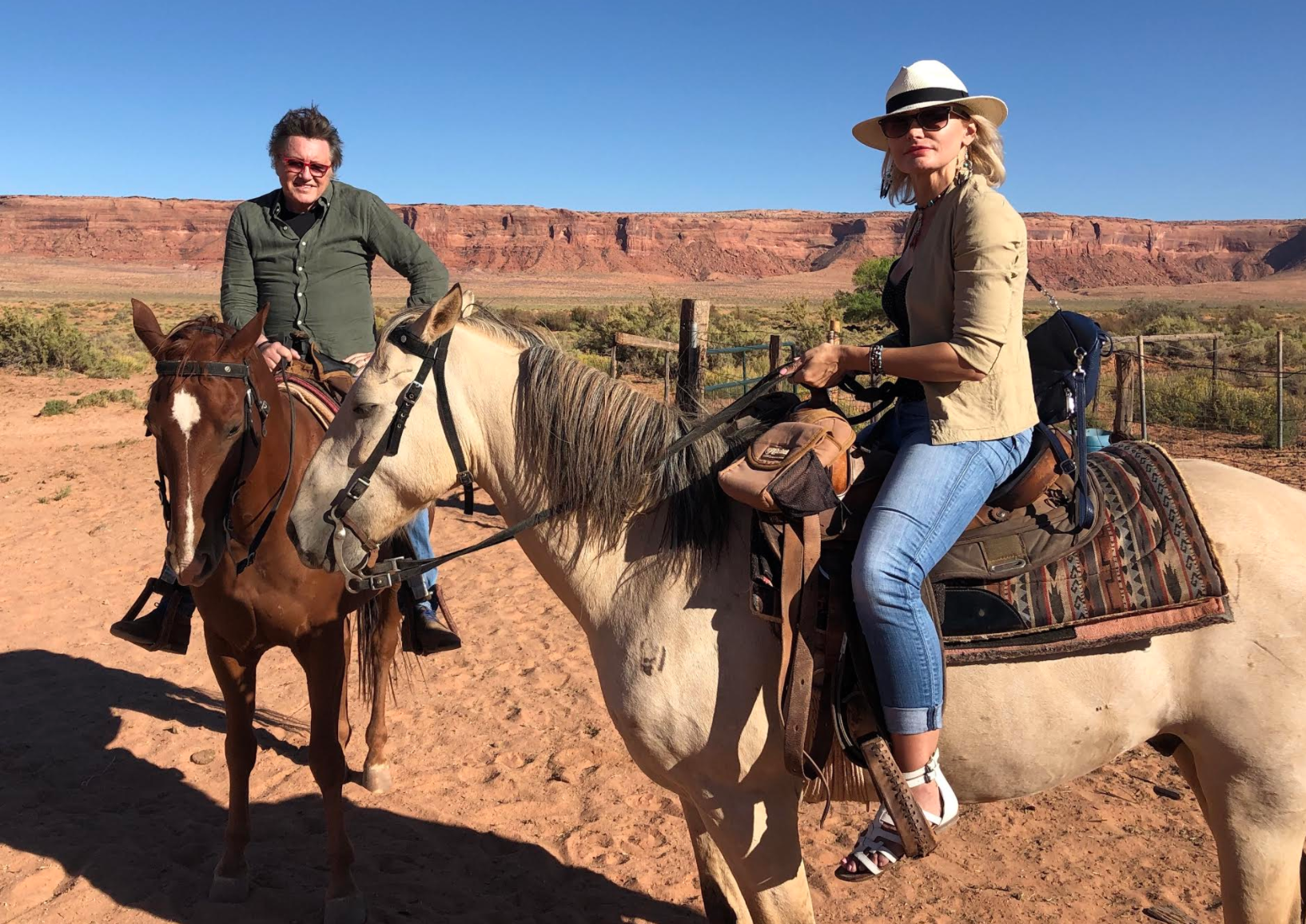
My horse, Copper, didn’t like me at first. I gave him the old affectionate neck-pet, and he tried to kick me three times as I attempted to mount. The horse guys had to tie off his back legs to keep him from doing so. And he tried to shake me off twice during the ride. Plus he was lazy — his attitude was “get the fuck off me.” But he gradually gave in to the servitude. A big strong horse (i.e., gelding) but I could feel him struggle with my weight. I felt badly for the guy, especially when we had to ascend small hills.

Read more

Long Way Down

Whatever happened to The Challenger, that Michelle Williams-as-Christa McAuliffe feature about the 1986 space shuttle tragedy that was announced in October ’18? At one point it was going to shoot in May ’19. Land of Mine director Martin Zandvliet would’ve directed, based on a script by Jayson Rothwell.

Challenger: The Final Flight (Netflix, 9.16) is a four-part doc series about same. Executive produced by J.J. Abrams, produced by Glen Zipper, directed by Daniel Junge (Being Evel, A Lego Brickumentary) and Steven Leckart (What’s My Name: Muhammad Ali).

Wiki excerpt: “Some experts believe most if not all of the crew were alive and possibly conscious during the entire descent until impact with the ocean. Astronaut and NASA lead accident investigator Robert Overmyer said, ‘I not only flew with Dick Scobee, we owned a plane together, and I know Scob did everything he could to save his crew. Scob fought for any and every edge to survive. He flew that ship without wings all the way down…they were alive.'”

The Searchers

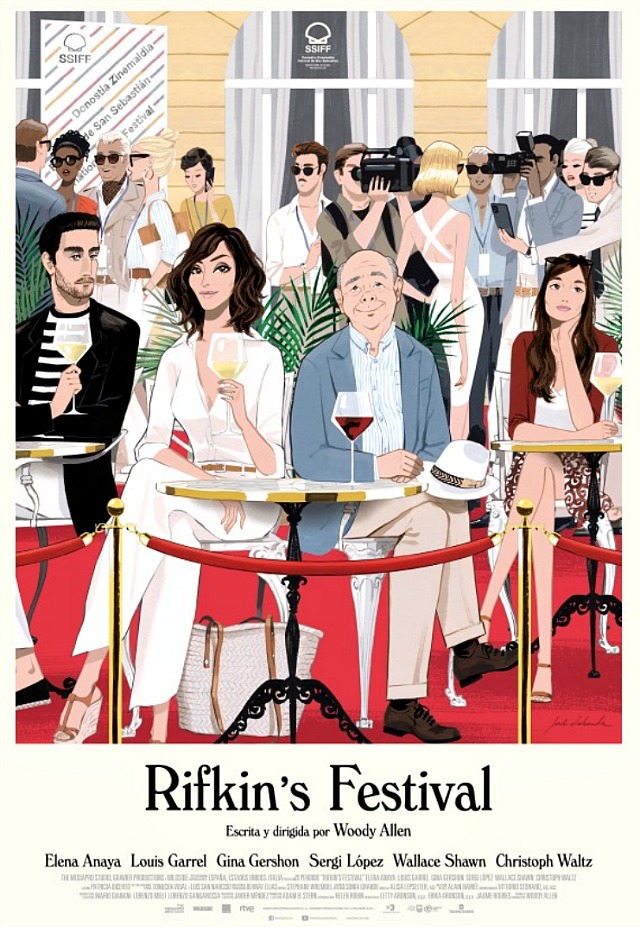
Woody Allen‘s Rifkin’s Festival is about (a) a couple who both cat around on each other (i.e., fall for someone else) while attending the San Sebastián Film Festival and (b) the same four people, in the midst of this romantic adventurism, talking, thinking and behaving like Woody or, you know, quintessential Woody characters.

Positive and Gumpy

It’s one thing to say “I’ve never seen Johnny Guitar” or “I was exasperated by Stephen FrearsThe Hit” or “I’ve never bothered to watch Three Days of the Condor.”

But it takes confidence, character and sand for a Variety columnist to say “I’ve never seen Casablanca.” That, ladies and germs, is called exposing your soft underbelly, and I admire any critic or columnist who does that on occasion. So here’s a toast to Clayton Davis, who’s posted his debut column.

That said, I have two disputes with Davis’s 9.2 essay, which is titled “How I’ll Be Predicting the Oscars for Variety.” Okay, not “disputes” but raised eyebrow reactions. Both, in a sense, are about the embrace of fair-minded, bend-over-backwards positivism.

Davis riff #1: “I’ve seen the grotesque districts of the internet in the form of message boards, comment sections and #FilmTwitter. We’ve seen and heard the noise and vitriol from all of them. Trolls and bot-like beings hiding behind a keyboard and throwing out vile descriptions of the subject being discussed. My objective in this space is to be as positive as possible with my casual moviegoers, celebrities and journalistic colleagues. How difficult can that be?”

Something in me goes “uh-oh” when I hear the phrase “try and be positive.” That sounds to me like a blend of “put on a happy face”, “I want to be happy” and “always look on the bright side of life.” All three are song titles, of course, but only the last, a Monty Python tune that was famously covered by Art Garfunkel, is ironically positive-minded. My basic motto is “never trust anyone who tries to put a positive spin on anything.” ** Because the hardest thing in the world is to be straight-from-the-shoulder but fair.

Davis riff #2: “In some ways, a pocket of the population might categorize me as ‘basic’ when sharing my top three films of all time: Dead Poets Society, Forrest Gump and Star Wars Episode V: The Empire Strikes Back. In other ways, my 10 favorite films of all-time also include Dial M for Murder from Alfred Hitchcock, the masterpiece of his career that no one mentions enough.”

It’s fine to champion Dead Poets and especially Empire, the universal consensus fave of all the Star Wars films, largely because it’s the only shadowy “noir” in that decades-spanning franchise. And I’ve long admired the way Hitchcock shot and cut Dial M for Murder (which I saw twice in a 3D boxy presentation at Manhattan’s Eighth Street Playhouse in ’80), because it manages to be visually gripping without ever leaving Ray Milland and Grace Kelly‘s apartment.

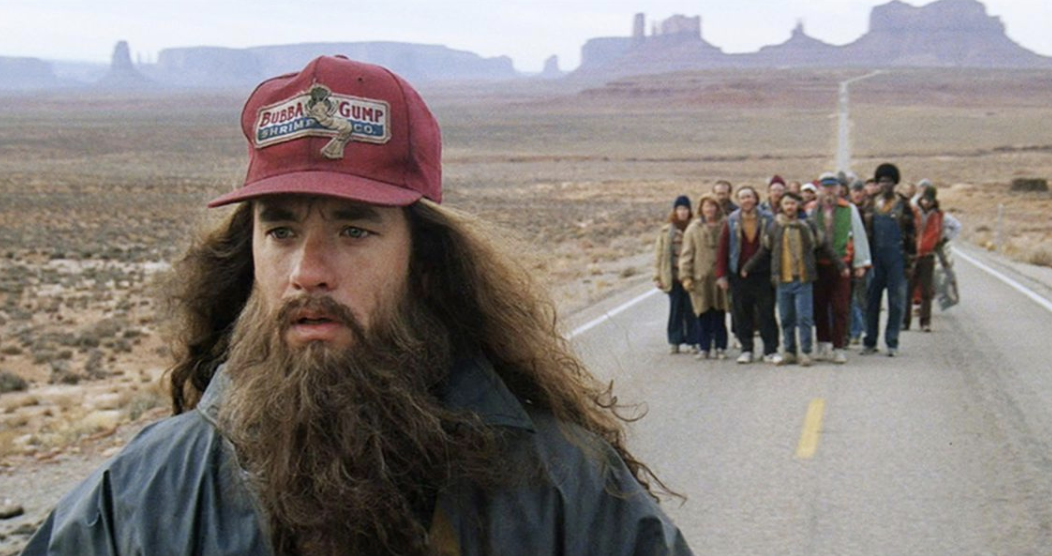
But praising the insipid rightist propaganda of Forrest Gump is…well, that’s worrisome.

Posted in October ’08: “I have a still-lingering resentment of that film, which I and many others disliked from the get-go for the way it kept saying ‘keep your head down’, for its celebration of clueless serendipity and simpleton-ism, and particularly for the propagandistic way it portrayed ’60s-era counter-culture types and in fact that whole convulsive period.

“Every secondary hippie or protestor character in that film was a selfish loutish asshole, and every man and woman in the military was modest, decent and considerate. These and other aspects convinced me that the film was basically reactionary Republican horseshit, and led me to write an L.A. Times Syndicate piece called ‘Gump vs. Grumps,’ about the Forrest Gump backlash.

“No offense to screenwriter Eric Roth, who’s a good fellow and a brilliant writer.”

In response to the above an HE reader named “hcat” said the following: “I have the same problem with Gump. While it flows well and is quite funny throughout, I hate the way it continually rewards Forrest for his stupidity and punishes Jenny for her exploration.

“What especially irks me is the fact that it criticizes the counter-culture and the hippies, but cues up their music every time they need a quick nostalgia hit. Forrest is a country boy and the soundtrack should have been wall to wall Oak Ridge Boys. But that way I can’t imagine it being anywhere near the hit it was.”

** Unless it’s an assessment of myself or Hollywood Elsewhere. In which case I heartily applaud positivism.