Obviously Time Travel

Because time travel is a passport to all kinds of excitement and adventure and God-knows-what-else, not to mention opportunity and great wealth.

Would I visit Dealey Plaza on the morning of 11.22.63? Yes, but not to alter history. In his novel and miniseries “11/22/63”, King has suggested what a screwed-up, tangled-up cosmic malfunction would result if anyone tried, so let’s leave it there.

Instead I would become the photographer and documentarian who removes all ambiguity.

I would get hold of three 16mm color cameras with long-lasting magazines and professional-class zoom lenses along with some first-rate Hasselblad still cameras, and hire a couple of assistants.

I would then (a) find a good vantage point and film Oswald (or whomever) shooting from the sixth-floor window. I’d also (b) film whatever actually happened (or not) behind the wooden grassy knoll fence. And most importantly I’d (c) capture some first-rate MCU color footage of JFK and John Connolly as the shots ring out.

Who Remembers “Secretariat”?

Posted on 10.3.10: In Secretariat (Disney, 10.8), Diane Lane gives an earnest, steady-as-she-goes performance as Penny Tweedy, the conservative housewife who risked financial ruin and defied her husband (Dylan Walsh) and brother (Dylan Baker), who wanted to sell their inherited horse farm for a quick profit, in order to nurture, train and place into competition one of the most celebrated racehorses in history.

The horse was initially named Big Red but eventually became Secretariat — legendary winner of the 1973 Triple Crown. And it’s a thrill to watch (and hear) him run. The film sometimes gives you that amazing charge with exceptional you-are-there photography and sound. But Secretariat is as rote and regimented and corny as Kansas in August, and I don’t see it selling many tickets beyond its base constituency — squares, tourists and hardcore horse-racing fans.

In short, I loved the story of Secretariat more than the movie. Actually, not the story so much as the horse-racing footage. The problem (and the movie has more than one) is that director Randall Wallace uses every trick in the book to make it seem touching, suspenseful, a cliffhanger…a story that massages your heart. Every. Trick. In. The. Book. And you’re not “in” the groove of Secretariat as much as fully aware of everything he’s trying to do to crank you up. You never forget you’re watching a Randall Wallace family-values movie for the schmoes — i.e., white people who stroll around in plaid shorts and white socks and La Crosse golf shirts, and who have an allegiance for old-fashioned Wonder Bread conservatism.

Everything is so right down the middle. And for me, Wallace’s directing style is too tight and straight-laced. There’s a little cut-loose dance sequence when Lane and her team are shown bopping and grooving to a ’70s soul tune, but Wallace doesn’t know how to cut and bump to this kind of thing, or at least not very well. Nor is he especially good at depicting early ’70s counter-culture kids and their behavior. It feels fake, “performed” — like some 1971 Methodist minister’s view of how hippie kids dressed and spoke and acted.

Lane has three moments that play exceptionally — (a) an argument/firing scene with a horse-farm manager in the first act, (b) a moment when she looks into the eyes of Secretariat to see if he’s ready to run, and (c) a financial face-off scene between she, Walsh and Baker. Except the latter scene is brought home by the housekeeper (Margo Martindale) when she spells out the specifics of their father’s will. A solid award-worthy performance needs three powerful moments, not two and a half. Lane’s performance wants to be as good as Sandra Bullock‘s in The Blind Side, but doesn’t quite get there. Sorry.

And Mike Rich‘s script doesn’t really give her any huge killer moments. Solid moments, but not great ones. The staring-at-Secretariat moment might be the best of all. Lane has a hold on the heart and spirit and determination that surely drove her character forward. Nice lady and mildly hot under the circumstances. But why did that wig she was wearing have to look so much like a wig? Don’t hairdressers know how to make wigs a little mussy and more natural-looking?

I quickly lost patience with Scott Glenn, who plays Lane’s ailing dad. Alzheimer’s, a stroke….die, you fucking boring actor!

Read more

Bad Ellen Vibes

I’ve been disregarding the Ellen DeGeneres brouhaha about all the complaints about her being a mean boss and the toxic environment among staffers for her daily talk show.

I was also suspicious of that recent Daily Mail report about former staffers accusing Ellen of “turning a blind eye” to rampant sexual misconduct by senior-level producers, etc. As well as a claim that DeGeneres is telling executives at Telepictures and Warner Bros that “she has had enough and wants to walk away from the show”, and that “she feels she can’t go on and the only way to recover her personal brand from this is to shut down the show.”

Today, however, The Sun‘s Emma Parry and James Desborough reported that James Corden is in line to replace Degeneres. So maybe there’s something to it.

This presumably all stems from the “safeties” (i.e., sensitive, mostly Millennial-aged staffers) complaining about the usual usual.

My attitude is that if you’re unlucky enough to be working for a difficult, bullying boss or supervisor, or one who could certainly stand to improve his/her people skills…if you’re in a bad situation like this you need to suck it in, man up and accept this unfortunate energy as the price of working on a popular TV show. You’re there to get paid and forge relationships and move ahead with your career. Hang tough, keep your head down, do the job, and land a better job when the opportunity arises.

I realize, of course, that this is not the prevailing attitude these days. But I can’t help but note the irony about all this complaining having possibly led to DeGeneres walking away from the show, which translates into all her complaining staffers suddenly being without income. On 8.1. a Daily Mail story reported that Ellen’s production staffers are “freaking out over fears she will quit or be cancelled after some employees complained of a toxic atmosphere on set,” etc.

Gee, guys…I guess that’s a possibility when workplace complaints reach a certain fever pitch or tipping point. Maybe you should’ve adopted the HE attitude and not complained quite so much in the first place? Just a thought.

“Mr. Smith” Beats HE To Pulp

All my moviegoing life I’ve been more or less avoiding Frank Capra‘s Mr. Smith Goes To Washington (’39). A highly respected political dramedy about idealism vs. corruption, of course. One of Capra’s finest films, they all say. And one of the standouts of 1939, which has long been celebrated as old-time Hollywood’s greatest year.

But we all know that Capra lays it on too thick. And so my thinking was, “Okay, I’ll see it eventually but I’m in no hurry.” I began telling myself this back in the ’70s, and I somehow managed to sidestep Mr. Smith all through the Nixon, Carter, Reagan, Bush, Clinton, Bush and Obama administrations, and over the last three and a half years of Trump. But a 4K Bluray version was part of a Sony package I bought a while back, and last night I decided to pop it in.

HE verdict: Mr. Smith is a “good” film in that it says the right populist things about governmental corruption (i.e., established stinky politicians need to consider the views of a true-blue idealist every so often), and it does so with crackerjack dialogue (written by Sidney Buchman and Myles Connolly) and lots of snappy attitude and sweaty passion, and you can see how and why it made Jimmy Stewart (between 30 and 31 when it was shot) a major star.

But my God, it wears you down! I felt exhausted after 45 minutes, and I had another 80 minutes to go. By the time it ended I felt all but poisoned by the sugar and the Capracorn syrup. And it felt so fake and cranked up…a big bowl of patriotic whipped cream with sentimental sauce and a cherry on top.

Has anyone in the history of the planet earth every been as naive and idealistic as Stewart’s Jefferson Smith? How could the son of a man who was friendly with Claude Rains‘ Senator Joseph Paine for so many years possibly be this clueless about the ways of the grown-up world?

Why in heaven’s name would Jean Arthur, who’s obviously class-A material and who seems destined to end up as Smith’s girlfriend or wife…why would she even flirt with the idea of marrying Thomas Mitchell‘s cynical Capitol Hill reporter? She and Mitchell were drunk when the idea arose, yes, but it makes no sense — nobody ever marries Thomas Mitchell, and flirting with this degraded Arthur’s value.

And after Stewart collapses on the Senate floor, the guilt-wracked Rains/Paine runs out and tries to shoot himself? Where did the gun come from? And Harry Carey, the president of the Senate (which makes him FDR’s vp), is the only person in the Senate chamber who sympathizes with Stewart’s plight?

I’m glad I finally saw Mr. Smith Goes To Washington. I’m not calling it a bad film but it’s certainly an exhausting one. I will never, ever see it again. And I’m saying this as a fan of It’s A Wonderful Life, which I’ve seen at least six or seven times.

Read more

Brimley’s Hot Streak

Respect for the formidable Wilford Brimley, the flinty character actor who passed on 8.1.20 at age 85. His performances were always convincing and unaffected and touched by gruffness, but there were only two that I regard as serious standouts. Okay, maybe three.

I know I’m supposed to say that his baseball team manager in The Natural and the lovable old codger in Cocoon were his two best, but I don’t feel that way. Odd as it may sound, I thought his chunky, snarly villain in The Firm (’94) was his absolute finest moment (particularly that scene with Tom Cruise when Brimley shows him the sexy beach photos and says the line “oral and whatnot”). My second favorite was his performance as Betty Buckley‘s manager, “Harry”, in Tender Mercies (’83). He was also quite good in a relatively small role (Assistant U.S. Attorney General James A. Wells) in Absence of Malice.

Brimley began working in the mid ’70s on TV (The Waltons) and his last film was in ’16 — a 40-year run give or take. But his peak period lasted only 15 years or so, or roughly from The China Syndrome (’79) to The Firm. He was certainly noteworthy in The Electric Horseman, Brubaker, The Thing, High Road to China, Harry & Son, The Hotel New Hampshire, The Stone Boy, Terror in the Aisles and Remo Williams: The Adventure Begins.

Read more

Spitballing “Nomadland”

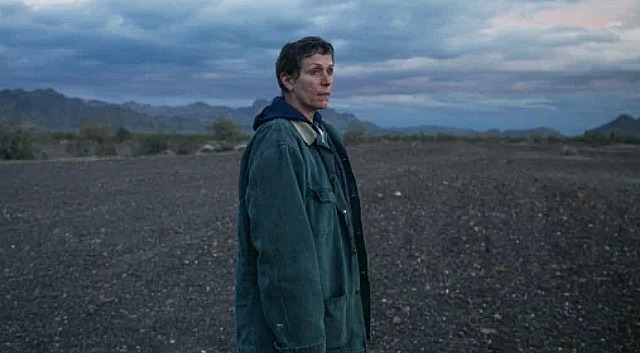
A lot of eyes will be on Chloe Zhao‘s Nomadland when it plays the 2020 Venice Film Festival, and thereafter the all-virtual Toronto Film Festival plus the NY Film Festival. Based on Jessica Bruder‘s same-titled book and set in the aftermath of the 2009 recession, it’s about a sporadically employed, cash-strapped Frances McDormand roaming around the western regions in a camper. We’re familiar with Zhao’s style and inclinations based on The Rider (’17). Understatement + lethargy + melancholy. Downmarket protagonist of relatively few words in a tough spot, no easy way out of the mire, some kind of difficult decision has to be made, etc. And then a third-act climax that may feel more somber than wowser. Or perhaps not.

“I Can’t Do This Format, Man!”

Bill Maher‘s Real Time discussion with Jim Carrey was a bit crazy. It reminded me of certain phoners I’ve done in which I’ve tried to steer the conversation in certain ways while the person I was interviewing was on planet Neptune. Carrey has always resided in his own realm. Can anyone recall any celebrity interview on Zoom in which the subject went close into the camera lens like Carrey does?

Son of Oval Office Recall

Originally posted on 4.2.08: 25 years ago Oliver Stone did me a great favor, and I’ve thanked him at least two if not three times since. In ’95 he and publicist Stephen Rivers arranged for me to pay a brief visit to the Nixon West Wing — Oval Office, cabinet room, hallways, various offices, etc.

Production designer Victor Kempster had built the amazingly detailed set (including an outdoor portion with grass and bushes) on a massive Sony sound stage.

I was allowed in just after Stone and his cast (including Anthony Hopkins) and crew had finished filming. It was sometime around February or March of ’95. I wrote up my impressions for an L.A. Times Syndicate piece. Nixon opened on 12.20.95.

The Nixon unit publicist (or somebody who worked for Rivers) escorted me onto the stage and left. Nobody was around; I had the place all to myself. I had a video camera with me and shot all the rooms, and took my time about it. I was seriously excited and grateful as hell for the opportunity because it was, in a sense, better than visiting the real Oval Office in the real White House, which I would have never been allowed to do even if I’d been best friends with someone in the Clinton administration.
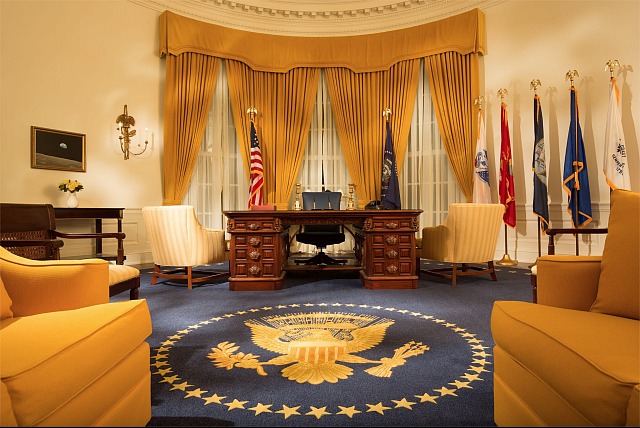

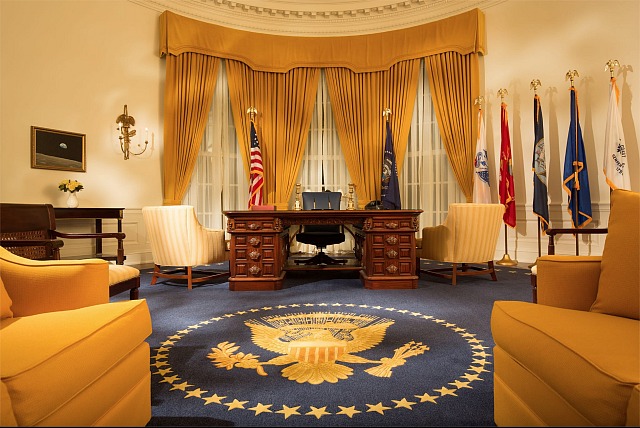
Nixon’s oval office.
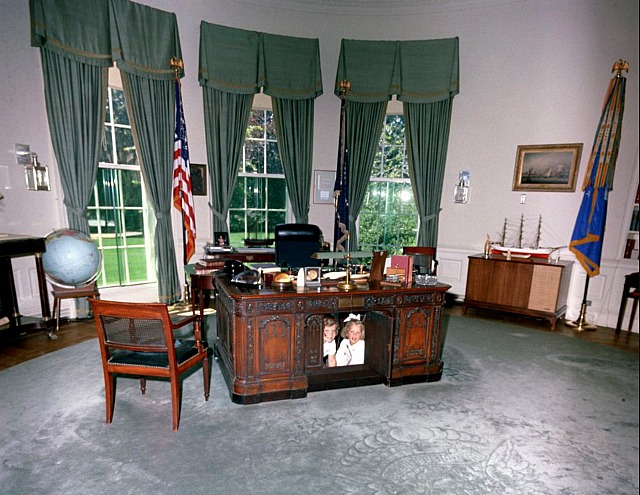
JFK’s subdued variation.

Every detail was Eric von Stroheim genuine. Wooden floors, real plaster, ceilings, rugs, moldings, early 1970s phones, bright gold French aristocracy drapes, china on the shelves and mantlepiece, etc.

Five years later I was granted a visit to a replica of Jack Kennedy‘s West Wing that had been used for the shooting of Roger Donaldson‘s Thirteen Days. It was around the same time of year — February or March of 2000, roughly nine or ten months before the movie’s release in December. The set had been built by production designer Dennis Washington inside a warehouse-type sound stage somewhere in southern Glendale or Eagle Rock.

The difference between the Nixon Oval Office decor — creamy beiges and bright golds, a bright blue rug, gilded bric a bracs on the shelves (which contributed to a kind of effete, faux-aristocratic atmosphere) — and the subdued greens, browns and navy blues of JFK’s office (which even had a replica of the coconut shell that Lt. Kennedy used to carve out a message during his PT 109 adventure) will always stay in my mind.

You can tell a lot about people from the decor in their homes and workplaces. Only an arrogant know-nothing would have chosen the nouveau-riche wooden floor that Bush had installed in ’05. The White House is a place of great history, echoes and ghosts, and it should look and feel like it’s been hanging in there for at least a century or so — stressed floors, old timber and dark varnish, like the early 20th Century and 19th Century homes that are found in the northeast.

These visits were as close as I’m ever going to get to the real Oval Office — they gave me a real organic window into recent history. Even if I’d been invited to the real White House I wouldn’t have had the chance to poke around and study everything at my leisure.

Read more

Stone-Feinberg Deep Dive

In Scott Feinberg’s intro to his THR podcast chat with “Chasing The Light” author Oliver Stone, he mentions an excerpt from a Guardian piece that churlishly described Stone as “a sort of latter-day Ernest Hemingway…an action man with a reputation for women and drugs.” That’s bullshit — Stone is actually one of the most nakedly honest and at the same time deeply vulnerable fellows out there. A spirited adventurer slash poet slash politician slash outsider eccentric. Fascinating to listen to. His chat with Feinberg is perhaps the most illuminating he’s done during the whole book tour so far. I wasn’t expecting much at first, but the interview just takes off.