There are three distinct 21st Century nouveau riche approaches to interior design…three vomit-bag aesthetics favored by socially insecure people with too much money and no taste to speak of. A generally over-sized feeling, gold everything, too many drapes, questionable paintings, gaudy chandeliers, imitation ancient-Rome statues, huge windows, 14 foot tall ceilings, etc.
The offense-givers are (a) Kardashian Splendor (i.e., way too much conspicuous luxury, every nook and cranny designed and furnished like a luxury hotel, the exact opposite of distressed bohemian), (b) Uday and Qusay Hussein Palatial — Middle Eastern gold-and-marble kitsch, more conspicuous luxury, too many mounted 4K flat screens, large fountains and jacuzzis, and (c) Aggressive Putin, or the home stylings of an ostentatious Russian gangster — the main idea is to announce to the first-time visitor, “Look how much man money I have!…trust me, what I’ve spent on this place is only a fraction of my total holdings.”
The first and best known wrong-way freeway car chase happened in William Friedkin‘s To Live and Die in L.A. (’85). Another wrong-way-on-the-freeway happened in John Hughes‘ Planes, Trains & Automobiles (’88), but that was for comic effect. In his 9.3 Tenet review The New Yorker‘s Anthony Lanewrote that while Chris Nolan stages another such chase with panache, “heading the wrong way up a busy road is pretty much a daily commute” for Matt Damon‘s Jason Bourne. Except I’ve done some searching and while there’s no shortage of magnificent car-chase sequences in the five Bourne flicks, there’s no actual wrong-way-on-a-freeway. So thriller-wise there’ve really only been two — Live and Die plus Tenet. Right?
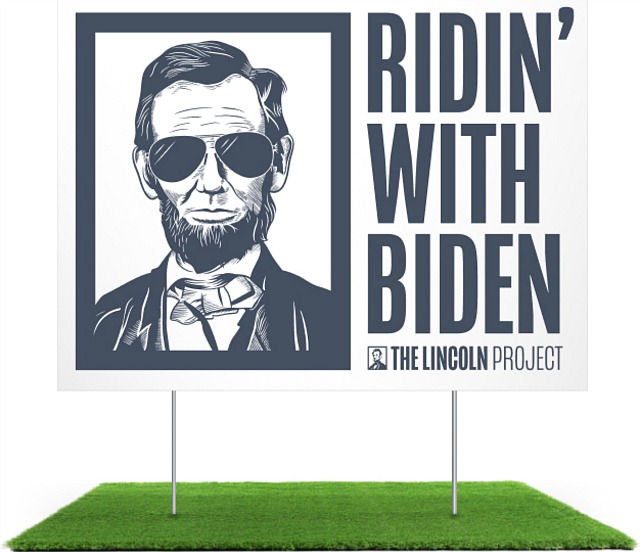
The Trump psychopath factor has led to a battleground-state tightening, although there’s little question that Biden is strongly favored as we speak. Especially with the new Democrat fervor in the wake of Justice Ginsburg‘s passing. Only pessimists and the proverbially panic-stricken are concerned.
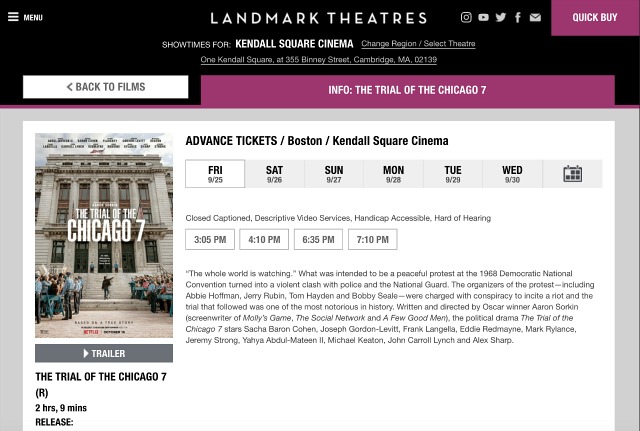
Last week select junket journos were given a peek at Aaron Sorkin‘s The Trial of the Chicago 7 (Netflix, 10.16). It’s also being press-streamed today. But of particular interest are the limited theatrical bookings starting on Thursday, 9.24 and continuing until Wednesday, 9.30. Chicago, Boston, Stamford, Greewniwhc, Hoboken, etc. HE regulars willing to brave an indoor theatre are requested to catch Chicago 7 and offer comments.
Yesterday I posted about an 85-minute doc, Meeting The Beatles in India. The piece was titled “I’ll Kill You, Lennon, You Bastard.” A comment from Variety‘s Chris Willman mentioned that a portion of the doc briefly dealt with allegations about sexual misbehavior on the part of Maharishi Mahesh Yogi, and yet Willman passed along observations from others that this portion may (emphasis on the “m” word) have been removed from the PPV version.
This morning I wrote a Facebook note to Paul Saltzman, director of Meeting The Beatles in India, which Gathr is now offering PPV streaming access to the film. I also wrote the film’s publicist, Maggie Begley.
“Paul — Greetings from Jeffrey Wells of Hollywood Elsewhere. On 9.9 Variety‘s music critic Chris Willmanreviewed your Meet the Beatles in India doc. I riffed on the film yesterday, and here’s what Willman said in the HE comment section:
“‘When I reviewed the film, I made mention of a section toward the end that brings up the allegations against the Maharishi and then explains it away to sabotage by Magic Alex that spoiled a good thing.
“‘I then heard from people who watched the film upon its PPV opening that said this section I described was no longer in the film, and viewers were left thinking that everything ended happily. I’d be interested to hear from anyone else who saw the film which cut they saw.’
Willman is a totally reliable, first-rate journalist so I’m taking his word for this, or at least regarding what he says he’s been told. Have you in fact removed the referred-to portion of your doc? If so, do you have any comment or explanation as to why this was done?
“The Maharishi is portrayed only in a positive light, although there’s a passing reference to the nasty song Lennon wrote about him immediately after the sojourn, ‘Sexy Sadie,’ before Saltzman fleetingly addresses the still hot-button topic of why some of the group members fell out with the guru, which had to do with the Maharishi allegedly making moves on women in the compound. The apologia offered by Saltzman and Lewisohn is that a peripheral figure in the Beatles’ entourage, ‘Magic Alex,’ spread false stories about the holy man, though [Alex] told a very different accounting of the fallout (and sued The New York Times over a description similar to the one offered here) before he died in 2017.”
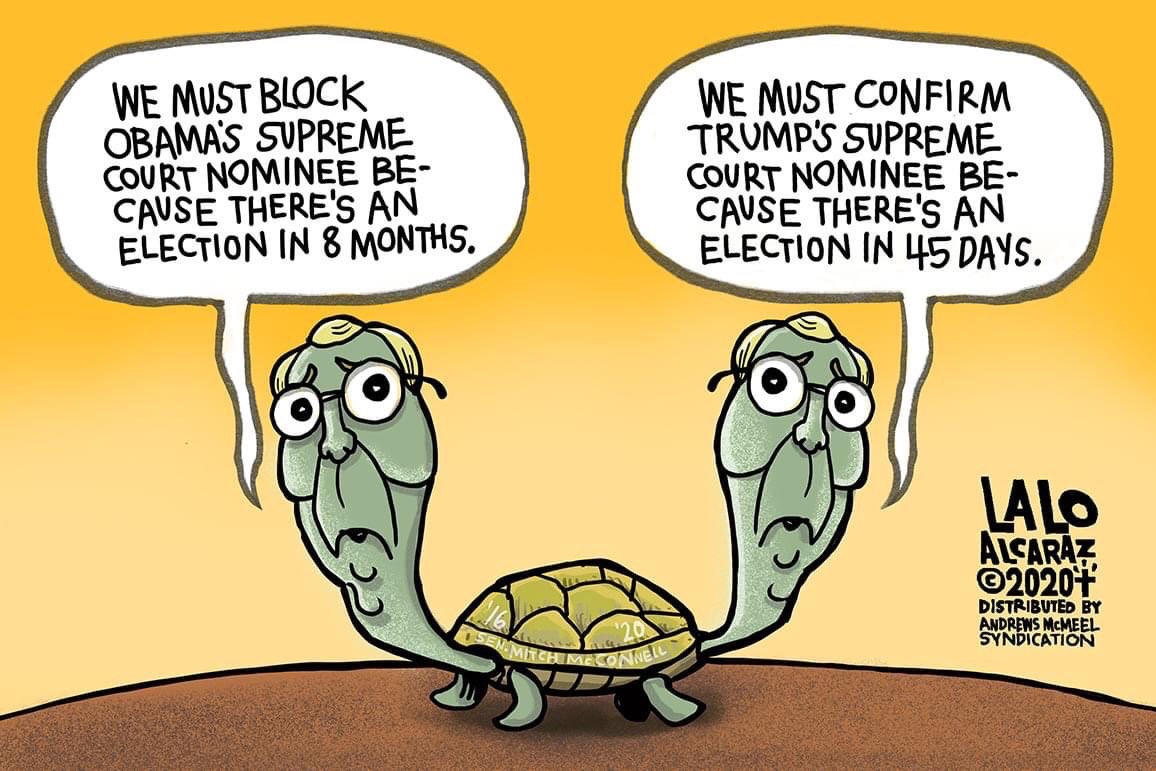
The only way to stop the Supreme Court confirmation process, at least until after the election and perhaps into January or beyond the 1.20.21 inauguration, is for the Democrat-controlled House of Representatives to initiate impeachment proceedings against Attorney General William Barr, which would have been warranted anyway. Seriously — what other blocking option is there? Re-impeach Trump?
During 89 years of life and a distinguished 60-year acting career, Michael Lonsdale hits the jackpot twice — as Deputy Commissioner Claude Lebel in The Day of the Jackal (’73, filmed when he was 43 years old) and especially as the blustery counselor Grigoriev in the 1982 Smiley’s People miniseries. (I’m sorry there’s no HD version of the below scene with Alec Guinness.) Lonsdale had a mere 25 or 26 minutes of screen time, but what a lasting impression.
I don’t even remember his Bond villain performance in Moonraker (’79); nor do I recall his performance as M. Dupont d’Ivry in The Remains of the Day. I’m sorry but neither made a strong imprint.
If I were teaching an NYU film school course in “How To Write An Amusingly Snooty Pan,” I would have the students study Guy Lodge‘s withering Varietyreview of Woody Allen‘s Rifkin’s Festival. It’s not only masterfully written, but it conveys the spiritual fatigue that Guy was grappling with as he watched Allen’s 49th film, ands especially when he sat down to put his reactions to pen.
As I danced through it I was thinking, “Woody has made Guy suffer, but Guy has magnanimously not turned around and made his readers suffer in kind…he’s taken the Allen lethargy and converted it into something spryer and perhaps even funnier, I’m thinking, than what the film passes along.”
Excerpt: “Following Wallace Shawn and a typically jumbled grab-bag of fine actors as they mosey around the San Sebastián Film Festival — for which the film acts as an extended promo, duly opening this year’s edition — Rifkin’s Festival is a scenic summer-wind romcom that was presumably a good time for everyone involved. Saying the same for the audience would be a stretch, but on the spectrum of late Woody Allen clunkers, it registers on the mild, instantly-evaporating end of the scale, unlikely to change the positions of any loyalists, detractors, ex-fans or distributors with regard to the controversy-tailed filmmaker.
“Those who still turn up” — i.e., Guy understands your Kate Winslet-like ignorance animus and wouldn’t be surprised if you decide not to see the film, especially given the fact Woody’s been on a creative downslide since Midnight in Paris — “will be met with a blend of exhaust fumes from past Allens (and not even major ones, with Celebrity and Vicky Cristina Barcelona surfacing amid the recycled material), and a couple of sly one-liners in search of a peak-era script. These are the expectations now, and for better or worse, they are met.”
Legendary cinematography Michael Chapman, longtime creative ally of Martin Scorsese, Philip Kaufman, Robert Towne and Paul Schrader, has passed at age 84. His most significant credits happened in the ’70s and early ’80s heyday, basically over a ten-year stretch — The Last Detail, The Front, Taxi Driver, The Last Waltz, Invasion of the Body Snatchers, Fingers, The Wanderers, Hardcore, Raging Bull (Oscar nominated for Best Cinematography), Personal Best…and then movie culture started to become corporatized and corroded. Chapman kept plugging until ’07 or thereabouts, but the last half-decent film he worked on was Andrew Davis‘s The Fugitive.
“The aspect of Hopper/Welles that is bound to cause confusion among some reviewers and ordinary viewers who don’t know Welles’s work well or aren’t familiar with the shooting of The Other Side of the Wind is that most of the time in the documentary, Welles is sitting in for Hannaford. He told me that August that he hadn’t decided whom he would cast in the role of the aging macho director trying to make a comeback in the New Hollywood, but that it would be ‘either John Huston or Peter O’Toole doing his imitation of John Huston.’
“Since he didn’t settle on Huston (the perfect casting for the legendary, gruff old cynic) until early 1974, we had to play scenes to Welles off-camera as Jake, as Hopper does here (you can tell at one point that Welles is thinking about Huston, because he addresses Hopper as ‘Kid,’ Huston’s favorite all-purpose greeting). Sometimes Hopper addresses him as Jake and makes teasing comments about him, but sometimes he seems baffled whether he is speaking to Jake or Orson, as some viewers will be too. The danger in this approach is confusing Hannaford’s often reactionary, fascist, and racist views with Welles’s own. If you think viewers can sort out this complexity on their own, you’re mostly mistaken, since numerous reviewers of Other/Wind were confused by Hannaford’s blatant sexism, assuming Welles shares his views, even though the film is, as Welles told his longtime associate Richard Wilson on the set, ‘an attack on machoism.’
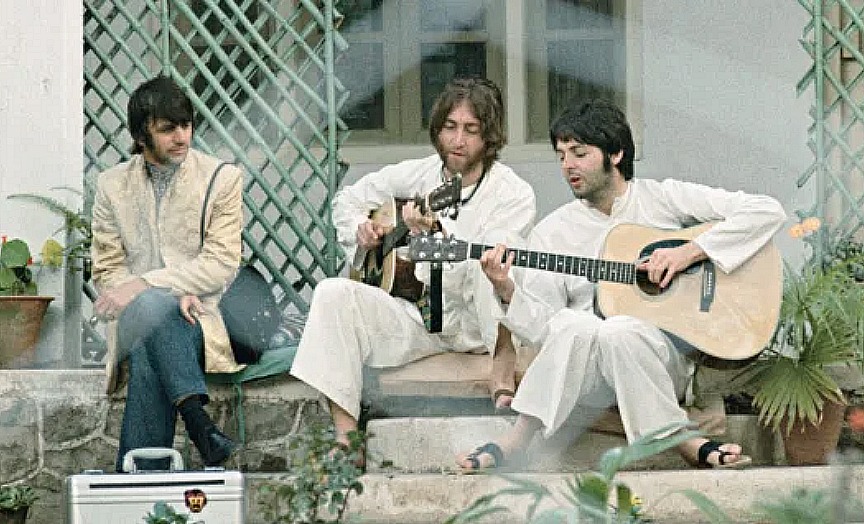
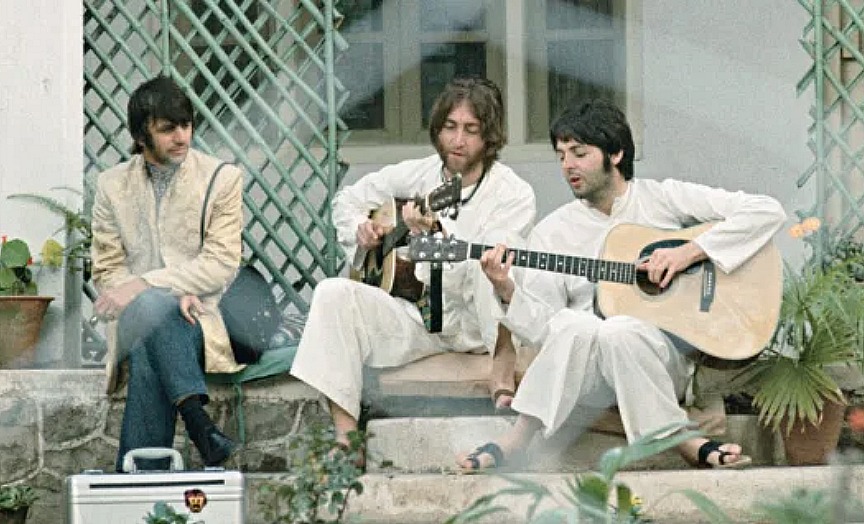
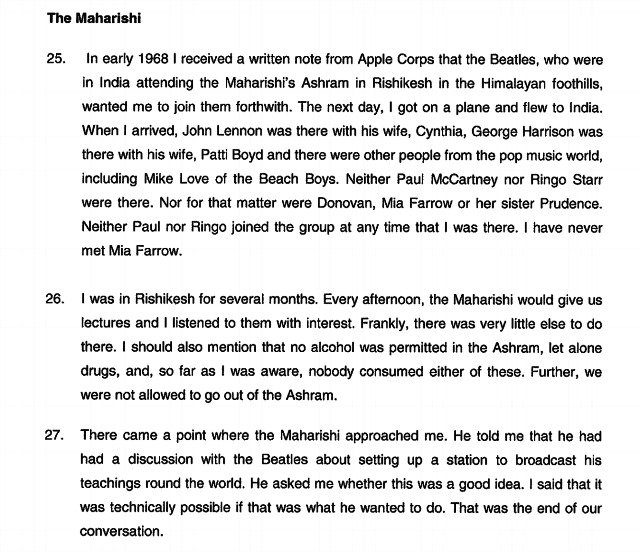
I’m mildly interested in visiting the now-abandoned Indian ashram of Maharishi Mahesh Yogi (aka “Sexy Sadie”) and the specific areas where the Beatles, the Farrow sisters, Mike Love and other transcendental meditation followers visited between February and April, 1968. Meditating, relaxing, writing songs, smiling cosmic smiles and considering inappropriate sexual behaviors. Why not, right?
“The book ‘Maharishi & Me: Seeking Enlightenment with the Beatles’ Guru‘ cites witnesses saying Mia Farrow told them he made a pass at her, and stroked her hair. She even came up with a memorable line — ‘Listen, I know a pass from a puja.’
“By the time John Lennon remembered it for ‘Lennon Remembers‘, the hullabaloo turned into a game of telephone with stories of Maharishi “trying to rape Mia Farrow or trying to get off with Mia Farrow and a few other women, things like that.’ The Beatles were happy writing songs in spiritual solitude. ‘Then everything went horribly wrong,’ Pattie Boyd wrote in her memoirs ‘Wonderful Tonight: George Harrison, Eric Clapton, and Me‘. “Mia Farrow told John she thought Maharishi had been behaving inappropriately,” Boyd wrote. ‘I think he made a pass at her.’
The incident with the Rosemary’sBaby star happened on her birthday — February 9, 1968. The Maharishi would always do Puja for people who were close to him. (The Puja is a ceremonial invocation of the spiritual lineage.) After the Puja, he stroked her hair — or so Farrow reported. In Farrow’s autobiography ‘What Falls Away‘, she writes that the Maharishi also put his ‘hairyarms‘ around her.
“According to ‘Lennon Remembers‘, John and his fellow meditators ‘stayed up all night discussing [if it was] true or not true. And when George started thinking it might be true, I thought, ‘Well it must be true, ’cause if George is doubting it, there must be something in it.’
“John threw a hissy fit. ‘Come on, we’re leaving,’ Boyd wrote in her memoir. ‘Then Magic Alex claimed that Maharishi had tried something with a girl he had befriended.
“’So we went to see Maharishi, the whole gang of us the next day charged down to his hut, his very rich-looking bungalow in the mountains,’ Lennon told Jann Wenner in Rolling Stone. ‘And I was the spokesman — as usual, when the dirty work came, I had to be the leader, whatever the scene was, when it came to the nitty gritty I had to do the leading. And I said, ‘We’re leaving.’
“The guru stopped giggling. ‘He said, ‘I don’t know why, you must tell me,’” Lennon recalled. ‘And I just kept saying, ‘You know why’ — and he gave me a look like, ‘I’ll kill you, you bastard.’ He gave me such a look, and I knew then when he looked at me, because I’d called his bluff. And I was a bit rough to him.’
“Poor Maharishi. I remember him standing at the gate of the ashram, under an aide’s umbrella, as the Beatles filed by, out of his life,” Boyd wrote in her book. “‘Wait,’ he cried. ‘Talk to me.’ But no one listened.”