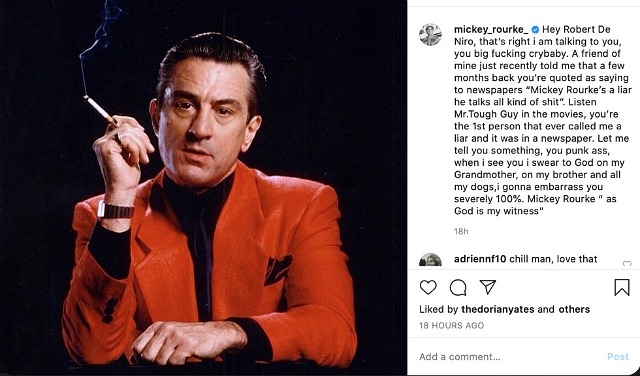
It’s unseemly and unfortunate when a big-name actor promises to embarass another big-name actor. Keep that shit stowed, guys. I was nonetheless impressed when Mickey Rourke recently swore to make life difficult for Robert DeNiro with, shall we say, a special linguistic pizazz.
MR: “I swear to God, on my grandmother, on my brother and all my dogs…i gonna [sic] embarrass you severally 100%.”
Only geniuses invent their own terms, and what Rourke meant by “severally”, of course, was that he would embarass DeNiro several times…over and over, embarassment without end. And who needs “I’m” when you can just say “i”? HE is also stirred by “I swear on all my dogs” — that’s a line that Jack Nicholson might’ve said in The Departed.
I’m also taken by “I don’t look up to [De Niro] no more, I look through him…I look right through his asshole.”
On or about 9.15.19, Rourke told an interviewer for a lightweight Italian interview show called “Live – Non è la D’Urso” that he was “broke,” and that he’s angry that DeNiro zotzed him out of a possible supporting role in The Irishman.
MR: “The casting person told my manager that De Niro said he refused to work with me in a movie.”
West Hollywood Pavilions, three or four evenings ago: Sitting on a curb near the middle of the main parking lot, right next to the rumblehog and facing the market, wearing my bright red James Dean jacket. Mostly phone surfing but also people-watching. Because I was unusually situated or because of the jacket or whatever, three or four people spoke to me.
A 70ish woman whom I suspected of being a tad racist and certainly under-educated began to complain about some younger Pavilions employees who “are clearly not from this neighborhood” and who speak with difficult accents. I wasn’t about to touch this one with a 20-foot pole so I just said “uh-huh,” “yeah”, “I hear ya” and so on. She eventually ran out of gas and walked on.
Then a friendly-faced heavyset guy came along, pointed at the four-year-old Bernie sticker on the bike, and asked if I was a supporter. “No, that’s from ’16,” I said. “I’m actually a Pete Buttigieg supporter…see?” I pointed to a Pete sticker on the rear case. “And a JFK supporter,” I added. “Because the Bernie people probably aren’t going to vote for Biden,” he said. “Who says?” I said. “I haven’t heard that. It’s Biden or Trump. Do they want Trump to win? After Biden gets in they can start agitating for the right kind of candidate in ’24, but they can’t not vote for Biden…c’mon.”
Then a black security guy came over and asked if I was okay. “Yeah….what, I can’t sit here?” Security guy: “You’re sittin’ down, you could be sick or somethin’. It’s my job to ask.” Me: “I’m good. I’m just breathin’ the night air for a bit.” Security guy: “It’s my job to make sure.” Me: “Okay.” Security guy: “So you’re okay?” Me: “So it’s a really odd thing when someone just sits on a curb, huh?” Security guy: “Someone sits down, I gotta ask.” Me: “I’m good, I promise.”
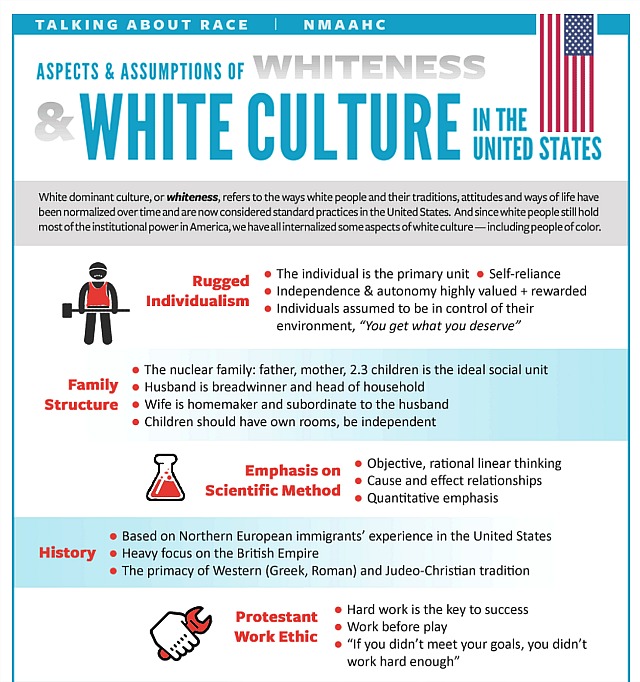
The National Museum of African American History & Culture, an adjunct of the Smithsonian, has posted some instructionals about white culture and behavior vs. non-white culture and behavior. Below is a portion of a NMAAHC chart that explains some of the basics. After looking at it, I couldn’t help but think “hey, I’ve seem something like this before.” It hit me a second later. The NMAAHC chart is in the same general vein as a September 1972 National Lampoon article titled “Our White Heritage,” which was written by Henry Beard, Michael O’Donoghue and George S. Trow. Not exactly the same, but they do seem cut from a similar cloth, certainly in terms of listing white traits and characteristics.
Elvis Presley and Frank Sinatra are in heaven and watching this colorized clip on a 77-inch Sony 4K HDR OLED.
Elvis: I obviously didn’t know when we sang this in ’60, but I only had another 17 years left. Frank: Yeah, I know…sorry, chief. Elvis: How long did you last? Frank: I died in ’98, age 82. Elvis: Shit, I was only 42. Frank: Quality, not quantity. Elvis: I had the quality until I went to see Nixon in the White House. That’s when it all turned sour. Frank: You liked Nixon? Elvis: He was against drug use, and I had to support him for that. Frank: Isn’t that how you died? Elvis: Yeah. (beat) If I’d played my cards differently I could’ve lasted as long as Jerry Lee Lewis. Frank: When did he die? Elvis: He’s still alive! 84 years old, and he was a crazy man in the ’50s. Frank: Genes.
A couple of weeks ago I finally caught up with Kelly Reichardt‘s First Cow. I avoided it at the 2019 Telluride Film Festival and again when it opened theatrically last February, and you know why. I tried to write this review for days and days, but couldn’t. If I was to write a piece about composing this review, I would call it “I Died A Thousand Times.”
We’re all familiar with Reichardt’s minimalist, low-energy mise en scene (Wendy and Lucy, Meek’s Cutoff, Certain Women), and her longtime co-writing partnership with Jonathan Raymond (First Cow is an adaptation of his 2008 book “The Half Life“) and so on. I guess I was intimidated by the prospect of sitting through another under-lighted, fly-on-a-wall, watching-paint-dry flick, especially with an 1820s Oregon backwoods setting. The only thing I was looking forward was the boxy aspect ratio (1.37), which Reichardt always shoots with.
Alia Shawkat** appears in the first scene, which is set in the present-day Oregon woods alongside a large river with a cargo ship cruising by. Shawkat, who doesn’t say a word and disappears within two or three minutes, happens to discover a pair of buried skeletons lying side by side and apparently touching hands. How did this couple happen to expire at the same moment (were they killed? a suicide pact?). And why in the woods? And who were they?
Reichardt never answers the first question, but at least we get to know the couple, “Cookie” (John Magaro) and King Lu (Orion Lee), when First Cow flashes back to the 1820s.
Cookie is an inventive organic chef who’s been making meals for beaver trappers, and King Lu, an Asian immigrant, has killed a Russian guy or something and is hiding from authorities. They become friendly at some trading post, but not in a way that struck me as gay or even especially affectionate. They’re just comfortable with each other, mainly because they’re both unassuming and soft-spoken.
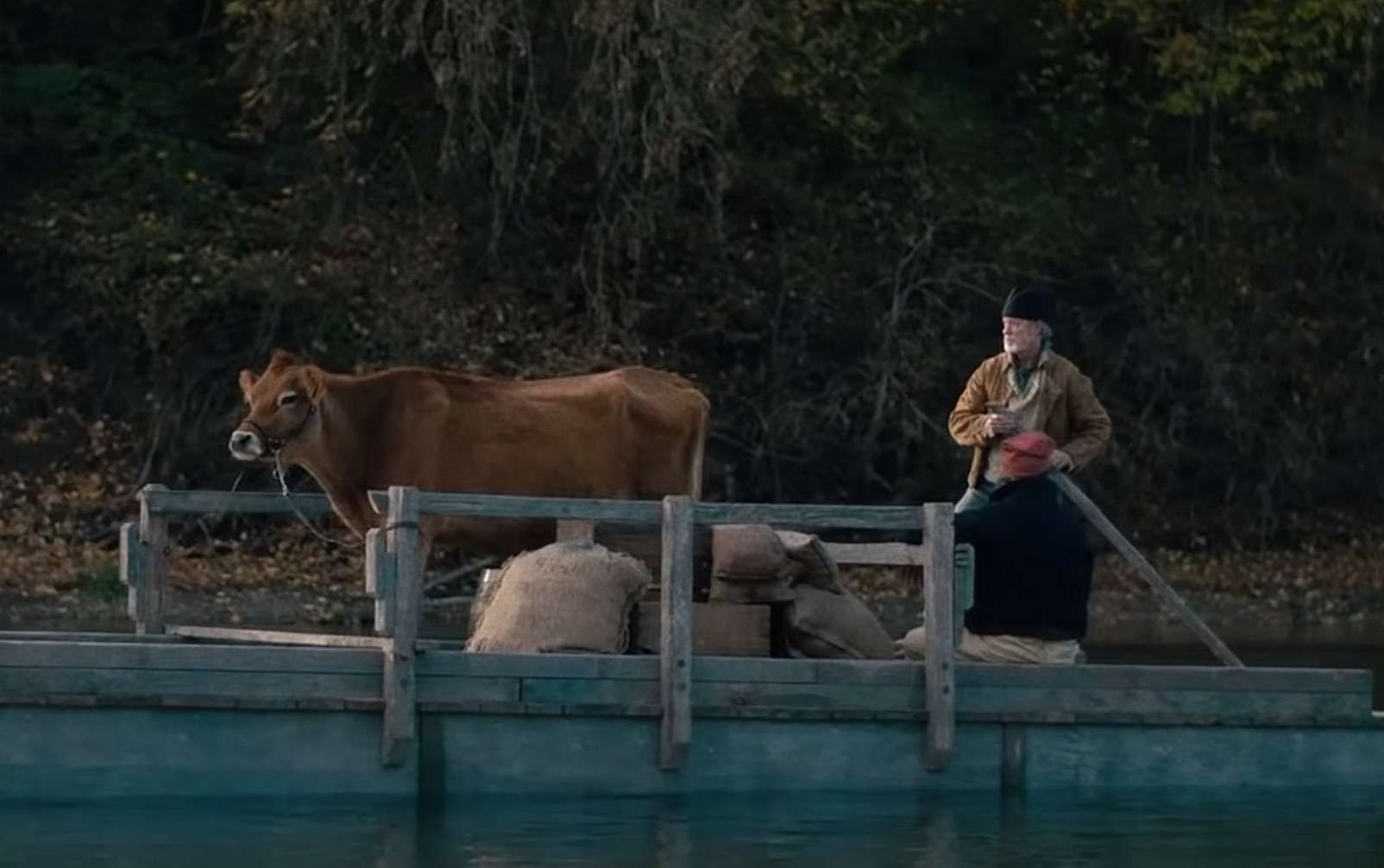
The only “plotty” thing that happens is when Cookie and King Lu, who are not larcenous by nature, decide to surreptitiously milk a skinny brown cow that belongs to a pompous rich guy (Toby Jones). Cookie uses the stolen milk to make tasty muffins of some sort, which they’re able to sell without effort to the local traders and miners (played in part by René Auberjonois, Ewen Bremner, Scott Shepherd, Gary Farmer).
All of a sudden the movie comes faintly (but only faintly) alive because they’re in business, and we actually care what might happen. Imagine!
We know, of course, that Jones will eventually realize where the milk is coming from, and then Cookie and King Lu will be in serious trouble. Do they deserve to be shot for milk theft? That seems to be the consensus among Jones’ pallies once the scheme is discovered, but all that really happens is that (a) Cookie suffers a bad cut on his forehead, which seems to make him weak and wobbly, and (b) an armed Jones ally or employee is seen hunting them in the woods.
This leads to a finale in which woozy Cookie needs to lie down in the woods, after which he appears to pass out and die. King Lu lies down besides him and…what? Wills himself to death for the sake of sympathy or friendship? King Lu: “If you’re going to die in the woods, Cookie…okay, your call. But you’ll need some company as you enter heaven, and maybe if I lie beside you my body will also get tired and give up the ghost? Worth a try. What have I got to live for anyway?”
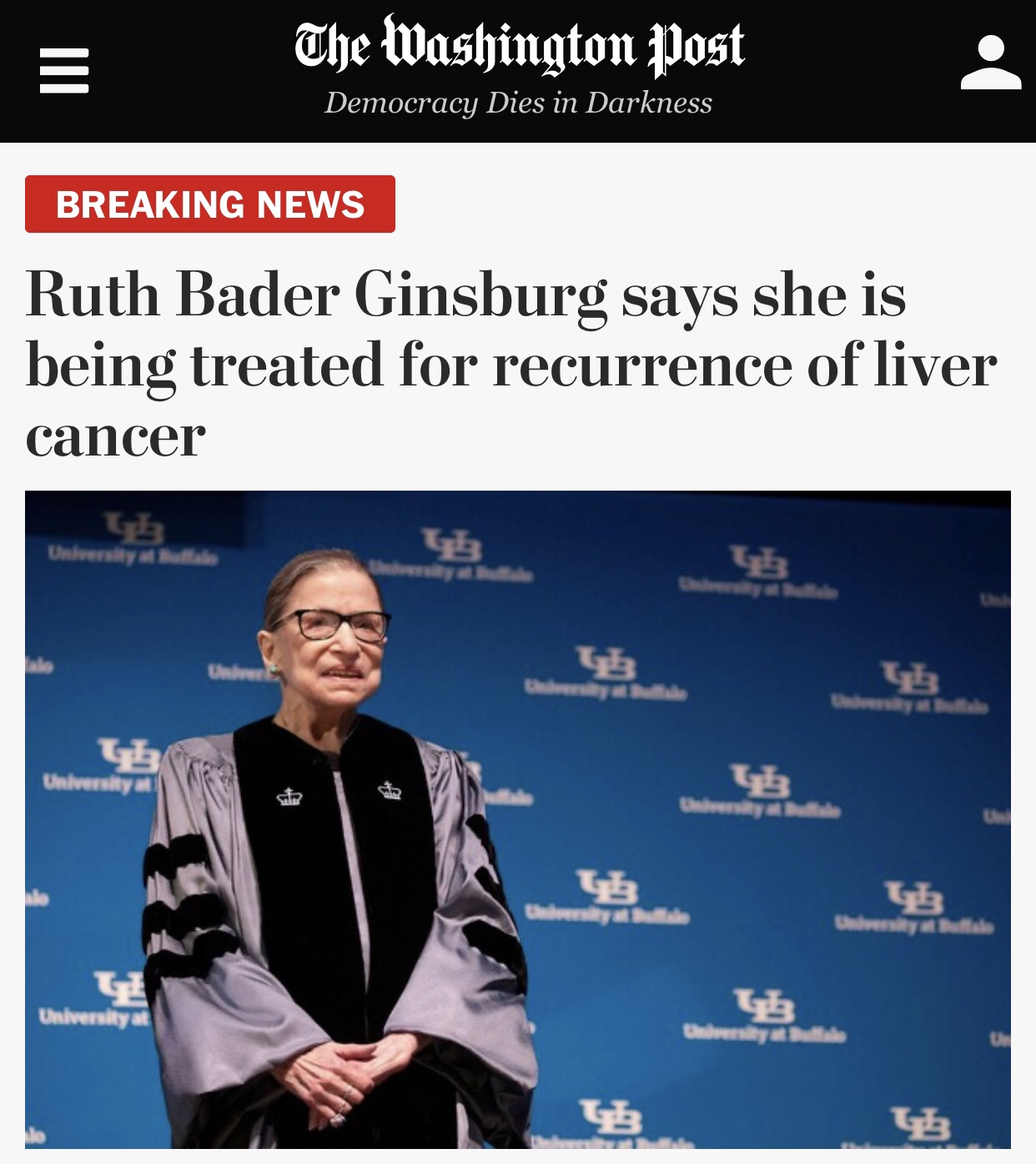
Justice Ruth Bader Ginsburg will hang on and keep going until at least 1.20.21. And presumably beyond. This, at least, is what we’re all hoping and praying for. She’s always been sharp, tough, tenacious. Character is destiny.
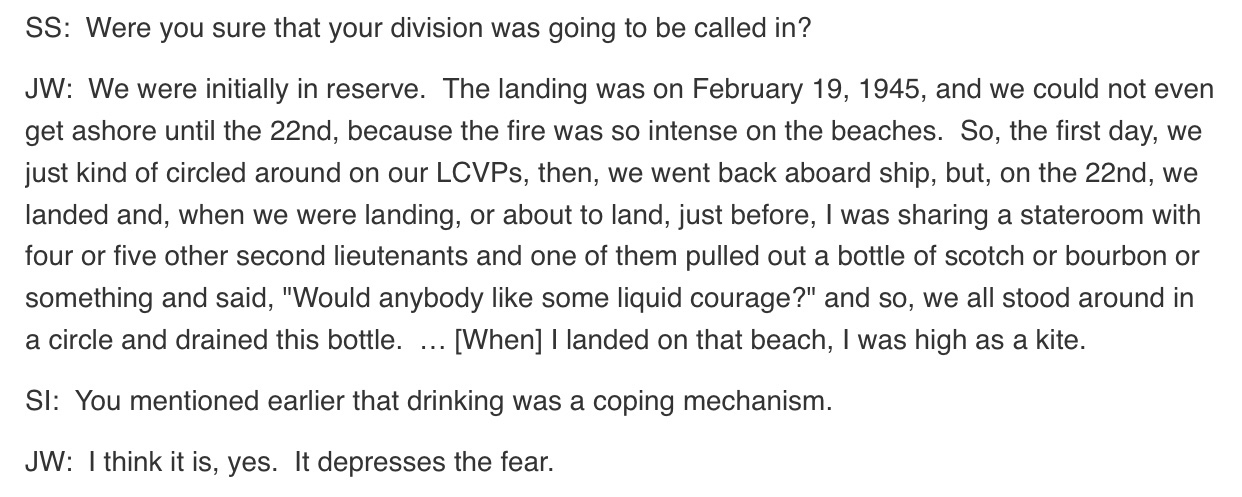
Of all the scores of war movies I’ve seen over the decades, not one has had a scene in which combat troops pass a bottle around before the shooting starts. To punch up their courage. You’d think at least one war film would attempt a scene in this vein, but nope. Martin Sheen drinks in his Saigon hotel room at the beginning of ApocalypseNow but not during the journey upriver. Charlie Sheen and Willem Dafoe get ripped on pot in Platoon, but not just prior to battle.
In ‘04 James Wells, a Marine lieutenant who fought Japanese troops during the battles of Guadalcanal and Iwo Jima, was interviewed at Rutgers University, his alma mater, about…well, his whole life but mainly his college and wartime experiences.
A day or two ago Jett found a transcript of the interview. Here’s one of my dad’s recollections. It happened just before his division was about to land on the beaches of Iwo Jima:
Gus Van Sant‘s 1995 film, based on the 1990 Pamela Smart husband-murder case, struck most of us as a sardonic suburban drama about careless idiots rather than a head-turning noir comedy. It made you smirk from time to time, but it was never intended to be “amusing.” Unless you’re a misanthrope.
The article sells the idea that To Die For is some kind of masterpiece, but my recollection is that it was more in the realm of good — handsomely shot and edited (it was certainly one of Van Sant’s better looking films) and very dry and matter-of-fact — rather than great. The tone was cool and somewhat dismissive of the none-too-bright characters (Nicole Kidman‘s especially), and the feeling at the end is “jeez, what a bunch of delusionals.” The perpetrators, I mean.
We all admired Kidman’s performance as the robotic, icy-mannered Smart, and particularly the naivete and vulnerability conveyed by 20 year-old Joaquin Pheonix, who played Smart’s teenaged lover, Jimmy Emmett, and the killer of her husband Larry (Matt Dillon).
The two indelible images, for me, are (a) Phoenix’s lovestruck, heartbroken expression while being grilled by the cops about his motive for killing Larry, and (b) the frozen face of Smart, killed by a mafia assassin and carried along by river currents, captured through thin ice.
To Die For premiered in Cannes on 5.28.95, opened in Canada on 9.29.95 and then a week later — 10.6.95 — in the States. It cost $20 million to make but only earned $21.3 million at the end of the day,
I haven’t seen it since the Westwood all-media screening, but I’ll be watching it again tonight. Why haven’t I wanted to re-watch until now? I think I’ve explained that.
Did you know that Matt Mulhern‘s Duane Hopwood is a film that people were talking about 15 years ago? And that it played Sundance ’05, and was positively reviewed by both Roger Ebert and Variety‘s Robert Koehler?
But did you also know that other critics were less happy with it, and that the general consensus resulted in 53% and 55% scores on Metacritic and Rotten Tomatoes, respectively?
Did you also know that later that year IFC decided against releasing Duane Hopwood in New York City and Los Angeles, focusing instead on Philadelphia, Tucson and Kansas City? And that the film ended up with a total domestic gross of $13,510?
Earlier today Collider‘s Gregory Lawrencewrote that “if you’re going to watch one New England-set character study about an alcoholic father struggling to regain control and cathartically work through his traumas, watch Duane Hopwood, not Manchester by the Sea.”
Two of Lawrence’s reasons for offering this view, that Manchester is “overlong” and “oppressively morose”, are nothing sort of asinine. One suspects that his main reason is because Casey Affleck, who won the Best Actor Oscar for his Lee Chandler performance, is, in Lawrence’s words, “a noted sexual predator.”
I’m not saying Lawrence is a p.c. kumquat, but he kinda sounds like one.
The bottom line is that no amount of icky (not to mention financially settled and apologized for) behavior on Affleck’s part can possibly negate the effect of his performance or Kenneth Lonergan‘s film. And no amount of Collider spin can enhance the reputation of the smudgy, obviously second-tier, all-but-forgotten Duane Hopwood. There was a reason, trust me, why it wasn’t deemed worthy of a NY or LA opening. One look at the below videos (and a single sampling of Judah Friedlander‘s failed-actor character) tells you everything.
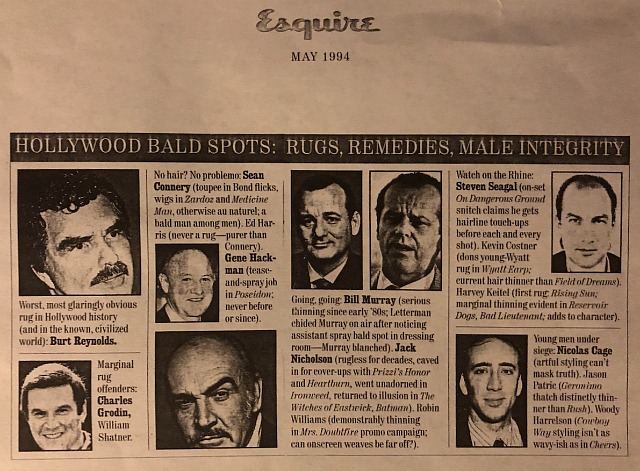
Here’s proof that I’ve been keeping tabs on Hollywood balding trends for a good 26 years. (Although I’ve been focused on such matters since my mid teens, which is when I first suspected that my own follicles might one day be in jeopardy.) I sent a snail-mail pitch to Esquire, and they went for it almost right away. I was paid something like $350 or $400. The same year I began writing a weekly Sunday piece for the N.Y. Daily News entertainment section. I also began a stint as a weekly columnist for the L.A. Times Syndicate, which I did for five years (or until ’99).