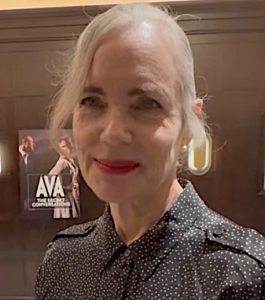
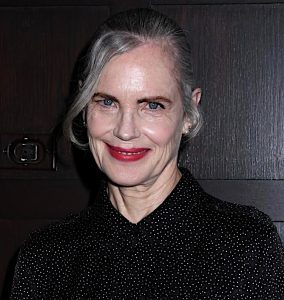
Born on 7.18.61, Elizabeth McGovern was around 18 when she played Jeanine Pratt in Robert Redford’s OrdinaryPeople (9.10.80). A lively career followed, and 45 years have since flown by. McGovern is now about to begin a six-week run in Ava: TheSecretConversations at the New York CityCenter (131 W. 55th Street).
On-stage she resembles the older AvaGardner, wearing a dark and tidy OnTheBeach wig. This Ava actually half-resembles the brunette Elizabeth McGovern who appeared in Cannes in 2012. But she’s gone gray in recent years and is making no effort to hold onto a semblance of her former self.
The truth is that McGovern currently looks like a blend of Jessica Tandy in TheBirds and that care-worn woman who came to take Blanche Dubois to the mental hospital during the finale of AStreetcarNamedDesire.
Not that there’s anything wrong with that.
McGovern is roughly Demi Moore’s age (actually a year older), but she sure as hell hasn’t been taking Substance injections. We’re simply accustomed to famous actresses looking a little bit better for wear, and it’s a wee bit jolting when, out of costume and sans makeup, they appear to be more or less their natural age. Which is not a crime — just a surprise.
OnFridayafternoonIasked Mark Kane, a friend since ‘80 and a devoted fan of Bruce Springsteen from way back, to write about the approach of Scott Cooper’s DeliverMeFromNowhere (20th Century, 10.24), a film about the making of Nebraska:
Kane: “Obviously, I love Bruce Springsteen. I feel connected to him on many levels, and it’s been that way since 1975. I buy all of his music and listen to it over and over.
“That said, I’ve become a little uncomfortable with his increasing deification. It reminds me a little, although the analogy is far from perfect, of what Noah Cross said in Chinatown: ‘Of course, I’m respectable…I’m old.’
“I guess there’s no getting around the fact that Bruce is old too. I don’t think we have many heroes these days, but Bruce seems to fit the bill. And yet rock and roll, as I understand it, wasn’t about being respectable. It was about something much different, perhaps even the opposite of being respectable.
“I also felt Bruce was a good guy, perhaps better than just good, but he wasn’t perfect. He was a guy trying to figure it out, just like we all were, and that was one of the things I loved about him. The evolution of his music showed him trying to figure it out. I could relate.
“Which brings me to Nebraska, which came out in 1982 after TheRiver. At that point, it was another example of Bruce doing his thing. Sure, it was different than his other records but it wasn’t that big a leap to follow Bruce down that dark and dusty road. After all, Dylan had evolved and we all kept up. So had the Beatles.
“The songs on Nebraska were good, and some bordered on great: “Atlantic City”, “Nebraska”, “State Trooper”, “Open All Night”, “Highway Patrolman”. Everyone has their favorites.
“My brother-in-law, a banjo player who isn’t much into commercial rock, was a big fan of Nebraska. I remember him saying that it was the one that made him impressed with Springsteen. Movies have been inspired by the record. The songs have been covered by many other artists, Johnny Cash, TheBand, etc. Ryan Adams has covered the entire record.
“Nebraska isn’t a ‘respectable’ record. It’s an outlaw thing. A recording of someone exorcising demons. The narrators of those songs are fucked up. So it’s a brave record. The lo-fi production values (it was recorded at home) seemed risky. And given the trajectory of Springsteen’s career at the time, just after TheRiver and right before Born In The USA, it was a detour that was surprising and perhaps a little dangerous career-wise.
“Interestingly, Nebraska sold well, soaring high on the charts and becoming certified Platinum. It continues to be revered.
“Which brings me to DeliverMeFromNowhere. I haven’t worked up much enthusiasm so far. The trailer tells us that Springsteen has become such an icon in our society. The movie, as far as I can see from the trailer, is part of the myth-making.
“But the dialogue in the trailer is Hollywood-reverent in a way that makes me somewhat uncomfortable. Jeremy Strong’s (Jon Landau) dialogue in the trailer is…well, I admire his commitment, but it seems kind of silly (‘He’s going to repair the world’).
“I’m sure Jeremy Allen White’s Bruce will be very good. But if I want to see young Bruce Springsteen, I can rent the NoNukes concert video of his performance only, which is truly awesome. I’m not sure I want, or need, to see someone playing Bruce Springsteen at this point. There are still too many ways for me to see Springsteen himself at every stage of his career.
“I also have my memories. Perhaps that is the most important thing. I don’t want the movie to interfere with my memories of what I thought and felt about Springsteen when Nebraska came out.
“In his concerts, Springsteen told us about his relationship with his father. I’ve read the interviews through the years about what he was trying to accomplish with the album. I know about his struggle with relationships. I’ve heard this story before. It’s old news to me in one sense.
“Perhaps the movie will be surprising in ways, but it will still be a movie with an actor and not the real thing. In some ways, this isn’t a movie for me. I guess it’s for a different generation. That’s okay.
“This is similar to the upcoming quartet of Beatles movies. I’m not that interested in seeing actors play the Beatles. AHardDay’sNight is always streaming and it’s great to rewatch and admire it, and them.
“Of course, I’ll probably end up seeing DeliverMeFromNowhere. I’ve always assumed that there would be a movie made some day about Bruce. But for some of the reasons above, I wish it hadn’t been made because Jeremy Allen White won’t be as good in my mind as the original, not even close, and it just interferes.”
In his just-published Clint Eastwoodbook, author Shawn Levy dismisses Breezy (’73), a gentle, deftly handled romantic drama about an affair between William Holden’s 50ish real-estate salesman and Kay Lenz’s free-spirited bohemian, with “ew, just ew” (actually pronounced “eeyooh”).
I really don’t like that kind of thinking or judging about a nicely honed, well-written film that isn’t even vaguely lewd, so here’s what I wrote this morning about the jailbait aspect:
“I think somewhat older guys (10 years older or less) should keep their distance until a woman has hit 20, or her junior year in college.
“That said, there are 30 states in which the age of consent is 16, and 7 states that determine consent can be given at 17. (Connecticut is one of the former.)
“Breezy happens in California (primarily the flush environs of Laurel Canyon and the surrounding hills), where the age of consent is 18. If you accept the film’s narrative about Lenz’s Breezy being 17, Holden is definitely outside the legal zone when their relationship becomes intimate.
“Then again the social perimeters of ‘70s culture, especially in the affluent regions of Los Angeles, were more liberal than in today’s post-#MeToo era, in which taking down or shaking down inappropriately frisky or even half-interested older guys is par for the course. In today’s culture adult males are deer, and every younger woman is armed with a rifle and ready to shoot at the drop of a hat.
“But it wasn’t like dudes in the ‘70s weren’t mindful of the dangers of jailbait. Holden’s real-estate shark is a fairly crusty and guarded type and obviously a social conservative, and yet he doesn’t have a line in which he even ALLUDES to the fact that the age of consent is 18. Does that make any sense?
“Plus it really doesn’t figure that Breezy is 17. She tells Holden that she graduated from high school a year prior to their meeing. It would have been fairly unusual if she’d graduated at 17, but let’s bend over backwards and say she did. It naturally follows she would be 18 when she meets Holden.
“On the face of it, this kind of age gap (roughly 40 years) is unappealing, granted. But it’s the singer, not the song. Eastwood directs and cuts it just so, and Jo Heim’s’ script is nicely sculpted with just the right amount of restraint.”
“Hey Jeff — I watched GrandPrix yesterday. For whatever it may be worth, it STILL is the quintessential car-racing film. Just a technical masterpiece from John Frankenheimer. I caught F1 in IMAX on the 23rd and enjoyed the hell out of it. But GP reaches for and finds a deeper place when it comes to super-fast, 180 mph racing and the competitive human spirit. The racing scenes are absolutelyremarkable in their construction — you really do feel the speed in the final product. I had seen scenes of it before but had never sat for a full viewing, so glad I finally did. Thanks for recommending it.”
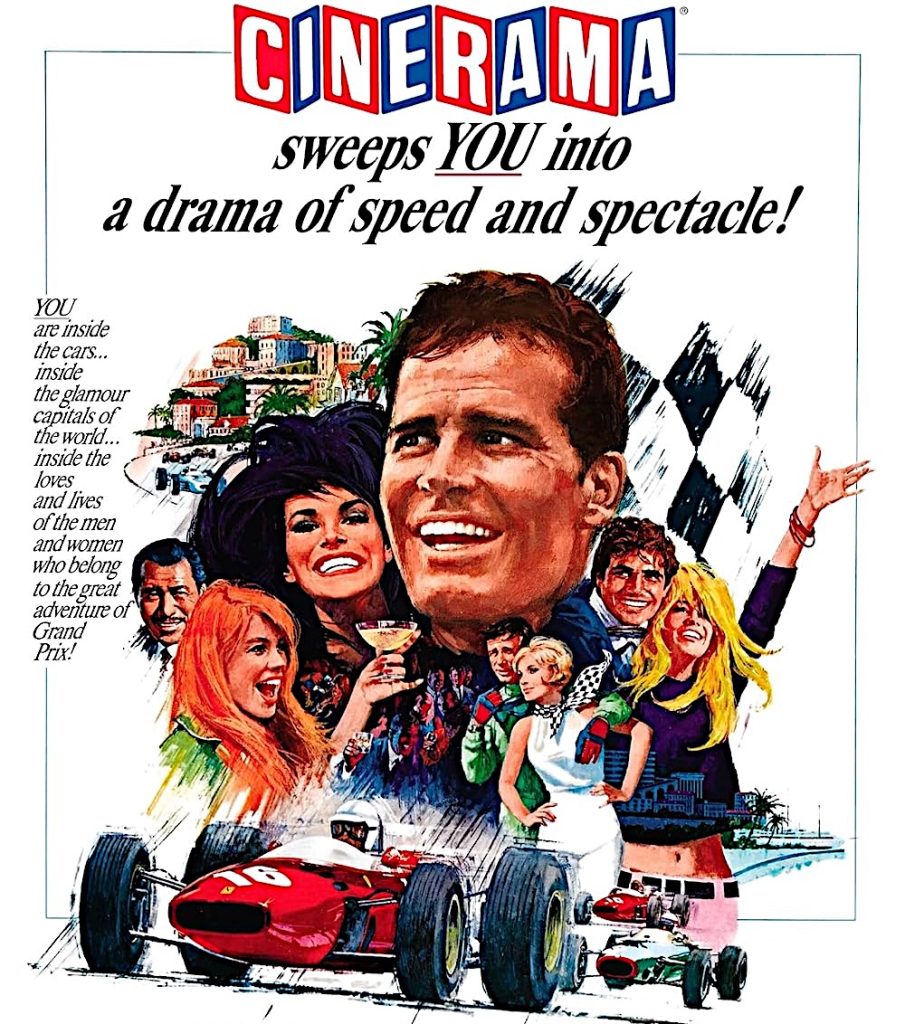
HEtoMGMmarketing (LBJ era): This 1966 poster art is shamelessbullshit The mood of GrandPrix is tense, pensive, anxious, even melancholy at times. “I have a rendezvous with death” = nobody’s having a rollicking good time.
Just for clarification’s sake, Dennis Hopper directed The Hot Spot. To further clarify, I don’t think I’ve ever seen it. Okay, maybe I did see it and put it out of my mind. But if not, maybe I should? A sexually simmering, small town noir-slash-potboiler, based on “Hell Hath No Fury“, a 1953 novel by Charles Williams, who also co-wrote the screenplay.
No firm release date for Apple’s The Lost Bus, but with Paul Greengrass directing you know it’ll be fairly decent, at worst. Greengrass (United 93) doesn’t fool around.
A bus driver (Matthew McConaughey) has to navigate a bus carrying children and their teacher (America Ferrera) to safety through the 2018 Camp Fire, which became the deadliest fire in California history.
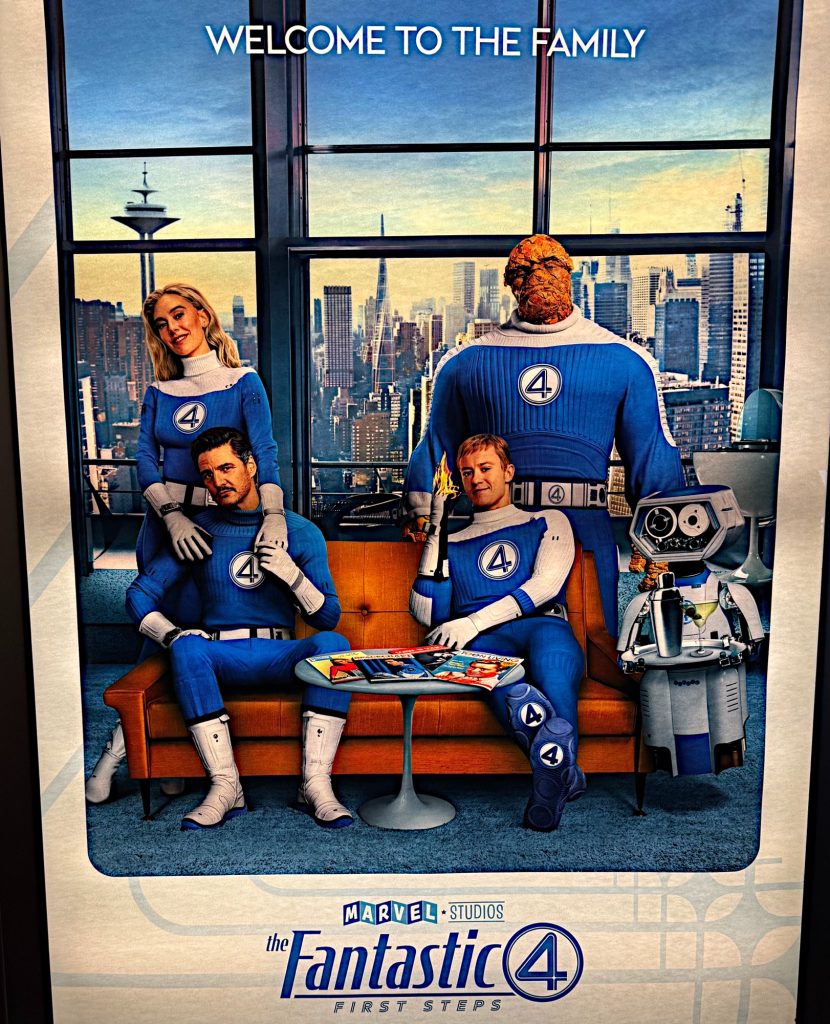
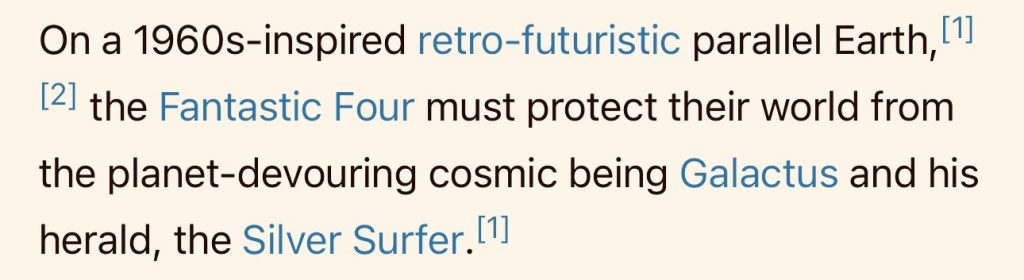
I’m not going to say that I loathe and despise Marvel’s Fantastic Four: First Steps sight unseen, as that wouldn’t be fair or wise, much less patient.
And yet I do kinda feel this way. The light-blue color scheme — it’s basically The Jetsons within a Marvel universe — makes me feel nauseous. But let’s not go there until it screens.
I can at least say this: As one of the Fantastic Four is played by Joseph Quinn, who is destined to sully, vandalize and perhaps ruin the memory of George Harrison when Sam Mendes‘ quartet of Beatles biopics comes out in ’27…I can at least call myself a Fantastic Four hater because of Quinn alone.
Snapped last night inside the big Danbury AMC, prior to catching Ballerina. Obviously the people behind FantasticFour: FirstSteps (Disney, 7.25) have no shame. Has Pedro Pascal ever said no to anything or anyone? And the gingered Joseph Quinn, who will play the physically dissimilar George Harrison for Sam Mendes later this year…this, ladies and germs, is whoredom personified.
Imagine trying to follow or make sense of this Warner Bros. release on its own terms (and with shitty AMC multiplex sound to boot!) when it opens next week.
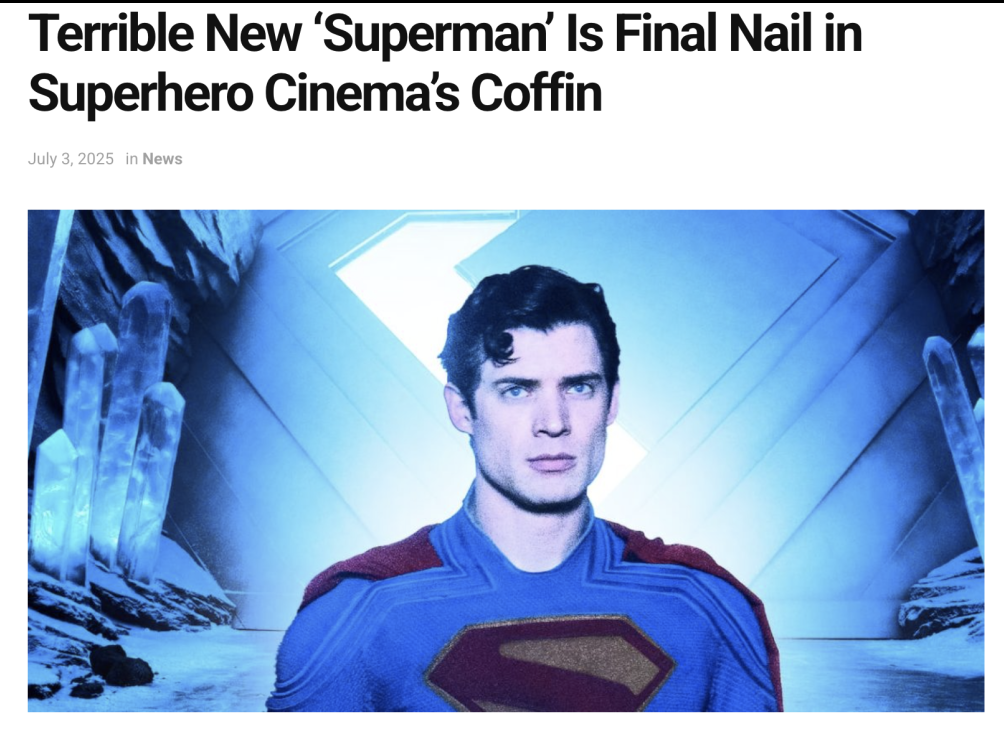
So now that the cat is out of the bag and the Superman review embargo is totally blown, will the trades follow suit today with their own reactions (whether positive, comme ci come ca or negative)? Will trade reviewers try to go a little easy out of sympathy, given the vitriolic tone of Schager’s review?
Here’s Schager’s review: Just as the seemingly indestructible Man of Steel is fatally weakened by kryptonite, so too is the once-unbeatable superhero genre gravely threatened by audience fatigue.
Tasked (alongside Peter Safran) with reinventing Warner Bros’ DC movie brand with an all-new “DC Universe,” director James Gunn strives to combat such lethargy with Superman, a rambunctious reboot of the Action Comics icon that, tonally and narratively, is the exact opposite of Zack Snyder’s grimdark predecessors.
It’s a big swing in a polar-opposite direction, and one that, alas, turns out be as big a whiff, resulting in a would-be franchise re-starter that resembles a Saturday morning cartoon come to overstuffed, helter-skelter life.
Superman’s hero is no brooding Snyder-ian Christ figure; rather, he’s a sweet and sincere do-gooder who uses the word “dude,” takes time out of fighting behemoths to save squirrels from harm, and believes that viewing everyone as beautiful is “punk rock.”
The same goes for Gunn’s film, which is set on an Earth overrun by metahumans, the most powerful of which is Superman (David Corenswet), who at outset crash lands in the Arctic after losing his first-ever fight to an armored adversary known as the Hammer of Boravia—a country whose attempts to start war with neighboring Jarhanpur was recently thwarted by Superman.
Dragged to the Fortress of Solitude by his caped canine companion Krypto, Superman is nursed back to health by his lair’s robot minions, all as he listens to an incomplete recording made by his parents that accompanied him on his initial journey to our planet.
Superman is soon back in the fight, although he doesn’t initially realize that his true enemy is Lex Luthor (Nicholas Hoult), whose unparalleled knowledge of the Kryptonian’s moves and instincts allows him to successfully direct the Hammer of Boravia in their clashes. Following this battle, Superman wrestles with growing political and public outrage over his rash unilateralism, and bristles at the nasty social media campaigns ruining his reputation.
He receives merely moderate support from Lois Lane (Rachel Brosnahan), his Daily Planet colleague as well as his girlfriend, whom he grants an interview only to immediately regret it. Everyone has doubts about the noble titan, including Green Lantern Guy Gardner (Nathan Fillion), who dubs him a “wuss” for wanting to study rather than kill a fire-breathing goliath, and who is partners with genius Mister Terrific (Edi Gathegi) and warrior Hawkgirl (Isabela Merced) in a trio he’s desperate to dub the “Justice Gang” (and whose headquarters is the classic Super Friends Hall of Justice).
Luthor is in league with the president of Boravia, whom he visits via portals through a “pocket universe” that he’s created, damn its potential to beget a reality-destroying black hole. He’s also determined to turn humanity against Superman by executing a scheme that raises nature-vs.-nurture questions this tale doesn’t seriously address.
Despite his enmity for metahumans and, particularly Superman, Luthor is aided in his quest by two superpowered minions, the nanotechnology-enhanced Engineer (María Gabriela de Faría) and the mute, masked Ultraman, who partake in some of Gunn’s elastic, hyper-speed skirmishes.
Superman doesn’t skimp on the high-flying action, to a fault; the film is so awash in over-the-top CGI insanity that its slam-bang mayhem loses its punch. Not helping matters, the charming Corenswet looks the part but, in the shadow of Christopher Reeve (whose son Will cameos) and Henry Cavill, he comes across as relatively slight—a situation exacerbated by the all-over-the-place nature of his saga.
Superman doesn’t establish its scenario so much as it situates viewers in media res and then asks them to hold on for dear life as it whiplashes about from one out-of-this-world locale and incident to another. While verve isn’t in short supply, substantiality is; by not first building a foundation for its fantasy, the film feels as if it’s operating in a comic-book sandbox devoid of any (literal or figurative) gravity.
That continues to be the case as Superman finds himself at the mercy of Luthor and is compelled to partner with the Justice Gang as well as Metamorpho (Anthony Carrigan), a shapeshifting creature whom he meets in an interdimensional prison that boasts an “anti-proton river,” and who asks him to rescue his giant-headed infant son from Luthor’s minions.
DC Comics die-hards may delight in Superman’s endless geekiness but everyone else is apt to feel adrift or, at least, along for a frenetic, flimsy ride that only feigns interest in actual emotion. Superman and Lois’ relationship gets about as much attention as do sequences in which the Daily Planet reporter flies a spaceship. And interjected into the middle of colorful chaos and madness, a trip back to Smallville to visit Ma (Neva Howell) and Pa Kent (Pruitt Taylor Vince) is too sketchy to generate aww-shucks pathos.
Unfortunately, the proceedings aren’t better when it comes to humor; though Gunn continues to be adept at balancing multi-character concerns, his script — unlike his superior Guardians of the Galaxy trilogy and 2021’s The Suicide Squad — delivers scant amusing one-liners or gags, save for cute Krypto’s habit of excitably wrestling and licking Superman at the least opportune moments.
With a chrome dome and a cocky sneer, Hoult makes for a faithful Luthor. However, as with Brosnahan and Skyler Gisondo as Jimmy Olsen—who has a straining-to-be-funny subplot involving Luthor’s selfie-loving girlfriend Eve (Sara Sampaio)—his performance is overwhelmed by the material’s endless sound and fury.
Zipping this way and that, Superman gets tangled up in fanciful nonsense that soon renders the entire affair superficial and silly. Similar to Snyder and Joss Whedon’s misshapen Justice League, Gunn’s spectacular overpopulates itself with heroes and villains it has neither the time nor the inclination to develop. Consequently, everyone and everything is two-dimensional, no matter that the director’s imagery is sharp and vibrant.
John Williams’ classic theme from Richard Donner’s 1979 Superman is heard (in different forms) throughout, yet it’s incapable of lending the scattershot film the magic it needs. Biting off more than it can chew, Gunn’s wannabe-blockbuster eventually resorts to setting up future franchise installments via quick-hit appearances from Maxwell Lord (Sean Gunn) and Supergirl (Milly Alcock). That’s not to mention by highlighting second-banana figures like Mister Terrific at the expense of fully establishing the altruistic heart of its protagonist, whose path toward self-actualization is mostly an afterthought.
Looking ahead rather than focusing on the here and now, this attempt at reimagining DC’s movie series ultimately proves to be more of the same old interconnected-universe bedlam that, at this point, is perilously close to going out of fashion.
WB’s Superman review embargo ends on Tuesday, July 8 at 3:00 pm eastern.
In a certain vague sense, I was “there” when this Arthur scene was shot on Fifth Avenue and 59th Street. It was the summer of ’80 and I was anxious and under-employed. I was standing across the street with several other onlookers, and I recall watching Liza Minnelli, Dudley Moore and John Gielgud performing this scene two or three times. I can still hear Minnelli yelling “get me a cop!”, over and over….the clapper, “cut”, etc.
I remember staring at Gielgud between takes, parked on a canvas chair, and wondering why he was sitting so stiffly…motionless, like a sphinx. Then I saw the film a year later, and Gielgud’s snooty putdown riffs were hilarious. He and Minnelli had the funniest lines.
“Dudley Moore‘s drunken playboy was funny in 1981’s Arthur, but less so in 1988’s Arthur 2: On The Rocks. Arthur was a fresher film, of course, with a kind of champagne-fizz attitude. The sequel was boozier and more “real.” Moore was obviously older in ’88, his career wasn’t going quite as well, the performance felt desperate and the mood wasn’t the same.
“Drunks aren’t funny in real life unless you’re 19 and hanging with your drunken friends and as drunk as they are. You have to be fairly young and unsullied.
“True story: I was staying with some friends at a beach house on the Jersey shore when we were all 17 or thereabouts, and there was this big guy named Richard Harris who was half-sitting and half-lying on the living-room couch and about to throw up from too much vodka. I was coming down the stairs and Harris was suddenly on his feet and making for the bathroom (or at least the kitchen sink), but he wasn’t fast enough.
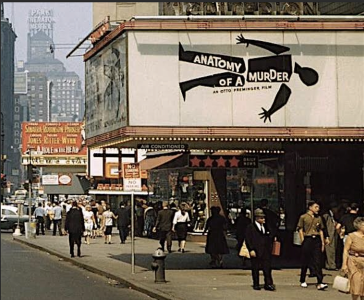
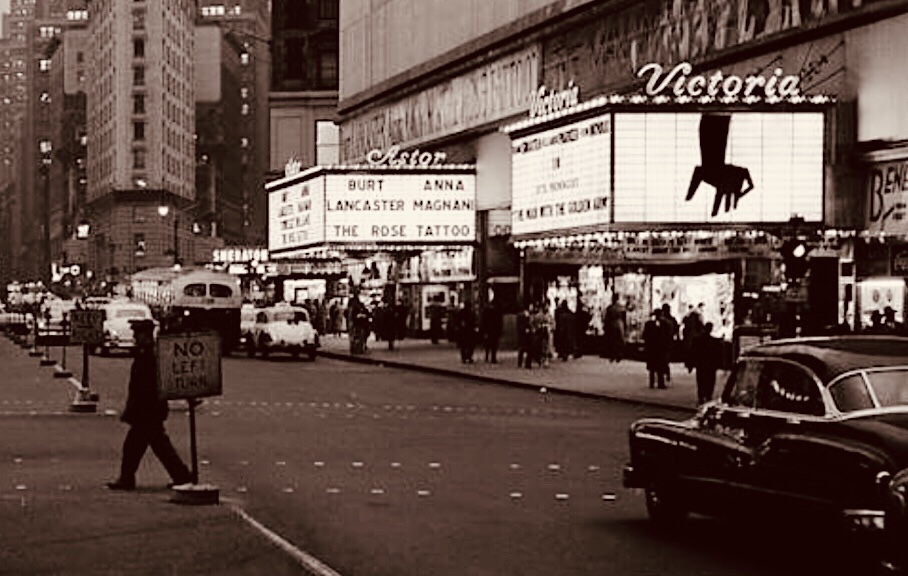
In the good old Times Square of the ‘50s and ’60s, the movie marquee sell — the visual presentation of the theme or tone of the film — made a big impression. It conveyed attitude and confidence. It meant a lot.
In the case of Otto Preminger‘s Anatomy of a Murder, it’s noteworthy that Columbia distribution execs felt that Saul Bass‘s austere, monochrome logo for this 1959 film (opened on July 2nd) was the way to go.
Frank Capra‘s A Hole in the Head, playing one block to the north at Leow’s State, opened two weeks later (July 15th).
You also have to admire the marketing chutzpah of the distribution executive who calculated that a visually concise Saul Bass logo (is there any other kind?) would be more than sufficient to attract Times Square passers-by. You have to admire the certainty and the confidence. The applicable term is “balls.”
The point was that the distribution guys were so confident that Saul Bass’s twisted arm logo had penetrated the marketplace that they figured they didn’t need to spell out the title to sidewalk traffic. Yes, the east-facing front of the Victoria marquee spelled it out, but that side wasn’t seen as much as the north and south facers.
In A.O. Scott‘s N.Y. Timesreview of Shawn Levy‘s “Clint“, he notes that Levy’s judgments “mostly follow the critical consensus, but the mini-reviews embedded in the narrative are among the most amusing and illuminating parts of the book.
“Levy can be witheringly succinct: ‘Ew. Just ew’ sums up his view of Breezy (’73), Eastwood’s little remembered third feature as a director. (It’s about a middle-aged man’s sexual awakening with a 17-year-old flower child).”
Correction #1: Scottisdeadwrong. Breezy is about a middle-aged man’s (William Holden) spiritual awakening by way of a relationship with a 17-year-old hippie chick (Kay Lenz). They eventually become lovers in Act Two, yes, but Eastwood gently de-emphasizes the sexual aspects of their relationship. It’s a story about emotionally opening up.
Correction #2: Breezy isn’t even a slight “ew” — it’s modest and character-driven and entirely effective for what it is. I hate Holden’s ’70s wardrobe (orange sweaters, checked pants, elephant collars) and his real-estate hustler scowls a lot (Lenz’s hippie-chick calls him “dark cloud”) but it’s an honestly felt, medium-range thing, and a better-than-decent effort on Eastwood’s part.
The pacing is natural and unhurried, and the dialogue is nicely sculpted for the most part. It was also the first film Clint directed in which he didn’t star.
Holden’s performance as Frank Harmon, a cynical real-estate agent, radiates a solid gravity force in every one of his scenes. I’m particularly fond of a moment in which Harmon and a real-estate colleague are discussing some hippie kids who are frolicking nearby. Harmon offers a sardonic two-word assessment: “Low tide.”