Al Kooper’s “Like A Rolling Stone” Tale

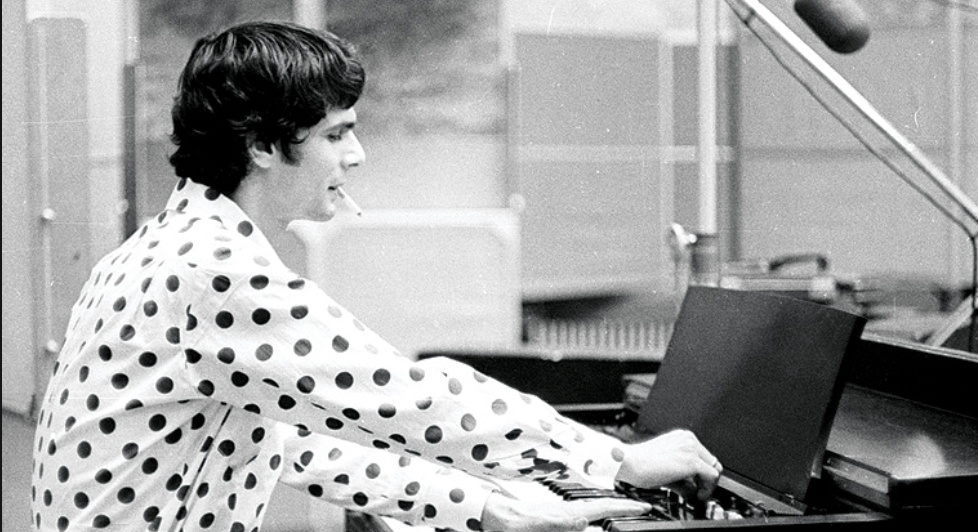
The Hammond organ track that made history. Ignore the horrific first 30 seconds and just cut to Al Kooper‘s story. 21 years old, June 16, 1965. Columbia Records, 799 Seventh Avenue, Studio B. It was included in Martin Scorsese‘s No Direction Home doc, but this is a more complete telling.

Boilerplate: “When Dylan heard Like A Rolling Stone played back, he insisted that the organ be turned up in the mix, despite [chief engineer] Tom Wilson‘s protestations that Kooper was ‘not an organ player.’ Dylan: “I don’t care who he is and what his experience level is…turn it up.”

Read more

“Joker” Is Oscar Nom Champ; Followed by “Irishman”, “Once”, “Parasite”

Todd PhillipsJoker has landed more Oscar nominations than anyone or anything — 11 of these babies including Best Picture, Best Director for Phillips and Best Actor for Joaquin Phoenix. Which leads one to imagine that it might conceivably win the Best Picture Oscar…right? Best Picture handicappers have ignored this possibility all along, but it’s obviously on the table.

Martin Scorsese’s The Irishman (yowsah!), Quentin Tarantino’s Once Upon a Time in Hollywood (okay) and Sam Mendes1917 (yup) snagged 10 nominations each. Jojo Rabbit, Little Women, Marriage Story and Parasite landed six each.

The Best Director nominees are all dudes — Martin Scorsese for The Irishman, Quentin Tarantino for Once Upon a Time in Hollywood, Bong Joon-ho for Parasite, Sam Mendes for 1917 and Todd Phillips for Joker.

Marriage Story and Little Women landed Best Picture nominations (congrats), but no respective Best Director noms for Noah Baumbach or Greta Gerwig. Both, however, scored screenwriting noms — Gerwig for Little Women (adapted) and Baumbach for Marriage Story (original).

No Best Supporting Actress nom for HustlersJennifer Lopez! Snubbed, ixnayed, frozen-out, brushed off, given the go-by and the bum’s rush. Everyone thought JLo was locked down. Where exactly did she go wrong? What did she fail to do? Her fans are shrieking, howling, reeling in shock.

Then again Kathy Bates‘ supporting performance in Richard Jewell was nominated; ditto Jarin Blaschke‘s cinematography for The Lighthouse.

Back to #Oscarssowhite…right? With the exception of Harriet‘s Cynthia Erivo being Best Actress nominated, woke quota mandates were pretty much ignored. Gerwig wasn’t Best Director-nominated but who would seriously argue that Harriet director Kasi Lemmons was in any way, shape or form shafted? The universal opinion is that Harriet is nowhere near good enough. The Khmer Rouge quota commissars have a point as far as the overlooking of The Farewell‘s Lulu Wang is concerned.

Best Supporting Actor: Tom Hanks (A Beautiful Day in the Neighborhood), Anthony Hopkins (The Two Popes), Al Pacino and Joe Pesci (The Irishman), Brad Pitt (Once Upon A Time in Hollywood). Pitt has this, of course.

Best Picture: Ford v Ferrari, The Irishman, Jojo Rabbit, Joker, Little Women, Marriage Story, 1917, Once Upon a Time in Hollywood, Parasite. Hollywood Elsewhere can read the writing on the wall as well as anyone else, but all will be well as long as Parasite doesn’t win.

Best Actor: Antonio Banderas, Pain and Glory; Leonardo DiCaprio, Once Upon a Time in Hollywood; Adam Driver, Marriage Story; Joaquin Phoenix, Joker; Jonathan Pryce, The Two Popes.

Best Actress: Cynthia Erivo, Harriet; Scarlett Johansson, Marriage Story; Saoirse Ronan, Little Women; Charlize Theron, Bombshell; Renee Zellweger, Judy. What happened to The Farewell‘s Awkwafina? I’ll tell you what happened to her. Her nomination slot was snatched by Cynthia Erivo.

Best Supporting Actor: Tom Hanks, A Beautiful Day in the Neighborhood; Anthony Hopkins, The Two Popes; Al Pacino, The Irishman; Joe Pesci, The Irishman; Brad Pitt, Once Upon a Time in Hollywood.

Best Supporting Actress: Kathy Bates, Richard Jewell; Laura Dern, Marriage Story; Scarlett Johannson, Jojo Rabbit; Florence Pugh, Little Women; Margot Robbie, Bombshell.

Read more

Critics Choice Awards Clarify Some Things

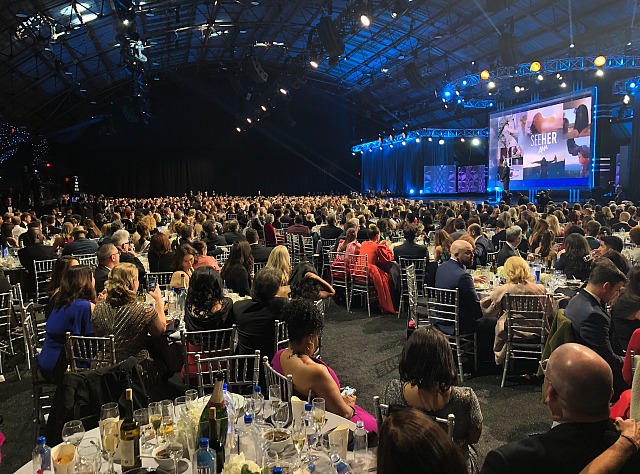
HE’s beloved Irishman won only one trophy at the 25th annual Critics’ Choice Awards show on Sunday night, and that’s a shame. My heart is aching over the apparent fate of this awesome classic.

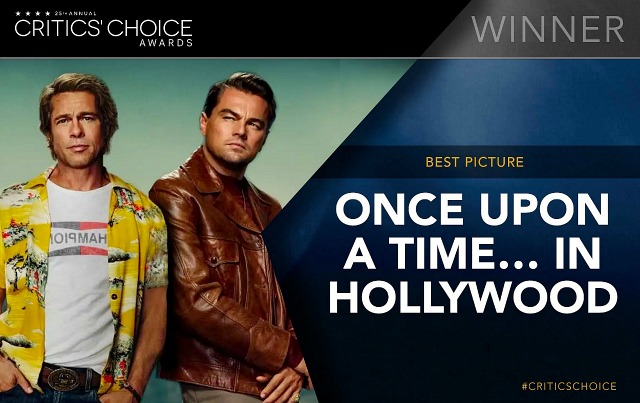
Once Upon A Time in Hollywood scored awards for Best Picture, Best Supporting Actor for Brad Pitt (who didn’t show up), Best Original Screenplay for Quentin Tarantino, and Best Production Design (Barbara Ling and Nancy Haigh).

And 1917‘s Sam Mendes split the Best Director prize with Parasite‘s Bong Joon-ho, but thank God Parasite didn’t win anything else. This underlines the likelihood that Parasite will only win the Best International Feature Oscar on 2.9.20. I regard this as a kind of victory or vindication.

The indicators suggest that either Once Upon A Time in Hollywood or 1917 will take the Best Picture Oscar. The Critics Choice awards have often reflected the final choices of the Academy.

I think it’s tragic that enough people don’t seem to be standing up for The Irishman, which is easily the year’s best film…easily. Either they’re impatient or too stupid or simply not interested in the lives of gangster geezers with neck wattles and pot bellies.

The CC Best Actor and Best Actress awards were taken by Joker‘s Joaquin Phoenix and Judy‘s Renee Zellweger. The Best Supporting Actor award went to Pitt, as noted. Marriage Story‘s Laura Dern won the Best Supporting Actress trophy — no surprise.

On the TV side of the equation it was Fleabag, Fleabag, Fleabag and Succession Succession Succession. Plus prizes for Watchmen‘s Regina King, Barry‘s Bill Hader, When They See Us‘s Jharrel Jerome and Fosse/Verdon‘s Michelle Williams (who, like Pitt, didn’t bother to show).

People applauded warmly or appreciatively when this or that white nominee took a prize, but you could feel extra whoo-whoo currents when anyone outside this fraternity won.

When John Lithgow announced that the Best Director award had been partly given to Sam Mendes, the applause indicated that people were saying “aaah, good, we approve!” When Lithgow added that the other winner was Parasite‘s Bong Joon-ho, it was like a home town basketball team had won the state championship. Ditto when Ava DuVernay‘s When They See Us (Netflix) won for Best Limited Series.

Read more

Woody Allen’s “Bananas”


Why do I find ’70s muscle cars painted in this color repulsive while regarding the same hue on natural-ass bananas appealing?

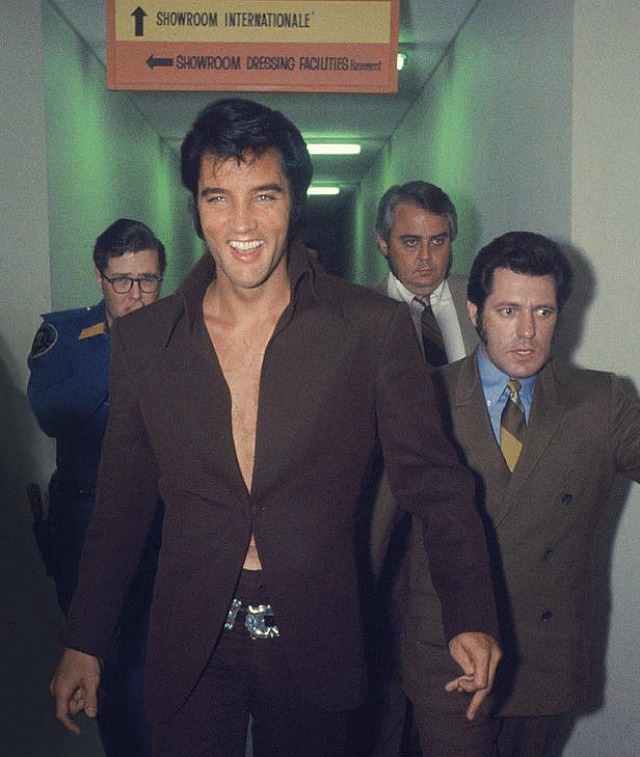
When we think of “Elvis Presley in Las Vegas,” we see images of a bloated, pot-bellied, drug-addled remnant of ’50s Elvis, dressed in a white, high-collared, sequined jumpsuit with tinted shades. But in ’69 he looked good — young, healthy, vibrant.

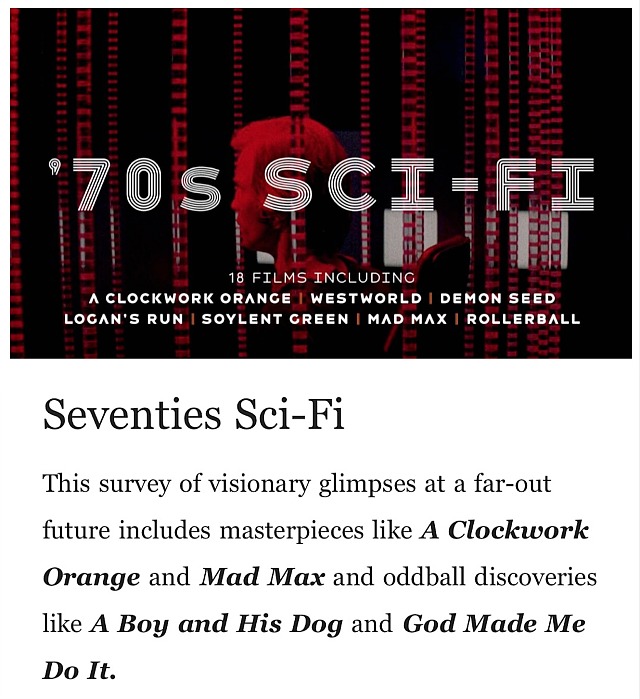
It’s a stretch to call Stanley Kubrick’s A Clockwork Orange “science fiction.” It’s a dystopian social drama. Okay, the fictional Ludivico technique was a scientific element, but it didn’t propel the story forward; the conniving plans of politicians did that.

Same Old Oscar Nomination Spitballs

When it comes to 2020 Oscar nominations, Hollywood Elsewhere is partly run-of-the-mill and partly…well, a bit peculiar. In some ways I’m a lot like Scott Feinberg, and more similar than not to Sasha Stone. But I’m everybody’s brother and son. I ain’t much different from anyone. Well, in some ways I am.

Advance warning: Bong Joon-ho‘s over-praised social dramedy will wind up Best Picture nominated (along with a locked nom for Best International Feature), but it must not and can not win in the former category…no!

Best Picture in order of likelihood: The Irishman, Once Upon a Time in Hollywood, 1917, Parasite, Joker, Marriage Story (6). Outliers: Little Women (will a series of impassioned journalist columns and the ever-present Twitter fervor push it through?), Jojo Rabbit (too broad, too comedically tidy, lacking in boldness), Ford v Ferrari (respectable character-driven drama, excellent race-car footage), Knives Out (VERY clever, first-rate popcorn whodunit), Uncut Gems (an endurance test to sit through, the Safdies are sadists). (5)

Best Director in order of likelihood: Martin Scorsese, The Irishman; Quentin Tarantino, Once Upon a Time in Hollywood; Sam Mendes, 1917; Bong Joon-ho, Parasite; Todd Phillips, Joker. (5)

Possible surprise omission: Noah Baumbach, Marriage Story (not much momentum over last four months, might fall by the wayside). Forget it: Taika Waititi, Jojo Rabbit.
Best Actor in order of likelihood: Joaquin Phoenix, Joker; Adam Driver, Marriage Story; Jonathan Pryce, The Two Popes; Antonio Banderas, Pain and Glory; Taron Egerton, Rocketman.

Not happening: Leonardo DiCaprio, Once Upon a Time in Hollywood (nobody has said boo about Leo’s performance — all the heat has been about Brad).

Best Actress in order of likelihood: Renée Zellweger, Judy; Scarlett Johansson, Marriage Story; Charlize Theron, Bombshell; Saoirse Ronan, Little Women; Awkwafina, The Farewell.

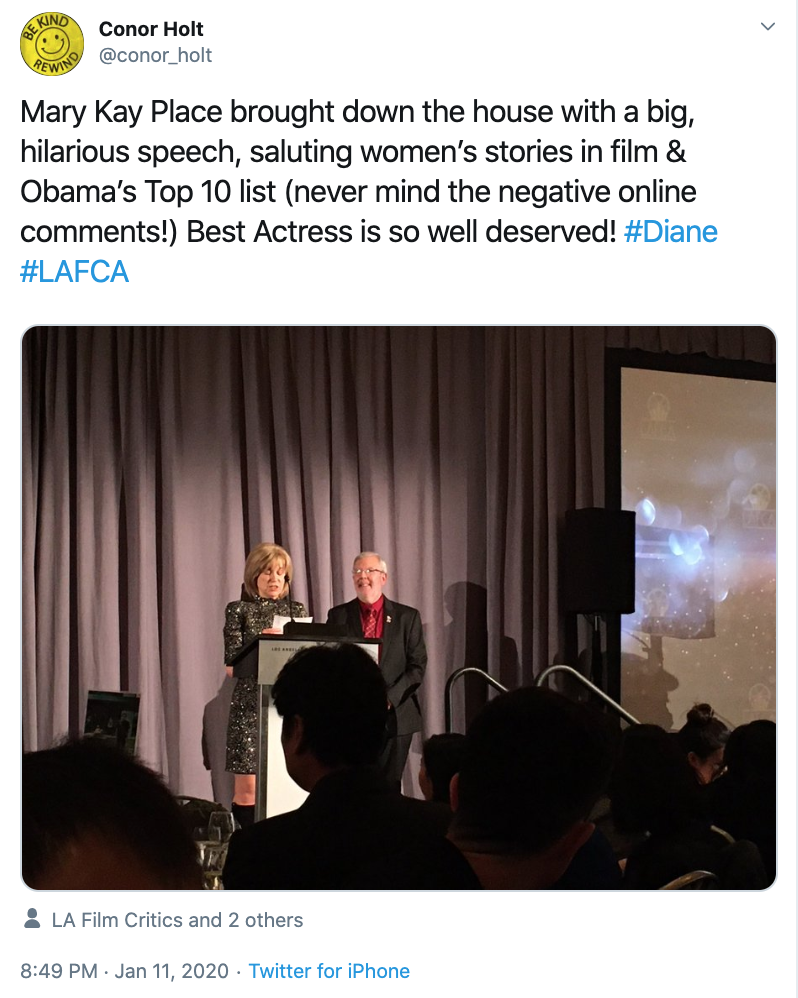
Shameful omission of the best female lead performance of the year: Mary Kay Place, Diane.

Forget it: Lupita Nyong’o, Us. Not a chance: Cynthia Erivo, Harriet.

Best Supporting Actor in order of likelihood: Brad Pitt, Once Upon a Time in Hollywood; Al Pacino, The Irishman; Joe Pesci, The Irishman (will cancel each other out), Tom Hanks, A Beautiful Day in the Neighborhood; Jamie Foxx, Just Mercy.

Not likable enough: Anthony Hopkins, The Two Popes. Too broad: Taika Waititi, Jojo Rabbit.

Best Supporting Actress in order of likelihood: Laura Dern, Marriage Story; Jennifer Lopez, Hustlers; Kathy Bates, Richard Jewell. (3) Possible: Shuzhen Zhao, The Farewell.

Should be nominated but won’t be: Julia Butters, Once Upon a Time in Hollywood.

Unworthy contenders: Scarlett Johansson, Jojo Rabbit (because her character was hung?); Margot Robbie, Bombshell (because Roger Ailes humiliates her in that one agonizing scene?); Nicole Kidman, Bombshell (because she delivers a prim-and-proper performance that she could have performed in her sleep?).

Death Of A Culture

In a 1.11 Facebook entry, director Eugene Jarcecki (The King, Reagan, Why We Fight) posts some photos of various West Village retail shops that have shuttered and laments “the lie of a ‘booming’ economy…in Gentrification 2.0, where even the crappy soulless establishments that once replaced the original mom-and-pop places, even these onetime intruders can no longer survive.”

One of the photos was of the recently shuttered Vesuvio’s Bakery (or more precisely the Birdbath bakery inside the Vesuvio’s storefront) at 160 Prince Street. Devastating. I haven’t been to Manhattan since last spring, and had somehow missed the closing last August. Early 20th Century storefronts like Vesuvio’s are the heart and soul of what remains of the old West Village. This kind of thing has been happening in Manhattan for the last 20, 25 years. Earthy single-owner establishments have been dropping like flies, and with them the flavor and character of Sidney Lumet‘s Manhattan.

In ’78 and ’79 I lived a hop, skip and a jump away at 143 Sullivan Street. I was mostly miserable back then, and yet I felt so glad that my apartment was part of a living, breathing neighborhood composed of mom-and-pop businesses, and run by people with pugnacious New York personalities.

Eugene Jarecki anecdote: During the annual Sony Pictures Classics party in the middle of the 2005 Toronto Film Festival, I was talking to Jarecki about Why We Fight, which the festival was screening. We were engaged in the usual party chit-chat. And then I somehow shifted into a testy-bordering-on-hostile discussion with MCN’s David Poland, who was standing right next to me. “Whoa, wait,” Jarecki quipped. “This sounds like a real conversation…you guys actually have something to say to each other!”

Read more

Lurie Was Right — Freeman Was Wrong

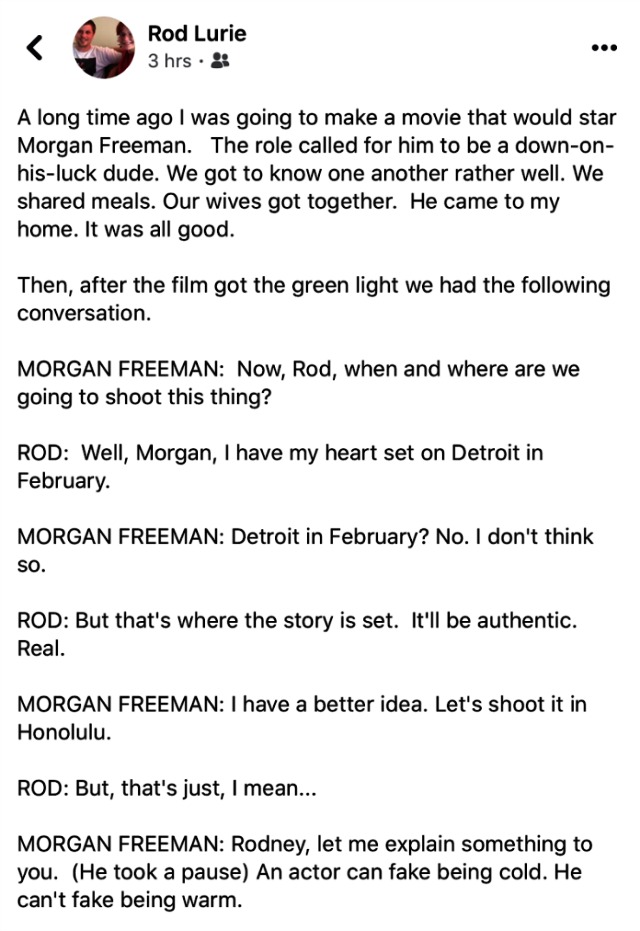
Morgan Freeman had a point, but Rod Lurie had a better one. Read Lurie’s Facebook tale below [posted on 1.9], and then consider Elia Kazan‘s story about shooting On The Waterfront in December of ’53 and early ’54. In the video it starts at 42 seconds, ends at 1:24.

On The Waterfront director Elia Kazan: “We were shooting [On The Waterfront] in the winter, and it was a cold winter. And as we went along [we got] more and more into the winter, more and more cold and rain…and we never stopped shooting. And Brando…sometimes I had to go into the hotel…I think it was called the Majestic hotel, some phony name…I had to go in and drag him out because it was too cold out there, and he’s not very hearty in some ways. And also the cold helped the actors’ faces. They looked a certain way…they were sunk in here. They didn’t have this lovely flesh of success that leading men in Hollywood have…dimpled, pink, beautiful complexions. They were miserable looking human beings, and that included Brando.”

Slider

I was initially concerned that this 1.9 SNTS piece by “Cameron” was a hit piece of some kind. Then I started reading…uh-huh, okay, yeah, hmmm, alright. Somewhere along the way I realized it’s an okay thing for the most part. I would only argue with the c-word, which always sounds dismissive. What it means in this context is “crazy like Yossarian.” As in eccentric, mercurial, unpredictable, partially outside the box, unregimented. Anyway, dodged a bullet.

“Salo” Doesn’t Satirize Fascism

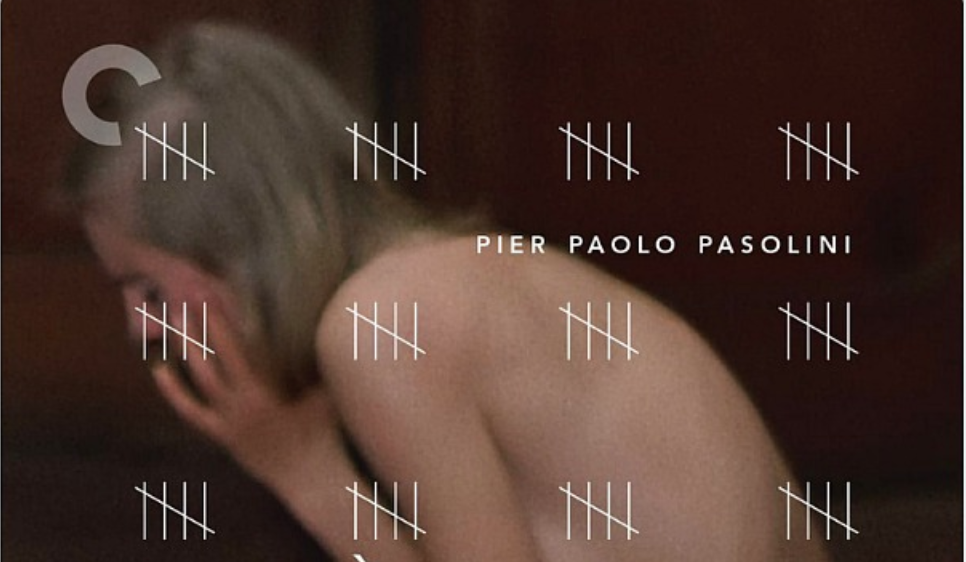
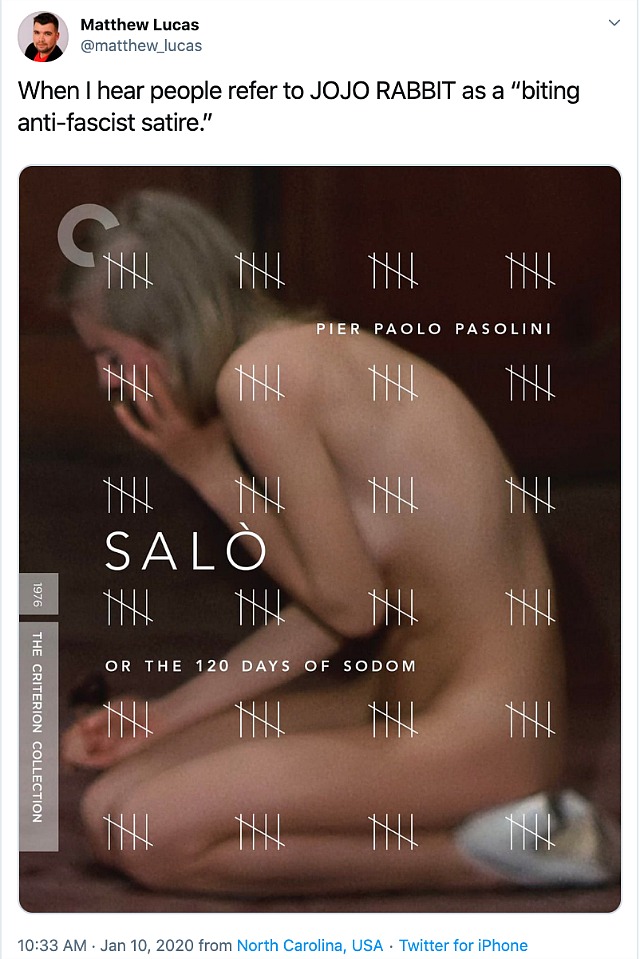
Pier Paolo Pasolini‘s Salo, or the 120 Days of Sodom is a grotesque portrait of fascism unbridled, but it’s certainly no satire. A “satire” this cold and clinical inevitably morphs into something else. Salo is essentially a horror film about the practice of cruelty…cruelty and contempt taken to their final expression. And yet it’s certainly a tougher, harder, more unforgiving creation than Jojo Rabbit, and a much fiercer thing than Taiki Waititi ever thought to attempt. Talk about films that focus on a similar situation but exist in two completely separate universes. There’s a Salo scene in which the four brute fascists (Paolo Bonacelli, Giorgio Cataldi, Umberto Paolo Quintavalle, Aldo Valletti) are dressed in drag, looking like perverse middle-aged biddies with pearl necklaces, too much rouge, ornate hats and whatnot. Imagine if Jojo Rabbit had the nerve to be this dark, this diseased.

Baumbach’s Boldest Hour

Posted on 4.3.10: I knew when I first saw Greenberg that it obviously wasn’t Night at the Museum, but I figured that the usual indie suspects would discover and support it, and that it might eventually find its way to cult success as one of the finest character-driven, psychologically acute, no-laugh-funny flicks in a long while.

There’s really no disputing that Greenberg is one of the best films released this year (along with Roman Polanski‘s The Ghost Writer), and yet guys are bolting out of Greenberg showings and going up to theatre managers and saying “I want a refund”? What?

If I didn’t like Greenberg I would slink out quietly and keep my feelings to myself and my friends. I would at least defer to its reputation among most critics and tastemakers and say, “Okay, fine, critics and their weird tastes…but it’s not for me.” I certainly wouldn’t turn my animosity into a vocal lobby rant.

People not liking or recommending a film is standard, but this kind of hostility, I suspect, means Greenberg is touching some kind of nerve. It’s not just about a somewhat dislikable neurotic, but about a guy who’s at best treading water at age 40 and looking at a lot more of the same as he gets older. Speaking as the older brother of a guy whose life ended tragically because of this syndrome, I know this is about as scary as it gets. There are millions of people out there who are not that different from Ben Stiller‘s character, or who know people who are in this kind of head-jail.

As I said in my initial review, “Greenberg is about what a lot of 30ish and 40ish people who haven’t achieved fame and fortune are going through, or will go through. It’s dryly amusing at times, but it’s not kidding around.”

Many people feel as I do, of course, but Greenberg is clearly a major polarizer. It’s all evident on the Greenberg IMDB chat boards. Here’s how one fellow (i.e., “Famous Mortimer,” the guy who sent me the photo) defends it:

“I think it is provoking such strong levels of resentment from viewers because it is a movie very much of these times but not made in the style of these times. It exposes the toxic levels of conceitedness and alienation today with the sincerity and empathy of ’70’s films by Ashby, Altman and Allen.

“First off, it’s a story about people. There is no high concept or shoehorned stake-raising set piece. Viewers either have the patience to connect with the human pain on display or they are lost. Unlike Sideways, there is no charming countryside setting or buddy comedy hijinks to punch up the mood.

“Second, the dialogue is the action. Only when the viewer is willing to think over the dialogue will characters’ seemingly ambiguous motivations and back-stories become clear. There’s no juicy monologue or nauseating flashback to convey these points. Instead, the viewer comes upon them over the course of the film in the form of passing references made by various characters. It is up to us to take these bits and pieces together and unlock the character revelations for ourselves. No more spoon-feeding cinema.

“Third, this film is a labor of love. That means idiosyncratic details are to be found at every level of its making. Only by thinking these details over and feeling the connections between them do we appreciate what the movie is trying to do. It’s a really thoughtful and heartfelt experience.”