Golden Globe Predictions

Here’s what I’m vaguely sensing or at least preferring…

Best Motion Picture (Drama): Will win: The Irishman. Should win: The Irishman.
Best Motion Picture (Comedy/Musical): Will win: Once Upon A Time in Hollywood. Sentimental Favorite: Dolomite Is My Name.
Best Director: Either Bong Joon-ho, Parasite or Martin Scorsese, The Irishman.
Best Actor (Drama): Joaquin Phoenix, Joker.
Best Actress (Drama): Rene Zellweger, Judy. Might win: Saoirse Ronan, Little Women (due to incessant campaigning on film’s behalf by allies of progressive industry feminism)
Best Actor (Comedy/Musical): Eddie Murphy, Dolemite Is My Name.
Best Actress (Comedy/Musical): Awkwafina, The Farewell. (HE exception: The Farewell is eccentrically amusing here and there, but it’s a heart + family movie about impending death.)
Best Supporting Actor: Brad Pitt, Once Upon A Time in Hollywood.
Best Supporting Actress: Will win: HustlersJennifer Lopez or Marriage Story‘s Laura Dern. Should win: Richard Jewell‘s Kathy Bates.
Best Foreign Film: Will Win: Parasite. Should win: Les Miserables.

“Parasite” Temblors

Last night Tatyana and I attended an A-plus Parasite party at the Sunset Tower hotel. Crowded but not oppressively so, and attended by some of the coolest creatives in town — Guillermo del Toro (who officially co-hosted with Colleen Camp), Leonardo DiCaprio, Noah Baumbach, Laura Dern, Michael Mann, HE’s own Phillip Noyce and Vuyo Dasi, Portrait of a Lady on Fire‘s Adele Haenel and Noemie Merlant, Jay Roach, Eli Roth, Lukas Haas, Kevin Bacon, Show Me What You’ve Got‘s Svetlana Cvetko, Dolemite In My Name‘s Larry Karaszewski, Knives Out producer Ram Bergman — along with the usual industry-journo crowd. Plus a lavish buffet supper, etc. The coolest gathering in town.

Hardly anyone wore whitesides, and I was checking, believe me.

There was such a feeling of “this is the place, these are the people, this is the film” that it began to hit me that Parasite, a richly cinematic, very incisive serving of social portraiture that is nonetheless hampered by ludicrous plot turns in the second half, might win the Best Picture Oscar. You can always sense a favorite when everyone comes to the favorite’s party. Everyone wants to be chummy and hair-mussy with the perceived winner in whatever realm. It’s just human nature.

I’m trying to deal with this curious premonition like a mature adult, but there’s a little part of me that’s going “please, God…no.” I’ve been calculating all along that Bong Joon-ho‘s film (his finest ever) would take the Best International Feature Oscar without breaking a sweat, but it can’t win that plus the Best Picture Oscar…can it?

The most exciting and pleasing moment of the evening was when I went over to Adele Haenel and…well, behaved like a typical adoring fan, complimenting her Lady on Fire performance and telling her I’ve seen it three times (in Cannes last May, twice in Los Angeles) and chit-chatting about this and that.

The second most pleasing moment was hearing from journalist pally Bill Desowitz that “many” people he’s spoken to feel the same way about Parasite as I do — i.e., Bong’s best, very commendable but calm down.

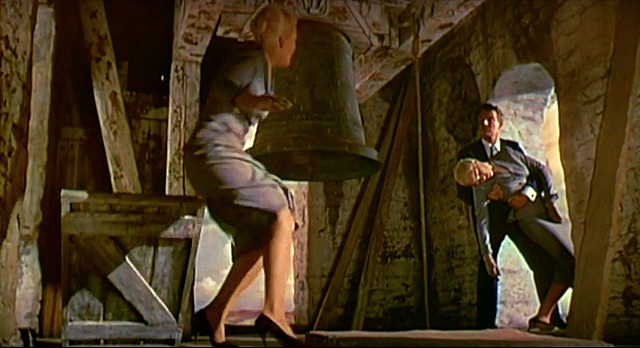
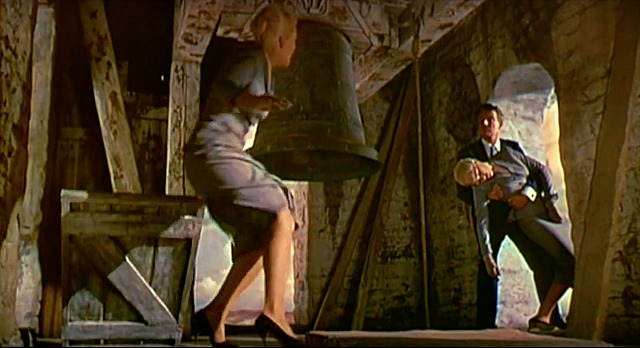
Yes, I know — Vertigo‘s second-half plotting is just as ludicrous. But it ends so magnificently. Scott looking down from the bell tower, his hands outstretched, cured of his phobia, Madeline gone.

I’m not trying to fight city hall. If the Best Picture Oscar has Parasite‘s name on it, so be it. I won’t be angry or upset about this exactly, although I will feel disappointed. The Irishman is the best film of the year, hands down. I know it, the Godz know it, many people out there know it, and history will verify.

Read more

Mental Defectives

A couple of nights ago I was awakened by voices coming from the downstairs garage. Conversational but loud. I looked at my watch — 3 am. I told myself it might be someone who’d returned home late and was possibly arguing with a friend on his phone. But after 10 or 15 minutes it was still going, and I gradually realized the voice wasn’t arguing — it was blah-blahing.

[Click through to full story on HE-plus]

Balagov — Young, Gifted, Grim-Minded

Kantemir Balagov, the director of the much-admired Beanpole, is only 28 years old (and his appearance suggests he could be even younger). But he’s already delivering the studied chops and immaculate directorial control that are par for the course among accomplished directors twice his age.

How intense is Beanpole? How invested, how richly composed, how well acted, how Klimovian, how Kubrickian, how immersive? “Very” on all counts. A psychological survival tale set in Leningrad just after the ravages of World War II, it’s probably the fiercest and darkest post-war drama made in the 21st Century.

Hollywood Elsewhere sat down with Balagov a while back, and it’s fair to say he doesn’t default to the usual animated, occasionally jokey, “delighted to be here” repartee. He sits there and waits for your questions and answers them, politely but curtly. And that’s it. He doesn’t feel he has to augment or supplement. He’s a first-rater and knows it. A mixture of confidence and patience.


Beanpole director Kantemir Balagov.

Balagov is quite the portraitist and, to go by a just-posted Variety interview, quite the film scholar.

Is it fair to call Beanpole gloomy? Yes, but also riveting. I felt sorrow and pity for each and every character, of course. But the tone is solemn and somewhat oppressive. And yet, given the context, this is probably necessary.

Viktoria Miroshnichenko‘s titular character, Iya, is an all-but-catatonic giraffe from whom verbal expression does not easily emanate. Why must she take 30 to 45 seconds to collect her thoughts before answering the simplest questions? Because that’s Balagov’s intention — to convey her destroyed inner state with traumatized expressions, gut feelings and minimal dialogue.

Vasilisa Perelygina‘s Masha, Iya’s best friend, is far more interesting — more expressive and generally more alluring. If Perelygina had played the lead (which is to say if Iya had been eliminated), I would be a bigger fan of Beanpole. In my estimation she’s a natural movie star.

But not Viktoria. Iya is impenetrable and burdensome and, as far as the afore-mentioned death of the child is concerned, inexplicable and even hateful.
The ghastly murder of Masha’s young son is “addressed” but not really dealt with, and I was simply unable to get past this.

Balagov’s idea, I gather, is that if a character is profoundly devastated by war trauma, it’s within her realm to accidentally smother an innocent. In basic emotional movie-watching terms that’s simply not acceptable.

Read more

Urge to Dominate

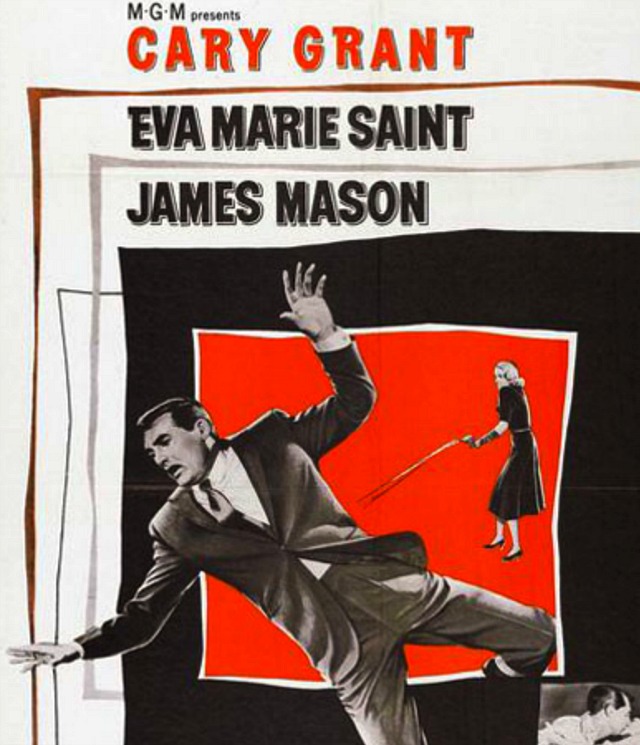
North by Northwest star Cary Grant naturally had top billing over costars Eva Marie Saint and James Mason. But that wasn’t enough. His agents insisted on red lettering to further distinguish his superiority and extra-ness. And they insisted on stretching out the width of his name to C A R Y G R A N T so the number of letters in his name (only nine) wouldn’t seem insignificant compared to Saint and Mason’s.

Whole Cloth Avoidance

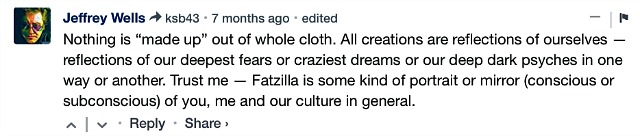
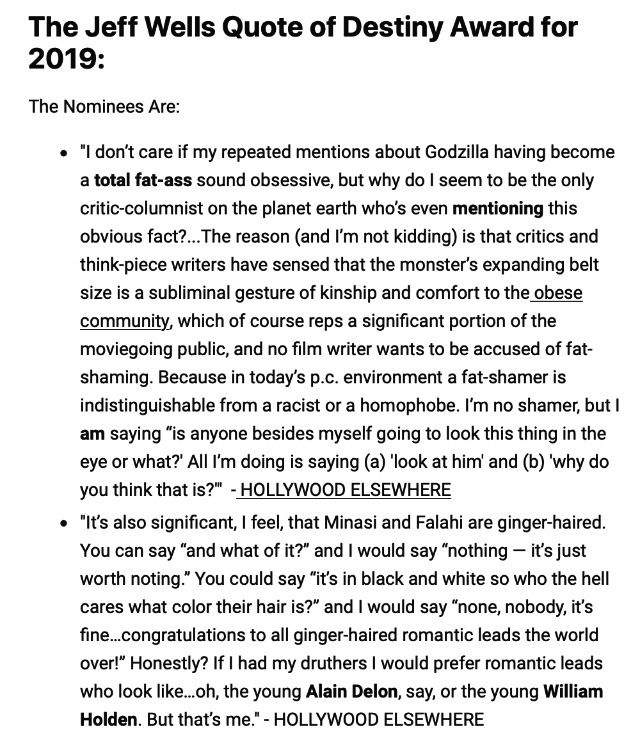
Yesterday Richard Rushfield‘s Ankler newsletter ran, as a year-end thing, four HE excerpts. I wouldn’t have revived this issue if he hadn’t done this, but as long as he has I’m just going to repeat the legend from last May, which is that aside from Variety‘s Owen Gleiberman, the N.Y. TimesGlenn Kenny, the National Review‘s Kyle Smith and myself the entire critical community acted like cowards by refusing to even briefly acknowledge the girth thing. They all “ignored” it because they were afraid of being accused of fat-shaming.

Choice Movie Habitats

If you could easily move into any home or apartment in which a movie character resides, what would you select? A recent Facebook thread asked this question, and believe it or not the author said he’d like to live in Scotty Ferguson‘s Vertigo apartment in San Francisco.

The guy has his pick of any residence in the movie world, including Robert Downey, Jr.‘s houseboat in Zodiac, the gaudy Tony Montana mansion in Scarface, Robert De Niro‘s seaside home in Heat, Joe Starrett‘s cabin in Shane and Xanadu in Citizen Kane, and he chooses an unexceptional and rather pokey one-bedroom apartment at 900 Lombard (at Jones)?

Jesus, why not choose Popeye Doyle’s Brooklyn one-bedroom rathole in The French Connection? Or Jeff Lebowski‘s Venice apartment?

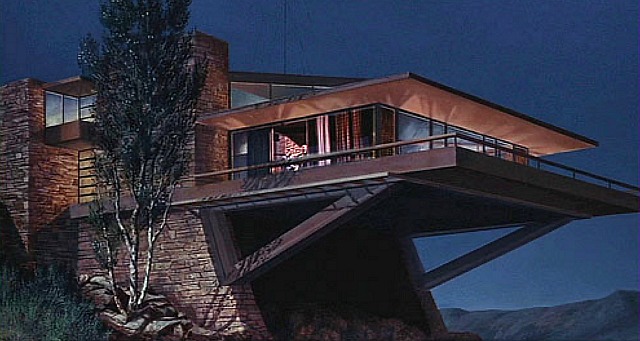
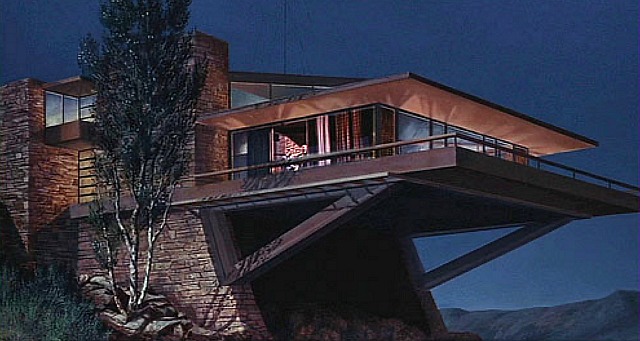
Hollywood Elsewhere is torn between (a) Kristen Stewart‘s small Paris apartment in Personal Shopper, (b) the mountainside John Robie home in To Catch A Thief (which Sasha Stone and I actually visited in 2011), (c) the Frank Lloyd Wright-inspired VanDamm home in North by Northwest, and (d) Lionel Barrymore‘s ramshackle hotel in Key Largo.

No, I wouldn’t like to live in that 19th Century Knives Out mansion. I love that cozy third-floor area where Chris Plummer wrote and slept, but otherwise it’s too big, too cavernous, too costly to heat.

“Hud” Template

Name some noteworthy films that started out as one thing, and ended up as another.

All serious-minded films are designed and executed with a certain moralistic or thematic or sensationalist intention. They’re made to stir emotions. Or merely excite or amuse. Or cast light upon certain aspects of the culture. Or make some kind of political point…whatever. But every so often the intended doesn’t happen when the film plays before paying audiences and it becomes something that the filmmakers never expected.

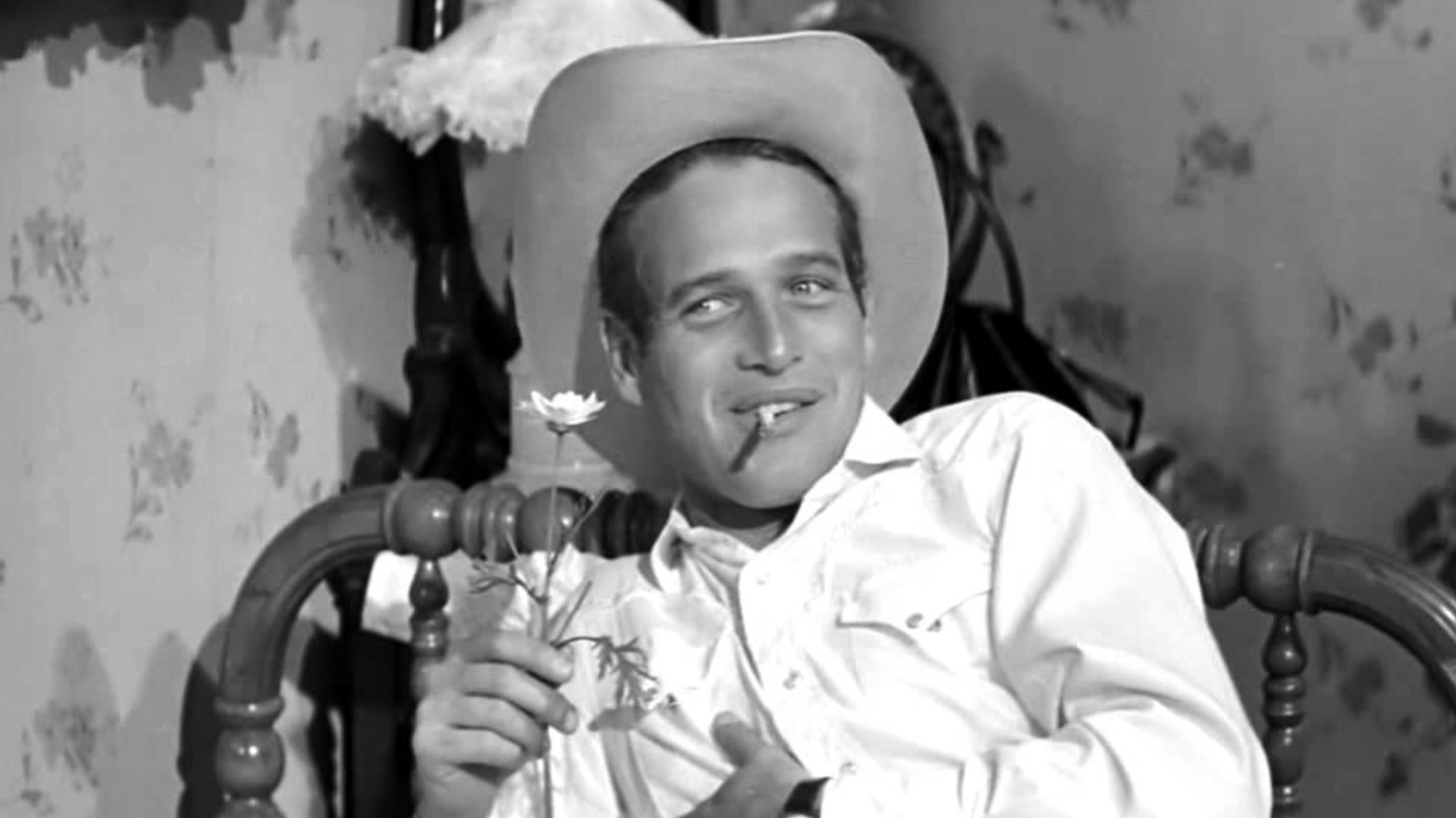
This is what happened to Martin Ritt‘s Hud (’63). The below excerpt from a 2003 conversation with Hud screenwriters Irving Ravetch and Harriet Frank, Jr. and Michigan Quarterly Review‘s William Baer explains the basics.

The most obvious kind of “wait, what happened?” is when a film is made as a straightforward drama or melodrama, only to “land’ as an unintentional comedy because of ineptitude or an overload of attitude or something. Another is when a film is ostensibly made as some kind of half-crude exploitation but is nonetheless received as a sophisticated genre commentary in “quotes” (Mark Lester‘s Truck Stop Women), or something along these lines.

BAER: “Well, Hud was certainly a unique picture in many ways, but, most significantly, it dared to portray a central character who was a pure bastard, and who remained totally unredeemed and unrepentant at the end of the picture.”

RAVETCH: “Yes, we sensed a change in American society back then. We felt that the country was gradually moving into a kind of self-absorption, and indulgence, and greed. Which, of course, fully blossomed in the ’80s and ’90s. So we made Hud a greedy, self-absorbed man, who ruthlessly strives for things, and gains a lot materially, but really loses everything that’s important. But he doesn’t care. He’s still unrepentant.

FRANK: “In our society, there’s always been a fascination with the ‘charming’ villain, and we wanted to say that if something’s corrupt, it’s still corrupt, no matter how charming it might seem. Even if it’s Paul Newman with his beautiful blue eyes. But things didn’t work out like we planned.

BAER: “It actually backfired.”

RAVETCH: “Yes, it did, and it was a terrible shock to all of us. Here’s a man who tries to rape his housekeeper, who wants to sell poisoned cattle to his neighbors, and who stops at nothing to take control of his father’s property. And all the time, he’s completely unrepentant. Then, at the first screenings, the preview cards asked the audiences, ‘Which character did you most admire?’ and many of them answered ‘Hud.’ We were completely astonished. Obviously, audiences loved Hud, and it sent us into a tailspin. The whole point of all our work on that picture was apparently undone because Paul was so charismatic.

Read more

Mulletville

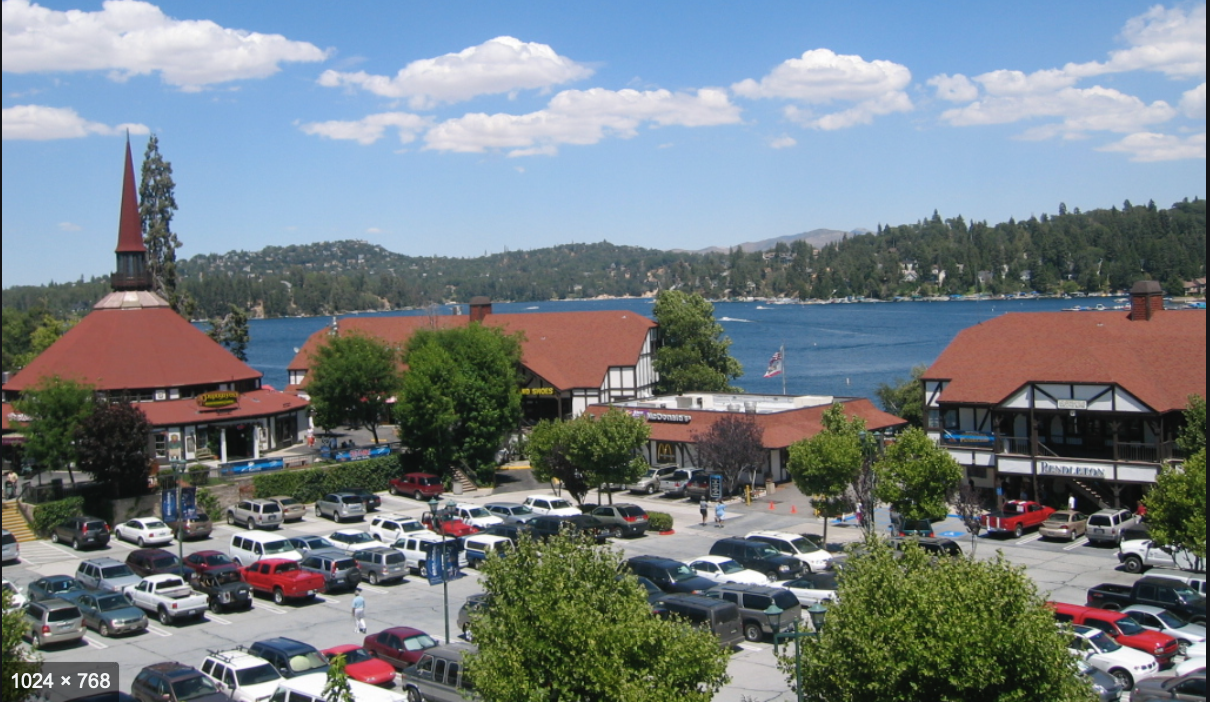
Lake Arrowhead Is Scenic and Fragrant But…,” posted 5 and 1/3 years ago: “Before yesterday I had never visited Lake Arrowhead. High in the mountains (about 5000 feet), quite hilly, the scent of pine and wood chips, forests of towering fir trees, about 30 minutes north of San Bernardino.

“It seems wonderful when you first arrive, but then you start noticing things.

“Like the sparsity of sidewalks and bike-riding and general hiking paths — the town is strictly about cars, and big fat SUVs at that. Not to mention the blue-collar, vaguely bumblefuck atmosphere — you can immediately sense a downmarket culture that is at least somewhat lacking in educated, upscale sensibilities. I knew something was up when I spotted a couple of streetside banner ads celebrating the local ‘heroes’ who’ve served in Iraq and Afghanistan. On top of which many of the homes lack architectural integrity and have obviously been built with cheap materials. On top of which Lake Arrowhead Village is so overdeveloped that any concept of charm probably went out the window 50 years ago.

“In a phrase, the town lacks a certain refinement. It’s for people who like to eat at McDonald’s. It almost feels like some kind of low-security, blue-collar prison camp. The town that F.W. Murnau shot Sunrise in 90 years ago was a very different place, I’m sure. Many decades before the middle-American mob moved in and transformed this little mountain village into Mulletville. This is not a community that would appeal to Bernardo Bertolucci or Michelangelo Antonioni in their prime. Europeans do lakeside resorts with a lot more class and style.”