Son of Thinner, Intense, Floppy Mane, etc.

Leonardo DiCaprio turns 45 tomorrow. He’ll be 50 before you know it because time flies when you can’t get enough of the treadmill. I chatted with Leo a few days ago at a San Vicente Bungalows after-party, and between the lines I was thinking “wow, the train is moving faster and faster.”

DiCaprio has been a power-hitter and marquee headliner for 22 years now, or since Titanic. 26 years if you count The Boy’s Life. Nobody can ever diminish or take away the killer performances he’s given in Once Upon A Time in Hollywood, The Departed, Inception, Revolutionary Road and especially The Wolf of Wall Street…a lot to be proud of. And I can’t wait for what happens with Killers of the Flower Moon.

But when I think of vintage DiCaprio I rewind back to that dynamic six-year period in the ’90s (’93 to ’98) when he was all about becoming and jumping off higher and higher cliffs — aflame, intense and panther-like in every performance he gave. I was reminded of this electric period this morning that I watched the below YouTube clip of DiCaprio and David Letterman in April ’95, when he was 20 and promoting The Basketball Diaries.

I respected Leo’s performance in This Boy’s Life but I didn’t love it, and I felt the same kind of admiring distance with Arnie, his mentally handicpped younger brother role in What’s Eating Gilbert Grape, partly because he was kind of a whiny, nasally-voiced kid in both and…you know, good work but later. Excellent actor, didn’t care for the feisty-kid vibes.

But a few months before Gilbert Grape opened I met DiCaprio for a Movieline interview at The Grill in Beverly Hills, and by that time he was taller and rail-thin and just shy of 20. I was sitting in that booth and listening to him free-associate with that irreverent, lightning-quick mind, and saying to myself, “This guy’s got it…I can feel the current.”

Then came a torrent: a crazy gunslinger in Sam Raimi‘s The Quick and the Dead (’95), as the delicate Paul Verlaine in Total Eclipse (’95), as himself in the semi-improvised, black-and-white homey film that only me and a few others saw called Don’s Plum (’95), as the druggy Jim Carroll in The Basketball Diaries (’95), as a wild, angry kid in Jerry Zak’s Marvin’s Room, opposite Claire Danes in Baz Luhrmann‘s Romeo + Juliet, as Jack Dawson in Titanic and finally as a parody of himself in Woody’s Celebrity. Eight performances, and every one a kind of sparkler-firecracker thing.

Read more

Come Again?

Two or three weeks ago I began hearing about certain levels of Marriage Story discomfort among older couples. Even about walk-outs, believe it or not. Which is crazy because (a) Marriage Story is obviously a first-rate, grade-A film about real-life angst and mistakes and hurdles, and with excellent performances up and down from Adam Driver, Scarjo, Laura Dern, Ray Liotta and Alan Alda, and (b) all good films serve truth-and-honesty sauce, and in so doing provide nourishment for the soul.

Who the hell would lean over and whisper in their significant other’s ear, “Uhm, look, this movie is kinda weirding me out…it’s taking me back to my divorce in the ’90s and I’d rather concentrate on the here-and-now…is it okay if I meet you outside the theatre after it’s over?”

What’s past is past, and difficult times with an ex-wife shouldn’t have any significant bearing upon your current situation. (Unless you’re exactly the same person you were 20 years ago.) What kind of an emotional weakling would run like a coward from Marriage Story?


When Obama Was An Unqualified Long Shot

Watch this 60 Minutes piece on Obama. The tone of Steve Kroft‘s questions are mostly in the realm of “really?…what’s the hurry?…where’s the experience?…but you’re black, and are you black enough?”

Marinated D.C. experience means zip — what matters is character, intelligence, vision, practicality, humility, street wisdom.

Don’t kid yourself — the Beast could be re-elected. It follows that I am white-knuckle-terrified of Elizabeth Warren and/or Joe Biden winning the 2020 Democratic nomination.

Buttigieg, Buttigieg, Buttigieg.

Read more

A Finale Not Chosen

That third-act moment in Marriage Story when the beleagured Charlie (Adam Driver) stands up and sings Stephen Sondheim‘s “Being Alive” in a piano bar and in so doing draws on the pain and regrets and somber self-reflection that he’s been grappling with throughout the whole film…the second after Driver finishes the tune is where Noah Baumbach’s film should have ended. I had this thought upon during my initial Telluride viewing, and now Anthony Lane has stated the same in his New Yorker review. It would have been perfect since the cathartic summing-up in this Company song offers a symmetrical counterbalance to Marriage Story‘s beginning in which Charlie and Scarlett Johansson‘s Nicole recite lists of things they love about each other.

The HE community has had three days and two nights to consider the merits of Marriage Story, which won’t begin streaming on Netflix until 12.6. So?

Read more

Prelude To “Big Show”

(1) Everything that Anthony “Michael Corleone” Scaramucci says to Brian Stelter is accurate and ethical and straight on a plate; (2) With the impeachment proceedings starting Wednesday (11.13), will the Democrats put on a powerful, compelling impeachment inquiry?; (3) Why has Stelter gone from close-cropped tennis ball to shaved Yul Brynner sidewalls?

Tale of Two Parties

11.9, 2:25 pm: Simultaneous parties were thrown Friday night (7 to 11 pm or later) by the Apple and A24 guys. The Apple bash was hosted at the recently opened, bucks-up Edition hotel; the A24 soiree happened at the Sunset Tower. The Apple event was very pleasant as far as it went and certainly well-catered, but the atmosphere felt more corporate than Hollywood-y. The Sunset Tower affair was a relaxed and familial industry affair — Adam Sandler, Robert Pattinson, Waves director Trey Edward Shults, Colleen Camp, et. al. Beautiful outdoor pool, lots of cigarette and pot smoke, everyone just chillin’.


Read more

Kohn: Beware of Toxic Oscar Season Masculinity

Indiewire‘s Eric Kohn has tut-tutted his way through an essay about the rank aroma of toxic masculinity in such award-season contenders as The Irishman, Marriage Story, Parisite, Honey Boy, Once Upon A Time in Hollywood and A Beautiful Day in the Neighborhood.

Such ugliness, and so upsetting to wokesters who need their safe spaces, of course, and who may need to take breaks from these films in the lobby with, you know, neckrubs and counselling.

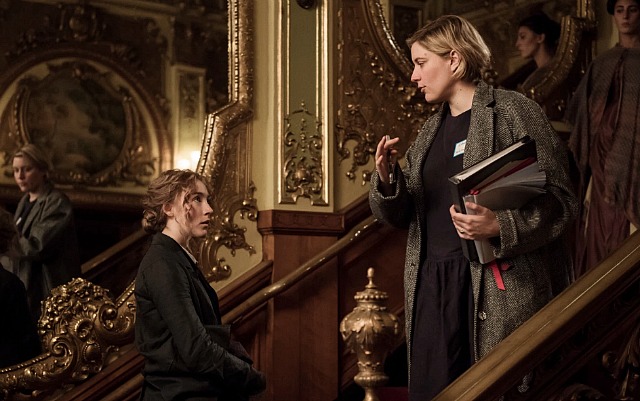
My favorite part is Kohn’s kicker paragraph, to wit: “If these movies all probe toxic masculinity from a male perspective, the season is poised to balance out with some of its most anticipated titles around the corner. Greta Gerwig’s Little Women adaptation and Jay Roach‘s Bombshell are both poised to address the other side of the equation.

“As moviegoers navigate a sea of toxic masculinity, these late-season entrants may deliver a lifeline — or at least the opportunity to widen the cultural frame. They can’t come soon enough.” Thank God…a lifeline!

I don’t want to speak out of turn or sound like a contrarian, but there might be a strain or two of toxic masculinity in William Shakespeare‘s Othello, Macbeth, Romeo and Juliet, A Winter’s Tale, etc. I think it also appeared in the works of other playwrights, novelists, screenwriters and directors. Certainly over the last couple of centuries. Or am I mistaken?

Total Spencer Recall

If you’re the least bit invested in Trek lore, this “Inglorious Treksperts” chat with director, screenwriter, script doctor and creator of Sledgehammer and Bullet in the Face Alan Spencer is pretty good. Spencer reveals some stuff that most people don’t know. Like how Star Trek creator Gene Roddenberry and Twilight Zone maestro Rod Serling were friends, and how Roddenberry eulogized Serling at his funeral at the behest of the family, etc.

“Oh, She Growed Up”

I’ve re-watched this scene 20 or 30 times, and could watch it another 20 or 30. Hell, make it 50 or 100.

I love the seven-second delay between the first mention of “old times” and the second, and especially Ben Johnson‘s decision to pick up a stick in the interim…perfect. The camera begins to track forward at the 54-second mark (“More than 20 years ago”) and begins its retreat to the original position at 1:53 (“I bet she’s still got that silver dollar”).

The Last Picture Show was shot in the small northern Texas town of Archer City, sometime in late ’70 or early ’71. Almost a half-century ago.

It may sound cruel to say this, but director Peter Bogdanovich never delivered a sequence as good as this over the rest of his career. It’s arguably the finest shot ever captured by dp Robert Surtees, although some would say his work on Mike NicholsThe Graduate was just as noteworthy.

How Is This The Least Bit Funny?

According to Scott Feinberg‘s account of last night’s American Cinematheque tribute to Charlize Theron, David Oyelowo shared a curious recollection that happened during the making of Gringo, in which Theron and Oyelow costarred.

Oyelowo: “The first thing Charlize ever said to me was, ‘David, what is your opinion about anal bleaching?’ She’s the only person I’ve ever known who laughed so hard that she pissed herself…she ran out, I looked down at her seat and it was wet.”

Anal bleaching is funny on what planet? In what kind of upside-down, twisted-pretzel universe is the dampening of a canvas chair due to leaked urine…how is that even smirk-worthy?

Jokes “land” because they reveal or allude to some suppressed or unacknowledged truth about our shared experience. Mentioning that someone busted a gut about this or that is flagrantly unfunny. As I’ve pointed out repeatedly, watching or listening to someone laugh hard is extremely unfunny if you’re not sharing in the mirth, which in my case is often.

Seth McFarlane, on the other hand, did allude to suppressed or unacknowledged truths. He joked that Theron “is proof that, at long last, African-Americans are thriving.” (Theron is from South Africa, grew up on a farm near Johannesburg) He also suggested that “‘Charlize’ sounds like a brand of champagne enjoyed by rednecks in Florida.” Well, it is kind of a girly-girl name.

Referring to her Oscar-winning performance in Monster, McFarlane said that “Charlize played a monster who committed unspeakable acts…Megyn Kelly.”

The best line alluded to Theron’s costarring role in McFarlane’s A Million Ways to Die in the West (’14) as well as her romantic pairing with Seth Rogen in Long Shot, to wit: “Theron has made a cottage industry of playing a lover of guys named Seth who could never land her in real life.”

Tragedy is when Scott Feinberg slices his finger with a steak knife. Comedy is when Oyelowo is poking at a Ceasar salad while listening to McFarlane.

Bleeding Cow Set Upon By Piranhas

Take away the Atlanta Olympics bombing aspect and the suffering that poor Richard Jewell endured could be processed as a metaphor for what all obese people go through.

As I said last month, the guy was primarily found guilty of not looking like Cary Grant in the 1940s or Clint Eastwood in the ’70s or even Seth Rogen in Pineapple Express. A damp-skinned, flat-topped, moustachioed beach ball, Jewell initially looked and, in the opinion of some, behaved like a guy with issues. The very model of a neurotic loner, and out of this a certain zealous reporter for the Atlanta Constitution became convinced he was probably a wrong one, and then the FBI bought into this also, and before you knew it everyone was off to the races.