
I won’t be able to catch Ari Aster‘s director’s cut of Midsommar until next Tuesday, after I’ve returned from Telluride. The original version ran 147 minutes. This new unrated cut runs 170 minutes, or 23 minutes longer.


Update: Even though the New York Film Festival website has removed the Irishman running time from its web page, I’m told it’s “in the neighborhood of 209 minutes.”
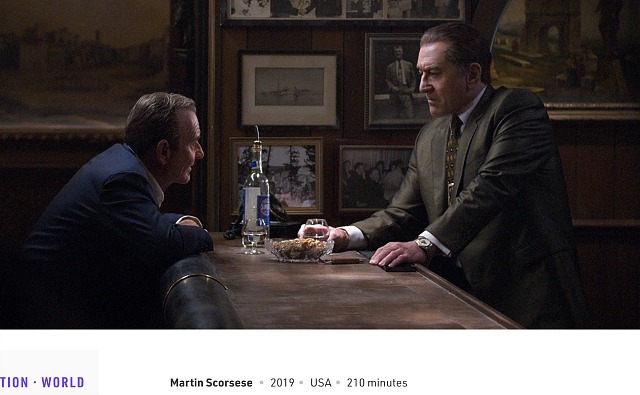
Earlier: The New York Film Festival has just announced that Martin Scorsese‘s The Irishman is 210 minutes. Very impressive. All in. Longer than The Godfather, Part II (202 minutes), Lord of the Rings: The Return of the King (200 minutes), Titanic (195 minutes) and The Godfather (178 minutes). But shorter than The Last Emperor (219 minutes), Ben-Hur (224 minutes), Lawrence of Arabia (222 minutes), Dances With Wolves (236 minutes) and Gone With The Wind (221 minutes).
This is a month old, for Chrissake. Produced by Fox Searchlight. Very meta, just right. The concluding Thor: Ragnarok bit is excellent. I don’t know how this flew by me but it did.
“We few, we happy few, we band of brothers…”
Henry V was a young English king — driven, vigorous — who led British troops to victory at the Battle of Agincourt in 1415, when he was only 29. He died six years later.
King Henry will be portrayed by 23 year-old Timothee Chalamet in David Michod‘s The King (Netflix, 10.11 theatrical, streaming 11.1). The great Laurence Olivier was 36 or 37 when he portrayed the same noble, aggressively spirited fellow in Henry V (’44). There’s no point in comparing the films or for that matter the two performances. We all understood we’re living through an Age of Collapse and Degradation. There’s no stopping the process.
The beheading scene clip presumably depicts the death of one of the conspirators (possibly Thomas Grey) behind the Southampton Plot. Has anyone who’s about to be beheaded ever cried like some pathetic, shrieking candy ass? I don’t think so, but movies like The King would have you believe otherwise.
Focus Features has announced that Todd Haynes‘ Dark Waters, a fact-based attorney-vs.-polluters drama in the vein of Erin Brockovich and A Civil Action, will open on 11.22.19.
November 22nd isn’t too far down the road. In a perfect world it would screen at Telluride this weekend. If they’ve got the goods, the word-of-mouth will follow.
The tale of Rob Bilott vs. Dupont is reported in Nathaniel Rich’s N.Y. Times Magazine story, which appeared on 1.6.16.
The screenplay is by Matthew Carnahan and Mario Correra, and stars Mark Ruffalo (as Bilott), Anne Hathaway, Tim Robbins, Victor Garber, Mare Winningham, William Jackson Harper and Bill Pullman.

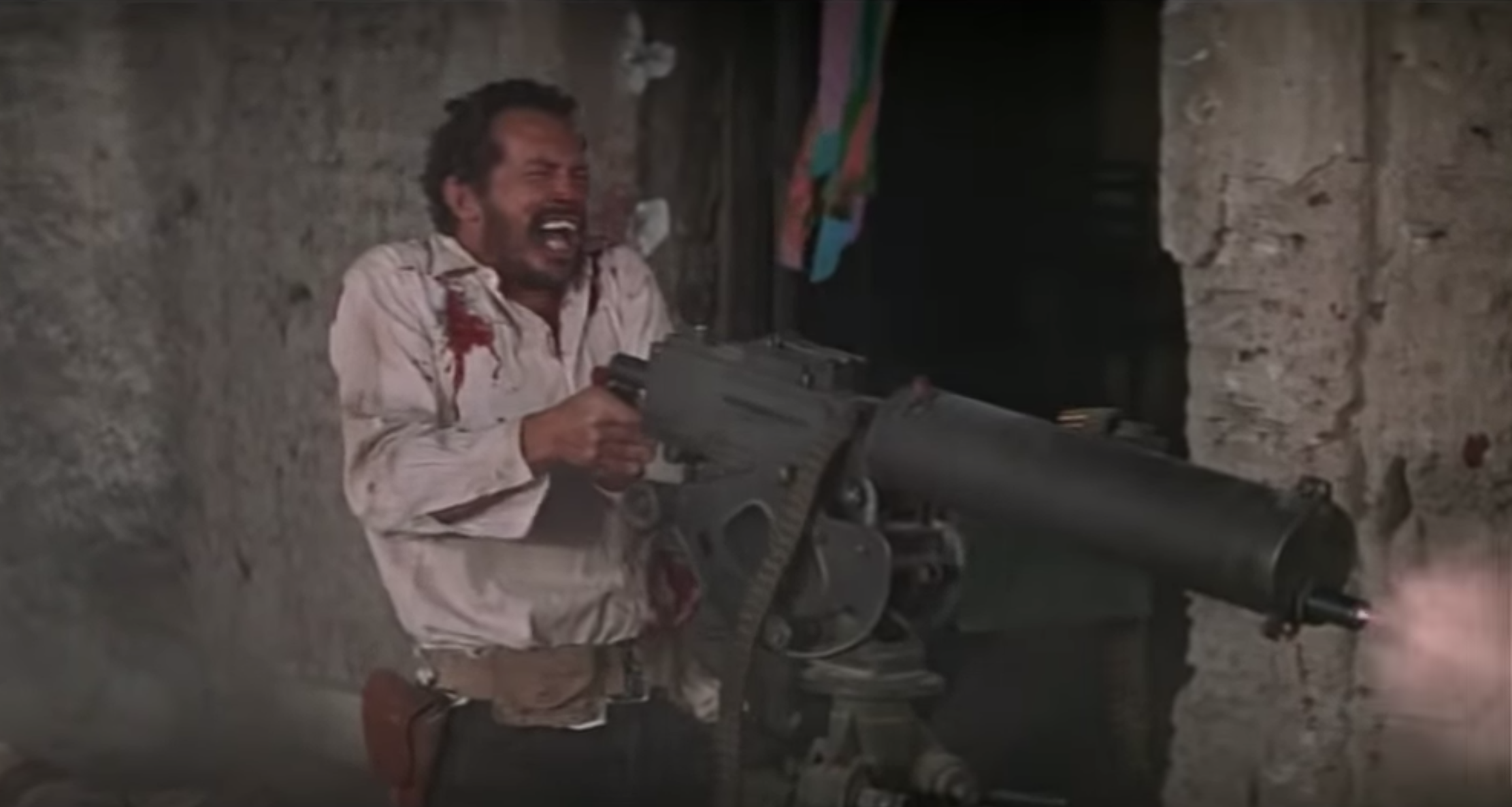
When The Wild Bunch opened it was regarded as the last revisionist wheeze of a genre that had peaked in the ’50s and was surely on its last legs. It was also seen, disparagingly, as a kind of gimmick film that used ultra-violence and slow-mo death ballets to goose the formula. Now it’s regarded as one of the best traditional, right-down-the-middle westerns ever made. This kind of writing, acting and pacing will never return or be reborn. Lightning in a bottle.
“What Citizen Kane was to movie lovers in 1941, The Wild Bunch was to cineastes in 1969,” Michael Sragow wrote, adding that Peckinpah had “produced an American movie that equals or surpasses the best of Kurosawa: the Gotterdammerung of Westerns”.
“After a reporter from the Reader’s Digest got up to ask ‘Why was this film even made? I stood up and called it a masterpiece; I felt, then and now, that The Wild Bunch is one of the great defining moments of modern movies.” — from 9.29.02 article by Roger Ebert.
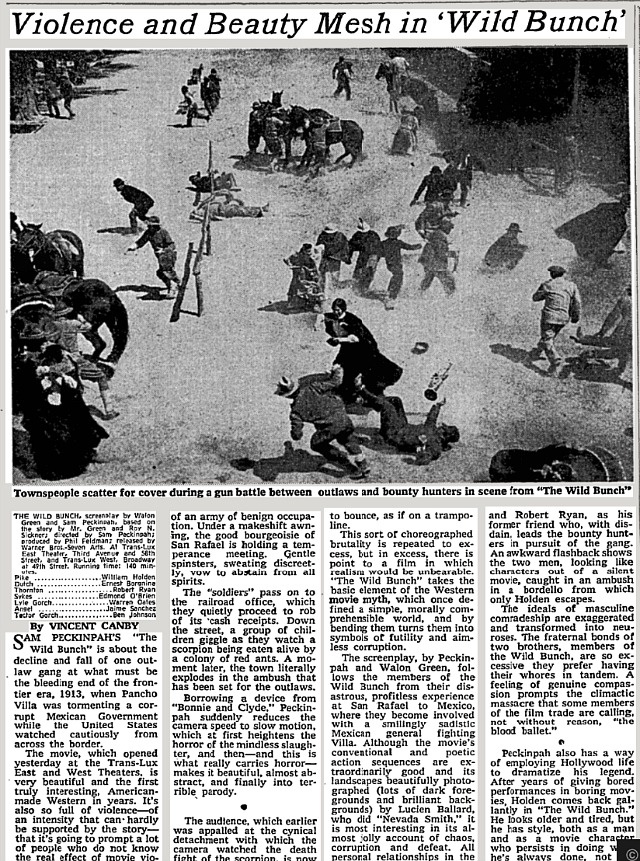
Vincent Canby on William Holden‘s performance as Pike Bishop, from 6.26.69 N.Y. Times review: “After years of giving bored performances in boring movies, Holden comes back gallantly in The Wild Bunch. He looks older and tired, but he has style, both as a man and as a movie character who persists in doing what he’s always done, not because he really wants the money but because there’s simply nothing else to do.”
Edmond O’Brien: “They? Why they is the plain and fancy ‘they’…that’s who they is. Caught ya, didn’t they? Tied a tin can to your tails. Led you in and waltzed you out again. Oh, my, what a bunch! Big tough ones, eh? Here you are with a handful of holes, a thumb up your ass and big grin to pass the time of day with.”
The great Edward Norton reached the half-century mark on 8.18.19, or the weekend before last. Which is no biggie, of course, 50 being the new 40 and all. It’s just that his brilliant debut performance in Primal Fear doesn’t feel like it happened all that long ago. (Except it did.) I’ve been thinking of Norton because of the imminent Telluride premiere of Motherless Brooklyn, the ’50s noir that he directed, adapted, produced and stars in. And the roles and films that followed over the next four years — Holden Spence in Everyone Says I Love You, Alan Isaacman in The People vs. Larry Flynt, a jazz gambler in Rounders, a reformed neo-Nazi in American History X, the unreliable narrator in Fight Club — six knockouts if you include Primal Fear.
I was speaking to a guy who’s seen The Irishman. I asked if that 8.25 piece I ran, “Six Reasons For Irishman Win,” was perhaps a bit florid (I was thinking of paragraph #8), and whether it might need some rephrasing or toning down.
His response: “Your assessment does not require rephrasing. It’s perfect.”
A friend had told me my assessment was over the top. “You can’t trust [early-bird] reactions,” he said. “Because when you see something alone you see it in a vacuum. I knew A Star Is Born was never going to do squat with the Oscars. I knew it before I ever saw it and after I saw it it was confirmed. You really can’t know until the thing opens, gets reviewed, what’s the buzz, etc.
“The Irishman will be a Best Picture nominee but I’d never predict it to win at this point.”
Then Guy #3 chimed in: “Except the movie Netflix is really counting on Oscar-wise is Marriage Story. Emotional content trumps everything. Plus there’s still a big [Academy] contingent that just won’t vote for a Netflix movie for Best Picture, choosing instead to make a statement otherwise by going with a non-streamer. Marriage Story could be the one that breaks that rule.”
HE to Guy #3: “Marriage Story might ‘break the rule’ but a grand, climactic, epic-length gangster symphony by Martin Scorsese won’t break it? You’re talking to some real obstinate hard-heads out there.”
Guy #3: “Recent history with Green Book, The Shape of Water and Moonlight suggest otherwise. Let’s see the movies first and then kick it around.”
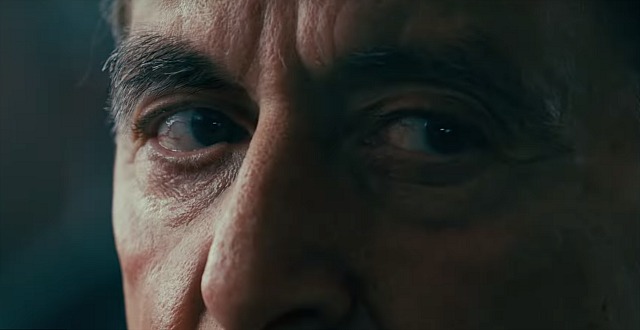
Martin Scorsese‘s The Irishman will open theatrically on Friday, November 1st, and will remain in whatever theatres it will occupy, uncompromised by Netflix streaming, for four weekends — 11.1 to 11.3, 11.8 to 11.10, 11.15 to 11.17 and 11.22 to 11.24. And then, on Wednesday, 11.27, the 210-minute gangster drama will begin streaming on Netflix.
The film will continue to play theatrically all through award season (“an expanded theatrical release in the U.S. and international markets” starting on 11.27), for those who feel that a theatrical immersion with popcorn is the only way to go.
The bottom line is that Netflix and the major theatrical chains (AMC, Regal, Cinemark) were too far apart to come to an agreement. Netflix wanted a slightly-longer-than-Roma-style release (as they’ve just announced) and the exhibs wanted a 90-day exclusivity without concurrent streaming.
It needs to be fully understood that the exhibs were being flat-out unrealistic. They should have admitted to Netflix, themselves and God Almighty that almost ALL movies have shot their wad after six weeks (42 days), and that 45 days of theatrical exclusivity would suffice. 90 days is ridiculous, and they knew it.
All the biggies are getting into streaming. The world is changing. You can’t go home again. Suck it up, do your best and deal with things as they actually are (as opposed to how you’d like them to be).
In Los Angeles, The Irishman will presumably play theatrically in Landmark Cinemas, possibly the downtown Alamo Drafthouse and possibly at the American Cinematheque, but — this is important — Netflix REALLY needs The Irishman to play in the Pacific Theatres-owned Arclight locations. Not being in the Hollywood, Santa Monica and Sherman Oaks Arclight would be a very bad thing, public profile- and Academy voter-wise.
Who knows where The Irishman will play in the New York City area, but probably The Quad, Alamo Drafthouse, BAM Cinema, City Cinemas, etc.
From Anne Thompson’s Indiewire report: “Rooting for Netflix from the sidelines were the studios: At this point, almost all of them are following Netflix headlong into the streaming world and they are desperate for a middleman like Netflix to use its first-mover advantage to break this exhibition logjam.
“Their filmmakers want theaters, Oscar voters want theaters, and if theaters refuse to budge as the world changes, the logic goes, they risk being left in the rearview.
Noah Hawley‘s Lucy in the Sky (Fox Searchlight/Disney, 10.4) is about an emotional breakdown suffered by astronaut Lucy Cola (Natalie Portman) after she returns from a long space voyage and begins a hothouse affair with a fellow astronaut, Mark Goodwin (Jon Hamm).
Boilerplate: “Lucy heads into a downward spiral as she loses her connection to her family, and particularly when Goodwin begins another affair with an astronaut trainee. The film is loosely based on astronaut Lisa Nowak‘s criminal activities around her romantic involvement with fellow astronaut William Oefelein.”
The noteworthy thing is the decision by Hawley and dp Polly Morgan to use shifting aspect ratios — widescreen (2.39:1) for footage shot during Lucy’s time in earth orbit, and a more confining a.r (1.37:1) for scenes on earth.
A new Monmouth University poll has Elizabeth Warren, Bernie Sanders and “Drooling” Joe Biden in a statistical tie — 20% for Warren and Sanders, and Biden at 19%. Thank God! In other words 40% of the those polled favor progressive candidates.
From HE correspondent Mark Smith: “The second season of Mindhunter is about utilizing the new FBI science: can the psychological profiles of the incarcerated serial killers that Holden and Bill have so far gathered be used to catch a killer who’s still active? Is all this interviewing and traveling and sharing pizza with Ed Kemper worth a shit? This question is not only relevant to the Atlanta Child Murders, but to Bill Tench‘s creepy future-killer adopted son.
“One of the common traits of a serial killer (confirmed by Ed Kemper) is that he’s compelled to return to the scene of the crime, especially if there’s a chance to see the killer’s nefarious deeds being inspected by police and/or civilians. It gives his ego a jolt, fuels the narcissism.
“In episode 6, about 31 minutes in, we see the Atlanta police chief and Holden on the side of the road where a massive search is taking place for new bodies. A group of reporters/photographers chases down the chief. When he gets into his car, the reporters turn and see Holden walking away, the giant yellow letters FBI leaping off his windbreaker. The throng chases him down. He calmly gets into his car and shuts the door.
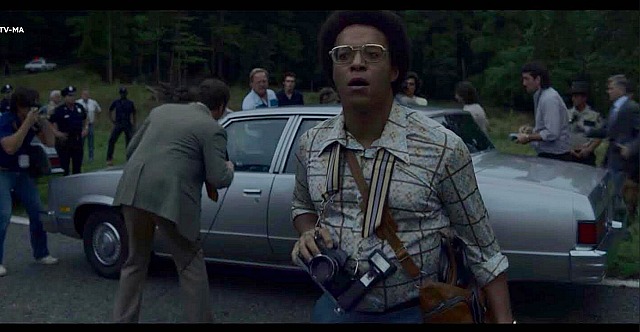
“And then something weird happens…
At the very end of the shot Holden’s car is surrounded by reporters and photographers, and one of them suddenly spins toward the camera, right in the foreground. He’s got a camera around his neck. He looks around and runs out of frame, as if trying to find another bit of the action to focus on, scanning the area for a Pulitzer-prize winning snapshot. It happens fast and is made to feel random, like another part of the chaos.
“But anyone who’s watched Mindhunter knows that it’s extremely deliberate: the shot selection, the editing, the camera movements, the acting. No one is Method Acting here, no one is holding court: you say your lines with clarity and honesty, and please shit-can the histrionics. Camera movements are usually slow and deliberate, if they occur at all. And the action is staged with almost robotic precision.
“So when a guy in the foreground spins toward the camera and rips the viewer’s attention away, you can bet it’s deliberate.
“I’m not saying I jumped from my chair and screamed, “That was the killer…that was Wayne Williams!” but the moment stuck with me.
“It felt odd, out of place, a red flag, a mental coupon to be tucked away and cashed in later.
“And then when they showed Wayne Williams after they pulled him over on the bridge (50 minutes into episode 8), that’s when I jumped out of my seat in triumph.”