Fairly Atrocious Filmmaking

Released between ’66 and ’69, Dean Martin‘s Matt Helm films (The Silencers, Murderers’ Row, The Ambushers, The Wrecking Crew) were lightweight James Bond spoofs, but even within that cynical realm they felt cheap — third-rate, oddly antiseptic, visually tepid flotsam. And not even vaguely amusing.

Below is a passage from The Wrecking Crew (’69), portions of which are seen in Quentin Tarantino‘s Once Upon A Time in Hollywood. It’s a lame, Man From Uncle-level martial-arts fuel between Sharon Tate and Nancy Kwan, and presented in short clips during Margot Robbie‘s “Sharon Tate catches an afternoon show inside Westwood’s Bruin theatre” sequence.

It’s an immediate drop-out because the bleached-blonde Robbie and the red-haired Tate resemble each other only slightly, which makes you wonder why Tarantino didn’t re-shoot the Wrecking Crew footage with Robbie and a Kwan stand-in.

But the scene plays even worse when you watch it without the “Robbie chuckling in her theatre seat” inserts. Right away you’re thinking this is extra-level godawful. Tate was a flat and wooden actress — she had no special gifts or moves, no sparkle in the eye, nothing going on inside. The combat choreography (Bruce Lee was credited as “karate advisor”) feels absurdly phony. Hugh Montenegro‘s music is atrocious — every note and stanza announces “this movie is bullshit.” Director Phil Karlson shoots like some disengaged second-unit guy — no edge or style. Sam Leavitt‘s cinematography decimates with overly bright lighting.

“Waxy and Flabby”

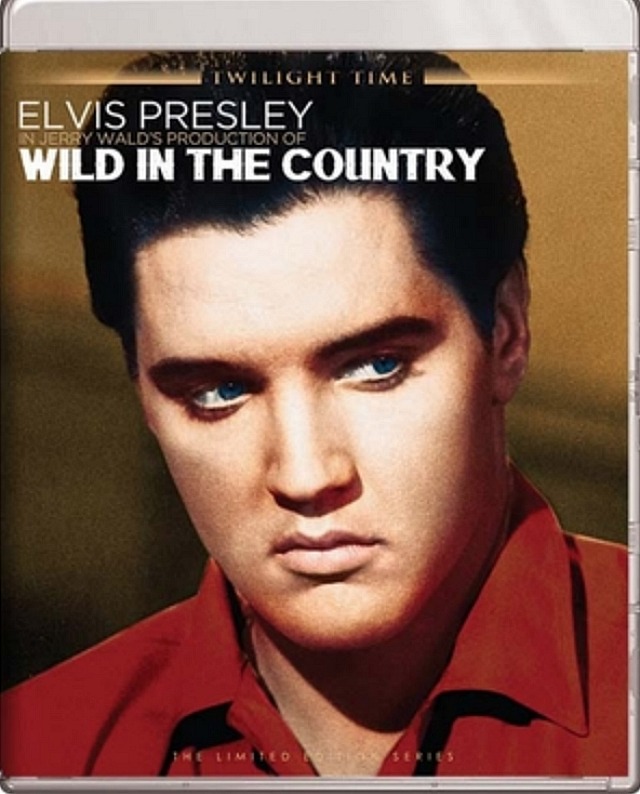
Who the hell would want to shell out $29.95 plus shipping for a Twilight Time Bluray of Wild In The Country (’61), which was the last half-serious dramatic attempt by Elvis Presley before he succumbed to that godawful run of lightweight formula flicks that characterized the remainder of his Hollywood output? Who would want to even watch it?

Read the Turner Classic Movies profile — serious people were involved, but it was a clunker with songs.

Based on a long-in-the-works novel by J.R. Salamanca, who also wrote the source book for Robert Rossen‘s Lilith (’64), it’s about a surly, indifferent malcontent who turns out to be a writer of some merit. The usual complications interfere, of course.

In August 1960 Clifford Odets signed to write the screenplay, with Philip Dunne to direct. Filming was to start in November. (“It pained me to hear him rationalize writing the screenplay,” said Odets’ colleague Harold Clurman.) But poor Odets was canned during filming.

Presley was allegedly intimate with Tuesday Weld during filming.

Costar Millie Perkins in Peter Guralnick‘s “Careless Love: The Unmaking of Elvis Presley” (from TCM): “I saw Elvis looking around that set and summing up people faster than anyone else could have, and I felt that after a short period of time he was disappointed in Philip Dunne…He tried very hard to make this film better than his other movies and you saw him trying and asking questions…I remember doing this one scene in the truck, and we were supposed to be driving home from a dance or going to a dance, and in the script he was supposed to break into song, turn on the radio and start singing. And to me it was like, ‘Yuck’….finally the director walked away, and Elvis looks at me and says, ‘God, this is so embarrassing. Nobody would ever do this in real life. Why are they making me do this?’ So there we were, both of us having to do something and we just wanted to vomit.”

Read more

“Irishman” Roll-Out

A decision has been made to screen Martin Scorsese‘s The Irishman as the closing-night attraction of the 2019 BFI London Film Festival on Sunday, 10.13. This will be two weeks and two days after The Irishman has its big world premiere at the New York Film Festival on Friday, 9.27. I’m guessing this was the best date for Netflix’s p.r. schedule, arranging for the cast and crew to fly to London and submit to the usual dog-and-pony. If I had to guess the basic plan would be to open The Irishman in a few hundred grade-A urban theatres sometime in mid October, and let it play for a month or so (or a bit longer), and then debut it on Netflix sometime in mid to late November. Theories?

Beto Breakthrough…Yes!

Yesterday, for perhaps the first time since he announced his presidential candidacy, Beto O’Rourke bluntly said what he really and truly felt as opposed to what he believed he ought to say within the bounds of political propriety and p.c. terminology. And he did so with a couple of shots of take-it-or-leave-it profanity…thank you! It was as if he’d told himself a second or two before he said what he said that “this is what I really and truly think so fuck it…plus I’m so low in the polls it can’t matter so how can I lose?”

As a onetime Beto booster I feel cleansed, rejuvenated, invigorated. A reporter asked an idiotic question — “Is there anything in your mind that [President Trump] can do now to make this any better?” — and Beto, to his everlasting credit, replied to the tune of “sorry but are you fucking insane? I mean, is this a trick question or what?”

Actual Beto quote: “What do you think? You know the shit [Trump has] been saying. He’s been calling Mexican immigrants rapists and criminals. I don’t know…like, members of the press, what the fuck? It’s these questions that you know the answers to. Hold on a second! I mean, connect the dots about what he’s been doing in this country. He’s not tolerating racism, he’s promoting racism. He’s not tolerating violence, he’s inciting racism and violence in this country. So you know, I just…I don’t know what kind of question that is.”

Hum and Aroma

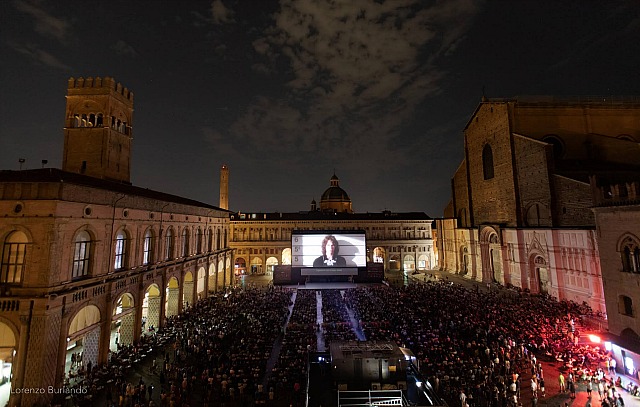
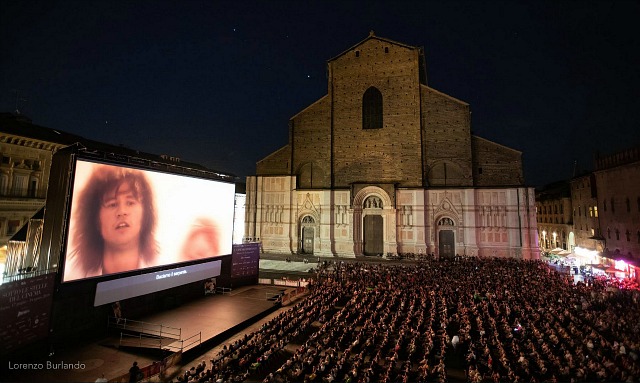
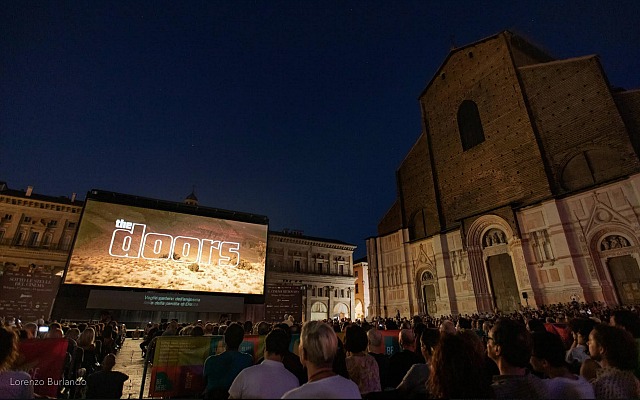
A couple of months ago I shared some ambivalent, somewhat negative feelings I have about Oliver Stone‘s The Doors, which is why I haven’t purchased the recently released 4K Bluray. But a few days ago Stone posted some pics of a screening of this 1991 film in Bologna’s grand piazza. God, to have been there! Huge crowd, dark blue sky, high-tech projection, centuries-old architecture…peace and tranquility.

Read more

Canine Caress

In a review of Barbra Streisand‘s 8.3 Madison Square Garden concert, Variety‘s Ramin Setoodeh includes the following passage:

“Streisand soaked in all the love, and toasted the crowd too with a voice-preserving cup of tea: ‘May we all be as wonderful as our dogs think we are…my three are in my dressing room,’ she said of her beloved Miss Fanny, Miss Violet and Miss Scarlett.”

What was Streisand saying here? First, that none of us are as wonderful as our dogs think we are, but that we should nonetheless aspire to deserve that kind of love. And second, that on this often melancholy, sometimes lonely planet there are few things as emotionally soothing and caressing as being loved by our dogs, because their love is always full-hearted and unqualified by even a smidgen of judgment.

The love-worship we get from our dogs, in other words, isn’t tempered or mitigated by less-than-stellar-opinions of our character unless, you know, we treat them cruelly or indifferently. It isn’t affected, to put another way, by human perspective. Dogs never say “I love you for the most part, I guess, but the way you always leave bread crumbs on the kitchen counter is so infuriating, plus the fact that you can’t seem to get past your selfishness or your adolescent assholery or the unfortunate fact that you’re a financial miser”…none of that.

Dogs sense our antsy, conflicted vibes, yes, but they never withhold affection and are always radiating trust and optimism about our basic nature and in fact life itself, and that’s why they’re so dear to us.

A decade ago I got into trouble with the militant feminist crowd (Melissa Silverstein, et. al.) for voicing a similar remark about affection and dogs. I decided to phrase it in a needlessly provocative fashion (which was tactless of me), but it wasn’t that different from what Streisand said the other night.

In a 6.6.09 column called “Just Hot Enough,” I wrote that “life would be heavenly and rhapsodic if women had the personality and temperament of dogs — forever loyal, non-judgmental, constantly affectionate. But that’s a loser’s dream.”

The key words in that sentence were “a loser’s dream.” Which I took from The Band’s “Up on Cripple Creek,” to wit: “Up on Cripple Creek, she sends me / If I spring a leak, she mends me / I don’t have to speak, as she defends me / A drunkard’s dream if I ever did see one.”

It’s not in our genetic inheritance for adult women or men to offer dog-level affection. It’ll never happen. Human behavior and mores would never advance or refine if it did. Barbra Streisand understands this, obviously, but the kind of love that she gets from her canines melts her heart regardless, and so on a certain tucked-away level she probably wishes she was such a glowing and wonderful person that certain humans would offer the same kind of untempered affection. It’s absurd to even dream about, yes, but we’d love it if this could somehow manifest. Be honest.

That’s all I was saying ten years ago. That dog love isn’t in the cards, obviously, and that only losers would pine for this but that it’s privately blissful to dream about regardless. Naturally the Silverstein crowd interpreted this in the worst possible way. But that’s what they do.

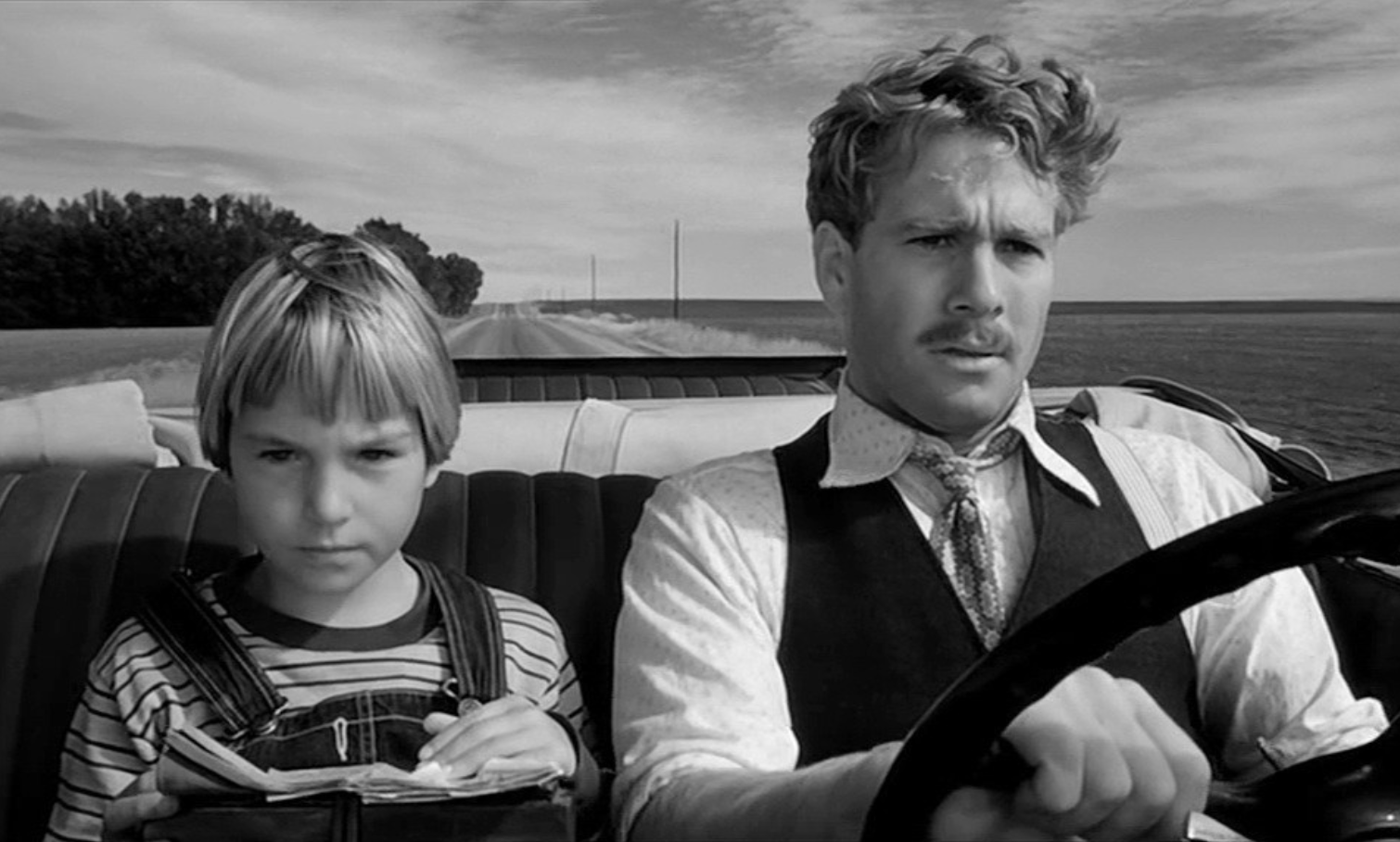
Ryan O’Neal’s Five Untouchable Years

I prefer to sidestep the biological reality of Ryan O’Neal being 78, and to think of him as the guy he was in the early to mid ’70s, when things were as good as they would ever get for him.

I had two minor run-ins with O’Neal in the ’80s. The first was after an evening screening of the re-issued Rear Window** at West L.A.’s Picwood theatre (corner of Pico and Westwood) in late ’83. As the crowd spilled onto Pico O’Neal and his date (probably Farrah Fawcett) were walking right behind me, and I heard O’Neal say “that was sooo good!” Being a huge Alfred Hitchcock fan, this sparked a feeling of kinship.

Four years later I was a Cannon publicity guy and charged with writing the press kit for Norman Mailer‘s Tough Guys Don’t Dance, which didn’t turn out so well. I for one liked Mailer’s perverse sense of humor.

I did an hour-long phoner with O’Neal, and my opening remark was that he was becoming a really interesting actor now that he was in his mid 40s with creased features. He was too good looking when younger, I meant, and so his being 46 added character and gravitas. O’Neal was skeptical of my assessment but went along — what the hell.

In fact O’Neal’s career had been declining for a good five or six years at that point. He knew it, I knew it — we were doing a press-kit-interview dance because there was nothing else to say or do.

O’Neal’s last hit film had been Howard Zeiff and Gail Parent‘s The Main Event (’79), which critics panned but was popular with audiences. He had starred in four mezzo-mezzos before that — Peter Bogdanovich‘s Nickelodeon (’76), Richard Attenbrough‘s A Bridge Too Far (’77), Walter Hill‘s The Driver (’78) and John Korty‘s Oliver’s Story.

Consider this HE anecdote about some 41-year-old graffiti on an Oliver’s Story poster.

O’Neal’s career peak lasted for five years (’70 to ’75) and was fortified by a mere four films — Arthur Hiller‘s Love Story (’70), Bogdanovich’s What’s Up Doc? (’72) and Paper Moon (’73), and Stanley Kubrick‘s Barry Lyndon (’75). (The Wild Rovers and The Thief Who Came to Dinner, which O’Neal also made in the early ’70s, were regarded as mostly negligible and therefore didn’t count.)

O’Neal has said for decades that his career never really recovered from Barry Lyndon — Kubrick had changed the film entirely in editing, and had made him look like a clueless and opportunistic Shallow Hal of the 18th Century. Plus the film had lost money.

Read more

The “Not Really” Factor

Journo pally to HE: How come you didn’t post this? Bill Maher is saying exactly what I’ve been saying for months.
HE to journo pally: Yes, you’re right. Sadly, lamentably, you’re both right. At 3:47 Maher says, “Do I want Biden to be president? Not really, but Biden is the only Democrat who beats Trump in Ohio. He’s like non-dairy creamer. Nobody loves it, but in a jam it gets the job done.” I find the “not really” part of that statement incredibly depressing.
Journo pally to HE: My fear is that [Elizabeth] Warren might win the nomination. If that happens all bets are off. We’re fucked.
HE to journo pally: I agree — very scared of Warren winning the nomination. As much as I admire and love her, the prospect terrifies me. Mayor Pete, Mayor Pete, Mayor Pete.
Journo pally to HE: He’s great but not for 2020. A Biden-Buttigieg ticket would be ideal. Pete could basically be the de facto president like Cheney was. But women would probably freak if Biden picks him for vp.
HE to journo pally: They’d freak because picking Pete would mean, in their heads, an outright rejection of the feminine factor on a national political stage.
Journo pally to HE: Right. Already there’s this bizarre anti-Pete thing going around Twitter because “waaahhh, no woman got that kind of attention.”
HE to journo pally: My personal favorites (in this order): Tulsi, Marianne, Kamala, Elizabeth. I don’t much care for Gillibrand (although she’s okay) and forget Klobuchar.
Journo pally to HE: The only one I even remotely like is Klobuchar along with Warren. I have a new appreciation for Tulsi for going after Kamala, whom I can’t stand. But she’s cray cray.
HE to journo pally: Disagree completely.

Believe It

Read more

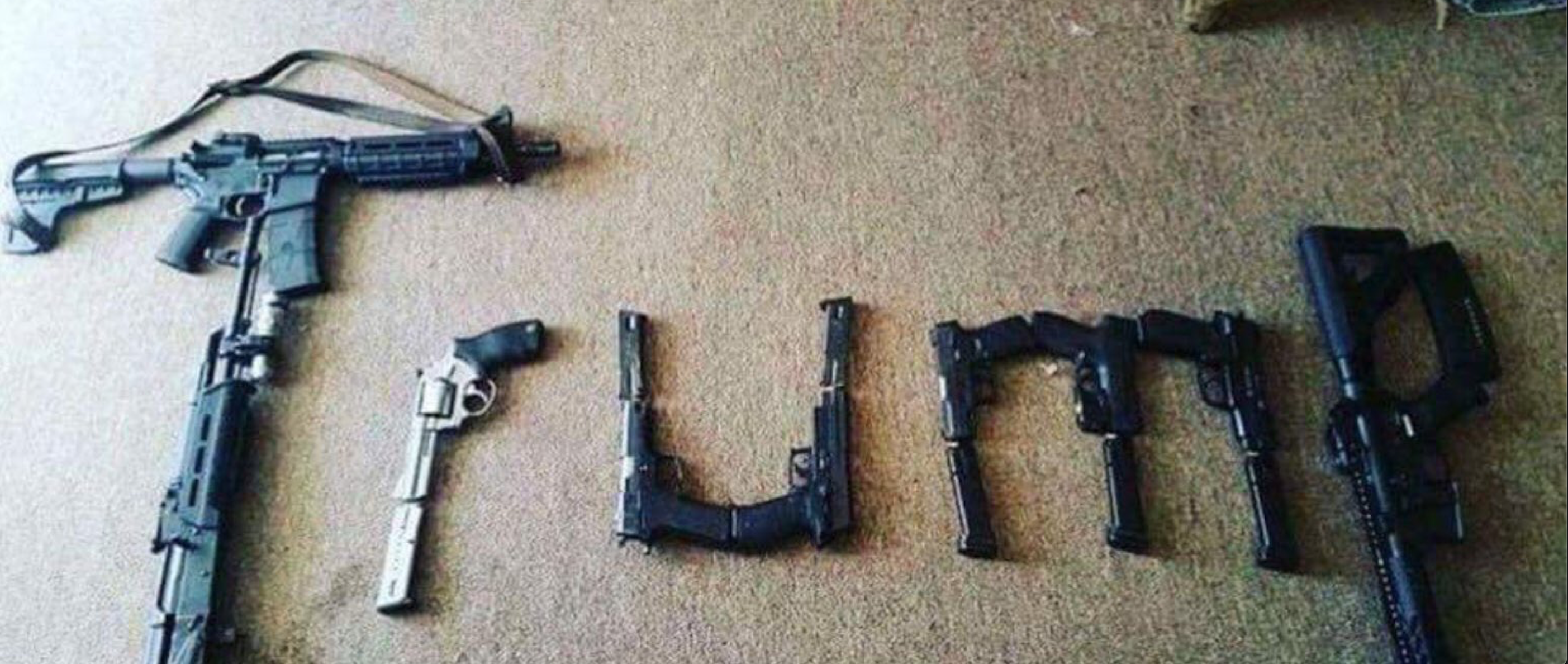
Trump Hate Fumes Sired El Paso Massacre

“In general, I support the Christchurch shooter and his manifesto. This attack is a response to the Hispanic invasion of Texas. They are the instigators, not me. I am simply defending my country from cultural and ethnic replacement brought on by an invasion.

“Hispanics will take control of the local and state government of my beloved Texas, changing policy to better suit their needs. The heavy Hispanic population in Texas will make us a Democrat stronghold,” [leading to the United States] “rotting from the inside out.” — from racist manifesto by Patrick Crusius, the 21-year-old El Paso shooter who allegedly killed at least 20 people earlier today.

1:30 am update: What was the motive behind tonight’s mass shooting at Ned Peppers bar in Dayton, Ohio, which has resulted in nine dead? (Ten including the shooter.). The Dayton Daily News has reported that “a person who was denied entry to the bar opened fire.”

Read more

“Nightingale” Drop-Out Moment

Jennifer Kent‘s The Nightingale opened yesterday. It has a 79% Rotten Tomatoes rating, but that number should be in the 90s. It’s a difficult sit but a very worthy and highly respectable film. The only problem is that it drops the ball around 15 or 20 minutes before the ending. Reactions?

Posted on 6.16.19: The controversial highlight of the just-concluded Sydney Film Festival was the adverse reaction to Jennifer Kent‘s The Nightingale (IFC Films, 8.2) during a 6.9 screening at the Ritz Cinema.

Except I saw The Nightingale three or four days ago and didn’t think it was quite as horrific as Sydney festivalgoers did. Rough stuff, yes, but delivered with a kind of stylistic restraint.

Set in 1825 Tasmania, the film is a rough-round-the-edges revenge drama in which Clare (Aisling Franciosi), a young Irish convict, is determined to pursue a cruel British officer (Sam Claflin) and three underlings after they rape her and then murder her husband and baby. Clare hires Billy (Baykali Ganambarr), an Aboriginal tracker, to guide her through the island’s jungle-like wilderness on the trail of the killers.

The audience complaints were about two scenes in which Clare is savagely raped, the second time in gang fashion. Her infant child is also killed in the latter scene.

Give all this negative build-up, I was surprised by how much I admired and respected The Nightingale, the awful cruelty and brutality notwithstanding. Kent is a very scrupulous and well-focused director, and she’s simply incapable of delivering over-the-top violence for its own sake. Start to finish The Nightingale feels well-honed and exacting. It depicts terrible things, but it’s not a wallow. It conveys a sense of justice and appropriate balance.

But there’s also a point in The Nightingale in which which everything changes and it all kind of falls apart — the story tension vanishes. It happens somewhere around the 75% or 80% mark when Clare loses her nerve in her quest for revenge. From that point on it doesn’t work. Because the film has delivered what William Goldman used to call a “drop-out” moment -— i.e., when something happens that just makes you collapse inside, that makes you surrender interest and faith in the ride that you’re on. You might stay in your seat and watch the film to the end, but you’ve essentially “left” the theatre. The movie had you and then lost you, and it’s not your fault.

Read more