Ongoing Kong Perversion

The odds may seem lopsided in next year’s Godzilla vs Kong flick, but co-screenwriter Michael Dougherty (director of the just-opening Godzilla: King of the Monsters) says it’ll be a good “David vs. Goliath situation” with Kong becoming the clever, resourceful underdog.

“Because everyone, the moment you say Godzilla’s going to fight Kong, your first reaction is Kong doesn’t stand a chance,” Dougherty recently said. “But if you really take the time to look at Kong as a character, it’s like, okay, in Skull Island he was an adolescent, so he was still growing. So who knows how big he is since the 1970s, when they first met him?”

So the Skull Island Kong was a kid, a sixth-grader, a big-ape version of a 12 or 13 year-old? He was a mid-sized office building, for Chrissake — at least triple the size of Peter Jackson‘s 2005 version, the Dino de Laurentiis Kong of 1976 or the 1933 original from Merian C. Cooper and Willis O’Brien, all of whom were roughly 30 feet tall. (Whereas the light gray Son of Kong beast was only about 15 feet tall.)

Wikipedia says the Skull Island Kong was 104 feet tall. And for the 2020 version he’s going to…what, double that?

I’m not buying the “different Kongs for different folks” rationale. King Kong is a vital, organic element in the psyche of 20th Century America, and you can’t swoop in and super-size him in order to make a profit. Well, you can but you’re the devil. The recent super-sized Kong hybrids come from the minds of greedy phonies, corporatists, non-believers, film-flammers, delusionals. Yes, I’m speaking of Dougherty and his Godzilla vs. Kong co-conspirators (director Adam Wingard, producer Mary Parent, co-screenwriter Terry Rossio).
Read more

Gulliver In Reverse

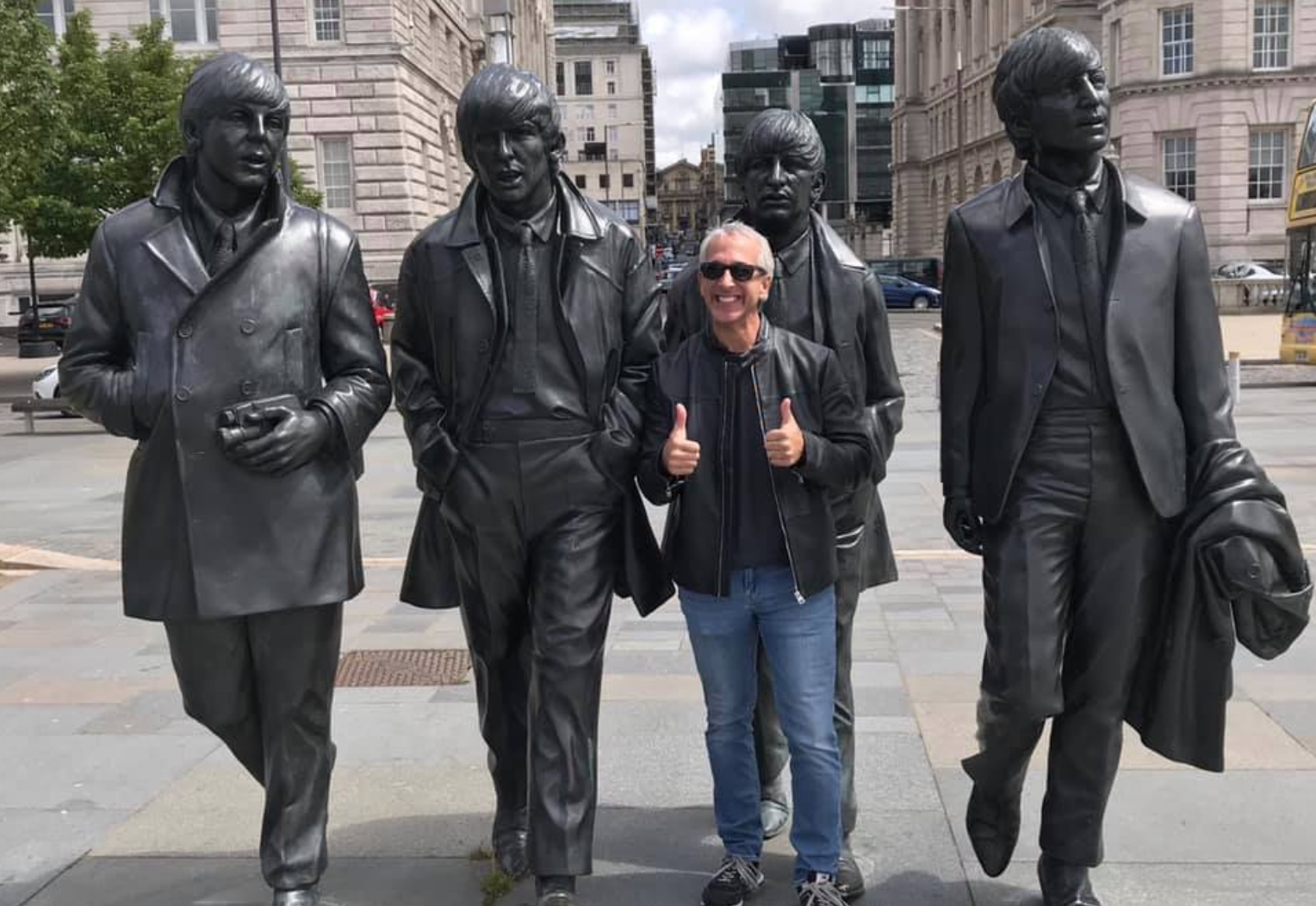
Why did this Scott Mantz-in-Liverpool Facebook photo weird me out like it did? (He’s attending Universal’s press junket for Danny Boyle and Richard Curtis‘s Yesterday, which opens in late June.) I guess it’s because I’m not accustomed to thinking of the Beatles as a quartet of 475-pound, Richard Kiel-sized giants. Plus they just look weird alongside Little Mantz. Tribute statues can be larger than life if they’re elevated a few feet off the ground on a marble or iron pedestal, but if they’re planted alongside pedestrians they should be life-sized. As in “yeah, it’s us but we’re no different than anyone else.” Except creatively, that is, and to some extent spiritually, I suppose. The Beatles were/are mythic figures who cast a giant shadow, but this is a crude way of putting it.

Read more

Dardennes Flick Almost Took It

A week ago I conveyed a certain muted respect for Jean-Pierre and Luc Dardenne‘s Young Ahmed. I described it fairly and accurately an “an 84-minute waiting-game movie about a young Islamic psychopath and would-be Jihadist (Idir Ben Addi) planning to murder his female teacher out of blind adherence to Islamic derangement syndrome.”

Everyone understands that in a European or U.S.-made drama (or comedy even) there’s only one reason to introduce a character with strong Islamic beliefs — i.e., to start the clock ticking on whether or not this character will commit some act of ghastly terror.

This is exactly what the Dardennes have done with Young Ahmed, which should probably be re-titled Young Islamic Asshole and subtitled Just For Laughs, How About Killing Yourself Without Taking Any Innocent Victims With You?Which is why it’s a “waiting game” film because all you can think about is “who is this kid going to kill, and will somebody kill him before he strikes?”

Except Young Ahmed ends rather profoundly. The last couple of minutes are so good, in fact, that I wound up forgiving the first 80 or so.

How good is Ahmed on a Dardennes scale? I would give it a 7.5. It’s certainly better than their last one, The Unknown Girl, which I called C.S.I: Liege. I would call Ahmed a “good but calm down”-er. Dialogue, dialogue. MCU interiors, MCU interiors. It certainly warrants respect but minus any post-screening cartwheels.

Except Jordan Ruimy‘s Cannes-whisperer is now confiding that The Young Ahmed was thisclose to winning the Palme d’Or. Then Bong Joonho‘s Parasite came along and the Alejandro G. Inarritu-led jury was so impressed that they decided to split the difference, giving the Palme to Parasite and the Best Director prize to the Dardennes brothers.

Last Night…

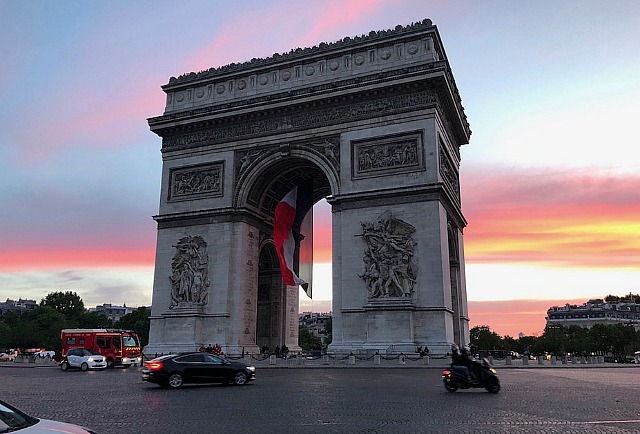
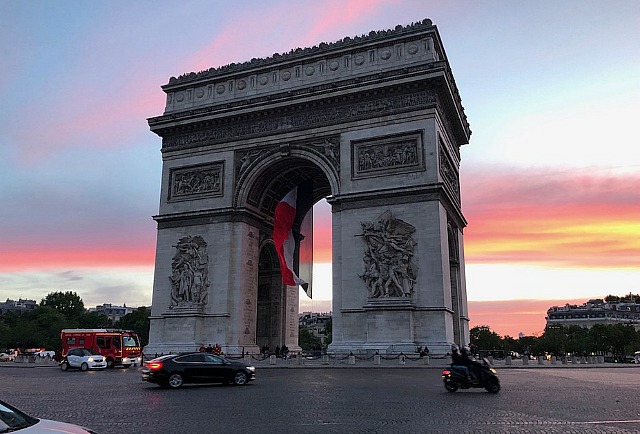
The red-pinkish caramel skies are my excuse for posting a touristy Arc de Triomphe photo. Although I’ve been coming here since the ’70s, last night was my first time ascending the monument’s circular metal staircase (my lungs and leg muscles were fine until the very end of the climb) and then finally standing on top and gazing all over, the late-night breezes gently slapping my face.

Read more

Molly-Tracy (i.e., Beanie-Reese) Connection

Booksmart has been compared to Superbad (2007), and it’s not hard to see why. They’re both raucous but heartfelt stories about two teenage friends trying to make the most of a big night out before setting off on different paths that will probably pull them apart. But there’s another movie that comes to mind when looking at Beanie Feldstein’s Molly — Alexander Payne‘s Election (1999), and its dogged would-be class president Tracy Flick (Reese Witherspoon), another eyes-on-the-prize striver whose ambitions have kept her apart from the rest of her classmates.

“In Booksmart, Molly, the Tracy equivalent, gets placed front and center, given a best friend and a good time. In some ways (though not in their politics), Molly feels like Tracy Flick, set free.

“And yet Booksmart can’t entirely separate itself from the kind of “you think you’re better than me” resentments that Election‘s teacher protagonist harbors toward Tracy (who does, of course, think she’s better than everyone). Molly experiences a mild comeuppance regarding her own superiority complex, but it rests on the assumption that college acceptance is a pure meritocracy, and that she’s misjudged everyone.

“Realistically, it’s more likely she misjudged the resources that those classmates had available to them. The idea that most of us really do have to work that hard to compete with those who have advantages that we never will — and that we still might not get what we want — is less comfortable as the stuff of comedy. But it’s a lot closer to the truth.” — from Allison Wilmore‘s “Booksmart Has A Blind Spot When It Comes To Class,” posted on 5.24.

Read more

Inexplicable

Wiki excerpt: “On 6.24.47 private pilot Kenneth Arnold claimed that he saw a string of nine, shiny unidentified flying objects flying past Mount Rainier at speeds that Arnold estimated at a minimum of 1,200 miles an hour. The first post-WWII sighting in the U.S. and the first of the modern-era UFO sightings, Arnold’s description of the objects also led to the press quickly coining the terms flying saucer and flying disc as popular descriptive terms for UFOs.”

Video caption from “‘Wow, What Is That?’ — Navy Pilots Report Unexplained Flying Objects,” a 5.26 N.Y. Times story. Written and reported by Helene Cooper, Ralph Blumenthal and Leslie Kean:

“Videos filmed by Navy pilots show two encounters with flying objects. One was captured by a plane’s camera off the coast of Jacksonville, Fla., on Jan. 20, 2015. That footage, published previously but with little context, shows an object tilting like a spinning top moving against the wind. A pilot refers to a fleet of objects, but no imagery of a fleet was released. The second video was taken a few weeks later.”

“If It Bites Ya, You’re Bit”

This interview with Jack Nicholson happened in ’07, when the renowned actor was 70. With his half-raspy, half-wheezy tobacco voice and gutty tee-hee chuckle, Jack sounds like Barnacle Bill…like some old coot smoking an old stogie or a corncob pipe while sitting in a creaky rocking chair. And he wasn’t even that old. He’s 82 now, and even that‘s not so old. Ask Norman Lloyd.

I’m not buying the Godfather anecdote. First, Nicholson could have never sold himself as an Italian-American. He’s an Irishman from New Jersey, and no amount of deft acting could have hidden that fact. Secondly, I’ve always understood that he didn’t turn down The Godfather offer because he was “doing something else” (Nicholson is almost certainly alluding to The King of Marvin Gardens, which shot during the winter months of late ’71 and early ’72) as much as his belief that he was too old to play a character in his mid 20s, Michael Corleone having been born around 1920. Nicholson turned 35 in ’72, and looked it.

Read more

Absolutely Final Mention

Godzilla: King of the Monsters opens in Paris on Wednesday, or a day and a half before the States. I don’t care if my repeated mentions about Godzilla having become a total fat-ass sound obsessive, but why do I seem to be the only critic-columnist on the planet earth who’s even mentioning this obvious fact?

Five years ago Japanese film enthusiasts were fat-shaming Godzilla, and for good reason. Compared to the original Toho Godzilla of 1954, Gareth Edwards’ super-reptile was definitely Raymond Burr in the mid ’60s. But the new Godzilla is flat-out obese — a kaiju Orson Welles. And no one, it seems, wants to even take note of this. Not even in passing. Not even as a joke.

The reason (and I’m not kidding) is that critics and think-piece writers have sensed that the monster’s expanding belt size is a subliminal gesture of kinship and comfort to the obese community, which of course reps a significant portion of the moviegoing public, and no film writer wants to be accused of fat-shaming. Because in today’s p.c. environment a fat-shamer is indistinguishable from a racist or a homophobe.

I’m no shamer, but I am saying “is anyone besides myself going to look this thing in the eye or what?” All I’m doing is saying (a) “look at him” and (b) “why do you think that is?”

You can bet that if the new Godzilla had ignored the 2014 precedent and reverted to the relatively lean-and-mean physique of the 1954 Toho version, reviewers would be mentioning this left and right. Because they’d have nothing to fear for saying “wow, Godzilla’s been working out…he’s back in shape!” Because that wouldn’t be shaming.

Three Sheets To The Wind

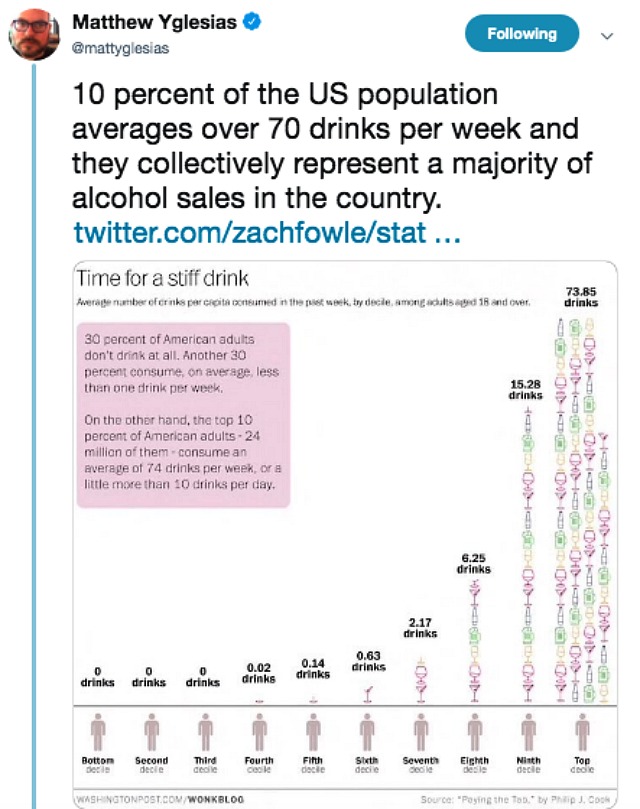
A little less than five years ago, the Washington Post‘s Christopher Ingraham reported that “the top 10 percent of American drinkers — 24 million adults over age 18 — consume, on average, 74 alcoholic drinks per week.

“That works out to a little more than four-and-a-half 750 ml bottles of Jack Daniels, 18 bottles of wine, or three 24-can cases of beer. In one week. Or, if you prefer, 10 drinks per day.”

So five years ago we had 24 million woozy drunks stumbling around like Nic Cage in Leaving Las Vegas. I’ll bet that figure has risen among Democrats over the last two and half years.

During my worst vodka-and-pink-lemonade period (’93 to early ’96) I was downing maybe two glasses a night. During my white wine heyday I would sip two glasses a night, three or four if I was at a party. I embraced sobriety on 3.20.12.

Ingraham’s data was from Philip J. Cook’s “Paying the Tab,” an economically-minded examination of the costs and benefits of alcohol control in the U.S. Specifically, they’re calculations made using the National Epidemiologic Survey on Alcohol and Related Conditions (NESARC) data.

Never Too Early To Spitball

A random, non-prioritized list of 38 potential titles for the 2019 Venice, Telluride and/or Toronto festivals, sent along by World of Reel‘s Jordan Ruimy. Additional titles and/or suggested deletions?

1. The Irishman (Martin Scorsese); 2. Knives Out (Rian Johnson); 3. The Laundromat (Steven Soderbergh); 4. Jojo Rabbit (Taika Waititi); 5. Uncut Gems (The Safdie brothers); 6. Ad Astra (James Gray); 7. First Cow (Kelly Reichardt); 7. A Beautiful Day in the Neighborhood (Marielle Heller); 8. Bergman Island (Mia Hanson-Love); 9. Fair and Balanced (Jay Roach); 10. A Rainy Day in New York (Woody Allen)

11. The Last Thing He Wanted (Dee Rees); 11. Little Women (Greta Gerwig); 12. The Truth (Hirokazu kore-eda); 13. Antlers (Scott Cooper); 14. Ema (Pablo Larrain); 15. Waiting for the Barbarians (Cirro Guerra); 16. Untitled Noah Baumbach (Noah Baumbach);
17. The King (David Michod); 18. The Glorias: A Life on the Road (Julie Taymor); 19. Fonzo (Josh Trank); 20. The Rhythm Section (Reed Morano).

21. Gemini Man (Ang Lee); 22. Downhill (Nat Faxon/Jim Rash); 23. The Hunt (Craig Zobel); 24. Against All Enemies (Benedict Andrews); 25. The Woman in the Window (Joe Wright); 26. Ford vs Ferrari (James Mangold); 27. The Trial of the Chicago (Aaron Sorkin); 28. Motherless Brooklyn (Edward Norton); 29. The Nest (Sean Durkin); 30. The Personal History of David Copperfield (Armando Iannucci).

31. Joker (Todd Phillips); 32. The True History of the Kelly Gang (Justin Kurzel); 33. The Good Nurse (Tobias Lindholm); 34. The Devil All the Time (Antonio Campos); 35. The Goldfinch (John Crowley); 36. Lucy in the Sky (Noah Hawley); 37. Wendy (Benh Zeitlin); 38. Waves (Trey Edward Schultz).

Moody Uber Guys

Last night Gleb (Tatyana’s 19-year-old son) and I had dinner at Kathmandu (22 Rue des Boulangers, 75005 Paris). As we crossed the Seine an hour later Gleb suddenly realized he’d left a newly purchased hipster hat at the restaurant. I called and was told the hat was safe, but we had to return before closing time.

We were looking at a good 14 or 15 blocks so I called an Uber. Over the next couple of minutes three drivers said they were on their way, but all three cancelled seconds later. Every so often a Los Angeles driver might cancel but I’ve never suffered three cancellations in a row, for heaven’s sake. So we just humped it back and arrived just as they were closing. The hat was sitting exactly where Gleb had left it.

Legacy

I still haven’t gotten to Antoine Fuqua‘s What’s My Name: Muhammad Ali (HBO, two parts, 165 minutes). Fuqua basically enables the three-time heavyweight champ to narrate his own story. One result, according to The Hollywood Reporter‘s Caryn James, “is undeniably an exercise in image-burnishing, not that Ali’s already heroic image needs it.”

Ali’s life has always been its own burnishment, but I’d rather re-watch his YouTube clips (I’ve watched the 10.30.74 “Rumble in the Jungle” match several times) or better yet When We Were Kings. I’ve just re-watched an eloquent N.Y. Times video obit (19 minutes, posted on 6.6.16) that addresses the “what’s my name” thing perfectly. Who’s seen Fuqua’s film and what’s the reaction?

Read more