It was so wonderful last night when Sean Baker‘s Anora won the Critics Choice Best Picture award…whoo-whoo! I love the idea of this notion carrying over to the Oscars, but there are so many Academy members who just aren’t smart or hip enough to understand that Anora really is the best or them all.
There are so many idiots out there who believe that a three-hour-plus movie with an overture and an intermission and shot in VistaVision…there are just too many stupid people out there who equate this kind of thing with greatness so it’s best not to get our hopes up.
HE reply: To have spoken the plain, unfettered truth about the many, many missteps of the Criterion Collection…my God, who else has had the stones and sand to do this with?
Over the years HE has righteously exposed (a) all of Criterion’s beyond-horrible Egyptian mosquito grainstorm Blurays (Stagecoach, The Awful Truth, The Third Man, His Girl Friday), (b) those grotesque, teal-tinted vandalism Blurays (Bull Durham, Teorema, Midnight Cowboy), (c) Criterion needlessly cleavering A Hard Day’s Night and Some Like It Hot from the pedestal of their healthy, breathing-room aspect ratios of 1.66:1 into the harsh a.r. realm of 1.75 and 1.85, respectively, (d) the mine-shafty, overly inky monochrome renderings of Only Angels Have Wings and Rebecca…the list goes on and on.
Have the Criterion bros fixed any of these errors, the teal vandalizing in particular? Not to my knowledge.
On top of which their social signature is odious. The Criterion crew is pretty much exactly like your snooty cool kidz in high school — chilly, elitist, obstinate snobs. They’re brilliant at sucking up to edge-factor filmmakers and going “coo, coo…we want to slurp your dirty bath water!”
On the other hand their highest quality Bluray/4K visual and compositional signature is second to none (I’ve acknowledged this from the get-go) and fully respected the world over.
And my praise for their game-changing On The Waterfront visual essay about the criminality of cleavering a film that was protected by dp Boris Kaufman at 1.37:1 and yet cropped down to 1.85…for this I will bow down to Criterion on bended knee for the rest of my life.
And I adore, adore, ADORE their wonderfully grain-free Sweet Smell of Success Bluray, not to mention their transportational Blurays of The Hit, Sunday Bloody Sunday and especially Barry Lyndon.
Recounting the saga once again, Criterion rejected Leon Vitali’s claim that Kubrick’s 1975 classic should have been cropped to 1.78:1 -— they corrected this error by cropping Lyndon at 1.66. And yet — and yet! — they failed to give credit to Glenn Kenny for un-earthing a letter (provided by Jay Cocks) that Kubrick sent to exhibitors specifying that the film should ideally be projected at 1.66…and they ignored my weeks-long, one-man-band campaign on behalf of that 1.66 aspect ratio…I was truly the coal fire that kept that engine going.
Nonetheless all hail Criterion for generally being on the side of the angels, not just on this front but many others. They just need to fix the grain, the teal and the aspect ratios on the above titles.
HE reply: “How is a simple, from-the-heart statement of fact — Tony Roberts gave his finest, tastiest, grittiest supporting performances in a pair of early ‘70s cop dramas — how is that obviously respectful tribute ‘showing my ass’?
“To be able to stand up tall and say to the image in the bathroom mirror that you are a member in good standing of the fabled Serpico and The Taking of Pelham One Two Three clubs (and that’s quite the fraternity, quite the badge of honor)…what’s Marc Antony’s final line about Brutus in Julius Caesar? “This was a man!”
The general view is that Tony Roberts, the ascerbic, Manhattan-flavored actor who passed today at age 85, is best known for his supporting roles in six early Woody Allen films — Play It Again, Sam, Annie Hall, Radio Days, Stardust Memories, Hannah and Her Sisters, A Midsummer Night’s Sex Comedy.
But Roberts’ finest performances were as Detective Bob Blair in Sidney Lumet‘s Serpico (’73) and as Deputy Mayor Warren LaSalle in Joseph Sargent‘s The Taking of Pelham One Two Three (’74).
I finally saw Walter Salles‘ I’m Still Here two days ago in Ojai. It’s obviously an absorbing, very well-crafted, fact-based poltical drama, and yes, Fernanda Torres carries the whole thing on her shoulders. Superb actress. Fully deserving of her Best Actress nomination.
But as good as it basically is and as much as Salles is a masterful filmmakr, I’m Still Here — a film about South American political terror — is not as gripping or unnerving as Costa-Gavras‘ Missing (’82) or Luis Puenzo‘s The Official Story (’85).
Within the realm of anti-left, military-dictatorship South American films about leftist victimization, it doesn’t stick to your ribs quite as much. It’s certainly less haunting.
This is because I’m Still Here‘s focus is much more on treading the emotional family waters…the anguished struggles of Eunice Paiva, the real-life mom (played by Torres), and her five kids as they attempt to cope with the sudden absence of their dad, Rubens Paiva. The film is much more committed to this side of things than on the creepy, ominous particulars of her husband’s absence (which we all know is due to his murder).
I had a problem with one aspect, however — an aspect that infuriated me more and more. What bothered me was how Torres’ Eunice constantly hides the horrifying indications about what may be going on from the kids, and in some cases flat-out lies to them. At the two-thirds mark one of her daughters, the one who’s been living in London, calls her out on this.
Eunice’s kids are very smart and exceptionally mature, and yet in the initial stages of her husband’s disappearance she treats them like emotionally retarded simpletons who can’t be trusted with the facts, and so I became angrier and angrier with her.
Always level with your kids, and never blow smoke up their asses…ever.
Interesting sidenote: Eunice Paiva was around 50 when her husband was taken by government agents, never to be seen again. The film shows many photos of how Eunice looked in 1970 and in the years that followed, and the fact is that she was much more attractive than Fernanda Torres, who has the honest, fascinating face of a formidable stage actress and an apparent inner life that you can’t help believing and investing in, but who is also, truth be told, a bit homely looking. I’m just being honest — what do you want me to do, lie?
After three-plus-years of delay and fiddling around, Bernard McMahon‘s Becoming Led Zeppelin, an obsequious 2021 doc about the early glory days of arguably the greatest metal-rock band of all time, is opening in IMAX today in roughly 200 theaters. Sony Pictures Classics is distributing.
All I can say is, it took ’em long enough.
I saw a version of McMahon’s film roughly 41 months ago in Telluride, and then it vanished. I really liked most of it but what was the big hassle? The now-playing version runs 121 minutes — the version I saw in Telluride ran 137 minutes or 2 hours and 17 minutes….the newbie is 16 minutes shorter.
In early September of ’21 the 137-minute doc screened at the Venice and Telluride film festivals, which almost always signals some kind of imminent fall release, or at least early the following year. But then it disappeared. Either nobody acquired it or it was withdrawn for further editing or something. All I know is that there’s no word about anything.
HE wild guess: There’s been a general sense of frustration with the critical response to the doc. Most reviewers found it overly obsequious and not even slightly inquisitive, and so (again, purely a guess) some re-editing and re-shaping is going on.
Led Zeppelin headliners Jimmy Page and Robert Plant, who had apparently turned down previous proposals for a definitive Led Zeppelin doc over the years, presumably because they didn’t want a warts-and-all portrait (i.e., infamous drug use and groupie debauchery on the road + the drug-related death of dummer John Bonham), are presumably hammering things out with McMahon as we speak. Or not. Who knows?
I saw and reviewedBecoming Led Zeppelin at Telluride ’21. Like most many reviewers I found it satisfactory if (and I say “if“) you’re willing to just go with it and put away your cranky hat. Providing, in other words, that you’re willing to ignore the doc’s kiss-ass attitude and general lack of curiosity about anything other than how the band came together and how the early songs were created, etc.
Forty-eight words: Becoming Led Zeppelin is highly enjoyable but a bit under-nourishing due to control-freak conditions imposed by Page and Plant. Overly sanitized, dishonest by way of omission, totally obsequious. But I still “liked” it — i.e., had a mildly good time except during the last 20 or 25 minutes.
Excerpt: “The first hour relates the individual paths of the three remaining Zeppers, and straight from the mouths — Jimmy Page, Robert Plant, John Paul Jones (all currently in their 70s and in good spirits) as well as the late John Bonham, who is heard speaking to a journalist about this and that.
“The second hour is about the launch of Led Zeppelin — the early play dates, the creation of the first two albums, the acclaim, the power and the glory. It’s basically about good times, and there’s certainly nothing ‘wrong’ with that.
“The problem is that it doesn’t dig in. It’s not even slightly inquisitive. It’s way too obliging, almost feeing like an infomercial at times. It offers, in short, a really restricted portrait, and around the 110-minute mark (and with 27 minutes to go) I started to mind this.
Three years ago the control freaks running the Prince estate refused to allow director Kathryn Ferguson to use “Nothing Compares 2 U”, the Prince song owned by the estate, for her Sinead O’Connor doc, Nothing Compares.
A low-budget doc that paid devotional tribute to O’Connor was seriously bruised by the Prince estate by refusing to allow her most famous recording to be heard? This had to be one of the lowest scumbag moves in rock-music history.
Variety is reporting that Netflix has canceled the release of a six-part Prince documentary, directed over a period or nearly five years by the greatly respected Ezra Edelman (O.J.: Made in America).
Netflix statement sent to Variety: “The Prince Estate and Netflix have come to a mutual agreement that will allow the estate to develop and produce a new documentary featuring exclusive content from Prince’s archive. As a result, the Netflix documentary will not be released.”
Estate reps are apparently upset that Edelman’s nine-hour doc (which was originally contracted to run six hours) includes “Prince’s ex-girlfriends accusing him of physical and emotional abuse.” The doc also includes accounts of “Prince’s own abusive childhood and the abandonment of his young wife Mayte Garcia after the couple lost their child.”
Variety‘s Thania Garcia and Jem Aswad are reporting that the estate bulldogs are claiming that “a first cut of the film was filled with ‘dramatic’ factual inaccuracies and ‘sensationalized’ renderings of certain events from his life.”
If you’ve experienced the excellence of O.J.: Made in America, you have ample reason to doubt the veracity of the Prince rep claims.
“How should we think about artists whose moral failings are exposed? Ezra Edelman manages to present a deeply flawed person while still granting him his greatness — and his dignity.
“Wesley Morris, a critic at The Times and one of a small group of people who have seen the film, told me, ‘It’s one of the only works I have ever seen that approximates the experience of suffering with and suffering through and alongside genius.'”
Yesterday afternoon I was prevented from catching a 3:20 pm Santa Barbara Film Festival screening of Ricardo de Montreuil’s Mistura. But I saw it this morning and lo and behold, it’s fully approvable — a fall-and-rise saga of Norma (Barbara Mori), a somewhat older elitist who’s forced to cope with personal upheaval by overcoming cultural prejudice while exploring the glorious riches of French-Peruvian cuisine.
It’s basically about survival through rebirth, sensual discovery and the shirking of shitty attitudes in the wake of a shattering divorce…quite a mouthful!
It’s also another sublime foodie film in the vein of Tran Anh Hùng‘s The Taste of Things (i.e., The Pot au Feu) and Sandra Nettlebeck‘s Mostly Martha.
Set in 1960s Peru (apparently Lima), Norma’s privileged life collapses when her husband’s infidelity results in her being cut loose from elite social circles. She attempts to restart her life as some kind of food entrepeneur or restaurant owner, but is first obliged to overcome certain cultural prejudices (social, culinary) she acquired during her well-heeled marriage.
This is one of those personal-struggle-and=growth films that feels wonderfully, culturally and organically alive.
May I admit to a prejudice on my own? I’ve never had much interest in visiting Peru or for that matter South America — I’ve only been to Argentina once, and that was 20 years ago. But now, thanks to Mistura, I’m thinking about making the trek someday. I feel slightly awakened.
Norma is a compelling character because of the realistic prejudices that define her early on, and because she taps into an inner moxie that helps her struggle through by grappling with a challenging but ultimately rewarding reality.
Norma’s butler, warmly played by César Ballumbrosio, serves as her coach and moral compass — a good fellow to have in your corner.
Five days ago Queer‘s Daniel Craig was handed the Dilys Powell Award at the 45th London Critics’ Circle Film Awards at London’s May Fair hotel. (Why don’t they just spell it “Mayfair”?)
There’s simply no way that Adrien Brody‘s Oscar-nominated lead performance in The Brutalist begins to even flirt with the level of top-tier expertise and emotional soul-sharing that Craig or Conclave‘s Ralph Fiennes achieve. Brody really isn’t in their league…sorry but asi es la verdad.
In his own Bob Dylan-esque way Timothee Chalamet achieves something just as phenomenal…a totally spot-on inhabiting of a guy who prevailed 60 to 65 years ago, but in a sense is no longer with us.
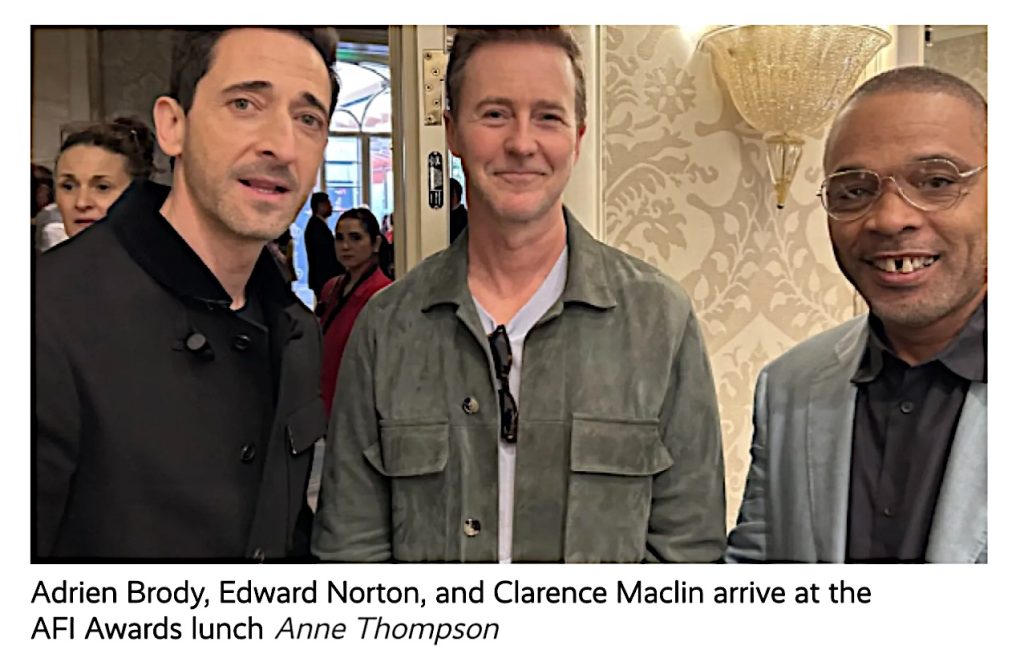
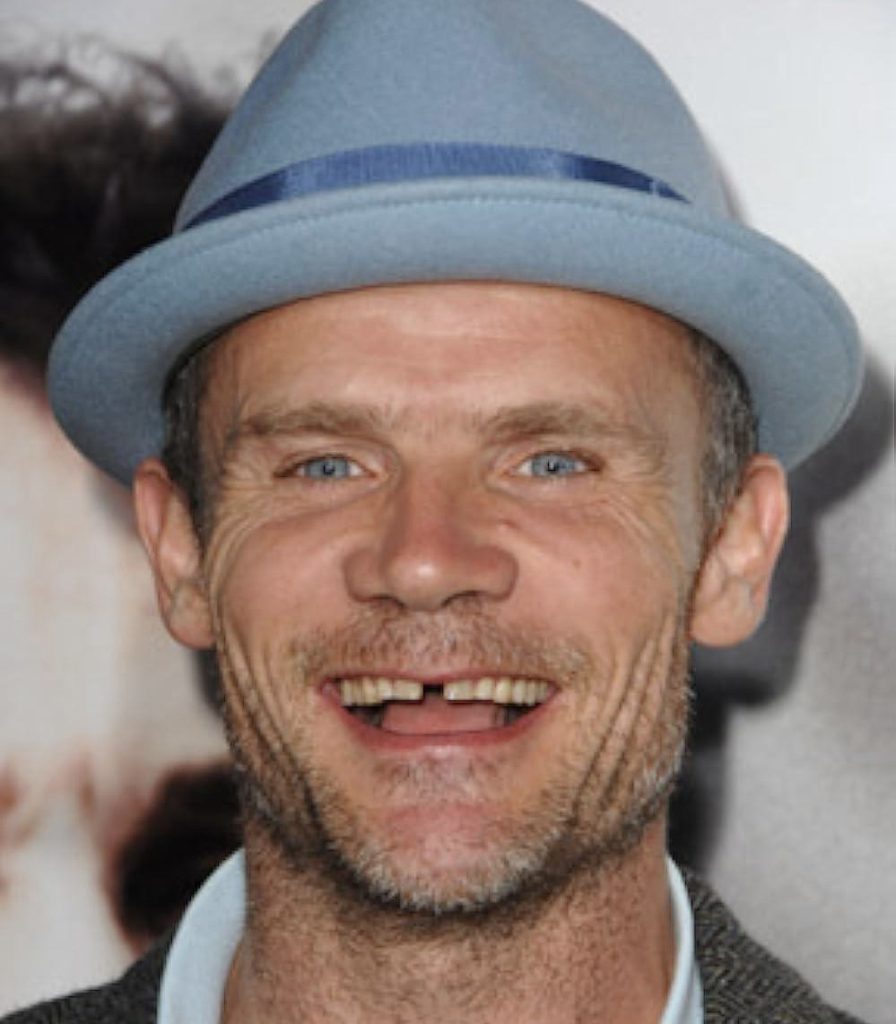
We all understand that bad-teeth flaunting or calling attention to dental imperfections (a.k.a “grillz”) is a no-excuses, no-apologies Black cultural thing.
I guess what I’m really asking is if Flea is the only famous white guy to do the edgy gap-tooth. Would Adrien Brody be a leading Best Actor nominee if he had followed suit? How about Edward Norton?



 ,/p>
,/p>