Big, Over-Produced “Dumbo” Lacks The Original’s Gentle Soul

How many have seen Walt Disney‘s original 1941 Dumbo? I did when I was seven or eight, something like that. That endearing scene in which tearful little Dumbo longs for his mom’s embrace after she’s been locked up for being a “mad” elephant…right? Then came my second immersion when I saw Steven Spielberg‘s 1941, which opened (good God) almost 40 years ago. That scene, I mean, when Robert Stack’s General Stillwell weeps while watching the locked-up-mom scene in a Hollywood Blvd. theatre.

Disney’s almost 80-year-old animation may seem a little crude by present-day standards, and the film only runs 64 minutes, but the original Dumbo (overseen by Walt and “supervising director” Ben Sharpsteen) emotionally works.

Dumbo‘s basic theme (first articulated in Helen Aberson and Harold Pearl‘s Dumbo, the Flying Elephant, a 1938 children’s book) is that young oddballs — anyone or anything perceived as “different” — are doomed to suffer at the hands of selfish, short-sighted humans. But if the little fella has some kind of inner gift or aptitude (like flying, say) and can somehow express it, the ugliness can be stilled to some extent. Or he can at least snuggle up with mom.

Tim Burton‘s big, over-produced, annoyingly simple-minded remake sticks to the same basic idea — i.e., oddballs can find light at the end of the tunnel if they can show a little moxie.

Burton takes a small, mostly sad little story — a big-eared baby elephant that can fly is separated from his mom, and has to learn to fend for himself — and basically throws money at it while adding nearly 50 minutes to the running time — 112 minutes vs. the original’s 64.

Okay, money and a really nice compositional eye, at least during the first half. The first 55 or 60 minutes of Dumbo are largely about old-worldish production design (by Rick Heinrichs, who worked with Burton on Sleepy Hollow) and Ben Davis‘s cinematography, which is really quite handsome. Within the first hour every shot is an exquisite, carefully lighted painting.

We’re talking about a small-scaled, old-fashioned, Toby Tyler-ish realm, owned and operated by the hucksterish but good-hearted Max Medici (Danny DeVito). A big canvas circus tent, wooden bleachers, peanuts and popcorn, lions and lion tamers, strong men and fat ladies…the kind of operation celebrated in Cecil B. DeMille‘s The Greatest Show on Earth (’52) and in Samuel Bronston‘s Circus World (’64).

But the second half — or when poor Dumbo’s life is darkened by Michael Keaton‘s V. A. Vandevere, a P.T. Barnum-meets-Beetlejuice figure who represents all kinds of venality, corporate greed and the seven circles of hell — the second half is just awful. The scale of Keaton’s super-circus (a Dante-esque amusement park called Dreamland) is oppressive. Watching this portion is a combination of (a) “villainy! vulgarity! greed!”, (b) “turn off the stupid spigots,” (b) “who wrote this godawful dialogue?” (answer: Ehren Kruger) and (d) “please burn it all down.”

Read more

Why Should I Care?

My streaming options feel fairly flush these days — Amazon, Netflix, Criterion, Vudu. Why do I have to get all hot and bothered about Apple TV +? What matters to me is cinematic enrichment — discovering fresh currents and minerals in the stream, refining them, adding a good score, making them into films and then throwing them up on BIG screens on the way to general streaming. If Apple wants to join in that effort, great.

“We Sell What You Need”

Brie Larson’s Unicorn Store (Netflix, 4.5) “is about unicorns, but only obliquely. Mostly, it’s about a unicorn-obsessed young art student named Kit (Larson) who needs some sort of life lesson, although what this [might be] exactly remains maddeningly unclear at the end.

“In order for this pixie-dusted contemporary fable to make its point, the movie erects a magical pop-up shop just for Kit, complete with world’s most flamboyant salesman (Samuel L. Jackson, wearing tablecloth-print suits and tinsel in his afro, a la Beyonce), where Kit can arrange to adopt her very own unicorn.

“What if Kit’s childhood wish came true? Would it be the best thing that ever happened? Or in some cases, is giving a girl a pony the worst possible present? Perhaps there’s some wisdom to that, but wouldn’t it be great to find out?

Unicorn Store spends so much time focused on Kit’s mostly-average, mostly-boring pre-unicorn life that it’s hard to understand what the universe (or the movie, at least) is trying to teach her — something about not being selfish, or the importance of not throwing bratty tantrums in your 20s, or (and this is a direct quotation, albeit one whose meaning is muddled) “we’re all looking for happiness and maybe if we’re lucky we can just buy it in a store.” — from Peter Debruge’s 9.11.17 Variety review.

Dishonest Operation

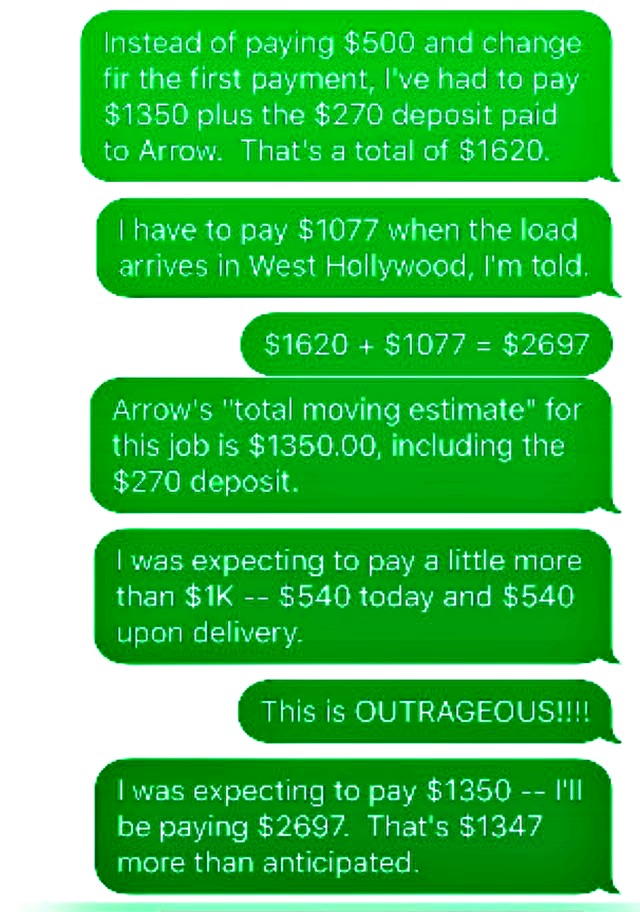
A while back I hired a shifty outfit called Arrow Moving and Storage to haul some stuff (including my trusty Yamaha Majesty) from Wilton, Connecticut back to West Hollywood. I told them exactly what the items were and their size. (Arrow had moved many of the same items last summer.) There was no ambiguity about the load or their estimate — they said it would set me back $1350, give or take.

My total packed-box count was 14 instead of 10 so I knew there’d be an overage charge, but after the stuff (including a big TV and a wooden shoe rack) was loaded earlier today I was told by the local subcontracted movers that the total hit would be a hair under $2700$1350 paid today and another $1347 when the stuff arrives in WeHo. But add the $270 deposit I sent to Arrow a few weeks ago, and the tally is $2967.

In other words, I was charged more than double what had been estimated by an Arrow guy named “Thomas”.

In my humble judgment, Arrow’s way of doing business is, at the very least, sloppy and careless. We all understand that moving estimates can sometimes be a bit off, but when you wind up getting charged more than double the original estimate, something is seriously wrong.

I think it’s a scam — deliberately under-estimate in order to land a sale and a deposit, and then refuse to answer the phone when the movers charge much, much more due to a higher cubic-foot and weight count than originally estimated.

Read more

Two Faces Have I

Published in ’92, Joe McBride‘s “Frank Capra: The Catastrophe of Success” revealed that the respected, Oscar-winning director of audience-friendly films about the “common man” during the ’30s and ’40s (It Happened One Night, You Can’t Take It with You, Mr. Smith Goes to Washington, It’s a Wonderful Life) wasn’t exactly a champion of liberal and proletarian sentiments behind the scenes.

“Spurning his ethnic roots, ashamed of his parents, Capra lusted to be accepted by mainstream America. He was affiliated with conservative Republicans, spied on labor in the 1930s for powerful producers and collaborated surreptitiously with the McCarthyite witch hunt,” according to the Amazon summary.

“McBride presents a man seething with bitterness, rage, self-doubt and sexual anxiety with his two wives. He analyzes Capra’s reactionary idealization of small-town America and the misogynist undertones of his films. In a canvas crowded with stars like Claudette Colbert, Jimmy Stewart, Barbara Stanwyck and Gary Cooper, McBride convincingly paints a great director who lost his touch after the late 1940s, unable to adjust to postwar Hollywood or to function independently.”

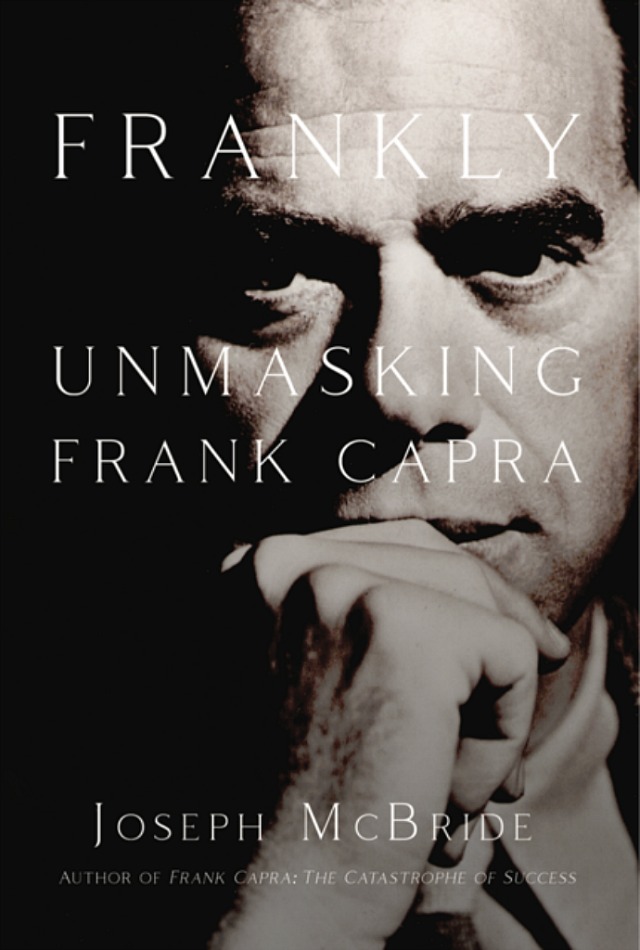
McBride now has a second Capra book coming out — “Frankly: Unmasking Frank Capra” (Vervante, 3.22). It tells the saga of what a bitch it was to research and publish “The Catastrophe of Success.”

Excerpt: “While McBride was researching and writing for more than seven years, he was fighting a pitched legal battle with his original publisher and allies of the celebrated film director. ‘Frankly: Unmasking Frank Capra’ is McBride’s revealing, harrowing, often darkly comical account of that Kafkaesque but ultimately successful struggle.”

HE question for readership: Who in today’s realm is a similar Capra-esque figure? Which artists or celebrities project a certain persona on talk shows and in press-junket interviews, but when you learn a thing or two about their private lives are not that person, or at least are not believed to be so? The private George Clooney and Tom Hanks are pretty much exactly the guys they seem to be (to go by their projected personas), but there are others who are not quite the person they’re pretending to be.

All Over Now

Scott Walker, the Walker Brothers lead singer whose moody crooning baritone was a major reason why “The Sun Ain’t Gonna Shine Any More” was such a big hit in ’66, has left the earth. He was 76.

The irony, of course, is that once Walker began releasing solo albums in ’67 he rejected all aspirations to being a mainstream pop singer. Variety‘s Jem Aswad: “While his increasingly challenging music cost him many fans, the singer never looked back excepting a Walker Brothers reunion in the mid-1970s. Walker released several albums that were individual and esoteric by any standard. In recent years he collaborated with artists ranging from arch pop combo Pulp and Seattle drone-metal outfit Sunn O))) to British avant-pop singer Bat for Lashes.”

Being a musical plebian when it comes to the avant-garde realm, I still think of Walker as the “Sun Ain’t Gonna Shine” guy. Sorry.

Mayor Pete — Double Digits in Iowa, Smartest Guy In The Room

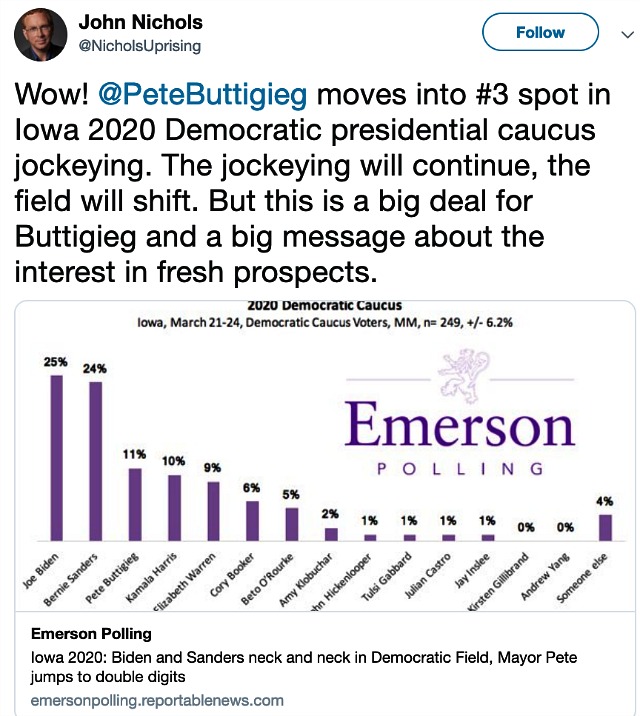
Speaking as a staunch Beto O’Rourke admirer, I have to acknowledge — admit — that Pete Buttigieg, however likely or unlikely his chances of winning the Democratic Presidential nomination, is right now the most engaging contender out there. Somebody on Morning Joe recently called him “the Mister Rogers of the Democratic presidential candidates“; in my eyes he resembles Eric Kohn of Indiewire. Brilliant, well-spoken, a Millennial (he was in high school when Colombine happened)…an obviously sharp guy who seems to really understand the worldly particulars as they exist right now, but especially gets the coming shape of things. Progressive but specific, practical. Definitely not on the side of the p.c. Robespierre purists.

Pizza and Darts

The other day I riffed on the trailer for Noah Hawley‘s Lucy in the Sky (Fox Searchlight). It stars Natalie Portman as an astronaut who suffers some kind of emotional-spiritual crisis following a longish space voyage.

The emotional breakdown drama is “loosely” based on some real-life unhinged behavior (stalking and threatening a perceived romantic rival) by astronaut Lisa Nowak in early ’07.

The episode was prompted by the breakup of Nowak’s sexual relationship with fellow astronaut William Oefelein and more particularly by her discovery that Oelefein had become involved with another, somewhat younger woman named Colleen Shipman.

Oefelein and Shipman have been married since 2010. They live in Anchorage with a young son.


William Oefelein (middle), Colleen Shipman (right).

Nowak was initially arrested for an attempted murder of Shipman, but later pled guilty to a reduced charge of burglary and misdemeanor battery.

Three years ago Shipman spoke to People‘s Jeff Truesdell in an attempt to explain what had actually happened and to defend her husband from impressions that he had behaved like a rake.

Shipman tells Truesdell that her first meeting with Oefelein happened at a party in November ’06, at which time Oefelein, whose romantic relationship with Nowak had begun sometime in ’98 or thereabouts, had disengaged and was more or less free to cat around.

Truesdell reports that Oefelein and Shipman “exchanged phone numbers” as the party drew to a close, and that “the next night they went on a double-date for pizza and darts.”

Curious as this may sound, the reason I’ve written about this turbulent romantic triangle is the phrase “pizza and darts.”

Until I read the term in Truesdell’s article I’d never once heard it, much less gone on a “pizza and darts” date of my own.” I’m trying to imagine what kind of person would characterize a romantic date as being about eating pizza and playing fucking darts. I haven’t played darts in a bar in eons. Who regards the throwing of darts as an activity worthy of even an anecdote? And by the way, wouldn’t a more accurate description be pizza, darts and suds (i.e., beer)? Or pizza, darts and wine? Don’t you have to be half-bombed to even want to play darts in the first place?

I’m sorry but the whole thing has just blown my mind. Hollywood Elsewhere has never gone out for pizza and darts…not once, not ever. And I never will. But there are people out there who have.

Did Scott and Zelda, Roberto Rossellini and Ingrid Bergman, Jack and Jackie, Tomcat or Brangelina ever go out for pizza and darts? Has anyone of any consequence ever engaged in this activity as an object in or of itself? Is there anyone in the HE community who’s ever invited a would-be romantic partner for p & d? Has anyone ever heard the term before reading this article? I’m serious. I really want to know.

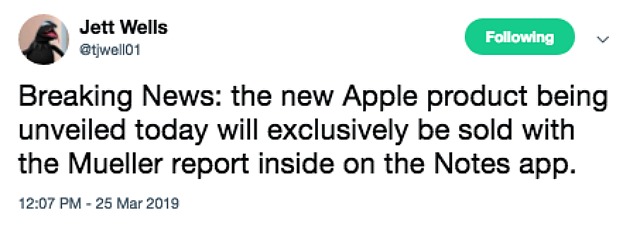
Mueller Sidesteps But Doesn’t Find Trump Blameless

I’m disappointed. Make that damn disappointed. What semi-intelligent, fair-minded person wouldn’t be?

It seems to me that in observing the precise letter of the law and drilling only into possible proof of an actual, real-deal conspiracy to undermine the 2016 election by colluding with Russian operatives, Robert Mueller has seemingly sidestepped the basic overall, which is that President Trump is a malignant narcissist, an amoral sociopath and the head of a New York crime family, and that he doesn’t give a shit about anyone or anything other than his own empowerment and/or his mushroom dick being sucked. And that before and after 1.20.17 he’s acted this way to the detriment of the country and that portion of the population (i.e., a two-thirds majority) that respects the law and various concepts of human decency.

Michael, a N.Y. Times commenter, posted a few minutes ago: “I’m not surprised absent a written directive from Trump, a recorded phone call, or someone close to the president willing to tell the truth under oath, that Mueller could not prove obstruction of justice or criminal conspiracy inside the campaign.

“However, as Barr and Mueller state, this does not exonerate him. There is too much circumstantial and incriminating evidence surrounding the president’s firing of Comey, the many meetings between the Trump campaign and Russian operatives, to say ‘no collusion, no obstruction.’

“It was a huge mistake not to interview Trump under oath. I believe after the full report is issued, Congress needs to continue its oversight role that has only just barely begun. Important facts are waiting to be uncovered.

“This isn’t about optics — it’s about determining the integrity and/or duplicity of the man holding the highest office in the land.”

Laura, another Times commenter: “I’m just shocked. There’s no other word for it. As an avid follower of this whole sprawling Russia story over the last 2 years, I just don’t see how this is possible.

“There is just so much wrongdoing is plain sight — how can this be the outcome?

What about the Trump Tower meeting? And Kushner wanting to establish a back channel to Russia so US intelligence couldn’t listen to their conversations? And Trump trying to fire Sessions for not recusing himself? And the dozens of other examples of things just as corrupt, suspicious, and possibly illegal??

“Is Barr covering up for Trump? I don’t really think that, but it’s sort of the best idea I can come up with at the moment of why this is happening.

Read more