

This scene makes me feel so sad, and so curiously comfortable. Goes right through me. Of all the millions who’ve watched this scene over the last decade or so, maybe 2% had even a vague notion what Tommy Lee Jones was talking about. If that. All that dark and all that cold.
Bernie Needs To Face Reality and Drop Out
Obviously the second Democratic debate group, meeting in Miami on Thursday, 6.27, will be the one to watch. Pete Buttigieg vs. Uncle Joe Biden and Bernie Sanders (who hasn’t a prayer and can only spoil…face it), not to mention Kamala Harris, Kirsten Gillbrand and Andrew Yang plus noteworthy second-stringers like Marianne Williamson, John Hickenlooper and Eric Swalwell. Michael Bennet, whom nobody knows or cares about, will also participate.
The first group, gathering the night before on Wednesday, 6.26, will include three serious candidates — Elizabeth Warren, Amy Klobuchar ad Beto O’Rourke. The rest haven’t a prayer and they know it — Cory Booker, Julian Castro, Bill de Blasio, John Delaney, Tulsi Gabbard, Jay Inslee and Tim Ryan.
Hollywood Elsewhere is hoping and praying for an Uncle Joe gaffe or two…any kind of mistake or misstatement….anything in that realm.
The real long-haul candidates are Biden, Bernie, Buttigieg and Warren. And maybe Harris and O’Rourke. Bernie, a tough guy and a principled visionary but at the same time a stubborn old goat, has to man up, face facts (he can’t possibly win the nomination) and stop trying to block the inevitable.
Both debates will happen at the Adrienne Arsht Center for the Performing Arts of Miami-Dade County, 1300 Biscayne Blvd, Miami, FL 33132.

They Stink
I knew from the get-go that both Shaft and Men in Black: International would blow chunks. So did everyone else. So I didn’t even try to see their press screenings because life is short. MIB:I has a 25% Rotten Tomatoes rating, and Shaft has a not-much-better 34% score. Now comes word that Men in Black: International and Shaft are both underperforming as we speak. I don’t care. Good riddance.
Siphoning Lore of 39 Year-Old Classic
HE to Danny Torrance: It happened in 1980 when you were…what, five or six years old and you’re still feeling wobbly and woozy and going “whoa, man, those memories are still eating away at me”? It was one thing that happened over a single winter in the Colorado mountains. A horrifying and traumatic nightmare, granted, but get over it. You’re 44 or 45 years old. Life is short. Turn the page. Shake it off. Oh, that’s right — you can’t. Because there’s a sequel to be made and you need the money.
Reactions to “Rolling Thunder Revue”?
I wrote a few days ago that Martin Scorsese‘s Rolling Thunder Revue is “all over the map in a splotchy, rambunctious sort of way, but it’s mostly a fun, relaxing ride — a 140-minute road journey with some very cool and confident people. Mish-mashy, whimsical, good-natured, sometimes deeply stirring and in four or five spots flat-out wonderful.”
It’s been on Netflix for two and a half days. Is it deeper, stronger, more pleasurable or less substantial than I suggested?
Here’s a very nicely written riff by WBGO’s Harlan Jacobson (which you can also listen to): “You have to be a little careful with Rolling Thunder: Scorsese has punctuated his extraordinary career as film’s Dostoevsky — from Mean Streets, Taxi Driver, Raging Bull all the way to The Age of Innocence and The Wolf of Wall Street — with music docs like The Last Waltz, George Harrison and No Direction Home, a PBS doc about the young Dylan.
“Rolling Thunder Revue adds into the mix of archival footage some witness testimony by recognizable people — Sharon Stone, for instance — who weren’t there but are playing fictional characters like The Beauty Queen, a high school groupie. If I go any further about Scorsese’s creative innovation — real people playing fictional roles in a documentary — we’ll all fall through Alice’s funhouse mirror and remain lost forever.
“In this terrible media age, it makes some critics nervous that it’s a blend of fact and fiction to arrive at ‘faction,’ a truth that relies on invention. It’s that kind of work. Creatively, it’s a beautiful cull of footage from when we thought we’d stay forever young.”
HE to Jacobson: Bullshit. Scorsese’s doc isn’t some fanciful, mask-wearing thing. 96% of it is just footage of Dylan’s ’75 Rolling Thunder tour throughout New England intercut with visual-aural references to what life was like back in the mid ’70s. The fact that it contains invented testimony from four fleeting fakers doesn’t dilute the basic composition.
Back to Jacobson: “Scorsese laces throughout the film these concert closeups of Dylan, the bard of late 20th Century America, earning his Nobel Prize by singing what was then assumed to be truth to power with utter clarity. The result is a kind of emotional truth about something larger than the tour, but about post WWII America that was truer than the official story would acknowledge.
“Taken together — Rocketman, David Crosby Remember My Name and Rolling Thunder — are more than about music men, and I say that because women are mostly sidemen in them. They are about Boomers, who are now, in Dylan’s much earlier phrasing, busy dying.
HE’s Best Films of 2019’s First Half
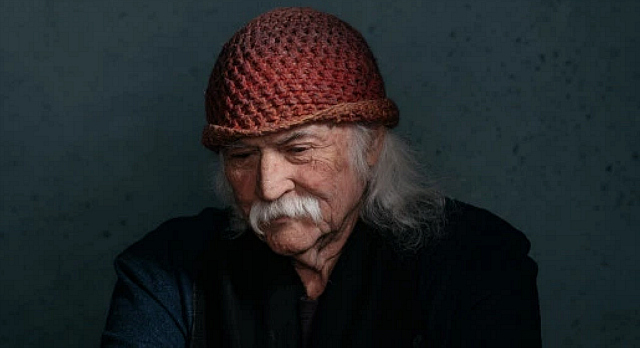
There are no upcoming June releases of any apparent consequence so I may as well post HE’s Best of 2019 at Half-Time roster. A grand total of 23 films, and I don’t care if they’re docs or features, streaming or theatrical…none of those distinctions matter any more. I’m once again profusely apologizing for not having seen Christian Petzold‘s Transit but I’ll be correcting this oversight very soon.
How many of the 23 are really, really good? The first 20 with the exception of Once Upon A Time in Hollywood, which I feel is mostly a flavorful in-and-outer that pays off only at the very end. So basically 19 out of 23 are the cat’s meow. Seriously.
Jordan Ruimy‘s list: Luce, Dogman (HE: not so much), Dragged Across Concrete, Ayka (what?), The Art of Self-Defense, David Crosby: Remember My Name, Gloria Bell, Midnight Family, Cold Case Hammerskjold (excellent!), American Dharma, The Farewell (didn’t see it), Avengers: Endgame, Once Upon A Time in Hollywood, Portrait of A Lady on Fire.
I asked a young Manhattan-based friend for his 2019 faves, and he had the nerve to send a list that included David Robert Mitchell‘s Under The Silver Lake…c’mon! I hate it when films that certain people have found “interesting” or “offbeat intriguing” are listed as among the year’s best. No way in hell is Harmony Korine‘s The Beach Bum (55% on Rotten Tomatoes) one of the year’s finest; ditto the Dardennes brothers’ Young Ahmed…please.
1. Kent Jones‘ Diane / “All Hail Diane — 2019’s Best Film So Far“, filed on 3.27.19.
2. Craig Zahler‘s Dragged Across Concrete / “All Hail Dragged Across Concrete,” filed on 3.21.19.
3. FX’s Fosse/Verdon / “Fosse/Verdon — Theatrical, Exquisite, Pizazzy, Deep Blue,” filed on 4.25.19.
4. A.J. Eaton and Cameron Crowe‘s David Crosby: Remember My Name / “Crosby Doc Hurts Real Good,” filed on 1.27.19.
5. Russo Brothers‘ Avengers: Endgame / “Okay With Nominating Endgame For Best Picture Oscar,” filed on 5.4.19.
6. Robert Eggers‘ The Lighthouse / “This Way Lies Madness,” filed on 5.19.19.
7. Diao Yinan‘s The Wild Goose Lake / “Goose-d by Diao Yinan Levitation,” filed on 5.18.19.
8. Martin Scorsese‘s Rolling Thunder Revue: A Bob Dylan Story / “Rolling Along With Scorsese/Dylan” filed on 6.10.19.
9. Julis Onah‘s Luce / “Luce: Assumptions, Triggers, Blind Spots“, filed on 1.29.19.
10. J.C. Chandor‘s Triple Frontier / “Five Sons of Fred C. Dobbs,” filed on 3.6.19.
11. Quentin Tarantino‘s Once Upon A Time in Hollywood / “Once Upon A Time in Hollywood Is…‘, filed on 5.21.19.
12. Olivia Wilde‘s Booksmart / “This Time SXSW Hype Was Genuine“, filed on 4.25.19.
13. Celine Sciamma‘s Portrait of a Lady on Fire / “By my sights as close to perfect as a gently erotic, deeply passionate period drama could be,” excepted from “Midnight Panini,” filed on 5.21.19.
14. Dan Reed‘s Leaving Neverland / “After Tomorrow, Jackson’s Name Will Be Mud“, filed on 3.2.19.
15. Steven Soderbergh‘s High Flying Bird / “Basically A Black Moneyball About Basketball,” filed on 1.27.19.
16. Sydney Pollack and Alan Elliott‘s Amazing Grace / “Finally Saw Amazing Grace,” filed on 12.14.18.
17. Todd Douglas Miller‘s Apollo 11 / Just because I forgot to review this Neon/CNN Films doc doesn’t mean it doesn’t deliver a profound IMAX charge. I loved that it offers no narration or talking heads.
18. Laure de Clermont-Tonnerre‘s The Mustang.
19. Mads Brugger‘s Cold Case Hammarskjöld / “Riveting, Occasionally Oddball Cold Case”, posted on 1.29.19.
20. Sebastien Lelio‘s Gloria Bell / “Moore May Snag Best Actress Nom for Gloria Bell,” filed on 9.13.18.
21. Cristina Gallego and Ciro Guerra‘s Birds of Passage / “Spreading Native Scourge,” filed on 11.26.18.
22. Kirill Serebrennikov‘s Leto / “When Russian Rock Was Born,” filed on 5.10.18.
23. Abel Ferrara‘s Pasolini / “The Night Pasolini Died,” filed on 4.13.19.
From Boston Herald‘s Jim Verniere: Arctic, Gloria Bell, Diane, Dogman, The Fall of the American Empire, Booksmart, Greta, Halston, Aquarela, Hail Satan.
Spikes, Ropes, Saddles, Chainsaws, etc.
In my 20s I worked as a tree surgeon. Shitty money but at least I was in great shape. I did it all — shaping, pruning, tree removal (or “takedowns”), cabling, spraying. As a former professional I laughed out loud at the idiots in these videos. I always removed trees in a careful, methodical fashion. I would always climb to the top of a tree, tie in with my rope, saddle, spikes and chain, and then take the leaders and branches off one at a time, until the tree became a telephone pole. And then I’d start chainsawing chunks of it, one by one from the top and slowly working my way down.
If there was the slightest chance of any falling pieces hitting a shed or a swimming pool or (God forbid) the main residence, I would tie a rope to the piece I was about to cut and loop the rope over a nearby leader and have the ground crew slowly lower it down. And when it came time to drop the “telephone pole”, we would always make sure it would fall upon a bouncy bed of cut branches. There would always be a rope tied to the top with a couple of guys maintaining tension, and then I would carefully cut a pie slice at the base of the tree. The tree would always land exactly where I planned.
The guys in these videos (i.e., no women) are morons.
Courage, Confidence
I’ve never owned a pair of white bucks, but I can feel myself warming to the possibility. I generally steer clear of preppy apparel, but I’ve got this idea that wearing these things (remember when people used to call high-style shoes “kicks”?) will make me feel good about life — that I’ll feel like some kind of special-aroma Great Gatsby guy if I wear them to screenings and restaurants and…whatever, to the West Hollywood Pavillions.
I can imagine wearing a pair as I stroll into a nice open-air rooftop bar (the Waldorf Astoria, say) while listening to Eric Clapton‘s “Anyone For Tennis” on my Bowers & Wilkins P5 headphones.
I can foresee two problems. One, being snickered at or, you know, people calling me a clueless poseur. Two, the Robert Redford-as-Jay Gatsby thing only lasts for the first week or two, for once they get scuffed and beaten up the special aura evaporates.
I was looking online this morning and none of the white bucks I liked (like the ones for sale at the Brooks Brothers site) were in my size — i.e., 13. In the guy realm 13 isn’t all that unusual, but shoe sellers treat you like a carnival freak if your size is larger than 12. Plus a sales rep told me this morning that white bucks are regarded as seasonal accessories (in Southern California?), but summer is just beginning and they’re already running out. All right, forget it…a bad idea from the start.

Wishful Drinking
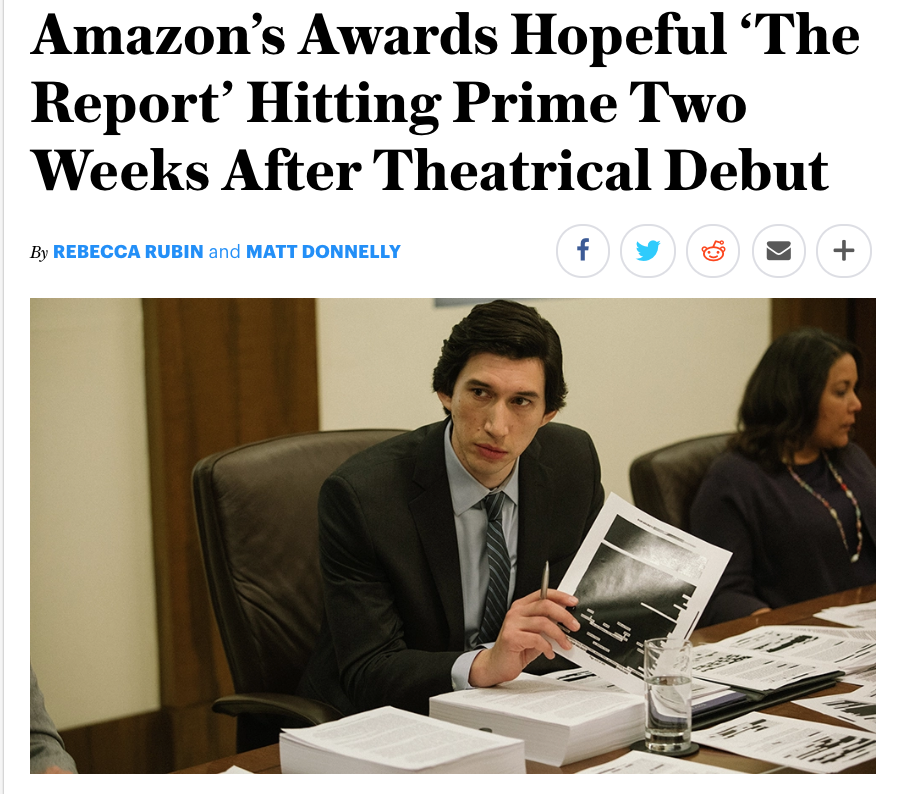
Earlier today Variety‘s Rebecca Rubin and Matt Donnelly posted a story about Amazon’s release strategy for Scott Z. Burns‘ The Report, a fact-based whistleblower drama that I saw five months ago at Sundance.
Set in the late aughts, it’s about real-life Senate staffer Daniel Jones (Adam Driver) investigating, authoring and releasing a massive report on CIA torture, and in so doing exposing Bush-Cheney flim-flammery about the waging of the Iraq War.
The Variety story was fine except for the headline, which described The Report as an “awards hopeful“. That, trust me, is not in the cards. Burns film is plodding, sanctimonious and a chore to sit through — precisely the kind of self-righteous, moral-breast-beating drama that I can’t stand.
Deadline‘s Anthony D’Alessandro posted the same story with a headline that said The Report would be getting an “Awards Season Release.” That, at least, was technically accurate as The Report‘s 9.27 theatrical release date falls within award season. The film’s streaming release will launch two weeks later (i.e., 10.11).
Speaking of Overlooked…
Industry pally: Why are you not writing at length about this Sienna Miller performance?
HE: Because I haven’t seen it. It played at the ’17 Venice Film Festival and the Oldenburg International Film Festival a year later, and that was it. Even if I had seen it, the #MeToo brigade would have me killed or at least shunned if I were to so much as mention a film by Jim Toback.
Industry pally: I’m sure you can find a link. As for this Crucible-like atmosphere of which you speak, it’s news to me! 🙂
HE: Are you kidding? It’s the French “terror” out there.
Industry pally: My sense of humor is sometimes a touch too dry.
Would You Hire A Lying Sociopath?
The daily toxins finally became too much, and so Sarah Huckabee Sanders is leaving the White House at the end of the month. Strange as this may sound, she’s probably looking a great future.
All employers look for smarts, discipline, dependability and good political skills. And loyalty, of course. They don’t want someone with an independent mind or who marches to his/her own drum — they want a Good German who will do or say whatever the employer wants. By this standard old “Smokey Eye”, who’s been dutifully lying and obfuscating for Donald Trump since July 2017, should be able to find a flush new gig in the conservative community.
Some believe that every time you lie you inject a tiny amount of poison into your system, and that it stays there until you admit to it. And that you add to the general communal illness in the bargain. Think of the hundreds of blatant falsehoods that have come out of SHS over the last 23 months, and yet she’s apparently in good health. The applicable phrase is “when good things happen to bad people.”
“I Don’t Get It…What?”
Peter Wehner: “[This is] a window into the inverted moral world of Donald Trump. What he was arguing is ‘what helps me is, by definition, right, and what hurts my opponent should be done, and what hurts me is, by definition, wrong.’ That is the ethical construct that he operates upon. It’s a kind of moral narcissism. When you get a person with that kind of distorted moral world with the tremendous power of the Presidency, it does great damage to the country. This guy is a daily battering ram against norms, against ethics and integrity.”